LIFE & HISTORY of LORD BUDDHA
Many, many years ago, in a small kingdom in the north of India,
Something was happening that would change the whole world.
Queen Maya, wife of the good King Suddhodana, lay asleep and had
a wondrous dream. She dreamt she saw a brilliant white light shining
down to her from the sky, and in the rays of this light was a magnificent
elephant of light flew closer and closer to the Queen and finally melted
into her body. Queen Maya awoke, filled with greater happiness than
she had ever felt before.
 Quickly she went to the king and together they asked the wise men at the court what this strange
and wonderful dream might mean. The wise men answered "O Your Majesties, this dream is a most
excellent one! It means that the Queen will give birth to a son, and this prince will someday
become a great man. Not only you, but the entire world is fortunate that the Queen will have
such a special child."
Hearing this good news, the King and Queen were overjoyed. The King was especially happy because
he belonged for a son who would someday rule his kingdom hin his place. And now it seemed his
wish was being granted.
It was the custom in those days for a woman to return to her parents home in order to give
birth. And so, when the time had almost come for the baby to be born, Queen Maya and many of her
friends and attendants left the palace of the king and began to journey to her childhood home.
They had not traveled far when the Queen asked that they stop and rest. She knew the baby would
be born very soon. They had reached the beautiful gardens of Lumbini and the Queen went into
this garden looking for a comfortable place in which she could give birth. The stories say that
even the animals and plants, somehow understanding what a special child was about to be born,
wanted to help. A large tree bent down one of its branches and the Queen took hold of it with
her right hand. Supporting herself in this way, she gave birth to a son. The attendants cradled
the baby in their arms and were amazed at how beautiful he was and how peaceful he seemed.
Quickly she went to the king and together they asked the wise men at the court what this strange
and wonderful dream might mean. The wise men answered "O Your Majesties, this dream is a most
excellent one! It means that the Queen will give birth to a son, and this prince will someday
become a great man. Not only you, but the entire world is fortunate that the Queen will have
such a special child."
Hearing this good news, the King and Queen were overjoyed. The King was especially happy because
he belonged for a son who would someday rule his kingdom hin his place. And now it seemed his
wish was being granted.
It was the custom in those days for a woman to return to her parents home in order to give
birth. And so, when the time had almost come for the baby to be born, Queen Maya and many of her
friends and attendants left the palace of the king and began to journey to her childhood home.
They had not traveled far when the Queen asked that they stop and rest. She knew the baby would
be born very soon. They had reached the beautiful gardens of Lumbini and the Queen went into
this garden looking for a comfortable place in which she could give birth. The stories say that
even the animals and plants, somehow understanding what a special child was about to be born,
wanted to help. A large tree bent down one of its branches and the Queen took hold of it with
her right hand. Supporting herself in this way, she gave birth to a son. The attendants cradled
the baby in their arms and were amazed at how beautiful he was and how peaceful he seemed.
A Holy Man's Visit
At that moment, throughout the land, there was a great feeling of peace and happiness. People forgot
their troubles, ceased their quarrels and felt great love. and friendship for one another. Some
people saw rainbows suddenly and unusual things were seen.
Wise men from all over the kingdom noticed these signs of peace and joy and excitedly said to each
other, "Something very fortunate has just happened. Look at all these wonderful signs! Today is the
full moon day of the fourth month. It must certainly be a special day!"
Queen Maya, unaware that her joy at having a son was being shared at that very moment throughout the
kingdom, took the new-born baby in her arms and returned to the palace of the King.
With great rejoicing, King Shuddhodana greeted his Queen and his new son. Splendid festivals were
held and the whole kingdom was decked in beautifully colored banners. It was a time of great
happiness and peace. There was so much gladness everywhere that his parents decided to name the
Prince "Siddhartha", which means "the one who has brought about all good ".
Now the wise men made new predictions about the baby. "O King," they said, "the signs of the
Prince's birth are most favorable. Your son will grow up to be even greater than you are now!" This
news made the King very proud. "If these wise men are correct," he thought, "my son, Prince
Siddhartha, may one day be the ruler not only of my small kingdom, but perhaps of the entire world!
what a great honors for me and my family !"
In the first few days after his birth, many people came to the palace to see the new baby. One of
these visitors was and old man named Asita. Asita was a hermit who lived by himself in the distant
forests, and he was known to be a very holy person. The King and Queen were Surprised that Asita
would leave his forest home and appear at their court, "We are very honored that you have come to
visit us, O holy teacher," They said with great respect. "Please tell us the purpose of your journey
and we shall serve you in any way we can."
Asita answered them, "I thank you for your kind welcome. I have come a great distance to visit you
because of the wonderful signs I have recently seen. They tell me that the son recently born to you
will gain great spiritual knowledge for the benefit of all people. Since I have spent my entire life
trying to gain such holy wisdom, I came here as quickly as possible to see him for myself."
The King was very excited and hurried to where the baby Prince lay sleeping. He carefully picked up
his son and brought him back to Asita. For a long time the holy man gazed at the infant, saying
nothing. Then he finally stepped back, looked sadly up at the sky, sighed heavily and began to cry.
Seeing Asita weep, the King and Queen became very frightened. They were afraid that the holy man had
seen something wrong with their child. With tears in his eyes, the King fell to his knees and cried
out, "O holy teacher, what have you seen that makes you weep? Didn't you and all the other wise men
say that my son was born to be a great man, to gain supreme knowledge? But now, when you look at my
baby you cry. Does this mean that the Prince will die soon? Or will something else very terrible
happen to him? He is my only child and I love him dearly. Please tell me quickly what you have seen
for my heart is shaking with sadness and fear."
Then with a very kind look, Asita calmed the new parents and told them not to worry. "Do not be
upset," he told them. "I am not crying because of something bad I saw for the Prince. In fact, now
that I have seen your son, I know for certain that he will grow up to be more than just a great man.
There are special signs that I have seen on this child-such as the light that shines from his
fingers-that tell me he will have glorious future.
"If your son decides to stay with you and become a king, he will be the greatest king in history. He
rule a vast realm and bring his people much peace and happiness. But if he decides not to become a
king, his future will be even greater! He will become a great teacher, showing all people how to
live with peace and love in their hearts. Seeing the sadness in the world he will leave your palace
and discover a way to end all suffering. Then he will teach this way to whoever will listen.
"No, dear King and Queen, I was not crying for the child. I was crying for myself. You see, I have
spent my whole life looking for the truth, searching for a way to end all suffering. And today I
have met the child who will someday teach everything I have wanted to learn. But by the time he is
old enough to teach, I shall already have died. Thus, I shall not be able to learn from him in this
life. That is why I am so sad. But you, O fortunate parents, should not be sad. Rejoiced that you
have such a wonderful child."
Then Asita took one long, last look at the child, and slowly left the palace. The King watched him
leave and then turned towards his son. He was very happy that there was no danger to the Prince's
life. He thought, "Asita has said that Siddhartha will become either a great king or a great
teacher. It would be much better if first he became a king. How proud I would be to have such a
famous and powerful son! then, when he is an old man like Asita, he can become a holy man if he
wants."
So, thinking like this, King Shuddhodana stood happily with his baby in his arms, dreaming of the
fame that his son would someday have.
The King Prince
While the new baby was still very young, his mother, Queen Maya died. Shortly before she passed
away, the Queen said to her sister, "Soon I shall not be able to take care of my baby anymore. Dear
Sister, after I have gone, please look after Siddhartha for me." Her sister promised that she would.
She loved the little Prince very much and brought him up as if he were her own child.
The Prince grew into a bright, handsome and kind hearted boy. His father, the King , arranged for
him to be educated by the best teachers in the kingdom, and very quickly he showed his remarkable
intelligence. After the first few days of classes the teachers reported to the King, "Your Majesty,"
they said, "the Prince does not need us anymore. After only a few lessons he has learned everything
we have to teach him. In fact, he has taught us a few things that we ourselves never knew before!"
Hearing this, the King's pride in his son grew even greater. "With his intelligence, my son will
certainly grow up to be a wise and powerful king," he thought, and this made the King very happy.
But there was something else about this boy that was even more remarkable than his intelligence. He
had a very kind, gentle and loving nature. The rest of his young playmates enjoyed the rough and
tumble games of small children, or pretended they were soldiers and fought with one another. But
Prince Siddhartha quietly spent most of his time alone. He loved the small animals that lived in the
palace gardens and became friendly with them all. The animals knew that the Prince would never hurt
them, so they were never afraid of him. Even the wild animals, who would run away if anyone else
came near, would come to greet the Prince when he entered the garden. They approached him fearlessly
and ate from his hand the food he always brought with him for them.
One day as the Prince was sitting in the garden, a flock of white swans flew overhead. Suddenly an
arrow shot up into the air, striking one of them. It fell out of the sky and landed at the Prince's
feet, the arrow still stuck into its wing. "Oh, you poor swan," Siddhartha whispered as he gently
picked up the wounded bird, "do not be afraid. I shall take care of you. Here, let me remove this
arrow." Then, with one hand he gently stroked the bird, calming its fear. With his other hand he
slowly pulled out the painful arrow. The Prince was carrying a special lotion with him, and softly
rubbed it into the bird's wing , all the time speaking in low, pleasant voice that the swan would
not become afraid. Finally he took off his own silk shirt and wrapped it around the bird to keep it
warm.
After the short time, another young boy came running into the garden. It was the Prince's cousin,
Devadatta, he was carrying a bow and some arrows and he was very excited. "Siddhartha, Siddhartha,"
he shouted "great news! I got a swan! you should have seemed. I hit it with my first shot! It fell
down somewhere near here. Help me look for it."
Then Devadatta noticed one of his arrows, with blood still on its tip, lying on the ground near
Siddhartha's feet. Looking closer he saw that the Prince was holding something in his arms, and
realized it was the swan he was searching for. "Hey, you took my swan," he yelled. "Give it back to
me. I shot it and it's mine!" Devadatta grabbed at the bird, but the Prince held onto it, keeping
his angry cousin from even touching it.
"I found this bird lying here bleeding," the Prince said firmly, "and I don't plan to give it to
anyone while it is still wounded." "But it's mine!" shouted Devadatta again. "I shot it fair and
square, and you've stolen it from me. Give it back or I'll take it back."
The two boys stood arguing like this for some time. Devadatta was getting angrier and angrier, but
Siddhartha refused to give him the swan. Finally the Prince said, "When two grown-ups have a quarrel
like this, they settle it in court. In front of a group of wise people, each one explains the story
of what happened. Then the wise people decided who is right. I think you and I should do the same."
Devadatta did not like this idea very much, but because it was the only way he could ever get the
swan back, he agreed. So the two of them went to the palace and appeared in front of the King and
his ministers. The people at court smiled at each other when they heard what these two children
wanted. "To Think," they said, "that they want to take up our time over a mere bird!" But the King
said, "Both Siddhartha and Devadatta are royal princes, and I am glad they brought their quarrel to
us. I think it is very important that , as future rulers, they become used to the ways of this
court. Let the trial begin!"
So in turn each of the boys described what happened. Then the minster tried to decide which boy was
right and should therefore have the swan. Some thought, "Devadatta shot the bird; therefore it
should belong to him. " Others thought, "Siddhartha found the swan; therefore it should belong to
him." And for a long the ministers talked and argued about the case.
Finally, into the court came a very old man whom no one remembered ever seeing before. But because
he looked so wise, they told him the story of the boys and their swan. After listening to what they
had to say, he declared, "Everyone values his or her life more than anything else in the world.
Therefore, I think that the swan belongs to the person who tried to save its life, not to the person
who tried to take its life away. Give the swan to Siddhartha."
Everyone agreed that what the wise man said was true, so they decided to let the Prince keep the
swan. Later, when the King tried to find the old man and reward him for his wisdom, he was nowhere
to be found. "This is very strange, " the king thought. "I wonder where he came from and where he
went." But no one knew. This was just one of the many unusual things that happened concerning the
Prince, so many people thought he must be a very special child indeed!
The Marriage Contest
As the Prince grew older, his kindness made him well-loved by everyone who knew him. But his father
was worried. "Siddhartha is too gentle and sensitive," He thought. "I want him to grow up to be a
great kind and kings must, be strong and powerful. But the Prince is more interested in sitting by
himself in the garden than he is in learning how to be the ruler of a kingdom. I am afraid that my
son will soon want to leave the palace and follow the lonely life of holy men like Asita. If he does
this he will never become a great king."
These thought bothered the King very much. He sent for his most trusted ministers and asked them
what he could do. Finally one of them suggested, "O King your son sits and dreams of other worlds
only because he is not yet attached to anything in his world. Find him a wife, let him get married
and have children, and soon he will stop dreaming and become interesting in learning how to rule the
kingdom."
The King thought this was an excellent idea. So he arranged for a large banquet at the palace. All
the young women from noble families were invited. At the end of the evening the Prince was asked to
give presents to each of the guests, while several ministers watched him closely to see which of the
young women the Prince seemed to like.
The women, who were scarcely more than young girls, were all very embarrassed to appear before the
Prince. He looked so handsome but so distant as he stood in front of the table bearing all the
expensive gifts. One by one they shyly went up to him, timidly looking downwards as they approached.
They silently accepted the jewel or bracelet or other gift, and quickly returned to their places.
Finally, only one young woman was left. She was Yasodhara, the daughter of a neighbouring King.
Unlike the others, she approached the Prince without any shyness. For the first time that evening,
the young Prince looked directly at the woman before him. She was very beautiful and the Prince was
immediately attracted to her.
They stood in silence for a while, looking into each other's eyes. Then Yasodhara spoke, " O Prince,
where is the gift for me?" The Prince was startled as if awakening from a dream. He looked down at
the table and saw it was empty. All the gifts had already been given out to the other guests. "Here
, take this," said the Prince, taking his own ring from his finger. "This is for you." Yasodhara
graciously accepted the ring and walked slowly back to her place.
The ministers saw all that happened and excitedly ran to the King. "Sire!" they reported happily,
"we have found the perfect bride for the Prince. She is Princess Yasodhara, daughter of your
neighbor, King Suprabuddha. Let us immediately go to this King and arrange for the marriage of his
daughter and your son.
King suddhodana agreed and somm afterwards visited Ysodhara's father. The other King greeted him
warmly and said, "I am sure that your son is a fine young man, but I can not give my daughter away
to just anyone. Many other princes want to marry her, and they all excellent young men. They are
skilled in riding, archery and other royal sports. Therefore, if your son wants to marry my
daughter, he will have to compete in a contest with the other suitors, as is out custom."
And so it was arranged for a great contest to be held, with beautiful Yasodhara as the prize. King
Shuddhodana was worried. He thought, "My son has never showed the slightest interest in warrior
games. How can be ever win this contest?" But the Prince understood his father's fears and said to
him, "Do Not be worried. I am prepared to do whatever is necessary to win Yasodhara for my bride."
The first event was archery. The other men placed their targets a long distance away, yet each was
able to hit the bull's eye. And when it was Devadatta's turn for Siddhartha's cousin was also one of
the suitors-he not only hit the bull's eye, but sent his arrow right through the target until it
stuck out the other side. The crowd cheered, but Yasodhara covered her eyes in fright. "How can my
beloved Siddhartha ever beat that shot?" She thought. "How dreadful if I had to marry Devadatta!"
But the Prince was confident. When it was his turn he had his target placed so far away that most of
the people could hardly even see it. Then he took an arrow from his quieter and pulled back on his
bow. The Prince was so strong, however, that the bow burst in half; he had drawn it back so far!
"Please fetch me another bow," the Prince asked "but a much stronger one this time that will not
break like the other one." Then a ministers called out, "O Prince, there is a very old bow in the
palace. IT belonged to one of the greatest warriors of the past. But since he died many years ago no
one has been strong enough to string it , much less shoot it."
"I shall use that one," said the Prince, and everyone was amazed. When he was handed the bow he
carefully bent it and strung it easily. Then he notched an arrow on the string, drew it back so far
that the ends of the bow almost touched, aimed, and let the arrow fly. Twang! The bow made such a
loud sound that people in far away villages heard it. The arrow shot away so fast that when it hit
the distant target right in the central of the bull's-eye-it did not even slow down, but continued
to fly until it was out of sight.
The crowd roared in delight! "The Prince has won! The Prince has won!" But archery was only the
first event of the day; the next contest was in swords man ship.
Each young man selected a tree and showed his strength by slashing through it with his sword. One
suitor cut through a tree six inches thick, another nine inches, and a third cut through a tree a
foot thick with a single stroke of his sword!
Then it was the Prince's turn. He selected a tree that had two trunks growing side by side. He swung
his sword so quickly that it cut through the tree faster than anyone could see. His sword was so
sharp and his cut so even that the tree did not even fall over. Instead it remained standing,
perfectly balanced. When they saw the tree still standing upright, the crowd and especially
Yasodhara moaned, "He has failed. The Prince's sword did not even cut into the first trunk."
But just then a breeze stirred up and blew over the neatly severed tree trunks. The crowd's moans
turned into cheers, and again they shouted, " The Prince has won!" The final contest was in
horsemanship. A wild horse, while had never been ridden before was held down by several strong men
while each young suitor tried to mount it. But the horse bucked and kicked so furiously that none of
them could stay on its back for more than a few seconds. Finally on young man managed to hold on and
the attendants let go of the horse. But it jumped and lunged about with such fury and anger that the
rider was thrown to the ground. And he would have been trampled if the men had not rushed out and
pulled him to safety.
The crowd began screaming loudly, "Stop the contest! Don't let the Prince near that horse! It is too
dangerous; the horse will kill him! But Siddhartha had no fear. "Gentleness can be more powerful
than brute strength, " he thought, and slowly reached out and took hold of a small tuft of hair that
grew from the horse's forehead. Speaking in a low and pleasant voice, and gently stroking the wild
horse's head and sides, he calmed its anger, rage and fear.
Soon the horse was so gentle that it began licking Siddhartha's hand. Then, still whispering sweetly
to the horse, the Prince climbed onto its back. While the crowd roared happily, he paraded the steed
in front of the kings and ministers, and bowed low to his fair prize, the lovely Yasodhara. The
contest was over; young Siddhartha had won! And he had done so not only by the power of his great
strength, but of his gentleness and kindness as well.
The Pleasure Palaces
Soon afterwards, Prince Siddhartha and Princess Yasodhara were married. The King wanted to be
certain that his son would never desire to leave the kingdom, so he ordered not one but three
magnificent places to be built for the new couple. "Make them as beautiful as possible," he told the
chief builder. "I want them to be so magnificent that the people entering them will think they are
in heaven.
"I want one to be a summer palace, made of cool marble and surrounded by refreshing pools and
fountains. The second will be the winter palace, warm and comfortable. And the third will be for the
rainy reason. Place these palaces in the middle of a large park, with beautiful scenery in every
direction. And surround the park with a large wall, so that nothing unpleasant from the outside
world can ever get in. Everything is to be so perfect that Prince Siddhartha will be tempted to
leave."
The King did everything possible to make these new homes attractive to the Prince. He had the most
skilled musicians in his kingdom play there throughout the day and into the night. All the servants
were beautiful young dancing girls, and the chefs in the kitchen were instructed to serve a
never-ending variety of delicious food. Nothing was allowed into the palaces that night disturb the
Prince's mind and make him want to leave.
And so for many years Prince Siddhartha lived in these heavenly surroundings. From morning to night
he was entertained in a thousand ways. He never say anything that was not beautiful, nor ever heard
any sound that was not sweet and pleasant. For instance, if one of the servant girls became ill, she
was removed from the palace and not allowed to return until she was better again. In this way, the
Prince never saw sickness or anything that might disturb his gentle mind. The King ordered that no
one speaking to the Prince should ever mention anything sad or depressing. And even if one of the
plants in the garden began to droop or wilt, it was immediately snipped off by a special gardener .
Thus the Prince never even saw a faded or dying flower! In all these ways, then, he was kept
ignorant of the suffering and unpleasantness in the world.
The time went by, Yasodhara had a son who was Rahula. Everything seemed like to desire. The King was
very pleased, glad that his plans to keep the Prince interested in the royal life were working out
so well.
A Song of Beauty
One evening after dinner, Prince Siddhartha lay reclining on his couch, his head resting in
Yasodhara's lap. The musician were playing sweet melodies and the servant girls were whispering and
laughing quietly to each other. The evening was like so many the Prince had known since moving into
the pleasure palaces. But this night he felt a bit restless. Turning to one of his favorite singers,
he requested, "Please lull us to sleep with a song. Choose a tune you have never sung for me
before."
The singer graciously agreed and began to make up a new song from the words that floated through her
mind; all the while accompanying herself on a stringed instrument. She sang of the beauties of the
world, of the distant lands where she had traveled as a child, of golden cities where happy people
lived.
The song enchanted the Prince and when it was over he asked the singer, "tell me truly, are there
really such beautiful places beyond these garden walls? What kind of lives do the people in the city
live? Are there things in this world more lovely than what I have seen in these magnificent palaces?
Please tell me all you know."
"O Prince," she answered, "surely these palaces of yours are most magnificent; but there are many
other beautiful things to be seen in this wide world. There are cities and towns, mountains and
valleys, distant lands where people speak strange languages. There are many things that I have seen,
and many more that I have only heard about. Your palaces and gardens are indeed beautiful, but there
is much to see outside their walls."
Hearing this, the Prince became interesting in seeing all these strange and wonderful things for
himself. For so many years he had been content to live within the pleasure palaces and gardens,
completely forgetting about the world beyond. But now he desired to journey out, and so he sent a
message to the King requesting him to arrange a travel party into the city beyond the garden walls.
top
An Unexpected Sight
The King still wanted to be certain that his son would not see anything on his trip that might
disturb his mind. This might make him want to leave the kingdom and follow the holy life. So the day
before the Prince was about to travel to the city, the King sent his servants and soldiers out with
this message: "By order of the King! Tomorrow the royal Prince Siddhartha will visit the capital
city of Kapilavastu. Decorate your houses and the streets and let everything be colorful in his
honor. Let those who are sick or old or in any way unhealthy stay indoors tomorrow. Nothing should
be seen in the city that is not young and fair and beautiful." And then, very gently, the soldiers
took all the street beggars and brought them to a part of the city where the Prince would not visit.
When the morning came, the charioteer Channa groomed the Prince's favorite horse, Kantaka, and drove
out through the palace gates with his royal passenger. It was the first time the Prince had seen
Kapilavatu since he was a small child, and it was the first that the most of the citizens of the
city had ever seen their Prince.
Everyone was excited and lined the newly decorated streets to catch a glimpse of the handsome young
man as he rode by. "How tall and good looking he is!" They said to one another. "How bright his eyes
and his brow!" We are indeed fortunate that someday he will be our king."
And the Prince, too, was delighted. The city was sparkling and clean and everywhere he saw people
laughing and cheering and even dancing. The streets where he rode were covered with the flower
petals the citizens joyously threw towards their beloved Prince. "The song was true," he remembered
happily. "This is indeed a golden, beautiful and wondrous city!"
But as the Prince and his charioteer were riding by they spotted an old, bent, sad-looking person
among the joyous crowd. Curious-for the Prince had never seen anything like this before-he turned
and asked, "Channa, who is that person over there? why is he stooping over and not dancing like the
others? Why is his face not smooth and shining like everyone else's; why is it pale and wrinkled?
Why is he so different from the others?"
And Channa pointed to that man, who remained unseen by everyone else, and answered the Prince, "Why
Sir, that is just an old man."
"Old?" the Prince questioned. " Was this man always "old" like this before, or did it happen to him
recently?"
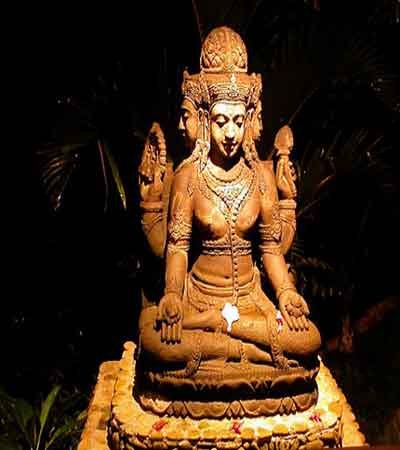
"Neither, O Prince," Channa answered. "Many years ago that wrinkled man before you was young and
strong as all the others you see here today. But slowly he lost his strength. His body became bent,
the colors faded from his cheeks, he lost most of his teeth, and now he appears the way he does."
Surprised and saddened, Siddhartha asked again, "That poor man, is he the only one suffering the
weakness of old age? Or are there any others like him?"
"Surely you know, O Prince, that everyone must experience old age. You, me, your wife Yasodhara,
Rahula, everyone at the palace-we are all growing older every moment. Someday most of us will look
like that man."
These words so shocked the gentle Prince that for a long time he remained speechless. He looked like
a person who had just been frightened by a sudden lightning flash. Finally he regained his voice and
spoke, "O Chana, I have seen something today that I never expected to see. In the midst of all these
happy young people this vision of old age frightens me. Turn the chariot back to the palace ; all my
enjoyment of this trip has fled. Turn back; I wish to see no more."
Channa did as commanded. When they arrived back home, the Prince entered his palace without greeting
anyone, hurried upstairs to his own room, and sat by himself for a long time. Everyone noticed how
strangely he acted and tried hard to cheer him up. But nothing helped. At dinner he did not touch
any of his food, even though the chef prepared his favorite meal. He paid no attention to the music
and dancing, but sat by himself thinking, "Old age, Old age, Old age..."
The Second Journey
The King heard about his son's unhappy mood and wondered what could have gone wrong. "He needs more
variety, " the King thought. "I will plan another trip for him , but this time to an even more
beautiful section of the city."
And so Channa prepared Kantaka again, and again they rode out into Kapilavastu. The streets were
decorated as before, and the people were again happy to see their Prince. But this time, seen only
by Siddhartha and his charioteer, a vision of a sick person appeared in the crowd of laughing
people.
"Look, Channa," the Prince called out. "Who is that man who coughs so violently, who shakes his body
and cries so pitifully?"
"That is a sick person, O Prince." "Why is he sick?" he asked. "People become sick for many reasons,
Sire. Perhaps he ate some bad food or let himself become too cold. Now his body is out of balance
and he feels feverish."
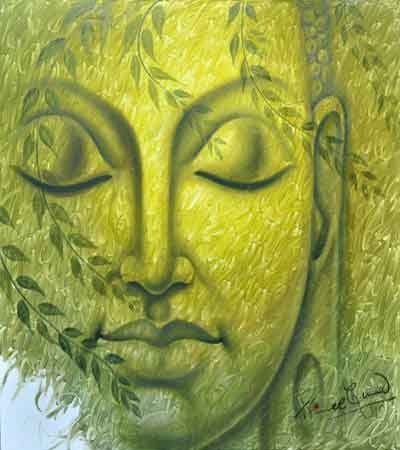
"Do even happy people like those in the crowd ever become sick?" "Oh yes," answered the charioteer.
" A person might be healthy one day and sick the next. No one is safe from illness." For the second
time the Prince was deeply shocked. " I can not understand," he said , "how people can be so
carefree and happy knowing that sickness might strike them at any time. Please, turn back the
chariot. I have seen more than enough for one day." When he returned to the palace the Prince was
even more unhappy than before. Nothing anyone did could make him smile, and he did not want to speak
to anyone. When the King found out about his son's unhappiness he became very worried and confused.
"I have tried everything to make my son happy, but lately his heart is filled with gloom. I must ask
my ministers what I can do to brighten my son's spirits."
They suggested that the next time the Prince wanted to leave the palace grounds, he should not go
alone. Rather, he should be accompanied by singers, dancers and nobles from the court. And they
should plan to visit a specially prepared garden where the Prince could be amused and distracted by
all sorts of entertainment.
And so, when Prince Siddhartha again requested to visit the city beyond the garden walls, many
arrangements were made to make the journey as enjoyable as possible. The city was beautiful even
more than before . All unpleasant sights removed and a special park was prepared with all manner of
delights.
The Final Shock
Siddhartha and Channa again left the palace by chariot. With their accompanying ministers, musicians
and servants they looked like part of a ceremonial parade. As before, the people lined the streets
and feasted their eyes on the grand, royal procession.
But for a third time a vision appeared that only the Prince and his charioteer could see. A group of
sad eyed people, carrying a long box in which a body covered in a orange sheet lay, appeared from
one of the houses and slowly made its way down one of the side streets.
"Channa, why is that man in the box lying so still?" Is he asleep? And why are all those people
crying? Where are they taking him? "He is dead man, Sire. They are going to the river where they
will burn his body." The Prince was confused. "What do you mean by dead? And if they burn his body ,
will it not burn him? Please, Channa, explain what you mean so I can understand."
And so Channa explained, telling the Prince the truths his father had tried to hide from him all
these years. "That man was once alive, as you and I are now. He was born, grew into a child, then he
became a young man. He experienced the many pleasures and pains of life, raised a family, worked for
a living and grew older. Then he began to get weaker and weaker. He was confined to his bed. Soon he
was unable to recognize even his closest friends. He grew worse and eventually his breath left his
body. And with his final breath, his understanding and life-force also left. Now he is dead. All
that is left behind to see is the body he cared for so much while he was still alive. It lies there
cold and without feeling. When his family burn the body he will not feel anything, because he has
already left it behind."
"Tell me, Channa, is it unusual for people to die like this?" The charioteer answered "No, my
Prince, not at all. It is true that there are some people who never get the chance to grow old, and
there are some who are very rarely sick. But everyone, without exception, must one day die."
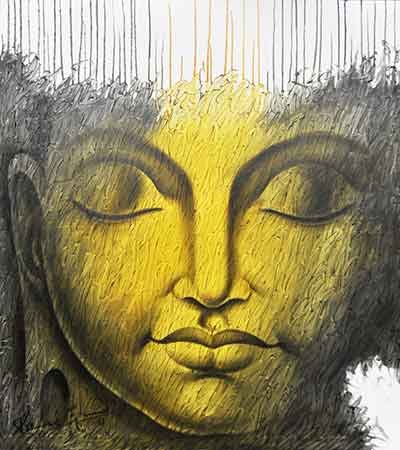
These words, uttered innocently by the charioteer, shocked the Prince deeply. "Do you mean," he
exclaimed passionately, "that one day my wife, my child, my friends and myself will all be dead? And
all these people I see here today, all dressed up so radiant, will also died? Oh, how blind is the
world that it can dance and sing while death is just waiting for everyone! Why do they all bother to
dress themselves in such fine clothes if one day they shall be wearing nothing more than a simple
white sheet? Do people have such short memories that they forget about death? Or are their hearts so
strong that the thought of death does not bother them? Come, Channa, turn the chariot around. I wish
to return to the palace and think."
But instead, Channa drove the chariot to a beautiful garden. There all the most charming singers and
dancers from the palace were waiting, along with musicians, ministers and a large feast prepared by
the palace chefs. They all welcomed the Prince joyfully and cheered when he stepped from the
chariot. But the Prince did not smile, nor did he say anything. His thoughts were totally absorbed
in what he had seen that day.
Fading Pleasures
Everyone tried his or her best to amuse the Prince. The dancing girls flirted with him, hoping to
win at least a smile from his handsome but saddened face. Yet Siddhartha did not even seem to notice
them. He could not get the visions of old age, sickness and death out of his mind.
One of the ministers, seeing that the Prince was not enjoying any of the splendid arrangements that
had been made for him, came over to the Prince. In the joking manner of a friend he said,
"Siddhartha, it is not right that you ignore these lovely dancers and refuse to join the
festivities. Come on! You are young and healthy; you should be enjoying yourself. What is the
matter? Aren't these women pretty enough for you?"
But the Prince answered him in a voice as strong and low as thunder. "You have misunderstood me. I
do not dislike the lovely people and things I see here. But when I think of how quickly their beauty
will disappear, how everything changes so fast, I can not find much pleasure in them anymore.
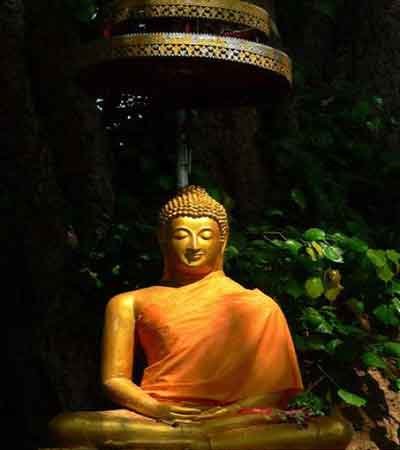
"If there were no old age, sickness and death, then I too, could find great pleasure in such lovely
objects. But in the middle of such unhappiness, knowing what awaits us all in the future, how can I
be satisfied with pleasures that will fade so quickly? "You, my friend, must have a stronger heart
than mine if you can be amused so easily. But for me, everything I see is on fire with suffering.
Until I find a way out of this suffering, such worldly amusements do not interest me at all." And
so, unable to brighten the Prince's mood, everyone returned sadly to the palace. When the ministers
told the King that his son could not be entertained or distracted by anything, he felt so much grief
that he could not sleep, "O, my beloved son," he thought to himself, "what else can I do to keep you
here in my kingdom with me? What other pleasures can I provide so that you will stay? And with such
worried thoughts, fearful that he would soon lose his only son, the King spent the night in despair.
A Vision of Peace
The Prince sank deeper and deeper into gloom. He seemed to lose interest in everything. He hardly
ate anything anymore, and as a result began to look pale and unhealthy. The King and everyone else
were very upset that these unhappy changes had come over their beloved Siddhartha.
One day he appeared before the King. "Father," he began, "lately my mind has been very troubled. I
feel restless and would like your permission to leave the palace once again. Perhaps a change of
scenery will do me good." The King was quick to agree to his son's request, for he would do anything
to please him and make him happy again. But, as before, he asked some of his most trusted ministers
to stay close to the Prince and keep an eye on him. This time Siddhartha saddled Kantaka himself and
rode out of the palace grounds in search of some beautiful countryside. Finally he came to the edge
of some farmland and dismounted. The ministers followed close behind. They tried to gain his
attention with stories, news and gossip of the court. But the Prince had no interest in such idle
talk, and soon the ministers left him alone and walked away, still chattering to themselves.
Siddhartha looked out over the farmland. A man and his oxen were plowing the field, the birds were
singing and the sun was shinning brightly. "It is so beautiful here," he thought. "The plowed rows
in the field look like ripples on a lake." He sat down, and his mind relaxed for the first time in a
long while. But as he looked closer at the scene before him, he began to notice things he had not
seen before. Where the plow had come by and cut rows into the soil, he saw the bodies of hundreds of
small insects that had been killed by its blade. He saw hundreds more running back and forth in
conclusion now that their homes had been destroyed
He also noticed that the birds were not just gayly singing. They were constantly searching for food,
swooping down to snatch up the frightening insects. and the smaller birds darted about in fear,
scared of the hawks and other large birds who circled hungrily above them.
He noticed that the oxen labored heavily while trying to drag the heavy plow through the ground. The
lashes of the farmer's whip cut painful blisters into their sweating sides. And the farmer, too,
worked hard. Like the beasts, his rough and sun-burnt body glistened with sweat.
"Such a circle of misery," thought the Prince. "This farmer, his animals, the birds and the insects
work all day to be happy ,comfortable, and having enough to eat. But, in fact, they are constantly
killing and hurting each other. How pitiful of the world seem to me." The Prince's heart was filled
with compassion for all these suffering creatures. He hated to see them so unhappy. He found a shady
place to sit under a rose apple tree and began to meditate deeply on what he had seen. As he looked
deeper and deeper into the nature of the suffering he saw, his mind became more and more
concentrated and calm. He experienced a quietness unlike anything he had known before.
With his mind now at rest he began to think, " every living thing is searching for happiness. Yet
most are so blinded by their ignorance and desires that they find nothing but misery. Fear,
disappointment, hunger, old age, sickness, and death are rewarding for their trouble! " "Now that I
have seen this, I have no more interest in the small and changeable pleasures of this world. I must
find something that will bring me lasting peace and happiness. But how can I content to be free from
others suffering? I must find out a way to help all other living as well. Because they have been so
kind to me , and they are so suffering. And then I will share this experience with them."
When Prince Siddhartha had finished this compassionate meditation . He opened his eyes and saw a man
who was standing in front of him with a dress like a poor beggar. His eyes were bright and calm.
"Please tell me," the Prince asked, "who are you?"
The man answered, " I am someone who has become frightened by the sufferings of the world. I have
grown tired of the so-called pleasures to be found in the company of others, so now I wander alone.
I have given up my home and now live and sleep in caves, in the forest or wherever I find myself. My
only interest in finding the highest and most happiness." When he had spoken these words, the man
disappeared. " At last I have found the true meaning for my life," he thought , "I begin searching
for the true of the happiness and stop these sufferings." With this thinking, he went back to the
palace.
A Father's Fear
Upon his arrival home the Prince immediately went to the King's room. Pressing his hands together,
as was the custom when making an important request, he announced, "I wish to become a homeless
wanderer and search for the end of all suffering. Grant me your permission, Father, to leave the
palace." From the time his son was a baby, the King had feared that someday he would have to hear
this dreaded request. But still his son's words came as a great shock to him. In a voice chocked
with tears he replied, "Dearest son, forget this idea of leaving. You are still much too young to
follow the lonely life of a holy man. Wait until you are older. Meanwhile stay here in Kapilavastu
and rule my kingdom."
"O father, I shall stay here only if you can promise me four things. Tell me that I shall never grow
old, never become ill, never die, and never be unhappy. If you can not promise me these things, then
I must leave immediately."
The King was shocked by these strange words and began to get angry. "Forget these foolish ideas,
Siddhartha," he said loudly. But the Prince remained firm. "Father, If you can not save me from the
sufferings of old age, sickness, death and unhappiness, then you must let me go and try to save
myself. It is not right to keep me a prisoner here."
But the King would hear no more. "Do not let the Prince leave! Set a guard around the palace
grounds!" he shouted to his ministers and then stormed out of the room angrily.
Escape
Siddhartha left the King's room and returned to his palace. He passed through the beautifully
decorated rooms, the magnificent hallways, past the sparkling fountains and into his rooms on the
upper story. He walked among the talented musicians and past the beautiful serving girls. But none
of these delights affected his mind. He had only thought, and that was to leave.
That night after dinner a strange force seemed to enter the palace. One by one the musicians and
dancers and servants became drowsy and fell asleep. Finally even Yasodhara fell asleep next to her
baby Rahula. The Prince saw them lying there and thought to himself, "I would like to hold my child
in my arms one last time before I leave, but that might awaken Yasodhara. Then it would be very
difficulty to depart. No, I must go quickly and quietly before anyone wakes up."
Stepping carefully around the sleeping bodies, he reached the window and climbed out onto the roof
and then down to the ground. He went to where Channa, the charioteer was sleeping and gently woke
him up. "Hurry, Channa, saddle my horse. I wish to ride tonight."
Channa was surprised that the Prince would want to go out in the middle of the night, but he did as
he was asked. He saddled Kantaka and led him to the Prince. Siddhartha patted his horse and
whispered, "Kantaka, my old friend, we must be very quiet. I do not want to wake up any of the
guards. Tonight is a very special night." As the three of them approached the heavy gates at the
edge of the gardens, the doors suddenly opened by themselves. Silently they rode out into the night.
When they reached the edge of the city, the Prince looked back and vowed, "until I learn how to
conquer all sufferings, I shall not return to this fair city of Kapilvastu !"
They rode all night. Just as the morning sun was about to rise they reached a quiet forest where
many holy people lived. The Prince was happy and thought to himself, "now my real journey has
begun." Then he turned to Channa and said, "my friend, I thank you deeply for your help. I have
reached the place that I wanted. Now it is time for you to take my horse and return to the palace."
Channa could not believe that the Prince would not be returning to the palace with him. He stood
there confused, tears begining to fill his eyes. The Prince understood his grief and spoke to him
again very softly, "my faithful Channa, do not cry. Sooner or later we all have to say goodbye.
Here, take these royal jewels I am wearing; I shall not need them anymore. Return to the palace and
tell my father that I have not left in anger. It is not that I do not love my family anymore.
Rather, it is because I love them all so much that I must leave them for now. If I ever discover the
way to end all suffering, I shall return to them. If I fail, then it really makes little difference
that I am leaving them now. Sooner or later death would pull us apart anyway. Go now, and let me
begin my search."
Channa realized that there was no way he could change the Prince's mind. He took Kantaka's reins
from the Prince and slowly led the horse away. Many times both the charioteer and Kantaka looked
back at the Prince with tears in their eyes. Eventually they reached Kapilavastu where Channa had
the sad duty of telling everyone that Siddhartha had left the royal life forever.
The Journey Begins
As Siddhartha stood alone in the forest, ready to begin his great adventure, he thought, "From today
onwards I am no longer a prince. Therefore, it is not right that I continue to look and dress like
one. " He took his knife and cut off his long, flowing hair, a sign of royalty. Then he met a poor
hunter and said to him, "Sir, I have no more need of these silk clothes. If I am to live in the
forest I should wear something rough like yours. Let us switch." The hunter was surprised and
delighted to receive such expensive clothing in exchange for his own and quickly agreed to
Siddhartha's suggestion.
Now that he was properly dressed as a poor seeker of the truth, Siddhartha began to look for a
teacher who could show him the way to end all sufferings. He wandered through the forests and spoke
to all the many holy men he found there. Everywhere he went he was welcomed with respect. Even
though he now wore ragged clothes and ate only the poor food he could beg, he was still a very
handsome and striking looking man. When the people in the forest saw him coming they said to each
other, "Here comes a very special person. His face is so strong and determined! If such a man is
looking for the truth, he is sure to find it."
Siddhartha studied with several teachers, but was not satisfied with what he learned from them.
"What they teach is helpful," he thought, "but it does not lead to perfect happiness." Finally he
heard that some very wise men lived in the kingdom of Magadha where King Bimbisara ruled. So he
decided to travel far to the south and east to find them.
One day, as he was walking through Rajagriha, the capital city of Magadha, he passed near the palace
gates. One of the King Bimbisara's ministers saw him and immediately ran to the King. "Sir," He said
excitedly, "I have just seen a most unusual man in the city. He is dressed in rags and begs his food
from door to door , but I am sure he must be a great person. His face is so strong and he walks with
such dignity. It almost seems that a special light shines from him!" The King was very interested
and asked that Siddhartha be brought before him. They talked together for a while and the King was
very impressed by his intelligence, modesty and king manner. Then the King said, " I have never met
a man I felt I could trust more than you. Please settle here in Rajagriha and help me rule my
kingdom." But Siddhartha replied politely, "O King, I have already had the chance to rule a kingdom,
but I had to refuse. I am not interested in wealth or power, only in the path of truth. I thank you
for you offer, but I have come to your kingdom only to find teachers who can help me with my
search." Then the King bowed to the man in rags and said, " I wish you have a lot of luck on your
journey. If you do find what you are looking for, please return here and teach it to me. But even if
you fail, you are already welcome to return to my palace." Siddhartha thanked him and continued on
his way.
Six Years of Struggle
Eventually Siddhartha came to the forest where the wise men lived. He studied first with Arada and
then with Udraka. In a short time he mastered everything they had to teach him. But still he was not
satisfied. "My teachers are holy people, but what they have taught me does not bring an end to all
suffering. I must continue to search on my own." He continued his travels until he came to the
Nairangana River, Near the holy town of Gaya. He crossed the river and entered the forests on the
other side. There he found a group of five men. Their life was extremely simple. They ate very
little food, lived out in the open, and sat perfectly still for many hours each day.
"Why are you doing such painful thing to your bodies?" Siddhartha asked these men. "Most people in
the world treat their bodies very gently," they answered, "yet still experience such suffering. We
feel that if we can learn to master pain, we shall have found the way to control all suffering."
Siddhartha thought to himself, "For so many years I lived in those luxurious pleasure palaces. I was
treated very gently, yet still my mind did not find peace. Perhaps these men are right. I shall join
them in their practices and see if this leads to the end of sufferings."
And so he began these difficulty and painful practices. He sat for hours and hours in the same spot.
Even though his legs and back hurt very much, he would not move a muscle. He let himself be burned
by the blazing summer sun and chilled by the winter winds. He ate barely enough food to remain
alive. But no matter how difficult it was, he thought, "I must continue and discover the way out of
all misery!"
The five men were amazed at Siddhartha. They said to themselves, "we have never seen anyone with as
much determination as this man. He drives himself on and on and never quits. If anyone is ever going
to succeed in these practices it will be Siddhartha. Let us stay near him so that when he discovers
the true path we shall be able to learn it from him."
Siddhartha treated his body more and more harshly. In the beginning, he slept only a few hours for
each night, but eventually he stopped going to sleep . He stopped taking even the one poor meal a
day that he used to eat, and would only eat the few seeds and berries that the wind blew into his
lap. He grew thinner. His body lost its radiance and became covered with dust and dirt. Eventually,
he looked like little more than a living skeleton. But still, he did not give up his practices.
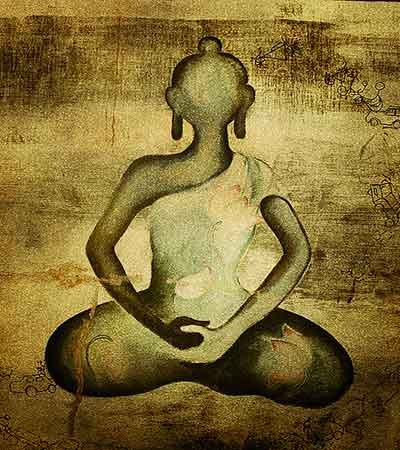
Six long years passed. Siddhartha was thirty five, having spent six years with hardly any food,
sleep, shelter or decent clothing. One day he thought to himself, "Am I any closer to my goal now
than I was six years ago? Or am I still as ignorant as before? When I was a Prince and lived in
luxury, I had everything a person could desire. I wasted many years in those prisons of pleasures.
"Then I left and began my search. I have lived the forests and caves and have had nothing but poor
food and much pain. But I still have not learned how to put an end to suffering. I can see now that
it is a mistake to punish my body like this, just as it was a mistake to have wasted so much time in
those palaces. To find the truth I must follow a middle path between too much pleasure and too much
pain." He remembered that many years ago, after he had seen the dead man, he had meditated under a
rose apple tree. "After that meditation," he thought, "my mind was very calm and still. I was able
to see things clearly for the first time. I shall try to meditate like that again now."
But when he looked at himself he realized, "I have been sitting here for such a long time with no
food that I am tired, dirty and weak. I am so thin that I can see my bones through my skin. How can
I meditate when I am too hungry dirty even to think clearly?" And so he slowly pulled himself up and
went to bath himself in the river. He was so weak, however, that he fell and was almost drowned.
With great effort he just managed to pull himself to the shore. Then he sat for a while, resting.
An Offering
In a small village at the edge of the forest lived a herdsman and his wife Sujata. She just given
birth to her first child and was very happy. She took the finest milk from her husband's cows and
prepared a delicious meal from it. Now she was taking this food into the forest as an offering to
the spirits she thought lived there. She had often prayed to these spirits and wanted to thank them
for helping her have such a healthy baby.
As she entered the forest she saw Siddhartha sitting there. His body was thin and weak, but his face
was radiant and handsome. Sujata gazed at him in surprise. "I have never seen anyone like that
before," she thought to herself. "Perhaps it is the king of the tree spirits himself !" And so she
took the specially prepared food and placed it before him.
Siddhartha slowly opened his eyes and saw the bowl in front of him. Smiling silently to Sujata he
lifted it to his lips and began to drink. To her amazement, his body grew more and more radiant as
he drank. When he was finished he placed the bowl down and thanked her saying, "you thought I was a
spirit, but I am only a man in search of the truth. Your offering has made me strong again. Now, I
am sure that I shall find the truth. Much good will come from-what you have done today. Thank you."
The five men who were living in the forest with Siddhartha saw him accept this special food from
Sujata. They were very disappointed and said to themselves, "Siddhartha has given up his search. He
is no longer following the holy life. Look, he bathes himself and takes rich food again. How can we
stay with such a man any longer? come. Let us leave this forest and travel to Benares. We can
continue our practices in Deer Park near there."
And so they left, thinking that Siddhartha was longer interested in discovering the truth. But
Siddhartha, strengthened by his meal and prepared to meditate, was now ready to find what he had
been looking for all these many years. He stood up, waded across the river and headed towards what
would be known in later years as the Tree of Enlightenment.
The Great Battle
The moment that the world had been waiting for was now at hand. Siddhartha, who had given up a
kingdom in search of truth, was approaching the tree. On his way, he passed a man carrying freshly
cut grass and asked him for a small bundle. This he would use his seat.
As he drew closer the air became very still. It was as if the whole world was holding its breath,
anxiously awaiting what would happen next. The branches of the tree bent down as if welcoming him to
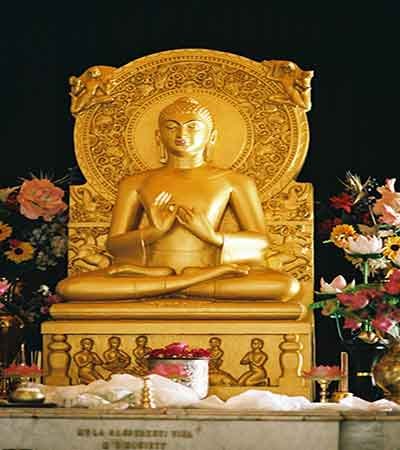
come and sit down under its shade. Siddhartha carefully arranged the grass into a small cushion and
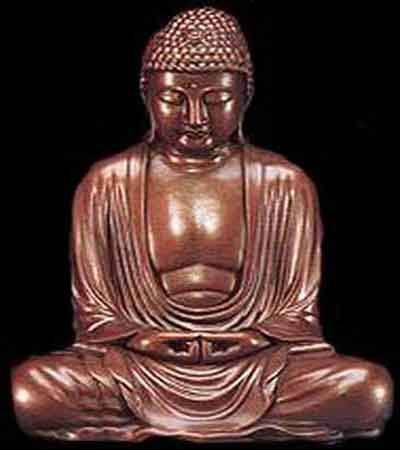
sat down, facing the east. He crossed his legs in a firm meditation posture on rested his hands in
his lap. Then he made a bold and determined vow: "I shall not arise from this position until I have
reached my goal, even if I die sitting here !" And all the spirits of the air looking on rejoiced,
hearing Siddhartha's great pledge. It was the full moon day of the fourth month, and the sun was
about to set. But the ancient stories tell us that not everyone rejoiced at this moment. There was
one force, called Mara, who was terrified and angry. For Mara, She is the name the ancient Indian
people gave to the evil forces that disturb our minds. Mara is our greed, hatred, ignorance,
jealousy, doubt and all the other poisons bringing people unhappiness and grief.
Thus, when Mara saw Siddhartha seated under the tree of enlightenment, he was enraged. Calling his
sons and daughters around him he shouted, "Look, all of you. Siddhartha is seated in meditation. If
he is successful and discovers the way to end all suffering, what will happen to us? Don't you
understand that we shall lose all our power ? We can not harm people if he teaches them the truth.
We must disturb his meditation, or else we doomed !" So Mara and his evil forces tried everything to
disturb Siddhartha. They produced a fearful storm and hurled lightning bolts down around him. They
churned up a great wind until everything around seemed ready to crash down. But beneath the branches
of the tree everything remained calm, protected by the force of Siddhartha's meditation.
Mara saw that the storm had no effect so he turned to his troops and shouted, "Attack!" The whole
horde of evil spirits, demons and nightmare shapes turned against Siddhartha. They ran towards him
wildly, yelling blood-curdling screams. They shot poisoned arrows of hate at him. But as these
arrows flew towards the Siddhartha, they turned into lotus petals and fell harmlessly at his feet.
Nothing could disturb the peace of his meditation. "If these weapons and fearful shapes do not
distract him," Mara thought, "perhaps a vision of beauty will disturb his mind." All at once the
frightful demons turned into the most beautiful and alluring of women. These bewitching creatures
danced in front of the meditation, but even they could not affect him. Memories of the pleasure
palaces, visions of his wife and son, heavenly music, delicious food-nothing could break through the
calm determination of this seeker of truth.
Mara felt defeated. But he had one last plan. Dismissing his attendants, he appeared alone in front
of the Prince . Addressing him in a mocking voice he said, "so you are the great Prince Siddhartha ?
you think you are a great meditation. So many holy people have failed to find the truth, but you
think you will succeed ! "How foolish you are ! Don't you know that it takes a lot of preparation to
find the truth you are looking for. First you wasted twenty-nine years pampering yourself. Then you
wasted six more years starving yourself. Now you sit here thinking that wisdom will just come to
you. How foolish ! Quit this meditation, or at least show me a witness who will swear that you are
worthy of succeeding where all others have failed. "
These scornful words failed to bother Siddhartha . Silently he lifted his right hand from his lap,
reached in front of him and touched the earth. Yes, the earth itself was Siddhartha's witness ! For
countless lifetimes he had appeared on this earth in various forms. He had practiced generosity and
patience, he had acted lovingly and had avoided harming others, and he had meditated on the truth.
He had done all these things-sometimes as a man, sometimes as a woman; sometimes rich, sometimes
poor-over and over again. He had done this all , just for the sake of discovering the end to all
suffering. And the earth was his witness. Mara realized that now he was truly defeated, and faded
away like a bad dream. Siddhartha was left completely alone. The storm clouds parted and the moon
shone brightly in the sky. The air smelled sweet and a light dew glistened on the tips of the grass.
Everything was ready.
Awakened
Siddhartha's mind was calm and relaxed. Slowly his concentration deepened and his wisdom grew
brighter. In his mind's eye he saw far into the past. He saw that when one life ended, another
began. Death only brought the body to an end; life itself continued on and on finding a new body
again and again. He saw that when a person did evil in one life-such as harming another-he or she
experienced sadness in the future. But when a person acted with love, happiness and joy followed.
Nothing anyone did was ever lost, but was carried on from life to life, bringing happiness or pain.
As he discovered how all life is linked together in this way, deeper truths appeared to his mind.
The sun, planets, all the stars, the galaxies of the universe-they all appeared in his meditation.
He saw how everything, from the smallest speck of dust to the largest star, was linked together.
Everything was constantly changing , growing, decaying, and growing again. Nothing happened without
a cause, and every cause produced and effect.
Then he saw all the sufferings of the world. He saw how everyone-from the smallest insect to the
greatest king-ran after pleasure, only to end up with unhappiness. And he discovered the reason for
all this unhappiness. He saw that people do not really understand that everything is always
changing. They are blind to this truth. In their blindness they fight and steal and kill for the
things they want, but these things can never bring them lasting happiness. Soon they change or
decay, and the search starts again.
He saw that people fight against the things they dislike. Their whole life is filled with hatred and
anger. And every time they harm someone else, they suffer for it later. They go from lifetime to
lifetime creating more unhappiness for themselves. They are searching for peace, but find nothing
but pain.
Finally he discovered the way to end all this suffering. If a person could see the truth clearly-as
he himself and seen it this night-all running after pleasure and away from pain would stop. There
would be no more greed or hatred in the person's mind. He or she would no longer do anything to harm
anyone else. Thus, there would be no more unhappiness to be felt. With all hatred finished, the
person's heart would fill with love. And this love would bring a peace and happiness unlike anything
else.
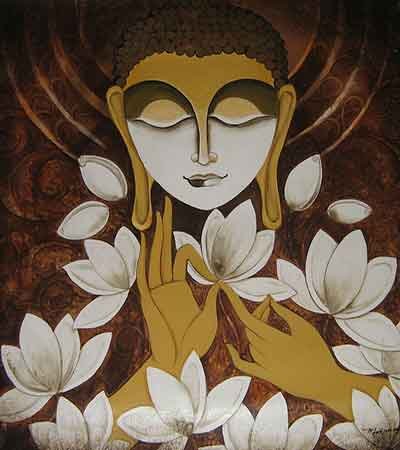
When Siddhartha had seen all this, even the last speck of darkness disappeared from his mind. He was
filled with a radiant clear light. He was no longer and ordinary person. He had become fully
enlightened to the truth. He was now a Buddha. He had reached his goal ! With a calm and peaceful
smile, he arose from his meditation. It was morning, and the sun was rising in the east.
Whom to teach
All of nature rejoiced that glorious morning. Fresh flowers blossomed everywhere and sent their
sweet perfume into the air. Birds sang joyfully and creatures everywhere forgot their fear. Rainbows
and beautifully coloured clouds appeared in the sky, and people marvel led to see such wondrous
sights.
Buddha himself was filled with the highest happiness. His mind, free from all darkness and pain,
felt a boundless joy. For days and weeks he stayed near the Tree of Enlightenment, enjoying the
bliss and happiness only a Buddha knows. Then he thought, "it was so difficult for me to reach the
end of suffering and become a Buddha. I had to work so hard for so long. When I see how blind and
ignorant most people are, I wonder if there is anyone who can understand the truths I have
discovered. How could I possibly teach them? Perhaps it is better for me to live the rest of my life
in the forests alone and enjoy the happiness of being a Budhha myself." Then he heard an inner voice
which said, "please do not forget us ! We are the suffering beings of the world. We have been
waiting for this moment ever since your birth, and even before that. We have hoped and prayed these
for many years that you would leave the princely life and discover the way to end all suffering. Now
that you have found this path, please teach it to us. Unlike you, we are still suffering."
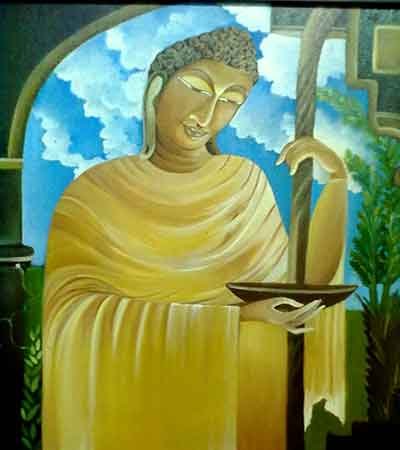
But another thought arose in buddha's mind: "who will be able to follow the teachings I have to give
? Who is strong and brave enough ? Who will try hard and long enough ?" And the inner voice came
again: "It is true that our minds are clouded in ignorance, O Buddha. But for some people this
ignorance is not so thick. They will be able to understand you. For their sake, please teach us all
the true path !" And Buddha smiled and said, "Of course, of course, I shall teach. The only reason I
felt the princely life was to find a way to help others. Now that I have become a Buddha, I shall do
everything I can."
"But even a Buddha can not remove the sufferings of others if they do not try to help themselves.
People must want to get better before a doctor can cure them. In the same way, they must want to
hear the teachings of the truth before anyone can help them. But whoever comes to me with an open
mind will find that I am ready to teach them in every way I can."
Then he thought, "who, among all the people in world, should I teach first ? Who is the most ready?
He remembered Arada and Udraka, the two teachers he had met six years before. "They would be the
best to teach, but I can see that they have already died and left this world." Then he thought of
the five men who lived with him for so long in the forest. "They are ready to understand the truth,
" he thought, " I shall teach them first." He knew that he would find these men in the Deer Park
near Benares, the holiest city of ancient India. "I shall go there," Budhha proclaimed, " and begin
the work I came to do."
The First Teaching
It was a long way to Benares and Budhha walked slowly through village and farm. Everyone was
immediately attracted to him. He was tall and handsome and moved with dignity and grace. Just seeing
him brought calmness and joy to the people. He spoke kind and gentle words of comfort to everyone he
met. Whether they were rich or poor, simple or intelligent, of noble birth or low, Buddha treated
them all equally, with great love and respect.
Finally, he reached the Deer Park. From a distance the five men saw him approach. Quickly they s
whispered to one another, "Here comes that good-for-nothing Siddhartha. Let us have nothing to do
with such a quitter ! Ignore him if he comes near." But as Buddha approached the men immediately
felt that there was something very special about him. Forgetting their plan to ignore him, they
automatically stood up as he drew near. With great respect they prepared a seat for him, took his
robe, brought him some water and said, "Welcome Siddhartha, to the Deer Park. We are honored that
you have joined us here." Buddha answered, " I thank you for your kind welcome, O monks. But you
should know that I am no longer simply Siddhartha, and it is no longer right for you to call me by
that name." "By what name should we call you then ?" they asked. "The whole world is asleep in
ignorance," he answered. "When someone discovers the truth, he or she is asleep no longer. Now I am
awake, having discovered the truth. All such Awakened Ones are called Buddha."
Then the five men, with great respect, said, "O Buddha, please teach us what you have learned so
that we too may awaken." And so, in answer to their request, Buddha delivered his first teaching. It
is called "
Turning the Wheel of the Dharma" and "Dharma" is the truth he discovered. "O monks, " he began, "you
must know that there are four Noble Truths. The first is the Noble Truth of suffering. Life is
filled with the miseries of old age, sickness, death and unhappiness. People chase after pleasure
but find only pain. Even when they find something pleasant they soon grow tired of it. Nowhere is
there any real satisfaction or peace.
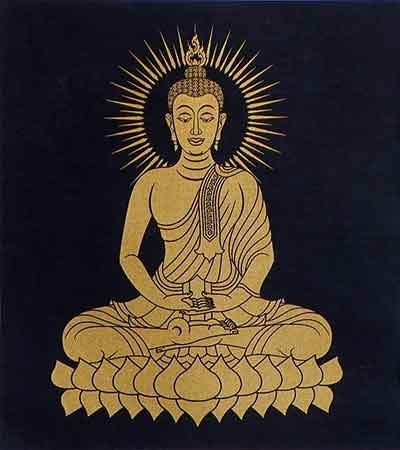
The second is the Noble Truth of the Cause of Suffering. When our mind is filled with greed and
desire, sufferings of all types follow. For example, if a rich man is attached to his wealth, his
miserliness will bring him nothing but pain.
The third is the Noble Truth of the End of Suffering. When we remove all craving and desire from our
mind, suffering will come to an end. We shall experience a peace and happiness that is beyond words.
Finally, the fourth truth is the Noble Truth of the Path. This path leads to the end of all
suffering. If we avoid harming all other living beings, if we sharpen and focus our mind, and if we
gain wisdom, each of us can reach perfect happiness, the end of all misery."
When they heard these words the five men felt as happy as if they had found a great treasure of
gold. " Oh, Buddha," they said, "you have indeed found the truth. Please teach us the path to
perfect wisdom and happiness and we shall be your followers." It is said that many unseen spirits
also heard these first teachings and flew to the ends of the earth crying, "The Buddha has begun to
teach. Let us the world rejoice !"
A Mother's Grief
Buddha taught in many different ways. To simple people and to children he taught by telling stories.
To those people with high intelligence, Buddha gave detailed explanations of the path. To others, he
taught without speaking any words at all. But, perhaps, his most powerful teaching was his own
example, the very way he lived his life. He always acted with kindness and love. He was patient with
everyone, even the most ignorant and foolish.
Very soon, many people were attracted to him and became his followers. If someone had a problem, he
or she would go to Buddha and ask his advice. There was one woman, named Gotami, whose child had
just died. She was so sad that she became crazy. She went everywhere trying to bring her child back
to life. Her friends felt sorry for her and said, "Gotami, you should go and see the Buddha. Perhaps
he can help you."
She went before Buddha still holding her child in her arms. "Please bring him back to life for me,"
she cried. Very gently Buddha answered her, " I can help you, Gotami, but first you must bring me
something. I need one small mustard seed. However, it must come from a house where no one has ever
died." Gotami quickly went out in search of a mustard seed. She asked at one home and the woman
there answered, "Of course you can have a mustard seed. You can have whatever you want... But you
should know that last year my husband died. "
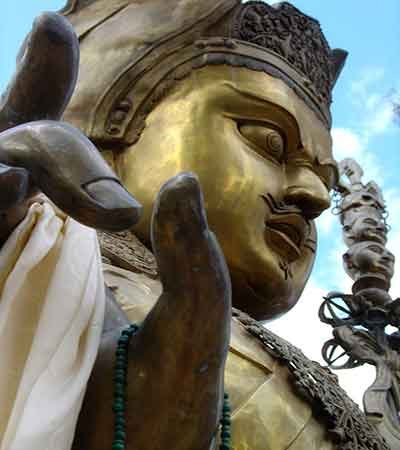
"Oh," Gotami replied, "then I must search elsewhere" and ran off to the next house. But everywhere
she went, the same thing happened. Everyone wanted to help her, but someone had died in every family
she visited. One person told her, "Three years ago I lost my daughter." Another said, " my bother
died her yesterday." It was always the same.
At the end of the day she returned to the Buddha. "What have you found, Gotami?" he asked. "Where is
your mustard seed. ? And there is your son? You are not carrying him any longer." She answered,
"Buddha, today I have discovered that I am not the only one who has lost a loved one. Everywhere
people have died. I see how foolish I was to think I could have my son back. I have accepted his
death, and this afternoon I buried him. Now I have returned to you to hear your teachings. I am
ready to listen. " Then Buddha said, "Gotami, you have learned a great deal today. Death must come
to everyone sooner or later. But if you learn the truth you can live and die in happiness. Come, I
shall teach you." And so he taught her, and soon she found more peace and happiness than she had
ever known before.
button