














Who is Bhagavan Sri Sathya Sai Baba – Incomprehensible Divinity
Who is Bhagavan Sri Sathya Sai Baba – Incomprehensible Divinity

His was the advent that was a silver lining, glittering in golden! Two decades before independence, when the country was suppressed and was clamouring for freedom from the British, in a remote village in Andhra Pradesh was born a little boy by name Sathya Narayana Raju. His birth was no less significant, but in line with the promise of the famous Gita verse, “Parithranaya Sadhuunam…”! Sathya Narayana Raju’s birth was the fulfilment of the word of Bhagawan Sri Krishna over 5230 years ago, given to Arjuna. His Story may sound utopian, but it is verily the True Story. He came, beyond any doubt, at the most significant of times, when the world was in disarray and needed a healing touch.
He came to be known as Bhagawan Sri Sathya Sai Baba, and with this began the all-conquering, incredible Sai Sojourn! Human destiny was scribbling out its unique history, erasing the void and filling in with the vivid. Basking in His glory of selfless love, the wise recognized Him to be the personification of Divinity.
He came to walk on the earth this time neither with a bow and arrows, nor a flute and discus; neither as a powerful prince of prowess and statesmanship nor as a kingmaker, but much more than that, since, the battles to be fought and won are on the intellectual plane. Physical prowess and conventional warfare had to take a backseat this time. Their place has been taken by penetrating powerful words of wisdom and disarming Pure Love, the splendour and majesty remaining the same as a rule. The assurance given more than five thousand years ago at the beginning of the Kali Age thus became a fulfilment on the 23rd of November 1926 when the present Avatar Bhagawan Sri Sathya Sai Baba was born at Puttaparthi, an insignificant, underdeveloped and remote village in the Anantapur District of Andhra Pradesh.
He says: “Yes, I am God and so are you. The only difference between you and I is that while I am aware of this fact, you are not.”
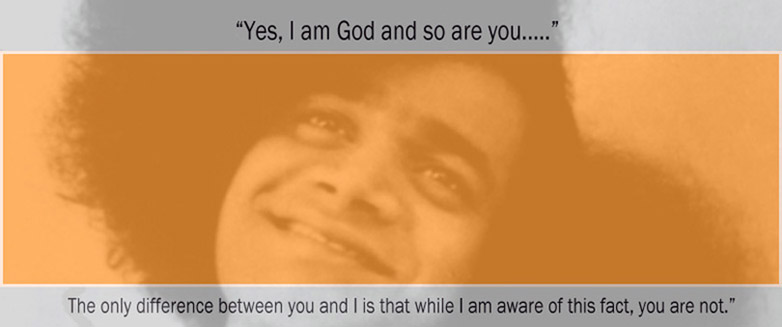
And this is no casual remark. Indeed, inherent in this small, but extremely significant statement is the fundamental truth of humanity’s divine nature – its true reality; and revivifying the heart of every human being to this salient truth is the mission and message of Bhagawan Sri Sathya Sai Baba. Very aptly, Baba begins His every discourse, addressing the gathering as, “Embodiments of the Divine Atma”.
All who listen to Him, experience His unconditional love, benefit from His caring counsel and witness His supernormal supremacy over mind and matter, which give a real glimpse of the glory and majesty of God, and therefore, of the infinity that each human potentially and inherently is.
Crime has overtaken compassion, anger has replaced adoration, greed has swallowed gratitude, and selfishness has drowned selflessness and sacrifice…
Like His previous avatars, this time also He chose His father and mother for His earthly career. The choice fell on Pedda Venkama Raju of the Ratnakaram family and Mother Easwaramma, whose lives were sanctified and glorified for posterity to remember. Motherhood received a greater measure of respect and honour, which was probably its due. What He could not (or did not?) do for Mother Kausalya in the Thretha yuga, He fulfilled in the Dwapara yuga, and what still remained, in Kali Yuga. If Mother Kausalya had to suffer pain and agony at the separation of Rama while He was in exile, it was amply compensated when Mother Devaki and Father Vasudeva were emancipated from the clutches of his uncle, the devilish Kamsa. He also gave joy and grace to Mother Yashoda by making her His foster mother. So, the fortune of one was divided for the two as both – chosen by Him only – deserved that grace. Yet, He was not satisfied in rewarding them. Perhaps He chose two more this time – Mother Easwaramma as His Devaki and Mother Subbamma as His Yashoda. How fortunate these mothers are! Their names are inked in golden letters in human history.
The baffling experiences and the mind-boggling miracles that followed and the unlimited glory that brought even the toughest and the greatest to the fore, to kneel before Him and seek His blessings, convinced even His adamant elder brother Sheshama Raju, the Telugu Pundit of Kamalapuram School, with whom He lived for a few years, though the elder brother wished to educate Him to become a Government servant.
As a child He was not only precocious, but demonstrated exemplary divine qualities of compassion, forbearance, generosity and wisdom which distinguished Him from all children of His age in the village. The Divine child was recognized only by the centurian grandfather Kondama Raju, who discovered much to his joy and wonder, that the Lord had only fulfilled his prayers as foretold by the celebrated Venkavadhoota (a realized soul – an anchorite of wisdom) of his family whom the former revered like a guardian angel. The boy Sathyanarayana Raju was miraculous even as a child. He would take out peppermints and sweets from nowhere for His classmates who looked at Him with awe, wonder and adoration. They conferred on Him the title ‘Guru’ as His wisdom was sufficient to command respect from even His teachers. Then came the enunciation on the 20th of October 1940, at the age of 14, that He, as the reincarnation in the form of Sai Baba, had to respond to the call of His devotees for whom He had come and was, therefore, no more the ‘Sathya’ of His family members. This startling revelation marked the beginning of His avataric mission. Crossing over to the garden of Shri Anjaneyulu, the next door neighbour of His elder brother, He sat on a stone block to teach those who had collected around Him and to the whole universe the first prayer:
“Manasa bhajare Gurucharanam
Dustara bhava sagara tharanam”
(Meditate in thy mind on the feet of the Guru; that can take you across the turbulent sea of samsara). Young Baba was given a rousing welcome at Puttaparthi. He took residence at the house of Subbamma, His ‘mother Yashoda’, who looked after Him and His ever-growing number of devotees. His mission was further amplified in a letter He wrote to His brother Sheshama Raju on 25th May 1947 in answer to the fear and anxiety the former had expressed out of fraternal love. He said: “I have a task to foster all mankind and ensure for all of them lives full of bliss. I have a vow: To lead all who stray away from the straight path, again into goodness and save them. I am attached to a work that I love: to remove the sufferings of the poor and grant them what they seek”.

Subsequent years witnessed His multifaceted personality in action on all fronts of human activity, mainly, spiritual, educational and service. The avatar made it clear that the objectives of His avataric mission would consist mainly of Vedaposhana (fostering of the Vedas – the repository of wisdom) and Bhaktasamrakshana (protecting and fostering of His devotees). The former broadly included the propagation of Vedic philosophy and Indian Culture and preservation and dissemination of ancient wisdom enshrined in the scriptures. The latter, namely, Bhaktasamrakshana, covered a wide variety of subjects offering succour, whenever and wherever they were physically or mentally in distress, medical treatment through special institutions like Super Speciality hospitals, establishment of educational institutions for the overall development of the human personality, providing pure drinking water through huge water projects, housing and monetary help to the poor and the destitute, Narayana Seva (feeding the less privileged) and clothes distribution through students under village seva activities, overall development by adopting villages all over the country through Sri Sathya Sai Seva Organisations and umpteen number of activities aiming at the welfare of human society, all free and with no discrimination.
When God undertakes any activity directly, its expansion is unlimited and the beneficiaries innumerable. The Primary School He started to fulfil the desire of Mother Easwaramma, has grown into a full-fledged university. The small hospital opened to meet the medical exigencies of the village has now become a gigantic world class hospital. The water projects, Sri Sathya Sai Central Trust has undertaken for Rayalaseema Region and subsequently for Mahboob Nagar and Medak districts, and not to miss the gigantic water supply scheme for the capital city of Tamil Nadu, Chennai, is providing the most essential thing in life, pure drinking water to lakhs and lakhs across these regions.
And with the years passing by, many more projects and many more happenings! His is a Mission with a Vision and it goes on…

He says, “My Life is My Message”. Every move of this Divine Persona on Earth is to be rightly tracked, to be imbibed by the millions and billions of lives on earth; every gesture of this Divine Phenomenon is to be rightly noticed to be engraved in the hearts of billions, every word oozing out from those Divine Lips is to be properly marked, for these words carry precious gems of Wisdom; every moment in His life is to be captured in the hearts of men for He lives a life full of His message, walking the talk, moment after moment in the most selfless style.
God is now here, radiating the love of a thousand mothers and thus preparing us to embark on the ultimate journey – the direct flight to Divinity, the journey within!!!
Samasta Lokah Sukhino Bhavantu
Bhagawan Sri Sathya Sai Baba

Who is Sathya Sai Baba?
Yes, I am God. And You too are God. The only difference between you and me is that while I am aware of it, you are completely unaware.” This has been the response of Bhagawan Sri Sathya Sai Baba to people who question Him about His identity and divinity. This is the basic spiritual truth that Sai Baba is ceaselessly striving to inculcate in the mind of every man. Anybody who has been a witness to His miraculous powers and illuminating wisdom, and experienced His pure love would know that He is demonstrating to one and all what God is, and therefore, what man potentially and inherentl
The Avatar
An ‘Avatar’ is defined as the incarnation (bodily manifestation) of the Supreme Being. The word ‘Avatar’ is derived from the Sanskrit word ‘Avataranam’ which means ‘descent’, and usually implies a deliberate descent of the Divine into the mortal realms to reveal the Absolute Truth to humanity and remind them of their true divine nature. Though Avatars may appear in different forms at different times, places and circumstances, yet they are all the manifestations of the One Supreme Lord.
Bhagawan Sri Sathya Sai Baba, the Avatar of the Age, has succinctly explained the meaning and the reason for the descent of the Avatar in the following Telugu verse:
Avatarinchuta yanutalo Arthamemi?
Janulapai Preethi Vaatsalya Paratha thoda
Vaari Sthaayaiki Daivambu Vachchu Bhuviki
Jeeva Prajnatho baatuga Daiva prajna
He says that the Formless God takes a form and descends upon the Earth as an expression of His boundless love and affection towards humanity. The Avatar is an enigmatic, yet delightful blend of individual consciousness and the Divine Consciousness. The Avatar behaves in a human way so that mankind can feel kinship with Him, but rises to His super-human heights so that mankind can aspire to reach those heights.
This doctrine of Avatarhood has had a great impact on the Hindu religious life, for, it means that God manifests Himself in a form that can be appreciated even by the least sophisticated. Rama and Krishna have remained prominent as beloved and adored manifestations of the Divine for thousands of years among Hindus.
The scriptures mention seven characteristics of a Divine incarnation:
- Aishwarya – Unmatched splendour and prosperity
- Keerthi – Eternal fame
- Jnana – Wisdom and knowledge of the past, present and future
- Vairagya – Non-attachment to the material world
- Shrushti – Power of creation
- Sthithi – Power of sustenance and preservation
- Laya – Power of destruction and dissolution
In the Bhagavad Gita, Lord Sri Krishna, the Avatar of the Dwapara Era, declares thus:
Yada Yada Hi Dharmasya Glanirbhavathi Bharatha
Abhyukthanam adharmasya Thadathmanam Srujamyaham.
Parithranaya Sadhunam Vinashaya cha Dhushkrutham
Dharma samsthapanarthaya Sambhavami Yuge Yuge
Whenever there is a decline of Righteousness and rise of evil, the Lord incarnates from time to time to uphold Righteousness, to protect the Virtuous and to uproot the evil. The Avatar appears whenever the world is passing through a spiritual and moral crisis. The Avatar comes in order to uphold Dharma (Righteousness) and raise the universal consciousness.
One may ask – why should the Lord Himself incarnate? Why should He not set about the task of restoring Dharma through the many minor gods that He has at His command? The Mughal Emperor Akbar once posed the same question before the courtiers, for he scoffed at the Hindu idea of the Formless adopting a Form and descending into the world as an Avatar to save Dharma. Birbal (the celebrated courtier in Akbar’s court, known for his wit and wisdom) asked for a week’s time to answer the question. A few days later, when he was in the pleasure boat of the emperor, sailing across the lake with his family, Birbal threw overboard a doll made to look like the emperor’s little son, crying at the same time, “O, the prince has fallen into the water!” Hearing this, immediately the emperor jumped into the lake to rescue his son.
Birbal then disclosed that it was only a doll and that the prince was safe. He allayed the anger of Akbar by explaining that he had to perforce enact this drama in order to demonstrate the truth of the Hindu belief that God takes human form to save Dharma without commissioning some other entity to carry out that task. Akbar could have ordered one among the many personnel he had on board to jump in and rescue his son. But his affection was so great and the urgency so acute that the emperor himself plunged into the lake to save his son from drowning. The decline in Dharma is so acute a tragedy and the intensity of affection that the Lord has for good men is so great that He Himself comes to the rescue.
The Triune Sai Avatar
The Divine mysteries cannot be fathomed by the human mind, unless God himself chooses to unlock them out of His immense love and compassion. Bhagawan Sri Sathya Sai Baba, in a landmark discourse on 6th July, 1963, the Guru Poornima Day, declared the secret behind His advent. He revealed that the Sai Avatar is a triple incarnation of the Shiva-Shakthi Principle – Shiva as Shirdi Sai Baba, Shiva and Parvathi embodied as Sri Sathya Sai Baba and the Shakthi Principle that will incarnate as Prema Sai in the Mandya District of the state of Karnataka.
Even in his childhood days, Swami used to refer to ‘The Saint of Shirdi’ in the songs that he taught his companions. Very few in that region had ever seen or heard about Shirdi or Sai Baba. Little did they realize that the child in their midst, singing and dancing so captivatingly would, in a few years, make their village another Shirdi to which hundreds and thousands would come seeking the same Baba!
Sai Baba of Shirdi was born in a remote village called Pathri in Maharashtra on September 28, 1835 to the couple, Gangabhavadiya and Devagiriamma. Gangabhavadiya, overcome with a feeling of intense renunciation immediately after the child’s birth, decided to retire into a forest. With Devagiriamma religiously following her husband, the newborn was left in nature’s care. A pious Muslim and his wife took care of the abandoned child till He was four years of age. Then they handed Him over to a spiritual master by name Gopalrao Deshmukh (also known as Venkusa). For 12 years, till 1851, Baba stayed in Sri Venkusa’s ashram. One night in 1851, for the first time, Baba came to Shirdi. However, He left after a two month stay. He returned to Shirdi again in 1858 and stayed there for 60 long years. Just prior to His shedding the mortal coil in 1918, Shirdi Baba told some of his devotees that he would reappear in the Madras Presidency in 8 years time. Sri Sathya Sai Baba, born in 1926, declared that he was Shirdi Baba come again.
Sathya Sai Baba invariably refers to ‘my previous body’ when he speaks about Shirdi Baba. He often describes to his devotees, how he in his previous body dealt with people and situations, what illustrations he gave to clarify certain points, what questions were asked, etc. Many devotees of Shirdi Baba have had experiences confirming the unity of the two Sais.
Years ago, the Rani of Chincholi (an erstwhile kingdom in Andhra Pradesh) went to Puttaparthi to see Bhagawan. Even as she was entering the gate, Bhagawan told one of the close devotees standing there: “Ask her to bring the brass Kamandalu (a kettle-shaped container used by ascetics) that I left at her house years ago.” The Rani Saheb herself did not know much about it. But on a thorough search of the heirlooms in the house, it turned out that the brass Kamandalu which Shirdi Baba had left at their palace when he had visited them had been carefully preserved by the elders. The Kamandalu had the letters ‘Sa’ ‘Ba’ (the initials of Sai Baba) in the Marathi language engraved on its surface.
Sri Dixit, the nephew of Kakasaheb Dixit, who was a close disciple of Shirdi Baba, went to Puttaparthi to put to test the identity of Sathya Sai Baba with Shirdi Baba. He always carried a small photo of his uncle in his pocket. The first thing that Bhagawan asked Dixit to do was to take out the photograph of “My Kaka” from the pocket!
Birth
Bhagawan Sri Sathya Sai Baba was born on the 23rd day of November 1926, at a quiet little village, Puttaparthi, in the South Indian state of Andhra Pradesh, then a part of the Madras Presidency. The year was Akshaya, the Never-declining, the Ever-full. It was the time of sunrise; and, the villagers were chanting the names of Lord Shiva, remembering that the day was still Karthika Somavara, a Monday of the Holy Month of Karthika, devoted to the puja (worship) of Shiva. That day was made even more auspicious for Shiva worship, because the ascendant star was Ardra (the star of Shiva). On this day, when these rare and propitious signs came together, the people thronged the temples of the Lord to offer special pujas and pray for His benediction.
Signs of the Descent
Meanwhile, mysterious indications of the impending incarnation occurred in Pedda Venkamma’s house. For example, there was the twang of the tambura! Since the brothers and the father were all interested in the village operas, there was a big tambura (a string instrument) and a maddala (drum). As the birth of the Son for whom Mother Easwaramma prayed, announced itself as imminent, the house was awakened at midnight, and sometimes even later, by the tambura twanging automatically, and the maddala beating rhythmically as if an expert Hand was playing on it! One Shastri (Vedic scholar), whom Pedda Venkama Raju approached for an explanation, said that it was an auspicious occurrence: it meant the presence of a Shakthi, a beneficent Power, conferring harmony, spiritual elevation and joy.
The Sun rises above the horizon!
The Mother had also just finished her Sathya Narayana Puja in accordance with her vows, for, even while she was going through the final rituals, the pangs forewarned her. When Easwaramma announced the pangs, word was sent to the mother-in-law, Lakshmamma, the pious lady of the house; but, it became known that she had gone to the house of the priest to perform the Puja of Sathya Narayana; the messenger discovered her there and urged her to return; but she was so confident of the Grace of Sathya Narayana, so steadfast in her devotion, so disciplined in her religious adherence, that she refused to be hustled! She sent word that she would bring with her the sacred offerings after the Puja and that on no account would she allow her prayers to be interrupted! She finished the entire ritual with full concentration, came home and gave her daughter-in-law the flowers and the sacred water. Easwaramma partook of the blessings of the Lord. Next moment, the Lord was born and the Sun rose above the horizon!
Sathyanarayana Raju
A very significant event occurred soon after the birth of the child, which revealed the divinity of the baby. One day, it was noticed that the bed of clothes on which the baby was lying was being moved up and down in a peculiar way by something underneath. They watched with bated breath and when they looked under the bed they found a cobra underneath! The snake was playing the role of Sesha to the Seshasai! (according to Hindu belief, Sesha is the serpent on whose bed of coil Lord Vishnu rests.)
The baby was named Sathyanarayana because there seemed to be a significant relationship between the worship to that God and the realisation of the mother’s cherished desire. When the Namakaranam (naming ceremony) was performed and the name was whispered in the ear; it seems the baby smiled, for the suggestion to give that name must have emanated unobtrusively from Itself! The embodiment and exponent of Truth could not give Himself a more appropriate name.
Family History
The Raju family was noted for its piety since the days of the renowned sage, Venkavadhootha, who was looked upon as a Guru in hundreds of villages around. Not only did they build and endow the Gopalaswami Temple (dedicated to Lord Krishna), but Sri Ratnakaram Kondama Raju, the grandfather of Bhagawan’s physical frame, dedicated a temple to Sathyabhama, the consort of Lord Krishna, a deity to whom this type of homage is seldom offered in any part of India.
Sri Kondama Raju was a pious soul who lived out his hundred and ten years of earthly existence in the unceasing contemplation of the Lord. His wife Srilakshmamma predeceased him by twenty years. They had two sons who were both named after Sage Venkavadhootha – Pedda Venkama Raju and Chinna Venkama Raju. Pedda Venkama Raju, the elder son, was married to Easwaramma, daughter of Sri Subba Raju of Kolimigundla of Kurnool district. Pedda Venkama Raju and Easwaramma were blessed with a son and two daughters in that order, Seshama Raju, Venkamma, and Parvathamma. Some years passed and Easwaramma longed for another son. She prayed to the village gods, performed Sathyanarayana Puja and observed a number of rigorous vows and finally, the Lord heard her prayers. He decided to be born as ‘Sathyanarayana’ in the Raju household of the Ratnakara lineage.
The Announcement
On May 23, 1940, Sathya rose from bed as usual, but after some time, He called the members of the household around Him, gave them sugar candy and flowers taken from nowhere. At this, the neighbours too rushed in. He gave them each a ball of rice cooked in milk, flowers and sugar candy concretised by a mere wave of the hand. Meanwhile, Venkama Raju came and he was incensed by what he thought was a trick, hiding things somewhere and producing them by sleight of hand. He wanted the chapter to be closed before it lengthened into a tragedy. So, arming himself with a stick, he accosted Sathya and asked, “Are You a God, a ghost or a madcap? Tell me!” Prompt came the answer, the Announcement, that had been held back so long, “I am Sai Baba.”
At this, Venkama Raju was stunned into silence; the stick slid from his hands. He stood staring at Sathya trying to grasp the implications of that announcement – “I am Sai Baba.” But, Sathya continued, “I belong to Apasthamba Sutra; I am of the Bharadwaja Gothra; I am Sai Baba; I have come to ward off all your troubles; keep your houses clean and pure.” The elder brother, Seshama Raju went near him, and asked, “What do you mean by ‘Sai Baba’?” He did not reply, but only said this much – “Your Venkavadhootha prayed that I be born in your family. So, I came.” (There was a tradition in the family, of a great ancestral sage called Venkavadhootha, who was looked upon as a Guru in hundreds of villages around.)
The father felt that Sai Baba was a Muslim spirit speaking through the boy and so, he asked, “What are we to do with You?” Prompt came the answer; “Worship Me!” “When?” “Every Thursday! Keep your minds and houses pure.”
One Thursday, someone challenged Sathyanarayana and asked Him, “If you are Sai Baba show us some proof, now!” Baba replied, “Yes, I shall” and asked for some jasmine flowers. With a quick gesture, He threw them on the floor and said “Look.” They saw that the flowers had formed, while falling, the Telugu letters, ‘Sai Baba’!
Divine Omnipresence
On an invitation from some townsmen in Hospet (Municipal commissioner of Bellary invited Swami. Ref. 20 Oct. 2002 discourse), Seshama Raju decided to take Sathya on a picnic to see if it might improve the mental health of the boy. Hospet is a few miles away from the ruins of Hampi, the capital city of the Emperors of ancient Vijayanagara Kingdom in what is now the state of Karnataka.
There, they visited the temple of Lord Virupaksha, the patron deity of the Vijayanagara. While the others in the party went into the temple to offer worship at the sanctum sanctorum, Sathya stood outside admiring the height and majesty of the Gopuram (tall pyramid-shaped roof of a temple). When the priest waved the flame of camphor before the Lingam (ellipsoid structure worshipped as Lord Shiva), they saw to their utter amazement, Sathya there inside the shrine! He was standing in place of the Lingam, smiling and accepting their salutations. Thinking that Sathya may have slipped into the shrine evading everybody’s notice, Seshama Raju went outside to verify whether He was still there. Yes, indeed Sathya was there, leaning on a wall and staring at the horizon! He rushed inside the sanctum sanctorum and, yet again, he found Sathya standing there and blessing everybody.
This incident confirmed their faith in Sathya as a Divine Manifestation. They offered special Puja (worship) to Him that day. Hospet was on its toes with expectation and excitement. The story that He was seen as Virupaksha had spread to that town long before they reached it. The next day He cured a chronic tuberculosis patient by His touch and made him get up and walk a mile; He materialised a variety of articles for the devotees and the enthusiasm of the people knew no bounds. Bhajan and Namasankirtan (singing the name of God) continued far into the night.
The Early Years
The Divine child became the pet of the entire village of Puttaparthi and the farmers and cowherds vied with each other in fondling it and feeding it and playing with its lovely silken curls. Its charming smile attracted every one. Like a lighted lamp, Sathya moved about the house and laughter tinkled in the street when he lisped his sweet vocabulary of sounds.
The little “Brahmajnani”
The villagers started referring to him as “Brahmajnani”, the knower and proponent of Brahman or Godhood. Even at a young age, Sathya was known for his extraordinary love and compassion towards creation and aversion towards harming any creature. His heart melted at human suffering. Whenever a beggar appeared at the door and raised his cry, Sathya abandoned his play and rushed in, to force his sisters to dole out grain or food. The elders in the house tried to deter him saying, “Look here! You may give him food; but, mind you, you will have to starve.” That did not daunt the child; he used to run inside and bring food to the hungry man at the door; and stay away from dinner or lunch, himself. Nothing and nobody could persuade him to come to his plate, which was left untouched!
While others relished non-vegetarian food, little Sathya would advise them to desist from such cruel habits. Whenever such food was cooked in the household, the boy used to run to the Karnam’s (village chief) house, for they were Brahmins and vegetarians and take the food offered by Subbamma, the aged lady residing there.
So distinct was his behaviour that a wag once nicknamed him “the Brahmin child”! Yes, it was a fitting description. Little did that wag know that, while in the previous body, this child, so laughed at now, had declared at Shirdi, “This Brahmin can bring lakhs of men on the White path and take them to their destination!”
The early school days
At the age of eight, Sathya was declared fit to proceed to the Higher Elementary School at Bukkapatnam, about two and a half miles from Puttaparthi. He had to start early, after a meal of cold rice and curds or cooked ragi (maize), rice and chutney, carry the afternoon meal in a bag, and with his companions make the arduous trek daily to Bukkapatnam.
Sathyanarayana was a precocious child, learning more things than any one could teach him and much quicker than most; he could sing all the songs and Sthotras (prayers) that were recited at the village operas. He even composed at the tender age of seven or eight, some touching songs for the cast, which were gladly accepted by them for public presentation!
The Pandhari Bhajan group
When he was about ten years of age, Sathya formed a ‘Pandhari Bhajan’ group in the village of Puttaparthi. The group consisted of about sixteen to eighteen boys dressed uniformly in ochre clothes, holding each a flag in the hand and wearing jingling anklets. They all danced to the tune of folk-songs and ballads, describing the yearning of pilgrims for Lord Panduranga’s Darshan. He also added some Bhagavatha songs of his own. It was noticed that he added to these traditional themes, songs on a pilgrimage to a new shrine of which no one had heard, and the majesty of a new Deity of whom they had not even the faintest idea, Shirdi and Sai!
Moreover, it was observed that when an infection of cholera swept like a poisonous miasma over the area and wiped out entire families in the surrounding villages, Puttaparthi did not feel the blast of death. Wise men told one another that the Divine Atmosphere generated by the Bhajan group was responsible for saving their lives.
At Kamalapuram
Sathya had to move to Kamalapuram with his brother Seshama Raju. His parents planned to give Sathya a college education, so that he may become an officer! And hence, they were prepared to part with their beloved son and send him to far-off Kamalapuram so that his studies could be continued.
Sathya was a quiet, well-behaved boy and the favourite of his teachers. Once, he sang the prayer song before the curtains went up on a drama in the town and those who heard his sweet voice spread the news that a ‘fine musician’ had come to town. Prayer songs at functions like public meetings became his monopoly thereafter. A merchant by name Kote Subbanna who sold medicines, tonics, glassware, umbrellas, etc came to know of Sathya’s talents and approached him for a ditty to market his new product. He gave him the necessary information and by evening, Sathya was ready with an attractive Telugu song, which was sung in chorus by his friends and him. They used to march along the streets, with placards in their hands, singing Sathya’s slogan-filled song and evidently enjoying their task!
A word may be said about Sathya and his involvement in the theatrical activities at school. Sri Thammi Raju, the teacher in-charge, once asked Sathya, who was only twelve years old then, to produce a play in Telugu. Sathya plunged into the work very enthusiastically. The drama was a great success, not only because the hero of the play was a little boy, a role enacted by Sathya himself, but, chiefly because it had as its theme the eternal sin of man – hypocrisy. The title of the play was “Cheppinattu Chesthara?” meaning “Do deeds follow words?”
The First Signs
At Uravakonda
Sathya was also sought after by people who had lost articles of value, for He had brought with Him to Uravakonda the reputation for intuitive perception, which revealed to Him the place where anything was! Baba says that in those days, He used to give His friends only the first and last letters of the names of the persons with whom the lost articles could be found. He left them with their own resources to recover the goods.
Sathya then moved to Uravakonda for further studies. On March 8, 1940, the whole town was shocked to hear that a big black scorpion had stung Sathya in the twilight hours of the evening. However, Sathya slept that night without any sign of pain! Everyone felt relieved, only to become anxious once again when the next evening, Sathya fell unconscious and became stiff; He would not speak and breathing appeared faint. Seshama Raju brought in a doctor, who gave an injection and left behind a mixture. Sathya was apparently unconscious throughout the night. The doctor came again in the morning and declared that the boy was out of danger!
An incident happened in the night which showed that Sathya was not ‘unconscious’ but, that He was actually supraconscious! Someone suggested that the local deity be propitiated, because the condition of the boy may be due to some evil spirit that possessed Him. So, volunteers hurried to the temple and offered worship, placed flowers and incense, and broke a coconut at the altar. At that very moment, Sathya, who was to all intents ‘unconscious’, said, “The coconut has broken into three pieces,” and when the volunteers came home with the offerings, they had with them three pieces and not the usual two!
Sathya got up in a day or two and began to behave in an extraordinary way. Baba has said that He Himself initiated the process of manifestation, for He could not wait any longer, playing about as a mere boy, with ‘brother’ and ‘sister’ and ‘classmates’ and other secular bonds. He wanted to demonstrate that He was beyond both ‘Visha’ and ‘Vishaya’, that neither the poison of the scorpion nor worldly attractions could ever affect Him.
Meanwhile, Seshama Raju had informed his parents at Puttaparthi about the state of affairs at Uravakonda. He had written that Sathya was not answering anyone who spoke to Him, that it was a Herculean task to make Him accept food, that He was spending the time mostly in silence but, sometimes bursting into song and poetry, at times reciting long Sanskrit slokas (hymns), sometimes expounding the highest Vedantic philosophy. The parents took about a week to reach the place, because of unforeseen and inexplicable difficulties.
Seshama Raju got nervous as to why the parents had not arrived. He decided to send someone to Puttaparthi to find out the reason for the delay. But, Sathya interposed and said, “You need not send for them now, they will be here in half an hour,” and true to His words, they came in exactly thirty minutes later.
Divine Fortitude
The parents were beside themselves with worry at the condition of Sathya; He sang and spoke and behaved in such a queer manner. It was all so mysterious. At that time, someone gave information to the worried parents that there was an expert exorcist before whom no evil spirit dare wag its poison tail! He will cure Sathya perfectly and make Him fit to go to school, they assured.
The exorcist was a gigantic figure, terrible to behold, with blood-red eyes and untamed manners. He tried all his craft which he dared not experiment even with strong adult patients! For example, he shaved the head of the boy and, with a sharp instrument scored three ‘X’ marks on the scalp, from the top towards the forehead. Sathya sat through the pain without wilting. With the scalp injured and bleeding with those markings, the witch doctor poured on the open wound the juice of lime, garlic, and other acidic fruits. The parents who were watching the proceedings in utter despair were surprised, for there was not even a tear, or a gasp of pain from the boy! But the exorcist was unrelenting and put the boy through even more terrible trials until the parents could bear to see it no more. They wanted to save the boy from the jaws of that Yama (God of Death) in human form; they had seen and suffered enough. They paid him full fees and also gave some unasked gifts, and thanked him for all the ‘learning’ he had utilised.
When asked later as to why He chose to go through this horrendous adventure, Bhagawan remarked, “Even after seeing all that fortitude and the miracle of a little boy passing unscathed through all that terror, even now, you are not convinced that I am Baba; how then would you have reacted if I just made the announcement one fine day? I wanted to make known that I am Divine, impervious to human suffering, pain or joy.”
Meanwhile, Sri Krishnamachari, a lawyer-friend from Penukonda, heard of these occurrences in the Raju household and came to the village to study the situation and offer what help he could. He had a good look and told Venkama Raju, “It is really more serious than I thought; take Him immediately to the Narasimha Temple (Lord Narasimha – the man-lion incarnation of Lord Vishnu) at Ghatikachalam; that is the last chance.” On hearing these words, Sathya said, “Funny, is it not? I am already there at Ghatikachalam and you want to take Me to Myself!” The Vakil had no inclination to cross-examine.
The Mission Begins
On October 20, 1940, the day after they all returned from Hampi, Sathyanarayana started for school as usual. However, within a few minutes, He returned to the house. Standing on the outer doorstep, He cast aside the books He was carrying and called out, “I am no longer your Sathya. I am Sai.” The sister-in-law came from the kitchen, only to be blinded by the splendour of the halo around Baba’s head! He addressed her, “I am going; I don’t belong to you; Maya (delusion) has gone; My Bhaktas (devotees) are calling Me; I have My Work; I can’t stay here any longer.” When the brother hurried home on hearing all this, Baba only told him, “Give up all your efforts to ‘cure’ Me. I am Sai; I do not consider Myself related to you.”
In spite of repeated pleas, Sathya would not step into that building again. He moved into the garden of the Excise Inspector Sri Anjaneyulu’s bungalow, and sat on a rock in the midst of trees. People came into the garden from all directions bringing flowers, fruits, incense and camphor to worship Him. The garden resonated to the voices of hundreds singing bhajans (devotional singing); following the lines of the first prayer that Sri Sathya Sai taught them.
“Manasa Bhajare Gurucharanam Dusthara Bhava Sagara Tharanam”
(Meditate on the Feet of the Guru in thy mind, which will take you across the wearisome sea of Samsara or worldly existence.)
A photographer came with a camera to capture a beautiful picture of the young . He wanted to remove a crude stone that was right in front of him, but Baba did not heed to the prayer. He clicked nevertheless and lo! When the photo was developed, the stone had become an image of Shirdi Sai Baba!
http://www.sssbpt.org/images/SaiwithBaba.jpg
A few days later, Baba left Uravakonda for Puttaparthi. Soon, He shifted to the house of Karanam (the village headman) whose aged and devout wife Subbamma attended on Him with love and affection and welcomed all devotees into her spacious house; she spared no effort to make their stay happy and comfortable.
Sri Sathya Sai Avatar
Today people of all nationalities, professing different faiths, speaking different tongues and hailing from varied walks of life, throng Prasanthi Nilayam, the abode of Bhagawan Sri Sathya Sai Baba, to see the God that they worship, in flesh and blood. For has He not affirmed in a Discourse delivered on May 17, 1968 at the First World Conference of the Sri Sathya Sai Seva Organisations held at Mumbai – “Sarvadevatha swaroopaalanu dharinchina maanavaakaarame ee aakaaram.” (This is a human form in which every Divine entity, every Divine Principle, that is to say, all the Names and Forms ascribed by man to God, are manifest.)
Bhagawan declared in no uncertain terms the grand mission on which He has come and what He expects from us, His devotees, in a letter that He wrote to His brother Sri Seshama Raju way back in 1947:
I have a Task: To foster all mankind and ensure for all of them lives full of Ananda (Bliss).
I have a Vow: To lead all who stray away from the straight path, again into goodness and save them.
I am attached to a Work that I love: To remove the sufferings of the poor and grant them what they lack.
I have a reason to be proud, for I rescue all who worship and adore Me.
I have My definition of the devotion I expect: Those devoted to Me have to treat joy and grief, gain and loss, with equal fortitude.
These words of Bhagawan have concretised into the Sri Sathya Sai Seva Organisations spread over 170 nations, and the various service projects that He has undertaken in the fields of education, healthcare, drinking water supply and rural development. They have not only contributed to the social, economic and spiritual uplift of mankind, but also stand out as a beacon of hope and inspiration to others to emulate those values and ideals and thus sublimate their lives. Truly, Bhagawan’s life has been a demonstration of His boundless and selfless love for His creation, for which mankind shall be grateful for all times to come.