












The Eternal Religion – Sanathan Dharam (Glory of Sanathan Dharam)
The Eternal Religion – Sanathan Dharam
by Swami Sivananda
Introduction
Hinduism is the religion of the Hindus. It is the oldest of all living religions. Hinduism is not a man-made religion. It was not founded by any single person. It is not based on a set of dogmas preached by a particular set of teachers. It was not started as a system, like Islam or Christianity. It is the product of the seers of the Vedas. It was developed from age to age by the teachings of Avataras, Rishis, Vedas, the Upanishads, the Gita and the Itihasas. It will exist as long as the world lasts. There is a peculiar, mysterious spiritual force that is ingrained in the heart of every Hindu.
Hinduism is also known by the names Sanatana Dharma and Vaidika Dharma. Sanatana Dharma means eternal religion, the Ancient Law. Vaidika Dharma means the religion of the Vedas. The Vedas are the foundational scriptures of Hinduism.
Hinduism allows absolute freedom to the rational mind of man. Hinduism never demands any undue restraint upon the freedom of human reason, the freedom of thought, feeling and will of man.
Hinduism is a religion of freedom. It allows the widest freedom in matters of faith and worship. It allows absolute freedom to the human reason and heart with regard to questions such as the nature of God, soul, creation, form of worship, and goal of life. It does not force anybody to accept particular dogmas or forms of worship. It allows everybody to reflect, investigate, enquire and cogitate. Hence, all sorts of religious faiths, various forms of worship or Sadhana, diverse kinds of rituals and customs, have found their honourable place side by side within Hinduism, and are cultured and developed in harmonious relationship with one another.
Hinduism, unlike other religions, does not dogmatically assert that the final emancipation is possible only through its means and not through any other. It is only a means to an end, and all means which will ultimately lead to the end are equally approved.
The religious hospitality of Hinduism is proverbial. Hinduism is extremely catholic and liberal. This is the fundamental feature of Hinduism. Hinduism pays respects to all religions. It does not revile any other religions. It accepts and honours truth, wherever it may come from and whatever garb it may put on.
In every religion, there are three parts, viz., philosophy, mythology and ritual. Philosophy is the essence of religion. It sets forth its basic principles or fundamental doctrines or tenets, the goal, and the means of attaining it. Mythology explains and illustrates philosophy by means of legendary lives of great men or of supernatural beings. Ritual gives a still more concrete form of philosophy so that everyone may understand it. Ritual consists of forms and ceremonies.
Mythology is a part of every religion. Mythology is concretized philosophy. Mythology is the science which investigates myths or fables or legends founded on remote events, especially those made in the early period of a people’s existence. Mythology inspires the readers through precepts and laudable examples, and goads them to attain perfection or the highest ideal. The abstract teachings and subtle ideas are made highly interesting through the garb of stories, parables, legends, allegories and narratives. The sublime and abstract philosophical ideas and ideals of Hinduism are taken straight to the heart of the masses through impressive stories. Mythology is slightly mixed up with a little history. It is difficult to make a fine distinction between history and mythology.
There are great truths behind the ancient mythology of Hinduism. You cannot ignore a thing simply because it has a garb of mythology. Do not argue. Keep your intellect at a reasonable distance when you study mythology. Intellect is a hindrance. It will delude you. Give up arrogance, vanity. Cultivate love for imagery. Sit like a child and open your heart freely. You will comprehend the great truths revealed by mythology. You will penetrate into the hearts of the Rishis and sages who wrote the mythology. You will really enjoy mythology now.
You study geography through maps. There is no real country or town in a map, but it helps you to know a great deal about the different countries. Similar is the case with myths. You can grasp the subtle, philosophical truths through myths only. The object of myth and legend is merely to lure the mind to the truths of religion.
The Glory of Sanathan Dharam by Bhagavan Sri Sathya Sai Baba
The Religion
Sanatana Dharma, “The Law Eternal”, is the more appropriate or rather the accurate name for the religion which is now known as “Hinduism”. The word Hinduism is not the original name for the religion. It is a name aquired in later historic times, while the religion has been in existence since timeless beginning. This religion has its roots in the “Vedas” which are scriptures of the highest wisdom and which originated with creation itself. It was not a founded religion, it was based on revelations directly from God himself to the seers during their transcendental and intuitive communion with the Divine. It was the Dharma and code of life for men of Bharat or Aryavarta from times immemorial, i.e., from even the pre-historic and most antique ages.
The religion was used to be known as “Vaidika Dharma” or “Vedanta”, as it has the Vedas for its authority and source (Vedokhilo Dharma Mulam); it is also called Sanatana Dharma as it delineates and embodies values and doctrines which are of eternal validity. Sanatana Dharma stands for “Rita” – the majesty of moral and spirtual law. It looks upon the whole universe as being under the purview of a moral law and subserving to the supremacy of God, its creator. Times may change, ages may roll by, continents may rise and disappear, but values of life like truth, love, compassion, one’s duty to mother, father, preceptor and to fellow beings, and the eternal reality of the spirit and unity of all life, are truths and values that subsist and will subsist for ever. These are the eternal values and truths which are embedded in the Vedas and are embodied in the religion that had evolved out of Vedas. These values being of eternal validity and universality, are the justification for the religion that embody them, for being called as Sanatana Dharma, the eternal Dharma, law/religion.
The word “Hindu” was of a far, far later origin; during the Greek period of history, Greeks and West Asians used the term Indu/Hindu with reference to the people living beyond the banks of the River Indus, and later the name began to be ascribed to the religion of the land also. ‘Hindu’ thus has only a geographical connotation and derivation; but, nevertheless, it has come to stay.
Hinduism exhorts people to abstain from all violence by thought, word and deed to any being or creature. “Ahimsa Paramo Dharmaha” – “Veneration of all life” (because everything is enveloped by God); “Isavasyamidam Sarvam” – “God inheres in all beings”; these are the basic, primary and fundamental tenets of Hinduism.
To sum up the whole essence of the Hindu religion and philosophy: “Love for all beings and love for God”- this is the essence of Hinduism, and as a matter of fact, it is the essence of all religions too. Anyway Hinduism can be said to be the most primeval and, so to say, as the mother of all
religions.
“Dharma” sustains the harmony in the cosmos
Dharma means that which links man with God. The Indian name for religion is Dharma. Dharma is described as: Dharanat Dharma ityahuhu, or Dharayati sa Dharmah.
Dharma is that which upholds the creation together, which sustains all the creation-that means which helps to keep up the harmony in creation. That is the Vedic ‘Rita’. It lays the codes of discipline, temporal as well as spiritual for man to conduct himself during his life’s journey so as to live in tune with and blend himself into the divine harmony of the Cosmos. Without religion, Cosmos will turn into chaos. Religion implies realisation of the Reality, i.e., realisation of God who pervades the entire creation, who inheres in all the beings and who holds all the creations together; it also charts out the pathway towards this supreme realisation.
“Prastanatraya” – The triple texts: the source scriptures for the religious philosophy (Vedanta) of the Hindus
(i) “Upanishads” (the end portion of Vedas- the essence of Vedas): Vedas are, of course, the basic source of Indian religious philosophy. But they are said to be originally countless-Anantavaivedah, though they have been later collated by sage Vyasa into four principal texts, namely, “Rigveda, Samveda, Yajurveda and Adharvaveda.” The Upanishads, i.e, the culminating portions of these Vedas (Srutis-divine revelations or revealed scriptures) form the primary scriptural authority for the Indian religious philosophy)
(ii) “Brahma Sutra” (the Vedantic aphorisms, as given out by sage Vyasa): these are a systematic grouping together and enunciation of the essential doctrines of the Upanishads.
(iii) “Bhagavad Gita” (the song celestial): the gospel given by Lord Krishna (God Himself)
Brahma Sutras and Bhagavad Gita come under the category of Smritis. Smritis are secondary scriptures based on Srutis but they are human compositions whereas Srutis are of divine origin. These triple texts form the authority for Indian religious philosophy.
Hinduism is predominantly mono-theistic
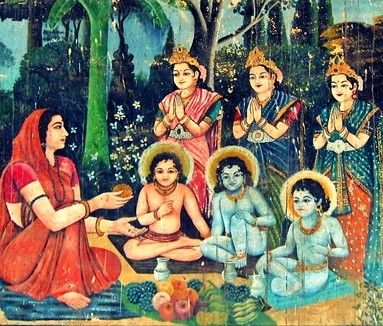
While the Indian Philosophy in its higher and ultimate reaches is absolutist, i.e, believes in the ultimate Reality as being impersonal, the popular religion is predominantly theistic, i.e., it believes in a personal God. The impersonal Brahman (Absolute Spirit) manifests itself as “Iswara”, a perosnal God, and besides as various Avatars from age to age. The concept of Avatar is explained later under “the principle doctrines of Hinduism”. God manifests Himself on earth among humans, in a human form, to guide the erring humanity into the right path and to shower His infinite love and grace. God thus assumes various names. One is free to choose any name and any form for his adoration and worship. All names and forms ultimately belong to the one Supreme Being only. This is spelled out in the Upanishads and re-echoed in the Gita:
“Ekam Satyam, Bahuda Chintayanti”‘
“Truth is one, but it is conceived differently”
“Ye yathamaam prapadyante Taamstathaiva bhajamyaham” – “Oh Arjuna! whichever path men may choose,, howsoever they may approach, I do accept them all, as all the paths in their ultimate reaches lead upto me only, who am the Supreme Godhead.”
The infinite is conceived in different ways, as per the various and different levels of understanding and capacity of men. The multiplicity of names of deities and forms of worship practised by Hindus are like scaffoldings of different designs to suit the needs of men and women of varying temperaments, aptitudes and stages of psychological development prevailing amongst people. The Hindu seers are conscious of the amazing variety of ways in which we may approach the Supreme and they have provided for diverse ways of worship according, to suit the needs of anyone and as per his choosing and choice.
However, all worship is said to reach the only one and the supreme Godhead – “Sarva Deva namaskaram Kesavam prati gacchati!”
Hari roopo Mahadevaha, Lingaroopo Janardhanaha,
Yo vai Vishnuhu, sa vai Rudrah, sa pitamaha,
Yam Saivah samupasate Siva iti, Brahmeti Vedantinah!
The same applies also to the various Vedic deities like Indra, Varuna, Agni and various aspects, facets and manifestations of the supreme divinity. The different deities and god-concepts are, as it were, so many doorways through which men can enter into the sanctum sanctorum of the One and Final Existence. To a Hindu Worshipper, the “Ishta Devta”, his chosen form of deity, is both the Supreme being as well as in whom all the other gods also reside. Thus, Hinduism is essentially monotheistic but with the belief and dictum–“Infinite is God and infinite are his expressions”.
Man’s imperative need for religious life
God is the mother and father of all the creation. He is the basis of all life. Can a son disclaim his mother? Just as the mother, so also is the religion for man. Actually, God’s love for man exceeds that of thousands of mothers. He is the Sustainer, the Provider and the Redeemer. One cannot afford to remain a run-away and a ‘prodigal son’ for long. He has to get back “home” to his mother and father, i.e., God, sooner or later. God is Truth, God is Reality. A ceaseless quest for God is the purpose of human life. Hinduism accepts the theme of evolution of consciousness. Effort, i.e, “Sadhana” ( moral and spiritual practices ), accelerates this evolution; man is a ceaseless pilgrim on the path of perfection.
Man is of the same essence as that of his Creator. “Tat Twam Asi” (That thou art) – proclaims the scripture. The core of his personality is an “amsa” of God himself. In addition to his body (deha), man has a mind (manas),intellect (buddhi) and a soul (atma) which is the aspect (amsa)
of God himself. The Atma links man with God (Brahman).
Kathopanishad gives the beautiful chariot analogy explaining this.
“The senses (indriyas) are the horses, the objects sought by the senses
are the roads, the body is the chariot, buddhi is the charioteer and
mind is the reins that control the unruly horses. Lord of the chariot
is Atman, and senses are to be regulated by the reins of mind, mind by
the intellect and intellect should be subservient to the Spirit, who is
the lord of the chariot of the human body”.
Dharma (righteousness) is the way of life that confers lasting joy; the Shasthras are the source of dharma; they lay down the rules of dharma. The Shruthis and Puranas, the Shruthis and Ithihasas are all included in the term Shasthra. Of these, the Shruthis are the most authoritative. The others all follow the Shruthis and keep in step with them. Bharatheeya culture is the expression of such sacred ideals. Throughout the ages, this culture has been providing spiritual teaching and training in a friendly fruitful manner. The Puranas are but simple and sweet expositions of the Shruthi ideals of life; that is why they are called, the comrades of man. Those who study the Vedas and understand the principles direct from them are called Shrothriyas and Nais-thikas. They are the highest grade of seekers. Those who understand them from the popular texts like the Puranas and base their conduct on that knowledge are of the middle grade. They get inspired from some excellent poems and dramas also and they follow the dharma that is sought to be explained through those media. Thus, Hindus have tried to spread the principles of their culture through various means among the masses. Bharatheeya culture teaches not merely the truth about the visible objective world; it lays bare the truth of the subjective invisible world of the spirit also. This is the task of SanathanaDharma or Veda Dharma. This religion has in it the principles of all contemporary religions. Those who doubt this should examine the scriptural sources in an impartial spirit. Due to the wide influence of Western civilisation, absence of exposition and explanation by persons who have accumulated experience, inability to clearly grasp the meaning of the texts, and neglect of the Sanskrit language which is the precious treasure of India, truth about the greatness of Bharatheeya culture is largely unknown today.