













A Dreamy New Beginning in New Zealand
A Dreamy New Beginning in New Zealand
the love of Sai comes to the refuge of the Bhutanese refugees
No one wanted them, neither the country of their origin nor the land to which they had given their sweat and blood for years. More than a lakh of such Bhutanese refugees have lived a miserable existence in the north-east of Nepal for nearly two decades now. But now, when there was an opportunity to end this desperate situation of at least a few of them, the Sai devotees in New Zealand grabbed this opportunity and opened their hearts out to embrace them in the love of Sai. This is one heart warming account which demonstrates how through little kinds of kindness and genuine love we can make profound and powerful impact in the lives of our brethren, no matter who they are or where they come from.
It is a country which is often referred to as one which is “scarcely touched by the modern age.” Progress, in this nation, is not measured by Gross National Product, but by Gross National Happiness. The people of this land take great measures to preserve their old culture, rich traditions, and more importantly, their literally ‘top of the world’ natural environment.
Yes, this tiny landlocked nation is perched right on the roof of the world. Nestled in the eastern Himalayas, Bhutan is one of those rare countries of this world where people live in great harmony with nature and where the environment is still pristine even today. In fact, the country has been identified as one of the 10 bio-diversity hot-spots in this world. But what is more interesting is the fact that it was rated as the happiest country in Asia by Business Week in 2006.
Yes, the majority of Bhutanese are pleased and proud of their country, and the way their land is governed, even though only in the previous year, in 2008, this nation moved from absolute monarchy to constitutional monarchy.
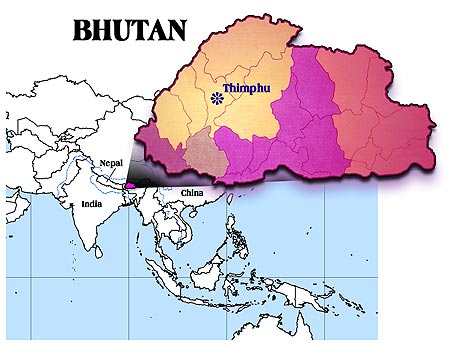
But, at the same time, this is not the story of every Bhutanese. At least one-sixth of the population of this mountainous nation lead a precarious existence in refugee camps, all from the ethnic Nepalese group.
A large number of them are actually descendants of Nepali settlers (Nepal is a neighbouring country) who came to work in the southern valleys of Bhutan in the late 19th and early 20th century. They are referred to as Lhotshampas (literally translated as “people from the south”), and in many ways are different from the indigenous population.
They speak Nepali, while Dzongkha is the country’s national language; most Nepalese are Hindus, while Buddhism is the state religion, which is followed by two-thirds of its population. But at the same time, they constitute almost 35% of the population of Bhutan and for generations had a ‘perfect life’ in this peaceful kingdom working as farmers.
In fact, the government encouraged the integration of this significant group into mainstream Bhutanese society in many ways, from teaching in Nepali in the schools of the southern Bhutan, to inter-ethnic group marriages.
But after 1980, the attitude of the Bhutan rulers changed for various reasons and the government started a series of “ethno-nationalist” policies in the 1990s. Since then hundreds of thousands of Nepalese-Bhutanese have become stateless and have been living in seven refugee camps in South-eastern Nepal.
But after 1980, the attitude of the Bhutan rulers changed for various reasons and the government started a series of “ethno-nationalist” policies in the 1990s. Since then hundreds of thousands of Nepalese-Bhutanese have become stateless and have been living in seven refugee camps in South-eastern Nepal.
The United Nations Commission for Refugees stepped in to help these homeless people and began discussions with the Bhutanese and Nepalese governments to provide the exiled people a home in either country, but met with little success. However, in 2006, the US government generously offered to resettle more than 60,000 of these refugees over the next five years.