







































Types of Lokas – Astral Worlds

The 14 Lokas as Explained by Bhagavan Sri Sathya Sai Baba
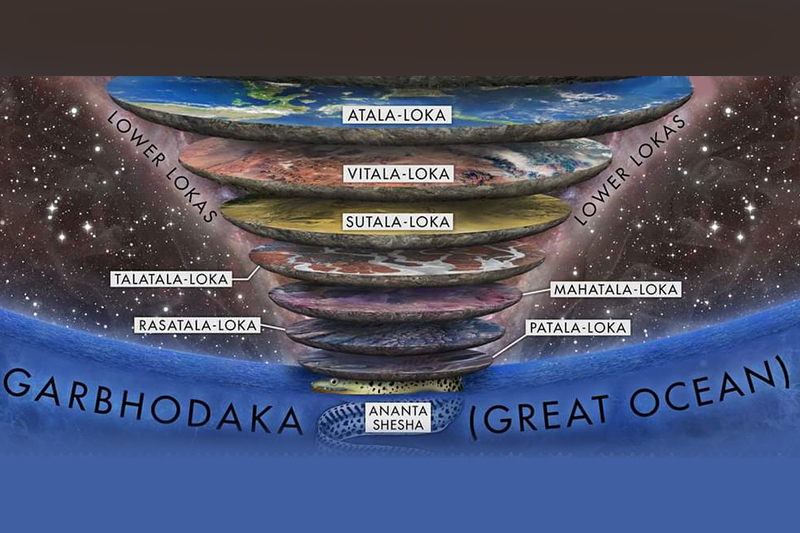
The Puranas speak of fourteen Lokas (seven higher and seven lower regions). People have adopted the superficial meaning of the names given to these and they classify them as ‘sacred’ lokas and ‘condemned’ lokas – Deva Lokas and Pathala Lokas. But, all these lokas do exist, in our own bodies, (the bodies which we carry about and care for), seven in the upper part and seven in the lower part.
Which is the upper part of the human body? It is the head, the Thrikuuta Peak, the crown, the higher region. Seven lokas are situated therein. They are the Garuda Loka, the Gandharva Loka, the Yaksha Loka, the Kinnara Loka and the Kimpurusha Loka. They are all situated in the head. The Garuda Loka is the nose, the seat of inhalation and exhalation. The Gandharva Loka is in the eye. The Yaksha Loka is in the tongue. Kinnara Loka is the ear and the Kimpurusha, on the skin, seat of the sense of touch. Though the names of the lokas are five, there are seven regions to which the name applies. The nose is the first, the eyes are the second and the third, the tongue is the fourth, the ears are the fifth and the sixth and the skin is the seventh. These are the Upper Lokas.
Those who sanctify these lokas by recognising the respective organs as instruments for higher ideals can be deemed worthy of human existence. That is to say, inhaling unpolluted air, seeing auspicious sights, hearing heartening sounds, etc. These lokas when properly cultivated, can make man divine.
Does thou know why you are given eyes? To see whatever can be seen ? No! No!
To fill the eyes with the Vision of God Who resides on Mount Kailash.
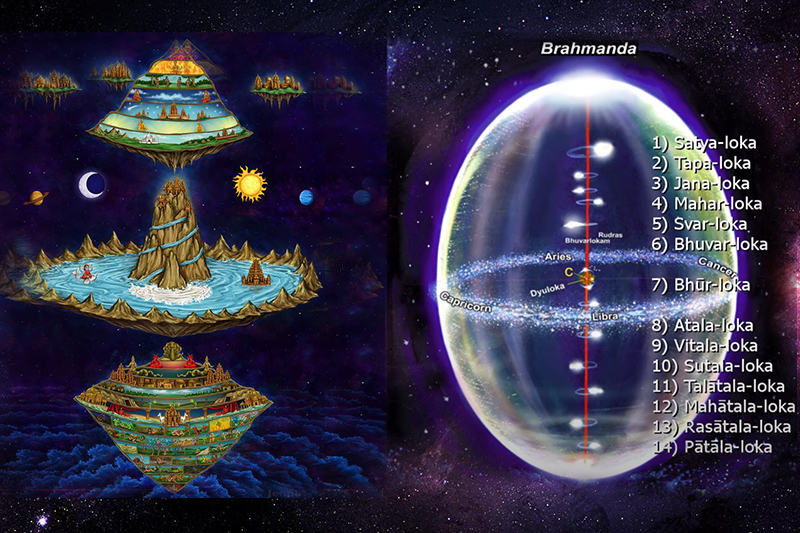
Both the higher and lower lokas are necessary
We have to cast our looks at sacred sights. We must visualise in every one only the good and the godly. That is the purpose for which God has equipped us with eyes. He has not gifted them to us to observe and judge others, to follow people into the bazar or to see unsightly films. Dost thou know why you have a tongue? To despatch tasty foods in ? No! No!
The prime purpose is not to enable us to swallow our meals. The object is to utter holy words Now, when some one is narrating some good incidents, the ears show no inclination to listen. But when one whispers something confidential to another, the ears jointly seek to overhear. Is it for this that God has blessed us with ears? Therefore, the seven higher lokas have to be utilised for Divine ends. When that is done, one becomes divinised, one is liberated. The rest of the lokas are intended for the maintenance of the physical frame in which we are enclosed. The stomach, so to say, is the petrol tank. When that is filled, every limb and cell of the body is supplied with energy and activated, to execute the beneficial duties assigned to each. With the two hands and the two legs, these make five lokas. The two others are the anal and the urinal parts. These seven lower lokas maintain the physical body. Both the higher seven and the lower seven are necessary; they complement each other. The lower lokas are the Pathala lokas according to the Puranas. They form the foundation, the base. Those who long for flowers and fruits have to feed the unseen roots. Pathala too should not be neglected merely because they are described as “low.” Joy has to be churned from grief. Pleasure is a product of pain.
The tongue should be used for spelling the name of the Lord, not for hissing like a serpent, or growling or roaring with intention to strike terror. That is not the purpose for which the tongue is granted to man.
Speech indicates one’s character, reveals one’s personality, educates others, and communicates experience and information. So, be vigilant about words.
Slip while talking the injury is irreparable!
– Sri Sathya Sai Baba
Q. I have heard it said that the worlds (lokas) are all in the body of people! Some experienced people and some who are learned in the scriptures (sastras) have said so. Is that true? What are those worlds? Where are they situated?
A. Yes. They are: the earth in the feet, the atmosphere in the genitals, heaven in the navel, the great world in the heart, the world of good people in the throat, the world of virtue in the brow centre, and the realm of truth on the crest of the head, These worlds, called the upper worlds, are all situated in the body of people. There are also lower worlds. (The upper worlds, in the order given above, are the bhu-loka, bhuvar-loka, swar-loka, mahar-loka, janaloka, thapo-loka, and sathya-loka.)
Q. What are the lower worlds? Where do they exist?
A. The bottomless region in the soles of the feet, the depth of hell on the nails, the great depth in the heels, the bottomless pit in the hip, the infernal region in the knees, the great pit in the thighs, and deepest hell in the anus. (The lower worlds are the athala, vithala, suthala, thalathala, rasathala, mahathala, and patala.)
Q. If all worlds are in the body – the five elements being the components – what happened to the seven legendary seas? Are they also in the body or mind?
A. When the body is the residence for all the worlds, how could only the seven seas have a separate existence? They are also “in” the body. The Seas of Salt (urine), Cane-juice (perspiration), Wine (senses), Ghee (semen), Buttermilk (mucus), Milk (saliva), and Pure Water (tears).
Q. You spoke of several types of fire (agni). What are they, and how are they named?
A. They are called the five fires, because there are five in all: the fire of time, the fire of hunger, the cold fire, the fire of anger, and the fire of knowledge.
Q. Where do these reside?
A. In the feet, navel, stomach, eye, and heart.
Q. Besides these, there seem to be varieties of sound. I have heard some talk of them.
A. Yes, there are.
Q. Are they also in the body? How many types are there? And their names?
A. There are ten types, all in the gross body itself. They are the sounds of clapping, kettle-drum, insect, drum, bell, cuckoo, small bell, flute, bee, and finally, Om (pranava). These are the varieties of sound.
Q. If all creation is subsumed in this composite of the five elements, the body, please explain the words andanda, pinda-anda, and Brahma-anda.
A. Anda-anda means all this creation, liable to evolution and involution; the movable and immovable nature, as it is often called.
Pinda-anda is the name for the inner principle of all this duality, the seer and the seen, the doer and the deed, etc. It is duality that produces birth after birth, according to the karma of the birth.
Brahma-anda means the collection of the inner forces of the five great elements: Atma, related to the ether; soul (jivatma), connected with wind; the inner Atma (Prathyagatma), arising out of fire; Universal Soul (Chaith- anya-Brahma), associated with the water element; and Highest Atma (Paramatma), attached to the earth element.
These are all covered by that conception of Brahma-anda. This Force makes the elements operate; beyond them is the Uncognizable or Unmanifest Absolute.
Q. Swami! I don’t clearly understand this rather complex subject. Please explain it to me by means of some simple illustration.
A. Well, creation (anda-anda) is like the black retina of the eye, the inner principle is like the inner circle within it, and the inner forces of the five elements (Brahma-anda) is the light that shines therein. The splendour of that light is Brahma.

Q. Some spiritually advanced persons and shastras (sacred body of knowledge, authentic source of knowledge) say that all the lokas (worlds) are all in the body of man! What are those lokas? Where are they situated?
A. Bhu-lokam (in the feet), Bhuvar-lokam (in the genitals), Suvar-lokam (in the navel), Mahar-lokam (in the heart), Jana-lokam (in the throat), Tapo-lokam (in the brow centre) and Satya-lokam (on the forehead). These seven lokas are called the urdhva lokas (upper worlds). They are all situated in the body of man. There are atho lokas (lower worlds), too.
Q. Atho lokas (lower worlds)! What are they? Where do they exist?
A. Atalam (in the soles of the feet), Vitalam (on the nails), Sutalam (in the heels), Talaatalaam (in the calf of the leg), Rasaatalaam (in the knees), Mahaatalam (in the thighs) and Paataalam (in the anus).
Q. If all lokas are in the body—the five elements being the components—what has happened to the sapta samudras, the Seven Legendary Seas? Are they too in the body or in the mind?
A. When the body is the residence for all the lokas, how can the Seven Seas alone have a separate existence when they are supposed to coexist with the lokas? They too are in the body. Lavana Samudram or Salt Sea (as urine), Ikshu Samudram or Cane Juice Sea (as perspiration), Sura Samudram or Sea of Wine (as senses), Sarpi Samudram or the Sea of Ghee (as semen), Dadhi Samudram or Buttermilk Sea (as mucus), Ksheera Samudram or the Sea of Milk (as saliva), and Shuddhodaka Samudram or the Sea of Pure Water (as tears).

Q. People speak of several types of agni or fire; what are they? How are they named?
A. Panchaagni, they are called collectively because they are five in all: Kaalagni (the fire of time); Kshudhaagni (the fire of hunger); Sheetagni (the cold fire); Kopaagni (the fire of anger) and Jnaanaagni (the fire of knowledge).
Q. And where do these reside in the human body?
A. Kaalagni in the feet, Kshudhaagni in the navel, Sheetagni in the heart, Kopaagni in the eye and Jnaanaagni in the atma (soul).
Q. Besides these, there seem to be varieties of nada or sound, too. Are they too in the body? How many types are they? And, their names?
A. Yes, they too are in the gross body itself. There are ten types of sounds: Laladi Ghosham, Bheri Naaam, Chaana Naaam, Mridanga Naaam, Ghanta Naaam, Kaahala Naaam, Kinkini Naaam, Venu Naaam, Bhramara Naaam, and Pranava Naaam.
Q. If all creation is subsumed in this composite of the five elements, the body, what are the things called anda, pinda and brahmanda?
A. Anda means all this creation, liable to evolution and involution; the movable and immovable prakriti (nature), as it is often called. Pinda is the name for the antargatakshara (indestructible inner principle) of all this dvandva (duality). It is the dvandva that produces birth after birth, according to the karma (deeds and their results) of the janma (birth). Now brahmanda (macrocosm) means the collection of maha-bhutas or the inner forces of the pancha-bhutas or five elements. Atma related to the akasha element, jivatma connected with vayu element, pratyagatma arising out of agni element, chaitanya-brahma associated with the jala element, and paramatma attached to the dharani (earth) element – this is the composition of vyashti (man, a separated aggregate, himself composed of individual parts) with all the five maha-bhutas. It is this grouped force that makes the elements operate which is the cause of the behaviour based on dvandva (duality). And that which is beyond these manifested five elements is the avyakta-brahma, the unmanifest absolute existence. This is what is brahmanda.
Q. Swami! I do not clearly understand this rather complex subject. Please explain it to me by means of some simple illustration.
A. Well, anda is the eyeball of the eye; pinda is the pupil of the eye representing bindu (point where the audible syllable of primordial sound OM dissolves) within it; brahmanda is the kana (that which is bound to time, objective world), light that shines therein (can be compared to the lens within the pupil). That which transcends this is nishkana (unbound by time, the timeless, flawless, pure consciousness) and nishkana is brahman. Of course, this can be explained in many other ways too, but, for the intelligent, this is enough.





