













The Three Bodies

The Three Bodies
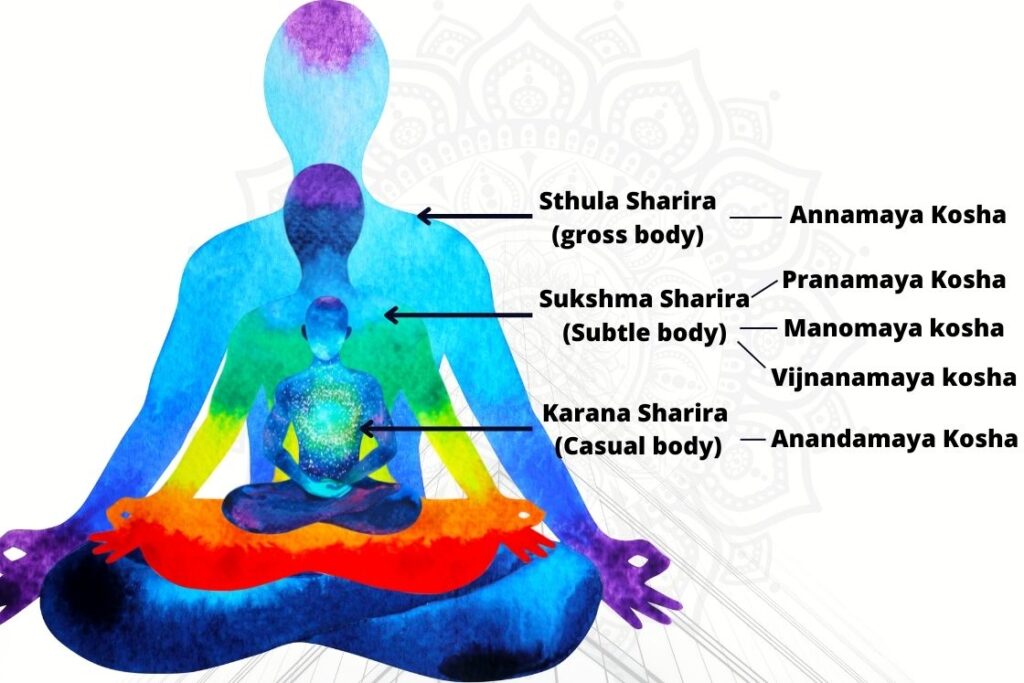
MAN is engaged in ceaseless search for happiness; but, he is incapable of defining what exactly is the essential component of happiness. So, he flits from one objective gain to another, ever discontented with himself, ever bothered by disappointment. He tries to possess, to accumulate, to acquire more and more of external junk, which cloud his vision and dulls his appetite for gains for lasting value. When can a man say, “I am fully happy; I need no more?” What is the nature of joy or comfort that external objects can give? Man does not pause to inquire. He is unaware that he himself is the embodiment of the highest and the most lasting happiness or Anandha (Bliss). That flaw has led him into disaster and disease. Before seeking happiness through the senses, the mind and the intellect, man has to examine whether he is a bundle of senses, or a mind playing with them or an intellect that rationalises the mental cravings. The body is the gross body; the water which it is intended to contain and carry is the subtle body; the reality of the potter who shaped it and willed it is the causal body. The three bodies which each has are called respectively Sthuula (gross), Suukshma (subtle) and Karana (causal). Physical and vital sheaths are sthuula, mental and the intellectual sheaths are the Suukshma, and the Blissful or Anandhamaya sheath is the Karana or Causal body of man. Behind the Anandha is the spring of Anandha, the Atma.
Three stages of Wisdom related to three bodies
There are three stages of wisdom correlated to those three bodies: Jnana, Sujnana and Vijnana. Knowledge that is gained by the analysis of the objective world and the similarities of the behaviour of its components is Jnana. When this knowledge is further studied and practised to subserve the best interests of the individual society, it becomes Sujnana, or beneficial wisdom. The intentions and urges that arise from the purified consciousness saturated with the Divine qualities emanating from the sage is Vijnana, the Highest Wisdom. It is to be noted that the word Vijnana is often misused to indicate mere Jnana, or co-ordinated information, analysed information about sense perceptions arising out of contact with the material objective world. Bharatheeya Culture uses the word for the Supreme Wisdom, which denotes the seer, the saint.
Intelligence, intellect, intuition – these three govern the thoughts and actions of man. One leads to another. This is the significance of the prayer with which Gandhi awakened the urge of liberation in this vast country, liberation not only from alien rule but also from alien tendencies and trends of thought. He caused the reverberation all over the land from a million throats of the prayer, Sabko sanmathi dhe Bhagavan – “O Lord! Grant every one the equipment of beneficent intelligence.” Once that is assured, progress is certain.
Lessons to be learnt from Hanuman’s mission to Lanka
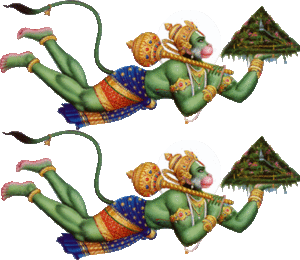
Once the intelligence is purified and dedicated to spiritual effort, there should be no slipping back whatever the obstacle, whatever the temptation. Hanuman, charged with the mission of discovering the place where Ravana had confined Seetha, decided that he should take a leap over the sea towards Lanka to search for her in that island of Ram that he carried in his heart and on his tongue. A mountain immersed at the bottom of the sea felt a strong urge to do him some little service, for, he was the instrument of God, and engaged in an exhausting adventure! Its name was Mynaka. It rose above the waters and called upon Hanuman to rest awhile on its crest, and refresh himself with the fruits upon the trees that grew thereon. Hanuman declined to delay his landing in Lanka; he was engaged in a Divine Mission, which brooked no rest, no delay, no dallying. He turned a deaf ear to the importunities of Mynaka, and sped forward to fulfil the command of the Lord. Ponder over this incident: Consider the compassion and the eagerness to serve which the ‘inert’ massive mountain felt! Consider the steadfastness, the un-deviating faith, the single-pointed loyalty of the monkey, Hanuman! Do they not teach invaluable lessons to man – lessons of heart that melts at suffering, a head that refuses to swerve from the path of duty? The whole duty of man is to engage himself in good acts with the gross body, scatter good thoughts and good influences around him with his subtle body, and earn self-realisation and Bliss through his causal body.
To search for God with the instruments of the laboratory is like trying to cure pain in the stomach by pouring drops into the eye. There is a technique and a special instrument for that purpose, which the pastmasters in that science have developed and spoken about.
Equip yourselves with a clear eye, through detachment and love, sharpen your sense of discrimination, viveka, so that it has no prejudice or predilection; then, you can see God in you, around you, in all that you know and feel and are.
– Sri Sathya Sai Baba

The Three Bodies & their Enumeratioon
(The individual experiencer is a consciousness-centre enveloped by several layers of matter existing as the factors causing objective awareness in it. The analysis of these layers or bodies is necessary to ascertain the nature of the true Self.)
Hari Om. Om Sat-Guru-Paramatmane Namah.
Disciple: How many bodies are there in an individual (Jiva)?
Guru: There are three bodies in every individual (Jiva).
Disciple: Please name them.
Guru: The physical body or the gross body (Sthula Sarira), the astral body or the subtle body (Sukshma Sarira or Lingadeha) and the causal body or the seed body (Karanasarira) are the three bodies.
Disciple: Please illustrate them.
Guru: The shell of a tamarind corresponds to the physical body. The pulp represents the subtle body. The seed corresponds to the causal body. Ice represents the physical body. H2O represents the subtle body. The Tanmatras or root-elements correspond to the causal body.
The Gross Body
Disciple: What are the components of the physical body?
Guru: The physical body is composed of five elements, viz., earth (Prithivi), water (Apah), fire (Tejas), air (Vayu) and space (Akasa).
Disciple: What are the seven primary essences (Sapta-Dhatus) of the physical body?
Guru: Chyle (Rasa), blood (Asra), flesh (Mamsa), fat (Medas), bone (Asthi), marrow (Majja) and semen (Sukla), are the seven primary essences of the physical body.
Disciple: What are the Shad-bhava-vikaras (six modifications of the body) ?
Guru: Asti (existence), Jayate (birth), Vardhate (growth), Viparinamate (change), Apaksheeyate (decay), Vinashyate (death), are the six modifications or changes of the body.
Disciple: What are the links with which the body is connected?
Guru: The body (Deha), action (Karma), love and hate (Raga-dvesha), egoism (Ahamkara), non-discrimination (Aviveka) and ignorance (Ajnana) are the seven links of the chain of Samsara (world-experience). From Ajnana (ignorance), Aviveka is born. Aviveka is non-discrimination between the real and the unreal. From Aviveka is born Ahamkara or egoism; from egoism is born Raga-dvesha (like and dislike); from Raga-dvesha Karma (action) arises; from Karma the body or the Deha is produced. If you want to free yourself from the pain of birth and death, destroy ignorance (Ajnana), the root cause of this Samsara (world-experience), through the attainment of the Knowledge of Brahman or the Absolute. When ignorance is removed, all the other links will be broken by themselves. This physical body of yours is the result of your past actions and is the seat of your enjoyment of pleasure and pain.
Disciple: Why is the body called Sarira or Deha?
Guru: Because the body decays (Sheeryate) on account of old age, it is called Sarira. Because it is cremated or burnt (Dahyate) it is called Deha.
The Subtle Body
Disciple: What is the composition of the subtle body?
Guru: The subtle body is composed of nineteen principles (Tattvas), viz., five Jnana Indriyas or organs of knowledge, five Karma Indriyas or organs of action, five Pranas or vital airs, Manas or mind, Buddhi or intellect, Chitta or the subconscious and Ahamkara or the ego. It is a means of enjoying pleasure and pain.
Disciple: When will this subtle body get dissolved?
Guru: It gets dissolved in Videha Mukti or disembodied Liberation.
The Causal Body
Disciple: What is the causal body (Karana Sarira) ?
Guru: The beginningless ignorance that is indescribable is called the causal body. It is the cause of the gross and the subtle bodies.
Disciple: How can I transcend the three bodies?
Guru: Identify yourself with the All-pervading, Eternal Atman. Stand as a witness (Sakshi) of all experiences. Know that the Atman is always like a king – distinct from the body, organs, vital breaths, mind, intellect, ego and Prakriti – the Witness of their attributes.
II. The Five Sheaths
Disciple: What is meant by a Kosha?
Guru: Kosha means a sheath.
Disciple: Kindly illustrate these sheaths.
Guru: Just as a pillow-cover is a covering or a sheath for the pillow, just as a scabbard is a sheath for the sword or the dagger, so also this body, Pranas, mind, intellect and the causal body are sheaths that cover the Atman or the Soul.
There is the singlet close to the body; over this there is the shirt; over the shirt there is the waist-coat; over the waist-coat there is the coat; over the coat there is the overcoat. Even so, the Atman is enveloped by these five sheaths.
Disciple: How many sheaths are there in the body?
Guru: There are five sheaths.
Disciple: Please name them.
Guru: Annamaya Kosha, Pranamaya Kosha, Manomaya Kosha, Vijnanamaya Kosha and Anandamaya Kosha are the five Koshas or sheaths.
Disciple: What is Annamaya Kosha?
Guru: Annamaya Kosha is food-sheath. It is the gross body made up of the five gross elements.
Disciple: Why is it called Annamaya Kosha?
Guru: It is called Annamaya Kosha, because it lives on account of food, it is made up of the essence of food, and, finally, it returns to food (earth or matter).
Disciple: What is Pranamaya Kosha?
Guru: Pranamaya Kosha is the vital sheath.
Disciple: What is the Pranamaya Kosha made of?
Guru: It is made up of the Pranas or the vital airs and the five Karmendriyas or organs of action.
Disciple: How many Pranas are there?
Guru: There are ten Pranas five Mukhya or chief Pranas, viz., Prana, Apana, Vyana, Udana and Samana, and five Upapranas or sub-Pranas viz., Naga, Kurma, Krikara, Devadatta and Dhananjaya.
Disciple: What is the function of Prana?
Guru: Ucchvasa and Nihshvasa (inhalation and exhalation) are the functions of the Prana.
Disciple: What is the function of Apana?
Guru: Excretion of faeces and urine is the function of the Apana.
Disciple: What is the function of Vyana?
Guru: Circulation of blood is the function of Vyana.
Disciple: What is the function of Udana?
Guru: Udana helps deglutition or swallowing of food. It takes the Jiva to rest in Brahman during deep sleep. It separates the astral body from the physical body at the time of death.
Disciple: What is the function of Samana?