



























Shirdi Calendar
Shirdi Calendar
The Shirdi Sai Avatar is extra-ordinary and also enigmatic in many respects. Though this incarnation belongs to recent history, myth and mystery continue to surround the story of this Avatar. However, thanks to the enlightenment provided at various times by Bhagavan Sri Sathya Sai Baba, one is now in a position to place many of the unknown aspects of the Shirdi Avatar in a proper perspective.
This calendar offers a summary of the life and philosophy of Shirdi Baba through a series of specially commissioned paintings. The summary is wrapped up with sketches of Shirdi landmarks, as they appeared at various points of time.
Bhagavan Sri Sathya Sai Baba has declared that the Shirdi Avatar was the first of a trilogy of Sai Avatars. The second of course is the current Sathya Sai Avatar, and the last would be the Prema Sai Avatar. Of the three, the Shirdi Avatar is the Prologue and the Prema Sai Avatar is the Epilogue to the Sri Sathya Sai Poorna Avatar. It has further been revealed that Shirdi Sai was an aspect of Shiva, Sathya Sai an aspect of both Shiva and Shakthi, while the yet-to-come Prema Sai would be an aspect of Shakti alone.
JANUARY 2003
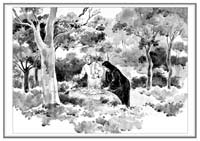
Bhagavan Baba has revealed that Shirdi Baba was born in early nineteenth century to a pious Brahmin couple in the village of Pathri in the erstwhile Nizam State. The Divine child was born following a boon granted by Lord Shiva and Parvathi to the mother, in appreciation of her deep devotion to God. Shortly before Baba took birth, the father left home for the forest to lead the life of a recluse. The lady followed her husband but could not keep pace, due to the advanced state of her pregnancy. Finally, she had to halt in order to deliver the baby. Once the baby was born, she reluctantly placed it under a tree and went in search of her husband. Soon there came near that tree a Muslim couple who picked up the child and brought it up. In 1842, the adopted father died and the adopted mother handed over charge of the young boy to one Gopal Rao, a rural chieftain. Gopal Rao is said to have placed Baba for some time under the care of a Guru known as Venkusa. Later Gopal Rao passed away, and Baba was now on His own. He wandered for some time and eventually made Shirdi His home.
FEBRUARY 2003
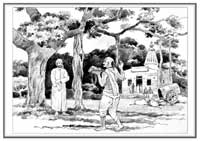
It is said that Baba came to Shirdi when He was about sixteen years of age. He wore a Kafni, the dress of a Muslim Fakir. He had no home of His own, and spent most of His time under a Neem tree that has since become a pilgrim spot known as Gurusthan. No one knew who this young man was, where He came from, and where He got His food. But this much every one knew: This mysterious young man definitely had a Divine Aura about Him, and was always most compassionate. Indeed, throughout His life, Baba’s devotees knew very little about His early history. In the Sai Sat Charita, for example, one finds the remark: “Nobody knew the parents, details of the birth or the birth-place of Sai Baba. Many enquiries were made, many questions were put to Baba and others regarding these items, but no satisfactory answer or information has yet been obtained. Practically, we know nothing about these matters.” Indeed, but for the enlightenment provided by Bhagavan Sri Sathya Sai Baba, this mystery would never have been cleared. Divinity often shrouds itself in mystery, and the mystery is removed only when the time and the circumstances are appropriate.


MARCH 2003
There lived in the village of Dhoop in Aurangabad District of Nizam State, a Muslim named Chand Patil. He was an officer of the Nizam State. Once while making a trip to Aurangabad, Chand Patil lost his mare that he loved very much. He searched for the mare for two long months, but could not find it. When returning from the fruitless search, Patil found a stranger under a tree, preparing to smoke a Chilim or native pipe. On seeing Patil go that way, this stranger accosted the tired merchant, invited him to share a smoke, and rest for a while. A conversation began and Chand Patil told the stranger who was none other than Baba, about the loss of his favourite mare. Baba asked Patil to look in a ravine nearby. Patil did so, and lo and behold, there was his lost mare! Amazed, Patil returned to Baba. Meanwhile, Baba wanted fire to light the Chilim and some water to wet the pipe, both of which Baba produced most casually with a miracle. Patil now believed that Baba was a saint and persuaded Him to go with him to Dhoop. Some years later, Patil came back Shirdi to celebrate a marriage in his family, and Baba returned with Patil. Thereafter Baba never left Shirdi.
APRIL 2003
When Baba first came to Shirdi, people there out of respect, started calling Him Sai. When Chand Patil’s marriage party arrived in Shirdi, the party alighted in the area near the Khandoba [Shiva] Temple there. The priest Mhalsapathi, recognised Baba and welcomed Him with the words Ya Sai, meaning “Welcome Saint!” When the wedding was over Chand Patil and his party returned to Dhoop but Baba settled down in Shirdi, choosing a dilapidated Mosque as His residence. Later, this Masjid as it was then known, became the famous Dwaraka Mai. In due course, Mhalsapathi became a close companion of Baba. For many years, Baba slept in the Masjid together with Mhalsapathi and another devotee named Tatya Kote Patil. They slept with their heads pointing towards the East, West and the North but feet touching together! If Tatya snored, as he did sometimes, Baba along with Mhalsapathi would turn Tatya over, rub his back and press his legs! Devotees wanting to worship Baba would offer sandal paste but no one dared to directly apply it on Baba. Mhalsapathi alone had the privilege of applying the paste on Baba’s throat. Blessed are they who earn Divine intimacy.
MAY 2003
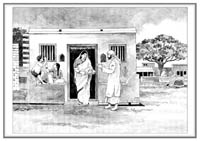
According to the scriptures, a Brahmachari and a Sannyasi have to live by begging. Both the Brahmachari and the Sannyasi are supposed to regard the whole Universe as their home, and all humans as belonging to the world-family. Baba resorted to seeking alms, perhaps to make His devotees see humanity as one large family. Every day Baba would go out with a tumbler in His hand and a Jholi or a bag strung round His shoulder, to just a few houses. In the tumbler He received cooked items and liquids, while in the Jholi He collected Bhakri or millet bread. He was content with what He received, and did not have any sense of taste – He was above the senses. The food collected would be put into wide-mouth earthern jar in the Masjid, from which even cows and crows were free to draw! The lady who swept the Masjid also took some Prasadam to her home. In the beginning, Baba did notfollow this practice. He would just disappear into the forest and there, Bayjabai, a woman of great devotion would go out everyday seeking Baba, and offer some Bhakri to Him. Later Baba stopped going to the forest, and that was when He began seeking alms.
JUNE 2003
Once there was a theft in the village, and the accused claimed in court that Baba had given him the stolen property. The Magistrate then issued a summons to Baba, asking Him to appear in Court and give evidence. When the summons was served, Baba threw it into the fire! The devotees were alarmed by this and afraid of the consequences. They therefore approached the Magistrate and explained that since Baba was a holy person, the issue of a summons was inappropriate. Instead, the Court could send an Officer to collect the required evidence. Accordingly, a Commissioner was sent to interview Baba. The Police Officer went to the Masjid and discovered that he was no match for Baba. For example, when asked His age, Baba replied, “Hundreds of thousands of years.” When asked if He knew the accused, Baba replied that He knew everyone! When asked if He gave the jewels and if so, how they came into His possession, Baba replied, “Everything belongs to Me!” The Officer tried to remind Baba that this was an investigation by saying, “Here is a serious charge of theft ?.” Baba cut the Officer short with the words, “What have I got to do with all this nonsense?” The conversation ended there and the Officer withdrew, having drawn a complete blank!

JULY 2003
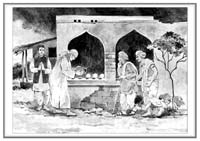
Baba was very fond of lighting lamps in the Masjid. In the early days, the oil for the lamps was offered free by the shop-keepers as a token of love, and Baba would go personally, tumbler in hand, and receive the oil from the merchants. He would then pour this oil into earthern lamps, using pieces of old cloth as wick. On the festival day of Deepavali, there would be extra lamps to celebrate the occasion. After some time, the grocers became tired of giving oil free to Baba and demanded payment. They obviously did not appreciate who Baba really was. Baba, naturally, was not going to pay, and He silently returned to the Masjid. In full view of the grocers, Baba first shook off the traces of oil in His tumbler, filled it with water, yes water, and then poured this water into the lamps, ready with wicks. Thereafter He lit the lamps, and wonder of wonders, the lamps all started burning; not only that, they kept burning all night. The shop-keepers realised their mistake, fell at Baba’s feet and sought pardon. They at last understood that Baba was Divine.
AUGUST 2003
Baba taught lessons in the most unusual manner. Lakshmibai Shinde was an ardent devotee of Baba. Once, she made a nice dish for offering to Him. After that she left the kitchen for a short while, to attend to some work. Meanwhile a dog gained entry into the kitchen and helped itself to the tasty item. Seeing this, Lakshmibai angrily dealt a few blows to the dog with a stick. Cursing the dog, the lady made the dish afresh, took it to Baba and offered it to Him. Baba refused to accept, though He was known to like this dish very much. Puzzled, Lakshmibai asked Baba why He refused, and He replied that it was because she had chased Him away when He came to her house. Lakshmibai was astonished because Baba had not come to her house, and who would dream of chasing Him away? So she protested, whereupon Baba said: “I don’t have to come in this particular form. I can come in any form. I came as a dog and what did you do? Did you not rain blows on Me?” Swami says that in this way, Shirdi Baba taught that He is Omnipresent, and that all forms are His.






