



























Sanskrit – Language of Gods

Sanskrit – Language of Gods
SANSKRIT- the mother of all languages is regarded as the ancient language in Hinduism, where it was used as a means of communication and dialogue by the Hindu Celestial Gods, and then by the Indo-Aryans.
It is also a liturgical language of Hinduism, Buddhism, and Jainism. The term ‘Sanskrit’ is derived from the conjoining of the prefix ‘Sam’ meaning ‘samyak’ which indicates ‘entirely’, and ‘krit’ that indicates ‘done’. Thus, the name indicates perfectly or entirely done in terms of communication, reading, hearing, and the use of vocabulary to transcend and express emotion.
HISTORY OF THE SANSKRIT LANGUAGE-
The Sanskrit language was termed as Deva-Vani (‘Deva’ Gods – ‘Vani’ language) as it was believed to have been generated by the god Brahma who passed it to the Rishis (sages) living in celestial abodes, who then communicated the same to their earthly disciples from where it spread on earth.
The origin of the language in written form is traced back to the 2nd millennium BCE when the Rig Veda, a collection of sacred hymns, is assumed to have been written after being continued for centuries through oral tradition and preservation of verbal knowledge in the Guru-Disciple relationship. The purity of this version (Vedic period, 1500 – 500 BCE) of Sanskrit is doubtlessly reflected in the flamboyance of the perfect description of the forces of nature in the Rig Veda.

VEDIC SANSKRIT-
Sanskrit in terms of its literary association is classified into two different periods, the Vedic and Classical. Vedic Sanskrit was the earliest form of Sanskrit language approximately around 1500-200 B.C.), when “knowledge” was handed down through the generations orally.
Vedic Sanskrit is found in the Vedas sacred texts, especially the Rig Veda, the Puranas, and the Upanishads, where the most original form of the language was used. The composition of the Vedas is traced to the period of 1000 to 500 BCE, until when Sanskrit had a vigorous tradition of being used consistently through oral communication. This early Sanskrit is rich in vocabulary, phonology, grammar, and syntax, which remains undiluted in its purity to this day. It consists of 52 letters in total, 16 vowels and 36 consonants. These 52 letters have never been tweaked or altered and are believed to have been constant since the beginning, thus making it the most perfect language for word formation and pronunciation.
The language is believed to have been generated by observing the natural progression of sounds created in the human mouth, thus considering sound as an important element of language formation. This is one of the prime reasons why Sanskrit has been rich in poetry and its expressive quality of bringing out the best meaning through perfect sounds that are soothing to the human ear. Vedic Sanskrit also contains abstract nouns and philosophical terms that are not to be found in any other language. The consonants and vowels are flexible enough to be grouped to express nuanced ideas. In all, the language is like an endless ocean without a base due to its reach, complexity, and hundreds of words to express a single meaning or object.

CLASSICAL SANSKRIT- ASHTADHYAYI–
Classical Sanskrit has its origin at the end of the Vedic period when the Upanishads were the last sacred texts to be written down, after which Panini, a descendant of Pani and grammar and linguistic researcher, introduced the refined version of the language. Panini’s timeline is assumed to be around the 4th century BCE when he introduced his work ‘Ashtadhyayi’, which means eight chapters, forming the only available foundational and analytical text of Sanskrit grammar. It is considered to be the only source of Sanskrit grammar and vocabulary today because everything that existed before had never been recorded except via their mention in Panini’s Ashtadhyayi.
The language is so vast that it has more than 250 words to describe rainfall, 67 words to describe water, and 65 words to describe the earth, among other descriptions. This proves the magnanimity of Sanskrit when compared with current modern languages. Panini was responsible for the standardization of the language, which to this day remains in use in multiple forms. Sanskrit as a spoken language is rare and is spoken in some regions in India, some even claiming it as their first language, but it is proudly mentioned as one of the 14 original languages of India in its Constitution. It is largely used in Carnatic music in the form of bhajans, shlokas, stotras, and kirtans, all indicating various hymns to the Gods, and songs and mantras of God worship.
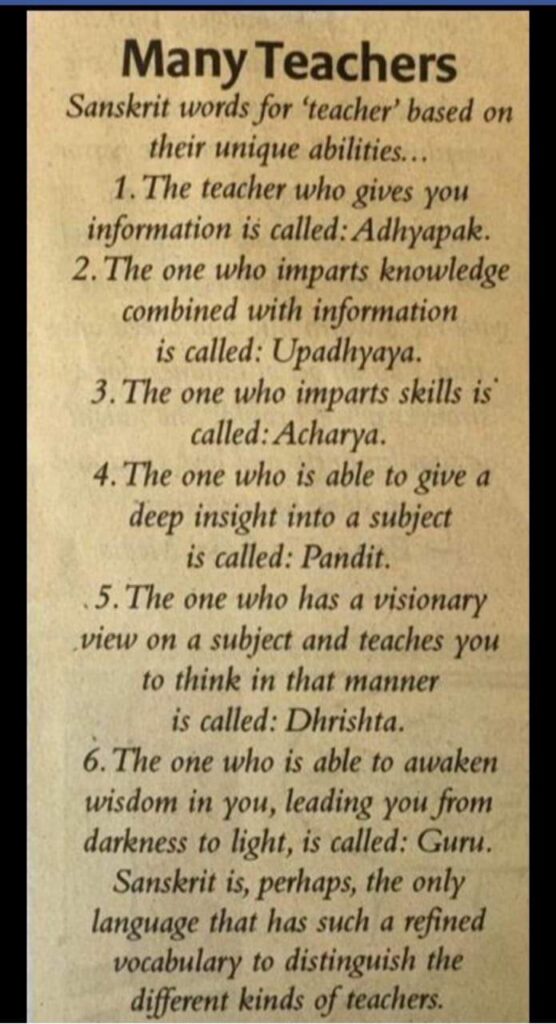
SANSKRIT LITERATURE-
Sanskrit literature forms the oldest stage for millions of years. The Sanskrit language has a wonderful structure and is more perfect than other languages. Over thousands of years, many scholars have contributed to Sanskrit literature. Sanskrit is written in the Devanagari (literally means “cities of the gods”) and Brahmi based scripts Sage Panini’s Sanskrit grammar called Ashtadhyayi produced around 4th century B.C gives the details of how the language works and forms the basis for modern Sanskrit grammars. The Sanskrit language has an extremely rich complex grammatical structure and an enormous vocabulary.
The three major Hindu philosophic concepts which were formulated in Sanskrit are Dvaita (Madhvacharya), Advaita ( Sankaracharya), and Vishistadvaita (Ramanujacharya). Among the best-known masterworks of Sanskrit, works of literature are Ramayana (Valmiki) and Mahabharata (Vyasa) epics, Panchatantra (Vishnu Sharma), Artashastra (Chanakya), Bhagavadgita, poems, and plays of Kalidasa, Puranas & Upanisads. Apart from these kinds of literature on astronomy, science, astrology, medicine, and law have been taken place.





