














Onam Puja Vidhi
Onam Puja Vidhi
Onam stands as the most memorable and ancient festival of Kerala, comparable in grandeur to the major festivals of India. It honors the divine appearance of Bhagwan Vishnu in his Vamana avatar and commemorates the annual homecoming of the legendary Emperor Mahabali from Patala, the netherworld.
Vamana consigned King Mahabali to the underworld but granted him the boon of returning once a year to visit his people during Onam. On Thiruvonam day, it is held that the emperor graces every home with his presence. The festival, spanning ten days, steadily builds in fervor and joy, filling the land with splendor and cultural vibrance.
Onam is observed in the month of Chingam (August to September) of the Malayalam solar calendar. This month corresponds to Simha in other solar calendars and Avani in the Tamil calendar. The festival is timed with the Thiruvonam Nakshatra in Chingam, which is identified as Shravana in other Hindu calendars.
When is Onam Festival (Onam 2026 Date)
Thiruvonam on Saturday, August 29, 2026
Thiruvonam Nakshathram Begins – 10:12 PM on Aug 28, 2026
Thiruvonam Nakshathram Ends – 10:05 PM on Aug 29, 2026
Significance of Onam
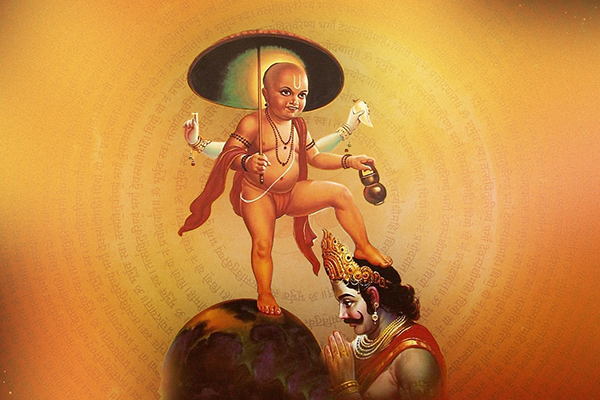
Onam celebrations begin on the day of Atham, falling in August or early September, and last for ten days, concluding on Thiruvonam. The festival honors King Mahabali, a legendary and benevolent asura ruler who presided over a kingdom of great prosperity and harmony and was deeply loved by his people. His growing power sparked envy among the gods, prompting Bhagwan Vishnu to appear as Vamana, a dwarf Brahmin. Vamana requested three measures of land from Mahabali; when granted, he expanded to cosmic proportions, covering the earth and sky in two strides. For the third step, Mahabali humbly offered his own head, leading to his descent into the netherworld. Moved by Mahabali’s unwavering devotion and virtue, Bhagwan Vishnu granted him the annual boon to return to earth. Onam celebrates this joyous homecoming with vibrant rituals and festivities that honor the beloved king and his enduring legacy.
Seasonal Significance
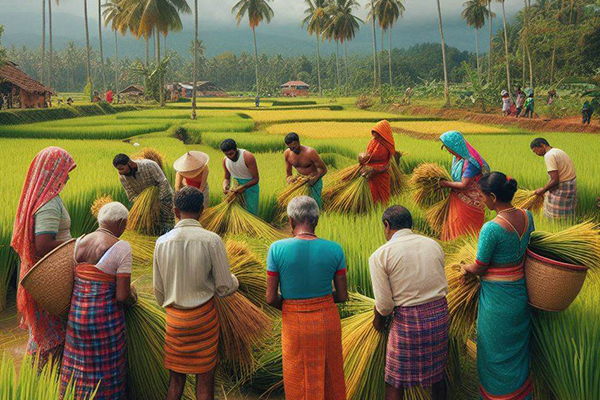
This ten-day festival, celebrated between August and September, signals the end of the monsoon and the beginning of the harvest season. It honors the return of King Mahabali, the legendary ancient ruler of Kerala, whose reign was remembered for prosperity, fairness, and joyous times.
Onam is celebrated across Kerala with widespread joy and enthusiasm, bringing together people from all sections of society. The festival reflects both its deep roots in ancient agrarian traditions and its strong connection to mythology, making it a vibrant blend of cultural heritage and spiritual significance.
Celebrations and Cultural Importance
Spanning ten days, Onam is observed in the month of Chingam (August to September) of the Malayalam solar calendar, coinciding with the Thiruvonam Nakshatra. The festival unites families and communities through traditional music, dance, boat races, and elaborate feasts called Onasadya. Symbolizing hope, unity, and the triumph of good over evil, Onam’s rich cultural heritage continues to inspire devotion and pride among the people of Kerala and beyond.
The Legend of Onam Thiruvonam
Onam and King Maha Bali
 .
.
Onam celebrates the homecoming of the great asura King Maha Bali from Patala Loka. Maha Bali, grandson of the revered devotee Prahlada, was a powerful and wise king who valued knowledge deeply. During a yagna, a radiant young boy appeared and was welcomed by Maha Bali, who asked what he desired. The boy requested land measured by three footsteps. Without hesitation, Maha Bali agreed, despite warnings from his guru Shukracharya that the guest was Bhagwan Vishnu in disguise.
As the legend unfolds, the boy took on the colossal form of Trivikrama. With his first step, he measured the entire earth; with the second, he spanned the whole sky, thus claiming all of Maha Bali’s kingdom. When asked where to place the third step, Maha Bali, in complete devotion and surrender, offered his own head. Recognizing this humility, Bhagwan Vishnu blessed him, sent him to Patala, promised him future kingship as Indra in the next Manvantara, and vowed to guard the gates of Patala Himself.
Responding to the pleas of Maha Bali’s subjects, Bhagwan Vishnu granted him permission to return and be with his people once every year. This annual return is joyfully celebrated as the festival of Onam.
The Deeper Meaning Behind the Legend
The legend of the Vamana avatar conveys a profound Puranic message, offering a timeless moral through symbolic storytelling. King Mahabali, despite his generosity and power, let pride overshadow his wisdom as he claimed control over all he could see, believing himself unconquerable. The story teaches that true strength lies in knowledge and humility, which alone can overcome ego, a force that otherwise grows boundlessly like the earth and sky.
Vamana’s three steps symbolize the journey to conquering arrogance:
- Step 1: Measuring the earth; recognize the vast number of living beings sharing the world, humbling oneself as merely one among many.
- Step 2: Measuring the skies; contemplate the immensity of the heavens and infinite realms beyond, realizing how small and limited our existence is in the cosmos.
- Step 3: Placing the third step upon the head; accept that within the endless cycle of birth, death, and cosmic renewal, our individual life and role are minute. True humility arises from understanding and embracing our place in the eternal universe.
How is Onam Celebrated
Onam is the most celebrated traditional festival of Kerala, observed with devotion and cultural splendor by the Malayali community across the world. It showcases a rich blend of rituals, art, music, dance, food, and social harmony.
Malayali households decorate their courtyards with Pookkalam, intricate floral rangoli designs made with fresh blossoms, especially yellow flowers. Pookkalam is considered a symbol of prosperity and good fortune, welcoming King Mahabali into every home.
Among the grand traditions of Onam, Vallamkali or the Snake Boat Race is one of the most popular. Longboats rowed in perfect rhythm across Kerala’s backwaters create a spectacle that attracts thousands, including tourists from far and wide.
Pulikali , the tiger dance, is another striking tradition. On the fourth day of Onam, men paint their bodies as tigers and hunters, dancing vibrantly to drumbeats in public spaces.
A highlight of the festival is the grand feast called Onam Sadya . Families invite relatives and friends to share a traditional vegetarian meal served on banana leaves. The spread includes an array of dishes, with rice, curries, curd, and the iconic Payasam, a sweet delicacy prepared with milk, rice, coconut, and jaggery or sugar.
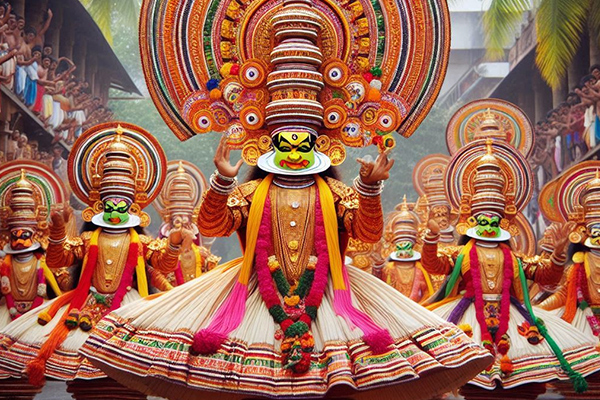
Performing arts are central to Onam celebrations. Kathakali, Kerala’s classical dance-drama, narrates episodes from Hindu epics with elaborate costumes and expressive gestures. Alongside Kathakali, other folk performances such as Thiruvathira, Kummattikali, ThumbiThullal, Onam Kali, and Pulikali enrich the festivities with color and rhythm.
On the tenth day, temples and public spaces host grand cultural activities. Elephants adorned with ornaments take part in majestic processions, adding to the visual grandeur of the festival.
The most important day is Thiruvonam, while Avittom and Chatayam also hold significance in the sequence of celebrations. On these days, families conclude the rituals of Onam by dismantling the Pookkalam and immersing clay figures of Onathappan in rivers or the sea, symbolizing the departure of King Mahabali until his next return.
Onam Puja at Home: A Step by Step Guide
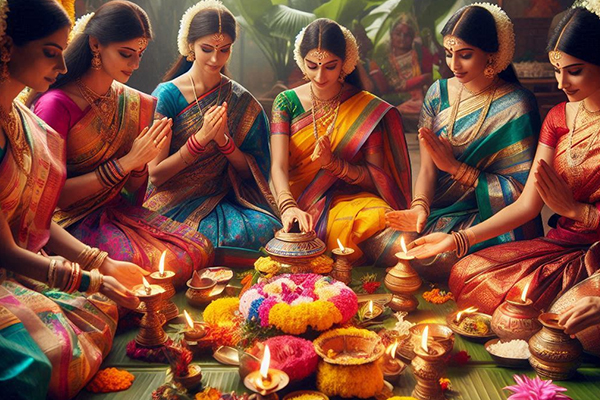
Celebrating Onam at home is a meaningful way to honor tradition and immerse in the festive spirit. The celebration can be observed through the following steps:
- Begin by thoroughly cleaning and decorating the house to welcome King Mahabali. Adorn the entrance or courtyard with a Pookkalam, a floral rangoli made with fresh flowers, adding layers each day until Thiruvonam. Use traditional decorations such as banana leaves and Nilavilakku (oil lamps) to enhance the festive ambiance.
- On the day of celebration, take an early morning bath and wear new traditional attire. Men usually wear a white Mundu while women wear a Kasavu saree. Set up a small altar with an image or idol of Bhagwan Vishnu or his Vamana avatar, light an oil lamp, and offer flowers, incense, and prayers.
- Prepare the grand vegetarian feast known as Onam Sadya . It features dishes like avial, sambar, thoran, olan, pachadi, and the essential payasam, all served on banana leaves. Invite family and friends to partake in this meal, as communal feasting is central to Onam.
- Include recreational and cultural activities to enrich the celebration. Engage in traditional games such as Vadam Vali (tug of war), watch or perform dances like Thiruvathirakali and Kathakali, and play music associated with the festival.
Conclude the festivities by exchanging gifts and seeking blessings from elders, often in the form of new clothes and presents. These customs reinforce the values of unity, joy, and gratitude that define Onam.