



























Mahabharata Stories
Mahabharata Stories

Duhshanta and Shakuntala
The founder of the Paurava line was Duhshanta, gifted with great energy. He was the protector of the earth bounded by the four seas. That king had full sway over four quarters of this world. He was the lord also of various regions in the midst of the sea. That great oppressor of all foes had sway over the countries even of the Mlechchhas.
During his rule there were no men of mixed castes, no tillers of the soil (for the land, of itself, yielded produce), no workers of mines (for the surface of the earth yielded in abundance), and no sinful men. All were virtuous and did everything from virtuous motives. There was no fear of thieves, no fear of famine, no fear of disease. All four orders took pleasure in doing their respective duties and never performed religious acts for obtaining fruition of desires. His subjects, depending upon him, never entertained any fear. Indra poured showers at the proper time, and the produce of the fields was always pulpy and juicy. The earth was full of all kinds of wealth and all kinds of animals. The Brahmanas were always engaged in their duties and they were always truthful.
The youthful monarch was endowed with wonderful prowess and a physical frame hard as the thunderbolt, so that he could, taking up the mountain Mandara with its forests and bushes, support it on his arms. He was well‐skilled in four kinds of encounters with the mace—hurling it at foes at a distance, striking at those that are near, whirling it in the midst of many, and driving the foe before him. He was skilled also in the use of all kinds of weapons and in riding elephants and horses. In strength he was like unto Vishnu, in splendour like unto the maker of day, in gravity like unto the ocean, and in patience like unto the earth. The monarch was loved by all his subjects, and he ruled his contented people virtuously.
Once the king, accompanied by a large force, went into the forest for hunting. He took with him hundreds of horses and elephants. The force comprised foot‐soldiers, car‐warriors, cavalry, and elephants—heroes armed with swords, darts, maces and stout clubs. With the leonine roars of warriors, notes of conchs, sound of drums, rattle of chariot wheels, shrieks of elephants, neighing of horses and clang of weapons, a deafening tumult arose as the king marched. Ladies watching from terraces saw the heroic monarch and compared him to Indra himself. They showered flowers upon him as blessings.
After travelling far, the king entered a great forest, full of Bilwa, Arka, Khadira, Kapittha and Dhava trees. The land was rough, filled with stones, without water and without people, yet full of deer, lions and other beasts. Duhshanta, with his warriors, agitated the forest, killing many animals. He pierced tigers with arrows, killed others with sword, mace, club and dart. The disturbance caused lions to flee, herds to scatter and animals to fall exhausted. Some were eaten by the warriors.
After slaying thousands of animals, the king reached another forest, beautiful and filled with hermitages. It was a delightful place with blossoming trees, green grass, sweet notes of birds, cool breezes, bees humming around flowers and bowers everywhere. The forest was frequented by Siddhas, Charanas, Gandharvas, Apsaras, monkeys and Kinnaras. It resembled the gardens of heaven.
In that forest the king saw a retreat of ascetics near the sacred river Malini, filled with birds and innocent deer. The Ashrama of the illustrious Kashyapa stood there, like the abode of Brahman, surrounded by Rishis of great merit. The king resolved to enter the retreat and see the great ascetic Kanwa.
Leaving his army at the entrance, he entered the hermitage with only his minister and priest. Inside he heard chants of Rig, Yajur, Sama and Atharva Vedic Brahmanas, experts in sacrifice, grammar, logic, astrology, rituals, prosody, Nirukta, sciences and sacred lore. The Ashrama resounded with recitations, Japa, Homa and philosophical discussions.
Proceeding further, the king left his retinue behind and entered alone. Not seeing Rishi Kanwa, he called out, and a maiden emerged—a stunningly beautiful ascetic girl with black eyes and sweet speech. She welcomed him, offered a seat, washed his feet and enquired after his welfare. The king, struck by her beauty and grace, asked who she was.
She replied that she was Shakuntala, daughter of the illustrious Kanwa.
Duhshanta, surprised, asked how she could be the daughter of a Rishi who observed strict celibacy. Shakuntala then narrated what she had been told:
Once a Rishi had asked Kanwa the same question. Kanwa explained:
Viswamitra, engaged in terrible penances, alarmed Indra, who feared being dethroned by the sage’s tapas. Indra summoned the celestial Apsara Menaka and instructed her to tempt Viswamitra with beauty, youth, art, smiles and speech, so that his penances might be interrupted.
Menaka expressed fear. She explained that Viswamitra’s wrath and power were capable of shaking the three worlds. He had humbled Vasishtha, created the river Kausiki, raised Trisanku to heaven, created a parallel universe, and by austerities had transformed from a Kshatriya into a Brahmana. Even gods trembled at his sight.
Still, obeying Indra, she agreed to attempt his distraction—if Indra would arrange protection. She suggested that when she approached the sage, the wind‐god Marut should blow away her garments and Love‐god Manmatha should assist, while forest fragrances tempted the ascetic. With these preparations made, Menaka went to the hermitage of the great Kausika.
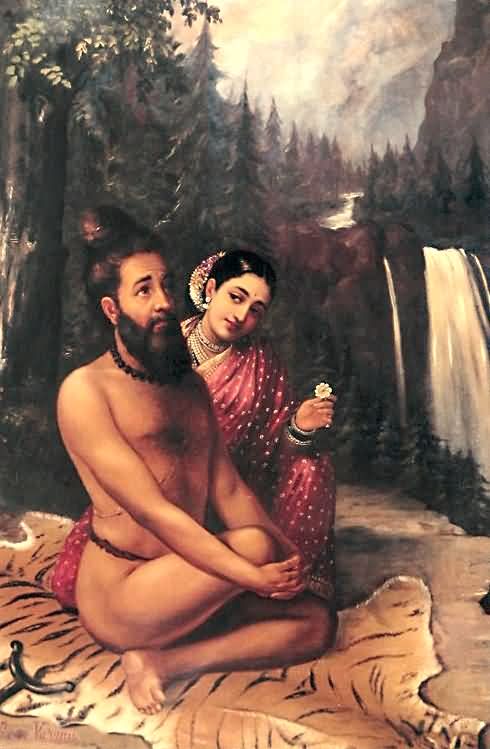
Indra, thus addressed by her, then commanded him who could approach every place (viz., the god of the wind) to be present with Menaka at the time she would be before the Rishi. The timid and beautiful Menaka then entered the retreat and saw there Viswamitra who had burnt, by his penances, all his sins, and was engaged still in ascetic penances. Saluting the Rishi, she then began to sport before him. Just at that time Marut robbed her of her garments that were white as the Moon. She thereupon ran, as if in great bashfulness, to catch hold of her attire, and as if she was exceedingly annoyed with Marut She did all this before the very eyes of Viswamitra who was endued with energy like that of fire. And Viswamitra saw her in that attitude. Beholding her divested of her robes, he saw that she was of faultless feature. That best of Munis saw that she was exceedingly handsome, with no marks of age on her person. Beholding her beauty and accomplishments that bull amongst Rishis was possessed with lust and made a sign that he desired her companionship. He invited her accordingly, and she also of faultless features expressed her acceptance of the invitation. They then passed a long time there in each other’s company. Sporting with each other, just as they pleased, for a long time as if it were only a single day,
There she gave birth to that daughter. She left the new-born infant on the bank of that river and went away. Beholding the new-born infant lying in that forest destitute of human beings but abounding with lions and tigers, a number of vultures sat around to protect it from harm. No Rakshasas or carnivorous animals took its life. Those vultures protected the daughter of Menaka. I went there to perform my ablution and beheld the infant lying in the solitude of the wilderness surrounded by vultures. Bringing her hither I have made her my daughter. Indeed, the maker of the body, the protector of life, the giver of food, are all three, fathers in their order, according to the scriptures. Because she was surrounded in the solitude of the wilderness, by Sakuntas (birds), therefore, has she been named by me Sakuntala (bird-protected). O Brahman, learn that it is thus that Sakuntala has become my daughter. And the faultless Sakuntala also regards me as her father.”
This is what my father had said unto the Rishi, having been asked by him. O king! It is thus that you must know I am the daughter of Kanwa. Not knowing my real father, I regard Kanwa as my father. Thus have I told you, O king, all that has been heard by me regarding my birth!”

King Duhshanta, hearing all this, said, “Well-spoken, O princess, this that you have said! Be my wife, O beautiful one! What shall I do for you? Golden garlands, robes, ear-rings of gold, white and handsome pearls, from various countries, golden coins, finest carpets, I shall present you this very day. Let the whole of my kingdom be yours today, O beautiful one! Come to me, wedding me, according to the Gandharva form. Of all forms of marriage, the Gandharva one is regarded as the first.”
Sakuntala, hearing this, said, “O king, my father has gone away from this Ashrama to bring fruit. Wait but a moment; he will bestow me on you.”
Duhshanta replied, “O beautiful and faultless one, I desire that you should be my life’s companion. Know you that I exist for you, and my heart is in you. One is certainly one’s own friend, and one certainly may depend upon one’s own self. Therefore, according to the ordinance, you can certainly bestow yourself. There are, in all, eight kinds of marriages. These are Brahma, Daiva, Arsha, Prajapatya, Asura, Gandharva, Rakshasa, and Paisacha, the eighth. Manu, the son of the self-create, has spoken of the appropriateness of all these forms according to their order. Know that the first four of these are fit for Brahmanas, and the first six for Kshatriyas. As regards kings, even the Rakshasa form is permissible. The Asura form is permitted to Vaisyas and Sudras. Of the first five the three are proper, the other two being improper. The Paisacha and the Asura forms should never be practised. These are the institutes of religion, and one should act according to them. The Gandharva and the Rakshasa form are consistent with the practices of Kshatriyas. You need not entertain the least fear. There is not the least doubt that either according to any one of these last-mentioned forms, or according to a union of both of them, our wedding may take place. Full of desire I am, you also in a similar mood mayst become my wife according to the Gandharva form.”
Sakuntala, having listened to all this, answered, “If this be the course sanctioned by religion, if, indeed, I am my own disposer, hear, O you foremost one of Puru’s race, what my terms are. Promise truly to give me what I ask you. The son that shall be begotten on me shall become your heir-apparent. This, O king, is my fixed resolve. O Duhshanta, if you grant this, then let our union take place.”
The monarch, without taking time to consider at once told her, “Let it be so. I will even take you with me to my capital. I tell you truly. You deserve all this.” So saying, that first of kings wedded the handsome Sakuntala of graceful gait, and knew her as a husband. Assuring her duly, he went away, telling her repeatedly, “I shall send you, for your escort, my troops of four classes. Indeed, it is even thus that I shall take you to my capital, O you of sweet smiles!”
Having promised so unto her, the king went away. And as he retraced his way homewards, he began to think of Kasyapa. He asked himself, “What will the illustrious ascetic say, after he has known all?’ Thinking of this, he entered his capital.
The moment the king had left, Kanwa arrived at his abode. But Sakuntala, from a sense of shame, did not go out to receive her father. That great ascetic, however, possessed of spiritual knowledge, knew all. Indeed beholding everything with his spiritual eye, the illustrious one was pleased, and addressing her, said, “Amiable one, what has been done by you today in secret, without, having waited for me, viz., intercourse with a man, has not been destructive of your virtue. Indeed, union according to the Gandharva form, of a wishful woman with a man of sensual desire, without mantras of any kind, it is said, is the best for Kshatriyas. That best of men, Duhshanta, is also high-souled and virtuous. You have, O Sakuntala, accepted him for your husband. The son that shall be born of you shall be mighty and illustrious in this world. He shall have sway over the sea. The forces of that illustrious king of kings, while he goes out against his foes shall be irresistible.”
Sakuntala then approached her fatigued father and washed his feet. Taking down the load he had with him and placing the fruits in proper order, she told him, “It beholds you to give your grace to that Duhshanta whom I have accepted for my husband, as well as his ministers!”
Kanwa replied, “For your sake I am inclined to bless him. But receive from me the boon that you desire.” Sakuntala, thereupon, moved by desire of benefiting Duhshanta, asked the boon that the Paurava monarchs might ever be virtuous and never deprived of their thrones.

After Duhshanta had left the Ashrama having made those promises unto Sakuntala, the latter of tapering thighs brought forth a boy of immeasurable energy. When the child was three years old, he became in splendour like the blazing fire. He was possessed of beauty and magnanimity and every accomplishment. Kanwa, caused all the rites of religion to be performed in respect of that intelligent child thriving day by day. The boy gifted with pearly teeth and shining locks, capable of slaying lions even then, with all auspicious signs on his palm, and broad expansive forehead, grew up in beauty and strength. Like unto a celestial child in splendour, he began to grow up rapidly. When he was only six years of age, endued with great strength he used to seize and bind to the trees that stood around that Ashrama, lions and tigers and bears and buffaloes and elephants. And he rode on some animals, and pursued others in sportive mood. The dwellers at Kanwa’s Ashrama thereupon bestowed on him a name. They said, because he seizes and restrains an animals however strong, let him, be called Sarvadamana (the subduer of all). It was thus that the boy came to be named Sarvadamana, endued as he was with prowess, and energy and strength. The Rishi seeing the boy and marking also his extraordinary acts, told Sakuntala that the time had come for his installation as the heir-apparent. Beholding the strength of the boy,
Kanwa commanded his disciples, saying, “Bear you without delay this Sakuntala with her son from this abode to that of her husband, blessed with every auspicious sign. Women should not live long in the houses of their paternal or maternal relations. Such residence is destructive of their reputation, their good conduct, their virtue. Therefore, delay not in bearing her hence.” These disciples of the Rishi thereupon, saying “So be it,” went towards Hastinapura with Sakuntala and her son ahead of them.
Then she of fair eye-brows, taking with her that boy of celestial beauty, endued with eyes like lotus petals, left the woods where she had been first known by Duhshanta. Having approached the king, she with her boy resembling in splendour the rising sun was introduced to him. The disciples of the Rishi having introduced her, returned to the Ashrama. Sakuntala having worshipped the king according to proper form, told him, “This is your son, O king! Let him be installed as your heir-apparent. This child, like unto a celestial, has been begotten by you upon me. Therefore, fulfil now the promise you gave me. Call to mind, the agreement you had made on the occasion of your union with me in the Ashrama of Kanwa.”
The king, hearing these her words, and remembering everything said, “I do not remember anything. Who are you, O wicked woman in ascetic guise? I do not remember having any connection with you in respect of Dharma, Kama and Artha. Go or stay or do as you please.” Thus addressed by him, the fair-coloured innocent one became abashed. Grief deprived her of consciousness and she stood for a time like an wooden post. Soon, however, her eyes became red like copper and her lips began to quiver. The glances she now and then cast upon the king seemed to burn the latter. Her rising wrath however, and the fire of her asceticism, she extinguished within herself by an extraordinary effort. Collecting her thoughts in a moment, her heart possessed with sorrow and rage, she thus addressed her lord in anger, looking at him:
Knowing everything, O monarch, how can you, like an inferior person, thus say that you know it not? Your heart is a witness to the truth or falsehood of this matter. Therefore, speak truly without degrading yourself. He who being one thing represents himself as another thing to others, is like a thief and a robber of his own self. Of what sin is he not capable? You think that you alone has knowledge of your deed. But don’t you know that the Ancient, Omniscient one lives in your heart? He knows all your sins, and you sinned in His presence. The sinner thinks that none observes him. But he is observed by the gods and by Him who is in every heart. The Sun, the Moon, the Air, the Fire, the Earth, the Sky, Water, the heart, Yama, the day, the night, both twilights, and Dharma, all witness the acts of man. Yama, the son of Surya, takes no account of the sins of him with whom Narayana the witness of all acts, is gratified.

But he with whom Narayana is not gratified is tortured for his sins by Yama. The gods never bless the one who degrades himself by representing his self falsely. Even his own soul does not bless him. I am a wife devoted to my husband. I have come of my own accord, it is true. But do not, on that account, treat me with disrespect. I am your wife and, therefore, deserve to be treated respectfully. Will you not treat me so, because I have come here of my own accord? In the presence of so many, why do you treat me like an ordinary woman? I am not certainly crying in the wilderness. Do you not hear me? But if you refuse to do what I supplicate you for, O Duhshanta, your head this moment shall burst into a hundred pieces! The husband entering the womb of the wife comes out himself in the form of the son. Therefore the wife is called by those cognisant of the Vedas as Jaya (she of whom one is born). The son that is so born unto persons cognisant of the Vedic Mantras rescues the spirits of deceased ancestors. Because the son rescues ancestors from the hell call Put, he has been called by the Self-create himself as Puttra (the rescuer from Put). By a son one conquers the three worlds. By a son’s son, one enjoys eternity. And by a grandson’s son great-grand-fathers enjoy everlasting happiness. The wife is a man’s half. The wife is the first of friends. The wife is the root of religion, profit, and desire. The wife is the root of salvation. Those who have wives can perform religious acts. Those who have wives can lead domestic lives. Those who have wives have the means to be cheerful. Those who have wives can achieve good fortune. Sweet-speeched wives are friends on occasions of joy. They are as fathers on occasions of religious acts. They are mothers in sickness and woe. Even to a traveler in the deep woods a wife is his refreshment and solace. He who has a wife is trusted by all. A wife, therefore, is one’s most valuable possession. Even when the husband leaving this world goes into the region of Yama, it is the devoted wife that accompanies him there. A wife going before waits for the husband. But if the husband goes before, the chaste wife follows close. For these reasons, O king, does marriage exist. The husband enjoys the companionship of the wife both in this and in the other worlds. It has been said by learned persons that one is himself born as one’s son. Therefore, a man whose wife has borne a son should look upon her as his mother. Beholding the face of the son one has begotten upon his wife, like his own face in a mirror, one feels as happy as a virtuous man, on attaining to heaven. Men scorched by mental grief, or suffering under bodily pain, feel as much refreshed in the companionship of their wives as a perspiring person in a cool bath. No man, even in anger, should ever do anything that is disagreeable to his wife, seeing that happiness, joy, and virtue,–everything depends on the wife. A wife is the sacred field in which the husband is born himself. Even Rishis cannot create creatures without women. What happiness is greater than what the father feels when the son running towards him, even though his body be covered with dust, clasps his limbs? Why then do you treat with indifference such a son, who has approached you himself and who casts pensive glances towards you for climbing your knees? Even ants support their own eggs without destroying them; then why should not you, a virtuous man that you are, support your own child? The touch of soft sandal paste, of women, of (cool) water is not so agreeable as the touch of one’s own infant son locked in one’s embrace. As a Brahmana is the foremost of all bipeds, a cow, the foremost of all quadrupeds, a protector, the foremost of all superiors, so is the son the foremost of all objects, agreeable to the touch. Let, therefore, this handsome child touch you in embrace. There is nothing in the world more agreeable to the touch than the embrace of one’s son. I have brought forth this child, capable of dispelling all your sorrows after bearing him in my womb for full three years. “He shall perform a hundred horse-sacrifices” – these were the words uttered from the sky when I was in the lying-in room. Indeed, men going into places remote from their homes take up there others’ children on their laps and smelling their heads feel great happiness. You know that Brahmanas repeat these Vedic mantras on the occasion of the consecrating rites of infancy: “You are born, O son, of my body! You are sprung from my heart. You are myself in the form of a son. Live you to a hundred years! My life depends on you, and the continuation of my race also, on you. Therefore, O son, live you in great happiness to a hundred years.” He has sprung from your body, this second being from you! Behold yourself in your son, as you behold your image in the clear lake. As the sacrificial fire is kindled from the domestic one, so has this one sprung from you. Though one, you have divided yourself. In course of hunting while engaged in pursuit of the deer, I was approached by you, I who was then a virgin in the Ashrama of my father. Urvasi, Purvachitti, Sahajanya, Menaka, Biswachi and Ghritachi, these are the six foremost of Apsaras. Amongst them again, Menaka, born of Brahman, is the first. Descending from heaven on Earth, after intercourse with Viswamitra, she gave birth to me. That celebrated Apsara, Menaka, brought me forth in a valley of Himavat. Bereft of all affection, she went away, cast me there as if I were the child of somebody else. What sinful act did I do, of old, in some other life that I was in infancy cast away by my parents and at present am cast away by you! Put away by you, I am ready to return to the refuge of my father. But it beholds you not to cast off this child who is your own.”
Hearing all this, Duhshanta said, “O Sakuntala, I do not know having begot upon you this son. Women generally speak untruths. Who shall believe in your words? Destitute of all affection, the lewd Menaka is your mother, and she cast you off on the surface of the Himavat as one throws away, after the worship is over, the flowery offering made to his gods. Your father too of the Kshatriya race, the lustful Viswamitra, who was tempted to become a Brahmana, is destitute of all affection. However, Menaka is the first of Apsaras, and your father also is the first of Rishis. Being their daughter, why do you speak like a lewd woman? Your words deserve no credit. Are you not ashamed to speak them, especially before me? Go hence, O wicked woman in ascetic guise. Where is that foremost of great Rishis, where also is that Apsara Menaka? And why are you, low as you are, in the guise of an ascetic? Your child too is grown up. You say he is a boy, but he is very strong. How has he soon grown like a Sala sprout? Your birth is low. You speak like a lewd woman. Lustfully you have been begotten by Menaka. All that you say is quite unknown to me. I don’t know you. Go wherever you choose.”
Sakuntala replied, “You see, O king, the fault of others, even though they are as small as a mustard seed. But you do not notice your own faults even though they are as large as the Bilwa fruit. Menaka is one of the celestials. Indeed, Menaka is reckoned as the first of celestials. My birth, therefore, is far higher than yours. You walk upon the Earth, but I roam in the skies! Behold, the difference between ourselves is as that between (the mountain) Meru and a mustard seed! Behold my power, O king! I can repair to the abodes of Indra, Kubera, Yama, and Varuna! The saying is true which I shall refer to before you! I refer to it for example’s sake and not from evil motives. Therefore, it beholds you to pardon me after you have heard it. An ugly person considers himself handsomer than others until he sees his own face in the mirror. But when he sees his own ugly face in the mirror, it is then that he perceives the difference between himself and others. He who is really handsome never taunts anybody. He who always talks evil becomes a reviler. As the swine always look for dirt and filth even in the midst of a flower-garden, so the wicked always choose the evil out of both evil and good that others speak. The wise, on hearing the speeches of others that are intermixed with both good and evil, accept only what is good, like geese that always extract the milk only, though it be mixed with water. As the honest are always pained at speaking ill of others, so do the wicked always rejoice in doing the same thing. As the honest always feel pleasure in showing regard for the old, so do the wicked always take delight in aspersing the good. The honest are happy in not seeking for faults. The wicked are happy in seeking for them. The wicked ever speak ill of the honest. But the latter never injure the former, even if injured by them. What can be more ridiculous in the world than that those that are themselves wicked should represent the really honest as wicked? When even atheists are annoyed with those that have fallen off from truth and virtue and who are really like angry snakes of virulent poison, what shall I say of myself who am nurtured in faith? He that having begotten a son who is his own image, regards him not, never attains to the worlds he covets, and verily the gods destroy his good fortune and possessions. The Pitris have said that the son continues the race and the line and is, therefore, the best of all religious acts. Therefore, none should abandon a son. Manu has said that there are five kinds of sons; those begotten by one’s self upon his own wife, those obtained (as gift) from others, those purchased for a consideration, those reared with affection and those begotten upon other women than upon wedded wives. Sons support the religion and achievements of men, enhance their joys, and rescue deceased ancestors from hell. It beholds you not, therefore, to abandon a son who is such. Therefore, cherish your own self, truth, and virtue by cherishing your son. It beholds you not to support this deceitfulness. The dedication of a tank is more meritorious than that of a hundred wells. A sacrifice again is more meritorious than the dedication of a tank. A son is more meritorious than a sacrifice. Truth is more meritorious than a hundred sons. A hundred horse-sacrifices had once been weighed against Truth, and Truth was found heavier than a hundred horse-sacrifices. Truth may be equal to the study of the entire Vedas and ablutions in all holy places. There is no virtue equal to Truth: there is nothing superior to Truth. Truth is God himself; Truth is the highest vow. Therefore, violate not your pledge! Let Truth and you be even united. If you place no credit in my words, I shall of my own accord go from here. Indeed, your companionship should be avoided. But you, O Duhshanta, that when you are gone, this son of mine shall rule the whole Earth surrounded by the four seas and adorned with the king of the mountains.”
Sakuntala having spoken to the monarch in this wise, left his presence. But as soon as she had left, a voice from the skies, emanating from no visible shape, thus spoke unto Duhshanta as he was sitting surrounded by his occasional and household priests, his preceptors, and ministers. The voice said, ‘The mother is but the sheath of flesh; the son sprung from the father is the father himself. Therefore, O Duhshanta, cherish your son, and insult not Sakuntala. The son, who is but a form of one’s own seed, rescues ancestors from the region of Yama. You are the progenitor of this boy. Sakuntala has spoken the truth. The husband, dividing his body in twain, is born of his wife in the form of son. Therefore, O Duhshanta, cherish, your son born of Sakuntala. To live by forsaking one’s living son is a great, misfortune. Therefore, cherish your high-souled son born of Sakuntala–And because this child is to be cherished by you even at our word, therefore shall this your son be known by the name of Bharata (the cherished).” Hearing these words uttered by the dwellers in heaven, the monarch of Puru’s race became overjoyed and spoke as follows unto his priests and ministers, “Hear you these words uttered by the celestial messenger? I myself know this one to be my son. If I had taken him as my son on the strength of Sakuntala’s words alone, my people would have been suspicious and my son also would not have been regarded as pure.”
The monarch, then, seeing the purity of his son established by the celestial messenger, became exceedingly glad. He took unto him that son with joy. The king with a joyous heart then performed all those rites upon his son that a father should perform. And the king smelt his child’s head and hugged him with affection. The Brahmanas began to utter blessings upon him and the bards began to applaud him. The monarch then experienced the great delight that one feels at the touch of one’s son. Duhshanta also received the wife of his with affection. He told her these words, pacifying her affectionately, “O goddess, my union with you took place privately. Therefore, I was thinking of how best to establish your purity. My people might think that we were only lustfully united and not as husband and wife, and therefore, this son that I would have installed as my heir apparent would only have been regarded as one of impure birth. Dearest, every hard word you have uttered in your anger, have I forgiven you. You are my dearest!” The royal sage Duhshanta, having spoken thus unto his dear wife, received her with offerings of perfume, food, and drink. King Duhshanta, then, bestowed the name of Bharata upon his child, and formally installed him as the heir apparent. The famous and bright wheels of Bharata’s car, invincible and like unto the wheels of the cars owned by the gods, traversed every region, filling the whole Earth with their rattle. The son of Duhshanta reduced to subjection all kings of the Earth. He ruled virtuously and earned great fame. That monarch of great prowess was known by the titles of Chakravarti and Sarvabhauma. He performed many sacrifices like Indra. Kanwa was the chief priest at those sacrifices, in which the offerings to Brahmanas were great. The blessed monarch performed both the cow and the horse-sacrifices. Bharata gave unto Kanwa a thousand gold coins as the sacerdotal fee. It is that Bharata from whom have emanated so many mighty achievements. It is from him that the great race called after him in his race are called after him. In the Bharata race there have been born many godlike monarchs gifted with great energy, and like unto Brahman himself. Their number cannot be counted.

Yayati
Kacha and Devayani
Between the celestials and the Asuras, there happened, of yore, frequent encounters for the sovereignty of the three worlds with everything in them. The gods, then, from desire of victory, installed the son of Angiras – Brihaspati – as their priest to conduct their sacrifices; while their opponents installed the learned Sukra (also known as Usanas, Kavya and Bhargava) as their priest for the same purpose. Between those two Brahmanas there are always much boastful rivalry. Those Danavas assembled for encounter that were slain by the gods were all revived by the seer Sukra by the power of his knowledge. Then starting again, into life, these fought with the gods. The Asuras also slew on the field of battle many of the celestials. But the open-minded Brihaspati could not revive them, because he knew not the science called Sanjivani (re-vivification) which Sukra endued with great energy knew so well. The gods were, therefore, in great sorrow. The gods, in great anxiety of heart and entertaining a fear of the learned Sukra, then went to Kacha, the eldest son of Brihaspati, and spoke unto him, saying, “We pay court to you, be kind to us and do us a service that we regard as very great. That knowledge which resides in Sukra, that Brahmana of immeasurable prowess, make your own as soon as you can. You shall find the Brahmana in the court of Vrishaparvan. He always protects the Danavas but never us, their opponents. You are his junior in age, and, therefore, capable of adoring him with reverence. You can also adore Devayani, the favourite daughter of that high-souled Brahmana. Indeed, you alone are capable of propitiating them both by worship. There is none else that can do so. By gratifying Devayani with your conduct, liberality, sweetness, and general behaviour, you can certainly obtain that knowledge.” The son of Brihaspati, thus solicited by the gods, said “So be it”, and went to where Vrishaparvan was. Kacha, thus sent by the gods, soon went to the capital of the chief of the Asuras, and beheld Sukra there. Beholding him, he thus spoke unto him, “Accept me as your disciple. I am the grandson of the Rishi Angiras and son of Brihaspati. By name I am known as Kacha. Yourself becoming my preceptor, I shall practise the Brahmacharya mode of life for a thousand years. Command me, then, O Brahmana!”

Sukra said, “Welcome are you, O Kacha! I accept your speech. I will treat you with regard; for by so doing, it is Brihaspati who will be regarded.”
Kacha commanded by Sukra, then said, “So be it,” and took the vow he had spoken of. Accepting the vow of which he had spoken, at the proper time, Kacha began to conciliate regardfully both his preceptor and his daughter Devayani. Indeed, he began to conciliate both. As he was young, by singing and dancing and playing on different kinds of instruments, he soon gratified Devayani who was herself in her youth. With his whole heart set upon it, he soon gratified the maiden Devayani who was then a young lady, by presents of flowers and fruits and services rendered with alacrity. Devayani also with her songs and sweetness of manners used, while they were alone, to attend upon that youth carrying out his vow.
When five hundred years had thus passed of Kacha’s vow, the Danavas came to learn his intention. Having no compunctions about slaying a Brahmana, they became very angry with him. One day they saw Kacha in a solitary part of the woods engaged in tending his preceptor’s kine. They then slew Kacha from their hatred of Brihaspati and also from their desire of protecting the knowledge of reviving the dead from being conveyed by him. Having slain him, they hacked his body into pieces and gave them to be devoured by jackals and wolves. When twilight came) the kine returned to the fold without him who tended them. Devayani, seeing the kine returned from the woods without Kacha, spoke unto her father thus:
“Your evening-fire has been kindled. The Sun also has set, O father! The kine have returned without him who tends them. Kacha is, indeed, not to be seen. It is plain that Kacha has been lost, or is dead. Truly do I say, O father, that without him I will not live.”
Sukra hearing this said, “I will revive him by saying, “Let this one come.”” Then having recourse to the science of reviving the dead, Sukra summoned Kacha. And summoned by his preceptor, Kacha appeared before him in the gladness of heart tearing by virtue of his preceptor’s science the bodies of the wolves that had devoured him. Asked about the cause of his delay, he thus spoke unto Sukra’s daughter. Indeed, asked by that Brahman’s daughter, he told her, “I was dead. Burdened with sacrificial fuel, Kusa grass, and logs of wood, I was coming towards our abode. I sat under a banyan tree. The kine also, having been brought together, were staying under the shade of that same banyan tree. The Asuras, beholding me, asked “Who are you?” They heard me answer, “I am the son of Brihaspati.” As soon as I said this, the Danavas slew me, and hacking my body into pieces gave my remains to jackals and wolves. They then went home in the gladness of heart. Summoned by the high-souled Sukra, I after all come before you fully revived.”
On another occasion, asked by Devayani, the Brahmana Kacha went into the woods. As he was roving about for gathering flowers, the Danavas beheld him. They again slew him, and pounding him into a paste they mixed it with the water of the ocean. Finding him long still in coming, the maiden again represented the matter unto her father. Summoned again by the Brahmana with the aid of his science, Kacha appearing before his preceptor and his daughter told everything as it had happened. Then slaying him for the third time and burning him and reducing him to ashes, the Asuras gave those ashes to the preceptor himself, mixing them with his wine. Devayani again spoke unto her father, saying, “O father, Kacha was sent to gather flowers. But he is not to be seen. It is plain he has been lost, or has died. I tell you truly, I would not live without him.”
Sukra hearing this said, “O daughter, the son of Brihaspati has gone to the region of the dead. Though revived by my science, he is thus slain frequently. What, indeed, am I to do? O Devayani, do not grieve, do not cry. One like you should not grieve for one that is mortal. You are indeed, O daughter, in consequence of my prowess, worshipped thrice a day during the ordained hours of prayer, by Brahmanas, the gods with Indra, the Vasus, the Aswins, the Asuras, in fact, by the whole universe. It is impossible to keep him alive, for revived by me he is often killed.” To all this Devayani replied, “Why shall I, O father, not grieve for him whose grandfather is old Angiras himself, whose father is Brihaspati who is an ocean of ascetic merit, who is the grandson of a Rishi and the son also of a Rishi? He himself too was a Brahmacharin and an ascetic; always wakeful and skilled in everything. I will starve and follow the way Kacha has gone. The handsome Kacha is, O father, dear unto me.”
The great Rishi Sukra, then, afflicted by what Devayani said, cried in anger, “Certainly, the Asuras seek to injure me, for they slay my disciple that stays with me. These followers of Rudra desire to divest me of my character as a Brahmana by making me participate in their crime. Truly, this crime has a terrible end. The crime of slaying a Brahmana would even burn Indra himself.” Having said this, the Brahmana Sukra, urged by Devayani, began to summon Kacha who had entered the jaws of Death. But Kacha, summoned with the aid of science, and afraid of the consequence to his preceptor, feebly replied from within the stomach of his preceptor, saying, “Be graceful unto me, O lord! I am Kacha who worships you. Behave unto me as to your own dearly-loved son.”
Sukra then said, “By what path, O Brahmana, has you entered my stomach, where you stay now? Leaving the Asuras this very moment, I shall go over to the gods.” Kacha replied, “By your grace, memory has not failed me. Indeed, I do recollect everything as it has happened. My ascetic virtues have not been destroyed. It is, therefore, that I am able to bear this almost insufferable pain. Slain by the Asuras and burnt and reduced to powder, I have been given to you with your wine. When you are present, the art of the Asuras will never be able to vanquish, the science of the Brahmana.”
Hearing this, Sukra said, “O daughter, what good can I do to you? It is with my death that Kacha can get his life back. O Devayani, Kacha is even within me. There is no other way of his coming out except by ripping open my stomach.” Devayani replied, “Both evils shall, like fire, burn me! The death of Kacha and your own death are to me the same! The death of Kacha would deprive me of life. If you also die, I shall not be able to bear my life.” Then Sukra said, “O son of Brihaspati, you are, indeed, one already crowned with success, because Devayani regards you so well. Accept the science that I will today impart to you, if, indeed, you be not Indra in the form of Kacha. None can come out of my stomach with life. A Brahmana, however, must not be slain, therefore, accept you the science I impart to you. Stare you into life as my son. Possessed of the knowledge received from me, and revived by me, take care that, on coming out of my body, you do act gracefully.”
Receiving the science imparted to him by his preceptor the handsome Kacha, ripped open his stomach, came out like the moon at evening on the fifteenth day of the bright fort-night. Beholding the remains of his preceptor lying like a heap of penances, Kacha revived him, aided by the science he had learned. Worshipping him with regard, Kacha said unto his preceptor, “Him who pours the nectar of knowledge into one’s ears, even as you have done into those of myself who was void of knowledge, him do I regard both as my father and mother. Remembering the immense service done by him, who is there so ungrateful as to injure him? They that, having acquired knowledge, injure their preceptor who is always an object of worship, who is the giver of knowledge, who is the most precious of all precious objects on Earth, come to be hated on Earth and finally go to the regions of the sinful.”
The learned Sukra, having been deceived while under the influence of wine, and remembering the total loss of consciousness that is one of the terrible consequences of drink, and beholding too before him the handsome Kacha whom he had, in a state of unconsciousness, drunk with his wine, then thought of effecting a reform in the manners of Brahmanas. The high-souled Sukra rising up from the ground in anger, then spoke as follows: “The wretched Brahmana who from this day, unable to resist the temptation, will drink wine shall be regarded as having lost his virtue, shall be reckoned to have committed the sin of slaying a Brahmana, shall be hated both in this and the other worlds. I set this limit to the conduct and dignity of Brahmanas everywhere. Let the honest, let Brahmanas, let those with regard for their superiors, let the gods, let the three worlds, listen!” Having said these words that high-souled one, that ascetic of ascetics, then summoning the Danavas who had been deprived by fate of the good sense, told them these words, “You foolish Danavas, know you that Kacha has obtained his wishes. He will henceforth dwell with me. Having obtained the valuable knowledge of reviving the dead, that Brahmana has, indeed, become in prowess even as Brahman himself!”
Sukra having said so much cut short his speech. The Danavas were surprised and went away to their homes. Kacha, too, having stayed with his preceptor for a full thousand years, then prepared to return to the abode of the celestials, after having obtained his preceptor’s permission.
After the expiry of the period of his vow, Kacha, having obtained his preceptor’s leave, was about to return to the abode of the celestials, when Devayani, addressing him, said, “O grandson of the Rishi Angiras, in conduct and birth, in learning, asceticism and humility, you shine most brightly. As the celebrated Rishi Angiras is honoured and regarded by my father, so is your father regarded and worshipped by me. Knowing this, listen to what I say. Recollect my conduct towards you during the period of your Brahmacharya. Your vow has now been over. It beholds you to fix your affections on me. Accept my hand duly with ordained mantras.”
Kacha replied, “You are to me an object of regard and worship even as your father! O you of faultless features, you are, indeed, even an object of greater reverence! You are dearer than life to the high-souled Sukra! As the daughter of my preceptor, you are ever worthy of my worship! As my preceptor Sukra, your father, is ever deserving of my regards, so are you, O Devayani! Therefore, it beholds you not to say so.” Hearing this, Devayani replied, “You, too, are the son of my father’s preceptor’s son. Therefore, you are deserving of my regards and worship. O Kacha, when you were slain so many times by the Asuras, recollect today the affection I showed for you. Remembering my friendship and affection for you, and, indeed, my devoted regard also, it beholds you not to abandon me without any fault. I am truly devoted to you.”
Hearing all this, Kacha said, “O you of virtuous vows, do not urge me into such a sinful course. Be gracious unto me. Beautiful one, you are to me an object of greater regard than my preceptor. The place where you had resided, viz., the body of Sukra, has also been my abode. You are truly my sister. Amiable one, happily have we passed the days that we have been together. There is perfect good understanding between us. I ask your leave to return to my abode. Therefore, bless me so that my journey may be safe. I must be remembered by you, when you recall me in connection with topics of conversation, as one that has not transgressed virtue. Always attend upon my preceptor with readiness and singleness of heart.” To all this, Devayani answered, “Solicited, by me, if, indeed, you truly refuse to make me your wife, then, O Kacha, this your knowledge shall not bear fruit.”
Hearing this, Kacha said, “I have refused your request only because you are the daughter of my preceptor, and not because you have any fault. Nor has my preceptor in this respect issued any command. Curse me if it please you. I have told you what the behaviour should be of a Rishi. I do not deserve your curse, O Devayani. But yet you have cursed me! You have acted under the influence of passion and not from a sense of duty. Therefore, your desire will not be fulfilled. No Rishi’s son shall ever accept your hand in marriage. You have said that my knowledge shall not bear fruit. Let it be so. But in respect of him it shall bear fruit to whom I may impart it.”
That first of Brahmanas, Kacha, having said so unto Devayani speedily wended his way unto the abode of the chief of the celestials. Beholding him arrived, the celestials with Indra ahead, having first worshipped him, spoke unto him as follows, “You have indeed, performed an act of great benefit for us. Wonderful has been your achievement! Your fame shall never die! You shall be a sharer with us in sacrificial offerings.”
Devayani and Sharmishta
The dwellers in heaven became exceedingly glad in welcoming Kacha who had mastered the wonderful science. The celestials then learnt that science from Kacha and considered their object already achieved. Assembling together, they spoke unto him of a hundred sacrifices, saying, “The time has come for showing prowess. Slay your foes, O Purandara!” Thus addressed, Indra, then accompanied by the celestials, set out, saying, “So be it.” But on his way he saw a number of damsels. These maidens were sporting in a lake in the gardens of the Gandharva Chitraratha. Changing himself into wind, he soon mixed up the garments of those maidens which they had laid on the bank. A little while after, the maidens, getting up from the water, approached their garments that had, indeed, got mixed up with one another. It so happened that from the intermingled heap, the garments of Devayani were appropriated by Sarmishtha, the daughter of Vrishaparvan, from ignorance that it was not hers. Thereupon, between them, Devayani and Sarmishtha, then ensued a dispute. Devayani said, “O daughter of the Asura, why do you take my attire, being, as you are, my disciple? As you are destitute of good behaviour, nothing good can happen to you!” Sarmishtha, however, quickly replied, “Your father occupying a lower seat, always adores with downcast looks, like a hired chanter of praises, my father, whether he sits at his ease or reclines at full length! You are the daughter of one that chants the praises of others, of one that accepts alms. I am the daughter of one who is adored, of one who bestows alms instead of ever accepting them! Beggar-woman as you are, you are free to strike your breast, to use ill words, to vow enmity to me, to give way to your wrath. Acceptress of alms, you weep tears of anger in vain! If so minded, I can harm you, but you can not. You desire to quarrel. But know you that I do not reckon you as my equal!”
Hearing these words, Devayani became exceedingly angry and began to pull at her clothes. Sarmishtha thereupon threw her into a well and went home. Indeed, the wicked Sarmishtha believing that Devayani was dead, bent her steps home-wards in a wrathful mood.
After Sarmishtha had left, Yayati the son of Nahusha soon came to that spot. The king had been out a-hunting. The couple of horses harnessed to his car and the other single horse with him were all fatigued. The king himself was thirsty. The son of Nahusha saw a well that was by. He saw that it was dry. But in looking down into it, he saw a maiden who in splendour was like a blazing fire. Beholding her within it, the blessed king addressed that girl of the complexion of the celestials, soothing her with sweet words. he said, “Who are you, O fair one, of nails bright as burnished copper, and with ear-rings decked with celestial gems? You seem to be greatly perturbed. Why do you weep in affliction? How, indeed, have you fallen into this well covered with creepers and long grass? O slender-waisted girl, answer me truly whose daughter you are.”
Devayani then replied, “I am the daughter of Sukra who brings back into life the Asuras slain by the gods. He does not know what has befallen me. This is my right hand, O king, with nails bright as burnished copper. You are well-born; I ask you, to take and raise me up! I know you are of good behaviour, of great prowess, and of wide fame! It beholds you, therefore, to raise me from this well.”
King Yayati, learning that she was a Brahmana’s daughter, raised her from that well by catching hold of her right hand. he monarch promptly raising her from the pit and squinting to her tapering thighs, sweetly and courteously returned to his capital.
When the son of Nahusha had gone away, Devayani of faultless features, afflicted with grief, then spoke unto her maid, Ghurnika by name, who met her then. She said, “O Ghurnika, go you quickly and speak to my father without loss of time of everything as it has happened. I shall not now enter the city of Vrishaparvan.”
Ghurnika, thus commanded, repaired quickly to the mansion, of the Asura chief, where she saw Sukra and spoke unto him with her perception dimmed by anger. She said, “I tell you, O great Brahmana, that Devayani has been ill-used in the forest by Sarmishtha, the daughter of Vrishaparvan.” Sukra, hearing that his daughter had been ill-used by Sarmishtha speedily went out with a heavy heart, seeking her in the woods. When he found her in the woods, he clasped her with affection and spoke unto her with voice choked with grief, “O daughter, the weal or woe that befalls people is always due to their own faults. You have therefore some fault, I ween, which has been expiated thus.” Hearing this Devayani replied, “Be it a penalty or not, listen to me with attention. Hear that all Sarmishtha, the daughter of Vrishaparvan, has said unto me. Really has she said that you are only the hired chanter of the praises of the Asura king! Even thus has she–that Sarmishtha, Vrishaparvan’s daughter,–spoken to me, with reddened eyes, these piercing and cruel words, “You are the daughter of one that ever chants for hire the praises of others, of one that asks for charities, of one that accepts alms; whereas I am the daughter of one that receives adorations, of one that gives, of one that never accepts anything as gift!” These have been the words repeatedly spoken unto me by the proud Sarmishtha, the daughter of Vrishaparvan, with eyes red with anger. If, O father, I am really the daughter of a hired chanter of praises, of one that accepts gifts, I must offer my adorations in the hope of obtaining her grace! Oh, of this I have already told her!”
Sukra replied, “You are, O Devayani, no daughter of a hired adorer, of one that asks for alms and accepts gifts. You are the daughter of one that adores none, but of one that is adored by all! Vrishaparvan himself knows it, and Indra, and king Yayati too. That inconceivable Brahma, that unopposable Godhead, is my strength! The self-create, himself, gratified by me, has said that I am for the lord of that which is in all things on Earth or in Heaven! I tell you truly that it is I who pour rain for the good of creatures and who nourish the annual plants that sustain all living things!”
It was by such sweet words of excellent import that the father endeavoured to pacify his daughter afflicted with woe and oppressed by anger.
Sukra continued, “Know, then, O Devayani, whoever minds not the evil speeches of others, conquers everything! The wise say that he is a true charioteer who without slackening holds tightly the reins of his horses. He, therefore, is the true man that subdues, without indulging in his rising wrath. Know you, O Devayani, that by him is everything conquered, who calmly subdues his rising anger. He is regarded as a man who by having recourse to forgiveness, shakes off his rising anger like a snake casting off its slough He who suppresses his anger, he who regards not the evil speeches of others, he who becomes not angry, though there be cause, certainly acquires the four objects for which we live (viz., virtue, profit, desire, and salvation). Between him who Performs without fatigue sacrifices every month for a hundred years, and him who never feels angry at anything, he that feels not wrath is certainly the higher. Boys and girls, unable to distinguish between right and wrong, quarrel with each other. The wise never imitate them.”
Devayani, on hearing this speech of her father, said, “O father, I know, also what the difference is between anger and forgiveness as regards the power of each. But when a disciple behaves disrespectfully, he should never be forgiven by the preceptor if the latter is really desirous of benefiting the former. Therefore, I do not desire to live any longer in a country where evil behaviour is at a premium. The wise man desirous of good, should not dwell among those sinfully inclined men who always speak ill of good behaviour and high birth. But there should one live,–indeed, that has been said to be the best of dwelling places,–where good behaviour and purity of birth are known and respected. The cruel words uttered by Vrishaparvan’s daughter burn my heart even as men, desirous of kindling a fire, burn the dry fuel. I do not think anything more miserable for a man in the three worlds than to adore one’s enemies blessed with good fortune, himself possessing none. It has been indeed said by the learned that for such a man even death would be better.”
Then Sukra, the foremost of Bhrigu’s line, became angry himself. Approaching Vrishaparvan where the latter was seated, began to address him without weighing his words, “O king,” he said, “sinful acts do not, like the Earth, bear fruit immediately! But gradually and secretly do they extirpate their doers. Such fruit visits either in one’s own self, one’s son, or one’s grandson. Sins must bear their fruit. Like rich food they can never be digested. Because you slew the Brahmana Kacha, the grandson of Angiras, who was virtuous, acquainted with the precepts of Dharma, and attentive to his duties, while residing in my abode, even for this act of slaughter–and for the mal-treatment of my daughter too, know, O Vrishaparvan, I shall leave you and your relatives! Indeed, O king, for this, I can no longer stay with you! Do you, O Asura chief, think that I am a raving liar? You make light of your offence without seeking to correct it!”
Vrishaparvan then said, “O son of Bhrigu, never have I attributed want of virtue, of falsehood, to you. Indeed, virtue and truth ever dwell in you. Be kind to me! O Bhargava, if, leaving us, you really go from here, we shall then go into the depths of the ocean. Indeed, there is nothing else for us to do.”
Sukra then replied, “You Asuras, whether you go into the depths of the ocean or fly away to all directions. I care little. I am unable to bear my daughter’s grief. My daughter is ever dear to me. My life depends on her. Seek you to please her. As Brihaspati ever seeks the good of Indra, so do I always seek you by my ascetic merits.”
Vrishaparvan then said, “O Bhargava, you are the absolute master of whatever is possessed by the Asura chiefs in this world-their elephants, kine and horses, and even my humble self!”
Sukra then answered, “If it is true, O great Asura, that I am the lord of all the wealth of the Asuras, then go and gratify Devayani.”
When the great Sukra was so addressed by Vrishaparvan, he then went to Devayani and told her all. Devayani, however, quickly replied, “O Bhargava, if you are truly the lord of the Asura king himself and of all his wealth, then let the king himself come to me and say so in my presence.” Vrishaparvan then approached Devayani and told her, “O Devayani of sweet smiles, whatever you desire I am willing to give you, however difficult it may be to grant the same.” Devayani answered, “I desire Sarmishtha with a thousand maids to wait on me! She must also follow me to where my father may give me away.”
Vrishaparvan then commanded a maid-servant in attendance on him, saying, “Go and quickly bring Sarmishtha here. Let her also accomplish what Devayani wishes.”
The maid-servant then repaired to Sarmishtha and told her, “O amiable Sarmishtha, rise and follow me. Accomplish the good of your relatives. Urged by Devayani, the Brahmana Sukra is on the point of leaving his disciples. You must do what Devayani wishes.” Sarmishtha replied, “I shall cheerfully do what Devayani wishes. Urged by Devayani Sukra is calling me. Both Sukra and Devayani must not leave the Asuras through my fault.”
Commanded by her father, then, Sarmishtha, accompanied by a thousand maidens, soon came, in a palanquin, out of her father’s excellent mansion. Approaching Devayani she said, “With my thousand maids, I am your waiting-maid! And I shall follow you where your father may give you away.” Devayani replied, “I am the daughter of one who chants the praises of your father, and who begs and accepts alms; you, on the other hand, are the daughter of one who is adored. How can you be my waiting-maid?”
Sarmishtha answered, “One must by all means contribute to the happiness of one’s afflicted relatives. Therefore shall I follow you wherever your father may give you away.”
When Sarmishtha thus promised to be Devayani’ s waiting-maid the latter, then spoke unto her father thus, “O best of all excellent Brahmanas, I am gratified. I shall now enter the Asura capital! I now know that your science and power of knowledge are not futile!”
That best of Brahmanas, of great reputation, thus addressed by his daughter, then, entered the Asura capital in the gladness of his heart. The Danavas worshipped him with great reverence.
Devayani, Yayati and Sharmishta
After some length of time, Devayani of the fairest complexion went into the same woods for purposes of pleasure. Accompanied by Sarmishtha with her thousand maids she reached the same spot and began to wander freely. Waited upon by all those companions she felt supremely happy. Sporting with light hearts, they began drinking the honey in flowers, eating various kinds of fruit and biting some. Just at that time, king Yayati, the son of Nahusha, again came there tired and thirsty, in course of his wanderings, in search of deer. The king saw Devayani and Sarmishtha, and those other maidens also, all decked with celestial ornaments and full of voluptuous languor in consequence of the flower-honey they drank. Devayani of sweet smiles, unrivalled for beauty and possessed of the fairest complexion amongst them all, was reclining at her ease. She was waited upon by Sarmishtha who was gently kneading her feet.
Yayati seeing all this, said, “O amiable ones, I would ask you both your names and parentage. It seems that these two thousand maids wait on you two.” “Hearing the monarch, Devayani then answered, “Listen to me, O best of men. Know that I am the daughter of Sukra, the spiritual guide of the Asuras. This my companion is my waiting-maid. She attends on me wherever I go. She is Sarmishtha, the daughter of the Asura king Vrishaparvan.”
Yayati then asked, “I am curious to know why is this your companion of fair eye-brows, this maiden of the fairest complexion, the daughter of the Asura chief your waiting-maid!” Devayani replied, “O best of king, everything results from Fate. Knowing this also to be the result of Fate, wonder not at it. Your feature and attire are both like a king’s. Your speech also is fair and correct as that of the Vedas. Tell me your name, from where you are and whose son also.”
The monarch replied, “During my vow of Brahmacharya, the whole Vedas entered my ears. I am known as Yayati, a king’s son and myself a king.” Devayani then enquired, “O king, what have you come here for? Is it to gather lotuses or to angle or to hunt?” Yayati said, “O amiable one, thirsty from the pursuit of deer, I have come here in search of water. I am very much fatigued. I await but your commands to leave this spot.”
Devayani answered, “With my two thousand damsels and my waiting-maid Sarmishtha, I wait but your commands. Prosperity to you. Be you my friend and lord.”
Yayati, thereupon, replied, “Beautiful one, I do not deserve you. You are the daughter of Sukra far superior to me. Your father cannot bestow you even on a great king.” To this Devayani replied, “Brahmanas had before this been united with the Kshatriyas, and Kshatriyas with Brahmanas. You are the son of a Rishi and yourself a Rishi. Therefore, O son of Nahusha, marry me.” Yayati, however, replied, “O you of the handsomest features, the four orders have, indeed, sprung from one body. But their duties and purity are not the same, the Brahmana being truly superior to all.” Devayani answered, “This hand of mine has never been touched before by any man save you. Therefore, do I accept you for my lord. How, indeed, shall any other man touch my hand which had before been touched by yourself who are a Rishi?” Yayati then said, “The wise know that a Brahmana is more to be avoided than an angry snake of virulent poison, or a blazing fire of spreading flames.” Devayani then told the monarch, “O bull amongst men, why do you, indeed, say that Brahmana should be more avoided than an angry snake of virulent poison or a blazing fire of spreading flames?” The monarch answered, “The snake kills only one. The sharpest weapon slays but a single person. The Brahmana, when angry destroys whole cities and kingdoms! Therefore, I do deem a Brahmana as more to be avoided than either. I cannot hence wed you, unless your father bestows you on me.” Devayani then said, “You are, indeed, chosen by me. O king, it is understood that you wilt accept me if my father bestows me on you. You need not fear to accept my poor self bestowed on you. You do not, indeed, ask for me.”
After this, Devayani quickly sent a maidservant to her father. The maid represented to Sukra everything as it had happened. As soon as he had heard all, Sukra came and saw Yayati. Beholding Sukra come, Yayati worshipped and adored that Brahmana, and stood with joined palms in expectation of his commands.
Devayani then said, ‘This, O father, is the son of Nahusha. He took hold of my hand, when I was in distress. I bow to you. Bestow me upon him. I shall not wed any other person in the world.” Sukra exclaimed, “O you of splendid courage, you have, indeed, been accepted as her lord by this my dear daughter. I bestow her on you. Therefore, O son of Nahusha, accept her as your wife.”
Yayati then said, “I solicit the boon, O Brahmana, that by so doing, the sin of begetting a half-breed might not touch me.” Sukra, however, assured him by saying, “I shall absolve you from the sin. Ask you the boon that you desire. Fear not to wed her. I grant you absolution. Maintain virtuously your wife–the slender-waisted Devayani. Transports of happiness be you in her company. This other maiden, Vrishaparvan’s daughter, Sarmishtha should ever be regarded by you. But you shall not summon her to your bed.”
Thus addressed by Sukra, Yayati then walked round the Brahmana. The king then went through the auspicious ceremony of marriage according to the rites of the scriptures. Having received from Sukra this rich treasure of the excellent Devayani with Sarmishtha and those two thousand maidens, and duly honoured also by Sukra himself and the Asuras, the best of monarchs, then, commanded by the high-souled Sukra, returned to his capital with a joyous heart.
Yayati then, on returning to his capital which was like unto the city of Indra, entered his inner apartments and established there his bride Devayani. The monarch, directed by Devayani, established Vrishaparvan’s daughter Sarmishtha in a mansion especially erected near the artificial woods of Asokas in his gardens. The king surrounded Vrishaparvan’s daughter Sarmishtha with a thousand maids and honoured her by making every arrangement for her food and garments. But it was with Devayani that the royal son of Nahusha sported like a celestial for many years in joy and bliss. When her season came, the fair Devayani conceived. She brought forth as her first child a fine boy. When a thousand years had passed away, Vrishaparvan’s daughter Sarmishtha having attained to puberty saw that her season had come. She became anxious and said to herself, “My season has arrived. But I have not yet chosen a husband. What has happened, what should I do? How am I to obtain the fruition of my wishes? Devayani has become mother. My youth is doomed to pass away in vain. Shall I choose him also for my husband whom Devayani has chosen? This is, indeed, my resolve: that monarch should give me a son. Will not the virtuous one grant me a private interview?”
While Sarmishtha was thus busy with her thoughts, the king wandering listlessly came to that very wood of Asokas, and beholding Sarmishtha before him, stood there in silence. Then Sarmishtha of sweet smiles seeing the monarch before her with nobody to witness what might pass, approached him and said with joined palms, “O son of Nahusha, no one can behold the ladies that dwell in the inner apartments of Soma, of Indra, of Vishnu, of Yama, of Varuna, and of you! You know, O king, that I am both handsome and well-born. I solicit you, O king! My season has arrived. See that it goes not in vain.”
Yayati answered, “Well do I know that honour of birth is yours, born as you are in the proud race of the Danavas. You are also gifted with beauty. I do not, indeed, see even the speck of a fault in your feature. But Sukra commanded me, while I was united with Devayani, that never should Vrishaparvan’s daughter he summoned to my bed.”
Sarmishtha then said, “It has been said, O king, that it is not sinful to lie on the occasion of a joke, in respect of women sought to be enjoyed, on occasions of marriage, in peril of immediate death and of the loss of one’s whole fortune. Lying is excusable on these five occasions. It is not true that he is fallen who speaks not the truth when asked. Both Devayani and myself have been called here as companions to serve the same purpose. When, therefore, you had said that you would confine yourself to one only amongst as, that was a lie you had spoken.” Yayati replied, “A king should ever be a model in the eyes of his people. That monarch certainly meets with destruction who speaks an untruth. As for myself, I dare not speak an untruth even if the greatest loss threatens me!” Sarmishtha answered, “O monarch, one may look upon her friend’s husband as her own. One’s friend’s marriage is the same as one’s own. You have been chosen by my friend as her husband. You are as much my husband, therefore.” Yayati then said, “It is, indeed my vow always to grant what one asks. As you ask me, tell me then what I am to do.” Sarmishtha then said, “Absolve me, O king, from sin. Protect my virtue. Becoming a mother by you, let me practise the highest virtue in this world. It is said, O king, that a wife, a slave, and a son can never earn wealth for themselves. What they earn always belongs to him who owns them. I am, indeed, the slave of Devayani. You are Devayani’ s master and lord. You are, therefore, my master and lord as much as Devayani’ s! I solicit you! Fulfil my wishes!”
Thus addressed by Sarmishtha, the monarch was persuaded into the truth of all she spoke. He therefore, honoured Sarmishtha by protecting her virtue. They passed some time together. Taking affectionate farewell of each other, they then parted, each returning to whence he or she had come.
It came to pass that Sarmishtha of sweet smiles and fair eyebrows conceived in consequence of that connection of hers with that best of monarchs. That lotus-eyed lady then in due course of time brought forth a son of the splendour of a celestial child and of eyes like-lotus-petals.
When Devayani of sweet smiles heard of the birth of this child, she became jealous, and, Sarmishtha became an object of her unpleasant reflections. Devayani, repairing to her, addressed her thus, “Sarmistha, what sin is this you have committed by yielding to the influence of lust?” Sarmishtha replied, “A certain Rishi of virtuous soul and fully conversant with the Vedas came to me. Capable of granting boons he was solicited by me to grant my wishes that were based on considerations of virtue. I would not seek the sinful fulfilment of my desires. I tell you truly that this child of mine is by that Rishi!” Devayani answered, “It is all right if that be the case! But if the lineage, name, and family of that Brahmana be known to you, I should like to hear them.” Sarmishtha replied, “O you of sweet smiles, in asceticism and energy, that Rishi is resplendent like the Sun himself. Beholding him, I had not, any need to make these enquiries.” Devayani then said, “If this is true, if indeed, you have obtained your child from such a superior Brahmana, then, O Sarmishtha, I have no cause of anger.”
Having thus talked and laughed with each other, they separated, Devayani returning to the palace with the knowledge imparted to her by Sarmishtha. Yayati also begot on Devayani two sons called Yadu and Turvasu, who were like Indra and Vishnu. Sarmishtha, the daughter of Vrishaparvan, became through the royal sage the mother of three sons in all, named Drahyu, Anu, and Puru.
It so came to pass that one day Devayani, accompanied by Yayati, went into a solitary part of the woods, (in the king’s extensive park). There she saw three children of celestial beauty playing with perfect trustfulness. Devayani asked in surprise, “Whose children are they, O king, who are so handsome and so like unto the children of the celestials? In splendour and beauty they are like you, I should think.”
Devayani without waiting for a reply from the king, asked the children themselves, “You children, what is your lineage? Who is your father? Answer me truly. I desire to know all.” Those children then pointed at the king and spoke of Sarmishtha as their mother.
Having so said, the children approached the king to clasp his knees. But the king dared not caress them in the presence of Devayani. The boys then left the place, and made towards their mother, weeping in grief. The king, at this conduct of the boys, became very much abashed. But Devayani, marking the affection of the children for the king learnt the secret and addressing Sarmishtha, said, “How has you dared to do me an injury, being, as you are, dependent on me? Do you not fear to have recourse once more to that Asura custom of yours?”
Sarmishtha said, “O you of sweet smiles, all that I told you of a Rishi is perfectly true. I have acted rightly and according to the precepts of virtue, and therefore, do I not fear you. When you had chosen the king for your husband, I, too, chose him as mine. O beautiful one, a friend’s husband is, according to usage, one’s own husband as well. You are the daughter of a Brahmana and, therefore, deserve my worship and regard. But do you not know that this royal sage is held by me in greater esteem still?”
Devayani then, hearing those words of hers, exclaimed thus, “You has wronged me, O monarch! I shall not live here any longer.” And saying this, she quickly rose, with tearful eyes, to go to her father. The king was grieved to see her thus, and alarmed greatly, followed in her foot-steps, endeavouring to appease her wrath. But Devayani, with eyes red with anger, would not desist. Speaking not a word to the king, with eyes bathed in tears, she soon reached the side of her father Sukra. Beholding her father, she stood before him, after due salutations. Yayati also, immediately after, saluted and worshipped Sukra.”
Devayani said, “O father, virtue has been vanquished by vice. The low have risen, and the high have fallen. I have been offended again by Sarmishtha, the daughter of Vrishaparvan. Three sons have been begotten upon her by this king Yayati. But, O father, being luckless I have got only two sons! This king is renowned for his knowledge of the precepts of Dharma. But, I tell you that he has deviated from the path of rectitude.”
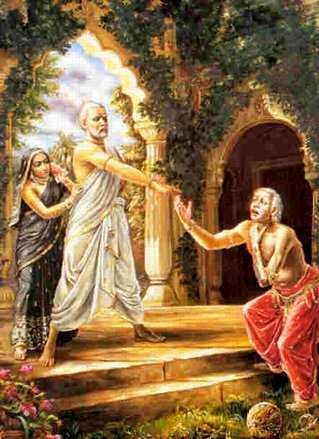
Sukra, hearing all this, said, “O monarch, since you has made vice your beloved pursuit, though fully acquainted with the precepts of Dharma, invincible decrepitude shall paralyze you!” Yayati answered, “Adorable one, I was solicited by the daughter of the Danava king to fructify her season. I did it from a sense of virtue and not from other motives. That male person, who being solicited by a woman in her season does not grant her wishes, is called, by those conversant with the Vedas, a slayer of the embryo. He who, solicited in secret by a woman full of desire and in season, goes not in unto her, loses virtue and is called by the learned a killer of the embryo, for these reasons, and anxious to avoid sin, I went into Sarmishtha.” Sukra then replied, “You are dependent on me. You should have awaited my command. Having acted falsely in the matter of your duty, O son of Nahusha, you has been guilty of the sin of theft.”Yayati, thus cursed by the angry Sukra, was then divested of his youth and immediately overcome by decrepitude. Yayati said, “O son of Bhrigu, I have not yet been satiated with youth or with Devayani. Therefore, be graceful unto me so that decrepitude might not touch me.” Sukra then answered, ‘I never speak an untruth. Even now, O king, are you attacked by decrepitude. But if you like, you are competent to transfer this your decrepitude to another.” Yayati said,
.“O Brahmana, let it be commanded by you that that son of mine who gives me his youth shall enjoy my kingdom, and shall achieve both virtue and fame ” Sukra replied, “O son of Nahusha, thinking of me you may transfer this your decrepitude to whomsoever you like. That son who shall give you his youth shall become your successor to the throne. He shall also have long life, wide fame, and numerous progeny!”
Yayati, then, overcome with decrepitude, returned to his capital and summoning his eldest son Yadu who was also the most accomplished, addressed him thus, “Dear child, from the curse of Sukra, decrepitude and wrinkles and whiteness of hair have come over me. But I have not been gratified yet with the enjoyment of youth. Do you, O Yadu, take this my weakness along with my decrepitude. I shall enjoy with your youth. When a full thousand years will have elapsed, returning to you your youth, I shall take back my weakness with this decrepitude!”
Yadu replied, “There are innumerable inconveniences in decrepitude, in respect of drinking and eating. Therefore, O king, I shall not take your decrepitude. This is, indeed, my determination. White hair on the head, cheerlessness and relaxation of the nerves, wrinkles all over the body, deformities, weakness of the limbs, emaciation, incapacity to work, defeat at the hands of friends and companions–these are the consequences of decrepitude. Therefore, I desire not to take it. O king, you have many sons some of whom are dearer to you. You are acquainted with the precepts of virtue. Ask some other son of thine to take your decrepitude.
Yayati replied, “You are sprung from my heart, O son, but you give me not your youth. Therefore, your children shall never be kings.” He continued, addressing another son of his, “O Turvasu, take you this weakness of mine along with my decrepitude. With your youth, O son, I like to enjoy the pleasure of life. After the lapse of a full thousand years I shall give back to you your youth, and take back from you my weakness and decrepitude.”
Turvasu replied, “I do not like decrepitude, O father, it takes away all appetites and enjoyments, strength and beauty of person, intellect, and even life.” Yayati said to him, “You are sprung from my heart, O son! But you give me not your youth! Therefore, O Turvasu, your race shall be extinct. Wretch, you shall be the king of those whose practices and precepts are impure, amongst whom men of inferior blood procreate children upon women of blue blood, who live on meat, who are mean, who hesitate not to appropriate the wives of their superiors, whose practices are those of birds and beasts, who are sinful, and non-Aryan.”
Yayati, having thus cursed his son Turvasu, then, addressed Sarmishtha’s son Drahyu thus, “O Drahyu, take you for a thousand years my decrepitude destructive of complexion and personal beauty and give me your youth. When a thousand years have passed away, I shall return you your youth and take back my own weakness, and decrepitude.” To this Drahyu replied, “O king, one that is decrepit can never enjoy elephants and cars and horses and women. Even his voice becomes hoarse. Therefore, I do not desire to take your decrepitude.” Yayati said to him, “You are sprung from my heart, O son! But you refuse to give me your youth. Therefore, your most cherished desires shall never be fulfilled. You shall be king only in name, of that region where there are no roads for horses and cars and elephants, and good vehicles, and asses, and goats and bullocks, and palanquins; where there is swimming only by rafts and floats.”
Yayati next addressed Anu and said, “O Anu, take my weakness and decrepitude. I shall with your youth enjoy the pleasures of life for a thousand years.” To this Anu replied, “Those that are decrepit always eat like children and are always impure. They cannot pour libations upon fire in proper times. Therefore, I do not like to take your decrepitude.” Yayati said to him, “You are sprung from my heart, you give not your youth. You find so many faults in decrepitude. Therefore, decrepitude shall overcome you! O Anu, your progeny also as soon as they attain to youth, shall die. And you shall also not be able to perform sacrifices before fire.”
Yayati at last turned to his youngest child, Puru, and addressing him said, “You are, O Puru, my youngest son! But you shall be the first of all! Decrepitude, wrinkles, and whiteness of hair have come over me in consequence of the curse of Sukra. I have not yet however, been satiated with my youth. O Puru, take you this my weakness and decrepitude! With your youth I shall enjoy for some years the pleasures of life. When a thousand years have passed away, I shall give back to you your youth and take back my own decrepitude.”
Thus addressed by the king, Puru answered with humility, “I shall do, O monarch, as you bid me. I shall take, your weakness and decrepitude. Take you my youth and enjoy as you list the pleasures of life. Covered with your decrepitude and becoming old, I shall, as you command, continue to live, giving you my youth.” Yayati then said, “O Puru, I have been gratified with you. And being gratified, I tell you that the people in your kingdom shall have all their desires fulfilled.”
Having said this, the great ascetic Yayati, then thinking of Sukra, transferred his decrepitude unto the body of the high-souled Puru.
The excellent monarch Yayati, having received Puru’s youth, became exceedingly gratified. With it he once more began to indulge in his favourite pursuits to the full extent of his desires and to the limit of his powers, according to seasons, so as to derive the greatest pleasure therefrom. In nothing that he did, he acted against the precepts of his Dharma. He gratified the gods by his sacrifices; the pitris, by Sraddhas; the poor, by his charities; all excellent Brahmanas, by fulfilling their desires; all persons entitled to the rites of hospitality, with food and drink; the Vaisyas, by protection; and the Sudras, by kindness. The king repressed all criminals by proper punishments. Yayati, gratifying all sections of his subjects, protected them virtuously like another Indra. The monarch possessed of the prowess of a lion, with youth and every object of enjoyment under control, enjoyed unlimited happiness without transgressing the precepts of Dharma. The king became very happy in thus being able to enjoy all the excellent objects of his desires. He was only sorry when he thought that those thousand years would come to an end. Having obtained youth for a thousand years, the king acquainted with the mysteries of time, and watching proper Kalas and Kashthas sported with the celestial damsel Biswachi, sometimes in the beautiful garden of Indra, sometimes in Alaka (the city of Kubera), and sometimes on the summit of the mountain Meru on the north. When the virtuous monarch saw that the thousand years were full, he summoned his son, Puru, and addressed him thus, “With your youth, O son, I have enjoyed the pleasures of life, each according to its season to the full extent of my desires, to the limit of my powers. Our desires, however, are never gratified by indulgence. On the other hand, with indulgence, they only flame up like fire with libations of sacrificial butter. If a single person were owner of everything on Earth–all her yields of paddy and barley, her silver, gold, and gems, her animals and women, he would not still be content. Thirst of enjoyment, therefore, should be given up. Indeed, true happiness belongs to them who have cast off their thirst for worldly objects–a thirst which is difficult to be thrown off by the wicked and the sinful, which fails not with the failing life, and which is truly the fatal disease of man. My heart has for a full thousand years been fixed upon the objects of desires. My thirst for these, however, increases day by day without abating. Therefore, I shall cast it off, and fixing my mind on Brahma I shall pass the rest of my days with the innocent deer in the forest peacefully and with no heart for any worldly objects. O Puru, I have been exceedingly gratified with you! Prosperity be yours! Receive back this your youth! Receive you also my kingdom. You are, indeed, that son of mine who has done me the greatest services.”
Then Yayati, received back his decrepitude. His son Puru received back his own youth. Yayati was desirous of installing Puru, his youngest son, on the throne. But the four orders, with the Brahmanas at their head, then addressed the monarch thus, “O king, how shall you bestow your kingdom on Puru, passing over your eldest son Yadu born of Devayani, and, therefore, the grandson of the great Sukra? Indeed, Yadu is your eldest son; after him has been born Turvasu; and of Sarmishtha’s sons, the first is Drahyu, then Anu and then Puru. How do the youngest deserve the throne, passing all his elder brothers over? This we represent to you! Conform to virtuous practice.”
Yayati then said, “You four orders with Brahmanas at their head, hear my words as to why my kingdom should not be given to my eldest son. My commands have been disobeyed by my eldest son, Yadu. The wise say that he is no son who disobeys his father. That son, however, who do the bidding of his parents, who seeks their good, who is agreeable to them, is indeed, the best of sons. I have been disregarded by Yadu and by Turvasu, too. Much I have been disregarded by Drahyu and by Anu also. By Puru alone has my word been obeyed. By him have I been much regarded. Therefore, the youngest shall be my heir. He took my decrepitude. Indeed, Puru is my friend. He did what was so agreeable to me. It has also been commanded by Sukra himself, the son of Kavi, that, that son of mine who should obey me will become king after me and bring the whole Earth under his sway. I, therefore, beseech you, let Puru be installed on the throne.”
The people then said, “True it is, O king, that, that son who is accomplished and who seeks the good of his parents, deserves prosperity even if he be the youngest. Therefore, do Puru, who has done the good, deserve the crown. As Sukra himself has commanded it, we have nothing to say to it.”
The son of Nahusha, thus addressed by the contented people, then installed his son, Puru, on the throne. Having bestowed his kingdom on Puru, the monarch performed the initiatory ceremonies for retiring into the woods. And soon after he left his capital, followed by Brahmanas and ascetics.
The sons of Yadu are known by the name of the Yadavas: while those of Turvasu have come to be called the Yavanas. The sons of Drahyu are the Bhojas, while those of Anu, the Mlechchhas. The progeny of Puru, however, are the Pauravas.
Uttara Yayati
King Yayati, having installed his youngest son, Puru, on the throne after casting his sons with Yadu for their eldest amongst the Mlechchhas, entered the forest to lead the life of a hermit. The king eating fruits and roots lived for some time in the forest. Having his mind and passions under complete control, the king gratified by sacrifices the Pitris and the gods. He poured libations of clarified butter upon the fire according to the rites prescribed for those leading the Vanaprastha mode of life. The illustrious one entertained guests and strangers with the fruit of the forest and clarified butter, while he himself supported life by gleaning scattered corn seeds. The king; led this sort of life for a full thousand years. Observing the vow of silence and with mind under complete control he passed one full year, living upon air alone and without sleep. He passed another year practising the severest austerities in the midst of four fires around and the Sun overhead. Living upon air alone, he stood erect upon one leg for six months. The king of sacred deeds ascended to heaven, covering heaven as well as the Earth (with the fame of his achievements).
While that king of kings dwelt in heaven–the home of the celestials, he was reverenced by the gods, the Sadhyas, the Maruts, and the Vasus. Of sacred deeds, and mind under complete control, the monarch used to repair now and then from the abode of the celestials unto the region of Brahman. It has been heard that he dwelt for a long time in heaven.
One day that best of kings, Yayati, went to Indra and there in course of conversation the lord of Earth was asked by Indra as follows: “What did you say, O king, when your son Puru took your decrepitude on Earth and when you gave him your kingdom?”
Yayati answered, “I told him that the whole country between the rivers Ganga and Yamuna was his. That is, indeed, the central region of the Earth, while the out-lying regions are to be the dominions of your brothers. I also told him that those without anger were ever superior to those under its sway, those disposed to forgive were ever superior to the unforgiving. Man is superior to the lower animals. Among men again the learned are superior to the un-learned. If wronged, you should not wrong in return. One’s wrath, if disregarded, burns one’s own self; but he that regards it not takes away all the virtues of him that exhibits it. Never should you pain others by cruel speeches. Never subdue your foes by despicable means; and never utter such scorching and sinful words as may torture others. He who pricks as if with thorns men by means of hard and cruel words, you must know, ever carries in his mouth the Rakshasas. Prosperity and luck fly away at his very sight. You should ever keep the virtuous before you as your models; you should ever with retrospective eye compare your acts with those of the virtuous; you should ever disregard the hard words of the wicked. You should ever make the conduct of the wise the model upon which you are to act yourself. The man hurt by the arrows of cruel speech hurled from one’s lips, weeps day and night. Indeed, these strike at the core of the body. Therefore the wise never fling these arrows at others. There is nothing in the three worlds by which you can worship and adore the deities better than by kindness, friendship, charity and sweet speeches unto all. Therefore, should you always utter words that soothe, and not those that scorch. You should regard those that deserve, your regards, and should always give but never beg!”
After this Indra again asked Yayati, “You did retire into the woods, O king, after accomplishing all your duties. O Yayati, I would ask you to whom you are equal in ascetic austerities.” Yayati answered, “O Vasava, I do not, in the matter of ascetic austerities, behold my equal among men, the celestials, the Gandharvas, and the great Rishis.” Indra then said, “O monarch, because you disregard those that are your superiors, your equals, and even your inferiors, without, in fact, knowing their real merits, your virtues have suffered diminution and you must fall from heaven.” Yayati then said, “O Indra, if, indeed, my virtues have really sustained diminution and I must on that account fall down from heaven, I desire, that I may at least fall among the virtuous and the honest.” Indra replied, “O king, you shall fall among those that are virtuous and wise, and you shall acquire also much renown. After this experience of yours, O Yayati, never again disregard those that are your superiors or even your equals.”
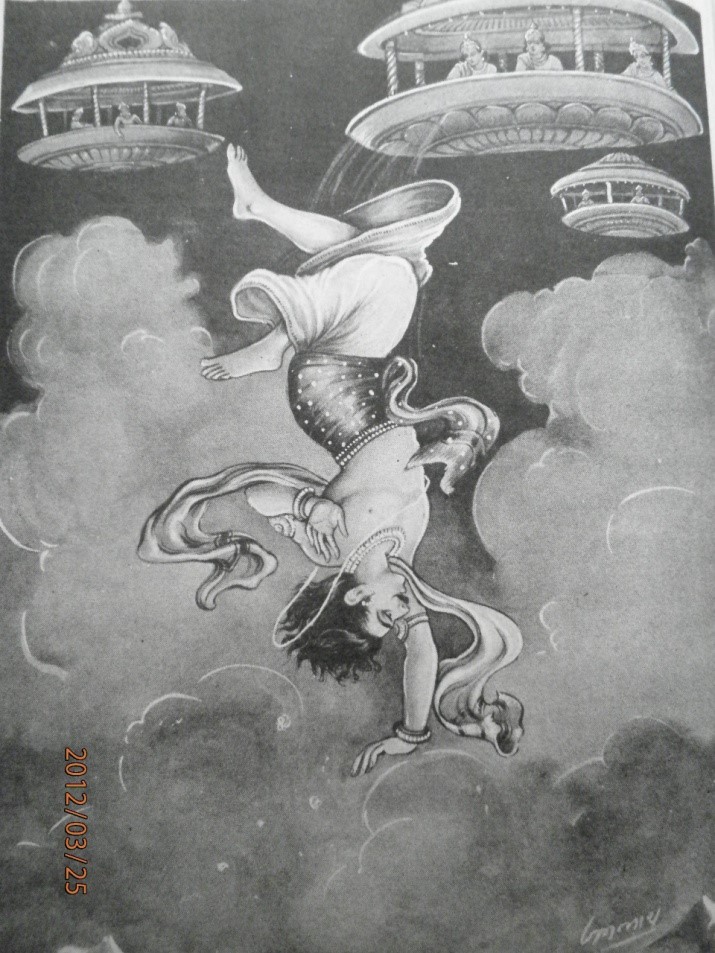
Upon this, Yayati fell from the region of the celestials. As he was falling, he was beheld by that foremost of royal sages, viz., Ashtaka, the protector of his own Dharma. Ashtaka beholding him, enquired, “Who are you, O youth of a beauty equal to that of Indra, in splendour blazing as the fire, thus falling from on high? Are you that foremost of sky-ranging bodies–the sun–emerging from, dark masses of clouds? Beholding you falling from the solar course, possessed of immeasurable energy and the splendour of fire or the sun, every one is curious as to what it is that is so falling, and is, besides, deprived of consciousness! Beholding you in the path of the celestials, possessed of energy like that of Indra, or Surya, or Vishnu, we have approached you to ascertain the truth. If you have first asked us who we were, we would never have been guilty of the incivility of asking you first. We now ask you who you are and why you approach here. Let your fears be dispelled; let your woes and afflictions cease. You are now in the presence of the virtuous and the wise. Even Indra himself cannot here do you any injury. The wise and the virtuous are the support of their brethren in grief. Here there are none but the wise and virtuous like you assembled together. Therefore, stay you here in peace. Fire alone has power to give heat. The Earth alone has power to infuse life into the seed. The sun alone has power to illuminate everything. So the guest alone has power to command the virtuous and the wise.”
Yayati said, “I am Yayati, the son of Nahusha and the father of Puru. Cast off from the region of the celestials and of Siddhas and Rishis for having disregarded every creature, I am falling down, my righteousness having sustained diminution. In years I am older than you; therefore, I have not saluted you first. Indeed, the Brahmanas always reverence him who is older in years or superior in learning or in ascetic merit.”
Ashtaka then replied, “You say, O monarch, that he who is older in years is worthy of regard. But it is said that he is truly worthy of worship who is superior in learning and ascetic merit.”
Yayati replied to this, “It is said that sin destroys the merits of four virtuous acts. Vanity contains the element of that which leads to hell. The virtuous never follow in the footsteps of the vicious. They act in such a way that their religious merit always increases. I myself had great religious merit, but all that, however, is gone. I will scarcely be able to regain it even by my best exertions. Beholding my fate, he who is bent upon (achieving) his own good, will certainly suppress vanity. He who having acquired great wealth performs meritorious sacrifices, who having acquired all kinds of learning remains humble, and who having studied the entire Vedas devotes himself to asceticism with a heart withdrawn from all mundane enjoyments, goes to heaven. None should exult in having acquired great wealth. None should be vain of having studied the entire Vedas. In the world men are of different dispositions. Destiny is supreme. Both power and exertion are all fruitless. Knowing Destiny to be all-powerful, the wise, whatever their portions may be, should neither exult nor grieve. When creatures know that their weal and woe are dependent on Destiny and not on their own exertion or power, they should neither grieve nor exult, remembering that Destiny is all powerful. The wise should ever live contented, neither grieving at woe nor exulting at weal. When Destiny is supreme, both grief and exultation are unbecoming. O Ashtaka, I never suffer myself to be overcome by fear, nor do I ever entertain grief, knowing for certain that I shall be in the world what the great disposer of all has ordained. Insects and worms, all oviparous creatures, vegetable existences, all crawling animals, vermin, the fish in the water, stones, grass, wood–in fact, all created things, when they are freed from the effects of their acts, are united with the Supreme Soul. Happiness and misery are both transient. Therefore, O Ashtaka, why should I grieve? We can never know how we are to act in order to avoid misery. Therefore, none should grieve for misery.”
Possessed of every virtue, king Yayati who was the maternal grandfather of Ashtaka, while staying in the welkin, at the conclusion of his speech, was again questioned by Ashtaka. The latter said, “O king of kings, tell me, in detail, of all those regions that you has visited and enjoyed, as well as the period for which you has enjoyed each. You speak of the precepts of Dharma even like the clever masters acquainted with the acts and sayings of great beings!”
Yayati replied, “I was a great king on Earth, owning the whole world for my dominion. Leaving it, I acquired by dint of religious merit many high regions. There I dwelt for a full thousand years, and then I attained to a very high region the abode of Indra, of extraordinary beauty having a thousand gates, and extending over a hundred yojanas all round. There too, I dwelt a full thousand years and then attained to a higher region still. That is the region of perfect beatitude, where decay never exists, the region, viz., that of the Creator and the Lord of Earth, so difficult of attainment. There also I dwelt for a full thousand years, and then attained to another very high region viz., that of the god of gods (Vishnu) where, too, I had lived in happiness. Indeed, I dwelt in various regions, adored by all the celestials, and possessed of prowess and splendour equal unto those of the celestials themselves. Capable of assuming any form at will, I lived for a million years in the gardens of Nandana sporting with the Apsaras and beholding numberless beautiful trees clad in flowery vesture and sending forth delicious perfume all round. After many, many years had elapsed, while still residing there in enjoyment of perfect beatitude, the celestial messenger of grim visage, one day, in a loud and deep voice, thrice shouted to me – Ruined! Ruined! Ruined! – this much do I remember. I was then fallen from Nandana, my religious merits gone! I heard in the skies, the voices of the celestials exclaiming in grief, – Alas! What a misfortune! Yayati, with his religious merits destroyed, though virtuous and of sacred deeds, is falling! – As I was falling, I asked them loudly, “Where, you celestials, are those wise ones amongst whom I am to fall?” They pointed out to me this sacred sacrificial region belonging to you. Beholding the curls of smoke blackening the atmosphere and smelling the perfume of clarified butter poured incessantly upon fire, and guided thereby, I am approaching this region of yours, glad at heart that I come amongst you.”
Ashtaka said, “Capable of assuming any form at will, you have lived for a million years in the gardens of Nandana. For what cause, have you been compelled to leave that region and come here?”
Yayati answered, “As kinsmen, friends, and relatives forsake, in this world, those whose wealth disappears so, in the other world, the celestials with Indra as their chief, forsake him who has lost his righteousness.”
Ashtaka said, “I am extremely anxious to know how in the other world men can lose virtue. Tell me also, O king, what regions are attainable by what courses of action. You are acquainted, I know, with the acts and sayings of great beings.”
Yayati answered, “O pious one, they who speak of their own merits are doomed to suffer the hell called Bhauma. Though really emaciated and lean, they appear to grow on Earth (in the shape of their sons and grandsons) only to become food for vultures, dogs, and jackals. Therefore, this highly censurable and wicked vice should be repressed. I have now, told you all. Tell me what more I shall say.”
Ashtaka said, “When life is destroyed with age, vultures, peacocks, insects, and worms eat up the human body. Where does man then reside? How does he also come back to life? I have never heard of any hell called Bhauma on Earth!”
Yayati answered, “After the dissolution of the body, man, according to his acts, re-enters the womb of his mother and stays there in an indistinct form, and soon after assuming a distinct and visible shape reappears in the world and walks on its surface. This is that Earth-hell (Bhauma) where he falls, for he beholds not the termination of his existence and acts not towards his emancipation. Some dwell for sixty thousand years, some, for eighty-thousand years in heaven, and then they fall. And as they fall, they are attacked by certain Rakshasas in the form of sons, grandsons, and other relatives, that withdraw their hearts from acting for their own emancipation.”
Ashtaka asked, “For what sin are beings, when they fall from heaven, attacked by these fierce and sharp-toothed Rakshasas? Why are they not reduced to annihilation? How do they again enter the womb, furnished with senses?”
Yayati answered, “After falling from heaven, the being becomes a subtle substance living in water. This water becomes the semen where is the seed of vitality. From there entering the mother’s womb in the womanly season, it develops into the embryo and next into visible life like the fruit from the flower. Entering trees, plants, and other vegetable substances, water, air, earth, and space, that same watery seed of life assumes the quadrupedal or bipedal form. This is the case with all creatures that you see.”
Ashtaka said, “Tell me, I ask you because I have my doubts. Does a being that has received a human form enter the womb in its own shape or in some other? How does it also acquire its distinct and visible shape, eyes and ears and consciousness as well? Questioned by me, explain it all! You are one acquainted with the acts and sayings of great beings.”
Yayati answered, “According to the merits of one’s acts, the being that in a subtle form co-inheres in the seed that is dropped into the womb is attracted by the atmospheric force for purposes of re-birth. It then develops there in course of time; first it becomes the embryo, and is next provided with the visible physical organism. Coming out of the womb in due course of time, it becomes conscious of its existence as man, and with his ears becomes sensible of sound; with his eyes, of colour and form; with his nose, of scent; with his tongue, of taste; by his whole body, of touch; and by his mind, of ideas. It is thus, O Ashtaka, that the gross and visible body develops from the subtle essence.”
Ashtaka asked, “After death, the body is burnt, or otherwise destroyed. Reduced to nothing upon such dissolution, by what principle is one revived?”
Yayati said, “The person that dies assumes a subtle form; and retaining consciousness of all his acts as in a dream, he enters some other form with a speed quicker than that of air itself. The virtuous attain to a superior, and the vicious to an inferior form of existence. The vicious become worms and insects. I have nothing more to say, I have told you how beings are born, after development of embryonic forms, as four-footed, six-footed creatures and others with more feet. What more wilt you ask me?”
Ashtaka said, “How do men attain to those superior regions whence there is no return to earthly life? Is it by asceticism or by knowledge? How also can one gradually attain to felicitous regions? Asked by me, answer it in full.”
Yayati answered, “The wise say that for men there are seven gates through which admission may be gained into Heaven. There are asceticism, benevolence, tranquility of mind, self-command, modesty, simplicity, and kindness to all creatures. The wise also say that a person loses all these in consequence of vanity. That man who having acquired knowledge regards himself as learned, and with his learning destroyed the reputation of others, never attains to regions of indestructible felicity. That knowledge also does not make its possessor competent to attain to Brahma. Study, taciturnity, worship before fire, and sacrifices, these four remove all fear. When, however, these are mixed with vanity, instead of removing it, they cause fear. The wise should never exult at honours nor should they grieve at insults. For it is the wise alone that honour the wise; the wicked never act like the virtuous. I have given away so much–I have performed so many sacrifices,–I have studied so much,–I have observed these vows,–such vanity is the root of fear. Therefore, you must not indulge in such feelings. Those learned men who accept as their support the unchangeable, inconceivable Brahma alone that ever showers blessings on persons virtuous like you, enjoy perfect peace here and hereafter.”
Ashtaka said, “Those cognizant of the Vedas differ in opinion as to how the followers of each of the four modes of life, viz., Grihasthas, Bhikshus, Brahmacharins, and Vanaprashthas, should conduct themselves in order to acquire religious merit.”
Yayati answered, “These are what a Brahmacharin must do. While dwelling in the abode of his preceptor, he must receive lessons only when his preceptor summons him to do so; he must attend to the service of his preceptor without waiting for the latter’s command; he must rise from his bed before his preceptor rises, and go to bed after his preceptor has gone to bed. He must be humble, must have his passions under complete control, must be patient, vigilant, and devoted to studies. It is then only that he can achieve success. It has been said in the oldest Upanishad that a grihastha, acquiring wealth by honest means, should perform sacrifices; he should always give something in charity, should perform the rites of hospitality unto all arriving at his abode, and should never use anything without giving a portion thereof to others. A Muni, without search for woods, depending on his own vigour, should abstain from all vicious acts, should give away something in charity, should never inflict pain on any creature. It is then only that he can achieve success. He, indeed, is a true Bhikshu who does not support himself by any manual arts, who possesses numerous accomplishments, who has his passions under complete control, who is unconnected with worldly concerns, who sleeps not under the shelter of a householder’s roof, who is without wife, and who going a little way every day, travels over a large extent of the country. A learned man should adopt the Vanaprastha mode of life after performance of the necessary rites, when he has been able to control his appetites for enjoyment and desire of acquiring valuable possessions. When one dies in the woods while leading the Vanaprastha mode of life, he makes his ancestors and the successors, numbering ten generations including himself, mix with the Divine essence.”
Ashtaka asked, “How many kinds of Munis are there (observers of the vow of the silence)?”
Yayati answered, “He is, indeed, a Muni who, though dwelling in the woods, has an inhabited place near, or who, though dwelling in an inhabited place, has the woods near. A Muni withdrawing himself from all worldly objects lives in the woods. Though he might never seek to surround himself with those objects that are procurable in an inhabited place, he might yet obtain them all by virtue of his ascetic power. He may truly be said to dwell in the woods having an inhabited place near to himself. Again a wise man withdrawn from all earthly objects, might live in a hamlet leading the life of a hermit. He may never exhibit the pride of family, birth or learning. Clad in the scantiest robes, he may yet regard himself as attired in the richest vestments. He may rest content with food just enough for the support of life. Such a person, though dwelling in an inhabited place, lives yet in the woods. The person again, who, with passions under complete control, adopts the vow of silence, refraining from action and entertaining no desire, achieves success. Why should you not, indeed, reverence the man who lives on clean food, who refrains from ever injuring others, whose heart is ever pure, who stands in the splendour of ascetic attributes, who is free from the leaden weight of desire, who abstains from injury even when sanctioned by Dharma? Emaciated by austerities and reduced in flesh, marrow and blood, such a one conquers not only this but the highest world. And when the Muni sits in yoga meditation, becoming indifferent to happiness and misery, honour and insult, he then leaves the world and enjoys communion with Brahma. When the Muni takes food like wine and other animals, i. e., without providing for it beforehand and without any relish (like a sleeping infant feeding on the mother’s lap), then like the all-pervading spirit he becomes identified with the whole universe and attains to salvation.”
Ashtaka asked, “Who amongst these, O king, both exerting constantly like the Sun and the Moon, first attains to communion with Brahma, the ascetic or the man of knowledge?”
Yayati answered, “The wise, with the help of the Vedas and of Knowledge, having ascertained the visible universe to be illusory, instantly realizes the Supreme Spirit as the sole existent independent essence. While they that devote themselves to Yoga meditation take time to acquire the same knowledge, for it is by practice alone that these latter divest themselves of the consciousness of quality. Hence the wise attain to salvation first. Then again if the person devoted to Yoga find not sufficient time in one life to attain success, being led astray by the attractions of the world, in his next life he is benefited by the progress already achieved, for he devotes himself regretfully to the pursuit of success. But the man of knowledge ever beholds the indestructible unity, and, is, therefore, though steeped in worldly enjoyments, never affected by them at heart. Therefore, there is nothing to impede his salvation. He, however, who fails to attain to knowledge, should yet devote himself to piety as dependent on action. But he that devotes himself to such piety, moved thereto by desire of salvation, can never achieve success. His sacrifices bear no fruit and partake of the nature of cruelty. Piety which is dependent on action that proceeds not from the desire of fruit, is, in case of such men Yoga itself.”
Ashtaka said, “O king, you look like a young man; you are handsome and decked with a celestial garland. Your splendour is great! Whence do you come and where do you go? Whose messenger are you? Are you going down into the Earth?”
Yayati said, “Fallen from heaven upon the loss of all my religious merits, I am doomed to enter the Earth-hell. Indeed, I shall go there after I have finished my discourse with you. Even now the regents of the points of the universe command me to hasten there. O king, I have obtained it as a boon from Indra that though fall I must upon the earth, yet I should fall amidst the wise and the virtuous. You are all wise and virtuous that are assembled here.”
Ashtaka said, “You are acquainted with everything. I ask you, O king, are there any regions for myself to enjoy in heaven or in the firmament? If there be, then, you shall not fall, though falling.”
Yayati answered, “O king, there are as many regions for you to enjoy in heaven even as the number of kine and horses on Earth with the animals in the wilderness and on the hills.”
Ashtaka said, “If there are worlds for me to enjoy, as fruits of my religious merits, in heaven, O king, I give them all unto you. Therefore, though falling, you shall not fall. Take you soon all those, wherever they be, in heaven or in the firmament. Let your sorrow cease.”
Yayati answered, “O best of kings, a Brahma-knowing Brahmana alone can take in gift, but not one like ourselves. And I myself have given away to Brahmanas as one should. Let no man who, is not a Brahmana and let not the wife of a learned Brahmana ever live in infamy by accepting gifts. While on earth, I ever desired to perform virtuous acts. Having never done so before, how shall I now accept a gift?”
Pratardana who was amongst them asked, “O you of the handsomest form, I am Pratardana by name. I ask you if there are any worlds for me to enjoy as fruits of my religious merits, in heaven or the firmament? Answer me, you are acquainted with everything.”
Yayati said, “O king, numberless worlds, full of felicity, effulgent like the solar disc, and where woe can never dwell, await you. If you dwell in each but for seven days, they would not yet be exhausted.”
Pratardana said, ‘These then I give unto you. Therefore, though falling, you must not fall. Let the worlds that are mine be thine, whether they be in the firmament or heaven. O, soon take them. Let your woes cease.”
Yayati answered, “O monarch, no king of equal energy should ever desire to receive as gift the religious merits of another king acquired by Yoga austerities. No king who is afflicted with calamity through the fates should, if wise, act in a censurable way. A king keeping his eye fixed for ever on virtue should walk along the path of virtue like myself and, knowing what his duties are, should not act so meanly as you direct. When others desirous of acquiring religious merits do not accept gifts, how can I do what they themselves do not?”
On the conclusion of this speech, Yayati, was then addressed by Vasumat in the following words: “I am Vasumat, the son of Oshadaswa. I would ask you, O king, whether there are any worlds for me to enjoy as fruits of my religious merits, in heaven or the firmament. You are acquainted with all holy regions.”
Yayati answered, “There are as many regions for you to enjoy in heaven as the number of places in the firmament, the Earth and the ten points of the universe illumined by the Sun.”
Vasumat then said, “I give them to you. Let those regions that are for me be yours. Therefore, though falling, you shall not fall. If to accept them as gift be improper for you, then, O monarch, buy them for a straw?”
Yayati answered, “I do not remember having ever bought and sold anything unfairly. This has never been done by other kings. How shall I therefore do it?”
Vasumat said, “If buying them, O king, be regarded by you as improper, then take them as gilt from me. For myself I answer that I will never go to those regions that are for me. Let them, therefore, be yours.”
Sibi then addressed the king thus, “I am, O king, Sibi by name, the son of Usinara. Are there in the firmament or in heaven any worlds for me to enjoy? You know every region that one may enjoy as the fruit of his religious merit.”
Yayati said, “You have never, by speech or in mind, disregarded the honest and the virtuous that applied to you. There are infinite worlds for you to enjoy in heaven, all blazing like lightning.”
Sibi then said, “If you regard their purchase as improper, I give them to you. Take them all, O king! I shall never take them, viz., those regions where the wise never feel the least disquiet.”
Yayati answered, “O Sibi, you has indeed, obtained for yourself, possessed of the prowess of Indra, infinite worlds. But I do not desire to enjoy regions given to me by others. Therefore, I accept not your gift.”
Ashtaka then said, “O king, each of us has expressed his desire to give you worlds that each of us has acquired by his religious merits. You accept not them. But leaving them for you, we shall descend into the Earth-hell.”
Yayati answered, “You all are truth-loving and wise. Give me that which I deserve. I shall not be able to do what I have never done before.”
Ashtaka then said, “Whose are those five golden cars that we see? Do men that repair to these regions of everlasting bliss ride in them?”
Yayati answered, “Those five golden cars displayed in glory, and blazing as fire, would indeed, carry you to regions of bliss.”
Ashtaka said, “O king, ride on those cars yourself and repair to heaven. We can wait. We follow you in time.”
Yayati said, “We can now all go together. Indeed, all of us have conquered heaven. Behold, the glorious path to heaven becomes visible.”
Then all those excellent monarchs riding in those cars set out for heaven for gaining admittance into it, illuminating the whole firmament by the glory of their virtues.
Then Ashtaka, breaking the silence asked, “I had always thought that Indra was my especial friend, and that I, of all others, should first obtain admittance into heaven. But how is it that Usinara’s son, Sibi has already left us behind?”
Yayati answered, “This Usinara’s son had given all he possessed for attaining to the region of Brahman. Therefore, is he the foremost among us. Besides, Sibi’s liberality, asceticism, truth, virtue, modesty, forgiveness, amiability, desire of performing good acts, have been so great that none can measure them!”
After this, Ashtaka, impelled by curiosity, again asked his maternal grandfather resembling Indra himself, saying, “O king, I ask you, tell me truly, whence you are, who you are, and whose son? Is there any other Brahmana or Kshatriya who has done what you didst on earth?”
Yayati answered, “I tell you truly, I am Yayati, the son of Nahusha and the father of Puru. I was lord of all the Earth. You are my relatives; I tell you truly, I am the maternal grandfather of you all. Having conquered the whole earth, I gave clothes to Brahmanas and also a hundred handsome horses fit for sacrificial offering. For such acts of virtue, the gods became propitious to those that perform them. I also gave to Brahmanas this whole earth with her horses and elephants and kine and gold all kinds of wealth, along with a hundred Arbudas of excellent milch cows. Both the earth and the firmament exist owing to my truth and virtue; fire yet burns in the world of men owing to my truth and virtue. Never has a word spoken by me been untrue. It is for this that the wise adore Truth. O Ashtaka, all I have told you, Pratardana, and Vasumat, is Truth itself. I know it for certain that the gods and the Rishis and all the mansions of the blessed are adorable only because of Truth that characterizes them all. He that will without malice duly read unto good Brahmanas his account of our ascension to heaven shall himself attain to the same worlds with us.”
It was thus that the illustrious king Yayati of high achievements, rescued by his collateral descendants, ascended to heaven, leaving the earth and covering the three worlds with the fame of his deeds.
Tapatyopakhyana: The story of Tapati
That one in heaven who pervades by his light the whole firmament, the Sun, had a daughter named Tapati equal unto himself. Tapati, the daughter of the god Vivaswat, was the younger sister of Savitri, and she was celebrated throughout the three worlds and devoted to ascetic penances. There was no woman amongst the celestials, the Asuras, the Yakshas, the Rakshasas, the Apsaras, and the Gandharvas, who was equal to her in beauty. Of perfect, symmetrical and faultless features, of black and large eyes, and in beautiful attire, the girl was chaste and of perfect conduct. Seeing her, Savitri the sun thought that there was none in the three worlds who, for his beauty, accomplishments, behaviour, and learning, deserved to be her husband. Beholding her attain the age of puberty and, therefore, worthy of being bestowed on a husband, her father knew no peace of mind, always thinking of the person he should select. At that time, Riksha’s son, that bull amongst the Kurus, the mighty king Samvarana, was duly worshipping Surya with offerings of Arghya and flower-garlands and scents, and with vows and fasts and ascetic penances of various kinds. Indeed, Samvarana was worshipping Surya constantly in all his glory, with devotion and humility and piety. Beholding Samvarana conversant with all rules of virtue and unequalled on earth for beauty, Surya regarded him as the fit husband for his daughter, Tapati. Vivaswat then resolved to bestow his daughter on that best of kings, Samvarana. As Surya himself in the heavens fills the firmament with his splendour, so did king Samvarana on earth fill every region with the splendour of his good achievements. All men, except Brahmanas, worshipped Samvarana. Blessed with good luck, king Samvarana excelled Soma in soothing the hearts of friends and Surya in scorching the hearts of foes. Tapana Surya himself was resolved upon bestowing his daughter Tapati upon king Samvarana, who was possessed of such virtues and accomplishments.
Once on a time, king Samvarana, endued with beauty and immeasurable prowess, went on a hunting expedition to the under-woods on the mountain-breast. While wandering in quest of deer, the excellent steed the king rode, overcome, with hunger, thirst and fatigue, died on the mountains. Abandoning the steed, the king, began to wander about upon the mountain-breast on foot and in course of his wandering the monarch saw a maiden of large eyes and unrivalled beauty, That tiger among kings, himself without a companion, beholding there that maiden without a companion, stood motionless gazing at her steadfastly. For her beauty, the monarch for some moment believed her to be the goddess Sri herself. Next he regarded her to be the embodiment of the rays emanating from Surya. In splendour of her person she resembled a flame of fire, though in benignity and loveliness she resembled a spotless digit of the moon. Standing on the mountain-breast, the black-eyed maiden appeared like a bright statue of gold. The mountain itself with its creepers and plants, because of the beauty and attire of that damsel, seemed to be converted into gold. The sight of that maiden inspired the monarch with a contempt for all women that he had seen before. By beholding her, the king regarded his eye-sight truly blessed. Nothing the king had seen from the day of his birth could equal, he thought, the beauty of that girl. The king’s heart and eyes were captivated by that damsel, as if they were bound with a cord and he remained rooted to that spot, deprived of his senses. The monarch thought that the artificer of so much beauty had created it only after churning the whole world of gods Asuras and human beings. Entertaining these various thoughts, king Samvarana regarded that maiden as unrivalled in the three worlds for wealth of beauty.
The monarch of pure descent, beholding the beautiful maiden, was pierced with Kama’s shafts and lost his peace of mind. Burnt with the strong flame of desire the king asked that charming maiden, still innocent, though in her full youth, saying, “Who are you and whose? Why also do you stay here? O you of sweet smiles, why do you wander alone in these solitary woods? Of every feature perfectly faultless, and decked with every ornament, you seem to be the coveted ornament of these ornaments themselves! You seem not to be of celestial or Asura or Yaksha or Rakshasa or Naga or Gandharva or human origin. O excellent lady, the best of women that I have ever seen or heard of would not compare with you in beauty! O you of handsome face, at sight of you lovelier than the moon and graced with eyes like lotus-petals, the god of desire is grinding me.”
King Samvarana thus addressed that damsel in the forest, who however, spoke not a word unto the monarch burning with desire. Instead, like lightning in the clouds, that large-eyed maiden quickly disappeared in the very sight of the monarch. The king then wandered through the whole forest, like one out of his senses, in search of that girl of eyes like lotus-petals. Failing to find her, that best of monarchs indulged in copious lamentations and for a time stood motionless with grief.
When that maiden disappeared, that feller of hostile ranks deprived of his senses by Kama himself fell down on the earth. As the monarch fell down, that maiden of sweet smiles and prominent and round hips appeared again before him, and smiling sweetly, said unto that perpetuator of Kuru’s race these honeyed words, “Rise, rise, O chastiser of foes! Blessed be you; it beholds you not, O tiger among kings, to lose your reason, a celebrated man as you are in the world.” Addressed in these honeyed words, the king opened his eyes and saw before him that selfsame girl of swelling hips. The monarch who was burning with the flame of desire then addressed that black-eyed damsel in accents, weak with emotion, and said, “Blessed be you O excellent woman of black eyes! As I am burning with desire and paying you court, accept me! My life is ebbing away. For your sake it is, that Kama is incessantly piercing me with his keen shafts without stopping for a moment! I have been bitten by Kama who is even like a venomous viper. Have mercy on me! My life now depends on you! Without you, I am unable to live! Kama is piercing me incessantly! Be merciful unto me! It becomes you not to cast me off; it beholds you to relieve me from such affliction by giving me your love! At first sight you have attracted my heart. My mind wanders! Beholding you I like not to cast my eyes on any other woman! Be merciful! I am your obedient slave–your adorer! Accept me! At the sight of you, the god of desire has entered my heart, and is piercing me with his shafts! The flame of desire burns within me! Extinguish that flame with the water of your love poured on it! By becoming mine, pacify you the irrepressible god of desire that has appeared here armed with his deadly bow and arrows and that is piercing me incessantly with those keen shafts of his! Wed me according to the Gandharva form, for, of all forms of marriage the Gandharva has been said to be the best.”
Hearing those words of the monarch, Tapati made answer, “O king, I am not the mistress of my own self! Be it known that I am a maiden under the control of my father. If you really entertain an affection for me, demand me of my father. You say that your heart has been robbed by me. But you also has, at first sight, robbed me of my heart; I am not the mistress of my body, and therefore, I do not approach you; women are never independent. What girl is there in the three worlds that would not desire you for her husband, as you are kind unto all your dependents and as you are born in a pure race? Therefore, when the opportunity comes, ask my father Aditya for my hand with worship, ascetic penances, and vows. If my father bestows me upon you, then, I shall ever be your obedient wife. My name is Tapati and I am the younger sister of Savitri, and the daughter of Savitri, of Sun the illuminator of the universe.”
Saying this, Tapati of faultless features, ascended the skies. The monarch thereupon again fell down on the earth. His ministers and followers searching for him throughout the forest at length came upon him lying on that solitary spot, and beholding that excellent king, that mighty bowman, thus lying forsaken on the ground like a rainbow dropped from the firmament, his minister-in-chief became like one burnt by a flame of fire. Advancing hastily with affection and respect, the minister raised that best of monarchs lying prostrate on the ground and deprived of his senses by desire. Old in wisdom as in age, old in achievements as in policy, the minister, after having raised the prostrate monarch, became easy in mind. Addressing the king in sweet words that were also for his good, he said, “Blessed be you, O sinless one! Fear not, O tiger among kings!” The minister thought that the monarch, that great feller of hostile ranks in battle, had been lying on the ground overcome with hunger, thirst, and fatigue. The old man then sprinkled over the crownless head of the monarch water that was cold and rendered fragrant with lotus-petals. Slowly regaining his consciousness, the mighty monarch sent away all his attendants with the exception of his minister only. After those attendants had retired at his command, the king sat upon the mountain-breast. Having purified himself duly, the king sat upon that chief of mountains, and began, with joined palms and upturned face, to worship Surya. King Samvarana, that smiter of all foes, thought also of his chief priest Vasishtha, that best of Rishis. The king continued to sit there day and night without intermission. The Brahmana sage Vasishtha came there on the twelfth day: that great Rishi of soul under perfect command knew at once by his ascetic power that the monarch had lost his senses in consequence of Tapati. That virtuous and best of Munis, as soon as he knew this, desirous of benefiting the monarch who was ever observant of vows, addressed him and gave him every assurance. The illustrious Rishi, in the very sight of that monarch, ascended upward to interview Surya, himself possessed of the splendour of that luminary. The Brahmana then approached with joined hands the god of a thousand rays and introduced himself cheerfully unto him, saying, “I am Vasishtha.” Then Vivaswat of great energy said unto that best of Rishis, “Welcome are you, O great Rishi! Tell me what is in your mind. O you of great good fortune, whatever you demand of me, O foremost of eloquent men, I will confer on you, however difficult it may be for me!” Thus addressed by Surya, the Rishi of great ascetic merit, bowing unto the god of light, replied, saying, “O Vibhavasu, this your daughter, Tapati, the younger sister of Savitri, I ask of you for Samvarana! That monarch is of mighty achievements, conversant with virtue, and of high soul. O firmament-ranger, Samvarana will make a worthy husband for your daughter.” Thus addressed by the Rishi Vibhakara, resolved upon bestowing his daughter upon Samvarana, saluted the Rishi, and replied unto him, saying, “Oh, Samvarana is the best of monarchs, you are the best of Rishis, Tapati is the best of women. What should we do, therefore, but bestow her on Samvarana?” With these words, the god Tapana, made over his daughter, Tapati, of every feature perfectly faultless, unto the illustrious Vasishtha to bestow her upon Samvarana. And the great Rishi then accepted the girl, Tapati, and taking leave of Surya, came back to the spot, where that bull amongst the Kurus, of celestial achievements, was. King Samvarana, possessed by love and with his heart fixed on Tapati, beholding that celestial maiden of sweet smiles led by Vasishtha, became exceedingly glad. Tapati of fair eyebrows came down from the firmament like lightning from the clouds, dazzling the ten points of the heavens. The illustrious Rishi Vasishtha of pure soul approached the monarch after the latter’s twelve nights’ vow was over. It was thus that king Samvarana obtained a wife after having worshipped with like the full moon.
Samvarana, with due rites took Tapati’s hand on that mountain-breast which was resorted to by the celestials and the Gandharvas. The royal sage, with the permission of Vasishtha, desired to sport with his wife on that mountain. The king caused Vasishtha, to be proclaimed his regent in his capital and kingdom, in the woods and gardens. Bidding farewell unto the monarch, Vasishtha left him and went away. Samvarana, who sported on that mountain like a celestial, sported with his wife in the woods and the under-woods on that mountain for twelve full years. And, the god of a thousand eyes poured no rain for twelve years on the capital and on the kingdom of that monarch. Then, when that season of drought broke out, the people of that kingdom, as also the trees and lower animals began to die fast. During the continuance of that dreadful drought, not even a drop of dew fell from the skies and no corn grew. The inhabitants in despair, and afflicted with the fear of hunger, left their homes and fled away in all directions. The famished people of the capital and the country began to abandon their wives and children and grew reckless of one another. The people being afflicted with hunger, without a morsel of food and reduced to skeletons, the capital looked very much like the city of the king of the dead, full of only ghostly beings. On beholding the capital reduced to such a state, the illustrious and virtuous and best of Rishis, Vasishtha was resolved upon applying a remedy and brought back unto the city Samvarana, along with his wife, after the latter had passed so long a period in solitude and seclusion. After the king had entered his capital, things became as before, for, when that king came back to his own, the god of a thousand eyes, the slayer of Asuras, poured rain in abundance and caused corn to grow. Revivified by the foremost of virtuous souls the capital and the country became animated with extreme joy. The monarch, with his wife, Tapati, once more performed sacrifices for twelve years, like the lord Indra (god of rain) performing sacrifices with his wife, Sachi.
Vasishthopakyana: The story of Vasishtha
There was, in Kanyakubja, a great king of worldwide fame named Gadhi, the son of Kusika. The virtuous Gadhi had a son named Viswamitra, that grinder of foes, possessing a large army and many animals and vehicles. Viswamitra, accompanied by his ministers, used to roam in quest of deer through the deep woods killing deer and wild boars. Once on a time, while out in quest of deer, the king became weak with exertion and thirst. The monarch arrived in that state at the Ashrama of Vasishtha, and the blessed and illustrious Rishi beholding him arrive, reverenced with his homage that best of men, king Viswamitra. The Rishi saluted the monarch by offering him water to wash his face and feet with, and Arghya, and wild fruits, and clarified butter. For the illustrious Rishi had a cow yielding anything that was desired of her. When she was addressed, saying, “O give,” she always yielded the article that was sought. She yielded various fruits and corn, wild or grown in gardens and fields, and milk, and many excellent nutritive viands full of six different kinds of juice and like unto nectar itself, and various other kinds of enjoyable things, of ambrosial taste for drinking and eating, and for licking and sucking, and also many precious gems and robes of various kinds. With these desirable objects in profusion the monarch was worshipped. The king with his minister and troops became highly pleased. The monarch wondered much, beholding that cow with six elevated limbs and the beautiful flanks and hips, and five limbs that were broad, and eyes prominent like those of the frog and beautiful in size, and high udders, and faultless make, and straight and uplifted ears, and handsome horns, and well-developed head and neck.
The son of Gadhi, gratified with everything and applauding the cow named Nandini, addressed the Rishi, saying, “O Brahmana, O great Muni, give me your Nandini in exchange for ten thousand kine, or my kingdom. Enjoy you my kingdom.”
Hearing these words of Viswamitra, Vasishtha said, “O sinless one, this cow has been kept by me for the sake of the gods, guests, and the Pitris, as also for my sacrifices. I cannot give Nandini in exchange for even your kingdom.” Viswamitra replied, “I am a Kshatriya, but you are a Brahmana devoted to asceticism and study. Is there any energy in Brahmanas who are peaceful and who have their souls under perfect command? When you give me not what I desire in exchange even for ten thousand cows, I will not abandon the practice of my order; I will take your cow even by force!”
Vasishtha said, “You are a Kshatriya endued with might of arms. You are a powerful monarch. Do in haste what you desire; and stop not to consider its propriety.”
Thus addressed by Vasishtha, Viswamitra, then forcibly seized Nandini, that cow like the swan or the moon, and attempted to take her away, afflicting her with stripes and persecuting her otherwise. The innocent Nandini then began, to low piteously, and approaching the illustrious Vasishtha stood before him with uplifted face. Though persecuted very cruelly, she refused to leave the Rishi’s Ashrama.
Beholding her in that plight, Vasishtha said, “O amiable one, you are lowing repeatedly and I am hearing your cries. But, O Nandini, even Viswamitra is taking you away by force, what can I do in this matter, as I am a forgiving Brahmana?”
Then, Nandini, alarmed at the sight of Viswamitra’s troops and terrified by Viswamitra himself, approached the Rishi still closer, and said, “O illustrious one, why are you so indifferent to my poor self afflicted with the stripes of the cruel troops of Viswamitra and crying so piteously as if I were master less?” Hearing these words of the crying and persecuted Nandini, the great Rishi lost not his patience nor turned from his vow of forgiveness. He replied, “The Kshatriya’s might lies in physical strength, the Brahmana’s in forgiveness. Because I cannot give up forgiveness, go you, O Nandini, if you choose.” Nandini answered, “Cast you me away, O illustrious one, that you say so? If you do not cast me off, I cannot, O Brahmana, be taken away by force.” Vasishtha said, “O blessed one, I do not cast you off! Stay if you can! O, yonder is your calf, tied with a stout cord, and even now being weakened by it!”
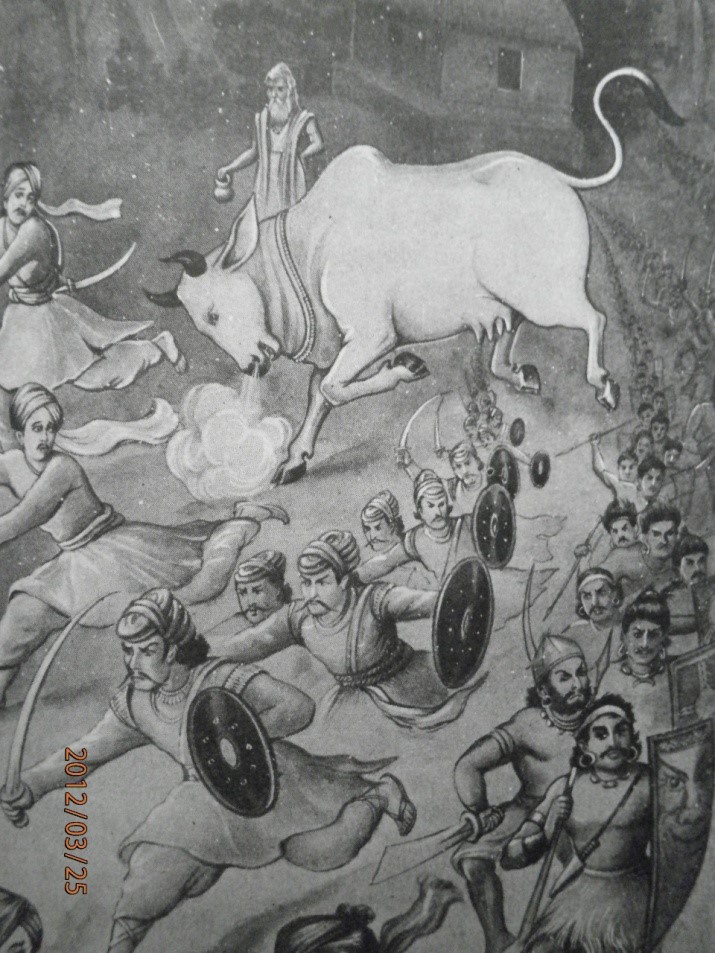
Then the cow of Vasishtha, hearing the word stay, raised her head and neck upward, and became terrible to behold. With eyes red with rage and lowing repeatedly, she then attacked Viswamitra’s troops on all sides. Afflicted with their stripes and running here and there with those red eyes of hers, her wrath increased. Blazing with rage, she soon became terrible to behold like unto the sun in his midday glory. And from her tail she began to rain showers of burning coals all around. Some moments after, from her tail she brought forth an army of Palhavas, and from her udders, an army of Dravidas and Sakas; and from her womb, an army of Yavanas, and from her dung, an army of Sabaras; and from her urine, an army of Kanchis; and from her sides, an army of Sabaras. From the froth of her mouth came out hosts of Paundras and Kiratas, Yavanas and Sinhalas, and the barbarous tribes of Khasas and Chivukas and Pulindas and Chinas and Hunas with Keralas, and numerous other Mlechchhas. That vast army of Mlechchhas in various uniforms, and armed with various weapons, as soon as it sprang into life, deploying in the very sight of Viswamitra, attacked that monarch’s soldiers. So numerous was that Mlechchha host that each particular soldier of Viswamitra was attacked by a band of six or seven of their enemies. Assailed with a mighty shower of weapons, Viswamitra’s troops broke and fled, panic-stricken, in all directions, before his very eyes. But, the troops of Vasishtha, though excited with wrath, took not the life of any of Viswamitra’s troops. Nandini simply caused the monarch’s army to be routed and driven off. Driven from the Ashrama, twenty-seven full miles, panic-stricken, they shrieked aloud and beheld not anyone that could protect them. Viswamitra, beholding this wonderful feat that resulted from Brahmana prowess, became disgusted with Kshatriya prowess and said, “O, fie on Kshatriya prowess! Brahmana prowess is true prowess! In judging of strength and weakness, I see that asceticism is true strength.” Saying this, the monarch, abandoning his large domains and regal splendour and turning his back upon all pleasures, set his mind on asceticism. Crowned with success in asceticism and filling the three worlds with the heat of his ascetic penances, he afflicted all creatures and finally became a Brahmana. The son of Kusika at last drank Soma with Indra himself.
There was a king in this world, named Kalmashapada, who was of the race of Ikshvaku and was unequalled on earth for prowess. One day the king went from his capital into the woods for purposes of hunting, and this grinder of foes pierced with his arrows many deer and wild boars. In those deep woods the king also slew many rhinoceroses. Engaged in sport for some length of time, the monarch became very much fatigued and at last he gave up the chase, desiring to rest awhile.
The great Viswamitra, endued with energy, had, a little while ago, desired to make that monarch his disciple. As the monarch, afflicted with hunger and thirst, was proceeding through the woods, he came across the illustrious son of Vasishtha, coming along the same path. The king ever victorious in battle saw that Muni bearing the name of Sakti, the eldest of the high-souled Vasishtha’s hundred sons, coming along from opposite direction. The king, beholding him said, “Stand out of our way.” The Rishi, addressing the monarch in a conciliatory manner, said unto him sweetly, “O king, this is my way. This is the eternal rule of morality indicated in every treatise on duty and Dharma, that a king should ever make way for Brahmanas.” Thus did they address each other respecting their right of way. “Stand aside, stand aside”, were the words they said unto each other. The Rishi, who was in the right, did not yield, nor did the king yield to him from pride and anger. That best of monarchs, enraged at the Rishi, refusing to yield him the way, acted like a Rakshasa, striking him with his whip. Thus whipped by the monarch, the son of Vasishtha, was deprived of his senses by anger, and speedily cursed that first of monarchs, saying, “O worst of kings, since you persecute like a Rakshasa an ascetic, you shall from this day, became a Rakshasa subsisting on human flesh! Hence, you worst of kings! you shall wander over the earth, affecting human form!” Thus did the Rishi Sakti, endued with great prowess, speak unto king Kalmashapada. At this time Viswamitra, between whom and Vasishtha there was a dispute about the discipleship of Kalmashapada, approached the place where that monarch and Vasishtha’s son were. That Rishi of severe ascetic penances, Viswamitra of great energy, approached the pair, knowing by his spiritual insight that they had been thus quarrelling with each other. After the curse had been pronounced, that best of monarchs knew that Rishi to be Vasishtha’s son and equal unto Vasishtha himself in energy. Viswamitra, desirous of benefiting himself, remained on that spot, concealed from the sight of both by making himself invisible. Then that best of monarchs, thus cursed by Sakti, desiring to propitiate the Rishi began to humbly beseech him. Viswamitra, ascertaining the disposition of the king and fearing that the difference might be made up, ordered a Rakshasa to enter the body of the king. A Rakshasa of the name of Kinkara then entered the monarch’s body in obedience to Sakti’s curse and Viswamitra’s command. And knowing that the Rakshasa had possessed himself of the monarch, Viswamitra, then left the spot and went away.
Shortly after, the monarch, possessed by the Rakshasa and terribly afflicted by him, lost all his senses. At this time a Brahmana beheld the king in the woods. Afflicted with hunger, that Brahmana begged of the king some food with meat. The royal sage, Kalmashapada, answered the Brahmana, saying, “Stay you here, O Brahmana for a moment. On my return, I will give you whatever food you desire.” Having said this, the monarch went away, but the Brahmana stayed on there. The high-minded king having roved for some time at pleasure and according to his will, at last entered his inner apartment. Thus waking at midnight and remembering his promise, he summoned his cook and told him of his promise unto the Brahmana staying in the forest. He commanded him, saying, “Go you to that forest. A Brahmana waits for me in the hope of food. Go and entertain him with food and meat.”
Thus commanded, the cook went out in search of meat. Distressed at not having found any, he informed the king of his failure. The monarch, however, possessed as he was by the Rakshasa, repeatedly said, without scruple of any kind, “Feed him with human flesh.” The cook, saying, “So be it,” went to the place where the executioners were, and from there taking human flesh and washing and cooking it duly and covering it with boiled rice offered it unto that hungry Brahmana devoted to ascetic penances. But that best of Brahmanas, seeing with his spiritual sight that the food was unholy and, therefore, unworthy of being eaten, said these words with eyes red with anger, “Because that worst of kings offered me food that is unholy and unworthy of being taken, therefore that wretch shall have himself a fondness for such food. Becoming fond of human flesh as cursed by Sakti of old, the wretch shall wander over the earth, alarming and otherwise troubling all creatures.” The curse, therefore, on that king, thus repeated a second time, became very strong, and the king, possessed by a Rakshasa disposition, soon lost all his senses.
A little while after, that best of monarchs, deprived of all his senses by the Rakshasa within him, beholding Sakti who had cursed him, said, “Because you have pronounced on me this extraordinary curse, therefore, I shall begin my life of cannibalism by devouring you.” Having said this, the king immediately slew Sakti and ate him up, like a tiger eating the animal it was fond of. Beholding Sakti thus slain and devoured, Viswamitra repeatedly urged that Rakshasa against the other sons of Vasishtha. Like a wrathful lion devouring small animals, that Rakshasa soon devoured the other sons of the illustrious Vasishtha that were junior to Sakti in age. But Vasishtha, learning that all his sons had been caused to be slain by Viswamitra, patiently bore his grief like the great mountain that bears the earth. That best of Munis, that foremost of intelligent men, was resolved rather to sacrifice his own life than exterminate in anger the race of Kusikas. The illustrious Rishi threw himself down from the summit of Meru, but he descended on the stony ground as though on a heap of cotton. When the illustrious one found that death did not result from that fall, he kindled a huge fire in the forest and entered it with alacrity. But that fire, though burning brightly, consumed him not. That blazing fire seemed to him cool. Then the great Muni under the influence of grief, beholding the sea, tied a stony weight to his neck and threw himself into its waters. But the waves soon cast him ashore. At last when that Brahmana of rigid vows succeeded not in killing himself by any means, he returned, in distress of heart, to his Ashrama.
Beholding his Ashrama bereft of his children, the Muni afflicted with great grief left it again. In course of his wandering he saw, a river swollen with the waters of the rainy season, sweeping away numberless trees and plants that had grown on its margin. Beholding this, the distressed Muni thinking that he would certainly be drowned if he fell into the waters of that river, he tied himself strongly with several cords and flung himself, under the influence of grief, into the current of that mighty stream. But, that stream soon cut those cords and cast the Rishi ashore. The Rishi rose from the bank, freed from the cords with which he had tied himself. Because his cords were thus broken off by the violence of the current, the Rishi called the stream by the name of Vipasa (the cord-breaker). For his grief the Muni could not, from that time, stay in one place; he began to wander over mountains and along rivers and lakes. Beholding once again a river named Haimavati of terrible aspect and full of fierce crocodiles and other aquatic monsters, the Rishi threw himself into it, but the river mistaking the Brahmana for a mass of fire, immediately flew in a hundred different directions, and has been known ever since by the name of the Satadru (the river of a hundred courses). Seeing himself on the dry land even there he exclaimed, “O, I cannot die by my own hands!” Saying this, the Rishi once more bent his steps towards his Ashrama. Crossing numberless mountains and countries, as he was about to re-enter his Ashrama, he was followed by his daughter-in-law named Adrisyanti. As she neared him, he heard the sound from behind of a very intelligent recitation of the Vedas with the six graces of elocution. Hearing that sound, the Rishi asked, “Who is it that follows me?” His daughter-in-law then answered, “I am Adrisyanti, the wife of Sakti. I am helpless, though devoted to asceticism.” Hearing her, Vasishtha said, “O daughter, whose is this voice that I heard, repeating the Vedas along with the Angas like unto the voice of Sakti reciting the Vedas with the Angas?” Adrisyanti answered, “I bear in my womb a child by your son Sakti. He has been here full twelve years. The voice you hear is that of the Muni, who is reciting the Vedas.”
Thus addressed by her the illustrious Vasishtha became exceedingly glad. Saying, “O, there is a child!”–he refrained from self-destruction. The sinless one accompanied by his daughter-in-law, then returned to his Ashrama. The Rishi saw one day in the solitary woods Kalmashapada. The king, possessed by fierce Rakshasa, as he saw the Rishi, became filled with wrath and rose up, desiring to devour him. Adrisyanti beholding before her that the Rakshasa of cruel deeds, addressed Vasishtha in these words, full of anxiety and fear, “O illustrious one, the cruel Rakshasa, like unto Death himself armed with fierce club, comes towards us with a wooden club in hand! There is none else on earth, except you to restrain him today. Protect me, from this cruel wretch of terrible mien. Surely, the Rakshasa comes here to devour us.” Vasishtha, hearing this, said, “Fear not, O daughter, there is no need of any fear from any Rakshasa. This one is no Rakshasa from whom you apprehend such imminent danger. This is king Kalmashapada endued with great energy and celebrated on earth. That terrible man dwells in these woods.”
“Beholding him advancing, the illustrious Rishi Vasishtha, endued with great energy, restrained him, by uttering the sound Hum. Sprinkling him again with water sanctified with incantations the Rishi freed the monarch from that terrible curse. For twelve years the monarch had been overwhelmed by the energy of Vasishtha’s son like Surya seized by the planet Rahu during the season of an eclipse. Freed from the Rakshasa the monarch illumined that large forest by his splendour like the sun illumining the evening clouds. Recovering his power of reason, the king saluted that best of Rishis with joined palms and said, “O illustrious one, I am the son of Sudasa and your disciple, O best of Munis! Tell me what is your pleasure and what I am to do.” Vasishtha replied, saying, “My desire has already been accomplished. Return now to your kingdom and rule your subjects. And, O chief of men, never insult Brahmanas any more.” The monarch replied, “O illustrious one, I shall never more insult superior Brahmanas. In obedience to your command I shall always worship Brahmanas. But, I desire to obtain from you that by which, I may be freed from the debt I owe to the race of Ikshvaku! It beholds you to grant me, for the perpetuation of Ikshvaku’s race, a desirable son possessing beauty and accomplishments and good behaviour.”
Thus addressed, Vasishtha, that best of Brahmanas devoted to truth replied unto that mighty bowman of a monarch, saying, “I will give you.” After some time, Vasishtha, accompanied by the monarch, went to the latter’s capital known all over the earth by the name of Ayodhya. The citizens in great joy came out to receive the sinless and illustrious one, like the dwellers in heaven coming out to receive their chief. The monarch, accompanied by Vasishtha, re-entered his auspicious capital after a long time. The citizens of Ayodhya beheld their king accompanied by his priest, as if he were the rising sun. The monarch who was superior to everyone in beauty filled by his splendour the whole town of Ayodhya, like the autumnal moon filling by his splendour the whole firmament. The excellent city itself, in consequence of its streets having been watered and swept, and of the rows of banners and pendants beautifying it all around, gladdened the monarch’s heart. The city filled as it was with joyous and healthy souls, in consequence of his presence, looked gay like Amaravati with the presence of the chief of the celestials. After the royal sage had entered his capital, the queen, at the king’s command, approached Vasishtha. The great Rishi, making a covenant with her, united himself with her according to the high ordinance. After a little while, when the queen conceived, that best of Rishis, receiving the reverential salutations of the king, went back to his Ashrama. The queen bore the embryo in her womb for a long time. When she saw that she did not bring forth anything, she tore open her womb by a piece of stone. It was then that at the twelfth year of the conception was born Asmaka, that bull amongst men, that royal sage who founded the city of Pandya.
Brought under the influence of the curse, king Kalmashapada, with eyes whirling in anger went out of his capital accompanied by his wife. Entering with his wife the solitary woods the king began to wander about. And one day while the king under the influence of the curse was wandering through that forest abounding in several kinds of deer and various other animals and overgrown with numerous large trees and shrubs and creepers and resounding with terrible cries, he became exceedingly hungry. The monarch thereupon began to search for some food. Pinched with hunger, the king at last saw, in a very solitary part of the woods, a Brahmana and his wife enjoying each other. Alarmed at beholding the monarch the couple ran away, their desire ungratified. Pursuing the retreating pair, the king forcibly seized the Brahmana. Then the Brahmani, beholding her lord seized, addressed the monarch, saying, “Listen to what I say, O monarch! It is known all over the world that you are born in the solar race, and that you are ever vigilant in the practice of morality and devoted to the service of your superiors. It beholds you not to commit sin, deprived though you have been of your senses by the Rishi’s curse. My season has come, and wishful of my husband’s company I was connected with him. I have not been gratified yet. Be propitious unto us! Liberate my husband.” The monarch, however, without listening to her cries cruelly devoured her husband like a tiger devouring its desirable prey. Possessed with wrath at this sight, the tears that that woman shed blazed up like fire and consumed everything in that place. Afflicted with grief at the calamity that overtook her lord, the Brahmani in anger cursed the royal sage Kalmashapada, “Vile wretch, since you has today cruelly devoured under my very nose my illustrious husband dear unto me, even before my desires have been gratified, therefore shall you, O wicked one afflicted by my curse, meet with instant death when you go in for your wife in season. And your wife, O wretch, shall bring forth a son uniting herself with that Rishi Vasishtha whose children have been devoured by you. And that child, O worst of kings, shall be the perpetuator of your race.” Cursing the monarch thus, that lady of Angira’s house bearing every auspicious mark, entered the blazing fire in the very sight of the monarch. The illustrious and exalted Vasishtha by his ascetic power and spiritual insight immediately knew all. And long after this, when the king became freed from his curse, he approached his wife Madayanati when her season came. But Madayanati softly sent him away. Under the influence of passion the monarch had no recollection of that curse. Hearing, however, the words of his wife, the best of kings became terribly alarmed. Recollecting the curse he repented bitterly of what he had done. It was for this reason, that the monarch infected with the Brahmani’s curse, appointed Vasishtha to beget a son upon his queen.
Then, Adrisyanti, who had been residing in Vasishtha’s Ashrama, brought forth a son who was the perpetuator of Sakti’s race and who was a second Sakti in everything. The illustrious Vasishtha himself performed the usual after-birth ceremonies of his grandson. Because the Rishi Vasishtha had resolved on self-destruction but had abstained therefrom as soon as he knew of the existence of that child, that child, when born, was called Parasara (the vivifier of the dead). The virtuous Parasara, from the day of his birth, knew Vasishtha for his father and behaved towards the Muni as such. One day, the child addressed Vasishtha, that first of Brahmana sages, as father, in the presence of his mother Adrisyanti. Adrisyanti, hearing the very intelligible sound father sweetly uttered by her son, addressed him with tearful eyes and said, “O child, do not address this your grandfather as father? Your father, O son, has been devoured by a Rakshasa in a different forest. O innocent one, he is not your father whom you regard so. The revered one is the father of that celebrated father of thine.” Thus addressed by his mother that best of Rishis of truthful speech, gave way to sorrow, but soon fired up and resolved to destroy the whole creation. Then that illustrious and great ascetic Vasishtha, that foremost of all persons conversant with Brahma, that son of Mitravaruna, that Rishi acquainted with positive truth, addressed his grandson who had set his heart upon the destruction of the world. “Blest be you! It beholds not you, to destroy the worlds. O you Parasara, who are acquainted with the higher regions, you foremost of wise men!”
The Brahmana sage Parasara thus addressed by the illustrious Vasishtha restrained his wrath from destroying the worlds. But the Rishi Parasara endued with great energy–the son of Sakti–the foremost of all persons acquainted with the Vedas—performed a grand Rakshasa sacrifice. Remembering the slaughter of his father Sakti, the great Muni began to consume the Rakshasas, young and old, in the sacrifice he performed. Vasishtha did not restrain him from this slaughter of the Rakshasa, from the determination of not obstructing this second vow (of his grandson). In that sacrifice the great Muni Parasara sat before three blazing fires, himself like unto a fourth fire. The son of Sakti, like the Sun just emerging from the clouds, illuminated the whole firmament by that stainless sacrifice of his into which large were the libations poured of clarified butter. Then Vasishtha and the other Rishis regarded that Muni blazing with his own energy as if he were the second Sun. Then the great Rishi Atri of liberal soul desirous of ending that sacrifice, an achievement highly difficult for others,–came to that place. There also came Pulastya and Pulaha, and Kratu the performer of many great sacrifices, all influenced by the desire of saving the Rakshasas. Pulastya then, seeing that many Rakshasas had already been slain, told these words unto Parasara that oppressor of all enemies:
“There is no obstruction, I hope, to this sacrifice of yours, O child! Take you any pleasure, in this slaughter of even all those innocent Rakshasas that know nothing of your father’s death. It beholds you not to destroy any creatures thus. This is not the occupation of a Brahmana devoted to asceticism. Peace is the highest virtue. Therefore, O Parasara, establish you peace. How have you, being so superior, engaged yourself in such a sinful practice? It beholds not you to transgress against Sakti himself who was well-acquainted with all rules of morality. It beholds not you to extirpate any creatures. O descendant of Vasishtha’s race, that which befell your father was brought about by his own curse. It was for his own fault that Sakti was taken hence unto heaven. O Muni, no Rakshasa was capable of devouring Sakti; he himself provided for his own death. And, O Parasara, Viswamitra was only a blind instrument in that matter. Both Sakti and Kalmashapada, having ascended to heaven are enjoying great happiness. The other sons also of the great Rishi Vasishtha who were younger than Sakti, are even now enjoying themselves with the celestials. O child, you have also been, in this sacrifice, only an instrument in the destruction of these innocent Rakshasas. Blessed be you! Abandon this sacrifice of yours. Let it come to an end.”
Thus addressed by Pulastya, as also by the intelligent Vasishtha, that mighty Muni–the son of Sakti then brought that sacrifice to an end. The Rishi cast the fire that he had ignited for the purpose of the Rakshasas’ sacrifice into the deep woods on the north of the Himavat. That fire may be seen to this day consuming Rakshasas and trees and stones in all seasons.
Aurvyopakhyana: The story of Aurva
There was a celebrated king of the name of Kartavirya. That bull among the kings of the earth was the disciple of the Veda-knowing Bhrigus. That king, after performing the Soma sacrifice, gratified the Brahmanas with great presents of rice and wealth. After that monarch had ascended to heaven, an occasion came when his descendants were in want of wealth. Knowing that the Bhrigus were rich, those princes went unto those best of Brahmanas, in the guise of beggars. Some amongst the Bhrigus, to protect their wealth, buried it under earth; and some from fear of the Kshatriyas, began to give away their wealth unto other Brahmanas; while some amongst them duly gave unto the Kshatriyas whatever they wanted. It happened, however, that some Kshatriyas, in digging as they pleased at the house of particular Bhargava, came upon a large treasure. The treasure was seen by all those bulls among Kshatriyas who had been there. Enraged at what they regarded as the deceitful behaviour of the Bhrigus, the Kshatriyas insulted the Brahmanas, though the latter asked for mercy. Those mighty bowmen began to slaughter the Bhrigus with their sharp arrows. The Kshatriyas wandered over the earth, slaughtering even the embryos that were in the wombs of the women of the Bhrigu race. While the Bhrigu race was thus being exterminated, the women of that tribe fled from fear to the inaccessible mountains of Himavat. One amongst these women, desiring to perpetuate her husband’s race, held in one of her thighs an embryo endued with great energy. A certain Brahmana woman, however, who came to know this fact, went from fear unto the Kshatriyas and reported the matter unto them. The Kshatriyas then went to destroy that embryo. Arrived at the place, they beheld the would-be mother blazing with inborn energy, and the child that was in her thigh came out tearing up the thigh and dazzling the eyes of those Kshatriyas like the midday sun. Thus deprived of their eyes, the Kshatriyas began to wander over those inaccessible mountains. Distressed at the loss of sight, the princes were afflicted with woe, and desirous of regaining the use of their eyes they resolved to seek the protection of that faultless woman. Then those Kshatriyas, afflicted with sorrow, and from loss of sight like unto a fire that has gone out, addressed with anxious hearts that illustrious lady, saying,
“By your grace. O lady, we wish to be restored to sight. We shall then return to our homes all together and abstain for ever from our sinful practice. It beholds you with your child to show us mercy. It beholds you to favour these kings by granting them their eye-sight.”
The Brahmana lady, thus addressed by them, said,
“You children, I have not robbed you of your eye-sight, nor am I angry with you. This child, however, of the Bhrigu race has certainly been angry with you. There is little doubt, you children, that you have been robbed of your sight by that illustrious child whose wrath has been kindled at the remembrance of the slaughter of his race. You children, while you were destroying even the embryos of the Bhrigu race, this child was held by me in my thigh for a hundred years! In order that the prosperity of Bhrigu’s race might be restored, the entire Vedas with their branches came unto this one even while he was in the womb. It is plain that this scion of the Bhrigu race, enraged at the slaughter of his fathers, desires to slay you! It is by his celestial energy that your eyes have been scorched. Therefore, you children, pray you unto this my excellent child born of my thigh. Propitiated by your homage he may restore your eye-sight.”
Hearing those words of the Brahmana lady, all these princes addressed the thigh-born child, saying, “Be propitious!” And the child became propitious unto them. That best of Brahmana Rishis, in consequence of his having been born after tearing open his mother’s thigh, came to be known throughout the three worlds by the name of Aurva (thigh-born). Those princes regaining their eye-sight went away. But the Muni Aurva of the Bhrigu race resolved upon overcoming the whole world. The high-souled Rishi set his heart, upon the destruction of every creature in the world. That scion of the Bhrigu race, for paying homage unto his slaughtered ancestors, devoted himself to the austerest of penances with the object of destroying the whole world. Desirous of gratifying his ancestors, the Rishi afflicted by his severe asceticism the three worlds with the celestials, the Asuras and human beings. The Pitris, then, learning what the child of their race was about, all came from their own region unto the Rishi and addressing him said:
“Aurva, O son, fierce you has been in your asceticism. Your power has been witnessed by us. Be propitious unto the three worlds. Control your wrath. O child, it was not from incapacity that the Bhrigus of souls under complete control were, all of them, indifferent to their own destruction at the hands of the murderous Kshatriyas. When we grew weary of the long periods of life allotted to us, it was then that we desired our own destruction through the instrumentality of the Kshatriyas. The wealth that the Bhrigus had placed in their house underground had been placed only with the object of enraging the Kshatriyas and picking a quarrel with them. As we were desirous of heaven, of what use could wealth be to us? The treasurer of heaven Kubera had kept a large treasure for us. When we found that death could not, by any means, overtake us all, it was then, that we regarded this as the best means of compassing our desire. They who commit suicide never attain to regions that are blessed. Reflecting upon this, we abstained from self-destruction. That which, therefore you desire to do is not agreeable to us. Restrain your mind, therefore, from the sinful act of destroying the whole world. Destroy not the Kshatriyas nor the seven worlds. Kill this wrath of yours that stains your ascetic energy.”
Hearing these words of the Pitris, Aurva, replied unto them to this effect:
“You Pitris, the vow I have made from anger for the destruction of all the worlds, must not go in vain. I cannot consent to be one whose anger and vows are futile. Like fire consuming dry woods, this rage of mine will certainly consume me if I do not accomplish my vow. The man that represses his wrath that has been excited by adequate cause, becomes incapable of duly compassing the three ends of life. The wrath that kings desirous of subjugating the whole earth exhibit, is not without its uses. It serves to restrain the wicked and to protect the honest. While lying unborn within my mother’s thigh, I heard the doleful cries of my mother and other women of the Bhrigu race who were then being exterminated by the Kshatriyas. You Pitris, when those wretches of Kshatriyas began to exterminate the Bhrigus together with unborn children of their race, it was then that wrath filled my soul. My mother and the other women of our race, each in an advanced state of pregnancy, and my father, while terribly alarmed, found not in all the worlds a single protector. Then when the Bhrigu women found not a single protector, my mother held me in one of her thighs. If there be a punisher of crimes in the worlds no one in all the worlds would dare commit a crime; if he finds not a punisher, the number of sinners become large. The man who having the power to prevent or punish sin doth not do so knowing that a sin has been committed, is himself defiled by that sin. When kings and others, capable of protecting my fathers, protect them not, postponing that duty preferring the pleasures of life, I have just cause to be enraged with them. I am the lord of the creation, capable of punishing its iniquity. I am incapable of obeying your command. Capable of punishing this crime, if I abstain from so doing, men will once more have to undergo a similar persecution. The fire of my wrath too that is ready to consume the worlds, if repressed, will certainly consume by its own energy my own self. You masters, I know that you ever seek the good of the worlds: direct me, therefore, as to what may benefit both myself and the worlds.”
The Pitris replied saying,
“Throw this fire that is born of your wrath and that desires to consume the worlds, into the waters. That will do you good. The worlds, indeed, are all dependent on water. Every juicy substance contains water, indeed the whole universe is made of water. Therefore, cast you this fire of your wrath into the waters. If, therefore, you desire it, let this fire born of your wrath abide in the great ocean, consuming the waters thereof, for it has been said that the worlds are made of water. In this way, your word will be rendered true, and the worlds with the gods will not be destroyed.”
Then, Aurva cast the fire of his wrath into the abode of Varuna. And that fire which consumes the waters of the great ocean, became like unto a large horse’s head which persons conversant with the Vedas call by the name of Vadavamukha. And emitting itself from that mouth it consumes the waters of the mighty ocean.
Sundopasundopakhyana : The story of Sunda and Upasunda
In olden days, a mighty Daitya named Nikumbha, endued with great energy and strength was born in the race of the great Asura, Hiranyakasipu. Unto this Nikumbha, were born two sons called Sunda and Upasunda. Both of them were mighty Asuras endued with great energy and terrible prowess. The brothers were both fierce and possessed of wicked hearts. Those Daityas were both of the same resolution, and ever engaged in achieving the same tasks and ends. They were ever sharers with each other in happiness as well as in woe. Each speaking and doing what was agreeable to the other, the brothers never were unless they were together, and never went anywhere unless together. Of exactly the same disposition and habits, they seemed to be one individual divided into two parts. Endued with great energy and ever of the same resolution in everything they undertook, the brothers gradually grew up. Always entertaining the same purpose, desirous of subjugating the three worlds, the brothers, after due initiation, went to the mountains of Vindhya. Severe were the ascetic penances they performed there. Exhausted with hunger and thirst, with matted locks on their heads and attired in barks of trees, they acquired sufficient ascetic merit at length. Besmearing themselves with dirt from head to foot, living upon air alone, standing on their toes, they threw pieces of the flesh of their bodies into the fire. Their arms upraised, and eye fixed, long was the period for which they observed their vows. During the course of their ascetic penances, a wonderful incident occurred there. For the mountains of Vindhya, heated for a long course of years by the power of their ascetic austerities, began to emit vapour from every part of their bodies. Beholding the severity of their austerities, the celestials became alarmed. The gods began to cause numerous obstructions to impede the progress of their asceticism. The celestials repeatedly tempted the brothers by means of every precious possession and the most beautiful girls. The brothers broke not their vows. Then the celestials once more manifested, before the illustrious brothers, their powers of illusion. For it seemed their sisters, mothers, wives, and other relatives, with disordered hair and ornaments and robes, were running towards them in terror, pursued and struck by a Rakshasa with a lance in hand. It seemed that the women implored the help of the brothers crying, “O save us!” But all this went for nothing, for firmly wedded thereto, the brothers did not still break their vows. When it was found that all this produced not the slightest impression on any of the two, both the women and the Rakshasa vanished from sight. At last the Grandsire himself, the Supreme Lord ever seeking the welfare of all, came unto those great Asuras and asked them to solicit the boon they desired. Then the brothers Sunda and Upasunda, both of great prowess, beholding the Grandsire, rose from their seats and waited with joined palms. The brothers both said unto the God, “O Grandsire, if you have been pleased with these our ascetic austerities, and are, O lord, propitious unto us, then let us have knowledge of all weapons and of all powers of illusion. Let us be endued with great strength, and let us be able to assume any form at will. Last of all, let us also be immortal.” Hearing these words of theirs, Brahman said, “Except the immortality you ask for, you shall be given all that you desire. Solicit you some form of death by which you may still be equal unto the immortals. Since you have undergone these severe ascetic austerities from desire of sovereignty alone I cannot confer on you the boon of immortality. You have performed your ascetic penances even for the subjugation of the three worlds. It is for this, O mighty Daityas, that I cannot grant you what you desire.”
Hearing these words of Brahman, Sunda and Upasunda said, “O Grandsire, let us have no fear then from any created thing, mobile or immobile, in the three worlds, except only from each other!” The Grandsire then said, “I grant you what you have asked for, even this your desire”. Granting them this boon, the Grandsire made them desist from their asceticism, and returned to his own region. Then the brothers, those mighty Daityas, having received those several boons became incapable of being slain by anybody in the universe. They then returned to their own abode. All their friends and relatives, beholding those Daityas of great intelligence, crowned with success in the matter of the boons they had obtained, became exceedingly glad. Sunda and Upasunda then cut off their matted locks and wore coronets on their heads. Attired in costly robes and ornaments, they looked exceedingly handsome. They caused the moon to rise over their city every night even out of his season. Friends and relatives gave themselves up to joy and merriment with happy hearts. Eat, feed, give, make merry, sing, drink–these were the sounds heard everyday in every house. Here and there arose loud uproars of hilarity mixed with clappings of hands which filled the whole city of the Daityas, who being capable of assuming any form at will, were engaged in every kind of amusement and sport and scarcely noticed the flight of time, even regarding a whole year as a single day.
As soon as those festivities came to an end, the brothers Sunda and Upasunda, desirous of the Sovereignty of the three worlds, took counsel and commanded their forces to be arranged. Obtaining the assent of their friends and relatives, of the elders of the Daitya race and of their ministers of state, and performing the preliminary rites of departure, they set out in the night when the constellation Magha was in the ascendant. The brothers set out with a large Daitya force clad in mail and armed with maces and axes and lances and clubs. The Daitya heroes set out on their expedition with joyous hearts, the charanas chanting auspicious panegyrics indicative of their future triumphs. Furious in war, the Daitya brothers, capable of going everywhere at will, ascended the skies and went to the region of the celestials. The celestials knowing they were coming and acquainted also with the boons granted unto them by the Supreme Deity left heaven and sought refuge in the region of Brahman. Endued with fierce prowess, the Daitya heroes soon subjugated the region of Indra, and vanquishing the diverse tribes of Yakshas and Rakshasas and every creature ranging the skies, came away. Those mighty car-warriors next subjugated the Nagas of the nether region, and then the inmates of the ocean and then all the tribes of the Mlechchhas. Desirous next of subjugating the whole earth, those heroes of irresistible sway, summoning their soldiers, issued these cruel commands, “Brahmanas and royal sages with their libations and other food offered at grand sacrifices, increase the energy and strength of the gods, as also their prosperity. Engaged in such acts, they are the enemies of the Asuras. All of us, therefore, mustering together should completely slaughter them off the face of the earth!” Ordering their soldiers thus on the eastern shore of the great ocean, and entertaining such a cruel resolution, the Asura brothers set out in all directions. Those that were performing sacrifices and the Brahmanas that were assisting at those sacrifices, the mighty brothers instantly slew. Slaughtering them with violence they departed for some other place. While their soldiers threw into the water the sacrificial fires that were in the Ashrams of Munis with souls under complete control, the curses uttered by the illustrious Rishis in wrath, rendered abortive by the boons granted, affected not the Asura brothers. When the Brahmanas saw that their curses produced not the slightest effect like shafts shot at stones they fled in all directions, forsaking their rites and vows. Even those Rishis on earth that were crowned with ascetic success, and had their passions under complete control and were wholly engrossed in meditation of the Deity, from fear of the Asura brothers, fled like snakes at the approach of Vinata’s son Garuda. The sacred Ashrams were all trodden down and broken. The sacrificial jars and vessels being broken, their contents were scattered over the ground. The whole universe became empty, as if its creatures had all been stricken down during the season of general dissolution. After the Rishis had all disappeared and made themselves invisible both the great Asuras, resolved upon their destruction, began to assume various forms. Assuming the forms of maddened elephants with temples rent from excess of juice, the Asura pair, searching out the Rishis who had sheltered themselves in caves, sent them to the region of Yama. Sometimes becoming as lions and again as tigers and disappearing the next moment, by these and other methods the cruel couple, seeing the Rishis, slew them instantly. Sacrifice and study ceased, and kings and Brahmanas were exterminated. The earth became utterly destitute of sacrifices and festivals. And the terrified people uttered cries of Oh and Alas and all buying and selling were stopped. All religious rites ceased, and the earth became destitute of sacred ceremonies and marriages. Agriculture was neglected and cattle were no longer tended. Towns and asylums became desolate. Scattered over with bones and skeletons, the earth assumed a frightful aspect. All ceremonies in honour of the Pitris were suspended, and the sacred sound of Vashat and the whole circle of auspicious rites ceased. The earth became frightful to behold. The Sun and the Moon, the Planets and Stars, and Constellations, and the other dwellers in the firmament, witnessing these acts of Sunda and Upasunda, grieved deeply. Subjugating all the points of heaven by means of such cruel acts, the Asura brothers took up their abode in Kurukshetra, without a single rival.
Then the celestial Rishis, the Siddhas, and the high-souled Rishis possessing the attributes of tranquility and self-restraint, beholding that act of universal slaughter, were afflicted with great grief. With passions and senses and souls under complete control, they then went to the abode of the Grandsire, moved by compassion for the universe. Arrived there, they beheld the Grandsire seated with gods, Siddhas, and Brahmarshis around him. There were present that God of gods, Mahadeva, and Agni, accompanied by Vayu, and Soma and Surya and Indra, and Rishis devoted to the contemplation of Brahma, and the Vaikhanasas, the Valakhilyas, the Vanaprasthas, the Marichipas, the Ajas, the Avimudas, and other ascetics of great energy. All those Rishis were sitting with the Grandsire, when the celestial and other Rishis, approaching Brahman with sorrowful hearts, represented unto him all the acts of Sunda and Upasunda. And they told the Grandsire in detail everything that the Asura brothers had done, and how they had done it, and in what order. Then all the celestials and the great Rishis pressed the matter before the Grandsire. The Grandsire, hearing everything they said, reflected for a moment and settled in his mind what he should do. Resolving to compass the destruction of the Asura brothers, he summoned Viswakarman, the celestial architect. Seeing Viswakarman before him, the Grandsire possessed of supreme ascetic merit commanded him, saying, “Create you a damsel capable of captivating all hearts.” Bowing down unto the Grandsire and receiving his command with reverence, the great artificer of the universe created a celestial maiden with careful attention. Viswakrit first collected all handsome features upon the body of the damsel he created. Indeed, the celestial maiden that he created was almost a mass of gems. And created with great care by Viswakarman, the damsel, in beauty, became unrivalled among the women of the three worlds. There was not even a minute part of her body which by its wealth of beauty could not attract the gaze of beholders. Like unto the embodied Sri herself, that damsel of extraordinary beauty captivated the eyes and hearts of every creature. Because she had been created with portions of every gem taken in minute measures, the Grandsire bestowed upon her the name of Tilottama. As soon as he started it into life, the damsel bowed to Brahman and with joined palms said, “Lord of every created thing, what task am I to accomplish and what have I been created for?” The Grandsire answered, “Go, O Tilottama, unto the Asuras, Sunda and Upasunda. Tempt them with your captivating beauty. And conduct yourself there in such a way that the Asura brothers may, in consequence of the wealth of your beauty, quarrel with each other as soon as they cast their eyes upon you.”
Bowing unto the Grandsire and saying, “So be it,” the damsel walked round the celestial conclave. The illustrious Brahman was then sitting with face turned eastwards, and Mahadeva with face also towards the east, and all the celestials with faces northwards, and the Rishis with faces towards all directions. While Tilottama walked round the conclave of the celestials, Indra and the illustrious Sthanu Mahadeva were the only ones that succeeded in preserving their tranquility of mind. But exceedingly desirous as Mahadeva was when the damsel was at his side, another face like a full-blown lotus appeared on the southern side of his body. When she was behind him, another face appeared on the west. And when the damsel was on the northern side of the great god, a fourth face appeared on the northern side of his body. Mahadeva came also to have a thousand eyes, each large and slightly reddish, before, behind and on his flanks. It was thus that Sthanu the great god came to have four faces, and the slayer of Bala, a thousand eyes. As regards the mass of the celestials and the Rishis, they turned their faces towards all directions as Tilottama walked round them. Except the divine Grandsire himself, the glances of those illustrious personages, even of all of them fell upon Tilottama’s body. When Tilottama set out with the wealth of her beauty, all regarded the task as already accomplished. After Tilottama had gone away, the great god who was the First Cause of the Universe, dismissed all the celestials and the Rishis.
Meanwhile the Asura brothers having subjugated the earth were without a rival. The fatigue of exertion gone, they, having brought the three worlds under equal sway, regarded themselves as persons that had nothing more to do. Having brought all the treasures of the gods, the Gandharvas, the Yakshas, the Nagas, the Rakshasas, and the kings of the earth, the brothers began to pass their days in great happiness. When they saw they had no rivals (in the three worlds), they gave up all exertion and devoted their time to pleasure and merriment, like the celestials. They experienced great happiness by giving themselves up to every kind of enjoyment, such as women, and perfumes and floral wreaths and viands, and drinks and many other agreeable objects all in profusion. In houses and woods and gardens, on hills and in forests, wherever they liked they passed their time in pleasure and amusement, like the immortals. It so happened that one day they went for purposes of pleasure to a tableland of the Vindhya range, perfectly level and stony, and overgrown with blossoming trees. After every object of desire, all of the most agreeable kind, had been brought, the brothers sat on an excellent seat, with happy hearts and accompanied by handsome women. Those damsels, desirous of pleasing the brothers, commenced a dance in accompaniment to music, and sweetly chanted many a song in praise of the mighty pair.
Meanwhile Tilottama attired in a single piece of red silk that exposed all her charms, came along, plucking wild flowers on her way. She advanced slowly to where those mighty Asuras were. The Asura brothers, intoxicated with the large portions they had imbibed, were smitten upon beholding that maiden of transcendent beauty. Leaving their seats they went quickly to where the damsel was. Both of them being under the influence of lust, each sought the maiden for himself. Sunda seized that maid of fair brows by her right hand. Intoxicated with the boons they had obtained, with physical might, with the wealth and gems they had gathered from every quarry, and with the wine they had drunk, maddened with all these, and influenced by wishful desire, they addressed each other, each contracting his bow in anger, “She is my wife, and therefore your superior,” said Sunda. “She is my wife, and therefore your sister-in-law”, replied Upasunda. And they said unto each other, “She is mine not yours.” Soon they were under the influence of rage. Maddened by the beauty of the damsel, they soon forgot their love and affection for each other. Both of them, deprived of reason by passion, then took up their fierce maces. Each repeating, “I was the first, I was the first,” struck the other. The fierce Asuras, struck by each other with the mace, fell down upon the ground, their bodies bathed in blood, like two suns dislodged from the firmament. Beholding this, the women that had come there, and the other Asuras there present, all fled away trembling in grief and fear, and took refuge in the nether regions. The Grandsire himself of pure soul, then came there, accompanied by the celestials, and the great Rishis. And the illustrious Grandsire applauded Tilottama and expressed his wish of granting her a boon. The Supreme Deity, before Tilottama spoke, desirous of granting her a boon, cheerfully said, “O beautiful damsel, you shall roam in the region of the Adityas. Your splendour shall be so great that nobody will ever be able to look at you for any length of time!” The Grandsire of all creatures, granting this boon unto her, establishing the three worlds in Indra as before, returned to his own region. It was thus that Asuras, ever united and inspired by the same purpose slew each other in wrath for the sake of Tilottama.
Shvetaki and Agni
There was a celebrated king of the name of Shvetaki who was endued with strength and prowess, equal unto Indra himself. No one on earth has equaled him in sacrifices, charity, and intelligence. Shvetaki performed the five great sacrifices and many others, at all of which the presents unto Brahmanas were large. The heart of that monarch was always set upon sacrifices, religious rites, and gifts of all kinds. Shvetaki, assisted by his Ritviks, performed sacrifices for many long years, till those sacrificial priests with eyes afflicted by the continued smoke and becoming very weak, left that monarch, wishing never more to assist at his sacrifices. The king, however, repeatedly asked those Ritviks to come to him. But they came not to his sacrifice in consequence of the painful state of their eyes. The king, therefore, invited at the command of his own Ritviks, others like unto them, and completed the sacrifice that he had begun.
After some days had elapsed, king Shvetaki desired to perform another sacrifice which should extend for a hundred years. But the illustrious monarch obtained not any priest to assist him in it. The celebrated king then, with his friends and relatives, casting off all sloth, repeatedly courted his priests with great persistence, by bowing down unto them, by conciliatory speeches, and by gifts of wealth. All of them, however, refused to accomplish the purpose which that king had in view. Then that king, getting angry, addressed those Brahmanas sitting in their Ashrams, and said, “If I were a fallen person, or, if, I were wanting in homage and service to you, I should then deserve to be abandoned without scruple by you and by other Brahmanas at the same time. But as I am neither degraded nor wanting in homage to you, it behoves you not to obstruct the performance by me of my sacrifice or to abandon me thus, without adequate reason. I seek your protection! It behoves you to be propitious unto me. But, if you abandon me from enmity alone or any improper motive, I shall go unto other priests for their assistance in this sacrifice of mine, and conciliating them by sweet words and gifts, I shall represent unto them the business I have on hand, so that they may accomplish it.”
Having said this, the king became silent. When those priests well knew that they could not assist at the king’s sacrifice, they pretended to be angry, and addressing him said, “O best of kings! Your sacrifices are incessant! By assisting you always, we have all been fatigued. As we have been wearied in consequence of these labours, it behoves you to give us leave. From loss of judgment, you can not wait. Go unto Rudra! He will assist at your sacrifice!”
Hearing those words of censure and wrath, king Shvetaki became angry. The monarch wending to the mountains of Kailasa, devoted himself to asceticism there. The monarch began to worship Mahadeva, with fixed attention, and by observing the most rigid vows. Foregoing all food at times, he passed a long period. The monarch ate only fruits and roots sometimes at the twelfth and sometimes at the sixteenth hour of the whole day. King Shvetaki stood for six months, rapt in attention, with arms upraised and steadfast eyes, like the trunk of a tree or a column rooted to the ground. Shiva at last gratified with that king, who was undergoing such hard penances, showed himself unto him. And the god spoke unto the king in a calm and grave voice, saying, “O tiger among kings! I have been gratified with you for your asceticism! Blessed be you! Ask now the boon that you desire.”
Hearing these words of Rudra of immeasurable energy, the king bowed unto that deity and replied, saying, “O illustrious one! If you have been gratified with me, then, assist me yourself in my sacrifice!” Hearing these words spoken by the monarch, the illustrious god was gratified, and smilingly said, “We do not ourselves assist at sacrifices: but as you have undergone severe penances, desirous of obtaining a boon, I will assist at your sacrifice, upon this condition.” And Rudra continued, ‘If, you can, for twelve years, pour without intermission libations of clarified butter into the fire, yourself leading all the while the life of a Brahmacharin with rapt attention, then you shall obtain from me what you ask.” King Shvetaki, thus addressed by Rudra, did all that he was directed to do by the wielder of the trident.
After twelve years had elapsed, he again came unto Shiva. Upon seeing Shvetaki, Shiva immediately said, in great gratification, “I have been gratified by you, O best of kings! with this your own act! But, the duty of assisting at sacrifices properly belongs to Brahmanas. Therefore, I will not myself assist at your sacrifice today. There is on earth an exalted Brahmana who is even a portion of my own self. He is known by the name of Durvasa. That Brahmana endued with great energy will assist you in your sacrifice. Let, therefore, every preparation be made.”
Hearing these words uttered by Rudra, the king, returning to his own capital, began to collect all that was necessary. After everything had been collected, the monarch again presented himself before Rudra and said, “Every necessary article has been collected, and all my preparations are complete, through your grace, O god of gods! Let me, therefore, be installed at the sacrifice tomorrow.”
Having heard these words of that illustrious king, Rudra summoned Durvasa before him and said. “This, O Durvasa! is that best of monarchs called Shvetaki. At my command, assist this king in his sacrifice.” The Rishi Durvasa said unto Rudra, “So be it.” Then the sacrifice for which king Shvetaki had made those preparations, took place. The illustrious monarch’s sacrifice was performed according to the ordinance and in proper season. The gifts, on that occasion, unto the Brahmanas were large. After that monarch’s sacrifice had come to an end, all the other priests who had come to assist at it went away with Durvasa’s leave. All other Sadasyas also of immeasurable energy, who had been installed at that sacrifice, then went away. That exalted monarch then entered his own palace, worshipped by exalted Brahmanas conversant with the Vedas, eulogized by chanters of panegyrical hymns and congratulated by the citizens.
Such was the history of that best of monarchs, the royal sage Shvetaki, who, when the time came, ascended to heaven, having won great renown on earth, and accompanied by the Ritwiks and the Sadasyas that had helped him in life.
At that sacrifice of Shvetaki, Agni had drunk clarified butter for twelve years. Indeed, clarified butter had been poured into Agni’s mouth in a continuous stream for that period. Having drunk so much butter, Agni, satiated, desired not to drink butter again from the hand of anybody else at any other sacrifice. Agni became pale, having lost his colour, and he could not shine as before. He felt a loss of appetite from surfeit, and his energy itself decreased and sickness afflicted him. Then when the drinker of sacrificial libations perceived that his energy was gradually diminishing, he went to the sacred abode of Brahma that is worshipped by all. Approaching the great Deity seated on his seat, Agni said, “O exalted one! Shvetaki has gratified me to excess. Even now I am suffering from surfeit which I cannot dispel. I am being reduced both in splendour and strength. I desire to regain, through your grace, my own permanent nature.”
Hearing these words from Agni, the Creator of all things smilingly replied unto him, saying, “O exalted one! You have eaten, for twelve years, a continuous stream of sacrificial butter poured into your mouth! It is for this that illness has seized you. But, grieve not for it. You shall soon regain your own nature. I shall dispel this surfeit of yours and the time for it is even come. The dreadful forest Khandava, that abode of the enemies of the gods, which you had of old once consumed to ashes at the request of the gods, has now become the home of numerous creatures. When you will have eaten the fat of those creatures, you shall regain your own nature. Proceed there in haste to consume that forest with its living population. You will then be cured of your malady.”
Hearing the words that fell from the lips of the Supreme Deity, Agni proceeded with great speed and soon reached the forest of Khandava in great vigour. Arrived there, he suddenly blazed forth in anger, assisted by Vayu. Beholding Khandava on fire the dwellers that were there, made great efforts to extinguish the conflagration. Elephants by hundreds of thousands, speeding in anger, brought water in their trunks and scattered it upon the fire. Thousands of many-hooded snakes, mad with anger, hastily began to scatter upon fire much water from those many hoods of theirs. So, the other creatures dwelling in that forest, by various appliances and efforts, soon extinguished the fire. In this way, Agni blazed forth in Khandava repeatedly, even for seven times. It was in this way that the blazing fire was extinguished there as often by the denizens of that forest.
Then Agni in anger and disappointment, with his ailment uncured, went back to the Grandsire. He represented unto Brahma all that had happened. The illustrious deity, reflecting for a moment, said unto him, “O sinless one! I see a way by which you may consume the forest of Khandava today in the very sight of Indra. Those old deities, Nara and Narayana, have become incarnate in the world of men to accomplish the business of the celestials. They are called on earth Arjuna and Krishna. They are even now staying in the forest of Khandava. Solicit them for aiding you in consuming that forest. You shall then consume the forest even if it be protected by the celestials. They will certainly prevent the population of Khandava from escaping, and thwart Indra also. I have no doubt of this!” Hearing these words, Agni came in haste unto Krishna and Arjuna.
Sarangopakhyana: The story of Saranga birds
There was a great Rishi known by the name of Mandapala, conversant with all the shastras, of rigid vows, devoted to asceticism, and the foremost of all virtuous persons. Following in the wake of Rishis that had drawn up their virile fluid, that ascetic, with every sense under complete control, devoted himself to study and virtue. Having reached the opposite shores of asceticism, he left his human form and went to the region of the Pitris. But going there he failed to obtain the fruit of his acts. He asked the celestials that sat around the king of the dead as to the cause of his treatment, saying, “Why have these regions become unattainable by me,–regions that I had thought had been acquired by me by my ascetic devotions? Have I not performed those acts whose fruits are these regions? You inhabitants of heaven, tell me why these regions are shut against me! I will do that which will give me the fruit of my ascetic penances.”
The celestials answered, “Hear, O Brahmana, of those acts and things on account of which men are born debtors. Without doubt, it is for religious rites, studies according to the ordinance, and progeny, that men are born debtors. These debts are all discharged by sacrifices, asceticism, and offspring. You are an ascetic and has also performed sacrifices; but you has no offspring. These regions are shut against you only for want of children. Beget children, therefore! You shall then enjoy multifarious regions of felicity. The Vedas declared that the son rescues the father from a hell called Put. Then, O best of Brahmanas, strive to beget offspring.”
Mandapala, having heard these words of the dwellers in heaven, reflected how best he could obtain the largest number of offspring within the shortest period of time. The Rishi, after reflection, understood that of all creatures birds alone were blest with fecundity. Assuming the form of a Sarngaka the Rishi had connection with a female bird of the same species called by the name of Jarita. He begat upon her four sons who were all reciters of the Vedas. Leaving all those sons of his with their mother in that forest, while they were still within eggs, the ascetic went to another wife called by the name of Lapita. When the exalted sage went away for the company of Lapita, moved by affection for her offspring, Jarita became very thoughtful. Though forsaken by their father in the forest of Khandava, Jarita, anxious in her affection for them, could not forsake her offspring, those infant Rishis encased in eggs. Moved by parental affection, she brought up these children born of her, herself following the pursuits proper to her own species. Some time after, the Rishi, in wandering over that forest in the company of Lapita, saw Agni coming towards Khandava to burn it down. Then the Brahmana Mandapala, knowing the intention of Agni and remembering also that his children were all young moved by fear, gratified the god, of the burning element, that regent of the universe, endued with great energy. And he did this, desiring to put in a word for his unfledged offspring. Addressing Agni, the Rishi said, ‘You are, O Agni, the mouth of all the worlds! You are the carrier of the sacrificial butter! O purifier (of all sins), you move invisible with the frame of every creature! The learned have spoken of you as an One, and again as possessed of triple nature. The wise perform their sacrifices before you, taking you as consisting of eight (mouths). The great Rishis declare that this universe has been created by you. O you that feed on sacrificial butter, without you this whole universe would be destroyed in a single day. Bowing to you, the Brahmanas, accompanied by their wives and children, go to eternal regions won by them by help of their own deeds. O Agni, the learned represent you as the clouds in the heavens charged with lightning. O Agni, the flames put forth by you consume every creature. O you of great splendour, this universe has been created by you. The Vedas are your word. All creatures, mobile and immobile, depend upon you. Water primarily depends on you, so also the whole of this universe. All offerings of clarified butter and oblations of food to the pitris have been established in you. O god, you are the consumer, and you are the creator and you are Brihaspati himself (in intelligence). You are the twin Aswins; you are Surya; you are Soma; you are Vayu.
Thus praised by Mandapala, Agni was gratified with that Rishi of immeasurable energy; and the god, well-pleased, replied, “What good can I do to you?” Then Mandapala with joined palms said unto the carrier of clarified butter, “While you burn the forest of Khandava, spare my children.” The illustrious bearer of clarified butter replied, “So be it.” It was, therefore, that he blazed not forth, while consuming the forest of Khandava, for the destruction of Mandapala’s children.
When the fire blazed forth in the forest of Khandava, the infant birds became very much distressed and afflicted. Filled with anxiety, they saw not any means of escape. Their mother, the helpless Jarita, knowing that they were too young to escape, was filled with sorrow and wept aloud. She said, “Oh, the terrible conflagration, illuminating the whole universe and burning the forest down, approaches towards us, increasing my woe. These infants with immature understanding, without feathers and feet, and the sole refuge of our deceased ancestors, afflict me. Oh, this fire approaches, spreading fear all around, and licking with its tongue the tallest trees. But my unfledged children are incapable of effecting their escape. I myself am not capable of escaping, taking all these with me. Nor am I capable of abandoning them, for my heart is distressed on their account. Whom amongst my sons, shall I leave behind, and whom shall I carry with me? What should I do now that is consistent with duty? What also do you, my infant sons, think? I do not, even by reflection, see any way of escape for you. I shall even cover you with my wings and die with you. Your cruel father left me some time before, saying, “Upon this Jaritari, because he is the eldest of my sons, will my race depend. My second Sarisrikka will beget progeny for the expansion of my ancestors’ race. My third, Stamvamitra, will be devoted to asceticism, and my youngest, Drona, will become the foremost of those acquainted with the Vedas.” But how has this terrible calamity overtaken us! Whom shall I take with me? As I am deprived of judgment what should I do that is consistent with duty? I do not see, by the exercise of my own judgment, the escape of my children from the fire!”
Unto their mother indulging in these lamentations, the infant ones said. “O mother, relinquishing your affection for us, go you to a place where there is no fire. If we are killed here, you may have other children born to you. If you, O mother, be killed, we can have no more children in our race. Reflecting upon both these calamities, the time has come for you, O mother, to do that which is beneficial to our race. Do not be influenced by affection for your offspring, which promises to destroy both us and you. If you save yourself, our father, who is even desirous of winning regions of felicity, may have his wishes gratified.”
Hearing what the infants said. Jarita replied, “There is a hole here in the ground near to this tree, belonging to a mouse. Enter this hole without loss of time. You shall have then no fear of fire. After you have entered it, I shall, you children, cover its mouth with dust. This is the only means of escape that I see from the blazing fire. Then when the fire will be put out, I shall return here to remove the dust. Follow my advice if you are to escape from the conflagration.”
The infant birds replied, “Without feathers we are but so many balls of flesh. If we enter the hole, certain it is that the carnivorous mouse will destroy us all. Beholding this danger before us, we cannot enter this hole. Alas, we do not see any means by which we may escape from the fire or from the mouse. We do not see how our father’s act of procreation may be prevented from becoming futile, and how also our mother may be saved. If we enter the hole, the mouse will destroy us; we remain where we are and the sky-ranging fire will destroy us. Reflecting upon both the calamities, a death by fire is preferable to a death by being eaten up. If we are devoured by the mouse within the hole, that death is certainly ignoble, whereas the destruction of the body in fire is approved by the wise.”
Hearing those words of her sons Jarita continued, “The little mouse that had come out of this hole was seized by a hawk with his claws and carried away hence. Therefore, you may fearlessly enter this hole now.” The young ones replied, “We are not by any means certain of that mouse having been taken away by the hawk. There may be other mice living here. From them we have every fear. Whereas it is doubtful whether fire will at all approach us here. Already we see an adverse wind blowing the flames away. If we enter the hole, death is certain at the hands of the dwellers in the hole. But if we remain where we are, death is uncertain. O mother, a position in which death is uncertain is better than that in which it is certain. It is your duty, therefore, to escape yourself, for, if you live you may obtain other children as good.”
Their mother then said, “You children, I myself saw the mighty hawk, that best of birds, swoop down and fly away with the mouse from the hole. While he was flying away swiftly, I followed him behind and pronounced blessing on him for his having taken away the mouse from the hole. I said unto him. “O king of hawks, because you are flying away with our enemy, the mouse, in your claws, may you, without a foe, live in heaven with a golden body.” Afterwards when that hawk devoured the mouse, I came away, obtaining his leave. Therefore, you children, enter this hole trustfully. You have nothing to fear. The mouse that was its inmate was seized and taken away by the hawk in my sight.” The young ones again said, “O mother, we do not by any means know that the mouse has been carried away by the hawk. We cannot enter this hole in the ground without being certain of the fact.” Their mother said, “I know to a certainty that the mouse has been carried away by the hawk. Therefore, you children, you have nothing to fear; do what I say.” The young ones again said, “We do not, O mother, say that you are dispelling our fears with a false story. For whatever is done by a person when his reason has been disturbed can scarcely be said to be that person’s deliberate act. You has not been benefited by us, nor dost you know who we are. Why dost you, therefore, strive to protect us at so much cost to yourself? Who are we to you? You are young and handsome, and capable of seeking out your husband. Go unto your husband. You shall obtain good children again. Let us by entering the fire attain to regions of felicity. If, however, the fire consume us not, you may come back and obtain us again.”
The parent bird then, thus addressed by her sons, left them in Khandava and hastily went to the spot where there was no fire and there was safety. Then Agni in haste and with fierce flames approached the spot where the sons of Mandapala were. The young birds saw the blazing fire come towards them. Then Jaritari, the eldest of the four, in the hearing of Agni, began to speak.
Jaritari said, “The person that is wise remains wakeful in view of death. Accordingly, when the hour of death approaches, he feels no pangs. But the person of perplexed soul, who remains not awake, when the hour of death comes, feels the pangs of death and never attains salvation.”
The second brother Sarisrikka, said, “You are patient and intelligent. The time is come when our lives are threatened. Without doubt, one only amongst many become wise and brave.”
The third brother, Stamvamitra, said, “The eldest brother is called the protector. It is the eldest brother that rescues (the younger ones) from danger. If the eldest himself fails to rescue them, what can the younger ones do?”
The fourth and the youngest brother, Drona said, “The cruel god of fire, with seven tongues and seven mouths quickly cometh towards our habitation, blazing forth in splendour and licking up everything in his path.”
Having addressed one another thus, the sons of Mandapala then each devotedly addressed an eulogistic hymn to Agni.
Jaritari said, “You are, O fire, the soul of air! You are the body of the Earth’s vegetation! O Sukra, water is your parent as you are the parent of water! O you of great energy, your flames, like the rays of the sun, extend themselves above, below, behind, and on each side.”
Sarisrikka said, “O smoke-bannered god, our mother is not to be seen, and we know not our father! Our feathers have not grown as yet. We have none to protect us save you. Therefore, O Agni, infants that we are protect us! O Agni, as we are distressed, protect us with that auspicious form you has and with those seven flames of thine! We seek protection at your hands. You alone, O Agni, are the giver of heat (in the universe). O lord, there is none else (save you) that giveth heat to the rays of the sun. O, protect us who are young and who are Rishis. O Havyavaha (carrier of sacrificial butter), be pleased to go hence by some other route.”
Stamvamitra said, “You alone, O Agni, are everything! This whole universe is established in you! You sustain every creature, and you support the universe! You are the carrier of the sacrificial butter, and you are the excellent sacrificial butter itself! The wise know you to be one (as cause) and many (as effects)! Having created the three worlds, you, O Havyavaha, again destroy them when the time cometh, swelling yourself forth! You are the productive cause of the whole universe, and you also are the essence in which the universe dissolve itself!”
Drona said, “O lord of the universe, growing in strength and remaining within their bodies, you cause the food that living creatures eat to be digested. Everything therefore, is established in you. O Sukra, O you from whose mouth the Vedas have sprung, it is you who assumes the form of the sun, and sucking up the waters of the earth and every liquid juice that the earth yields, gives them back in time in the form of rain and causes everything to grow! From you, O Sukra, are these plants and creepers with green foliage! From you have sprung these tanks and pools, and the great ocean also that is ever blessed! O you of fierce rays, this our (human) body depends on Varuna (the water-god)! We are unable to bear your heat. Be you, therefore, our auspicious protector! O, destroy us not! O you of copper-hued eyes, O you of red neck, O you whose path is marked by a black colour, save us by going along any remote route, as indeed, the ocean saves the house on its banks!”
Thus addressed by Drona–that utterer of Brahma–Agni, well-pleased at what he heard, and remembering also the promise he had made to Mandapala, replied unto him, saying, “You are a Rishi, O Drona! For what you has said is Brahma (Vedic truth). I shall do your pleasure. Fear not! Indeed, Mandapala had spoken to me of you to the effect that I should spare his sons, while consuming the forest. The words he spoke and your speech also are entitled to great weight to me. Say what I am to do. O best of Brahmanas, I have been greatly pleased with your hymn. Blest be you, O Brahmana!”
Drona said, “O Sukra, these cats trouble us every day. O Hutasana; consume them with their friends and relatives.”
Then Agni did what the Sarngakas; asked him to do, telling them of his intentions. And, growing in strength, he began then to consume the forest of Khandava.
The Rishi Mandapala became very anxious about his children, although he had spoken of them to the god of fierce rays. Indeed, his mind was not in peace. Distressed on account of his sons, he addressed Lapita (his second wife with whom he then was), saying, “O Lapita, as my children are incapable of the power of moving, how are they? When the fire will grow in strength and the wind begin to blow violently, my children will scarcely be able to save themselves. How will their mother be able to rescue them? That innocent woman will be afflicted with great sorrow when she will find herself unable to save her offspring. Oh, how will she compose herself, uttering various lamentations on account of my children who are all incapable of taking wing or rising up into the air. Oh, how is Jaritari, my son, and how is Sarisrikka, and how is Stamvamitra, and how is Drona, and how also is their helpless mother?”
Unto the Rishi Mandapala thus weeping in the forest, Lapita, thus replied, under the influence of jealousy, “You need not worry for your children who, as you has assured me, are all Rishis endued with energy and prowess! They can have no fear from fire. Didst you not speak to Agni in my presence, in their behalf? Has not the illustrious deity promised to save them? One of the regents of the universe as Agni is, he will never falsify his speech. You has no anxiety, nor is your heart inclined towards benefiting friends. It is only by thinking of her—my rival (Jarita) that you are so distracted! Certain it is that the love you bears to me is not equal to what you had for her at first. He that has two parties dividing his attention, can easily behold one of those suffer all sorts of pangs; but he should not disregard the party that is next to his heart. Then go you to Jarita, for whom your heart is sorrowing! As for myself, I shall henceforth wander alone, as a fit reward for my having attached myself to a wicked person.”
Hearing these words, Mandapala replied, “I do not wander over the earth with such intentions as you conceive. It is only for the sake of progeny that I am here. And even those that I have are in danger. He who castes off what he has for the sake of what he may acquire, is a wicked person. The world disregards and insults him. (Therefore, go I must). As for yourself you are free to do what you choosest. This blazing fire that licks up the trees causes sorrow in my anxious heart and raises therein evil presentiments.”
Meanwhile, after the fire had left the spot where the Sarngakas dwelt, Jarita, much attached to her children, hastily came there to see how they were. She found that all of them had escaped from the fire and were perfectly well. Beholding their mother, they began to weep, though safe and sound. She too shed tears upon beholding them alive. She embraced, one by one, all her weeping children. Just at that time, Rishi Mandapala arrived there. But none of his sons expressed joy, upon beholding him. The Rishi, however, began to speak to them one after another and unto Jarita also, repeatedly. But neither his sons nor Jarita spoke anything well or ill unto him in return.
Mandapala then said, “Who amongst these is your first born, and who the next after him? And who is the third, and who the youngest? I am speaking unto you woefully; why do you not reply to me? I left you, it is true, but I was not happy where I was.”
Jarita then said, “What has you to do with the eldest of these, and what with him that is next? And what with the third and what with the youngest? Go now unto that Lapita of sweet smiles and endued with youth, unto whom you didst go of old, beholding me deficient in everything!”
Mandapala replied, “As regards females, there is nothing so destructive of their happiness whether in this or the other world as a co-wife and a clandestine lover. There is nothing like these two that, inflames the fire of hostility and causes such anxiety. Even the auspicious and well-behaved Arundhati, celebrated amongst all creatures, had been jealous of the illustrious Vasishtha of great purity of mind and always devoted to the good of his wife. Arundhati insulted even the wise Muni amongst the (celestial) seven. In consequence of such insulting thoughts of hers, she has become a little star, like fire mixed with smoke, sometimes visible and sometimes invisible, like an omen portending no good (amongst a constellation of seven bright stars representing the seven Rishis). I look to you for the sake of children. I never wronged you, like Vasishtha who never wronged his wife. You has, therefore, by your jealousy behaved towards me like Arundhati of old towards Vasishtha. Men should never trust women even if they be wives. Women, when they have become mothers, do not much mind serving their husbands.”
After this, all his children came forward to worship him. He also began to speak kindly towards them all, giving them every assurance.
Mandapala then addressed his children, saying, “I had spoken unto Agni for the safety of you all. The illustrious deity had assured me that he would grant my wish. At those words of Agni, and knowing the virtuous disposition of your mother, as also the great energy that is in yourselves, I came not here earlier. Therefore, you sons, do not harbour in your hearts any resentment towards me. You are all Rishis acquainted with the Vedas. Even Agni knows you well.”
Having given such assurances unto his sons, the Brahmana Mandapala took with him his wife and sons, and leaving that region, went away to some other country.
Saubhavadhopakyana: The story of killing the Saubha
Hearing that Shishupala, the son of Shrutasravas had been slain by Krishna, Shalva came to the city of Dvaravati. That wicked king, stationing his forces in array, besieged that city around and above. Stationing himself in the upper regions, the king began his fight with the city. That encounter commenced with a thick shower of weapons from all sides. The city at that time was well-fortified on all sides, according to the science of fortification, with pennons, arches, combatants, walls, turrets, engines, miners, and streets barricaded with spiked wood-works and towers, edifices with gate-ways well-filled with provisions, engines for hurling burning brands and fires, vessels, of deer-skins for carrying water, and trumpets, tabors, drums, lances, forks, Shataghnis, plough-shares, rockets, balls of stone and battle-axes and other weapons, shield embossed with iron, engines for hurling balls and bullets and hot liquids! The city was also well-defended by numerous cars, and by Gada, Samba, Uddhava and others, and by warriors of prowess tried in battle, all well-born and capable of encountering any foe. These all placing themselves on commanding posts, aided by cavalry and standard-bearers, began to defend the town. Ugrasena, Uddhava and others, to prevent carelessness, proclaimed throughout the city that nobody should drink. All the Vrishnis and the Andhakas, well-knowing that they would be slain by Shalva if they behaved carelessly, remained sober and watchful. The police soon drove out of the city all mimes, dancers and singers of the Anartta country. All the bridges over rivers were destroyed, boats forbidden to ply, and the trenches around the city were spiked with poles at the bottom. The land around the city for full two miles was rendered uneven, holes and pits were dug thereon, and combustibles were secreted below the surface. The fort was naturally strong and always well-defended and filled with all kinds of weapons. In consequence of the preparations made, the city was more prepared than ever to meet the foe. In consequence of all this, the city looked like that of Indra himself. At the time of Shalva’s approach, nobody could either enter or leave the town of the Vrishnis and the Andhakas without presenting the sign that had been agreed upon. All the streets of the town and the open spaces were filled with numerous elephants and horses. The combatants were all specially gratified with allowances and wages, rations, weapons, and dresses. Amongst the combatants there was none who was not paid in gold, and none who was not paid at all, and none who was not somehow obliged, and none who was not of tried valour. It was thus Dvaraka, abounding in well-ordered arrangements, was defended by Ugrasena.
Shalva, the lord of Saubha, came towards Dvaraka with an immense force consisting of infantry, cavalry and elephants. The army headed by king Shalva, consisting of four kinds of forces, occupied a level ground commanding a copious water-supply. Forsaking cemeteries and temples dedicated to the gods, sacred trees, and grounds covered by ant-hills, that host occupied every other place. The roads leading to the city were blocked up by the divisions of his army, and the secret entrances also were all blocked up by his camp. Like unto the lord of birds Garuda, the ruler of Saubha rushed towards Dvaraka, bringing with him his host equipped with all kinds of arms, skilled in all weapons, consisting of a dense display of cars. elephants and cavalry abounding in banners, and well-paid and well-fed foot-soldiers possessed of great strength and bearing every mark of heroism and furnished with wonderful chariots and bows.
Pradyumna, Krishna’s son, fights Shalva Beholding the army of Shalva, the youthful princess of the Vrishni race resolved to encounter it sallying out of the city. Charudeshna, Samba, and the mighty warrior Pradyumna sailed out, ascending on their chariots, and clad in mail, and decked with ornaments, with colours flying, resolved to encounter the mighty and countless host of Shalva. Samba taking up his bows eagerly attacked on the field of battle Kshemavriddhi, the commander of Shalva’s forces and his chief counsellor. The son of Jambavati then began to shower arrows in a continuous stream as Indra showers down rain. Then Kshemavriddhi, the commander of Shalva’s forces, bore that shower of arrows, immovable as the Himavat. Kshemavriddhi on his part, discharged at Samba mightier volley of shafts, aided by his powers of illusion. Dispersing by counter illusion that discharge inspired by illusion, Samba showered on his adversary’s car a thousand arrows. Then pierced by the shafts on Samba and overwhelmed there with Kshemavriddhi, the commander left the field by the help of his fleet-steed.
When the wicked general of Shalva had left the field, a mighty Daitya called Vegavat rushed at Krishna’s son. Thus attacked, the heroic Samba, the perpetuator of the Vrishni race, bore that onset of Vegavat, keeping his ground. The heroic Samba, of prowess incapable of being baffled, whirling a quickly-going mace, hurled it speedily at Vegavat. Struck with that mace, Vegavat fell down on the ground, like a weather-beaten and faded lord of the forest of decayed roots. On that heroic Asura of mighty energy, being slain with the mace, Krishna’s son entered within that mighty host and began to fight with all.
A well-known Danava named Vivindhya, a mighty warrior wielding a large and powerful bow, encountered Charudeshna. The encounter between Charudeshna and Vivindhya was as fierce as that in days of yore between Vritra and Vasava. Enraged with each other the combatants pierced each other with their arrows, uttering loud roars like unto two powerful lions. Then the son of Rukmini fixed on his bow-string a mighty weapon possessing the splendour of fire or the sun, and capable of destroying all foes, having first vivified it with incantations. Then, that mighty warrior Krishna’s son, fired with wrath, challenged Vivindhya and discharged the weapon at him. The Danava struck with that weapon, fell down on the ground a lifeless corpse.
Beholding Vivindhya slain, and the whole host waver, Shalva advanced again on his beautiful car capable of going everywhere. Beholding Shalva on that beautiful car of his, the combatants of Dvaraka wavered with fear! But, Pradyumna sailed out, and bidding the Anarttas be of good cheer, said, “Waver you not, and staying behold me fight! I shall, by force, repell that car with Shalva on it! You Yadavas! This day, I shall, with my weapons like unto serpents discharged from my bow with my hand, destroy this host of the lord of Saubha! Be of good cheer, you all! Fear not! The lord of Saubha will be slain today! Attacked by me, the wretch will meet with destruction together with his car!” Upon Pradyumna speaking thus with cheerful heart, the Yadava host remained on the field and began to fight cheerfully.
Having spoken thus unto the Yadavas, Pradyumna ascended his golden car. The car he rode was drawn by excellent steeds in mail. Over it stood a standard bearing the figure of a Makara with gaping mouth and fierce as Yama. With his steeds, more flying than running on the ground, he rushed against the foe. The hero equipped with quiver and sword, with fingers cased in leather, twanged his bow possessed of the splendour of the lightning, with great strength, and transferring it from hand to hand, as if in contempt of the enemy, spread confusion among the Danavas and other warriors of the city of Saubha. As hot in contempt of the foe, he continuously slew the Danavas in battle. No one could mark the slightest interval between his successive shafts. The colour of his face changed not, and his limbs trembled not. People only heard his loud leonine roars indicative of wonderful valour. The aquatic monster with mouth wide open, that devourer of all fishes, placed on golden flag-staff of that best of cars, struck terror into the hearts of Shalva’s warriors. Pradyumna rushed with speed against Shalva himself so desirous of an encounter. Braved by the heroic Pradyumna in that mighty battle, the angry Shalva could ill bear the challenge. Shalva, maddened by anger, descended from his beautiful car of unchecked speed, resolved to encounter Pradyumna. The people beheld the fight between Shalva and Pradyumna which was like unto the encounter between Vasava with Bali. Mounting on his beautiful car decked with gold and furnished with flags, flag-staffs and quivers, the illustrious and mighty Shalva began to discharge his arrows at Pradyumna. Pradyumna also, by the energy of his arms, overwhelmed Shalva in the combat by a thick shower of arrows. The king of Saubha, however, thus attacked in battle by Pradyumna, endured him not, but discharged at him arrows that were like blazing fire. But the mighty Pradyumna parried off that arrowy shower. Beholding this, Shalva rained on him other weapons of blazing splendour. Then, pierced by the shafts of Shalva, the son of Rukmini discharged without loss of time an arrow that was capable of entering the vitals of a foe in fight. That winged shaft shot by Pradyumna, piercing Shalva’s mail, entered his heart – whereupon he fell down, in a swoon. Beholding the heroic king Shalva fallen down deprived of sense, the foremost of the Danavas fled away rending the ground beneath their feet. The army of Shalva sent up exclamations of Oh! and Alas! seeing their king drop down bereft of sense! Regaining his senses, the mighty Shalva rose and all of a sudden discharged his arrows on Pradyumna. Then the heroic and mighty armed Pradyumna, sorely pierced by his adversary about his throat, was enfeebled on his car. Wounding the son of Rukmini, Shalva sent up a shout like unto the roar of a lion, and filling the entire earth with it! When Pradyumna became senseless, Shalva, without losing a moment, again discharged at him other shafts difficult to bear. Pierced with numberless arrows and deprived of his senses, Pradyumna became motionless on the field of battle.
Afflicted with the arrows of Shalva when Pradyumna became senseless, the Vrishnis who had come to the fight were all disheartened and filled with grief. The combatants of the Vrishni and Andhaka races burst into exclamations of Oh! and Alas! while great joy was felt by the enemy and beholding him thus deprived of sense, his trained charioteer, the son of Daruka, soon carried him off the field by the help of his steeds. The car had not gone far when Pradyumna regained his senses, and taking up his bow addressed his charioteer, saying, “O son of the Suta! What have you done? Why do you go leaving the field of battle? This is not the custom of the Vrishni heroes in battle! Have you been bewildered at the sight of a Shalva in that fierce encounter? Or have you been disheartened, beholding the fight? Tell me truly your mind!”
The charioteer answered. “O son of Janardana! I have not been confounded, nor has fear taken possession of me. On the other hand, the task, I ween, of vanquishing Shalva is difficult for you! Therefore, I am slowly retiring from the field. This wretch is stronger than you are! It behoves a charioteer to protect the warrior on the car, however, when he is deprived of his senses! You should always be protected by me, as it behoves you to protect me! Thinking that the warrior on the car should always be protected by his charioteer, I am carrying you away! Further, you are alone, while the Danavas are many. Thinking that you are not equal to them in the encounter, I am going away!”
When the charioteer had spoken thus, Pradyumna replied unto him, saying: “Turn the car! O son of Daruka! Never do so again; never turn from the fight, while I am alive! He is no son of the Vrishni race who forsakes the field or slays the foe fallen at his feet and crying I am yours! or kills a woman, a boy, or an old man, or a warrior in distress, deprived of his car or with his weapons broken! You are born in the race of charioteers and trained to your craft! You are acquainted with the customs of the Vrishnis in battle! Versed as you are with all the customs of the Vrishnis in battle, never again fly from the field as you have done! What will the irrepressible Madhava say to me when he hears that I have left the field of battle in bewilderment or that I have been struck on the back, a run-away from the combat! What will the elder brother of Keshava, the mighty-armed Baladeva, clad in blue and inebriate with wine, say, when he returns? What also will Satyaki say on hearing that I have forsaken the fight? What will the ever-victorious Samba, the irrepressible Charudeshna. Gada, Sharana, and Akrura say unto me! What also will the wives of the Vrishni heroes when they meet together, say of me who had hitherto been considered as brave and well-conducted, respectable and possessed of manly pride? They will even say ‘this Pradyumna is a coward who comes here, leaving the battle! Fie on him!’ They will never say, ‘Well done!’ Ridicule, with exclamation of Fie, is to me or a person like me, more than death! Therefore, never again leave the field of battle! Reposing the charge on me, Hari has gone to the sacrifice of Yudhishthira! Therefore, I cannot bear to be quiet now! When the brave Kritavarma was sallying out to encounter Shalva, I prevented him, saying I will resist Shalva. For honouring me, he desisted! Having left the field of battle, what shall I say unto that mighty warrior when I meet him? When Krishna returns, what shall I say unto him? Satyaki, Baladeva, and others of the Vrishni and Andhaka races always boast of me! What shall I say unto them? Having left the field of battle and with wounds of arrows on my back while being carried away by you, I shall, by no means, be able to live! Therefore, turn that car speedily, and never do so again even in times of greatest danger! I do not think life worth much, having fled from the field like a coward, and my back pierced, with the arrows of the enemy! Have you ever seen me fly in fear from the field of battle like coward? It behoves you not to forsake the battle, while my desire of fight was not yet gratified! Therefore, go back to the field.”
Thus addressed, the son of Suta replied in haste unto Pradyumna, in these sweet words: “O son of Rukmini! I fear not to guide the horses on the field of battle, and I am acquainted also with the customs of the Vrishnis in war! It is not otherwise in the least! But, those that guide the car are taught that the warrior on the car is, by all means, to be protected by his charioteer! You were also much afflicted! You were much wounded by the arrows shot by Shalva. You were also deprived of your senses! Therefore is it that I retired from the field. But, now that you have regained your senses without much ado, you witness my skill in guiding the horses! I have been begotten by Daruka, and I have been duly trained! I will now penetrate into the celebrated array of Shalva without fear!”
Saying this, the charioteer, pulling the reins, began to lead the horses with speed towards the field of battle. Struck with the whip and pulled by the reins those excellent steeds seemed to be flying in the air, performing various beautiful motion, now circular, now similar, now dissimilar, now to the right, now to the left. Those steeds understanding as it were the intention of Daruka’s son endued with such lightness of hand, burned with energy, and seemed to go without touching the ground with their feet! Pradyumna wheeled round Shalva’s host so easily that they who witnessed it wondered exceedingly. The lord of Saubha, unable to bear that manoeuvre of Pradyumna, instantly sent three shafts at the charioteer of his antagonist! The charioteer, however, without taking any note of the force of those arrows, continued to go along the right. Then the lord of Saubha again discharged at Pradyumna a shower of various kinds of weapons! But the son of Rukmini, showing with a smile his lightness of hand, cut all those weapons off as they reached him. Finding his arrows cut by Pradyumna, the lord of Saubha, having recourse to the dreadful illusion natural to Asuras began to pour a thick shower of arrows. But cutting into pieces those powerful Daitya weapons shot at him in mid-career by means of his Brahma weapon, Pradyumna discharged winged shafts of other kings. These delighting in blood, warding off the shafts of Daitya, pierced his head, bosom and face. At those wounds Shalva fell down senseless. On the mean-minded Shalva falling down, afflicted with Pradyumna’s arrows, the son of Rukmini aimed another arrow at him, capable of destroying every foe. Beholding that arrow worshipped by all the Dasharhas, and flaming like fire and fatal as a venomous snake, fixed on the bow-string, the firmament was filled with exclamations of Oh! and Alas! Then all the celestials with Indra and Kubera at their head sent Narada and the god of wind endued with the speed of the mind. These two, approaching the son of Rukmini, delivered unto him the message of the celestial, saying: “O hero! King Shalva is not to be slain by you! Draw back the arrow. He is unslayable by you in fight! There breathes not a person who cannot be killed by that arrow! The Creator has ordained his death at the hands of Krishna, the son of Devaki! Let this be not falsified!” Thereupon, with a glad heart, Pradyumna withdrew that best of arrows from his excellent bow and deposited it back in his quiver. Then, the mighty Shalva, afflicted with the arrows of Pradyumna, rose disheartened, and speedily went away. Then the wicked Shalva, thus afflicted by the Vrishnis, mounted on his car of precious metals, and leaving Dvaraka scudded through the skies!
Krishna fights and kills Shalva
When Shalva had left the city of the Anarttas, Krishna returned to it, on the completion of Yudhishthira’s great Rajasuya sacrifice. On his arrival, he found Dvaraka shorn of its splendour, and, there were not sounds of Vedic recitation or sacrificial offering, The excellent damsels were all destitute of ornaments, and the gardens were devoid of beauty. Alarmed by the aspect, Krishna asked Kritavarma saying: “Why is it that the men and women of the city of the Vrishnis are so woe-begone?” Thus asked, Kritavarma related to him in detail the invasion of the city by Shalva, and his subsequent departure from it. Hearing all, Krishna made up his mind to slay Shalva. Encouraging the citizens, he cheerfully addressed king Ahuka, Anakdundhubi, and the chief heroes of the Vrishni race, saying: “O bulls among the Yadavas! Stay in the city, taking every care, and know that I go to slay Shalva! I return not to the city of Dvaravati without slaying him. I will again come to you having compassed the destruction of Shalva together with his car of precious metals. Strike up the sharp, middle and flat notes of the Dundhubi so dreadful to foes!”
Thus adequately encouraged by Krishna, those heroes cheerfully said unto him: “Go and slay the enemies!” Thus receiving the benedictions of those warriors with glad hearts, and causing the Brahmanas to utter auspicious words and bowing down to the best of the regenerate ones, and to Shiva also, he set out on his car unto which were yoked the horses Shaibya and Sugriva, filling all sides with the clatter of his wheels and blowing the Panchajanya. Accompanied by his redoubted and victorious army consisting of the four kinds of the forces so persevering in battle, Krishna set out. Leaving many countries, and mountains, crowned with trees, and pieces of water, and streams, he at last arrived at the country of Matrikavarta. It is there that he heard that Shalva was coursing on his car of precious metals near the ocean, and he followed in his pursuit. Having reached the main, Shalva on his car of costly metals was in the midst of the deep heaving with billows! On seeing Krishna from a distance, that one of wicked soul himself challenged him repeatedly to the fight. Many arrows capable of piercing to the quick, discharged from Krishna’s bow reached not his car. That essentially sinful wretch of a Daitya’s son of irrepressible energy, on his part began to shoot thousand upon thousands of arrows in torrents! He rained shafts upon Krishna’s soldiers and upon his charioteer and upon his steeds! But without thinking of the shafts, Krishna and his troop continued the conflict. Then the warriors following Shalva poured on Krishna straight arrows by thousands. The Asuras covered his horses and his car and Daruka with arrows capable of piercing the very vitals. Krishna could not at that time see either his horses, or his car, or his charioteer Daruka! He with his army was covered with weapons. Superhumanly skilled in weapons, Krishna also let fly from his bow arrows by tens of thousands, inspiring them with mantras! But as that car of costly metals was in the sky, full two miles off, it could not be seen by Krishna’s troops. They could therefore only remaining on the field of battle look on like spectators in a place of amusement, cheering Krishna on by shouts loud as the roar of the lion, and also by the sound of their clapping. The tinted arrows shot by the fore-part of hand penetrated into the bodies of the Danavas like biting insects. Then arose cries in the car of precious metals from those that were dying of wounds by those sharp arrows and falling into the waters of the mighty ocean. The Danavas deprived of their arms, necks, and wearing the form of Kavandhas, fell, sending up tremendous roars. As they fell they were devoured by animals living in the waters of the ocean. Then Krishna powerfully blew the Panchajanya obtained from the waters and graceful as the lotus-stalk and white as milk or the Kunda flower or the moon or silver. Seeing his soldiers fall, Shalva began to fight with the help of illusion. Then he began to ceaselessly hurl at Krishna maces, ploughshares, winged darts and lances, javelins, battle-axes, swords and arrows blazing like javelins and thunderbolts, nooses, broad swords, bullets from barrels, shafts, axes, and rockets. Permitting them to come towards him, Krishna soon destroyed them all by counter-illusion. On this illusion being rendered ineffectual, Shalva began the contest with mountain peaks. Then there was darkness and light alternately, and the day was now fair, and now gloomy, and now hot, and now cold. There was a perfect shower of coals, ashes, and weapons. Creating such illusion the enemy fought with Krishna. Ascertaining it Krishna destroyed his illusion by counter-illusion. In the due time Krishna showered arrows all round. Then the dome of heaven blazed as with a hundred suns, and with one hundred moons, and thousands and ten thousands of stars! Then none could ascertain whether it was day or night, or distinguish the points of the horizon. Becoming bewildered, Krishna fixed on his bowstring the weapon called Pragnastra. The weapon went like unto flakes of pure cotton blown away by the winds! A great fight took place, calculated to make the hair on one’s body stand on end. Having regained, light, Krishna again fought with the enemy.
King Shalva, thus encountered by Krishna in battle, again ascended the sky. Inspired with the desire of victory, that wicked one hurled at Krishna Shataghnis, mighty maces, flaming lances, and stout clubs, and as the weapons came along the sky, Krishna speedily resisted them with his swift arrows, and cut them in two or three pieces before they came at him. There was a great noise in the welkins. Shalva covered Daruka, Krishna’s steeds, and his car also with hundreds of straight shafts. Then Daruka, evidently about to faint, said unto Krishna: “Afflicted with the shafts of Shalva I stay in the field, because it is my duty to do so. But I am incapable of doing so any longer. My body has become weak!” Hearing these piteous words of his charioteer, Krishna looked at him, and found the driver wounded with arrows. Nor was there a spot on his breasts or the crown of his head, or body or his arms which was not covered with shafts! Blood flowed profusely from his wounds inflicted by arrows, and he looked like unto a mountain of red chalk after a heavy shower. Seeing the charioteer with the reins in his hands thus pierced and enfeebled by the shafts of Shalva in the field of battle, Krishna cheered him up.
About this time, a certain person, having his home in Dvaraka quickly coming to Krishna’s car, addressed him like a friend, delivering to him a message from Ahuka! He seemed to be one of Ahuka’s followers. Sadly and in a voice choked in sorrow, he said these words: “O warrior! Ahuka, the lord of Dvaraka, has said these words unto you! O Keshava! Hear what your father’s friend says: ‘O son! In your absence today, Shalva coming to Dvaraka has by force killed Vasudeva! Therefore, no need of battle any more. Cease, O Janardana! Do defend Dvaraka! This is your principal duty!’” Hearing these words of his, Krishna’s heart became heavy, and he could not ascertain what he should do and what he should not. Hearing of that great misfortune, Krishna mentally censured Satyaki, Baladeva, and also that mighty Pradyumna. Having reposed on them the duty of protecting Dvaraka and Vasudeva, he had gone to effect the destruction of Shalva’s city. In a sorrowful heart, he asked himself, “Does that mighty-armed Baladeva live, and Satyaki, and the son of Rukmini and Charudeshna, and Shamba and others? For, these living, even Indra himself could by no means destroy Vasudeva! And thought, I, It is plain that Vasudeva is dead and equally plain that the others with Baladeva at their head have been deprived of life–This was my certain conclusion. And, O mighty king, thinking of the destruction of those all, I was overwhelmed with grief! And it was in this state of mind that I encountered Shalva afresh. And now I saw, O great monarch, Vasudeva himself falling from the car of precious metals! And, O warrior I swooned away, and, O king of men, my sire seemed like unto Yayati after the loss of his merit, falling towards the earth from heaven! And like unto a luminary whose merit has been lost saw my father falling, his head-gear foul and flowing loosely, and his hair and dress disordered. And then the bow Sharanga dropped from my hand, and, O son of Kunti I swooned away! I sat down on the side of the car. And, O you descendant of the Bharata race, seeing me deprived of consciousness on the car, and as if dead, my entire host exclaimed Oh! and Alas! And my prone father with out-stretched arms and lower limbs, appeared like a dropping bird. And him thus falling, O you of mighty arms, O hero, the hostile warriors bearing in their hands lances and axes struck grievously! And (beholding this) my heart trembled! and soon regaining my consciousness, O warrior, I could not see in that mighty contest either the car of costly metals, or the enemy Shalva, or my old father! Then I concluded in my mind that it was certainly illusion. And recovering my senses, I again began to discharge arrows by hundreds.”
Then, taking up his beautiful bow, Krishna began to cut off with his arrows the heads of the enemies of the celestials. He began to discharge from the Sharanga many well-looking arrows of the forms of snakes, capable of going at a great height and possessing intense energy. He could not then see the car of costly metals, for it had vanished, through illusion. Krishna was then filled with wonder. That host of Danvas then, of frightful visages and hair, set up a loud howl. Krishna then, with the object of destroying them, fixed on his bow-string the weapon capable of piercing the foes, but its sound was inaudible. Upon this, their shouts ceased. But those Danavas that had sent up that shout were all slain by those shafts of Krishna blazing as the Sun himself, and capable of striking at the perception of sound alone. After the shout had ceased at one place, another yell proceeded from another quarter. Thitherto also Krishna sent his shafts. In this way, the Asuras began to send up yells in all the ten quarters above and across. These were all slain by Krishna with arrows of diverse forms, and celestial weapons inspired with mantras. Then, that car of precious metals capable of going anywhere at will, bewildering my eyes, reappeared at Pragjyotisha. Then the destroying Danavas of fierce forms suddenly drowned me with a mighty shower of rocks. Torrents of rocks falling upon Krishna covered him up, and he began to grow like an ant-hill with its summits and peaks. Covered along with his horses, charioteer and flagstaffs, with crags on all sides, Krishna disappeared from sight altogether. Then the Vrishni heroes who were with his army were struck with panic and all on a sudden began to fly in all directions. Beholding Krishna in that plight, the heaven, the firmament, and the earth were filled with exclamation of Oh! and Alas! Then, his friends filled with sorrow and grief began to weep and wail with heavy hearts. Delight filled the hearts of the enemies. Then wielding the thunderbolt, that favourite weapon of Indra, capable of riving stones, Krishna destroyed that entire mass of crags. But his steeds, afflicted with the weight of the stones and almost on the point of death began to tremble. Beholding him, all his friends rejoiced again even as men rejoice on seeing the sun rise in the sky, dispersing the clouds. Seeing his horses almost in their last gasp for breath, afflicted with that load of stones, his charioteer said unto him in words suitable to the occasion: “O you of the Vrishni race! Behold Shalva sitting yonder. Do not disregard him! Do you exert yourself! Do you abandon your mildness and consideration for Shalva. Slay Shalva, O you of mighty arms! O Kesava! do not let him live! An enemy should be slain with every exertion! Even a weak enemy who is under the feet of a man endued with strength, should not be disregarded by the latter: that shall I say of one that dares us to the fight? Therefore, putting forth every exertion, slay him, O lord! Do not delay again! This one is not capable of being vanquished by milder measures. He cannot in my opinion be your friend who is fighting you and who devastated Dvaraka!”
Hearing such words of his charioteer, and knowing that what he said was true, Krishna directed his attention to the fight afresh, with the view of slaying Shalva and destroying the car of costly metals! Saying unto Daruka, “Stay a moment” Krishna fixed on his bow-string his favourite weapon of fire, blazing and of celestial origin, of irresistible force, and incapable of being baffled, bursting with energy, capable of penetrating into everything, and of great splendour! Saying, “Destroy the car of precious metals together with all those enemies that are in it”, he launched with the might of my arms and in wrath with mantras, the great powerful discus Sudarshana which reduces to ashes in battle Yakshas, Rakshasas, Danavas and kings born in impure tribes, sharp-edged like the razor, and without stain, like unto Yama the destroyer, and incomparable, and which kills enemies. Rising into the sky, it seemed like a second sun of exceeding effulgence at the end of the Yuga. Approaching the town of Saubha whose splendour had disappeared, the discus went right through it, even as a saw divides a tall tree. Cut in twain by the energy of the Sudarshana, it fell like the city of Tripura shaken by the shafts of Maheswara. After the town of Saubha had fallen, the discus came back into Krishna’s hands. Taking it up, he once more hurled it with force saying, “Go unto Shalva!” The discus then cleft Shalva in twain who in that fierce conflict was at the point of hurling a heavy mace. With its energy it set the foe ablaze. After that brave warrior was slain, the disheartened Danava women fled in all directions, exclaiming “Oh! and Alas!” Taking his chariot in front of the town of Saubha Krishna cheerfully blew his conch and gladdened the hearts of his friends. Beholding their town, high as the peak of the Meru, with its palaces and gate-ways utterly destroyed, and all ablaze, the Danavas fled in fear. Having thus destroyed the town of Saubha and slain Shalva, Krishna returned to the Anarttas and delighted his friends.
Nalopakhyana: The story of Nala
There was a king named Nala, the son of Virasena. He was strong, handsome, well-versed in the knowledge of horses, and possessed of every desirable accomplishment. He was at the head of all the kings, like the lord of the celestials. Exalted over all, he resembled the sun in glory. He was the king of the Nishadhas, intent on the welfare of the Brahmanas, versed in the Vedas, and possessed of heroism. He was truth-telling, fond of dice, and the master of a mighty army. He was the beloved of men and women, and of great soul and subdued passions. He was the protector of all, and the foremost of bowmen, and like unto Manu himself.
Like him, there was, among the Vidarbhas, a king named Bhima, of terrible prowess, heroic and well-disposed towards his subjects and possessed of every virtue. He was childless. With a fixed mind, he tried his utmost for obtaining issue. There came unto him once a Brahmarshi named Damana. Desirous of having offspring, Bhima with his queen gratified that illustrious Rishi by a respectful reception. Damana, well-pleased, granted unto the king and his consort a boon in the form of a jewel of a daughter, and three sons possessed of lofty souls and great fame. They were called respectively Damayanti, Dama, Danta, and Damana. The three sons were possessed of every accomplishment and terrible mien and fierce prowess. The slender-waisted Damayanti, in beauty and brightness, in good name and grace and luck, became celebrated all over the world. On her attaining to age, hundreds of hand-maids, and female slaves, decked in ornaments, waited upon her like Shachi herself. Bhima’s daughter of faultless features, decked in every ornament, shone in the midst of her hand-maids, like the luminous lightning of the clouds. The large-eyed damsel was possessed of great beauty like that of Shree herself. Neither among celestials, nor among Yakshas, nor among men was anybody possessed of such beauty, seen or heard of before. The beautiful maiden filled with gladness the hearts of even the gods.
Nala and Damayanti fall in love with each other, even without seeing each other
That tiger among men, Nala also had not his peer in the three worlds: for in beauty he was like Kandarpa himself in his embodied form. Moved by admiration, the heralds again and again celebrated the praises of Nala before Damayanti and those of Damayanti before the ruler of the Nishadhas. Repeatedly hearing of each other’s virtues they conceived an attachment towards each other not begot of sight, and that attachment began to grow in strength.
Then Nala was unable to control the love that was in his bosom. He began to pass much of his time in solitude in the gardens adjoining the inner apartment of his palace. There he saw a number of swans furnished with golden wings, wandering in those woods. From among them he caught one with his hands. Thereupon the sky-ranging one said unto Nala: “Deserve I not to be slain by you. O king! I will do something that is agreeable to you. I will speak of you before Damayanti in such a way that she will not ever desire to have any other person for her lord.”
Thus addressed, the king liberated that swan. Those swans then rose on their wings and went to the country of the Vidarbhas. On arriving at the city of the Vidarbhas the birds alighted before Damayanti, who beheld them all. Damayanti in the midst of her maids, beholding those birds of extraordinary appearance was filled with delight, and strove without loss of time to catch those coursers of the skies. The swans at this, before that bevy of beauties, fled in all directions. Those maidens there pursued the birds, each running after one. The swan after which Damayanti ran, having led her to a secluded spot, addressed her in human speech, saying: “O Damayanti! There is a king amongst the Nishadhas named Nala. He is equal unto the Ashvins in beauty, not having his peer among men. Indeed, in comeliness, he is like Kandarpa himself in his embodied form. If you become his wife, your existence and this your beauty may be of purpose. We have, indeed, beheld celestials, Gandharvas, Nagas, Rakshasas, and men, but never saw we before any one like Nala. You also are a jewel among your sex, as Nala is the prime among men. The union of the best with the best is happy.”
Thus addressed by the swan. Damayanti replied unto him there, saying: “Do speak thus unto Nala also”. “Saying so be it!” to the daughter of Vidarbha, the oviparous one returned to the country of the Nishadhas, and related everything unto Nala.
Hearing those words of the swan, Damayanti thenceforth lost all peace of mind on account of Nala. Heaving frequent sighs, she was filled with anxiety, and became melancholy, pale-faced and lean. With her heart possessed by the god of love, she soon lost colour, and with her upturned gaze and modes of abstraction, looked like one demented. She lost all inclination for beds, seats and object of enjoyment. She ceased to lie down by day or night, always weeping with exclamation of Oh! and Alas! Beholding her uneasy and fallen into that condition, her hand-maids represented the matter of her illness unto the ruler of Vidarbha by indirect hints. King Bhima, hearing of this from the handmaids of Damayanti, regarded the affair of his daughter to be serious. He asked himself, “Why is it that my daughter seems to be so ill now?” The king, reflecting by himself that his daughter had attained to puberty, concluded that Damayanti’s Svayamvara should take place. The monarch invited all the rulers of the earth, saying, “You heroes! Know that Damayanti’s Svayamvara is at hand!”
Damayanti’s Svayamvara
All the kings, hearing of Damayanti’s Svayamvara, came unto Bhima, agreeable to his message, filling the earth with the clatter of their cars, the roar of their elephants, and the neighing of their horses, and accompanied with their fine-looking battalions decked in ornaments and graceful garlands. The mighty-armed Bhima paid due reverence unto those illustrious monarchs. Duly honoured by him they took up their quarters there.
At the juncture, the celestial Rishis – Narada and Parvata – having arrived in course of their wandering at the regions of Indra entered the mansion of the lord of the immortals, receiving proper worship. Indra having worshipped them reverentially, inquired after their undisturbed peace and welfare as regards all respects. Narada said: “O lord! Peace attends us in every respect. Peace attends also the kings of the whole world.” Hearing the words of Narada, Indra said: “Those righteous rulers of the earth who fight renouncing all desire of life, and who meet death when their time has come by means of weapons, without flying from the field, – theirs is this region, everlasting unto them and granting all desires, as it is to me. Where are those Kshatriya heroes? I do not see those kings approach now. Where are my favourite guests?” Thus addressed by Shakra, Narada replied: “Listen, O Indra! Why see not you the kings? The ruler of the Vidarbhas has a daughter – the celebrated Damayanti. In beauty, she transcends all the women of the earth. Her Swayamvara will take place shortly. There are going all the kings and Princes from all directions. All the lords of the earth desire to have that pearl of the earth, – desire to have her eagerly.” While they were talking thus, those foremost of the immortals, the Lokapalas with Agni among them, appeared before the lord of the celestials. All of them heard the words of Narada fraught with grave import. As soon as they heard them, they exclaimed in rapture: “We also will go there.” Accompanied by their attendants and mounted on their vehicles, they set out for the country of Vidarbhas, where had gone all the kings.
Nala visits Damayanti as a messenger from Gods
The high-souled king Nala also hearing of that concourse of kings, set out with a cheerful heart, full of Damayanti’s love. It came to pass that the gods saw Nala on the way treading on the earth. His form owing to its beauty was like that of the god of love himself. Beholding him resplendent as the sun, the Lokapalas were filled with astonishment at his wealth of beauty, and abandoned their intention. Leaving their cars in the sky, the dwellers of heaven alighted from the welkin and spoke unto the ruler of the Nishadhas, saying: “O Nala! You are devoted to truth. Do you help us. Be you our messenger.” Nala pledged his word to the celestials saying: “I will do it.” Then approaching these, he asked with folded hands: “Who are you? And who also is he that desires me to be his messenger? What, further, shall I have to do for you? O tell me truly!”
When the king of the Nishadhas spoke thus, Indra replied, saying: “Know us as the immortals come here for Damayanti’s sake. I am Indra, this one is Agni, this the lord of waters, and this is Yama, the destroyer of the bodies of men. Do you inform Damayanti of our arrival, saying, ‘The guardians of the world, consisting of the great Indra and the others, are coming to the assembly, desirous of beholding the Swayamvara. The gods, Shakra, Agni, Varuna and Yama, desire to obtain you. Do, therefore, choose one of them for your lord.’”
Thus addressed by Sakra, Nala said with joined hands: “I have come here with the self same object. It behoves you not to send me on this errand. How can a person who is himself under the influence of love bring himself to speak thus unto a lady on behalf of others? Therefore, spare me, you gods”
The gods, however, said: “O ruler of the Nishadhas! Having promised first, saying, “I will!” why will you not act accordingly now?”
Thus addressed by those celestials, the ruler of Nishadhas spoke again, saying: “Those mansions are well-guarded. How can I hope to enter them?”
Indra replied: “You shall be able to enter.”
Saying, “So be it,” Nala thereupon went to the palace of Damayanti. Having arrived there, he beheld the daughter of the king of Vidarbha surrounded by her hand-maids, blazing in beauty and excelling in symmetry of form, of limbs exceedingly delicate, of slender waist and fair eyes. She seemed to rebuke the light of the moon by her own splendour. As he gazed on that lady of sweet smiles. Nala’s love increased, but desirous of keeping his truth, he suppressed his passion. At the sight of Nala, overpowered by his effulgence, those first of women sprang up from their seats in amazement. Filled with wonder at his sight, they praised Nala in gladness of heart. Without saying anything, they mentally paid him homage, “Oh! What comeliness! What gentleness belongs to this high-souled one! Who is he? Is he some god or Yaksha or Gandharva?” Those foremost of women, confounded by Nala’s splendour and bashfulness would not accost him at all in speech. Damayanti, although herself struck with amazement, smilingly addressed the warlike Nala who also gently smiled at her, saying: “What are you, O you of faultless features, that have come here awakening my love? O hero of celestial form! I am anxious to know who you are that have come here. Why have you come here? How is it that you have not been discovered by any one, considering that my apartments are well-guarded and the king’s mandates are stern.”
Thus addressed by the daughter of the king of the Vidarbhas, Nala replied: “O beauteous lady! Know that my name is Nala. I have come here as the messenger of the gods. The celestials – Indra, Agni, Varuna and Yama, desire to have you. O beautiful lady! Do choose one of them for your lord. It is through their power that I have entered here unperceived, and it is for this reason that none saw me on my way or obstructed my entrance. I have been sent by the foremost of the celestials even for this object. Hearing this, do what you please.”
Damayanti, having bowed down unto the gods, thus addressed Nala with a smile: “O king! Love me with proper regard, and command me what I shall do for you. Myself and what else of wealth is mine are yours. Grant me your love in full trust. O king! the language of the swans is burning me. It is for your sake, that I have caused the kings to meet. If you forsake me who adore you, for your sake will I resort to poison, or fire, or water or the rope.”
Thus addressed by the daughter of the king of the Vidarbhas, Nala answered her saying: “With the Lokapalas present, will you choose a man? Do you turn your heart to those high-souled lords, the creators of the worlds, unto the dust of whose feet I am not equal. Displeasing the gods, a mortal comes by death. Save me, O you of faultless limbs! Choose the all-excelling celestials. By accepting the gods, do enjoy spotless robes, and celestial garlands of variegated hues, and excellent ornaments. What woman would not choose as her lord Agni – the chief of the celestials, who compassing the earth swallows it? What woman would not choose him as her lord the dread of whose mace induces all creatures to tread the path of virtue? What woman would not choose as her lord the virtuous and high-souled Mahendra, the lord of the celestials, the chastiser of Daityas and Danavas? Or, if you could choose in your heart Varuna amongst the Lokapalas, do so unhesitatingly. Accept this friendly advice.”
Thus addressed by Naishadha, Damayanti, with eyes bathed in tears of grief spoke thus unto Nala: “O lord of the earth! Bowing to all the gods, I choose you for my lord. Truly do I tell you this.”
The king, who had come as the messenger of the gods, replied unto the trembling Damayanti standing with folded hands: “O amiable one! Do as you please. Having given my pledge unto the gods in especial, how can I, having come on other’s mission, dare seek my own interest? If seeking my own interest consists with virtue, I will seek it, and do you also act accordingly.”
Then Damayanti of luminous smiles slowly spoke unto king Nala, in words choked with tears: “O lord of men! I see a blameless way, by which no sin whatever will attach unto you. Do come to the Swayamvara in company with all the gods headed by Indra. There, in the presence of the Lokapalas, I will choose you – at which no blame will be yours.”
Thus addressed by the daughter of Vidarbha, king Nala returned to where the gods were staying together. Beholding him approach, the Lokapalas, eagerly asked him about all that had happened saying: “Have you seen Damayanti of sweet smiles? What has she said unto us all? Tell us everything.”
Nala answered: “Commanded by you I entered Damayanti’s palace furnished with lofty portals guarded by veteran warders bearing wands. As I entered, no one perceived me, by virtue of your power, except the princess. I saw her hand-maids, and they also saw me. Seeing me, they were filled with wonder. As I spoke unto her of you, the fair-faced maiden, her will fixed on me, chose me for her spouse. The maiden said: ‘Let the gods come with you to the Swayamvara, I will in their presence, choose you. At this, no blame will attach to you.’ This is all, you gods, that took place, as I have said. Finally, everything rests with you.”
Damayanti chooses Nala as her husband in the presence of Gods
Then at the sacred hour of the holy lunar day of the auspicious season, king Bhima summoned the kings to the Swayamvara. Hearing of it, all the lords of earth smit with love speedily came there, desirous of possessing Damayanti. The monarchs entered the amphitheatre decorated with golden pillars and a lofty portal arch, like mighty lions entering the mountain wilds. Those lords of earth decked with fragrant garlands and polished ear-rings hung with jewels seated themselves on their several seats. That sacred assembly of Kings, graced by those tigers among men, resembled the Bhogavati swarming with the Nagas, or a mountain cavern with tigers. Their arms were robust, and resembling iron maces, and well-shaped, and graceful, and looking like five-headed snakes. Graced with beautiful locks and fine noses and eyes and brows, the countenance of the kings shone like stars in the firmament. When the time came, Damayanti of beauteous face, stealing the eyes and hearts of the princes by her dazzling light, entered the hall. The glances of those illustrious kings were rivetted to those parts of her person where they had chanced to fall first, without moving at all. When the names of the monarchs were proclaimed, the daughter of Bhima saw five persons all alike in appearance. Beholding them seated there, without difference of any kind in form, doubt filled her mind, and she could not ascertain which of them was king Nala. At whomsoever among them she looked, she regarded him to be the king of the Nishadhas. Filled with anxiety, the beauteous one thought within herself: “Oh! How shall I distinguish the celestials, and how discern the royal Nala?” Thinking thus, the daughter of Vidarbha became filled with grief. Recollecting the marks belonging to the celestials, of which she had heard, she thought: “Those attributes of the celestials, of which I have heard from the aged, do not pertain to any of these deities present here upon the earth.”
And revolving the matter long in her mind, and reflecting upon it repeatedly, she decided upon seeking the protection of the gods themselves. Bowing down unto them with mind and speech, with folded hands, she addressed them trembling, “Since I heard the speech of the swans, I chose the king of the Nishadhas as my lord. For the sake of truth, let the gods reveal him to me. As in thought or word I have never swerved from him, let the gods, for the sake of that truth, reveal him to me. As the gods themselves have destined the ruler of the Nishadhas to be my lord, let them, for the sake of that truth, reveal him to me. As it is for paying homage unto Nala that I have adopted this vow, for the sake of that truth, let the gods reveal him unto me, let the exalted guardians of the worlds assume their own proper forms, so that I may know the righteous king.”
Hearing these piteous words of Damayanti, and ascertaining her fixed resolve, and fervent love for the king of Nishadhas, the purity of her heart and her inclination and regard and affection for Nala, the gods did as they had been adjured, and assumed their respective attributes as best they could. Thereupon she beheld the celestials unmoistened with perspiration, with winkless eyes, and unfading garlands, unstained with dust, and staying without touching the ground. Naishadha stood revealed to his shadow, his fading garlands, himself stained with dust and sweat, resting on the ground with winking eyes. Discerning the gods and the virtuous Nala the daughter of Bhima chose Naishadha according to her truth. The large-eyed damsel then bashfully caught the hem of his garment and placed round his neck a floral wreath of exceeding grace. When that fair-complexioned maiden had thus chosen Nala for her husband, the kings suddenly broke out into exclamations of “Oh!” and “Alas!” The gods and the great Rishis in wonder cried “Excellent! Excellent!”, applauding the king. The royal son of Virasena, with heart filled with gladness, comforted the beauteous Damayanti, saying, “Since you, O blessed one! have chosen a mortal in the presence of the celestials, know me for a husband even obedient to your command. Truly do I tell you this that as long as life continues in this body of mine, I will remain yours and yours alone.”
Damayanti also, with folded hands paid homage unto Nala in words of like import. The happy pair beholding Agni and the other gods mentally sought their protection. After the daughter of Bhima had chosen Naishadha as her husband, the Lokapalas of exceeding effulgence with pleased hearts, bestowed on Nala eight boons. Indra bestowed on Nala the boon that he should be able to behold his godship in sacrifices and that he should attain to blessed legions thereafter, and Agni bestowed on him the boon of his own presence whenever Naishadha wished, and regions also bright as himself. Yama granted him subtle taste in food as well as pre-eminence in virtue. Varuna granted Nala his own presence whenever he desired, and also garlands of celestial fragrance. Thus each of them bestowed upon him a couple of boons. Having bestowed these the gods went to heaven. The kings also, having witnessed with wonder Damayanti’s selection of Nala, returned delighted whence they had come. On the departure of those mighty monarchs, the high-souled Bhima, well pleased, celebrated the wedding of Nala and Damayanti. Having stayed there for a time according to his desire, Nala returned to his own city with the permission of Bhima. Having attained that pearl of a woman, the virtuous king began to pass his days in joy, like Indra in the company of Shachi. Resembling the sun in glory, the king, full of gladness, began to rule his subjects righteously, and give them great satisfaction. Like unto Yayati that intelligent monarch celebrated the horse sacrifice and many other sacrifices with abundant gifts to Brahmanas. Like unto a very god, Nala sported with Damayanti in romantic woods and groves. The high-minded king begat upon Damayanti a son named Indrasena, and a daughter named Indrasena. Celebrating sacrifice, and sporting with Damayanti thus, the king ruled the earth abounding in wealth.
Kali wants to punish Nala and Damayanti for rejecting the Gods
When the blazing guardians of the worlds were returning after the daughter of Bhima had chosen Naishadha, on their way they met Dwapara with Kali approaching towards them. Seeing Kali, Indra said: “O Kali! say Where you are going with Dwapara?” Thereupon Kali replied unto Indra: “Going to Damayanti’s Svayamvara, will I obtain her for my wife, as my heart is fixed upon that damsel.” Hearing this, Indra said with a smile: “That Swayamvara is already ended. In our sight she has chosen Nala for her husband.” Thus answered by Indra, Kali, that vilest of the celestials, filled with wrath, addressing all those gods spoke: “Since in the presence of the celestials she has chosen a mortal for her lord, it is sure that she should undergo a heavy doom.” Upon hearing these words of Kali, the celestials answered: “It is with our sanction that Damayanti has chosen Nala. What damsel is there that would not choose king Nala endued with every virtue? Well-versed in all duties, always conducting himself with rectitude, he has studied the four Vedas together with the Puranas that are regarded as the fifth. Leading a life of harmlessness unto all creatures, he is truth-telling and firm in his vows, and in his house the gods are ever gratified by sacrifices held according to the ordinance. In that tiger among men, that king resembling a Lokapala, is truth, forbearance, knowledge, asceticism, purity and self-control, and perfect tranquillity of soul. O Kali! The fool that wishes to curse Nala bearing such a character curses himself, and destroys himself by his own act. He that seeks to curse Nala crowned with such virtues sinks into the wide bottomless pit of hell rife with torments.”
Having said this to Kali and Dwapara, the gods went to heaven. When the gods had gone away, Kali said unto Dwapara: “I am ill able to suppress my anger. I shall possess Nala, deprive him of his kingdom, and he shall no more sport with Bhima’s daughter. Entering the dice, it behoves you to help me.”
Kali enters Nala and latter loses his kingdom
Having made this compact with Dwapara, Kali came to the place where the king of the Nishadhas was. Always watching for a hole, he continued to dwell in the country of the Nishadhas for a long time. It was in the twelfth year that Kali saw a hole. For one day after answering the call of nature, Naishadha touching water said his twilight prayers, without having previously washed his feet. It was through this omission that Kali entered his person. Having possessed Nala, he appeared before Pushkara, and addressed him, saying, “Come and play at dice with Nala. Through my assistance you will surely win at the play. Defeating king Nala and acquiring his kingdom, you rule the Nishadhas.”
Thus exhorted by Kali, Pushkara went to Nala. Dwapara also approached Pushkara, becoming the principal die called Vrisha. Appearing before Nala, Pushkara, repeatedly said: “Let us play together with dice.” Thus challenged in the presence of Damayanti, the lofty-minded king could not long decline it. He accordingly fixed the time for the play. Possessed by Kali, Nala began to lose, in the game, his stakes in gold, silver, cars with the teams thereof, and robes. Maddened at dice, no one amongst his friends could succeed in dissuading Nala from the play that went on. Thereupon, the citizens in a body, with the chief councillors, came there to behold the distressed monarch and make him desist. The charioteer coming to Damayanti spoke to her of this, saying: “O lady! The citizens and officers of the state wait at the gate. Please inform the king of the Nishadhas that the citizens have come here, unable to bear the calamity that has befallen their king conversant with virtue and wealth.”
Thereupon Damayanti, overwhelmed with grief and almost deprived of reason by it, spoke unto Nala in choked accents: “O king! The citizens with the councillors of state, urged by loyalty, stay at the gate desirous of beholding you. It behoves you to grant them an interview.” But the king, possessed by Kali, uttered not a word in reply unto his queen of graceful glances, uttering thus her lamentations. At this, those councillors of state as also the citizens, afflicted with grief and shame, returned to their homes, saying, “He lives not.” It was thus that Nala and Pushkara gambled together for many months, the virtuous Nala being always worsted.
The cool-headed Damayanti, seeing the righteous king maddened and deprived of his senses at dice, was filled with alarm and grief. She thought the affair to be a serious one with the king. Apprehensive of the calamity that threatened Nala, yet seeking his welfare and at last understanding that her lord had lost everything, she said unto her nurse and maid-servant Brihatsena, intent upon her good, dexterous in all duties, faithful and sweet-speeched, these words: “O Brihatsena! You go and summon the councillors in the name of Nala, and tell them also what of wealth and other things has been lost and what remains.” The councillors then, hearing of Nala’s summons, said, “This is fortunate for us” and approached the king. When the subjects in a body had thus come a second time, Damayanti informed Nala of it. But the king regarded her not. Finding her husband disregarding her words, Damayanti, filled with shame, returned to her apartments. Hearing that the dice were uniformly unfavourable to the virtuous Nala, and that he had lost everything, she again spoke unto her nurse, saying, “O Brihatsena! You go again in Nala’s name to bring here the charioteer, Varshneya. The matter at hand is very serious.” Brihatsena, hearing those words of Damayanti caused Varshneya to be summoned by trusty servants. The blameless Damayanti, acquainted with conduct suitable to time and place, addressing soft words said according to the occasion, “You know how the king has always behaved towards you. He is now in difficulty, and it beholds you to assist him. The more the king loses to Pushkara, the greater becomes his ardour for the play. As the dice fall obedient to Pushkara, it is seen that they are adverse to Nala in the matter of the play. Absorbed in the play, he heeds not the words of his friends and relatives, nor even those of mine. I do not think, however, that in this the high-souled Nala is to blame, in as much as the king regarded not my words, being absorbed in play. I seek your protection. Do my behest. My mind misgives me. The king may come to grief. Yoking Nala’s favourite horses endued with the fleetness of the mind, you take these twins, my son and daughter, on the car and go to Kundina. Leaving the children there with my kindred as also the car and the horses, you either stay there, or go to any other place as it lists you.” Varshneya, the charioteer of Nala, then reported in detail these words of Damayanti unto the chief officers of the king. Having settled the matter in consultation with them, and obtaining their assent, the charioteer started for Vidarbha, taking the children on that car. Leaving there the boy Indrasena and the girl Indrasena, as also that best of cars and those steeds, the charioteer, with a sad heart grieving for Nala, bade farewell unto Bhima. Wandering for some time, he arrived at the city of Ayodhya. There he appeared with a sorrowful heart before king Rituparna, and entered the service of that monarch as charioteer.
After Varshneya had gone away, Pushkara won from the righteous Nala that latter’s kingdom and what else of wealth he had. Unto Nala, who had lost his kingdom, Pushkara laughingly said, “Let the play go on. But what stake have you now? Damayanti only remains; all else of yours has been won by me. Well, if you like, that Damayanti be our stake now.” Hearing these words of Pushkara the virtuous king felt as if his heart would burst in rage, but he spoke not a word. Gazing at Pushkara in anguish, king Nala took all the ornaments off every part of his body.
Nala and Damayanti are exiled
Attired in a single piece of cloth, his body uncovered, renouncing all his wealth, and enhancing the grief of friends, the king set out. Damayanti, clad in one piece of cloth, followed him behind as he was leaving the city. Coming to the outskirts of the city, Nala stayed there for three nights with his wife. But Pushkara, proclaimed through the city that he that should show any attention to Nala, would be doomed to death. On account of these words of Pushkara and knowing his malice towards Nala, the citizens no longer showed him hospitable regards. Unregarded though deserving of hospitable regards, Nala passed three nights in the outskirts of the city, living on water alone. Afflicted with hunger, the king went away in search of fruit and roots, Damayanti following him behind. In agony of famine, after many days, Nala saw some birds with plumage of golden hue. Thereupon he thought within himself: “These will be my banquet today and also my wealth.” Then he covered them with the cloth he had on—when bearing up that garment of his, the birds rose up to the sky. Beholding Nala nude and melancholy, and standing with face turned towards the ground, those rangers of the sky addressed him, saying, “O you of small sense! We are even those dice. We had come here wishing to take away your cloth, for it pleased us not that you should depart even with your cloth on.”
Finding himself deprived of his attire, and knowing also that the dice were departing with it, the virtuous Nala thus spoke unto Damayanti: “O faultless one! They through whose anger I have been despoiled of my kingdom, they through whose influence distressed and afflicted with hunger, I am unable to procure sustenance, they for whom the Nishadhas offered me not any hospitality, they are carrying off my cloth, assuming the form of birds. Fallen into this dire disaster, I am afflicted with grief and deprived of my senses, I am your lord, therefore, you listen to the words I speak for your good. These many roads lead to the southern country, passing by the city of Avanti and the Rikshavat mountains. This is that mighty mountain called Vindhya; the river Payasvini running sea-wards, and yonder are the asylums of the ascetics, furnished with various fruit and roots. This road leads to the country of the Vidarbhas – and that, to the country of the Kosalas. Beyond these roads to the south is the southern country.”
Addressing Bhima’s daughter, the distressed king Nala spoke those words unto Damayanti over and over again. Thereupon afflicted with grief, in a voice choked with tears, Damayanti spoke unto Naishadha these piteous words: “O king, thinking of your purpose, my heart trembles, and all my limbs become faint. How can I go, leaving you in the lone woods despoiled of your kingdom and deprived of your wealth, yourself without a garment on, and worn with hunger and toil? When in the deep woods, fatigued and afflicted with hunger, you think of your former bliss, I will soothe your weariness. In every sorrow there is no physic equal unto the wife, say the physicians. It is the truth, O Nala, that I speak unto you.”
Hearing those words of his queen, Nala replied, “Damayanti! It is as you have said. To a man in distress, there is no friend or medicine that is equal unto a wife. But I do not seek to renounce you, wherefore do you dread this? I can forsake myself but you I cannot forsake.”
Damayanti then said: “If you do not intend to forsake me, why then do you point out to me the way to the country of the Vidarbhas? I know that you would not desert me. But, considering that your mind is distracted, you may desert me. You repeatedly point out to me the way and it is by this that you enhance my grief. If it is your intention that I should go to my relatives, then if it pleases you, both of us will wend to the country of the Vidarbhas. There the king of the Vidarbhas will receive you with respect. Honoured by him, you shall live happily in our home.”
Nala said: “Surely, your father’s kingdom is as my own. But there I will not, by any means, repair in this extremity. Once I appeared there in glory, increasing your joy. How can I go there now in misery, augmenting your grief?”
Nala leaves Damayanti
Saying this again and again unto Damayanti, king Nala, wrapped in half a garment, comforted his blessed wife. Both attired in one cloth and wearied with hunger and thirst, in course of their wanderings, at last they came to a sheltered shed for travellers. Arrived at this place, King Nala sat down on the bare earth with princess Damayanti. Wearing the same piece of cloth with Damayanti, and dirty, haggard, and stained with dust, he fell asleep with Damayanti on the ground in weariness. Suddenly plunged in distress, the innocent and delicate Damayanti with every mark of good fortune, fell into a profound slumber. While she slept, Nala, with heart and mind distraught, could not slumber calmly as before. Reflecting on the loss of his kingdom, the desertion of his friends, and his distress in the woods, he thought with himself: “What avails my acting thus? What if I act not thus? Is death the better for me now? Or should I desert my wife? She is truly devoted to me and suffers this distress for my sake. Separated from me, she may perchance wander to her relatives. Devoted as she is to me, if she stays with me, distress will surely be hers; while it is doubtful, if I desert her. On the other hand, it is not unlikely that she may even have happiness some time.”
Reflecting upon this repeatedly, and thinking of it again and again, he concluded that the desertion of Damayanti was the best course for him. He also thought: “Of high fame and auspicious fortune, and devoted to me, her husband, she is incapable of being injured by any one on the way on account of her energy.” Thus his mind that was influenced by the wicked Kali, dwelling upon Damayanti, was made up for deserting her. Then thinking of his own want of clothing, and of her being clad in a single garment, he intended to cut off for himself one half of Damayanti’s attire. He thought: “How shall I divide this garment, so that my beloved one may not perceive?” Thinking of this, Nala began to walk up and down that shed. Pacing thus to and fro, he found a handsome sword lying near the shed, unsheathed. Nala, having, with that sword cut off one half of the cloth, and throwing the instrument away, left the daughter of Vidharbha insensible in her sleep and went away. But his heart failing him, the king of the Nishadhas returned to the shed, and seeing Damayanti again, burst into tears. He said: “Alas! That beloved one of mine whom neither the god of wind nor the sun had seen before, even she sleeps to-day on the bare earth, like one forlorn. Clad in this severed piece of cloth, and lying like one distracted, how will the beauteous one of luminous smiles behave when she awakes? How will the beautiful daughter of Bhima, devoted to her lord, all alone and separated from me, wander through these deep woods inhabited by beasts and serpents? O blessed one! May the Adityas, the Vasus, and the twin Ashvins together with the Marutas protect you, your virtue being your best guard.” And addressing thus his dear wife peerless on earth in beauty, Nala strove to go, reft of reason by Kali.
Departing and still departing, king Nala returned again and again to that shed, dragged away by Kali but drawn back by love. It seemed as though the heart of the wretched king was rent in twain, and like a swing, he kept going out from cabin and coming back into it. At length after lamenting long and piteously, Nala stupefied and bereft of sense by Kali went away, forsaking that sleeping wife of his. Reft of reason through Kali’s touch, and thinking of his conduct, the king departed in sorrow, leaving his, wife alone in that solitary forest.
Damayanti laments
After Nala had gone away, the beauteous Damayanti, now refreshed, timorously awoke in that lonely forest. Not finding her lord Naishadha, afflicted with grief and pain, she shrieked aloud in fright, saying: “O lord! O mighty monarch! O husband! Do you desert me? Oh! I am lost and undone, frightened in this desolate place. You are truthful in speech, and conversant with morality. How have you then, having pledged your word, deserted me asleep in the woods? Why have you deserted your accomplished wife, devoted to you, particularly one that has not wronged you, though wronged you have been by others? It behoves you to act faithfull, according to those words you had spoken unto me before in the presence of the guardians of the worlds. That your wife lives even a moment after your desertion of her, is only because mortals are decreed to die at the appointed time. Enough of this joke! I am terribly frightened. Show yourself! I see you! I see you, O king! Hiding yourself behind those shrubs, why do you not reply unto me? It is cruel of you, that seeing me in this plight and so lamenting, you do not approach and comfort me. I grieve not for myself, nor for anything else. I only grieve to think how you will pass your days alone. In the evening oppressed with hunger and thirst and fatigue, underneath the trees, how will it take with you when you seest me not?”
Then Damayanti, afflicted with anguish and burning with grief, began to rush here and there, weeping in woe. Now the helpless princess sprang up, and now she sank down in stupor; and now she shrank in terror, and now she wept and wailed aloud. Bhima’s daughter devoted to her husband, burning in anguish and sighing ever more, and faint and weeping exclaimed: “That being through whose imprecation the afflicted Naishadha suffers this woe, shall bear grief that is greater than ours. May that wicked being who has brought Nala of sinless heart this, lead a more miserable life bearing greater ills.”
Thus lamenting, the crowned consort of the illustrious king began to seek her lord in those woods, inhabited by beasts of prey. The daughter of Bhima, wailing bitterly, wandered here and there like a maniac, exclaiming, “Alas! Alas! Oh king!” And as she was wailing loudly like a female osprey, and grieving and indulging in piteous lamentations unceasingly, she came near a gigantic serpent. That huge and hungry serpent thereupon suddenly seized Bhima’s daughter, who had come near and was moving about within its range. Folded within serpent’s coils and filled with grief, she still wept, not for herself but for Naishadha. She said: “O lord! Why do you not rush towards me, now that I am seized, without anybody to protect me, by this serpent in these desert wilds? How will it fare with you when you remember me? Why have you gone away, deserting me today in the forest? Free from your course, when you will have regained your mind and senses and wealth, how will it be with you when you think of me? Who will soothe you when you are weary, and hungry, and fainting?”
A hunter is killed by Damayanti’s curse
While she was wailing thus, a certain huntsman ranging the deep woods, hearing her lamentations, swiftly came to the spot. Beholding the large-eyed one in the coils of the serpent, he rushed towards it and cut off its head with his sharp weapon. Having struck the reptile dead, the huntsman set Damayanti free. Having sprinkled her body with water and fed and comforted her. He addressed her saying: “O you with eyes like those of a young gazelle! Who are you? Why have you come into the woods? How have you fallen into this extreme misery”
Thus accosted by that man, Damayanti related unto him all that had happened. Beholding that beautiful woman clad in half a garment, with deep bosom and round hips, and limbs delicate and faultless, and face resembling the full moon, and eyes graced with curved eye-lashes, and speech sweet as honey, the hunter became inflamed with desire. Afflicted by the god of love, the huntsman began to soothe her in winning voice and soft words. As soon as the chaste and beauteous Damayanti, beholding him understood his intentions, she was filled with fierce wrath and seemed to blaze up in anger. But the wicked-minded wretch, burning with desire became wroth, attempted to employ force upon her, who was unconquerable as a flame of blazing fire. Damayanti already distressed upon being deprived of husband and kingdom, in that hour of grief beyond utterance, cursed him in anger, saying: “I have never even thought of any other person than Naishadha, therefore let this mean-minded wrath subsisting on chase, fall down lifeless.” As soon as she said this, the hunter fell down lifeless upon the ground, like a tree consumed by fire.
Damayanti laments further in search of Nala
Having destroyed that hunter, Damayanti went onwards through that fearful and solitary forest ringing with the chirp of crickets. It abounded with lions, leopards, Rurus, tigers, buffaloes, bears and deer. It swarmed with birds of various species, and was infested by thieves and mlechchha tribes. It contained the following trees: Sala, bamboo, Dhava, Ashvattha, Tinduka, Inguda, Kimsuka, Arjuna, Nimba, Tinisa, Salmala, Jambu, mango, Lodhra, the Catechu, the cane, Padmaka, Amalaha, Plaksha, Kadamba, Udumbara, Vadari, Bilva, Banian, Piyala, palm, date, Haritaka and Vibhitaka. The princess of Vidarbha saw many mountains containing ores of various kinds, and groves resounding with the notes of winged choirs, many glens of wondrous sight, many rivers, lakes, tanks and various kinds of birds and beasts. She saw numberless snakes, goblins, Rakshasas of grim visage, and pools, tanks and hillocks, and brooks and fountains of wonderful appearance. The princess of Vidarbha saw there herds of buffaloes, boars, and bears as well as serpents of the wilderness. Safe in virtue and glory and good fortune and patience, Damayanti wandered through those woods alone, in search of Nala. The royal daughter of Bhima, distressed only at her separation from her lord, was not terrified in that fearful forest. Seating herself down upon a stone and filled with grief, and every limb of hers trembling with sorrow on account of her husband, she began to lament thus:
“O king of the Nishadhas! Where have you gone leaving me in this lone forest? Having performed the Ashvamedha and other sacrifices, with gifts in profusion unto the Brahmanas, why have you played false with me alone? It behoves you to remember what you did declare before me! It behoves you also to call to mind what the sky-ranging swans spoke in your presence and in mine. The four Vedas in all their extent, with the Angas and the Upangas, well-studied, on one side, and one single truth on the other, are equal. Therefore, it behoves you to make good what you did formerly declare before me. I am about to perish in this dreadful forest. Wherefore do you not answer me? This terrible lord of the forest, of grim visage and gaping jaws, and famishing with hunger, fills me with fright. Does it not behove you to deliver me? You were wont to say always, ‘Save you there exists not one dear unto me.’ Do you now make good your words so spoken before. Why do you not return an answer to your beloved wife bewailing and bereft of sense, although you love her, being loved in return? Why do you not regard me, emaciated, and distressed, pale, discoloured, and clad in a half piece of cloth, and alone, weeping, and lamenting like one forlorn, and like unto a solitary doe separated from the herd? It is, I, Damayanti, devoted to you, who, alone in this great forest, address you. Wherefore, then, do you not reply unto me? I do not behold you today on this mountain! In this terrible forest, haunted by lions and tigers, whether you are lying down, or sitting, or standing, or gone, whom shall I ask, distressed and woe-stricken on your account, saying, ‘Have you seen in this woods the royal Nala?’ Of whom shall I in this forest enquire after the departed Nala, handsome and of high soul, and the destroyer of hostile arrays? From whom shall I today hear the sweet words – ‘That royal Nala, of eyes like lotus-leaves, whom you seek, is here?’ Yonder comes the forest-king, that tiger of graceful mien, furnished with four teeth and prominent cheeks. Even him will I accost fearlessly: ‘You are the lord of all animals, and of this forest the king. Know me for Damayanti, the daughter of the king of the Vidarbhas, and the wife of Nala, the king of the Nishadhas. Distressed and woe-stricken, I am seeking my husband alone in these woods. Do you comfort me with news of Nala if you have seen him. Or, if you cannot speak of Nala, do you, then devour me, and free me from this misery.’ Hearing my plaintive appeal in the wilderness, this king of mountains, this high and sacred hill, crested with innumerable jewels rolls towards the sea.
“Let me, then, for tidings of the king, ask this king of mountains, this high and sacred hill, crested with innumerable heaven-kissing, many-hued beauteous peaks, and abounding in various ores; decked with gems of diverse kinds; rising like a banner over this broad forest; ranged by lions, tigers, elephants, boars, bears and stags; echoing all around with the notes of winged creatures of various species; adorned with Kimsuka, Ashoka, Bakula, Punnaga, with blossoming Karnikara, Dhava, Plaksha; with streams haunted by waterfowls of every kind; and abounding in crested summits! O sacred one! O best of mountains! I bow to you! Know me for a king’s daughter, and a king’s daughter-in-law, and king’s consort, Damayanti by name that lord of earth who rules the Vidarbhas, that mighty warrior-king Bhima by name, who protects the four orders, is my sire. That best of kings celebrated the Rajasuya and Ashvamedha sacrifices, with profuse gifts to the Brahmanas. Possessed of beautiful and large eyes, distinguished for devotion to the Vedas, of unblemished character, truth-telling, devoid of guile, gentle, endued with prowess, lord of immense wealth, versed in morality, and pure, he having vanquished all his foes, effectually protects the inhabitants of Vidarbha. Know me for his daughter, thus come to you. That best of men – the celebrated ruler of the Nishadha – known by the name of Virasena of high fame, was my father-in-law. The son of that king, heroic, handsome and possessed of energy incapable of being baffled, who rules well the kingdom which has descended to him from his father, is named Nala. Know that of that slayer of foes, called also Punyashloka, possessed of the complexion of gold, devoted to the Brahmanas, versed in the Vedas, gifted with eloquence, – of that righteous and Soma-quaffing and fire-adoring king, who celebrates sacrifices and is liberal and warlike and who adequately chastises criminals, I am the innocent spouse – the chief of his queens – standing before you. Despoiled of prosperity and deprived of the company of my husband without a protector, and afflicted with calamity, here have I come seeking my husband. Have you, with your hundreds of peaks towering into the sky, seen king Nala in this frightful forest? Have you seen my husband, that ruler of the Nishadhas, the illustrious Nala, with the tread of a mighty elephant, endued with intelligence, long-armed, and of fiery energy, possessed of prowess, patience, courage and high fame? Seeing me bewailing alone, overwhelmed with sorrow, wherefore, do you not today soothe me with your voice, as your own daughter in distress? O hero! If you are in this forest, then, reveal yourself unto me. When shall I again hear the voice of Nala, gentle and deep as that of the clouds, that voice, sweet as Amrita, of the illustrious king, calling me Vidharbha’s daughter, with accents distinct, and holy, musical as the chanting of the Vedas and rich, soothing all my sorrows. O king! I am frightened. Do you comfort me.”
Damayanti sees an Ashram that disappears
Having addressed that foremost of mountain thus, Damayanti then went in a northerly direction. Having proceeded three days and nights, that best of women came to an incomparable penance grove of ascetics, resembling in beauty a celestial grove. The charming asylum she beheld was inhabited and adorned by ascetics like Vasishtha, Bhrigu and Atri, self-denying and strict in diet, with minds under control, endued with holiness, some living on water, some on air, and some on fallen leaves, with passions in check, eminently blessed, seeking the way to heaven, clad in barks of trees and deer-skins, and with senses subdued. Beholding that hermitage inhabited by ascetics, abounding in herds of deer and monkeys, Damayanti was cheered. Damayanti entered that asylum. Saluting those ascetics grown old in practising austerities, she stood in an attitude of humility. The ascetics living in that forest, said: “Welcome!” And those men of ascetic wealth, paying her due homage, said: “Sit down, and tell us what we may do for you.” Damayanti replied unto them, saying: “You sinless and eminently blessed ascetics! Is it well with your austerities, sacrificial fire, religious observances, and the duties of your own order? Is it well with the beasts and birds of this asylum?” They answered: “O beauteous and illustrious lady! Prosperity attends us in every respect. But, tell us who you are, and what you seek. Beholding your beauteous form and your bright splendour, we have been amazed. Cheer up and mourn not. Tell us, are you the presiding deity of this forest, or of this mountain, or of this river?” Damayanti replied unto those ascetics, saying: “O Brahmanas, I am not the goddess of this forest, or of this mountain, or of this stream. Know that I am a human being. I will relate my history in detail. Do you listen to me. There is a king – the mighty ruler of the Vidarbhas – Bhima by name. Know me to be his daughter. The wise ruler of the Nishadhas, Nala by name, of great celebrity, heroic, and ever victorious in battle, and learned, is my husband. That king devoted to truth and Dharma was summoned to dice by certain deceitful persons of mean mind, uncultured soul, of crooked ways, and skilful in gambling, and was deprived of wealth and kingdom. Know that I am the wife of that bull among kings, known to all by the name of Damayanti, anxious to find out my missing lord. In sadness of heart am I wandering among woods, mountains, lakes, rivers, tanks and forests, in search of that husband of mine – Nala, skilled in battle, high-souled, and well-versed in the use of weapons. Has king Nala, the lord of the Nishadhas, come to this delightful ashram of your holy selves? It is for him that I have come to this dreary forest full of terrors and haunted by tigers and other beasts. If I do not see king Nala within a few days and nights, I shall seek my good by renouncing this body. Of what use is my life without that bull among men? How shall I live afflicted with grief on account of my husband?”
Unto Damayanti, lamenting forlorn in that forest, the truth-telling ascetics replied, saying: “O blessed and beauteous one! We see by ascetic power that the future will bring happiness to you, and that you will soon behold Naishadha. You will behold Nala, the lord of the Nishadhas, and the foremost of the virtuous freed from distress. You will behold the king freed from all sins, decked with all kinds of gems, ruling the selfsame city, chasting his enemies, striking terror into the hearts of foes, gladdening the hearts of friends, and crowned with every blessing.”
Having spoken unto that princess the ascetics with their sacred fires and ashram vanished from sight. Beholding that mighty wonder, Damayanti was struck with amazement. She asked herself, “Was it a dream that I saw? What an occurrence has taken place! Where are all those ascetics? Where is that asylum? Where, further, is that delightful river of sacred waters, the resort of diverse kinds of fowls? Where, again, are those charming trees decked with fruits and flowers?” After thinking so for some time, Damayanti afflicted with grief on account of her lord, lost the colour of her face again.
Going to another part of the wood, she saw an Asoka tree. Approaching that first of trees in the forest, so charming with blossoms and its load of foliage, and resounding with the notes of birds, Damayanti, with tears in her eyes and accents choked in grief, began to lament, saying, “Oh, this graceful tree in the heart of the forest, decked in flowers, looks beautiful, like a charming king of hills. O beauteous Asoka, do you speedily free me from grief. Have you seen king Nala, the beloved husband of Damayanti, freed from fear and grief and obstacles? Have you seen my beloved husband, the ruler of the Nishadhas, clad in half a piece of cloth, with delicate skin, that hero afflicted with woe and who has come into this wilderness? O Asoka tree, do you free me from grief! Vindicate your name, for Asoka means destroyer of grief.”
Going round that tree thrice, with an afflicted heart, Damayanti entered a more terrible part of the forest. Wandering in quest of her lord, she beheld many trees, streams, delightful mountains, many beasts and birds, and caves, precipices, and many rivers of wonderful appearance.
The caravan that Damayanti joins gets destroyed
As she proceeded she came upon a broad way where she saw with wonder a body of merchants, with their horses and elephants, landing on the banks of a river, full of clear and cool water, lovely and charming to behold, broad, covered with bushes of canes, echoing with the cries of cranes, ospreys and Chakravakas, and abounding in tortoises, alligators, fishes, and studded with innumerable islets. As soon as she saw that caravan, the beauteous and celebrated wife of Nala, wild like a maniac, oppressed with grief, clad in half a garment, lean, pale and smutted, and with hair covered with dust, drew near and entered into its midst. Beholding her, some fled in fear, some became extremely anxious, some cried aloud, some laughed at her, and some hated her. Some felt pity for and addressed her saying, “O blessed one! Who are you, and whose? What do you seek in woods? Seeing you here we have been terrified. Are you human? Tell us truly, if you are the goddess of this wood or of this mountain or of the points of the heaven. We seek your protection. Are you a female Yaksha, or a female Rakshasa, or a celestial damsel? Do you bless us wholly and protect us. And, do you so act that his caravan may soon go hence in prosperity and that the welfare of all of us may be secured.”
Thus addressed by that caravan, the princess Damayanti, devoted to her husband and oppressed by the calamity that had befallen her, answered, saying, “O leader of the caravan,! You merchants, you youths, old men, and children, and you that compose this caravan! Know me for a human being. I am the daughter of a king, and the daughter in-law of a king, and the consort also of a king, eager for the sight of my lord. The ruler of the Vidarbhas is my father, and my husband is the lord of the Nishadhas, named Nala. Now I am seeking that unvanquished and blessed one. If you have chanced to see my beloved one, king Nala, tell me quick.”
Thereupon the leader of that great caravan, named Shuchi, replied unto Damayanti, saying, “O blessed one! Listen to my words. I am a merchant and the leader of this caravan. I have not seen any man of the name of Nala. In this extensive forest uninhabited by men, there are only elephants, leopards, buffaloes, tigers, bears and other animals. Except you, I have not met with any man or woman here!”
Thus addressed by them she asked those merchants as well as the leader of the host saying, “It behoves you to tell me where this caravan is bound.” The leader of the band said, “For the purpose of profit this caravan is bound direct for the city of Subahu, the truth-telling ruler of the Chedis.”
Having heard the words of the leader of that caravan, Damayanti proceeded with that caravan itself anxious to behold her lord. After having proceeded for many days, the merchants saw a large lake fragrant with lotuses in the midst of that dense and terrible forest. It was beautiful all over, and exceedingly delightful, with banks abounding in grass, fuel, fruits and flowers. It was inhabited by various kinds of fowls, birds, and fall of water that was pure and sweet. It was cool and capable of captivating the heart. The caravan, worn out with toil, resolved to halt there. With the permission of their leader, they spread themselves around those beautiful woods. That mighty caravan finding it was evening halted at that place.
It came to pass that at the hour of midnight when everything was hushed and still and the tired caravan had fallen asleep, a herd of elephants in going towards a mountain stream to drink of its water befouled by their temporal juice, saw that caravan as also the numerous elephants belonging to it. Seeing their domesticated fellows the wild elephants infuriated and with the temporal juice trickling down rushed impetuously on the former, with the intention of killing them. The force of the rush of those elephants was hard to bear, like the impetuosity of peaks lessened from mountain summits rolling towards the plain. The rushing elephants found the forest paths to be all blocked up, for the goodly caravan was sleeping obstructing the paths around that lake of lotuses. The elephants all of a sudden, began to crush the men lying insensible on the ground. Uttering cries of “Oh!” and “Alas!” the merchants, blinded by sleep, fled, in order to escape that danger, to woods for refuge. Some were slain by the tusks, some by the trunks, and some by the legs of those elephants. Innumerable camels and horses were killed, and crowds of men on foot, running in fright, killed one another. Uttering loud cries some fell down on the ground, some in fear climbed on trees, and some dropped down on uneven ground. Thus accidentally attacked by that large herd of elephants, that goodly caravan suffered a great loss. There arose a tremendous uproar calculated to frighten the three worlds, “Lo! a great fire has broken out. Rescue us. Do you speedily fly away. Why do you fly? Take the heaps of jewels scattered around. All this wealth is a trifle.” With such exclamation they ran about in fright.
Damayanti awoke in fear and anxiety, while that terrible slaughter was raging there. Beholding slaughter capable of awaking the fear of all the worlds, and which was so unforeseen, she rose up, wild with fright, and almost out of breath. Those of the caravan that had escaped unhurt, met together, and asked one another, “Of what deed of ours is this the consequence? Surely, we have failed to worship the illustrious Manibhadra, and likewise the exalted and graceful Vaisravana, the king of the Yaksha. Perhaps, we have not worshipped the deities that cause calamities, or perhaps, we have not paid them the first homage. Or, perhaps, this evil is the certain consequence of the birds we saw. Our stars are not unpropitious. From what other cause, then has this disaster come?” Others, distressed and bereft of wealth and relatives, said, “That maniac-like woman who came amongst this mighty caravan in guise that was strange and scarcely human, alas, it is by her that this dreadful illusion had been pre-arranged. Of a certainty, she is a terrible Rakshasa or a Yaksha or a Pisacha woman. All this evil is her work, what need of doubts? If we again see that wicked destroyer of merchants, that giver of innumerable woes, we shall certainly slay that injurer of ours, with stones, and dust, and grass, and wood, and cuffs.”
Hearing these dreadful words of the merchants, Damayanti, in terror, shame and anxiety, fled into the woods apprehensive of evil. Reproaching herself she said, “Alas! fierce and great is the wrath of God on me. Peace follows not in my track. Of what misdeed is this the consequence? I do not remember that I did ever so little a wrong to any one in thought, word, or deed. Of what deed, then, is this the consequence? Certainly, it is on account of the great sins I had committed in a former life that such calamity has befallen me, viz., the loss of my husband’s kingdom, his defeat at the hands of his own kinsmen, this separation from my lord and my son and daughter, this my unprotected state, and my presence in this forest abounding in innumerable beasts of prey!”
The next day, the remnant of that caravan left the place bewailing the destruction that had overtaken them and lamenting for their dead brothers, fathers, sons and friends. The princess of Vidarbha began to lament, saying, “Alas! What misdeed have I perpetrated! The crowd of men that I obtained in this lone forest, has been destroyed by a herd of elephants, surely as a consequence of my ill luck. Without doubt, I shall have to suffer misery for a long time. I have heard from old men that no person dieth ere his time; it is for this that my miserable self has not been trodden to death by that herd of elephants. Nothing that befalls men is due to anything else than Destiny, for even in my childhood I did not commit any such sin in thought, word, or deed, whence might come this calamity. Methinks, I suffer this severance from my husband through the potency of those celestial Lokapalas, who had come to the Swayamvara but whom I disregarded for the sake of Nala.”
Damayanti arrives in Chedi
Bewailing thus, Damayanti went, oppressed with grief and pale as the autumnal moon, with those Brahmanas versed in the Vedas that had survived the slaughter of the caravan. Departing speedily, towards evening, the damsel came to the mighty city of Subahu, the king of the Chedis. She entered that excellent city clad in half a garment. The citizens saw her as she went, overcome with fear, and lean, melancholy, her hair dishevelled and soiled with dust, and maniac-like. Beholding her enter the city of the king of the Chedis, the boys of the city, from curiosity, began to follow her. Surrounded by them, she came before the palace of the king. From the terrace the queen-mother saw her surrounded by the crowd. She said to her nurse, “Go and bring that woman before me. She is forlorn and is being vexed by the crowd. She has fallen into distress and stands in need of succour. I find her beauty to be such that it illumines my house. The fair one, though looking like a maniac, seems Goddess Shree herself with her large eyes.”
Thus commanded, the nurse went out and dispersing the crowd brought Damayanti to that graceful terrace. Struck with wonder, she asked Damayanti, saying, “Afflicted though you are with such distress, you own a beautiful form. You shine like lightning in the midst of the clouds. Tell me who you are, and whose. Surely, your beauty is not human, bereft though you are of ornaments. Although you are helpless, yet you are unmoved under the outrage of these men.”
Hearing these words of the nurse, Damayanti said, “Know that I am a female belonging to the human species and devoted to my husband. I am a serving woman of good lineage. I live wherever I like, subsisting on fruit and roots, whom a companion, and stay where evening overtakes me. My husband is the owner of countless virtues and was ever devoted to me. I also, on my part, was deeply attached to him, following him like his shadow. It chanced that once he became desperately engaged at dice. Defeated at dice, he came along into the forest. I accompanied my husband into the woods, comforting the hero clad in a single piece of cloth and maniac-like and overwhelmed with calamity. Once for some cause, that hero, afflicted with hunger, thirst and grief, was forced to abandon that sole piece of covering in the forest. Destitute of garment and maniac-like and deprived of his senses as he was, I followed him, myself in a single garment. Following him, I did not sleep for nights together. Thus passed many days, until at last while I was sleeping, he cut off half of my cloth, and forsook me who had done him no wrong. I am seeking my husband but unable to find him who is of hue like the filaments of the lotus, without being able to cast my eyes on that delight of my heart, that dear lord who owneth my heart and resembleth the celestials in mien, day and night do I burn in grief.”
Unto Bhima’s daughter thus lamenting with tearful eyes, and afflicted and speaking in accents choked in grief, the queen-mother herself said, “O blessed damsel! Stay with me. I am well pleased with you. My men shall search for your husband. Or, perhaps he may come here of his own accord in course of his wanderings. Residing here you will regain your lost lord.”
Hearing these words of the queen mother, Damayanti replied, “O mother of heroes! I may stay with you on certain conditions. I shall not eat the leavings on any dish, nor shall I wash anybody’s feet, nor shall I have to speak with other men. If anybody shall seek me as a wife or mistress he should be liable to punishment at your hands. Further, should he solicit me over and over again, that wicked one should be punished with death. This is the vow I have made. I intend to have an interview with those Brahmanas that will set out to search for my husband. If you can do all this, I shall certainly live with you. If it is otherwise, I cannot find it in my heart to reside with you.”
The queen-mother answered her with a glad heart, saying, “I will do all this. You have done well in adopting such a vow!”
Having spoken so unto the daughter of Bhima, the queen-mother said to her daughter named Sunanda, “O Sunanda, accept this lady like a goddess as your Sairindhri! Let her be your companion, as she is of the same age with you. With heart free from care, always sport with her in joy.” Sunanda cheerfully accepted Damayanti and led her to her own apartment accompanied by her associates. Treated with respect, Damayanti was satisfied, and she continued to reside there without anxiety of any kind, for all her wishes were duly gratified.
Nala is bitten by Karkotaka
Having deserted Damayanti, king Nala saw a mighty conflagration that was raging in that dense forest. In the midst of that conflagration, he heard the voice of some creature, repeatedly crying aloud, “O righteous Nala! Come here.” And answering, “Fear not,” he entered into the midst of the fire and beheld a mighty Naga lying in coils. The Naga with joined hands, and trembling, spoke unto Nala, saying, “O king! Know that I am a snake, Karkotaka by name. I had deceived the great Rishi Narada of high ascetic merit, and by him I have been cursed in wrath, in words such as these: ‘Stay here like an immobile thing, until Nala takes you hence. Indeed, on the spot to which he will carry you, there you shall be freed from my curse.’ It is for that curse of his that I am unable to stir one step. I will instruct you in respect of your welfare. It behoves you to deliver me. I will be your friend. There is no snake equal to me. I will be light in your hands. Taking me up, do you speedily go hence.”
Having said this, that prince of snakes became as small as the thumb. Taking him up, Nala went to a spot free from fire. Having reached an open spot where there was no fire, Nala intended to drop the serpent, upon which Karkotaka again addressed him, saying, “O king of the Nishadhas! Proceed yet, counting a few steps of yours; meanwhile, I will do you great good.” As Nala began to count his steps, the snake bit him at the tenth step. As he was bit, his form speedily underwent a change. Beholding his change of form, Nala was amazed. The king saw the snake also assume his own form. The snake Karkotaka, comforting Nala, spoke unto him, “I have deprived you of your beauty, so that people may not recognise you. He by whom you have been deceived and cast into distress, shall dwell in you tortured by my venom. As long as he does not leave you, he will have to dwell in pain in your body with you every limb filled with my venom. I have saved from the hands of him who from anger and hate deceived you, perfectly innocent though you are and undeserving of wrong. Through my grace, you shall have no longer any fear from animals with fangs, from enemies, and from Brahmanas also versed in the Vedas, O king! Nor shall you feel pain on account of my poison. You shall be ever victorious in battle. This very day, go to the delightful city of Ayodhya, and present yourself before Rituparna skilled in gambling, saying, ‘I am a charioteer, Bahuka by name.’ That king will give you his skill in dice for your knowledge of horses. Sprung from the line of Ikswaku, and possessed of prosperity, he will be your friend. When you will be an adept at dice, you shall then have prosperity. You will also meet with your wife and your children, and regain your kingdom. I tell you this truly. Therefore, let not your mind be occupied by sorrow. When you should desire to behold your proper form, you should remember me, and wear this garment. Upon wearing this, you shall get back your own form.”
And saying this, that Naga then gave unto Nala two pieces of celestial cloth. Having thus instructed Nala, and presented him with the attire, the king of snakes made himself invisible there and then!
Nala arrives in Ayodhya
After the snake had vanquished, Nala proceeded and on the tenth day entered the city of Rituparna. He approached the king, saying, “My name is Bahuka. There is no one in this world equal to me in managing steeds. My counsel also should be sought in matters of difficulty and in all affairs of skill. I also surpass others in the art of cooking. In all those arts that exists in this world, and also in every thing difficult of accomplishment, I will strive to attain success, O Rituparna! do you maintain me.”
Rituparna replied, “O Bahuka! Stay with me! May good happen to you. You will even perform all this. I have always particularly desired to be driven fast. Do you concert such measures that my steeds may become fleet. I appoint you the superintendent of my stables. Your pay shall be ten thousand coins. Both Varshneya and Jivala shall always be under your direction. You will live pleasantly in their company. Therefore, O Bahuka! stay with me.”
Thus addressed by the king, Nala began to dwell in the city of Rituparna, treated with respect, with Varshneya and Jivala as his companions. Residing there, the king Nala, remembering the princess of Vidarbha, recited every evening the following shloka: “Where lies that helpless one afflicted with hunger and thirst and worn with toil, thinking of that wretch? Upon whom also does she now wait?”
Once as the king was reciting this in the night, Jivala asked him saying, “O Bahuka! Whom do you lament thus daily? I am curious to hear it. Whose spouse is she whom you thus lament?” Thus questioned, king Nala answered him, saying, “A certain person devoid of sense had a wife well-known to many. That wretch was false in his promises. For some reason that wicked person was separated from her. Separated from her, that wretch wandered about oppressed with woe, and burning with grief he rests not by day or night. At night, remembering her, he sings this shloka. Having wandered over the entire world, he has at last found a refuge, and undeserving of the distress that has befallen him, passes his days, thus remembering his wife. When calamity had overtaken this man, his wife followed him into the woods. Deserted by that man of little virtue, her life itself is in danger. Alone, without knowledge of ways, ill able to bear distress, and fainting with hunger and thirst, the girl can hardly protect her life. O friend! She has been deserted by that man of small fortune and having little sense, with the wide and terrible forest, ever abounding in beasts of prey.”
Thus remembering Damayanti, the king of the Nishadhas continued to live unknown in the abode of that monarch!
Bhima undertakes a search for Nala and Damayanti
After Nala, despoiled of his kingdom, had, with his wife, become a bondsman, Bhima with the desire of seeing Nala sent out Brahmanas to search for him. Giving them profuse wealth, Bhima enjoined on them, saying, “Search for Nala, and also for my daughter Damayanti. He who achieves this task, ascertaining where the ruler of the Nishadhas is, brings him and my daughter here, will obtain from me a thousand kine, fields, and a village resembling a town. Even if failing to bring Damayanti and Nala here, he that succeeds learning their whereabouts, will get from me the wealth represented by a thousand kine.”
Thus addressed, the Brahmanas cheerfully went out in all directions seeking Nala and his wife in cities and provinces. But they did not find Nala or his spouse anywhere.
A Brahmin spots Damayanti in Chedi
After a long time, searching in the beautiful city of the Chedis, a Brahmana named Sudeva, during the time of the king’s prayers, saw the princess of Vidarbha in the palace of the king, seated with Sunanda. Her incomparable beauty was slightly perceptible, like the brightness of a fire enveloped in curls of smoke. Beholding that lady of large eyes, soiled and emaciated, he decided her to be Damayanti, coming to that conclusion from various reasons. Sudeva said, “As I saw her before, this damsel is even so at present. I am blessed, by casting my eyes on this fair one, like Shree herself delighting the worlds! Resembling the full moon, of unchanging youth, of well-rounded breasts, illumining all sides by her splendour, possessed of large eyes like beautiful lotuses, like unto Kama’s Rati herself the delight of all the worlds like the rays of the full moon, she looks like a lotus-stalk transplanted by adverse fortune from the Vidarbha lake and covered with mire in the process. Oppressed with grief on account of her husband, and melancholy, she looks like the night of the full moon when Rahu has swallowed that luminary, or like a stream whose current has dried up. Her plight is very much like that of a ravaged lake with the leaves of its lotuses crushed by the trunks of elephants, and with its birds and fowls affrighted by the invasion. Indeed, this girl, of a delicate frame and of lovely limbs, and deserving to dwell in a mansion decked with gems, is now like an uprooted lotus-stalk scorched by the sun. Endued with beauty and generosity of nature, and destitute of ornaments, though deserving of them, she looks like the moon ‘new bent in haven’ but covered with black clouds. Destitute of comforts and luxuries, separated from loved ones and friends, she lives in distress, supported by the hope of beholding her lord. Verily, the husband is the best ornament of a woman, however destitute of ornaments. Without her husband beside her, this lady, though beautiful, shines not. It is a hard feat achieved by Nala in that he lives without succumbing to grief, though separated from such a wife. Beholding this damsel possessed of black hair and of eyes like lotus-leaves, in woe though deserving of bliss, even my heart is pained. Alas! When shall this girl graced with auspicious marks and devoted to her husband, crossing this ocean of woe, regain the company of her lord, like Rohini regaining the Moon’s? Surely, the king of the Nishadhas will experience in regaining her the delight that a king deprived of his kingdom experiences in regaining his kingdom. Equal to her in nature and age and extraction, Nala deserves the daughter of Vidarbha, and this damsel of black eyes also deserves him. It behoves me to comfort the queen of that hero of immeasurable prowess and endued with energy and might, since she is so eager to meet her husband. I will console this afflicted girl of face like the full moon, and suffering distress that she had never before endured, and ever meditating on her lord.”
Having thus reflected on these various circumstances and signs, the Brahmana, Sudeva, approached Damayanti, and addressed her, saying, “O princess of Vidarbha! I am Sudeva, the dear friend of your brother. I have come here, seeking you, at the desire of king Bhima. Your father is well, and also your mother, and your brothers. Your son and daughter, blessed with length of days, are living in peace. Your relatives, though alive, are almost dead on your account, and hundreds of Brahmanas are ranging the world in search of you.”
Damayanti recognising Sudeva, asked him respecting all her relatives and kinsmen one after another. Oppressed with grief, the princess of Vidarbha began to weep bitterly, at the unexpected sight of Sudeva, the friend of her brother.
Damayanti returns to her father Bhima
Beholding Damayanti weeping, and conversing in private with Sudeva, Sunanda was distressed, and going to her mother informed her, saying, “Sairindhri is weeping bitterly in the presence of a Brahmana. If you like, check yourself.” Thereupon the mother of the king of the Chedis, issuing from the inner apartments of the palace, came to the place where the girl Damayanti was with that Brahmana. Then calling Sudeva, the queen-mother asked him, “Whose wife is this fair one, and whose daughter? How has this lady of beautiful eyes been deprived of the company of her relatives and of her husband as well? How also have you come to know this lady fallen into such a plight? I wish to hear all this in detail from you. Do truly relate unto me who am asking you about this damsel of celestial beauty.” Then, thus addressed by the queen-mother, Sudeva sat at his ease, and began to relate the true history of Damayanti.
Sudeva said, “There is a virtuous and illustrious ruler of the Vidarbhas, Bhima by name. This blessed lady is his daughter, and widely known by the name of Damayanti. There is a king ruling the Nishadhas, named Nala, the son of Virasena. This blessed lady is the wife of that wise and righteous monarch. Defeated at dice by his brother, and despoiled of his kingdom, that king, accompanied by Damayanti, went away without the knowledge of any one. We have been wandering over the whole earth in search of Damayanti. That girl is at last found in the house of your son. No woman exists that is her rival in beauty. Between the eye-brows of this ever-youthful damsel, there is an excellent mole from birth, resembling a lotus. Noticed by us before it seems to have disappeared, covered, as her forehead is with a coat of dust like the moon hid in clouds. Placed there by the Creator himself as an indication of prosperity and wealth, that mole is visible faintly, like the cloud-covered lunar crescent of the first day of the lighted fortnight. Covered as her body is with dust, her beauty has not disappeared. Though careless of her person, it is still manifest, and shines like gold. This girl, capable of being identified by this form of hers and that mole, has been discovered by me as one discovers a fire that is covered, by its heat!”
Hearing these words of Sudeva, Sunanda washed the dust that covered the mole between Damayanti’s eye-brows. Thereupon it became visible like the moon in the sky, just emerged from the clouds. Seeing that mole, Sunanda and the queen-mother began to weep, and embracing Damayanti stood silent for a while. The queen-mother, shedding tears as she spoke, said in gentle accents, “By this your mole, I find that you are the daughter of my sister. O beauteous girl! Your mother and I are both daughters of the high-souled Sudama, the ruler of the Dasharnas. She was bestowed upon king Bhima, and I on Virabahu. I witnessed your birth at our father’s palace in the country of the Dasharnas. My house is to you even as your father’s. This wealth, O Damayanti! is yours as much as mine.”
At this, Damayanti bowing down to her mother’s sister with a glad heart, spoke unto her these words, “Unrecognised, I have still lived happily with you, every want of mine satisfied and myself cared for by you. Happy as my stay has been, it would, without doubt, be happier still. But, mother, I have long been an exile. It behoves you, therefore, to grant me permission to depart. My son and daughter, sent to my father’s palace, are living there. Deprived of their father, and of their mother also, how are they passing their days stricken with sorrow. If you wish to do what is agreeable to me, do you without loss of time, order a vehicle, for I wish to go to the Vidarbhas.”
At this, the sister to Damayanti’s mother, with a glad heart, said, “So be it”. And the queen-mother with her son’s permission, sent Damayanti in handsome litter carried by men, protected by a large escort and provided with food and drink and garments of the first quality. Soon enough she reached the country of the Vidarbhas.
All her relatives, rejoicing in her arrival received her with respect. Seeing her relatives, her children, both her parents, and all her maids, to be well, the illustrious Damayanti worshipped the gods and Brahmanas according to the superior method. The king rejoiced at beholding his daughter gave unto Sudeva a thousand kine and much wealth and a village.
Bhima orders another search for Nala
Having spent that night at her father’s mansion and recovered from fatigue, Damayanti addressed her mother, saying, “O mother, if you wish me to live, I tell you truly, do you endeavour to bring Nala, that hero among men.” Thus addressed by Damayanti, the venerable queen became filled with sorrow. Bathed in tears, she was unable to give any answer. Beholding her in that plight, all the inmates of the inner apartments broke out into exclamation of “Oh!” and “Alas!” and began to cry bitterly. Then the queen addressed the mighty monarch Bhima, saying, “Your daughter Damayanti mourns on account of her husband. Banishing away all bashfulness, she has herself declared her mind to me. Let your men strive to find out Nala the righteous.”
Thus informed by her, the king sent the Brahmanas under him in all directions, saying, “Exert to discover Nala.” Those Brahmanas, commanded by the ruler of the Vidarbhas to seek Nala appeared before Damayanti and told her of the journey they were about to undertake. Bhima’s daughter spoke unto them saying, “You say this loud in every realm and in every assembly: ‘O beloved gambler! Where have you gone cutting off half of my garment, and deserting the dear and devoted wife asleep in the forest? And that girl, as commanded by you stays expecting you, clad in half a piece of cloth and burning with grief! O king! Relent towards, and answer, her who incessantly weeps for that grief.’ This and more you will say, so that he may be inclined to pity me. Assisted by the wind, fire consumes the forest. Further, you will say that ‘the wife is always to be protected and maintained by the husband. Why then, good as you are and acquainted with every duty, have you neglected both the duties? Possessed of fame and wisdom, lineage, and kindness, why have you been unkind? I fear, this is owing to the loss of my good luck! Therefore, have pity on me. I have heard it from you that kindness is the highest virtue.’ Speaking so, if anybody answers you, that person should by all means, be known, and you should learn who he is, and where he dwells. Bring me the words of him who hearing your this speech will chance to answer. You should also act with such care that no one may know the words you utter to be at my command, nor that you will come back to me. You should also learn whether that answers is wealyour, or poor, or destitute of power, in fact all about him.”
Thus instructed by Damayanti, the Brahmanas set out in all directions in search of Nala. The Brahmanas searched for him in cities, kingdoms and villages, and retreats of ascetics, and places inhabited by cow-herds. Wherever they went they recited the speeches that Damayanti had directed them to do.
After a long time had passed away, a Brahmana named Parnada returned to the city of the Vidarbhas, and said unto the daughter of Bhima, “O Damayanti! Seeking Nala, the king of Nishadhas, I came to the city of Ayodhya, and appeared before the son of Bhangasura. I repeated those words of yours in the presence of the blessed Rituparna. But hearing them neither that ruler of men, nor his courtiers, answered anything, although I uttered them repeatedly. Then, after I had been dismissed by the monarch, I was accosted by a person in the service of Rituparna, named Bahuka. Bahuka is the charioteer of that king, of unsightly appearance and possessed of short arms. He is skillful in driving with speed, and well acquainted with the culinary art. Sighing frequently, and weeping again and again, he inquired about my welfare and afterwards said these words, ‘Chaste women, although fallen into distress, yet protect themselves and thus certainly secure heaven. Although they may be deserted by their lords, they do not yet become angry on that account, for women that are chaste lead their lives, encased in the armour of virtuous behaviour. It behoves her not to be angry, since he that deserted her was overwhelmed with calamity, and deprived of every bliss. A beauteous and virtuous woman should not be angry with one that was deprived by birds of his garment while striving to procure sustenance and who is being consumed with grief. Whether treated well or ill, such a wife should never indulge in ire, beholding her husband in that plight, despoiled of kingdom and destitute of prosperity, oppressed with hunger and overwhelmed with calamity.’ Hearing these words of his, I have speedily come here. You have now heard all. Do what you think proper, and inform the king of it.”
Having heard these words of Parnada, Damayanti with tearful eyes came to her mother, and spoke unto her in private, “O mother! king Bhima should not, by any means, be made acquainted with my purpose. In your presence will I employ that best of Brahmanas, Sudeva! If you desire my welfare, act in such a way that king Bhima may not know my purpose. Let Sudeva without delay go to the city of Ayodhya, for the purpose of bringing Nala, having performed the same auspicious rites by virtue of which he had speedily brought me into the midst of friends.”
With these words, after Parnada had recovered from fatigue, the princess of Vidarbha worshipped him with profuse wealth and also said, “When Nala will come here, O Brahmana! I will bestow on you wealth in abundance again. You have done me the immense service which none else, indeed, can do me, for, owing to that service of yours, I shall speedily regain my lost lord.” And thus addressed by Damayanti, that high-minded Brahmana comforted her, uttering benedictory words of auspicious import, and then went home, regarding his mission to have been successful.
King Rituparna leaves with Nala for Damayanti’s second Svayamvara
After he had gone away, Damayanti oppressed with grief and distress, calling Sudeva, addressed him, in the presence of her mother, saying, “O Sudeva! Go to the city of Ayodhya, straight as a bird, and tell king Rituparna these words: “Bhima’s daughter, Damayanti will hold another Swayamvara. All the kings and princes are going there. Calculating the time, I find that the ceremony will take place tomorrow. If it is possible for you, go there without delay. Tomorrow, after the sun has risen, she will choose a second husband, as she does not know whether the heroic Nala lives or not.” Addressed by her thus, Sudeva set out. He said unto Rituparna, all that he had been directed to say.
Having heard the words of Sudeva, king Rituparna, soothing Bahuka with gentle words, said, “O Bahuka, you are well-skilled in training and guiding horses. If it pleases you, I intend to go to Damayanti’s Swayamvara in course of a single day.” Thus addressed by that king, Nala felt his heart to be bursting in grief. The high-souled king seemed to burn in sorrow. He thought within himself, “Perhaps Damayanti in doing this is blinded by sorrow. Or, perhaps, she has conceived this magnificent scheme for my sake. Alas! Cruel is the deed that the innocent princess of Vidarbha intends to do, having been deceived by my sinful and low self of little sense. It is seen in the world that the nature of woman is inconstant. My offence also has been great; perhaps she is acting so, because she has no longer any love for me owing to my separation from her. Indeed, that girl of slender waist, afflicted with grief on my account and with despair, will not certainly do anything of the kind, when especially, she is the mother of offspring by me. However whether this is true or false, I shall ascertain with certitude by going there. I will, therefore, accomplish Rituparna’s and my own purpose also.” Having resolved thus in his mind, Bahuka, with his heart in sorrow, spoke unto king Rituparna, with joined hands, saying, “O monarch! I bow to your behest, and, I will go to the city of the Vidarbhas in a single day!”
Then, at the command of the royal son of Bhangasura, Bahuka went to the stables and began to examine the horses. Repeatedly urged by Rituparna to make haste, Bahuka after much scrutiny and careful deliberation, selected some steeds that were lean-fleshed, yet strong and capable of a long journey, endued with energy and strength of high breed and docility, free from inauspicious marks, with wide nostrils and swelling cheeks, free from faults as regards the ten hairy curls, born in the country of Sindhu, and fleet as the winds. Seeing those horses, the king said somewhat angrily, “What is this, that you wish to do? You should not jest with us. How can these horses of mine, weak in strength and breath, carry us? How shall we be able to go this long way by help of these?” Bahuka replied, “Each of these horses bears one curl on his forehead, two on his temples, four on his sides, four on his chest, and one on his back. Without doubt, these steeds will be able to go to the country of the Vidarbhas. If, O king! you think of choosing others, point them out and I shall yoke them for you.” Rituparna rejoined, “O Bahuka! You are versed in the science of horses and are also skillful in guiding them. Speedily yoke those that you think to be able.” Thereupon the skillful Nala yoked upon the car four excellent steeds of good breed that were, besides, docile and fleet. After the steeds had been yoked, the king without loss of time mounted upon the car, when those best of horses fell down upon the ground on their knees.
Then, king Nala began to soothe horses endued with energy and strength. Raising them up with the reins and making the charioteer Varshneya sit on the car, he prepared to set out with great speed. Those best of steeds, duly urged by Bahuka, rose to the sky, confounding the occupant of the vehicle. Beholding those steeds gifted with the speed of the wind thus drawing the car, the blessed king of Ayodhaya was exceedingly amazed.
Noticing the rattle of the car and also the management of the steeds, Varshneya reflected upon Bahuka’s skill in guiding horses. He thought, “Is he Matali, the charioteer of the king of the celestials? I find the same magnificent indications in the heroic Bahuka. Or, has Shalihotra versed in the science of horses taken this human shape? Or, is it king Nala that has come here? Or, it may be that this Bahuka knows the science that Nala knows, for I perceive that the knowledge of Bahuka is equal to that of Nala. Further, Bahuka and Nala are of the same age. This one, again, may not be Nala of high prowess, but somebody of equal knowledge. Illustrious persons, however, walk this earth in disguise in consequence of misfortune, or agreeably to the ordinance of the scriptures. That this person is of unsightly appearance need not change my opinion; for Nala, I think, may even be despoiled of his personal features. In respect of age this one equals Nala. There is difference, however, in personal appearance. Bahuka, again is endued with every accomplishment. I think, therefore, he is Nala.” Having thus reasoned long in his mind, Varshneya, the former charioteer of Nala, became absorbed in thought. King Rituparna, also, beholding the skill of Bahuka in equestrian science experienced great delight, along with his charioteer Varshneya. Thinking of Bahuka’s application and ardour and the manner of his holding the reins, the king felt exceedingly glad.
Kali leaves Nala
Like a bird coursing through the sky, Nala soon crossed rivers and mountains, and woods and lakes. While the car was coursing thus, Rituparna saw his upper garment drop down on the ground. As soon as his garment had dropped down, he, without loss of time, told Nala, “I intend to recover it. Retain these steeds endued with exceeding swiftness until Varshneya brings back my garment.” Thereupon Nala replied unto him, “The sheet is dropped down far away. We have travelled one yojana thence. Therefore, it is incapable of being recovered.”
After Nala had addressed him thus, Rituparna came upon a Vibhitaka tree with fruits in a forest. Seeing that tree, the king hastily said to Bahuka, “O charioteer! Do you also behold my high proficiency in calculation. All men do not know everything. There is no one that is versed in every science of art. Knowledge in its entirety is not found in any one person, O Bahuka! The leaves and fruits of this tree that are lying on the ground respectively exceed those that are on it by one hundred and one. The two branches of the tree have fifty millions of leaves, and two thousand and ninety five fruits. Do you examine these two branches and all their boughs.” Thereupon staying the car, Bahuka addressed the king, saying, “O crusher of foes! you take credit to yourself in a matter which is beyond my perception. But, I will ascertain it by the direct evidence of my senses, by cutting down the Vibhitaka. When I actually count, it will no longer be matter of speculation. Therefore, in your presence, I will hew down this Vibhitaka. I do not know whether it will be as you have said. In your presence, I will count the fruits and leaves. Let Varshneya hold the reins of the horses for a while.”
Unto the charioteer the king replied, “There is no time to lose.” But Bahuka answered with humility, “Stay you a short space, or, if you are in a hurry, go then, making Varshneya your charioteer. The road lies direct and even.” At this, soothing Bahuka, Rituparna said, “O Bahuka! You are the only charioteer, there is none other in this world. It is through your help that I expect to go to the Vidarbhas. I place myself in your hands. It behoves you not to cause any obstacle. Whatever your wish. I will grant it if taking me to the country of the Vidarbhas to-day, you make me see the sun rise.” At this, Bahuka answered him, saying, “After having counted the leaves and fruits of the Vibhitaka, I shall proceed to Vidarbha, do you agree to my words.” Then the king reluctantly told him, “Count. And on counting the leaves and fruits of a portion of this branch, you will be satisfied of the truth of my assertion.” Thereupon Bahuka speedily alighted from the car, and felled that tree. Struck with amazement upon finding the fruits, after calculation, to be what the king had said, he addressed the king, saying, “O monarch! This your power is wonderful. I desire to know the art by which you have ascertained all this.” At this king, intent upon proceeding speedily, said unto Bahuka, “Know that I am proficient at dice besides being versed in numbers.” Bahuka said unto him, “Impart unto me this knowledge and, take from me my knowledge of horses.” King Rituparna, having regard to the importance of the act that depended upon Bahuka’s good-will, and tempted also by the horse-lore that his charioteer possessed, said, “So be it. As solicited by you, receive this science of dice from me, and, O Bahuka! Let my equine science remain with you in trust.” Saying this, Rituparna imparted unto Nala the science he desired.
Nala upon becoming acquainted with the science of dice, Kali came out of his body, incessantly vomiting from his mouth the virulent poison of Karkotaka. When Kali, afflicted by Damayanti’s curse came out of Nala’s body, the fire of that curse also left Kali. Indeed, long had been the time for which the king had been afflicted by Kali, as if he were of unregenerate soul. Nala, in wrath, was bent upon cursing Kali, when the latter, frightened, and trembling, said with joined hands, “Control your wrath, O king! I will render you illustrious. Indrasena’s mother had formerly cursed me in anger when she had been deserted by you. Ever since that time undergoing sore affliction I resided in you, miserably and burning night and day with the venom of the prince of snakes. I seek your protection. If you do not curse me who am affrighted and seek your protection, then those men that will attentively recite your history, shall be even free from fear on my account.”
Thus addressed by Kali, king Nala controlled his wrath. Thereupon the frightened Kali speedily entered into the Vibhitaka tree. While the Kali was conversing with Naishadha, he was invisible to others.
Delivered from his afflictions, and having counted the fruits of that tree, the king, filled with great joy and of high energy, mounted on the car and proceeded with energy, urging those fleet horses. From the touch of Kali the Vibhitaka tree from that hour fell into disrepute. Nala, with a glad heart, began to urge those foremost of steeds which sprang into the air once and again like creatures endued with wings. The illustrious monarch drove the car in the direction of the Vidarbhas. After Nala had gone far away, Kali also returned to his abode. Abandoned by Kali, the royal Nala became freed from calamity though he did not assume his native form.
Rituparna is received in Vidarbha
After Rituparna had, in the evening, arrived at the city of the Vidarbhas, the people brought unto king Bhima the tidings of his arrival. At the invitation of Bhima, the king of Ayodhya entered the city of Kundina, filling with the rattle of his car all the ten points, direct and transverse, of the horizon. The steeds of Nala that were in that city heard that sound, and hearing it they became delighted as they used to be in the presence of Nala himself. Damayanti also heard the sound of that car driven by Nala, like the deep roar of the clouds in the rainy season. Bhima and the steeds of Nala regarded the clatter of that car to be like that which they used to hear in days of yore when king Nala himself urged his own steeds. The peacocks on the terraces, the elephants in the stables, and the horses also, all heard the rattle of Rituparna’s car. Hearing the sound, so like the roar of the clouds, the elephants and the peacocks began to utter their cries, facing that direction, and filled with delight such as they experience when they hear the actual roar of the clouds. Damayanti said, “Because the rattle of his car filling the whole earth, gladdens my heart, it must be King Nala that has come. If I do not see Nala, of face bright as the moon, that hero with countless virtues, I shall certainly die. If I am not clasped today in that hero’s thrilling embrace, I shall certainly cease to be. If Naishadha with voice deep as that of the clouds does not come to me today, I shall enter into a pyre of golden brilliance. If that foremost of kings, powerful as a lion and gifted with the strength of an infuriated elephant, does not present himself before me, I shall certainly cease to live. I do not remember a single untruth in him, or a single wrong done by him to others. Never has he spoken an untruth even in jest. Oh! My Nala is exalted and forgiving and heroic and magnificent and superior to all other kings, and faithful to his marriage vow and like unto a eunuch in respect of other females. Night and day dwelling upon his perceptions, my heart, in absence of that dear one, is about to burst in grief.”
Thus bewailing as if devoid of sense, Damayanti ascended the terrace of her mansion with the desire of seeing the righteous Nala. In the yard of the central mansion she beheld king Rituparna on the car with Varshneya and Bahuka. Varshneya and Bahuka, descending for that excellent vehicle, unyoked the steeds, and kept the vehicle itself in a proper place. King Rituparna also, descending from the car, presented himself before king Bhima. Bhima received him with great respect, for in the absence of a proper occasion, a great person cannot be had as a guest. Honoured by Bhima, king Rituparna looked about him again and again, but saw no traces of the Svayamvara. The ruler of the Vidarbhas, approaching Rituparna, said, “Welcome! What is the occasion of this your visit?” King Bhima asked this without knowing that Rituparna had come to obtain the hand of his daughter. King Rituparna saw that there were no other kings or princes. Nor did he hear any talk relating to the Svayamvara, nor saw any concourse of Brahmanas. At this, the king of Kosala reflected a while and at length said, “I have come here to pay my respects to you.” The king Bhima was struck with astonishment, and reflected upon the probable cause of Rituparna’s coming, having passed over a hundred yojanas. He reflected, “That passing by other sovereigns, and leaving behind him innumerable countries, he should come simply to pay his respect to me is scarcely the reason of his arrival. What he assigns to be the cause of his coming appears to be a trifle. However, I shall learn the true reason in the future.” Although king Bhima thought so, he did not dismiss Rituparna summarily, but said unto him again and again, “Rest, you are weary.” Honoured thus by the pleased Bhima, king Rituparna was satisfied, and with a delighted heart, he went to his appointed quarters followed by the servants of the royal household.
Damayanti sends her maid to check on Rituparna’s charioteer
After Rituparna had gone away with Varshneya, Bahuka took the car to the stables. There freeing the steeds, and tending them according to rule, and soothing them himself, sat down on a side of the car. Meanwhile, the princess of Vidharba, Damayanti, afflicted with grief, having beheld Rituparna, Varshneya, and also Bahuka in that guise, asked herself, “Whose is this car-rattle? It was loud as that of Nala, but I do not see the ruler of the Nishadhas. Certainly, Varshneya has learnt the art from Nala, and it is for this the rattle of the car driven by him has been even like that of Nala. Or, is Rituparna equally skilled with Nala so that the rattle of his car seems to be like that of Nala?” Reflecting thus, the blessed and beauteous girl sent a female messenger in search of Nishada.
Damayanti said, “O Keshini! Go and learn who that charioteer is that sits by the car, unsightly and possessed of short arms. Approaching him, cautiously and with suit words, make the usual inquiries of courtesy and learn all particulars truly. Having regard to the feeling of satisfaction my mind experiences, and the delight my heart feels, I am greatly afraid this one is king Nala himself. Having inquired after his welfare, you shall speak unto him the words of Parnada. Understand the reply he may make thereto.”
Thus instructed, that female messenger, going cautiously, while Damayanti watched from the terrace, addressed Bahuka in these words, “O foremost of men! You are welcome. I wish you happiness. Hear now the words of Damayanti. When did you all set out, and with what object have you come here. Tell us truly, for the princess of Vidarbha wishes to hear it.” Thus addressed, Bahuka answered, “The illustrious king of Kosala had heard from a Brahmana that a second Svayamvara of Damayanti would take place. Hearing it, he has come here, by the help of excellent steeds fleet as the wind and capable of going a hundred yojanas. I am his charioteer.” Keshini then asked, “Whence does the third among you come, and whose son is he? And whose son are you, and how have you come to do this work?” Thus questioned, Bahuka replied, “He of whom you inquire was the charioteer of the virtuous Nala, and known to all by the name of Varshneya. After Nala had left his kingdom, he came to the son of Bhangasura. I am skilled in horse-lore, and have, therefore, been appointed as charioteer. Indeed, king Rituparna has himself chosen me as his charioteer and cook.” At this Keshini rejoined, “Perhaps Varshneya knows where king Nala has gone, and he may also have spoken to you about his master.” Bahuka then said, “Having brought here the children of Nala, Varshneya went away where he listed: He does not know where Naishadha is. Nor, does anybody else know of Nala’s whereabouts; for the king in calamity wanders over the world in disguise and despoiled of his native beauty. Nala’s self only knows Nala. Nala never discovers his marks of identity anywhere.” Thus addressed, Keshini returned, “The Brahmana that had before this gone to Ayodhya, had repeatedly said these words suitable to female lips, ‘O beloved gambler, where have you gone cutting off half my piece of cloth, and deserting me, his dear and devoted wife asleep in the woods? And she herself, as commanded by him, waits expecting him clad in half a garment and burning day and night in grief. O king! Do you relent towards her that weeps ceaselessly for that calamity and do you give her an answer. O illustrious one! Speak the words agreeable to her for the blameless one pains to hear them.’ Hearing these words of the Brahmana you did formerly give a reply! The princess of Vidarbha again wishes to hear the words you did then say.”
Hearing these words of Keshini, Nala’s heart was pained, and his eyes filled with tears. Repressing his sorrow, the king who was burning in grief, said again these words, in accents choked with tears: “Chaste women, though overtaken by calamity, yet protect themselves, and thereby secure heaven. Women that are chaste, deserted by their lords, never become angry, but continue to live, cased in virtue’s mail. Deserted by one fallen into calamity, bereft of sense, and despoiled of bliss, it behoves her not to be angry. A virtuous lady should not be angry with one that was deprived by birds of his garment while striving to procure sustenance and who is burning in misery. Whether treated well or ill she would never be angry, seeing her husband in that plight, despoiled of his kingdom, bereft of prosperity, oppressed with hunger, and overwhelmed with calamity.” While speaking thus, Nala oppressed with grief, could not restrain his tears, but began to weep. Thereupon Keshini went back to Damayanti, and acquainted her with everything about that conversation as well as that outburst of grief.
Hearing everything, Damayanti became oppressed with grief, and suspecting the person to be Nala, said unto Keshini, “O Keshini! Go again, and examine Bahuka, and staying in silence at his side, mark you his conduct. Whenever he happens to do anything skilful, you observe well his act while accomplishing it. Whenever he may ask water or fire, with the view of offering him obstruction, you shall be in no hurry to give it. Marking everything about his behaviour, come you and tell me. Whatever human or super-human you see in Bahuka, together with anything else, should all be reported unto me.”
Thus addressed by Damayanti, Keshini went away, and having marked the conduct of that person versed in horse-lore, she came back. She related unto Damayanti all that had happened, indeed, everything of human and superhuman that she had witnessed in Bahuka. Keshini said, “O Damayanti! A person of such control over the elements I have never before seen or heard of. Whenever he comes to low passage, he never stoops down, but seeing him, the passage itself grows in height so that he may pass through it easily. At his approach, impassable narrow holes open wide. King Bhima had sent various kinds of meat for Rituparna’s food. Many vessels had been placed there for washing the meat. As he looked upon them, those vessels became filled with water. Having washed the meat, as he set himself to cook, he took up a handful of grass and held it in the sun, when fire blazed up all on a sudden. Beholding this marvel, I have come here amazed. Further, I have witnessed in him another great wonder. He touched fire and was not burnt. At his will, water falling flows in a stream. I have witnessed another greater wonder still. He took up some flowers, began to press them slowly with his hands. Pressed by his hand, the flowers did not lose their original forms, but, on the contrary, became gayer and more odorous than before. Having beheld wonderful things I have come here with speed.”
Hearing of these acts of Nala, and discovering him from his behaviour, Damayanti considered him as already recovered. From these indications suspecting that Bahuka was her husband, Damayanti once more weepingly addressed Keshini in soft words, saying, “O beauteous one! Go once more, and bring from the kitchen without Bahuka’s knowledge some meat that has been boiled and dressed by him.” Thus commanded, Keshini, ever bent on doing what was agreeable to Damayanti, went to Bahuka, and taking some hot meat came back without loss of time. Keshini gave that meat unto Damayanti. Damayanti who had formerly often partaken of meat dressed by Nala, tasted the meat that was brought by her hand-maid. She thereupon decided Bahuka to be Nala and wept aloud in grief of heart. Overwhelmed with grief, and washing her face, she sent her two children with Keshini. Bahuka, who was the king in disguise, recognising Indrasena with her brother, advanced hastily, and embracing them, took them up on his lap. Taking up his children like unto the children of the celestials, he began to weep aloud in sonorous accents, his heart oppressed with great sorrow. After having repeatedly betrayed his agitation, Naishadha suddenly left children, and addressed Keshini, saying, “O fair damsel! These twins are very like my own children. Beholding them unexpectedly, I shed tears. If you come to me frequently people may think evil, for we are guests from another land. Therefore go at your ease.”
Damayanti is re-united with Nala
Beholding the agitation of the virtuous and wise Nala, Keshini returned unto Damayanti and related everything unto her. Thereupon Damayanti with a sorrowful heart and eager to behold Nala, again despatched Keshini to her mother, asking her to say on her behalf: “Suspecting Bahuka to be Nala, I have tried him in various ways. My doubt now only relates to his appearance. I intend to examine him myself. O mother, either let him enter the palace, or give me permission to go to him. Arrange this with the knowledge of my father or without it.” Thus addressed by Damayanti, her mother communicated unto Bhima the intention of his daughter, and upon learning it the king gave his consent. Having obtained the consent both of her father and mother, Damayanti caused Nala to be brought to her apartments.
As soon as he saw Damayanti unexpectedly, king Nala was overwhelmed with grief and sorrow, and bathed in tears. Damayanti, also, upon beholding king Nala in that condition, was sorely afflicted with grief. Herself clad in a piece of red cloth, and wearing matted locks, and covered with dirt and dust, Damayanti then addressed Bahuka, saying, “O Bahuka! Have you ever seen any person acquainted with duty, who has gone away, deserting his sleeping wife in the forest? Who, except the virtuous Nala, could go away, deserting in the woods, his dear and unoffending wife overcome with fatigue? Of what offence was I guilty in the eyes of that monarch since my early youth that he should go away deserting me in the woods while asleep overcome with fatigue? Why should he whom I formerly chose in preference to the gods themselves abandon his ever-devoted and loving wife who had become the mother also of his children? Before the fire, and in presence also of the celestials, he had taken my hand, vowing, ‘Verily I will be yours.’ Oh! Where was that vow when he deserted me.”
While Damayanti was saying all this, tears of sorrow began to flow plentifully from her eyes. Beholding her thus afflicted with grief, Nala also, shedding tears, black of those of the gazelle with extremities of reddish hue, said, “O timid one! Neither the loss of my kingdom nor my desertion of you was my act. Both were due to Kali. Lamenting for me day and night, and overcome with sorrow, you had in the woods cursed Kali, and so he began to dwell in my body, burning in consequence of your curse. Indeed burning with your curse, he lived within me like fire within fire. That our sorrows might terminate, that wretch have I overcome by my observances and austerities. The sinful wretch has already left me, and it is for this that I have come here. My presence here is for your sake. I have no other object. But, can any other woman, forsaking her loving and devoted husband, ever choose a second lord like you? At the command of the king, messengers are ranging this entire earth, saying, ‘Bhima’s daughter will, of her own accord, choose a second husband woryour of her.’ Immediately on hearing this, the son of Bhangasura has arrived here.”
Hearing these lamentations of Nala, Damayanti, frightened and trembling, said with joined hand, “It behoves you not to suspect any fault in me. Passing over the celestials themselves, I choose you as my lord. It was to bring you here that the Brahmanas had gone out in all directions, even to all the sides of the horizon, singing my words, in the form of ballads. At last, a learned Brahmana named Parnada had found you in Kosala in the palace of Rituparna. When you had returned a fit answer to those words of his, it was then that I devised this scheme to recover you. Except you, there is no one in this world, who in one day can clear a hundred yojanas with horses. Touching your feet I can swear truly that I have not, even in thought, committed any sin. May the all-witnessing Air that courses through this world, take my life, if I have committed any sin. May the Sun that ever courses through the sky take my life, if I have committed any sin. May the Moon, that dwell within every creature as a witness, take my life, if I have committed any sin. Let the three gods that sustain the triple worlds in their entirety, declare truly, or let them forsake me today.”
Thus addressed by her, the Wind-god said from the sky, “O Nala! I tell you truly that she has done no wrong. Damayanti, well guarding the honour of your family, has enhanced it. Of this we are the witnesses, as we have been her protectors for these three years. It is for your sake that she has devised this unrivalled scheme, for, except you, none on earth is capable of travelling in a single day a hundred yojanas. You have obtained Bhima’s daughter, and she has also obtained you. You need not entertain any suspicion but be united with your partner.”
After the Wind-god had said this, a floral shower fell there and the celestial kettle-drum began to play, and auspicious breezes began to blow. Beholding those wonders, king Nala cast away all his doubts in respect of Damayanti. Then that lord of earth, remembering the king of serpents, wore that pure garment and regained his native form. Beholding her righteous lord in his own form, Bhima’s daughter of faultless limbs embraced him, and began to weep aloud. King Nala also embraced Bhima’s daughter devoted to him, as before, and also his children, and experienced great delight. Burying her face in his bosom, the beauteous Damayanti of large eyes began to sigh heavily, remembering her griefs. Overwhelmed with sorrow, that tiger among men stood for some time, clasping the dust-covered Damayanti of sweet smiles.
The queen-mother then, with a glad heart, told Bhima all that had passed between Nala and Damayanti. The mighty monarch answered, “Let Nala pass this day in peace, to-morrow I shall see him after his bath and prayers, with Damayanti by his side.”
They passed that night pleasantly, in relating to each other the past incidents of their life in the forest. With hearts filled with joy, the princess of Vidarbha and Nala began to pass their days in the palace of king Bhima, intent upon making each other happy. It was in the fourth year after the loss of his kingdom that Nala was re-united with his wife, and all his desires gratified, once more experienced the highest bliss. Damayanti rejoiced exceedingly in having recovered her lord even as fields of tender plants on receiving a shower. Bhima’s daughter, thus recovering her lord, obtained her wish, and blazed forth in beauty, her weariness gone, her anxieties dispelled and herself swelling with joy, ever like a night that is lit by the bright disc of the moon!
Having passed that night, king Nala decked in ornaments and with Damayanti by his side, presented himself in due time before the king. Nala saluted his father-in-law with becoming humility and after him the fair Damayanti paid her respects to her father. The exalted Bhima, with great joy, received him as a son, and honouring him duly along with his devoted wife, comforted them in proper words. Duly accepting the homage rendered unto him, king Nala offered his father-in-law his services as became him.
Seeing Nala arrived, the citizens were in great joy. There arose in the city a loud uproar of delight. The citizens decorated the city with flags and standards and garlands of flowers. The streets were watered and decked in floral wreaths and other ornaments. At their gates citizens piled flowers, and their temples and shrines were all adorned with flowers. Rituparna heard that Bahuka had already been united with Damayanti. The king was glad to hear of all this. Calling unto him king Nala, he asked his forgiveness. The intelligent Nala also asked Rituparna’s forgiveness, showing diverse reasons. That foremost of speakers versed in the truth, king Rituparna, after being thus honoured by Nala, said, with a countenance expressive of wonder, these words unto the ruler of the Nishadhas. “By good fortune it is that regaining the company of your own wife, you have obtained happiness. O Naishadha! While dwelling in disguise at my house, I hope I did not wrong you in any way! If knowingly I have done you any wrong, it behoves you to forgive me.” Hearing this, Nala replied, “You have not, O monarch! done me ever so little an injury. And if you have, it has not awakened my ire, for surely you should be forgiven by me. You were formerly my friend, and, you are also related to me. Henceforth I shall find greater delight in you. With all my desires gratified, I lived happily in your abode, in fact more happily there than in my own house. This your horse-lore is in my keeping. If you wish, I will make it over to you.” Saying this, Naishadha gave unto Rituparna that science and the latter took it with the ordained rites. The royal son of Bhangasura, having obtained the mysteries of equestrian science and having given unto the ruler of the Naishadhas the mysteries of dice, went to his own city, employing another person for his charioteer. After Rituparna had gone, king Nala did not stay long in the city of Kundina.
Nala and Damayanti return to their kingdom
The ruler of the Nishadhas having dwelt there for a month, set out from that city with Bhima’s permission and accompanied by only a few followers for the country of the Nishadhas. With a single car white in hue, sixteen elephants, fifty horses, and six hundred infantry, that illustrious king, causing the earth itself to tremble, entered the country of the Nishadhas without loss of a moment and swelling with rage. The mighty son of Virasena, approaching his brothers Pushkara said unto him, “We will play again, for I have earned vast wealth. Let Damayanti and all else that I have be my stake, let your kingdom be your stake. Let the play begin again. This is my certain determination. Blessed be you! Let us stake all we have along with our lives. Having won over and acquired another’s wealth or kingdom, it is a high duty, says the ordinance, to stake it when the owner demands. Or, if you do not relish play with dice, let the play with weapons begin. Let me or yourself have peace by a single combat. That this ancestral kingdom should, under all circumstances and by any means, be recovered, there is the authority of sages for holding. O Pushkara! choose you one of these two things–gambling with dice or bending the bow in battle!”
Thus addressed by Nala, Pushkara, sure of his own success, laughingly answered that monarch, saying, “O Naishadha! it is by good fortune that you have earned wealth again to stake. It is by good fortune also that Damayanti’s ill-luck has at last come to an end. It is by good fortune that you are still alive with your wife! It is evident that Damayanti, adorned with this wealth of yours that I will win, will wait upon me like an Apsara in heaven upon Indra. I daily recollect you and am even waiting for you, since I derive no pleasure from gambling with those that are not connected with me by blood. Winning over to-day the beauteous Damayanti of faultless features, I shall regard myself fortunate, indeed, since she it is that has ever dwelt in my heart.”
Hearing these words of that incoherent braggart, Nala in anger desired to cut off his head with a scimitar. With a smile, however, though his eyes were red in anger, king Nala said, “Let us play. Why do you speak so now? Having vanquished me, you can say anything you like.”
Then the play commenced between Pushkara and Nala. Blessed be Nala who at a single throw won his wealth and treasures back along with the life of his brother that also had been staked. The king, having won, smilingly said unto Pushkara, “This whole kingdom without a thorn in its side is now undisturbedly mine. You can not now even look at the princess of Vidarbha. With all your family, you are now, O fool! reduced to the position of her slave. But my former defeat at your hands was not due to any act of yours. You know it not that it was Kali who did it all. I shall not, therefore, impute to you the faults of others. Live happily as you choose, I grant you your life. I also grant you your portion in the paternal kingdom along with all necessaries. Without doubt, my affection towards you is now the same as before. My fraternal love also for you will never know any diminution. O Pushkara! You are my brother, live you for a hundred years!”
Nala of unbaffled prowess, having comforted his brother thus, gave him permission to go to his own town, having embraced him repeatedly. Pushkara himself, thus comforted by the ruler of the Nishadhas saluted that righteous king, and addressed him saying these words with joined hands, “Let your fame be immortal and live you happily for ten thousand years, you who grants me both life and refuge.” Entertained by the king, Pushkara dwelt there for a month and then went to his own town accompanied by large force and many obedient servants and his own kindred, his heart filled with joy. That bull among men all the while blazed forth in beauty of person like a second Sun. The blessed ruler of the Nishadhas, having established Pushkara and made him wealyour and freed him from troubles, entered his richly decorated palace. The ruler of the Nishadhas, having entered his palace, comforted the citizens. All the citizens and the subjects from the country horripilated in joy. The people headed by the officers of state said with joined hands, “O king, we are truly glad to-day throughout the city and the country. We have obtained to-day our ruler, like the gods their chief of a hundred sacrifice!”
After the festivities had commenced in the city that was full of joy and without anxiety of any kind, the king with a large force brought Damayanti from her father’s home. Her father, too, Bhima of terrible prowess and immeasurable soul, sent his daughter, having honoured her duly. Upon the arrival of the princess of Vidarbha accompanied by her son and daughter, king Nala began to pass his days in joy like the chief of the celestials in the gardens of Nandana. The king of undying fame, having regained his kingdom and becoming illustrious among monarchs of the island of Jambu, began once more to rule it. He duly performed numerous sacrifices with abundant gifts to Brahmanas.
Agastyopakhyana: The story of Agastya
Once, the illustrious Agastya beheld his deceased ancestors hanging in a pit with heads downwards. He asked those personages thus suspended in that hole, saying, “What is the matter with you?” Thus questioned those utterers of Brahma replied, “It is for offspring.” They also told him, “We are your ancestors. It is for offspring that we stay suspended in this pit. If, O Agastya! you can beget us a good son, we may then be saved from this hell and you also will obtain your blessed state of those having offspring.” Endued with great energy and observant of truth and morality Agastya replied, saying, “You Pitris! I will accomplish your desire. Let this anxiety of yours be dispelled.” The illustrious Rishi then began to think of perpetuating his family.
But he saw not a wife worthy of him on whom he himself could take his birth in the form of a son. The Rishi accordingly, taking those parts that were regarded as highly beautiful, from creatures possessing them, created therewith an excellent woman. The Muni, thereupon gave that girl created for himself to the king of the Vidharbhas who was then undergoing ascetic penances for obtaining offspring. That blessed girl of sweet face thus disposed of then took her birth in Vidarbha’s royal line and, beautiful as the effulgent lightning, her limbs began to grow day by day. As soon as that ruler of the Vidarbhas saw her ushered into life, he joyfully communicated the intelligence unto the Brahmanas. The Brahmanas thereupon blessed the girl and they bestowed upon her the name Lopamudra. Possessed of great beauty, she began to grow quickly like unto a lotus in the midst of water or the effulgent flame of a fire. When the girl grew and attained to puberty, a hundred virgins decked in ornaments and a hundred maids waited in obedience upon her blessed self. Surrounded by those hundred maids and virgins, she shone in their midst, endued as she was with bright effulgence, like Rohini in the firmament amid an inferior multitude of stars. Possessed as she was of good behaviour and excellent manners, none dared ask for her hand even when she attained to puberty, through fear of her father, the king of the Vidharbhas. Lopamudra, devoted to truth, surpassing the Apsaras even in beauty, gratified her father and relatives by means of her conduct. Her father, beholding his daughter-the princess of Vidharbha-attain to puberty, began to reflect in his mind, saying, “To whom should I give this daughter of mine?”
When Agastya thought that girl to be competent for the duties of domesticity, he approached the ruler of Vidharbhas and addressing him, said, “I solicit you, O king! to bestow your daughter Lopamudra on me.” Thus addressed by the Muni, the king of the Vidharbhas swooned away. Though unwilling to give the Muni his daughter, he dared not refuse. That king then, approaching his queen, said, “This Rishi is endued with great energy. If angry, he may consume me with the fire of his curse. Tell me what is your wish.” Hearing these words of the king, she uttered not a word. Beholding the king along with the queen afflicted with sorrow, Lopamudra approached them in due time and said, “O monarch! It behoves you not to grieve on my account. Bestow me on Agastya, and, O father, save yourself, by giving me away.” At these words of his daughter, the king gave away Lopamudra unto the illustrious Agastya with due rites.
Obtaining her as wife, Agastya addressed Lopamudra, saying, “Cast you away these costly robes and ornaments.” At these words of her lord, that large-eyed damsel of thighs tapering as the stem of the plantain tree cast away her handsome and costly robes of fine texture. Casting them away she dressed herself in rags and barks and deerskins, and became her husband’s equal in vows and acts. Proceeding then to Gangadvara that illustrious and best of Rishis began to practise the severest penances along with his helpful wife. Lopamudra herself, well pleased, began to serve her lord from the deep respect that she bore him. The exalted Agastya also began to manifest great love for his wife.
Lopamudra asks Agastya for wealth
After a considerable time, the illustrious Rishi one day beheld Lopamudra, blazing in ascetic splendour come up after the bath in her season. Pleased with the girl, for her services, her purity, and self control, as also with her grace and beauty, he summoned her for marital intercourse. The girl, however, joining her hands, bashfully but lovingly addressed the Rishi, saying, “The husband, without doubt, weds the wife for offspring. But it behoves you, O Rishi! to show that love to me which I have for you. It behoves you to approach me on a bed like to that which I had in the palace of my father. I also desire that you should be decked in garlands of flowers and other ornaments, and that I should approach you adorned in those celestial ornaments that I like. Otherwise, I cannot approach you, dressed in these rags dyed in red. Nor it is sinful to wear ornaments on such an occasion.”
Hearing these words of his wife, Agastya replied, “I have not wealth like what your father has, O Lopamudra!”
She answered saying, “You who are endued with wealth of asceticism, are certainly able to bring here within a moment, by ascetic power, everything that exists in the world of men.”
Agastya said, “It is so as you have said. That, however, would waste my ascetic merit. Bid me do that which may not loosen my ascetic merit.”
Lopamudra then said, “My season will not last long, I do not desire, however, to approach you otherwise. Nor do I desire to diminish your ascetic merit in any way. It behoves you, however, to do as I desire, without injuring your virtue.”
Agastya then said, “O blessed girl! If this be the resolve that you have settled in your heart, I will go out in quest of wealth. Meanwhile, stay you here as it pleases you.”
Agastya goes in quest of wealth and kills Vatapi
Agastya then went to king Shrutarvan who was regarded as richer than other kings, to beg for wealth. That monarch, learning of the arrival of the pot-born Rishi on the frontiers of his kingdoms, went out with his ministers and received the holy man with respect. The king duly offering the Arghya in the first instance, submissively and with joined hands enquired then after the reason of the Rishi’s arrival. Agastya answered saying, “O lord of the earth! Know that I have come to you, desirous of wealth. Give me a portion according to your ability and without doing injury to others.”
The king, then, representing unto the Rishi the equality of his expenditure and income, said, “O learned one! Take from my possessions the wealth you please.” Beholding, however, the equality of that monarch’s expenditure with income, the Rishi who always saw both sides with equal eyes, thought that if he took anything under the circumstances, his act would result in injury to creatures. Taking, therefore, Shrutarvan with him, the Rishi went to Vradhnashva. The latter, hearing of their arrival on his frontiers, received them duly. Vradhnashva also offered them the Arghyas and water to wash their feet. The monarch, with their permission, then enquired after the reason of their coming. Agastya said, “O lord of earth! Know that we have come to you desirous of wealth. Give us what you canst, without doing injury to others.”
That monarch then represented unto them the equality of his expenditure and income, and said, “Knowing this, take you what you desire.” The Rishi, however, who saw both sides with equal eyes, beholding the equality of that monarch’s income with expenditure, thought that if he took anything under the circumstances, his act would result in injury to all creatures. Agastya and Srutarvan, with king Vradhnaswa then went to Purukutsa’s son, Trasadasyu, of enormous wealth. The high-souled Trasadasyu, learning of their arrival on the confines of his kingdom went out and received them well. That best of monarchs in Ikshvaku’s line, having worshipped all of them duly, enquired after the reason of their arrival. Agastya answered, “O lord of earth! Know that we have all come to you, desirous of wealth. Give us what you can, without injuring others.”
That monarch then, represented unto them the equality of his income with expenditure, and said, “Knowing this, take you what you desire.” Beholding, however, the equality of that monarch’s expenditure with income, the Rishi who saw both sides with equal eyes, thought that if he took anything under the circumstances, his act would result in injury to all creatures. Then, all those kings looking at one another, together spoke unto the Rishis saying, “O Brahmana! there is a Danava of the name Ilvala who of all persons on earth, is possessed of enormous wealth. Let us all approach him to-day and beg wealth of him.” This suggestion of begging wealth of Ilvala appeared to them to be proper. All of them went together to Ilvala after this!
Ilvala was a Daitya living in the city called Manimati, whose younger brother was Vatapi. One day that son of Diti addressed the Brahmana endued with ascetic merit, saying, “O holy one! Grant me a son equal unto Indra.” The Brahmana, however, did not grant the Asura a son like Indra. At this, the Asura was inflamed with wrath against the Brahmana. From that day, the Asura Ilvala became a destroyer of Brahmanas. Endued with power of illusion the angry Asura transformed his brother into a ram. Vatapi also capable of assuming any form at will, would immediately assume the shape of a ram. The flesh of that ram, after being properly dressed, was offered to Brahmanas as food. After they had eaten of it, they were slain. For whomsoever Ilvala summoned with his voice, he would come back to Ilvala even if he had gone to the abode of Yama, in re-embodied form endued with life, and show himself to Ilvala. So having transformed the Asura Vatapi into a ram and properly cooked his flesh and feeding Brahmanas therewith, he would summon Vatapi. The mighty Asura Vatapi, that foe of Brahmanas, endued with great strength and power of illusion, hearing, those sounds uttered with a loud voice by Ilvala, and ripping open the flanks of the Brahmana would come laughingly out! And it was thus that the wicked-hearted Daitya Ilvala, having fed Brahmanas, frequently took away their lives.
When Ilvala learnt that those kings along with the great Rishi Agastya had arrived on the confines of his domain, he went out with his ministers and worshipped them duly. That prince of Asuras received them hospitably, entertaining them with well dressed meat supplied by his brother Vatapi transformed into a ram. Then all those royal sages, beholding the mighty Asura Vatapi, who had been transformed into a ram thus cooked for them, became sad and cheerless and were nearly deprived of themselves. But that best of Rishis, Agastya, addressing those royal sages, said, “Yield you not to grief, I will eat up the great Asura.” The mighty Rishi then sat himself down on an excellent seat, and the prince of Asuras, Ilvala, began to distribute the food smilingly. Agastya ate up the whole of the meat supplied by Vatapi transformed into a ram.
After the dinner was over, Ilvala began to summon his brother. But thereupon a quantity of air alone came out of the illustrious Rishi’s stomach, with a sound that was as loud as the roar of the clouds. Ilvala repeatedly said, “Come out, O Vatapi!” Then Agastya bursting out in laughter, said, “How can he come out? I have already digested that great Asura.” Beholding his brother already digested, Ilvala became sad and cheerless and joining his hands, along with his ministers, addressing the Rishi and his companions, said, “What for have you come here, and what can I do for you?” Agastya smilingly answered Ilvala, saying, “We know you, O Asura! to be possessed of great power and also enormous wealth. These kings are not very wealthy while my need also of wealth is great. Give us what you can, without injuring others.” Thus addressed Ilvala saluted the Rishi and said, “If you say what it is that I mean to give, then will I give you wealth.” Hearing this Agastya said, “O great Asura! You have even purposed to give unto each of these kings ten thousand kine and as many gold coins. Unto me you have purposed to give twice as much, as also a car of gold and a couple of horses fleet as thought. If you enquire now, you will soon learn that your car is made of gold.”
Thereupon, Ilvala made enquiries and learnt that the car he had intended to give away was really a golden one. The Daitya then with a sad heart, gave away much wealth and that car, unto which were yoked two steeds called Virava and Surava. Those steeds took those kings and Agastya and all that wealth to the ashrama of Agastya within the twinkling of an eye. Those royal sages then obtaining Agastya’s permission, went away to their respective cities.
Agastya obtains a son on Lopamudra
Agastya also with that wealth did all that his wife Lopamudra had desired. Lopamudra then said, “O illustrious one! You have now accomplished all my wishes. Beget you a child on me that shall be possessed of great energy.” Agastya replied unto her, saying, “O blessed and beauteous one! I have been much gratified with your conduct. Listen you unto me as regards the proposal I make in respect of your offspring. Would you have a thousand sons, or a century of sons each equal to ten, or ten sons equal each to an hundred, or only one son who may vanquish a thousand?” Lopamudra answered, “Let me have one son equal unto a thousand! One good and learned son is preferable to many evil ones.”
Saying, “So be it,” that pious Muni thereupon knew his devout wife of equal behaviour. After she had conceived, he retired into the forest. After the Muni had gone away, the foetus began to grow for seven years. After the seventh year had expired, there came out of the womb, the highly learned Dridhasyu, blazing in his own splendour. The great Brahmana and illustrious ascetic, endued with mighty energy, took his birth as the Rishi’s son, coming out of the womb, as if repeating the Vedas with the Upanishads and the Angas. Endued with great energy while yet a child, he used to carry loads of sacrificial fuel into the ashrama of his father, and was thence called Idhmavaha (carrier of sacrificial wood). The Muni, beholding his son possessed of such virtues, became highly glad.
Agastya stops Vindhya mountain from growing
The sun between his rising and setting used to revolve round the great Meru of golden lustre. Seeing this, the mountain Vindhya spoke to Surya saying, “As you every day go round Meru and honour him by your circumambulations, you do the same by me, O maker of light!” Thus addressed, the sun replied to the great mountain, saying, “I do not of my own will honour this mountain by my circumambulations. By those who have built this universe has that path been assigned to me.” Thus addressed the mountain suddenly began to increase from wrath, desirous of obstructing the path of the Sun and the Moon. All the assembled gods came to Vindhya, the mighty king of mountains, and tried to dissuade him from his course. But he heeded not what they said. Then all the assembled gods went to the saint, living in the hermitage, engaged in the practice of austerities, and the very best of persons devoted to virtue; and stated all that happened to Agastya, possessed of exceeding marvellous power.
The gods said, “This king of hills, Vindhya, giving way to wrath, is stopping the path of the Sun and the Moon, and also the course of the stars. Excepting yourself, there is none who can prevent him; therefore you make him desist.” Hearing these words of the gods the Brahmana came to the mountain. He with his wife, having arrived there, came near Vindhya and spoke to him, saying, “O you best of mountains! I wish to have a path given to me by you, as, for some purpose, I shall have to go to the southern region. Until my return, do you wait for me. When I have returned, you may increase in bulk as much as you please.” Having made this compact with Vindhya, up to the present day Varuna’s son Agastya does not return from the southern region.
Agastya drinks up the ocean
There were in the Krita age certain family of fierce Danavas that were invincible in battle. They were known by the name of Kalakeyas and were endued with terrible prowess. Placing themselves under Vritra and arming themselves with diverse weapons they pursued the celestials with Indra at their head in all directions. The gods then all resolved upon the destruction of Vritra, and went with Indra at their head to Brahma. Beholding them standing before him with joined hands, Brahma addressed them all and said, “Everything is known to me, you gods, about what you seek. I shall indicate now the means by which you may slay Vritra. There is a high-souled and great Rishi known by the name of Dadhichi. Go you all together unto him and solicit of him a boon. With well-pleased heart, that Rishi of virtuous soul will even grant you the boon. Desirous as you are of victory, tell him, “For the good of the three worlds, give us your bones.” Renouncing his body, he will give you his bones. With these bones of his, make a fierce and powerful weapon to be called Vajra, endued with six sides and terrible roar and capable of destroying even the most powerful enemies. With that weapon will he of a hundred sacrifices slay Vritia. I have now told you all. See that all this is done speedily.”
Thus addressed by him, the gods with the Grandsire’s leave came away, and with Narayana at their head proceeded to the ashram of Dadhichi. That ashram was on the other bank of the river Sarasvati and covered with diverse trees and creepers. It resounded with the hum of bees as if they were reciting Samas. It also echoed with the melodious notes of the male Kokila and the Chakora. Buffaloes, boars, deer, and Chamaras wandered there at pleasure freed from the fear of tigers. Elephants with the juice trickling down from rent temples, plunging in the stream, sported with the she-elephants and made the entire region resound with their roars. The place also echoed with the loud roars of lions and tigers, while at intervals might be seen those grisly monarchs of the forest lying stretched in caves and glens and beautifying them with their presence. Such was the ashram, like unto heaven itself, of Dadhichi, that the gods entered. There they beheld Dadhichi looking like the sun himself in splendour and blazing in grace of person like the Grandsire himself. The celestials saluted the feet of the Rishi and bowed unto him and begged of him the boon that the Grandsire had bade them do. Then Dadhichi, well pleased, addressing those foremost of celestials, said, “You celestials! I will do what is for your benefit. I will even renounce this body of mine myself.” That foremost of men with soul under control, having said this, suddenly renounced his life. The gods then took the bones of the deceased Rishi as directed. The celestials, glad at heart, went to Tvashtri, the celestial Architect, and spoke to him of the means of victory. Tvashtri, hearing those words of theirs, became filled with joy, and constructed out of those bones with great attention and care the fierce weapons called Vajra. Having manufactured it, he joyfully addressed Indra, saying, “With this foremost of weapons reduce that fierce foe of the gods to ashes. Having slain the foe, rule you happily the entire domain of heaven with those that follow you.” Thus addressed by Tvashtri, Indra took the Vajra from his hand, joyfully and with proper respect.
Armed with the Vajra then, and supported by celestials endued with great might, Indra then approached Vritra, who was then occupying the entire earth and the heaven. He was guarded on all sides by huge-bodied Kalakeyas with upraised weapons resembling gigantic mountains with towering peaks. The encounter that took place between the gods and the Danavas lasted for a short while and was terrific in the extreme, appalling as it did the three worlds. Loud was the clash of swords and scimitars upraised and warded off by heroic hands in course of those fierce encounters. Heads severed from trunks began to roll from the firmament to the earth like fruits of the palmyra palm falling upon the ground, loosened from their stalks. The Kalakeyas armed with iron-mounted bludgeons and cased in golden mail ran against the gods, like moving mountains on conflagration. The gods, unable to stand the shock of that impetuous and proudly advancing host, broke and fled from fear. Indra, beholding the gods flying in fear and Vritra growing in boldness, became deeply dejected. He himself, agitated with the fear of the Kalakeyas, without losing a moment, sought the exalted Narayana’s refuge. The eternal Vishnu beholding Indra so depressed enhanced his might by imparting unto him a portion of his own energy. When the celestials beheld that Indra was thus protected by Vishnu, each of them imparted unto him his own energy. The spotless Brahmarshis also imparted their energies unto the chief of the celestials. Favoured thus by Vishnu, all the gods and by the high-blessed Rishis also, Indra became mightier than before.
When Vritra learnt that the chief of the celestials had been filled with might of others, he sent forth some terrific roars. At these roars of his, the earth, the directions, the firmament, heaven, and the mountains all began to tremble. The chief of the celestials, deeply agitated on hearing that fierce and loud roar, was filled with fear, and desiring to slay the Asura soon, hurled the mighty Vajra. Struck with Indra’s Vajra the great Asura decked in gold and garlands fell head-long, like the great mountain Mandara hurled of yore from Vishnu’s hands; and although the prince of Daityas was slain, yet Indra in panic ran from the field, desiring to take shelter in a lake, thinking that the Vajra itself had not been hurled from his hands and regarding that Vritra himself was still alive. The celestials, however, and the great Rishis became filled with joy, and all of them began to cheerfully chant the praise of Indra. Mustering together, the celestials began to slay the Danavas, who were dejected at the death of their leader.
Struck with panic at sight of the assembled celestial host, the afflicted Danavas fled to the depths of the sea. Having entered the fathomless deep, teeming with fishes and crocodiles, the Danavas assembled together and began to proudly conspire for the destruction of the three worlds. Some amongst them that were wise in inferences suggested courses of action, each according to his judgment. In course of time, however, the dreadful resolution arrived at those conspiring sons of Diti, was that they should, first of all, compass the destruction of all persons possessed of knowledge and ascetic virtue. The worlds are all supported by asceticism. Therefore, they said, “Lose no time for the destruction of asceticism. Compass without delay the destruction of those on earth that are possessed of ascetic virtues, that are conversant with duties and the ways of morality, and that have a knowledge of Brahma; for when these are destroyed, the universe itself will be destroyed.” All the Danavas, having arrived at this resolution for the destruction of the universe, became highly glad. Thenceforth they made the ocean with billows high as hills, their fort, from which to make their sallies.
The Kalakeyas then having recourse to that receptacle of waters, which is the abode of Varuna, began their operations for the destruction of the universe. During the darkness of the night those angry Daityas began to devour the Munis they found in woody retreats and sacred spots. Those wicked wretches devoured in the ashram of Vasishtha, Brahmanas to the number of a hundred and eighty, besides nine other ascetics. Proceeding to the Ashram of Chyavana that was inhabited by many Brahmacharis, they devoured a century of Brahmanas that lived upon fruit and roots alone. They began to do all this during the darkness of the night, while they entered the depths of the sea by day. They slew a full score of Brahmanas of subdued souls and leading a Brahmacharya mode of life and living upon air and water alone, in the retreat of Bharadwaja. It was thus that the Kalakeyas, intoxicated with prowess of arms and their lives nearly run out, gradually invaded all the Ashramas of the Rishis during the darkness of the night, slaughtering numerous Brahmanas.
Although the Danavas behaved in this way towards the ascetics in woody retreats, yet men failed to discover anything of them. Every morning people saw the dead bodies of Munis emaciated with frugal diet, lying on the ground. Many of those bodies were without flesh and without blood, without marrow, without entrails, and with limbs separated from one another. Here and there lay on the ground heaps of bones like masses of conch shells. The earth was scattered over with the sacrificial contents of broken jars and shattered ladles for pouring libations of clarified butter and with the sacred fires kept with care by the ascetics. The universe afflicted with the terror of the Kalakeyas, being destitute of Vedic studies and vashats and sacrificial festivals and religious rites, became entirely cheerless. When men began to perish in this way, the survivors, afflicted with fear, fled for their lives in all directions. Some fled to caverns and some behind mountain-streams and springs and some through fear of death, died without much ado. Some who were brave and mighty bowmen cheerfully went out and took great trouble in tracking the Danavas. Unable, however, to find them out, for the Asuras had sought refuge in the depths of the sea, these brave men came back to their homes gratified with the search.
When the universe was being thus destroyed, and when sacrificial festivals and religious rites had been suspended, the gods became deeply afflicted. Gathering together with Indra in their midst they began, from fear, to take counsel of one another. Repairing unto the exalted and uncreate Narayana, the celestials sought his protection. Bowing unto the slayer of Madhu, the gods addressed him, saying, “O lord! You are the creator, the protector, and the slayer of ourselves as well as of the universe. It is you who has created this universe with its mobile and immobile creatures. It was you who in days of yore had for the benefit of all creatures raised from the sea the sunken earth, assuming also the form of a boar. Assuming also the form of half-man and half-lion, you had slain in days of yore that ancient Daitya of mighty prowess known by the name of Hiranyakasipu. That other great Asura, Bali by name, was incapable of being slain by any one. Assuming the form of a dwarf, you exiled him from the three worlds. O lord! It was by you that that wicked Asura, Jambha by name, who was a mighty bowman and who always obstructed sacrifices, was slain. Achievements like these, which cannot be counted, are yours. We who have been afflicted with fear, have you for our refuge. It is for this that we inform you of our present troubles. Protect the worlds, the gods, and Indra also, from a terrible fear. Through your favour it is that all born beings of the four kinds increase. They being created, propitiate the dwellers of heaven by offerings made to the gods and the names of departed forefathers. Thus it is that people, protected by you and free from trouble live depending on one another, and so increase. Now this peril has befallen the people. We do not know by whom are Brahmanas being killed during the night. If the Brahmanas are destroyed, the earth itself will meet with destruction, and if the earth comes to an end, heaven also will cease to exist. O lord of the universe! We beseech you to act so that all the worlds, protected by you, may not come to an end, so it may please you.”
Vishnu said, “You gods! To me is known the reason of the destruction of the born beings, I shall speak of it to you; listen with minds free from tribulation. There exists an exceedingly fierce host, known by the name of Kalakeyas. They, under the lead of Vritra, were devastating the whole universe. When they saw that Vritra was slain by the sagacious Indra endued with a thousand eyes, they, to preserve their lives, entered into the ocean, that abode of Varuna. Having entered the ocean, abounding with sharks and crocodiles, they at night killed the saints at this spot with the view of exterminating the people. But they cannot be slain, as they have taken shelter within the sea. You should, therefore, think of some expedient to dry up the ocean. Who save Agastya is capable of drying up the sea. Without drying up the ocean, these demons cannot be assailed by any other means.”
Hearing these words of Vishnu, the gods took the permission of Brahma, who lives at the best of all regions, and went to the hermitage of Agastya. Then they beheld the high-souled Agastya, the son of Varuna, of resplendent mien, and waited upon by saints, as Brahma is waited upon by celestials. Approaching him, they addressed the son of Mitra and Varuna at the hermitage, magnanimous and unswerving, and looking like an embodiment of pious works piled together, and glorified him by reciting his deeds. The deities said, “You were formerly the refuge of the gods when they were oppressed by Nahusha. Thorn of the world that he was, he was thrown down from his throne of heaven–from the celestial regions. Vindhya, the foremost of all mountains, suddenly began to increase his height, from a wrathful competition with the sun. But he has ceased to increase, as he was unable to disobey your command. When darkness has covered the world, the born beings were harassed by death, but having obtained you for a protector, they attained the utmost security. Whenever we are beset by perils, your reverence is always our refuge; for this reason it is that we solicit a boon from you; as you ever grantest the boon solicited of you.”
Having heard the words of the gods, Agastya said, “Wherefore are you come? What boon do you solicit from me?” Thus addressed by him, the deities then spoke to the saint, saying, “This deed we ask you to achieve is to drink up the great ocean. Then we shall be able to slay those enemies of the gods, known by the name of Kalakeyas, together with all their adherents.”
Having heard the words of the gods, the saint said, “Let it be so. I shall do what you desire, and that which will conduce to the great happiness of men.”
Having said this, he then proceeded to the ocean accompanied by sages, ripe in the practice of penances, and also by the deities. Men and snakes, celestial choristers, Yakshas and Kinnaras followed the magnanimous saints, desirous of witnessing that wonderful event. Then they came up all together near to the sea, of awful roar, dancing, as it were, with its billows, bounding with the breeze, laughing with masses of froth, stumbling at the caves, thronged with diverse kinds of sharks, frequented by flocks of various birds. The deities accompanied by Agastya and celestial choristers and huge snakes and highly-gifted saints, approached the immense watery waste.
Agastya, having reached the sea spoke unto the assembled gods, and the saints gathered together, saying “I surely am going to drink up the ocean, that abode of the god of waters. You be quickly ready with those preparations which it devolves upon you to make.” Having spoken these few words, Agastya, full of wrath, began to drink up the sea, while all the worlds stood observing the deed. Then the gods, together with Indra, seeing how the sea was being drunk up, were struck with mighty amazement, and glorified him with laudatory words, saying, “You are our protector, and the Providence itself for men, and also the creator of the worlds. By your favour the universe with its gods may possibly be saved from havoc.” The magnanimous one, glorified by the gods, while the musical instruments of celestial choristers were playing all round, and while celestial blossoms were showered upon him, rendered waterless the wide ocean.
Seeing the wide ocean rendered devoid of water, the host of gods was exceedingly glad; and taking up choice weapons of celestial forge, fell to slaying the demons with courageous hearts. They, assailed by the magnanimous gods, of great strength, and swift of speed, and roaring loudly, were unable to withstand the onset of their fleet and valorous foes. Those demons, attacked by the gods, bellowing loudly, for a moment carried on terrible conflict. They had been in the first instance burnt by the force of penances performed by the saints, who had matured their selves; therefore, the demons, though they tried to the utmost, were at last slaughtered by the gods. Decked with brooches of gold, and bearing on their persons ear-rings and armlets, the demons, when slain, looked beautiful indeed, like palasa trees when full of blossoms. Then, a few, the remnant of those that were killed of the Kalakeya race, having rent asunder the goddess Earth, took refuge at the bottom of the nether regions.
The gods, when they saw that the demons were slain, with diverse speeches, glorified the mighty saint, and spoke the following words. “O you of mighty arms! By your favour, men have attained a mighty blessing, and the Kalakeyas, of ruthless strength have been killed by your power! Fill the sea now; give up again the water drunk up by you.” Thus addressed, Agastya replied, “That water has been digested by me. Some other expedient, therefore, must be thought of by you, if you desire to make endeavour to fill the ocean.”
Hearing this speech of that saint of matured soul, the assembled gods were struck with both wonder and sadness. Thereupon, having bidden adieu to each other, and bowed to the mighty saint all the born beings went their way. The gods with Vishnu, came to Brahma. Having held consultation again, with the view of filling up the sea, they, with joined hands, spoke about replenishing it.
Then gathered together, Brahma, the grandfather of men thus addressed, “Go you, O gods! Where your pleasure may lead you, or your desire conduct you. It will take a long course of time for the ocean to resume its wonted state; the occasion will be furnished by the agnates of the great king Bhagiratha.” Hearing the words of the universal grandfather Brahma, all the foremost gods went their way biding the day when the ocean was to be filled again.
The story of Indra and a compassionate parrot
This story appears in the Dana-dharma Parva of Anushasana Parva.
Yudhishthira said,
“O you that know the truths of Dharma, I wish to hear of the merits of compassion, and of the characteristics of devout men. Do you, O sire, describe them to me.”
Bhishma said,
“In this connection, this ancient legend, the story of Vasava and the high-minded Shuka, is cited as an illustration.”
![36+] Purple Flower White Background on WallpaperSafari](https://cdn.wallpapersafari.com/3/40/HPTXlV.jpg "Mahabharata Stories 74")
In the territories of the king of Kashi, a fowler, having poisoned arrows with him went out of his village on a hunting excursion in search of antelopes. Desirous of obtaining, meat, when in a big forest in pursuit of the chase, he discovered a drove of antelopes not far from him, and discharged his arrow at one of them. The arrows of that fowler of irresistible arms, discharged for the destruction of the antelope, missed its aim and pierced a mighty forest-tree. The tree, violently pierced with that arrow tipped with virulent poison, withered away, shedding its leaves and fruits. The tree having thus withered, a parrot that had lived in a hollow of its trunk all his life, did not leave his nest out of affection for the lord of the forest. Motionless and without food, silent and sorrowful, that grateful and virtuous parrot also withered away with the tree.
The conqueror of Paka (Indra) was struck with wonder upon finding that high-souled, and generous-hearted bird thus uninfluenced by misery or happiness and possessing extraordinary resolution. Then the thought arose in Shakra’s mind,
“How could this bird come to possess humane and generous feelings which are impossible in one belonging to the world of lower animals? Perchance, there is nothing wonderful in the matter, for all creatures are seen to evince kindly and generous feelings towards others.”
Assuming then the shape of a Brahmana, Shakra descended on the Earth and addressing the bird, said,
“O Shuka, O best of birds, the grand-daughter (Shuki) of Daksha has become blessed (by having you as her offspring). I ask you, for what reason do you not leave this withered tree?”
Thus questioned, the Shuka bowed unto him and thus replied:
“Welcome to you O chief of the gods, I have recognised you by the merit of my austere penances.”
“Well-done, well-done!” exclaimed the thousand-eyed deity. Then the latter praised him in his mind, saying, “O, how wonderful is the knowledge which he possesses!” Although the destroyer of Bala knew that parrot to be of a highly virtuous character and meritorious in action, he still enquired of him about the reason of his affection for the tree.
“This tree is withered and it is without leaves and fruits and is unfit to be the refuge of birds. Why do you then cling to it? This forest, too, is vast and in this wilderness there are numerous other fine trees whose hollows are covered with leaves and which you canst choose freely and to your heart’s content. O patient one exercising due discrimination in your wisdom, do you forsake this old tree that is dead and useless and shorn of all its leaves and no longer capable of any good.”
The virtuous Shuka, hearing these words of Shakra, heaved a deep sigh and sorrowfully replied unto him, saying
“O consort of Shachi, and chief of the gods, the ordinances of the deities are always to be obeyed. Do you listen to the reason of the matter in regard to which you have questioned me. Here, within this tree, was I born, and here in this tree have I acquired all the good traits of my character, and here in this tree was I protected in my infancy from the assaults of my enemies. O sinless one, why are you, in your kindness, tampering with the principle of my conduct in life? I am compassionate, and devoutly intent on virtue, and steadfast in conduct. Kindliness of feeling is the great test of virtue amongst the good, and this same compassionate and humane feeling is the source of perennial felicity to the virtuous. All the gods question you to remove their doubts in religion, and for this reason, O lord, you have been placed in sovereignty over them all. It behoves you not, O thousand-eyed one, to advise me now to abandon this tree for ever. When it was capable of good, it supported my life. How can I forsake it now?”
The virtuous destroyer of Paka, pleased with these well-meant words of the parrot, thus said to him:
“I am gratified with your humane and compassionate disposition. Do you ask a boon of me.”
At this, the compassionate parrot craved this boon of him, saying, “Let this tree revive.” Knowing the great attachment of the parrot to that tree and his high character, Indra, well-pleased, caused the tree to be quickly sprinkled over with nectar. Then that tree became replenished and attained to exquisite grandeur through the penances of the parrot, and the latter too, at the close of his life, obtained the companionship of Shakra by virtue of that act of compassion. Thus, by communion and companionship with the pious, people attain all the objects of their desire even as the tree die through its companionship with the parrot.
Fruits of good deeds: Conversation between Yudhishthira and Bhishma
This conversation is narrated by Vaishampayana to Janamejaya (Dana-dharma Parva, Anushasana Parva)
Yudhishthira said,
“O the best of Bharata’s race and the foremost of great men, I wish to know what the fruits are of good deed. Do you enlighten me on this point.”
Bhishma said,
“I shall tell you what you have asked. Do you, O Yudhishthira, listen to this which constitutes the secret knowledge of the Rishis. Listen to me as I explain what the ends, long coveted, are which are attained by men after death. Whatever actions are performed by particular corporeal beings, the fruits thereof are reaped by the doers while endued with similar corporeal bodies; for example, the fruits of actions done with mind are enjoyed at the time of dreams, and those of actions performed physically are enjoyed in the working state physically.
In whatever states creatures perform good or evil deeds, they reap the fruits thereof in similar states of succeeding lives. No act done with the aid of the five organs of sensual perception, is ever lost. The five sensual organs and the immortal soul which is the sixth, remain its witnesses.
One should devote one’s eye to the service of the guest and should devote one’s heart on the same; one should utter words that are agreeable; one should also follow and worship (one’s guest). This is called Panchadakshin Sacrifice, (the sacrifice with five gifts).
He who offers good food to the unknown and weary travellers fatigued by a long journey, attains to great merit. Those that use the sacrificial platform as their only bed obtain commodious mansions and beds (in subsequent births). Those that wear only rags and barks of trees for dress, obtain good apparel and ornaments in next birth. One possessed of penances and having his soul on Yoga, get vehicles and riding animals (as the fruit of their renunciation in this life). The monarch that lies down by the side of the sacrificial fire, attains to vigour and valour. The man who renounces the enjoyment of all delicacies, attains to prosperity, and he that abstains from animal food, obtains children and cattle.
He who lies down with his head downwards, or who lives in water, or who lives secluded and alone in the practice of Brahmacharya, attains to all the desired ends. He who offers shelter to a guest and welcomes him with water to wash his feet as also with food, light and bed, attains to the merits of the sacrifice with the five gifts. He who lays himself down on a warrior’s bed on the battle-field in the posture of a warrior, goes to those eternal regions where all the objects of desire are fulfilled.
A man, O king, attains to riches that makes charitable gifts. One secures obedience to one’s command by the vow of silence, all the enjoyments of life by practice of austerities, long life by Brahmacharya, and beauty, prosperity and freedom from disease by abstaining from injury to others. Sovereignty falls to the lot of those that subsist on fruits and roots only. Residence in heaven is attained by those that live on only leaves of trees.
A man, O king, is said to obtain happiness, by abstention from food. By confining one’s diet to herbs alone, one becomes possessed of cows. By living on grass one attains to the celestial regions. By foregoing all intercourse with one’s wife and making ablutions three times during the day and by inhaling the air only for purposes of subsistence, one obtains the merit of a sacrifice.
Heaven is attained by the practice of truth, nobility of birth by sacrifices. The Brahmana of pure practices that subsists on water only, and performs the Agnihotra ceaselessly, and recites the Gayatri, obtains a kingdom. By abstaining food or by regulating it, one attains to residence in heaven. O king, by abstaining from all but the prescribed diet while engaged in sacrifices, and by making pilgrimage for twelve years, one attains to a place better than the abodes reserved for heroes. By reading all the Vedas, one is instantly liberated from misery, and by practising virtue in thought, one attains to the heavenly regions. That man who is able to renounce that intense yearning of the heart for happiness and material enjoyments, a yearning that is difficult of conquest by the foolish and that does not abate with the abatement of bodily vigour and that clings like a fatal disease unto him, is able to secure happiness.
As the young calf is able to recognise its mother from among a thousand cows, so does the previous acts of a man pursue him (in all his different transformations). As the flowers and fruits of a tree, unurged by visible influences, never miss their proper season, so does Karma done in a previous existence bring about its fruits in proper time. With age, man’s hair grows grey, his teeth become loose; his eyes and ears too become dim in action; but the only thing that does not abate is his desire for enjoyments. Prajapati is pleased with those acts that please one’s father, and the Earth is pleased with those acts that please one’s mother, and Brahma is adored with those acts that please one’s preceptor. Virtue is honoured by him who honours these three. The acts of those that despise these three do not avail them.”
The princes of Kuru’s race became filled with wonder upon listening to this speech of Bhishma. All of them became pleased in mind and overpowered with joy.
Bhishma continued,
“As Mantras applied with a desire to win victory, or the performance of the Soma sacrifice made without proper gifts, or oblations poured on the fire without proper hymns, become useless and lead to evil consequences, even so sin and evil results flow from falsehood in speech. O prince, I have thus related to you this doctrine of the fruition of good and evil acts, as narrated by the Rishis of old. What else do you wish to hear?”
The story of Bhangaswana: Who derives greater pleasure from an act of union with each other? Man or woman?
This story is narrated by Bhishma to Yudhishthira in Dana-dharma Parva of Anushasana Parva.
Yudhishthira said,
“It befits, O king to tell me truly which of the two viz., man or woman derives the greater pleasure from an act of union with each other. Kindly resolve my doubt in this respect.”
Bhishma said,
“In this connection is cited this old narrative of the discourse between Bhangaswana and Shakra as a precedent illustrating the question. Listen to this. It is known that woman derives much greater pleasure than man under the circumstances you have asked.”

In days of yore there lived a king of the name of Bhangaswana. He was exceedingly righteous and was known as a royal sage. He was, however, childless and therefore performed a sacrifice from desire of obtaining an issue. The sacrifice which that mighty monarch performed was the Agnishtuta. In consequence of the fact that the deity of fire is alone adored in that sacrifice, this is always disliked by Indra. Yet it is the sacrifice that is desired by men when for the purpose of obtaining an issue they seek to cleanse themselves of their sins.
The highly blessed chief of the celestials, viz. Indra, learning that the monarch was desirous of performing the Agnishtuta, began from that moment to look for the laches of that royal sage of well-restrained soul (for if he could succeed in finding some laches, he could then punish his disregarder). Notwithstanding all his vigilance, however, Indra failed to detect any laches, on the part of the high-souled monarch.
Some time after, one day, the king went on a hunting expedition. Saying unto himself, “This, indeed, is an opportunity”, Indra stupefied the monarch. The king proceeded alone on his horse, confounded because of the chief of the celestials having stupefied his senses. Afflicted with hunger and thirst, the king’s confusion was so great that he could not ascertain the points of the compass. Indeed, afflicted with thirst, he began to wander here and there. He then beheld a lake that was exceedingly beautiful and was full of transparent water. Alighting from his steed, and plunging into the lake, he caused his animal to drink. Tying his horse then, whose thirst had been slaked, to a tree, the king plunged into the lake again for performing his ablutions. To his amazement he found that he was changed, by virtue of the waters, into a woman.
Beholding himself thus transformed in respect of sex itself, the king became overpowered with shame. With his senses and mind completely agitated, he began to reflect with his whole heart in this strain:
“Alas, how shall I ride my steed? How shall I return to my capital? In consequence of the Agnishtuta sacrifice I have got a hundred sons all endued with great might, and all children of my own loins. Alas, thus transformed, what shall I say unto them? What shall I say unto my spouses, my relatives and well-wishers, and my subjects of the city and the provinces? Rishis conversant with the truths of duty and religion and other matters say that mildness and softness and liability to extreme agitation are the attributes of women, and that activity, hardness, and energy are the attributes of men. Alas, my manliness has disappeared. For what reason has femininity come over me? In consequence of this transformation of sex, how shall I succeed in mounting my horse again?”
Having indulged in these sad thoughts, the monarch, with great exertion, mounted his steed and came back to his capital, transformed though he had been into a woman. His sons and spouses and servants, and his subjects of the city and the provinces, beholding that extraordinary transformation, became exceedingly amazed. Then that royal sage, that foremost of eloquent men, addressing them all, said,
“I had gone out on a hunting expedition, accompanied by a large force. Losing all knowledge of the points of the compass, I entered a thick and terrible forest, impelled by the fates. In that terrible forest, I became afflicted with thirst and lost my senses. I then beheld a beautiful lake abounding with fowl of every description. Plunging into that stream for performing my ablutions, I was transformed into a woman!”
Summoning then his spouses and counsellors, and all his sons by their names, that best of monarchs transformed into a woman said unto them these words:
“Do you enjoy this kingdom in happiness. As regards myself, I shall repair to the woods, you sons.”
Having said so unto his children, the monarch proceeded to the forest. Arrived there, she came upon an Ashram inhabited by an ascetic. By that ascetic the transformed monarch gave birth to a century of sons. Taking all those children of hers, she repaired to where her former children were, and addressing the latter, said,
“You are the children of my loins while I was a man. These are my children brought forth by me in this state of transformation. You sons, do you all enjoy my kingdom together, like brothers born of the same parents.”
At this command of their parent, all the brothers, uniting together, began to enjoy the kingdom as their joint property.
Beholding those children of the king all jointly enjoying the kingdom as brothers born of the same parents, the chief of the celestials, filled with wrath, began to reflect,
“By transforming this royal sage into a woman I have, it seems, done him good instead of an injury.”
Saying this, the chief of the celestials viz., Indra of a hundred sacrifices, assuming the form of a Brahmana, repaired to the capital of the king and meeting all the children succeeded in disuniting the princes. He said unto them,
“Brothers never remain at peace even when they happen to be the children of the same father. The sons of the sage Kashyapa, viz., the deities and the Asuras, quarrelled with each other on account of the sovereignty of the three worlds. As regards you princes, you are the children of the royal sage Bhangaswana. These others are the children of an ascetic. The deities and the Asuras are children of even one common sire, and yet the latter quarrelled with each other. How much more, therefore, should you quarrel with each other? This kingdom that is your paternal property is being enjoyed by these children of an ascetic!”
With these words, Indra succeeded in causing a breach between them, so that they were very soon engaged in battle and slew each other. Hearing this, king Bhangaswana, who was living as an ascetic woman, burnt with grief and poured forth her lamentations. The lord of the celestials viz. Indra, assuming the guise of a Brahmana, came to that spot where the ascetic lady was living and meeting her, said,
“O you that are possessed of a beautiful face, with what grief do you burn so that you are pouring forth your lamentations?”
Beholding the Brahmana the lady told him in a piteous voice,
“Two hundred sons of mine O regenerate one, have been slain by Time. I was formerly a king, O learned Brahmana and in that state had a hundred sons. These were begotten by me after my own form, O best of regenerate persons. On one occasion I went on a hunting expedition. Stupefied, I wandered amidst a thick forest. Beholding at last a lake, I plunged into it. Rising, O foremost of Brahmanas, I found that I had become a woman. Returning to my capital I installed my sons in the sovereignty of my dominions and then departed for the forest. Transformed into a woman, I bore a hundred sons to my husband who is a high souled ascetic. All of them were born in the ascetic’s Ashrama. I took them to the capital. My children, through the influence of Time, quarrelled with each other, O twice-born one. Thus afflicted by Destiny, I am indulging in grief.”
Indra addressed him in these harsh words,
“In former days, O lady, you gave me great pain, for you did perform a sacrifice that is disliked by Indra. Indeed, though I was present, you did not invoke me with honours. I am that Indra, O you of wicked understanding. It is I with whom you have purposely sought hostilities.”
Beholding Indra, the royal sage fell at his feet, touching them with his head, and said,
“Be gratified with me, O foremost of deities. The sacrifice of which you speak was performed from desire of offspring (and not from any wish to hurt you). It befits you therefore, to grant me your pardon.”
Indra, seeing the transformed monarch prostrate himself thus unto him, became gratified with him and desired to give him a boon.
“Which of your sons, O king, do you wish, should revive, those that were brought forth by you transformed into a woman, or those that were begotten by you in your condition as a person of the male sex?”
The ascetic lady, joining her hands, answered Indra, saying,
“O Vasava, let those sons of mine come to life that were borne by me as a woman.”
Filled with wonder at this reply, Indra once more asked the lady,
“Why do you entertain less affection for those children of yours that were begotten by you in your form of a person of the male sex? Why is it that you bear greater affection for those children that were borne by you in your transformed state? I wish to hear the reason of this difference in respect of your affection. It befits you to tell me everything.”
The lady said,
“The affection that is entertained by a woman is much greater than that which is entertained by a man. Hence, it is, O Shakra, that I wish those children to come back to life that were borne by me as a woman.”
Thus addressed, Indra became highly pleased and said unto her,
“O lady that are so truthful, let all your children come back into life. Do you take another boon, O foremost of kings, in fact, whatever boon you likest. O you of excellent vows, do you take from me whatever status you choosest, that of woman or of man.”
The lady said,
“I desire to remain a woman, O Shakra. In fact, do not wish to be restored to the status of manhood, O Vasava.”
Hearing this answer, Indra once more asked her, saying,
“Why is it, O puissant one, that abandoning the status of manhood you wishest that of womanhood?”
Questioned thus, that foremost of monarchs transformed into a woman answered,
“In acts of congress, the pleasure that women enjoy is always much greater than what is enjoyed by men. It is for this reason, O Shakra, that I desire to continue a woman; O foremost of the deities, truly do I say unto you that I derive greater pleasure in my present status of womanhood. I am quite content with this status of womanhood that I now have. Do you leave me now, O lord of heaven.”
Hearing these words of hers, the lord of the celestials answered, “So be it”, and bidding her farewell, proceeded to heaven.




