












Hiranayagrabha
Hiranayagrabha
Hiranyagarbha Sukta
The Hiranyagarbha Sukta is the 121st Hymn from the 10th Mandala of the Rig Veda. It deals with the creation of the universe.
हिरण्यगर्भः समवर्तताग्रे भूतस्य जातः पतिरेकासीत
स दाधार पृथ्वीं ध्यामुतेमां कस्मै देवायहविषा विधेम ॥१॥
य आत्मदा बलदा यस्य विश्व उपासते प्रशिषं यस्यदेवाः
यस्य छायाऽमृतं यस्य मृत्युः कस्मै देवाय हविषा विधेम ॥२॥
यः प्राणतो निमिषतो महित्वैक इद्राजा जगतो बभूव
य ईशे अस्य द्विपदश्चतुष्पदः कस्मै देवाय हविषाविधेम ॥३॥
यस्येमे हिमवन्तो महित्वा यस्य समुद्रं रसया सहाहुः
यस्येमाः परदिशो यस्य बाहू कस्मै देवाय हविषाविधेम ॥४॥
येन द्यौरुग्रा पृथ्वी च दृढा येन स्वस्तभितं येननाकः
यो अन्तरिक्षे रजसो विमानः कस्मै देवाय हविषा विधेम ॥५॥
यं करन्दसी अवसा तस्तभाने अभ्यैक्षेतां मनसारेजमाने
यत्राधि सूर उदितो विभाति कस्मै देवायहविषा विधेम ॥६॥
आपो ह यद बर्हतीर्विश्वमायन गर्भं दधानाजनयन्तीरग्निम
ततो देवानां समवर्ततासुरेकःकस्मै देवाय हविषा विधेम ॥७॥
यश्चिदापो महिना पर्यपश्यद दक्षं दधानाजनयन्तीर्यज्ञम
यो देवेष्वधि देव एक आसीत कस्मैदेवाय हविषा विधेम ॥८॥
मा नो हिंसीज्जनिता यः पर्थिव्या यो वा दिवंसत्यधर्मा जजान
यश्चापश्चन्द्रा बर्हतीर्जजानकस्मै देवाय हविषा विधेम ॥९॥
प्रजापते नत्वदेतान्यन्यो विश्वा जातानि परिताबभूव
यत्कामास्ते जुहुमस्तन्नो अस्तु वयं स्याम पतयोरयीणाम् ॥१०॥
- In the beginning there was the One in it’s splendour, as the Golden Womb, manifested as the sole Lord of land, skies, water, space and that beneath and that deity upheld the earth and the heavens.
This is the deity we shall worship with our offerings. - The one is that deity, who bestows us with life and vigor, whose guidance all men and the Demi-gods invoke; in whose shadow is immortal life and death.
This is the deity we shall worship with our offerings. - The great deity who became the Lord of all the creatures that breath and see, who is the Lord of man and bird and beast.
This is the deity we shall worship with our offerings. - Through its actions the snow-clad mountains rose, and the oceans joined with the rivers, The quarters and directions are his limbs.
This is the deity we shall worship with our offerings. - Through its will the heaven is strong and the earth firm, who has steadied the light (night and day) and the sky’s vault, and measured out the sphere of clouds in between.
This is the deity we shall worship with our offerings. - It is that to whom heaven and earth, look up, blessed with the ability to think, while over them the sun, rising, brightly shines.
This is the deity we shall worship with our offerings. - When the mighty waters came, carrying the Golden Womb, producing the flame of life, then dwelt there in harmony the One Spirit.
This is the deity we shall worship with our offerings. - It is that who in its might surveyed the waters, conferring skill and creating worship – That, the God of gods, the One and only One.
This is the deity we shall worship with our offerings. - The Mother of the world who with Truth as the Law made the heavens and produced waters, vast and beautiful.
This is the deity we shall worship with our offerings. - Lord of creation! No one other than thee pervades all these that have come into being.
Our prayers rise to you, may we be masters of many treasures, created by you, in your world!

The english translation above takes reference from a few different sources, as well as my very basic knowledge of Sanskrit. The choice of words is mine, and may not be entirely perfect.
Verse 1: The Emergence of the Golden Seed (Hiranyagarbha)
hi̠ra̠ṇya̠ga̠rbha-ssama̍varta̠tāgrē̍ bhū̠tasya̍ jā̠taḥ pati̠rēka̍ āsīt ।
sa dā̍dhāra pṛthi̠vī-ndyāmu̠tēmā-ṅkasmai̍ dē̠vāya̍ ha̠viṣā̍ vidhēma ॥ 1
“In the beginning arose the golden seed (Hiranyagarbha); born, he was the sole lord of every creature. He upheld this earth and heaven. Which Lord shall we worship with the offering?”
Hiranyagarbha, the golden seed, is the primordial entity that emerged at the start of creation. This verse highlights his role as the creator and sustainer of the universe. He is recognized as the lord of all beings and upholds the earth and the heavens. The rhetorical question “Which god shall we worship with offering?” implies that no other god is as worthy of worship as Hiranyagarbha.
Verse 2: Bestower of Life and Strength
ya ā̍tma̠dā ba̍la̠dā yasya̠ viśva̍ u̠pāsa̍tē pra̠śiṣa̠ṃ yasya̍ dē̠vāḥ ।
yasya̍ Chā̠yāmṛta̠ṃ yasya̍ mṛ̠tyuḥ kasmai̍ dē̠vāya̍ ha̠viṣā̍ vidhēma ॥ 2
“He bestows the soul force and vigour upon his call, and all, even gods, approach. His shadow is immortality; death is also his shadow. Which Lord shall we worship with the offering?”
Hiranyagarbha is the giver of life force (atmada) and strength (balada). All beings, including the gods, revere and approach him. He embodies the dual aspects of existence: immortality and death. This verse emphasizes his supreme power and the essential nature of his being, suggesting that he is the ultimate deity worthy of worship.
Verse 3: Sovereign Ruler of All Beings
yaḥ prā̍ṇa̠tō ni̍miṣa̠tō ma̍hi̠tvaika̠ idrājā̠ jaga̍tō ba̠bhūva̍ ।
ya īśē̍ a̠sya dvi̠pada̠śchatu̍ṣpada̠ḥ kasmai̍ dē̠vāya̍ ha̠viṣā̍ vidhēma ॥ 3
“In this Universe, he by his greatness becomes the sole king of the breathing and seeing. He is the lord of all beings with two states and four. Which Lord shall we worship with the offering?”
Hiranyagarbha is portrayed as the sovereign ruler of all living beings, those who breathe and see. He governs all creatures, both bipeds (humans) and quadrupeds (animals). His greatness makes him the sole king of the universe. This verse underscores his omnipotence and the universal scope of his rule, reinforcing that he is the only deity worthy of worship with offerings.
Verse 4: Creator of Mountains and Oceans
yasyē̠mē hi̠mava̍ntō mahi̠tvā yasya̍ samu̠draṃ ra̠sayā̍ sa̠hāhuḥ ।
yasyē̠māḥ pra̠diśō̠ yasya̍ bā̠hū kasmai̍ dē̠vāya̍ ha̠viṣā̍ vidhēma ॥ 4
“These snowy mountains arose through his greatness. They call the oceans and their essence as his. These quarters are his arms. Which Lord shall we worship with the offering?”
This verse emphasizes the vastness and power of Hiranyagarbha, whose greatness manifests in the creation of snowy mountains and oceans. The quarters or directions are metaphorically described as his arms, indicating his omnipresence and control over all regions of the earth.
Verse 5: Supporter of Heaven and Earth
yēna̠ dyauru̠grā pṛ̍thi̠vī cha̍ dṛ̠ḻhā yēna̠ sva̍-sstabhi̠taṃ yēna̠ nāka̍ḥ ।
yō a̠ntari̍kṣē̠ raja̍sō vi̠māna̠ḥ kasmai̍ dē̠vāya̍ ha̠viṣā̍ vidhēma ॥ 5
“Through him heaven is forceful and earth firm; He supported the world of Light (svah) and heaven (naka). He is the measurer of the region of the midworld. Which Lord shall we worship with the offering?”
Hiranyagarbha is the force that strengthens the heavens and stabilizes the earth. He upholds the world of light and the higher heavens, acting as the measurer and regulator of the cosmic regions. This verse highlights his crucial role in maintaining cosmic order.
Verse 6: Stabilizer of the Universe
ya-ṅkranda̍sī̠ ava̍sā tastabhā̠nē a̠bhyaikṣē̍tā̠-mmana̍sā̠ rēja̍mānē ।
yatrādhi̠ sūra̠ udi̍tō vi̠bhāti̠ kasmai̍ dē̠vāya̍ ha̠viṣā̍ vidhēma ॥ 6
“He who propped up the heavens and the earth, beholding them with his mind as they trembled. Where the risen sun brightly shines, which Lord shall we worship with offering?”
This verse portrays Hiranyagarbha as the supporter of the heavens and the earth, stabilizing them with his power. His gaze encompasses the entire universe, and the sun’s rising symbolizes his sustaining energy and presence. It again poses the rhetorical question of which deity deserves worship.
Verse 7: Progenitor of Agni and Divine Life
āpō̍ ha̠ yadbṛ̍ha̠tīrviśva̠māya̠-ngarbha̠-ndadhā̍nā ja̠naya̍ntīra̠gnim ।
tatō̍ dē̠vānā̠ṃ sama̍varta̠tāsu̠rēka̠ḥ kasmai̍ dē̠vāya̍ ha̠viṣā̍ vidhēma ॥ 7
“When the mighty Waters enveloped the universe, bearing the child in birth and gave birth to Agni, then (Prajapati), the sole breath of the Gods, arose. Which Lord shall we worship with the offering?”
In the primordial waters, Hiranyagarbha bore and gave birth to Agni, the fire god. This event marks Prajapati’s emergence, the gods’ sole breath, signifying the origin of divine life. The verse underscores his role as the creator and sustainer of the divine and natural orders.
Verse 8: Creator of Sacrifice and Supreme God
yaśchi̠dāpō̍ mahi̠nā pa̠ryapa̍śya̠ddakṣa̠-ndadhā̍nā ja̠naya̍ntīrya̠jñam ।
yō dē̠vēṣvidhi̍ dē̠va ēka̠ āsī̠tkasmai̍ dē̠vāya̍ ha̠viṣā̍ vidhēma ॥ 8
“He in his might beheld energies (waters), bearing discernment and gave birth to Yajna. He was the sole God above all the Gods. Which God shall we worship with the offering?”
Hiranyagarbha might perceive the waters’ energies, giving rise to discernment and Yajna (sacrifice). He is recognized as the supreme god above all others, highlighting his singular divinity and role in the inception of sacrificial (Yajna) rituals, a cornerstone of Vedic worship.
Verse 9: Protector and Creator of Heaven and Earth
mā nō̍ hiṃsījjani̠tā yaḥ pṛ̍thi̠vyā yō vā̠ diva̍ṃ sa̠tyadha̍rmā ja̠jāna̍ ।
yaśchā̠paścha̠ndrā bṛ̍ha̠tīrja̠jāna̠ kasmai̍ dē̠vāya̍ ha̠viṣā̍ vidhēma ॥ 9
“May he who is the father of earth protect us. He created heaven, and his law of being is Truth. He created the great, delightful Waters. Which god shall we worship with the offering?”
The hymn seeks protection from Hiranyagarbha, acknowledging him as the earth’s father and heaven’s creator. His being is rooted in truth, and he is the creator of the great and delightful waters. This verse emphasizes his role as the universe’s protector and foundational force.
Verse 10: Prajapati: The Supreme Creator and Fulfillment of Desires
prajā̍patē̠ na tvadē̠tānya̠nyō viśvā̍ jā̠tāni̠ pari̠ tā ba̍bhūva ।
yatkā̍māstē juhu̠mastannō̍ astu va̠yaṃ syā̍ma̠ pata̍yō rayī̠ṇām ॥ 10

“O Prajapati, none other than you has given existence to all these beings. That object of our desires for which we call you may be ours. May we become the masters of felicities?”
Hiranyagarbha is addressed as Prajapati, the lord of all creatures, who alone has brought all beings into existence. The verse is a prayer for the fulfilment of desires and for attaining prosperity and happiness through his blessings. It acknowledges his unique role as the creator and sustainer of all life.
The Hiranyagarbha Sukta extols the cosmic golden seed as the source and sustainer of the universe, seeking his favour and blessings through reverent hymns and offerings. The verses highlight his paramount importance in creation, his role as the life-giver, and his control over all aspects of existence, culminating in a prayer for protection, fulfilment of desires, and prosperity.
The Hiranyagarbha Sukta provides a rich and poetic depiction of the universe’s creation from the Hindu cosmology perspective. Each verse emphasizes Hiranyagarbha’s role as the cosmos’ supreme creator, sustainer, and ruler. Through symbolic language and profound metaphors, the hymn captures the essence of the divine origin and ongoing maintenance of the universe, reflecting the profound spiritual insights of the Vedic tradition.

हिरण्य गर्भ सूक्तम् (The Hiranyagarbha Sukta)
(ऋ.10.121)
हि॒र॒ण्य॒ग॒र्भ-स्सम॑वर्त॒ताग्रे॑ भू॒तस्य॑ जा॒तः पति॒रेक॑ आसीत् ।
स दा॑धार पृथि॒वी-न्द्यामु॒तेमा-ङ्कस्मै॑ दे॒वाय॑ ह॒विषा॑ विधेम ॥ 1
य आ॑त्म॒दा ब॑ल॒दा यस्य॒ विश्व॑ उ॒पास॑ते प्र॒शिषं॒-यँस्य॑ दे॒वाः ।
यस्य॑ छा॒यामृतं॒-यँस्य॑ मृ॒त्युः कस्मै॑ दे॒वाय॑ ह॒विषा॑ विधेम ॥ 2
यः प्रा॑ण॒तो नि॑मिष॒तो म॑हि॒त्वैक॒ इद्राजा॒ जग॑तो ब॒भूव॑ ।
य ईशे॑ अ॒स्य द्वि॒पद॒श्चतु॑ष्पदः॒ कस्मै॑ दे॒वाय॑ ह॒विषा॑ विधेम ॥ 3
यस्ये॒मे हि॒मव॑न्तो महि॒त्वा यस्य॑ समु॒द्रं र॒सया॑ स॒हाहुः ।
यस्ये॒माः प्र॒दिशो॒ यस्य॑ बा॒हू कस्मै॑ दे॒वाय॑ ह॒विषा॑ विधेम ॥ 4
येन॒ द्यौरु॒ग्रा पृ॑थि॒वी च॑ दृ॒ल्हा येन॒ स्वः॑ स्तभि॒तं-येँन॒ नाकः॑ ।
यो अ॒न्तरि॑क्षे॒ रज॑सो वि॒मानः॒ कस्मै॑ दे॒वाय॑ ह॒विषा॑ विधेम ॥ 5
य-ङ्क्रन्द॑सी॒ अव॑सा तस्तभा॒ने अ॒भ्यैक्षे॑ता॒-म्मन॑सा॒ रेज॑माने ।
यत्राधि॒ सूर॒ उदि॑तो वि॒भाति॒ कस्मै॑ दे॒वाय॑ ह॒विषा॑ विधेम ॥ 6
आपो॑ ह॒ यद्बृ॑ह॒तीर्विश्व॒माय॒-न्गर्भ॒-न्दधा॑ना ज॒नय॑न्तीर॒ग्निम् ।
ततो॑ दे॒वानां॒ सम॑वर्त॒तासु॒रेकः॒ कस्मै॑ दे॒वाय॑ ह॒विषा॑ विधेम ॥ 7
यश्चि॒दापो॑ महि॒ना प॒र्यप॑श्य॒द्दक्ष॒-न्दधा॑ना ज॒नय॑न्तीर्य॒ज्ञम् ।
यो दे॒वेष्विधि॑ दे॒व एक॒ आसी॒त्कस्मै॑ दे॒वाय॑ ह॒विषा॑ विधेम ॥ 8
मा नो॑ हिंसीज्जनि॒ता यः पृ॑थि॒व्या यो वा॒ दिवं॑ स॒त्यध॑र्मा ज॒जान॑ ।
यश्चा॒पश्च॒न्द्रा बृ॑ह॒तीर्ज॒जान॒ कस्मै॑ दे॒वाय॑ ह॒विषा॑ विधेम ॥ 9
प्रजा॑पते॒ न त्वदे॒तान्य॒न्यो विश्वा॑ जा॒तानि॒ परि॒ ता ब॑भूव ।
यत्का॑मास्ते जुहु॒मस्तन्नो॑ अस्तु व॒यं स्या॑म॒ पत॑यो रयी॒णाम् ॥ 10
The English translation above is based on multiple sources and my understanding of Sanskrit. The selection of vocabulary is my own and may not be accurate.
Hymn to Hiranyagarbha
(Rig-Veda—Mandala X, Sukta 121)
In the beginning there was the Golden Child in the Womb.
From the very birth he became the sole Lord of creation.
He upheld the earth and this heaven.
Who then is the God to whom we make our offering? [1]
He gives us our self, he gives us our strength!
His is the law that all the gods, all obey and adore.
Deathlessness is his shadow, and to him also Death belongs.
Who then is the God to whom we make our offering? [2]
He by his greatness became the one king
Of all that lives and breathes, indeed of the whole world.
He is the Master of the race of men and of animals.
Who then is the God to whom we make our offering? [3]
These snowy mountain-ranges are his greatness,
His are these oceans with all their sweet streams,
All these spaces are his, extended as his arms.
Who then is the God to whom we make our offering? [4]
Through Him the heavens are high and the earth firm.
Through Him the world of light is steadied and the world of Bliss beyond;
In the inner ranges He measures the extensions.
Who then is the God to whom we make our offering? [5]
Him the two firmaments in their vastness have transfixed:
They gaze at Him with their luminous mind:
There the sun rises up above and shines wide:
Who then is the God to whom we make our offering? [6]
As the vast waters came down filling the universe,
They held Agni in their womb and gave him birth;
Then came forth the One Force of all the Gods:
Who then is the God to whom we make our offering? [7]
In his greatness He saw the waters all around,
Holding in himself the clear perception and ushering the sacrifice,
He is One God, Lord over all the Gods:
Who then is the God to whom we make our offering? [8]
May He not hurt as, He who is the Father of the Earth,
He the Lord of Truth who brought forth the heaven,
He who brought forth the delightful wide Waters.
Who then is the God to whom we make our offering? [9]
O Lord of creatures, through none else, none else
Are all these worlds born everywhere;
Whatever prayer we offer to you, may that be granted to us,
May we become master of all delights. [10]
The Principle Of Hiranyagarbha

He is a realised one who forgets the past,
Does not worry about the future,
And discharges his duties in the present.
(Telugu Poem)
Embodiments of Love !
Past is past, future is uncertain, only present is in our hands. It is the foremost duty of man to live in the present and share his joy with his fellow beings. Truly speaking, the human being is the most fortunate one among all the living beings. Compared to the entire cosmos, man is very small like an atom, yet he is able to comprehend the magnitude and vastness of creation, which is very startling indeed. He attains immortality by understanding the unity between the microcosm and macrocosm. As mentioned by Me yesterday, whosoever reaps the harvest of love in the field of his heart is a true Christian, a true Sikh, a true Hindu and a true Muslim. In fact he is the true human being on earth. Man cannot exist without love. This Principle of Love is Hiranyagarbha. This Hiranyagarbha is situated on the right side of the human body and the physical heart is on the left. The physical heart on the left side has to be left one day or the other in some circumstance or the other. Hiranyagarbha located on the right side of the human body is always right. It is immortal, eternal and all encompassing. It is present not only in
human beings, but also in birds, beasts and all other living beings. The Vedas declare: “Eswara Sarvabhoothanaam“, God is present in all the beings, “Isavaasyam Idam Jagat“, God pervades the entire cosmos. It is love that originates out of this Hiranya. The three principles of reaction, resound and reflection have originated from Hiranyagarbha. Unable to recognize his true identity man is wasting his life in the pursuit of temporary fleeting, transient and ephemeral pleasures.
As I told you yesterday, gold loses its value, effulgence and identity when it is mixed with different metals such as silver, copper, brass. So also the heart, which can be compared to gold, loses its value, brilliance and identity on account of its association with the metals of worldly desires. This is the present plight of the world. Man is behaving like a demon, devil and a beast because he has forgotten his divine nature. Divine love originates from Hiranyagarbha. This divine love lives by giving and forgiving, whereas selfish love lives by getting and forgetting. Such divine love is essential for man.
Here is a small example to illustrate this: After Ravana was killed in the battle, Hanuman went to Sita and conveyed her the good news. Sita was overjoyed and started extolling Hanuman thus:
“Oh, Hanuman you are the Puravarashoura (the valiant one), who entered the Lankapura (city of tanks) in the sea of adversities; you are the Hadraparaakrama (the mighty one) who has crossed the ocean in a single leap, and you are the Kapirajashikamani (the crown jewel of the monkey clan) who has conveyed the whereabouts of Sita to Rama”.
But Hanuman did not relish any of titles conferred on him by Sita. Sita continued, “Oh, Hanuman, I have not seen a virtuous one like you. There is none equal to you in terms of physical strength in this world.” She also conferred the titles of Gunavantha and Balavantha on Hanuman. None of these pleased Hanuman. In the end, Sita blessed Hanuman saying, “May Rama love you forever and install Himself in your heart.” Then Hanuman leapt in joy. He said, “0h mother, there is nothing greater than God’s love in this world. I do not crave for any title. I pray only for Rama’s love. In the absence of the love of Lord Rama, I will not be happy even if the whole world were to come under my control. My life will find fulfillment only when I am the recipient of His love.”
Such an all-powerful one like Hanuman craved only for the love of Rama, nothing else. Love is everything. Human quality lies in kindling love within, speaking with love and acting with love. Basing on this it is said, “The proper study of mankind is man.”
Once, a Pandit approached Buddha and challenged him to enter into a debate with him. The terms were that if he were the loser, he would know Buddhism along with his 3000 disciples and serve Buddha lifelong. But if Buddha were to be the loser it was obligatory on his part to be subservient to the Pandit. Buddha smilingly said, “Pandita sama darshinaha“, a true Pandit is one who has equal-mindedness. A true Pandit makes no distinction between the dualities of life, such as pain and pleasure, joy and sorrow. A person with anger and ego is unfit to be called a Pandit. In pilgrim centers such as Haridwar, Rishikesh, Badrinath and Amarnath, you find Pandas who give mantras that would grant liberation to the departed souls. Pandas cannot be called Pandits.
In this world there are many who have gone through sacred texts. The knowledge of the Self cannot be acquired by mere scholarship or sitting at the feet of a guru. There are many who go through voluminous books, but is there a person who practices at least one teaching? Scholarship bereft of practice is futile.
Bhagavad Gita declares:
Kavim Puraanam, Manushaasi Thaaram
Manoraneeyaamsa Manusmare Dyah
Sarvasya Dhaataaram Aachintya Roopam
Aaditya Varnam Thamasah Parasthaath.
Who is a Kavi (poet)? A poet is the one who knows the past, present and the future; not the one who merely plays with words. This implies that God alone is the true poet. What is the inner meaning of Purana? Pura means body. The divine principle that moves from head to toe in the body is referred to as Purana. Next comes Anushaasita (one who has control over the mind); you may imprison a person who has committed a crime, but you cannot prevent his mind from travelling all over the world. There is no one in this world, who can command the mind. It is only God who has the power to control the mind. Therefore, God is known as Anushaasita. Explaining thus, Buddha silenced the Pandit, and advised him to give up pomp and show, pride and ego. He told the Pandit not to get carried away by the worldly knowledge. He exhorted him to acquire the divine knowledge and surrender to God.
Buddha said, “I undertook spiritual practice for a long time and have gone through various sacred texts in quest of knowledge. Ultimately I realized that mastering the senses is essential for acquiring knowledge of the Self. The five senses are the gift of God. Make proper use of them. Only then can you realize the Self. What is the use of going through sacred texts and undertaking spiritual practices without proper utilization of the five senses? I have controlled the five senses and put them on the right path as a result of which I am experiencing bliss”
Ancients have said that bliss lies in visualizing your true form, that is the Principle of Atma. Proper utilization of the senses will lead to the knowledge of the Atma. Sage Patanjali said, Yogaha Chitta Vritti Nirodhaha (the control of senses is true Yoga). No Sadhana is greater than this. All the spiritual practices such as Japa (chanting of Lord’s name) and Thapa (penance) will be of no avail if the senses are not controlled. You may be under the impression that it is not possible for a human being to control the senses. Here control does not mean total cessation. Discharge your duties. But whatever you do, do it with a feeling that it is to please God (Sarva Karma Bhagavath Preethyartham). Once you develop this feeling all your senses will naturally be controlled.
Embodiments of Love!
You feel that Arpitham (total surrender) to God is rather difficult; but according to Me nothing is easier than this. It may be easy to make a garland out of flowers or to remove the petals of a flower. For that matter, total surrender to God is much easier and simpler than this. You find it difficult because you do not have steady and firm faith in God. GOD IS. There is no place without God. There is no being without divinity. Each and everyone is the embodiment of God. If you have total faith in this truth, you will never have difficulties. When your faith is defective, you find it difficult to achieve anything.
Embodiments of Love! Have faith in God and love Him. Love Is God. You are bound to be successful in all your endeavors if you have faith in God. Any task, however difficult it may be, can be accomplished with God’s grace. That is what happened in the case of Hanuman. With Rama’s grace he leapt across the ocean, reached and found the whereabouts of Sita. He returned to Rama and described the untold suffering of Sita. “Oh Rama, please listen to what I say. I have seen Mother Sita surrounded by demons, shivering like a fear-stricken parrot in the cage.”
On hearing this, Rama and Lakshmana immediately took their bows and arrows. Rama said, “I cannot bear the suffering of Sita. Let us not waste even a moment. Let us go to Lanka.” Rama reacted in this manner not because of attachment towards His consort. Sita symbolizes Prakriti (nature). God cannot bear the suffering of Nature. In order to alleviate the suffering of Nature, Rama decided to go to Lanka immediately.
Dharma (righteousness), Artha (wealth), Kaama (desire) and Moksha (liberation) are considered to be the four objectives (Purushaarthaas) of human life. In fact these correspond to the four stages of human life namely, Brahmacharya, Grihastha, Vaanaprastha and Sanyasa. They do not correspond to Purushaarthaas in the true sense of the term. Today people are under the mistaken notion that the term Purusha corresponds to man, but not to woman. But actually Purusha means Atma or Chaitanya or Prana or Jivi. For the Atma there is no gender like masculine or feminine. So Purushaarthaa means Atma Dharma or the Dharma of the Awareness Principle or the Dharma of Life Principle. This is the true Purushaartha, the prime objective of human life. Without understanding the true meaning of the term Purushaarthaa, people talk of one Dharma for men and another for women. Saayujya (merger) is the true Atma Dharma and is true Purushaarthaa.
The second objective is Artha (wealth). Artha does not mean money or gold. Earning money or gold is not the objective of life. Money comes and goes. Wisdom is the true wealth. Advaita Dhanaanam Jnanam, seeing unity in diversity is the true wisdom. One has to earn this wealth of wisdom.
The third objective is Kaama (desire). This does not correspond to sensual desires. One should have desire for liberation (Moksha Kaama). One should have the desire to understand the Atmic Principle and attain divinity. These are the main objectives of human life. Each word in Vedanta has many meanings associated with it. Different people interpret it in different ways. Today what people understand of the four objectives of human life corresponds to the Ashrama Dharmas such as Brahmacharya, Grihastha, Vaanaprastha and Sanyasa. They do not correspond to the Adhyaathmika Dharma (Spiritual Dharma). Spiritual Dharma is the true Dharma. Only that can confer Liberation. What is Liberation? It is not merely reaching God. Your thoughts, words and actions should be one with the Divine. The rivers such as Ganga, Godavari and Saraswathi have different names and forms, but once they merge in the ocean, they lose their name, form, taste and. Similarly once you merge in God, there will be no difference whatsoever. Experiencing such non-dualism is the true objective of human life.
There was a spiritual aspirant who used to repeat the mantra Sivoham as commanded by his guru. One day someone asked him the meaning of the mantra he was chanting. He said Sivoham meant “I am Siva”. But when questioned what his relationship with Parvati was, he slapped his own cheeks and said with a tone of having committed a great sin, “aparaadham! aparaadham!” (blasphemy). If he really had faith in the mantra he was chanting, he would have surely said, “Parvati is a part of my own being.” He could not say so as he was attached to his body. Attachment to the body leads to dualities because of which man is suffering.
Eswara and Parvati are present in every individual. The combination of these two aspects constitutes Manavatwam (mankind). Manava refers to human being. Ma means ‘not’, Nava means ‘new’: So mankind is not new, it is ancient and eternal. But you are not able to understand this truth. Here there are three letters: Ma–Na–Va. Ma means maya (illusion), Na means without, Va means Varthinchuta (to conduct oneself). He is a true human being who conducts himself without being under illusion. But today man is acting in a contradictory manner. At least from today try to understand the truth. Your deha (body) and desha (country) can be compared to object and reflection. Just as you safeguard your body, keep in mind the welfare of the nation too. Understand the true meaning and inner significance of Sivarathri.
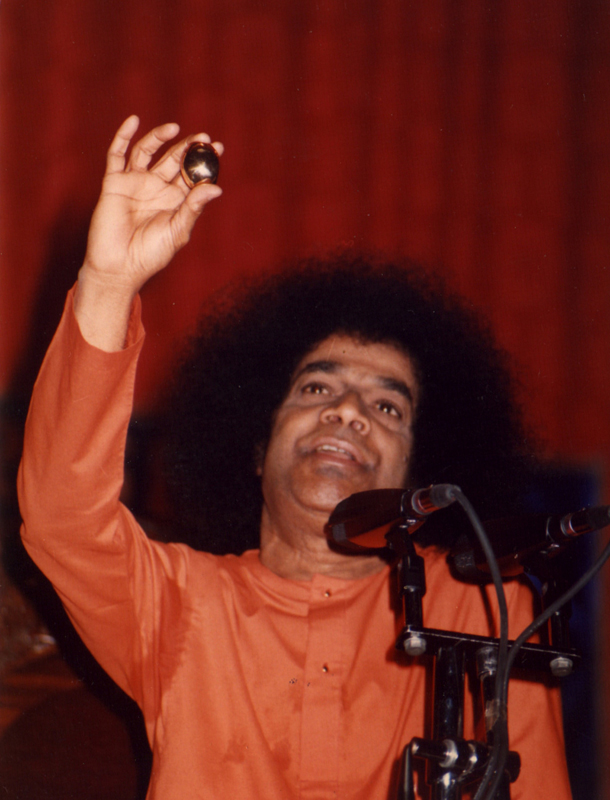
[Bringing up the Hiranyagarbha Lingam from His mouth and showing it to the devotees, Bhagavan continued…]
This is present in everybody’s Hridaya (spiritual heart) and is on the right side of the body. The principle of Hiranyagarbha is spread all over the body. It assumes a form when I will it. Whoever has seen this Lingam at the time of its emergence will not have rebirth. One should see its form as It emerges. In order to sanctify your lives, such sacred manifestations have to be shown to you every now and then. Only then can you understand the divinity in humanity. This Lingam will not break even if it is dropped from a height with force. This is Amruthatwam (immortality). It is changeless. You cannot see such a manifestation anywhere else in the world. it is possible only with Divinity.
[After singing the Bhajan, “Siva, Siva, Siva, Siva Anaraada.” Bhagavan continued]
For the past 20 years devotees did not have the privilege of witnessing Lingodbhava. The reason was lakhs of devotees used to gather in the Poornachandra Hall to witness this grand spectacle. As Poornachandra Hall cannot accommodate large gatherings, there used to be stampedes. As a result devotees were put to lot of inconvenience. In order to avoid this, Lingodbhavam was discontinued. Not only this, three types of Lingams emerge. They are Bhur, Bhuvah and Suvaha. Bhur refers to materialization (body), Bhuvaha refers to vibration (Prana) and Suvaha refers to radiation (Atma). I often say you are not one, but three: “The one you think you are (physical body), the one others think you are (mental body), the one you really are (Atma).” On every Sivarathri all the three Lingams would emerge. Even now the other Lingams had started to emerge, but I prevented them, because there are many things to be told to you. In future you will be a witness to many more manifestations of Divinity. Understand that this bliss can be experienced only in the proximity of the Divine and nowhere else.
Don’t get deluded just because I am talking, laughing, walking and eating like you. Don’t get deluded by the body feeling. All My actions are selfless, selfless, selfless. There is no trace of selfishness in Me. Have firm faith in this truth. If you have total faith, wherever you are, all your desires will be fulfilled without your asking. Only those who don’t have total faith suffer. Develop self-confidence. That is the first Sadhana you have to undertake.
Truly you are all most fortunate. Today Is Somavaaram (Monday), very endearing to Somasekara (Eswara). That is why Siva is extolled as Someshwara and Somasekara. This body was also born on a Monday. In every Siva temple, special prayers are offered on Mondays. Hanuman is worshipped on Mangalavaaram (Tuesdays). When Ravana was killed in the battlefield, Hanuman rushed to Sita to convey the good news. Sita was
overjoyed and blessed Hanuman profusely saying, “Hanuman, I don’t know what day it is, but since you have conveyed the much awaited Mangalakara Vaartha (auspicious news), this day shall be called Mangalavaaram (Tuesday) and may you be worshipped on this day.”
In the Treta Yuga names of the days, such as Monday and Tuesday, were not in existence; they are of recent origin. Therefore, in the culture of Bharat each term has an inner significance. But Bharatiyas themselves are not making any effort to understand them and are going along the wrong path. Culture is important, not caste. We have to uphold the culture.
Embodiments of Love! Understand the truth that love is Atma and Atma is love.