



























Ganga – The Celestial River
Ganga – The Celestial River
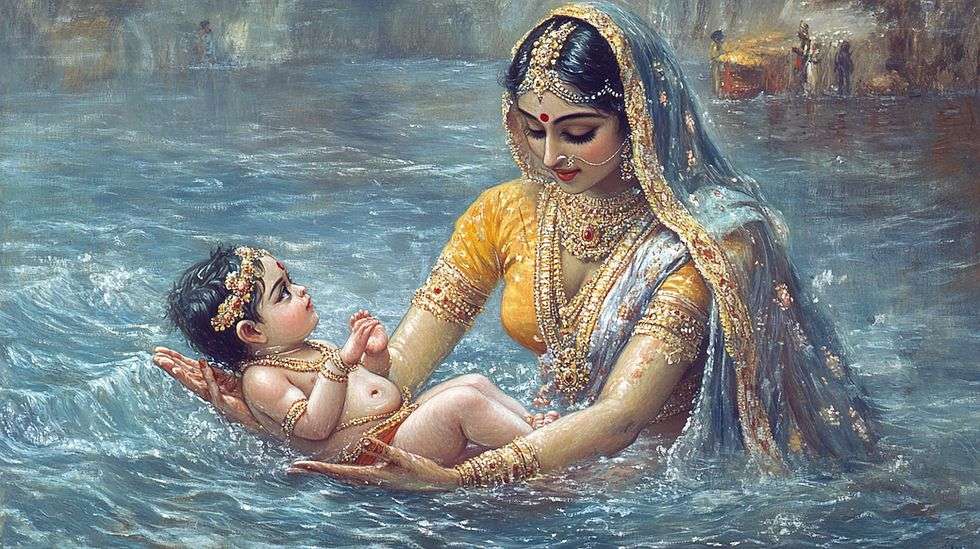
According to Hindu Scriptures, the River Ganges, better known as Ganga, originated in heaven where she was personified as a goddess bearing the name Akasha-Ganga. The Milky Way appearing in space from Earth is said to be the path of the Ganga River throughout the universe. This holy river brings life and fertility to nature; she is deeply revered and worshipped as a source of purification, healing, and liberation. She is also Jnana-ganga, the unbroken flow of knowledge itself. In the Mahabharata and Skanda Purana, her waters have been compared to amrita i.e., nectar of immortality.
The following article recounts how Gangaji leaves the higher planes and descends into the world in order to help human beings. It is through Shiva that she is able to do so. We go with her until she finally reaches her destination: Ganga Sagar. This place where the river (man) meets the ocean (God) in West Bengal is a symbol of enlightenment. The annual Gangasagar Mela will be held there from 10th January 2025 to 18th January 2025. It is the second largest Hindu fair (after the Kumbha Mela).
The origin and glory of the Ganges and the Lord’s Pastimes at Ganga Sagar are described in the Srimad Bhagavatam and other Gaudiya Vaishnava scriptures. Here they are presented in summary form.
According to the Srimad Bhagavatam the universe is a giant golden egg made up of fourteen planes of existence.
The seven upper planes are known as Bhu, Bhuva, Sva, Maha, Jana, Tapa, and Satya, and the seven lower planes are known as Tala, Atala, Vitala, Nitala, Talatala, Mahatala, and Sutala. These fourteen planes are often referred to as ‘the three worlds’: Svarga, Martya, and Patal [heaven, earth, and hell]. The universe, the golden egg made up of these worlds, floats in the Causal Ocean.
The Origin of Ganga Devi
Once the emperor Bali Maharaj conquered the three worlds. After a long battle, Bali Maharaj ousted Indra and the other demigods from heaven. The demigods’ mother, Aditi, became morose and performed a special sacrifice, the Payo Vrata, to induce the Lord to protect the demigods. Pleased with Aditi, the Lord agreed to descend to the world as her son and re-establish the demigods’ reign. He assumed the form of a young dwarf-brahman, Vamandev, and eventually came to a sacrificial arena where Bali Maharaj was performing an asvamedha sacrifice [horse sacrifice]. There He begged Bali Maharaj for three steps of land. When Bali Maharaj granted this, Vamandev began to expand His form. Gradually He became so large that His form filled the sky and all the directions. Vamandev stepped across the entire earth with His first step and across the heavens with His second step. When Bali Maharaj saw that there was nowhere else for the Lord to step, he surrendered and prayed that the Lord would place His last step on his head.
When the Lord stepped across the heavens, the nail of His big left toe poked a hole in the outer boundary of the universe.
“Water from the Causal Ocean entered the universe through this hole. It was coloured because it had washed the Lord’s kumkum-adorned lotus feet. Though the touch of this water destroys the sins of the whole world, the water itself remains uncontaminated. Because it emanates directly from the Lord’s feet, it is known as ‘Vishnupadi’.”
When the Ganges entered the universe, it flowed into Dhruvaloka, the polestar, and the Saptarshi Mandal, the seven planets that closely orbit Dhruvaloka, which are inhabited by the seven great sages—Kasyapa, Atri, Vasishtha, Visvamitra, Gautama, Jamadagni, and Bharadvaja. The Ganges remained there for thousands of yugas and was known as the Mandakini [‘she who flows gently’].
Meanwhile, on earth, the descendants of Manu, the progenitor of mankind, spread across the planet. The lineage of Manu’s son Ikshvaku, the lineage in which Ambarish Maharaj appeared, was eventually led by a king named Sagar. Once, on the direction of Aurva Muni, Maharaj Sagar was performing an asvamedha sacrifice for the Lord’s satisfaction. During the sacrifice, Indra stole the necessary horse. On his order, Maharaj Sagar’s sixty thousand sons went out to search for the horse and eventually found it on the bank of the ocean at the ashram of Kapila Muni (the Lord’s Saktyaves-avatar Kapiladev, who is described in Srimad Bhagavatam). Maharaj Sagar’s sons wrongly assumed that Kapila Muni had stolen the horse and came forward to kill him. As they did so, their bodies suddenly burned to ashes from within.
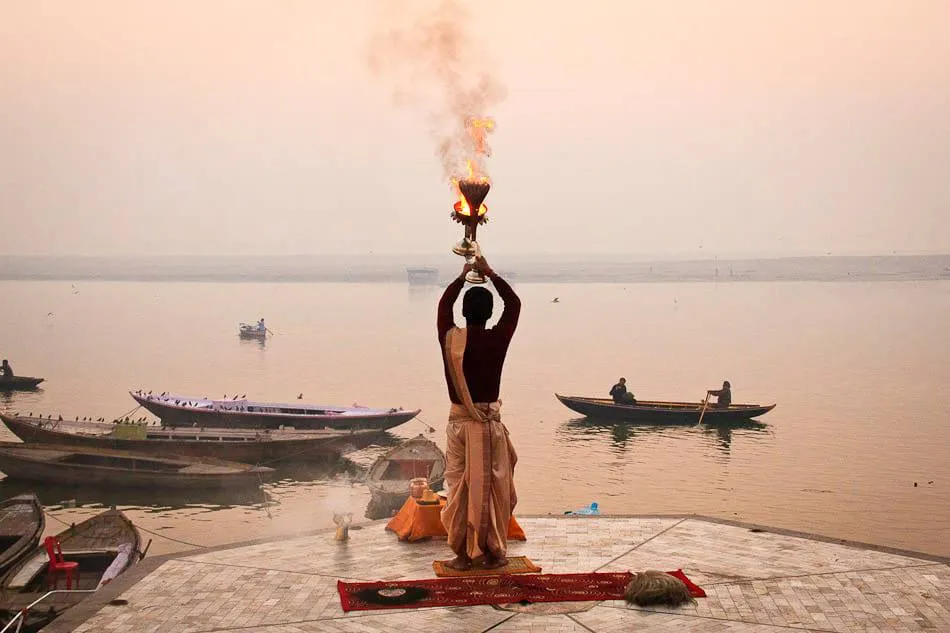
The Sanatana Dharma has always encouraged the worship of water bodies and specially rivers. This holy country of Bharat has seven sacred rivers flowing through it. These are Ganga, Yamuna, Godavari, Saraswati, Narmada, Sindhu and Kaveri. When we do a puja, we always invoke the waters of these rivers to flow into the kalasha vessel which contains water.
In Vedic times, the river Saraswati took predominance over the others. Today the Ganga has taken over this exalted position since the waters of the Saraswati have disappeared into the desert. The very first mention of Ganga is found in the Rig Veda.
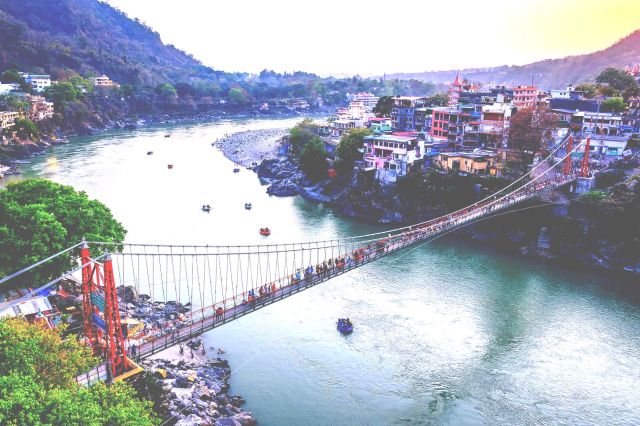
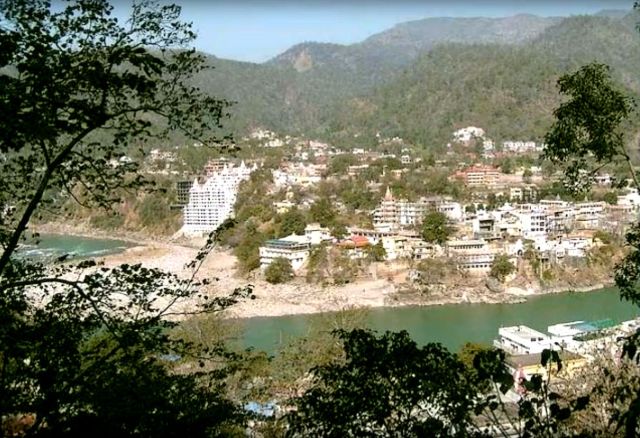
She is the artery of North Bharat so let us follow her journey from the Himalayas to the ocean. She originates from the mighty Himalayan mountains and flows through the north of Bharat. Cutting through the massive icy mountains with enormous force, Ganga reaches Central Bharat and flows in serenity up to the Bay of Bengal.
She is described in the Mahabharata as the “best of rivers, born of all the sacred waters.” Her father is Himavan, the mighty king of the Himalayas and her mother is his wife Mena. This makes her the sister of Parvati who was also the daughter of Himavan and Mena.
In the beginning she was a celestial river. In fact her name is associated with the Milky Way. This is why she is referred to as a theertha which is a crossing point between heaven and earth. What is the reason for her to come down to the earth? As usual science and myth are woven together in the inspiring story of her descent.
It starts eons ago when Lord Vishnu took on the avatara of Vamana or the dwarf. He came in order to put down the pride of the asura king, Mahabali, who had subdued the heavens and had declared himself to be the emperor of all the three worlds. However, since Mahabali was also a Vishnu devotee, the Lord decided to reduce his pride and give him a glorious opportunity to become the greatest of bhaktas! Actually he is supposed to be the grandson of the great asura devotee of Lord Vishnu called Prahlada!
The Lord took the form of a small Brahmin boy who had just been initiated into the Gayatri Mantra. The boy was supposed to go to three houses and beg for food – take biksha. He went to the yajnashala of Mahabali and asked him for three steps of land. Mahabali who was intoxicated with the power of wealth, laughed in scorn at this miserable request and told the boy to ask for anything he wanted since there was nothing in the whole world that he could not give!





