




















Divine Words of wisdom by Sathya Sai Baba – On Devotees
Divine Words of wisdom by Sathya Sai Baba - On Devotees
1. True devotee comes for Knowledge of the self
Description
Whatever others may do take it as the will of the Divine. Think that whatever, good or bad, happens, happens for your good. It is proper when such good thoughts are fostered in the hearts of the devotees. Though many come here, some go away thinking that Swami has not spoken to them or seen them or Swami has not fulfilled their desires. Yet there are some who sit in the mandir but do all the outside transactions. There are people of many ways. Are they all devotees? Therefore a true devotee comes for the knowledge of the self. But those are very rare. Whether they come here or not, Bliss can be obtained only with Self realization. One must make an effort to realise the true nature.

2. All who come to Prasanthi Nilayam are not devotees
Description
The poet Vemana said “If all stones were to become Gods, will not the kings grab and swallow them?” Similarly if all the people who visit Prashanthi Nilayam were to be devotees, then there would be no place in Prashanthi Nilayam! All those who come to Prashanthi Nilayam are not devotees. Only those who follow Swami’s teachings are devotees. That is the reason why Swami says He has been searching from the time of Shiridi. “I have been searching and searching, for whom? For the true man.”
3. Who is a true Sadhaka and a devotee
Description
A good person is described using many adjectives in Bhagavatha and Bhagavad Gita. He has been likened to sugarcane. A noble person is likened to a sandal wood tree and to sugarcane stalk. The sandalwood tree imparts its fragrance to the axe that cuts it but does not find fault with the axe for cutting it. The sugarcane, though subjected to squeezing and juicing, yields only sweet juice but not bitter juice. Likewise a true Sadhaka, spiritual aspirant, is the one who, in spite of troubles and hardships, endeavours to see and experience only the good in others and do good deeds but never seek revenge. A dry leaf and an iron ball stay still in the absence of wind. With the wind blowing, the dry leaf jumps eighty paces. The ball of iron does not budge and remains steady in its place. Similarly among the “sthitha pragnya”, (the one who is unwavering in both adversity and joy) and a fraudulent spiritual seeker, the fraudulent seeker is unsteady and is influenced by the troubles, sorrows and bad teachings. People regard themselves as devotees. But a true devotee does not think about God at appointed time; he thinks of God continuously. But an ordinary person, unlike the true devotee, gets influenced by hardships, troubles and bad teachings. He who has a wavering and fleeting mind cannot be called as a devotee. A true devotee would stand firm in the face of any difficulty, trouble, calumny and criticism. Such steady minded people are very few in the present times.
4. Swami speaks on Prime minister Vajpayee and on ministers
Description
Today Mr. Vajpayee has come here taking lot of strain. Such leaders are very much necessary for the world. He supports the institutions of this kind and ministers who extend such support to these projects are necessary. They must inculcate good feelings to make the country prosperous and to earn God’s grace. With the divine strength man can accomplish anything.
5. Swami on William Gladstone; UK PM
Description
There are lots of things that we need to achieve. For all this, Love and sacrifice are most important. At one time Queen Victoria was ruler at that time. There was a prime minister there. William was the prime minister. He is highly intelligent, highly educated and a great politician. Such a man through love and sacrifice had proved divinity, started discharging his duty. You may converse with anybody sweetly. You can assign work in a pleasing way. There was no trace of restlessness in him. Lord Brains mentioned all this points in the biography. That statesman described Williams the politician as very great noble soul. The noble qualities demonstrates the divinity. The selfless love, selfless sacrifice, where you find the bliss which is equal, there you find God.
6. Bhagawan's blessings to devotees
Description
Today, may you have that permanent devotion, may you have sacred life, long happy life and all of you have all these. May all your difficulties go, will leave you. Don’t be bothered by your problems and experience this permanent happiness here after.
7. Prahlada on intelligence and mind
Description
It is in this context that Prahlada proclaimed that there is no pleasure in this world. There is no pleasure in being born again and again. There is no pleasure in being born only to die and in dying only to be born again. Why should we be born if it is only to undergo the repeating cycle of births and deaths? One should be born in such a way that he becomes immortal and is never born again. One who, after finding the path, arrives at such truth is the wise person. If we carefully enquire into the words that Prahlada used on that occasion, we will note that he said that the intelligence of such a person is that of a wise man and not that of an animal. This means that Prahlada decided that one who understands and is after the path of immortality is a wise person. If one does not understand this, he is like an animal. He gave a very satisfactory answer to those who doubt the truth of such a statement. He illustrated it by comparing your body to a bow, your mind to the string on the bow and your life to the arrow. This means that the bow of your body has become subservient to the string which is your mind. When you put the arrow, that is your life, on this string of your mind and pull it, you find that the bow or the body bends. The arrow goes just as straight as is determined by the extent to which you are able to pull the string of your mind. This string of your mind should be pulled quite strong and should not be left loose. It is in this context that we are told that the right path to reach Madhava is to control our mind. By attaching much importance to our mind and body, a mind which is unsteady and a body which is like a water bubble, our entire life is rendered fruitless.
8. Story of Valmiki
Description
Ratnakara, who was ruthless and cruel hearted, indulged in many wicked activities to making a living. He had all wicked thoughts and they took a very wild form. All his actions were filled with cruelty. Hence Ratnakara became a way laying bandit. He had no thoughts of mine and thine and robbed and killed all who passed his path. Ratnakara was cleansed of all the sins accumulated from doing wrong and cruel deeds the moment he set eyes on the “Saptha rishis”, the seven sages. Ratnakara tried to rob and kill the seven sages. The seven sages said, “Son! Killing is no great deed. Even the insects and bugs do harm to humans. The one who helps is human. Good can be done by Lord too!! So seek to help and refrain from doing bad. Why are you doing these deeds? “Jaanedu potta nimpukona chikkula nonduchu, Kotividyalan punikamera nerchi, Paripoorna sukhambunu pondaleka, Ee manavajathi lokamuna mrakkaganela?!! Ee paratparun dhyanamu cheyu bhaktulaku Daarini choopakayundune maanava?” Man undergoes much travail to fill his small belly He studies hard various forms of knowledge, Still he is bereft of total happiness, Then why spend his time in this world undergoing so much? O man will He not show the path to them Who meditate on God and tread the path shown by God?” O madcap!! What happiness can you accumulate by harming so many to just fill your tummy? What kind of happiness can your family enjoy? You should not resort to such sinful acts. Having taken this human birth, do your duty; toil hard to earn your food.” The seven sages counselled him thus. Ratnakara’s thoughts underwent a change upon meeting and conversing with the Saptha rishis. Hence good company is essential to man. Man can develop focus and solitude due to good company. Man can get rid of bad thoughts by being in good company. Getting rid of bad and wicked thoughts leads to liberation. Therefore man must make an effort to develop good thoughts. After being counselled, motivated by the Saptha rishis, Ratnakara started chanting the name of Lord Rama. He sanctified his life with Lord Rama’s name. The Lord who is the giver of this world is “loka data” and Valmiki became the “sloka data” the giver of poetry. Being dedicated to His Lord, he could improve his compositions. Without the divine composer, “sloka data”, the magnificence and grace of the Lord, who is the “Loka data”, would not have spread in the world. Therefore “Sloka data” Valmiki became an ideal to the world.
9. Bhagawan wishes all of us to be happy
Description
“Lokasamastha sukhino bhavanthu!”- Let everybody in the world be happy and peaceful. That is Swami’s desire and for that Swami is ready to do anything. Swami is ready to sacrifice His life for the humanity. What is the use of that human being who does not aspire for the welfare of his fellow men? Swami always desires for the welfare of others and so Swami always has good thoughts. When one’s intentions and thoughts are good one need not bother about the money; the money will come walking to the person.
10. Swami on Dasa and Devotee
Description
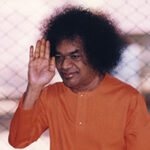
Few hours back Central trust member K R Prasad came. In the course of conversation, he said, “Swami! What is the difference between a devotee and servant? Then I said, “Child, Servant is the one who serves with body identification. Devotee is the one who thinks of God wherever he or she is. “Sarvada Srava kaleshu Sarvatra harichintanam”, that is everywhere, at all times, the devotee is thinking of God. Whereas servant is the one who serves continuously.