












Deities and Their Divine Vehicles

Deities and Their Divine Vehicles
In Indian mythology and art, the concept of vahana (vehicle or mount) holds a unique place, with each deity being associated with a particular animal. These animals are far more than mere companions, these vahanas are the divine mounts upon which deities are often depicted, acting as extensions of their power and personality. Be it the mighty Garuda soaring with Vishnu, the serene swan gliding with Saraswati, or the humble mouse seated at Ganesha’s feet, each vahana carries a symbolic meaning that deepens our understanding of the deity it accompanies. In Indian art forms, from temple sculpture to paintings, vahanas not only complete the divine image but also express profound philosophical ideas associated with the deity, as well as ideas related to the communities that worship these gods, making them integral to the daily life, spiritual thought and aesthetic tradition of India.
The origins of vahanas can be traced back to ancient Sanskrit literature, where these animals were not simply companions, but symbols of cosmic principles. Each mount embodies an aspect of nature, human instinct or universal energy, channeling the deity’s essence into a form that devotees could relate to.
Through this blog, we aim to explore the stories behind each animal as a vahana, as depicted in Indian art with their deity.
Mushaka

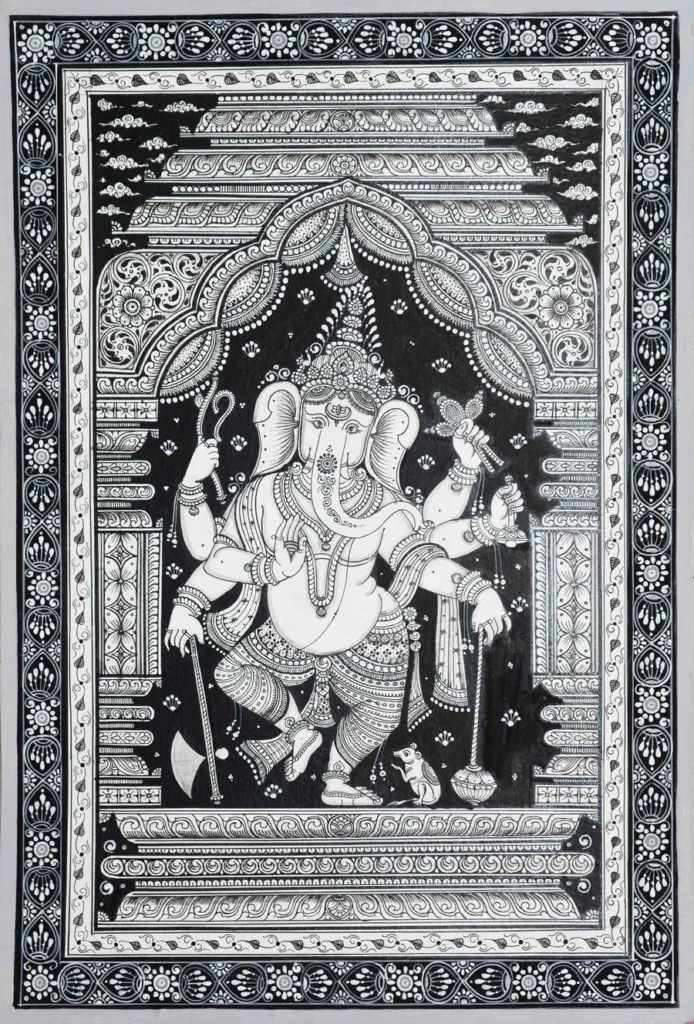
Lord Ganesha, the remover of obstacles and the patron God of wisdom, is always depicted with a small yet significant companion at his feet- Mushaka, the mouse. While the contrast between the mighty deity with his elephant head and the tiny, seemingly insignificant mouse may appear striking, this pairing is highly symbolic. The mouse represents desire, greed and restless energy, qualities that, if unchecked, can gnaw away at human life. By making the mouse his vahana, Ganesha demonstrates mastery over these impulses, teaching devotees that wisdom lies in controlling one’s desires rather than being consumed by them.
The mouse, being small and able to enter hidden spaces, also symbolises Ganesha’s ability to reach into the deepest corners of the human mind, uncovering hidden knowledge and removing unseen obstacles. In folk traditions, Mushaka also represents humility, proving that no matter how small or overlooked one may be, everyone has a role in the cosmic order. In traditional and folk Indian art,Mushaka is often seen gazing upward at Ganesha, highlighting his devotion and service, as seen in the below Madhubani and Pattachitra paintings.
Garuda
Garuda is the vahana of Lord Vishnu, the mighty eagle, also depicted as a half-human and half-eagle. He symbolises swiftness, strength and devotion to dharma. His wings represent speed and expansive vision, enabling him to soar across the three worlds, carrying Vishnu as the preserver of cosmic order.
In art, Garuda is also often shown kneeling with folded hands before Lord Vishnu, emphasising on humility and service despite his immense power. As eagles are considered the enemy of serpents (nagas), associated with ignorance and bondage, Garuda symbolically represents the eternal struggle against darkness. He is often shown with a naga held between his claws.
Thus, in both philosophy and visual representation, Garuda signifies the triumph of divine truth, courage and the unwavering devotion that sustains cosmic harmony.
This oleograph by Raja Ravi Verma depicts Garuda carrying Vishnu and his consorts Shri Devi and Bhu Devi on his back, and holding a serpent in his claws.
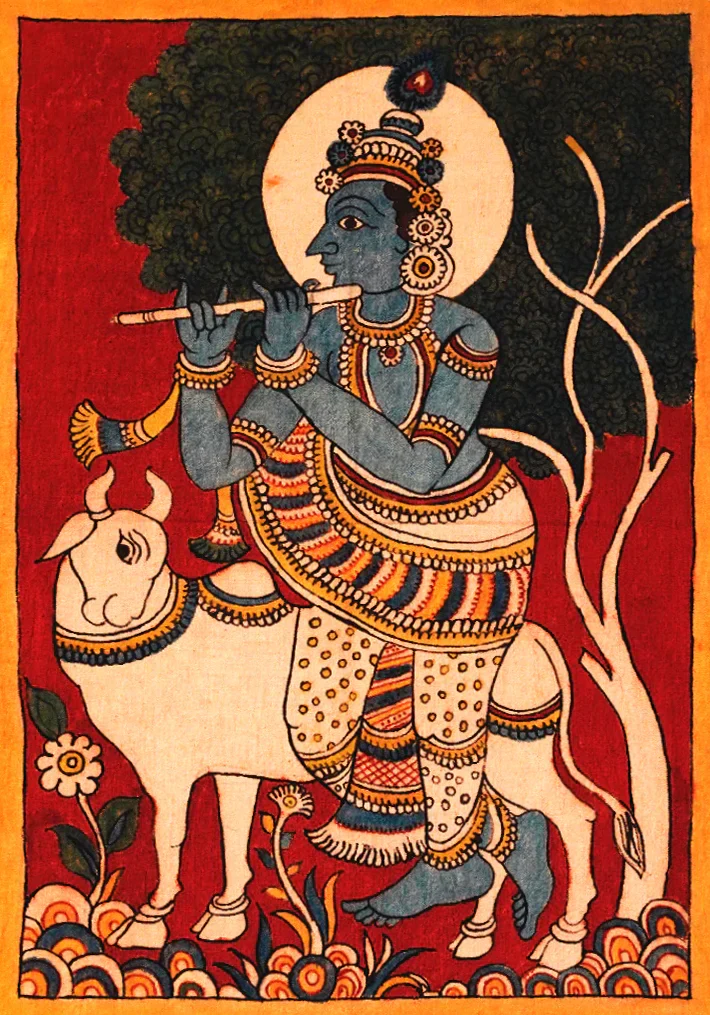
Krishna with Cow Kalamkari Painting by Siva Reddy
Cows are the most popular motif in Pichwai paintings, shown with Shrinathji, in herds, as a part of festivals like Gopashtami or Govardhan puja, or even by themselves with calves, surrounded by lotus flowers, etc. They are often depicted with saffron handprints on them, symbolising the divine presence of Lord Krishna.
Nandi
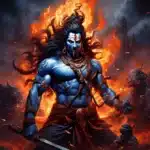
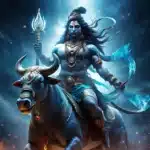
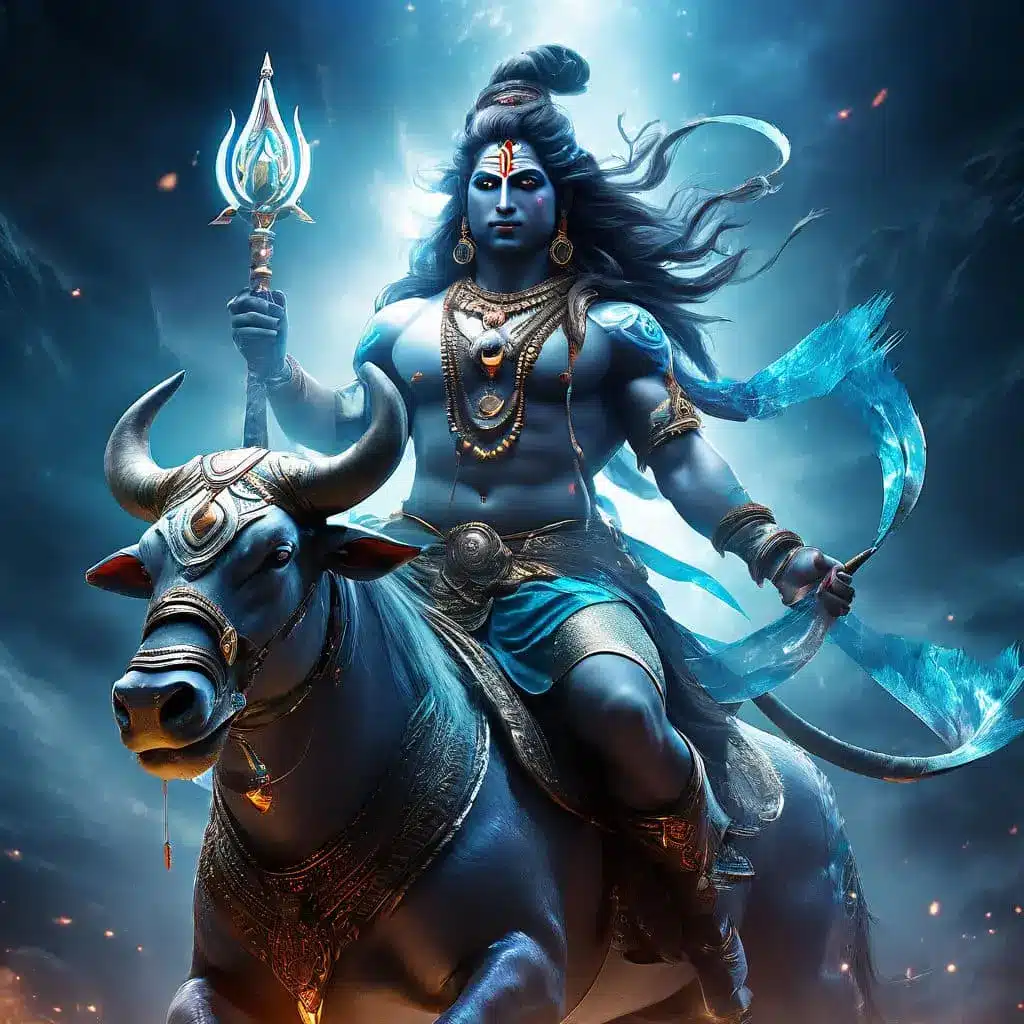
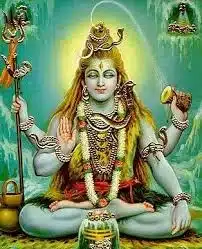
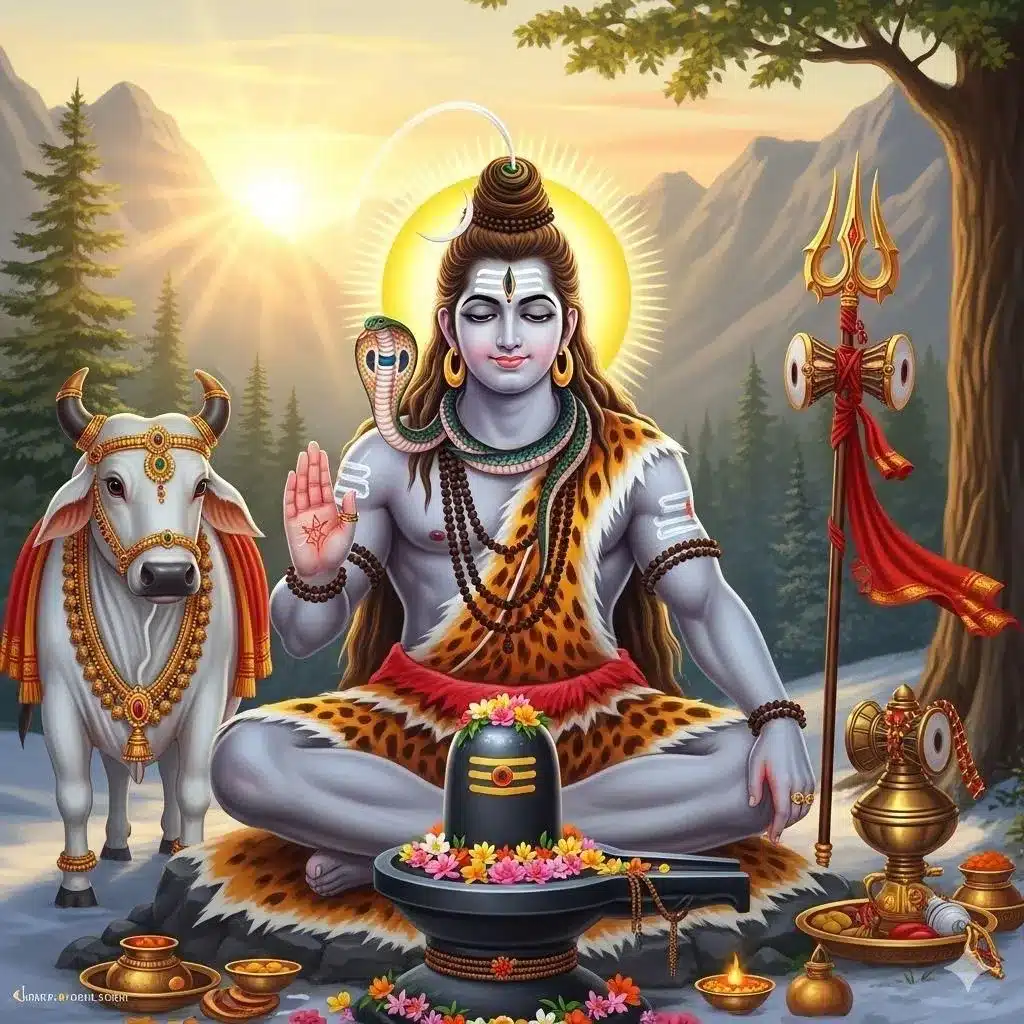
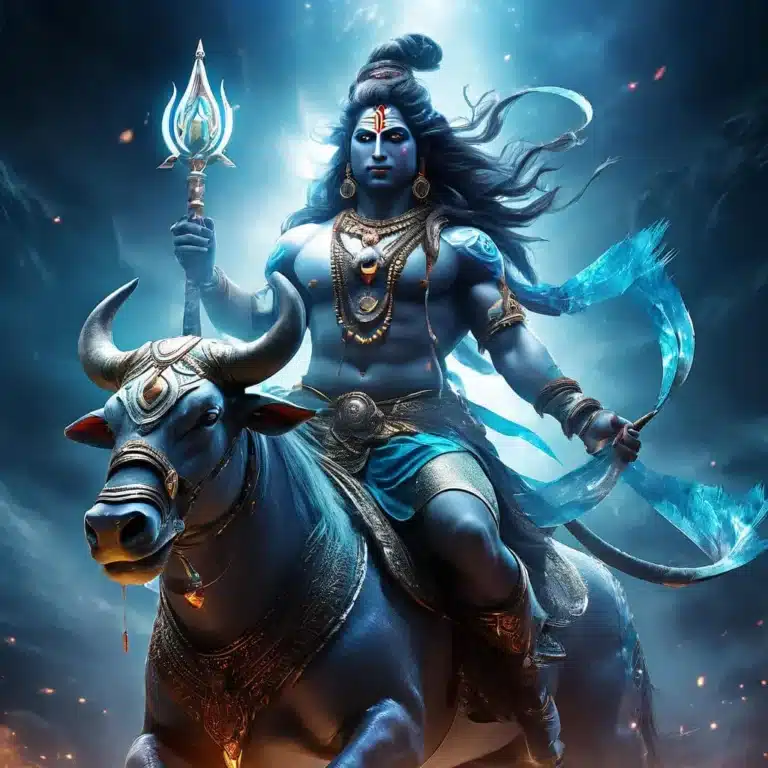
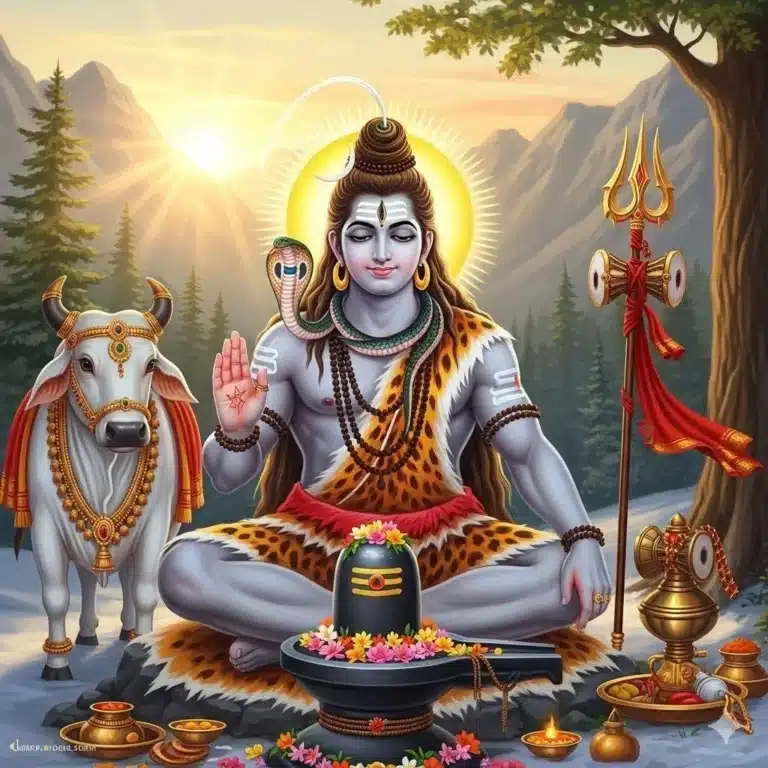
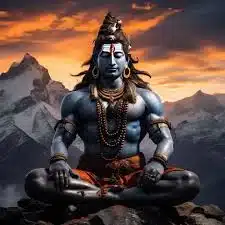
Nandi, the sacred bull, is the constant companion and vehicle of Lord Shiva. He holds a deep and symbolic meaning in Indian art and philosophy. A bull represents strength, virility and endurance – all attributes associated with Lord Shiva. Nandi can often be seen seated in front of Shiva in temples, facing the sanctum. He is the eternal devotee whose gaze never wavers from the divine, highlighting his unshaken faith, patience and discipline in spiritual practice. Nandi also embodies dharma or righteousness and the controlled use of power, reflecting Shiva’s role as protector of cosmic balance, who holds the power to destroy the world with his energy, but chooses to protect it instead.
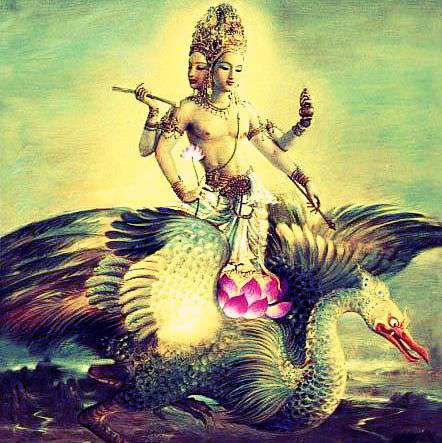
Hamsa (swan) is the
Vehicle of Brahma. It stands for discerning intelligence (buddhi), purity, judgment, skill, grace, knowledge, and creativity. The word “Hamsa” is a combination of two words, “aham”+ “sa”. It means “I am He”. This awareness that one is God exists only in enlightened people. Rightly Brahma is the friend and philosopher of all the enlightened beings in the world, and he has the power to give us this knowledge about our true nature. The bird hamsa is also very beautiful, peaceful and graceful. It suggests that Brahma is the master of all the beauty and grace of the world, and He can help us in our effort to acquire these qualities.
It is also believed that the bird has the capacity to separate milk from water. This symbolically means that Brahma can help us to transform our intelligence, or the buddhi, or our ability to discriminate between the rights from the wrong so that we can select the correct path to achieve salvation. The bird moves in waters, especially lake waters that are placid. The water symbolically stands for our consciousness and the lake itself for a limited consciousness such as ours. Brahma moves in our consciousness on his Vehicle hamsa and purifies it with his touch and grace. If you want to develop super fine intelligence, you should worship Brahma and invoke him in you during meditation.

Lord Shiva rides the Bull, Nandi, which stands for the bullying, aggressive, blind and brute power in man. It also stands for unbridled sexual energy, Kama. Only Lord Siva can help us control these and transform them. They are usually manifestations of excessive tamas in the body.
By invoking and worshipping Shiva one can get rid of them. Thus Shiva can transform a wild bull into a gentle and enlightened Nandi. Shiva is also considered a healer.
The Vedas address him as a divine healer and point to his power over death caused by snakebites, calamities, diseases, etc. Hence, those who suffer from chronic diseases, or physical ailments, may pray to him for relief or protection from toxicity in the body, pain, suffering, and death.