







































Ayurveda & Spirituality
Ayurveda & Spirituality

Ayurveda is an ancient system of medicine and holistic wellness that has been practised in India for thousands of years. Its roots lie in spirituality, and it is not only used to heal the body but also to connect with the spiritual self. One of the critical components of Ayurveda is yoga and meditation. These practices help individuals achieve balance and harmony in all aspects of their lives.
Though Krishna consciousness is chiefly about the soul in relationship to God, we devotees recognize the body’s role in our day-to-day spiritual activities and understand that proper bodily care is fundamental to the spiritual quest. After all, if one doesn’t properly care for the body—the soul’s vehicle— performing even basic spiritual practices becomes increasingly difficult. This is not to say that it is impossible to chant, pray, and so on, even in compromised health. But to have a sound body and mind is certainly an asset. In fact, that’s one reason why the sages of ancient India practiced yoga—to enhance their psycho-physical condition. They used their healthy body in pursuit of the spirit.
Ayurveda, the ancient Vedic system of holistic healing, was conceived and developed with a similar strategy in mind. Its purpose is to allow us to function at optimum level, so that we might use our God-given body in the Lord’s divine service.
The science that talks about the beneficial and harmful life, the happy and the miserable life, and the span of each type of life is called Ayurveda.
Spiritual and material status are the two dimensions that define the ayu(age/life) of an individual.
The beauty of the above shloka is that it focuses on the spiritual aspect of Ayurveda. The final aim of Ayurveda is to achieve oneness with the divine. According to Charak Samhita, the sages discovered Ayurveda in a transcendental state. They aimed to ensure a healthy and misery-free existence for all living beings. Therefore, Ayurveda emerged to provide healthy life, that is useful for spiritual development.
However, Ayurveda does not discriminate between a sage and a sinner. The Vedic people believed that all life experiences eventually lead to spiritual development.And a sinner deserves and needs better opportunities than a Saint.
This shloka conveys that Ayurveda has tailor-made solutions for each type of life, irrespective of its spiritual level. It is there to improve the quality of life for everyone, whether the person is a sinner or a sage. Therefore, Ayurveda defines all kinds of lives, their qualities, patterns, possible lifespans, etc.
According to Ayurveda, there can be 4 kinds of lives –
- Hitayu or the beneficial life
- Ahitayu or the non-beneficial life
- Sukhayu or the happy/comfortable life
- Dukhayu or the miserable/uncomfortable life
The ancient Vedic people believed that the far end of life is not death. Death is another beginning. We all have a treasure of mental impression called samskara. These samskaras lead us into learning cycles of birth and rebirth.
Ancients believed that our future birth depends on the way we live our current life. We can do good deeds and earn spiritual merit or engage in evil activities and lose the spiritual shine.
The four kinds of lives described above, lead to different results in another realm, after death. Ayurveda aimed to elongate and ensure optimal use of every life. Let’s look at the meaning of these lives and the way Ayurveda can improve them.
The word “Hita” means beneficial. The ultimate benefit of a soul is to get past its samskara or karmic bonds. “Hitayu” is a righteous life. Such a life might or might not be comfortable but it creates minimum bonds and relieves an individual from the past karmas. A life of remembrance and pursuit of spiritual development is what Hitayu means in the truest sense.
Ahitayu
Contrary to the “Hitayu”(righteous life), Ahitayu is a badly lived life. The word “ahita” means harmful. A life lived under the influence of greed, anger, arrogance, deceit, lust, and violence is most harmful to a soul. Such a life creates painful negative sanskaras that lead to karmic bonds for many more births. It is like a credit card badly used, which creates a huge loan on an individual. Interestingly, such a life might look to be very comfortable and even lavish from the outside. But it is nothing less than jail for the soul. Thus, Ayurveda also offers psychological treatment to such patients so that their quality of life can improve.
Sukhayu
The word sukha signifies comfort, pleasure, and abundance. However, it is one distinct parameter in Ayurveda. Comfort is the second level of consideration about the type of life a person is living. A comfortable life might or might not be virtuous. But it is comfortable on the physical dimension. For example, a virtuous person might have a very healthy body, a happy family, and good finances. At the same time, a vicious person might be extremely wealthy and have everything at his disposal. Both of these people have a comfortable life.
Dukhayu
According to the Vedic tradition, the biggest wealth is a healthy body. Therefore, the biggest loss is a diseased or disabled body. The word “dukkha” means misery or discomfort. The biggest factor for discomfort is an unhealthy condition. Apart from that, an unhappy family life, lack of friends or well-wishers, bad social status, and poverty are multiple factors that form a Dukhayu(miserable life). Like Sukhayu(comfortable life), a virtuous person can experience a lot of physical and mental trauma in a corrupt society. He can fall sick despite his good character. At the same time, a vicious person, a drug addict, or a person with bad character can also ruin his life and become sick and poor. In this way, both these people will experience a miserable life, irrespective of their character or conduct.
What Is Ayurveda?
Ayurveda is perhaps the oldest system of natural healing in the world, predating even the Chinese system. The name Ayurveda is from Sanskrit (veda = knowledge; ayu = life) and is often translated as “the knowledge of life.” But I would suggest that “the knowledge of longevity” more accurately captures its intent. The sages of ancient India carefully distinguished life, a spiritual phenomenon, from longevity, a term that refers to the proper maintenance of the body. This distinction between body and self is fundamental to Vaishnava thought.
Because death and disease present an ongoing challenge for all humans, encased as we are in a material body, we search for practical and effective methods of bodily health. Spiritual seekers want to maintain and care for their bodies in ways that do not compromise or infringe on their spiritual practices. The achievement of these dual and interdependent goals is the purpose of Ayurveda, which makes it more than an ordinary medical science. It not only elucidates the healthiest interaction of body and mind but also prescribes guidelines for realizing the relationship between these two and the eternal spirit within each of us. It is thus totally holistic.
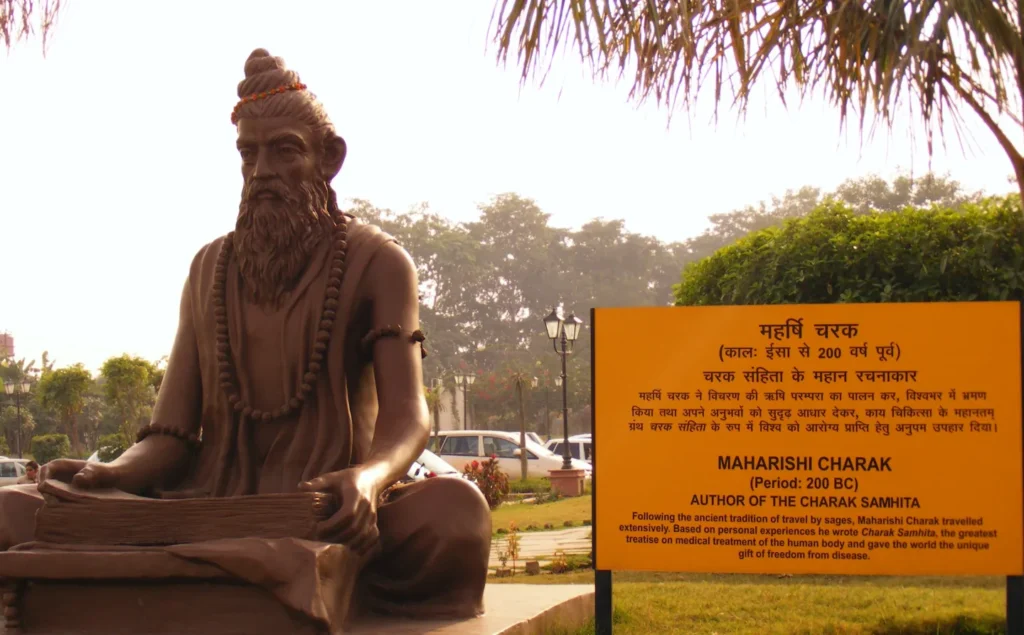
While the science of Ayurveda was put into written form about fifty centuries ago, as part of the Vedic literature, it has an oral tradition that dates back even further. Modern practitioners of the science rely more on medieval encyclopedias—such as the Charaka Samhita and the Sushruta Samhita (named after their respective authors)—than on the original Vedic texts. Still, these works are based on knowledge found in the Vedas, and discuss in detail such subjects as pediatrics, obstetrics, gynecology, internal medicine, otolaryngology, and plastic surgery. Modern scientists are still in awe at the depth and clarity of Ayurvedic information; it is a mystery that such a complex system was conceived so long ago.
A grasp of the tridosha theory is central to an understanding of Ayurveda. The doshas are dynamic forces within the body and mind. There are three doshas: vata, pitta, and kapha. Vata controls activity and motion; pitta, heat and energy; and kapha, structure and density. Vata, pitta, and kapha also relate, respectively, to air, bile, and mucus. These three interact with the seven dhatus (usually translated as “tissues”): lymph, blood, muscle, fat, bone, marrow, and semen.
Our daily activities put the interdependent doshas and dhatus into a state of disequilibrium, causing disease. We can gain proper equilibrium and, consequently, health only by considerations of diet, climate, season, activity, and mental discipline. Ayurveda deals with these things as a detailed science. Its methods are mainly preventive. But the system also includes effective approaches to rejuvenation and the healing of established diseases.
Ayurveda and Rasa
According to Ayurveda, there are six types of tastes, or rasas, each with a different effect on digestion. A rasa can be light or heavy, moist or dry. Light tastes are easier to digest, but the heavy ones require more energy for the body to assimilate. The six tastes are bitter, sour, salty, pungent, astringent, and sweet. According to Ayurveda, it is advisable to include foods in one’s diet that contain all six rasas because, properly combined, these six create dietary balance. Excessive consumption of any of these could result in adverse effects.
In Krishna consciousness our conception of God includes a similar phenomenon. We say that God is a person, Krishna, and that He relishes not just one or two but all kinds of relationships. Basically, there are five categories of relationship that one may have with the Lord: One can relate to Him in a neutral mood, as a servant, as a friend, in a nurturing capacity, or as a lover. The sweetest of these relationships is known as madhurya (“sweet”): the relationship of romantic love. So just as sweetness is one of the rasas, or tastes, in Ayurveda, it is also one of the rasas, or relationships, one may have with Krishna. The same word—rasa—is used in these two different ways. All rasas play a role in Ayurveda. Similarly, Krishna wants more than just the relationship of romantic love, madhurya. He wants diverse kinds of relationships, as we want diverse kinds of relationships with Him.
The term rasa means “sap,” “juice,” or “essence,” and by extension “flavor,” “enjoyment,” and “taste,” as in Ayurvedic texts. It was used in the early Upanishads to mean “essence,” and there it was associated with the highest reality. The Taittiriya Upanishad, for example, claims: “Verily he (the soul) is rasa. And he becomes joyful only after obtaining rasa.”
The word rasa was used in aesthetics and dramaturgy, as in the Natya Shastra of the legendary sage Bharata. Within this context the term rasa is best translated as “dramatic sentiment” or “aesthetic enjoyment.” Bharata and others, such as Abhinavagupta, developed this rasa idea into a science. Bharata reasoned that the emotions of day-to-day life could be recreated by dramatic performance and evoked in the audience.
Ayurveda
What is Ayurveda?
Ayurveda is a holistic approach to health that is designed to help people live long, healthy, and well balanced lives. The term Ayurveda is taken from the Sanskrit words “ayu”, meaning life or lifespan, and “veda”, meaning knowledge. Hence the word “Ayurveda” means “Knowledge of life”. Ayurveda has been originated and practiced in India for more than 5,000 years and has recently become popular in Western countries.
Yoga and Ayurveda is based on India’s timeless scriptures, known collectively as Vedas. The body of Vedic knowledge was handed down from generation to generation. Yoga and Ayurveda are two interrelated branches of the same great tree of Vedic wisdom that encompasses all of human life. Yoga and Ayurveda are not merely two separate but related healing disciplines of India. Each has its unique place and function, but each overlaps into the other on various levels. Ayurveda is a healing aspect of Yoga while Yoga is a spiritual aspect of Ayurveda.
“Ayurveda” is a complete healing science which encompasses the Physical (Body), Psychological (Mind) and Spiritual (Spirit) aspect of life. Hence, Ayurveda is both systematized knowledge and practical wisdom, an art of complete and holistic healthy living. “Ayurveda” not only confines treatments for ailments but also places great emphasis on its prevention.

What is “Healing” ?
Curing Vs Healing
The terms“cure” and “healing” are distinctly different. “Cure” basically reflects the physical reality that is, the body is free from specific symptoms and one is returned to a familiar state of function. “Healing” occurs at different levels of human existence. Healing is the natural way in which all imbalances are rectified so that the symptoms of the illness can be controlled.
Healing happens from within. Cure fixes, healing corrects. Cure is reactive; healing is proactive. Healing promotes wellness whereas Cure combats sickness. Cure addresses only the disease, but not always one suffers from disease, the illness may be a result of imbalances which are best addressed by “Healing”.

Why Ayurveda for Healing ?
According to Ayurveda, body has the power to heal itself.
WHO (World Health Organization) estimates that Ayurvedic medicine treats almost 1/3rd of Worlds population. It has been recognized as a valid system of medicine by UNO (United Nations Organization) since 1982.
Ayurveda is a system based more on function than on structure. It strives to bring the system of the body into equilibrium so that the body with its inner energies functions as a ‘unit’ according to the need of its environment.
A system of health that only takes into account the structure and functioning of physical body cannot effectively address human health in its totality.
Ayurveda’s Body-Mind-Spirit approach is not only entirely holistic in its application, but also emphasizes personal empowerment. Ayurveda unfolds the harmony between the Body-Mind-Spirit through the various techniques of Diet, Lifestyle, Herbs, Panchakarma (detox) , Yoga, Pranayam (breathing exercise), Meditation and Spiritual practices.
Ayurveda guides us in determining our unique mind-body type (called “prakruti”). Ayurvedic physiology states that each one has 3 biological energies (called doshas), depending upon your unique proportion of dosha marks your Body-Mind-Type (Prakruti).
We can strive for a harmonious balance between these three doshas, or mind-body energies—Vata (air), Pitta (fire), and Kapha (earth)—that make up our “Prakruti”. This mind-body network influences our physical appearance—body frame, eyes, complexion, hair—along with the way we typically think, act, move, eat, and sleep. All three energies are in us—with one generally predominant, while another often sub-dominant.
Ayurveda recognizes there is this magnificent life force energy that flows through us and around us—creating wholeness in mind, body, spirit, and environment.
Health is not only absence of disease but it is a state of balance of Body-Mind-Spirit. Ayurveda works to bring this state of balance in the individual. According to Ayurveda, health is a continual process of achieving and maintaining a dynamic balance in all aspects of life through the means of comprehensive natural therapies which are highly customized to suit the individuals’ constitution and their current doshic (energies) imbalance. The goal of this process is not only to heal the disease and to reestablish balance but more importantly to prevent disease and to promote holistic and optimal health.






