














Advent of the Sai Avatar
Advent of the Sai Avatar
“…And I saw heaven open and behold a white horse and he that sat upon was called Faithful and True and in righteousness he doth judge and make war.” John 17:Revelations
The above passage appears in the New Testament of the Holy Bible (John Ch.17). This description of the descent of God is strikingly similar to that of the description appearing in the Puranas of Hinduism, heralding the coming of the Kalhi Avathar – the soldier with a sword, mounting a white horse, at the dawn of the Kali Era. Though the scriptures are from different religious backgrounds, the message, once again seems to be that, “God is One.” Is it just pure coincidence or the prediction of the future? Examining the evidence, one comes to the conclusion that the avathar who is spoken of in the scriptures is no other than Bhagwan Sri Sathya Sai Baba himself.
In the Song Celestial or Bhagavad Gita, Lord Krishna, the 9th incarnation of Godhead declares, “Whenever and wherever there is a decline in religious practice, O descendent of Bharata, and a predominant rise of irreligion – at that time I descend Myself(4:7).” Presently, the world is in the throngs of evil and violence, a turbulent times desperately needing a deliverer. Hence, it seems an incarnation of God is inevitable.
Referring again to the verse from the Bible mentioned earlier, it speaks of He who is called Faithful and True, and he in righteousness, judges and makes war.
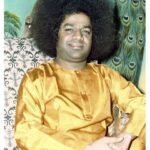
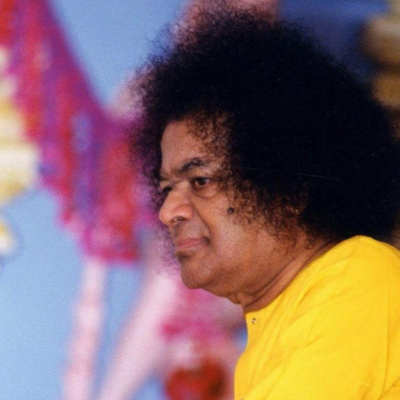
Bhagwan Sai is hailed as the personification of Truth and is known as Sri Sathya Sai Baba, the Sai of Truth. Furthermore, the verse from the Bible goes on to say, “…His eyes were as a flame of fire, and on his head were many crowns. He had a name written that no man knew but he himself, and he was clothed with a vesture dipped in blood…” It is a well known fact that Bhagwan Sai wears orange robes, his hair is curly and appears as a crown and is known to, miraculously, cure the diseased and the unbelieving with his vision, unparalleled by any other. Hence, Was St. John, the apostle of Jesus, granted a vision of the future Sai Avathar thousands of years ago, during the time of Christ? Even if the answer is a “No,” the striking similarities of the details mentioned in the Revelation section of the Holy Bible is too significant to be ignored as pure coincidence.
“To deliver the pious and annihilate the miscreants, as well as to re-establish the principles of religion, I myself appear millennium after millennium (4:8)” declares Lord Krishna at the battlefield of Kurukshetra. Similarly Swami speaks of his mission “…to spread happiness or ananda and so I am always ready to come among you, and to correct the buddhi or the intelligence. I have come to counsel, help, command, condemn and stand by as a friend and well-wisher to all, so that they may give up evil prosperities and recognize the straight path” of Dharma or righteousness. It is clear how Swami emphasizes the importance of right conduct and truth in our personal lives, leading to the realization of the soul.
Hilda Charlton, a foreign devotee of Swami, had the fortune of seeing a vision of a white horse above Bhagwan Baba’s head during bhajans at Prashanthi. Though at the time she was unaware of its significance, she inquired among her Indian devotees of the vision’s meaning and later found out the white horse is the mount of Lord Kalhi, the tenth and final incarnation of Vishnu at the end of the Kali Yug. Therefore, it is without doubt that Lord Sai is indeed the Kalhi Avathar, as predicted by the ancient Hindu scriptures such as the Puranas and Ithihasas.
Hinduism, one of the world’s oldest living faiths, relies mostly on the word of God passed down through the vision of the sages. According to such ancient scriptures an avathar of Godhead can be recognized by his seven ‘cosmic characteristics’. Surprisingly not, Bhagwan Baba displays the seven characteristics of splendour, wisdom, powers to create, preserve and destroy, prosperity and non-attachment thoroughly in his daily life. His miracles of various nature; from materializing vibhuthi, gem stones and necklaces to manifesting himself at foreign lands, quoting and speaking eloquently of any ancient scriptures, languages known to man to even interfering with nature to protect his devotees are true testaments of his Supreme Consciousness. He is constantly in a state of ananda or bliss and possesses an aura of love upto thirty feet, curing diseases and past karmas of everyone that comes in contact with him. Hence, Bhagwan Baba meets all criteria of avatharhood as outlined by the sacred scriptures of Hinduism.
However, one can raise the question that “Why does Baba not look like a soldier and ride a white horse as mentioned in the scriptures, if he is the Kalhi Avathar?” The pundits of India respond that the form of a soldier and the white horse are symbolic and are not to be taken literally. Imagine, at the present time, someone mounting a white horse dressed as a medieval Indian soldier, complete with a sword and a shield? Baba has often joked that if he were to appear on earth as Vishnu portrayed in our shrine pictures, with a blue complexion, four hands, the changku, chakra and katha and padma, we would put him in a museum and charge fees to see him! Hence, the Lord takes on the form that can be related to by humans, so that we too, may inspire to become God. But, Baba’s discourses and teachings are representative of the sword that destroys all evil, his white Benz in the earlier days of the white horse mount and he is indeed a soldier of peace and deliverance.
If one is still unconvinced, the declarations made by Swami himself reveal his true divine nature. On a fateful day in July of 1980, Bhagwan Baba declared that he is the incarnation of the divine couple Shiva and Shakti, a union of the male and female aspects of Godhead. He also revealed that this avathar was promised to a rishi thousands of years ago as his boon for his penance.