















A Beautiful Divine Message by Bhagavan Sri Sathya Sai Baba
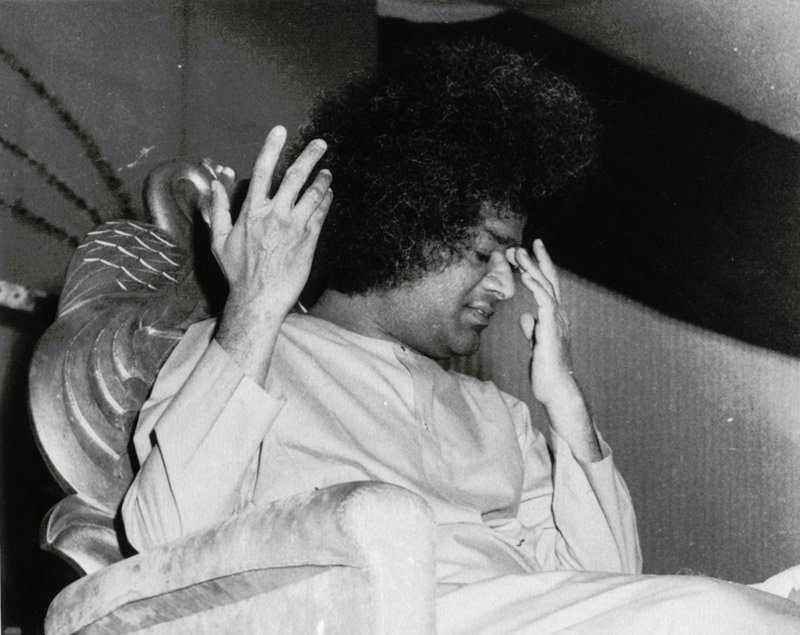
A Beautiful Divine Message by Bhagavan Sri Sathya Sai Baba
Sathya dharma prema shantulu lekunna
Vidhyalanniyu nerchi viluva sunna
Sathya dharma prema santhulu lekunna
Dana dharmala sardhakatha sunna
Sathya dharma prema santhulu lekunna
Bahula sathkarya labhmbhu sunna
Sathya dharma prema santhulu lekunna
Padavulanelina viluva sunna
Ee sanathana dharma harmyambu niluva gunamulivi nalgu punadhi godalappa
Intakannanu vereddi yerukaparathu
Sadhu sadhguna ganyulau sabhyularaWithout Sathya (Truth), Dharma (Righteousness), Prema (Love), and Shanti (Peace),
The mastery of all skills and all types of knowledge and education would be a futile exercise, the value being zero.
Without Sathya, Dharma, Prema, and Shanti,
All acts of charity, all acts of mercy would be rendered null and void.
Without Sathya, Dharma, Prema, and Shanti,
All the good that one does, all the good deeds that one performs, the fruit of such actions would be a zero.
Without Sathya, Dharma, Prema, and Shanti,
To occupy positions of power or authority, the results of actions which follow in the wake of this positions of authority would be a zero.
These ancient principles of Sathya, Dharma, Prema, and Shanti are verily four cornerstones.
They’re verily the fourfold pillars on which the rest of one’s life rests.
What else than this could I possibly communicate to you all, pious members, the virtuous and the noble members of this august assembly.
All those who can read and write, could they be called educated? Are those who secure degrees in the colleges, could they be called educated? And the type of education that does not fill you with good traits and a good conduct and character, could it be called true education? If by education you mean the means to live, what about the birds and the animals? Are they also not eking out a living?
Embodiments of love!
If man has to bring to the fore his innate personality, he has to develop ethics and morals. Without the guiding principle of morality, man cannot progress far in this life. This word, Neethi has its origin in the Sanskrit word Nathi. This word, Neethi, could be understood thus, that which you do through the capacity to discriminate. This word, Neethi is associated with good behavior, a good trait. Now this Morality or Neethi is the beacon light that leads you far.
Today we are born as members of the human race. We’re brought up as members of the human race. We make a living in the community of human beings, but we do not understand the meaning of the word Manavata. Every person who wishes to be called Man or Manava should first and foremost understand the meaning of these words Manavata. The English connotation, the meaning of this word Manavata, is human value. This human value is not a separate subject by itself. This idea of human value is part and parcel of our existence in our daily lives. We have forgotten that which is very much us, which is part and parcel of our own nature. As a result, we are seeking external ways and means of trying to know what the subject of human values is all about.
In order that you might further this idea of human value and the essence of human existence, a special effort has to be made. Alongside education you should also have this necessary culture which would go with it so that you can fulfill your life. Without this idea of culture or the transformation proper, mere education does not lead man far. One can master all types of skills, all types of education, and conquer an assembly of people. He could also be a valorous valiant one and win wars. He could be born a king among kings and rule over a vast empire. He could also indulge in acts of charity by way of giving away cow and cattle. He could also count all the stars in the skies. He could also recount to you the names of all the living forms of life. He could master all the eight types of education, Vidhya. He could also reach the moon. However, to control one’s bodily senses, to still the mind and look inwards, to be steady and one of equipoise, it’s impossible.
Today’s skills make you a slave of your senses. They do not render you to be master of the senses. Today’s educational system makes you into a mechanical entity. It will not endow you with skills or a sense of awareness of purpose. So today we must seek out ways and means of filling ourselves with skills and the sense of awareness. Man should try and reach out to that type of education which would make him self-dependent. We should also give room for job-oriented types of education. Today there is no point in pursuing courses like MA (Master of Arts) and BA (Bachelor of Arts) and the like. Nor should we try and study for the sake of getting a job.
We should have that education that will fill us with skills so that we are Self dependent. Today’s education system makes one get a degree. As a result, he wants to seek a job. He doesn’t get it. He’s subject to despair and despondency and takes undesirable ways to express his frustration. Today’s degree is like a begging bowl. You go from pillar to post seeking a job for yourself. If only you would understand your own nature and this essence of human values, you can certainly live on your own legs.
This idea of Manavathva, this process of trying to imbue these human values, is to try to bring about a harmony between the thought, word, and deed. That word which is not defiled by untruth; the actions of the body which are not impure which do not indulge in violence; and the mind which is not defiled by ideas of ego and attachment. This is true human values. What you must imbibe. This also is called, “The proper study of mankind is man”. So, what you mean by the proper study here is this perfect consonance that prevails between thought, word, and deed. When these three become sacred and pure you have really lived your life.
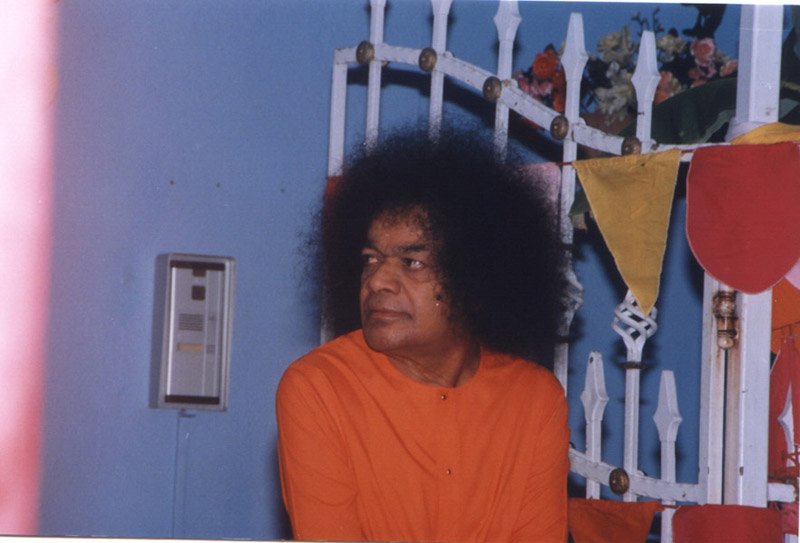
Today’s life is made up of two components. The body is a field of action, Karmakshetra. Atma is the field of Dharma, Dharmakshetra. So this field of Dharmakshetra should take on this field of action, the action oriented purpose – Karmakshetra and thereby it should become the Divine – Punyakshetra. It is in this context that the Bhagavad Gita proves that Swadharma is one that brings you benefits. Paradharma is that which brings you fear. Swa here means Atma, all that goes in the name of the Atma is Swadharma. By Atma, you should not mean it is mere conscience. It is in fact all-pervading consciousness. Once you go by your consciousness, whatever you do becomes Dharma proper and that leads you on. This consciousness is also called Chaitanya. This Chaitanya principle is present everywhere.
Therefore, the body is one. The mind is second thing, and the Atma is third thing altogether. So Atma is Sath (Eternal Truth). The mind is Chit (Consciousness). And the body is a medium which experiences the joy of these two Sath and Chit. Once Sath and Chit come together, the body experiences joy or bliss. Sath means “Being”. Chit is “Awareness”. Awareness is your life. Sath is “Ishwarathwa” (God consciousness). So once this godhead becomes part of your own life, then you have happiness. This is true human quality. This is human value. This truly is the essence of your life Sath-Chit-Ananda. You have become forgetful of it; you are going after the fleeting pleasures of the world. In the process you’re subjecting yourself to grief and sorrow.
For this an example here, in the Ramayana a mention is made of a unique character, a peculiar character. Now this character has a form which is very peculiar. This character has no neck. When you say it doesn’t have a neck, it’s not the neck that we all have. The neck of this person rests on his stomach instead. The name of this character is Kabandha. The inner meaning of this is that for the sake of filling his stomach, he’s making use of his head. Today’s educated people are very much like this Kabandha. In the sense that all they have learned, all the degree of proficiency they have achieved, they’re using for the sake of filling their stomach. Now you might go on filling the stomach, but you never can fill it. It will never lead you to satisfaction. You must eat in order to live. Not live in order to eat.
So, today’s educational system should embark on this new glorious path, wherein it must be practiced in such a way as to fully embrace life, to properly practice ideals, to increase the attitude of service to society, and to increase the sacredness of society.
A life which is healthy, a life which is full of happiness and joy, a life which is an ideal or a model, that is a true human value which can bring to the fore these qualities. First one is unity, and integrity is necessary. Second one is steadfastness of purpose is necessary. Third one is equally important, to have this element of brotherhood. Samkhyatha–integrity and equal mindedness, Karyadeekshata–steadfastness of purpose, Soubhrathuthwa–brotherhood of man: these are the three necessary things that make up mankind.
But today’s mankind has lost these three fundamental principles. The educated person doesn’t willingly come forward to undertake any task to serve the society. Or if you look at the moral side of the educated person, it doesn’t come to the external world. It doesn’t manifest itself. You must strive and work hard at the job or employment. You must give work to every pair of hands. Try and provide water to every agriculture field. Every house should be transformed into a cottage industry. Only then will the educated people fulfill the time that is given.
Because not enough work is there for the hands today, the mind is given to a lot of anxiety. Because these thoughts lead the person astray, the result is sorrow and grief. Because the thoughts have gone awry, he is not able to know which is truth, which is un-truth. He is not able to believe himself. He is not able to seek a sense of fulfillment in his life. As against it, every educated person should become the ideal. An ideal life should be the primary aim of any educational system. We should strive to secure such an education. Education does not mean all that you learn within the four walls of a college or school.
There are any number of themes that we can garner in this nature of ours. This Ananda, the joy, you get through this medium of nature is unequal. Vid means “to know” in the Sanskrit word Vidhya. Now today we build castles in the air in terms of what we have learned through the medium of this education. Alongside education as you know it to be, you must also develop humility and obedience. This is called Samskara—true culture—that which transforms your life. That’s why it is called Samskara.
There are no limits to what we desire. There are no limitations to our ego, and you are bound by a lot of attachments. Because we have fallen victim to this sense of attachment, to these senses of emotions and impulses, we succumb to grief by losing our human nature. We should try to curb these emotions and impulses. These emotions and passions are like waves. These waves momentarily come to the fore. We must try and bring them in check through this sense of peace within us.
Sathya (Truth), Dharma (Righteousness), Santhi (Peace), Prema (Love), Ahimsa (Non-Violence), these five great cardinal principles which are at the basis of the entire creation. They are very much like the five Pranas (vital life principles), like the five elements. And flowing beneath these like an undercurrent is this element of love. Without this element of love it is like living death. It is this love which permeates all things, all beings, all activities, all tasks, and it is present everywhere. When this love enters our thoughts, it manifests itself as Sathya. When this love enters the actions, it becomes Dharma. When this love enters our feelings and emotions, we experience Santhi. When this love enters in understanding, that transforms itself into Ahimsa. So, either in Sathya, Dharma, Santhi or in Ahimsa it is this love which is undercurrent. Today we must try and further the cause of love. Try to remove hatred. Try to keep a check on your impulses and anger. Exterminate your ego, this is the essence of human values that you associate with a living being in mankind.