







































Swami Rama Tirtha
Swami Rama Tirtha
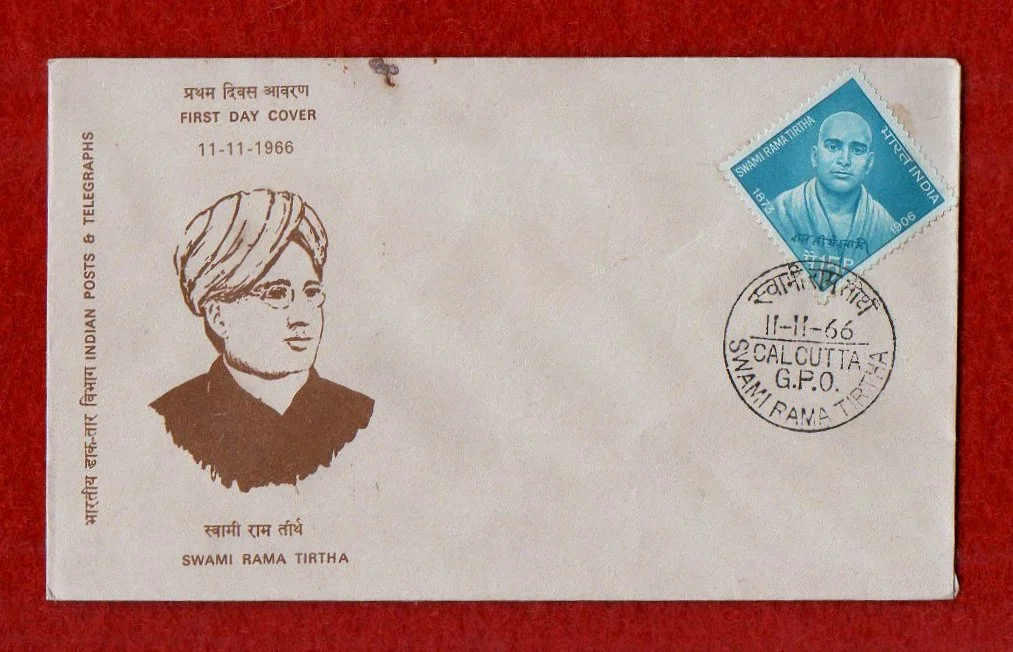
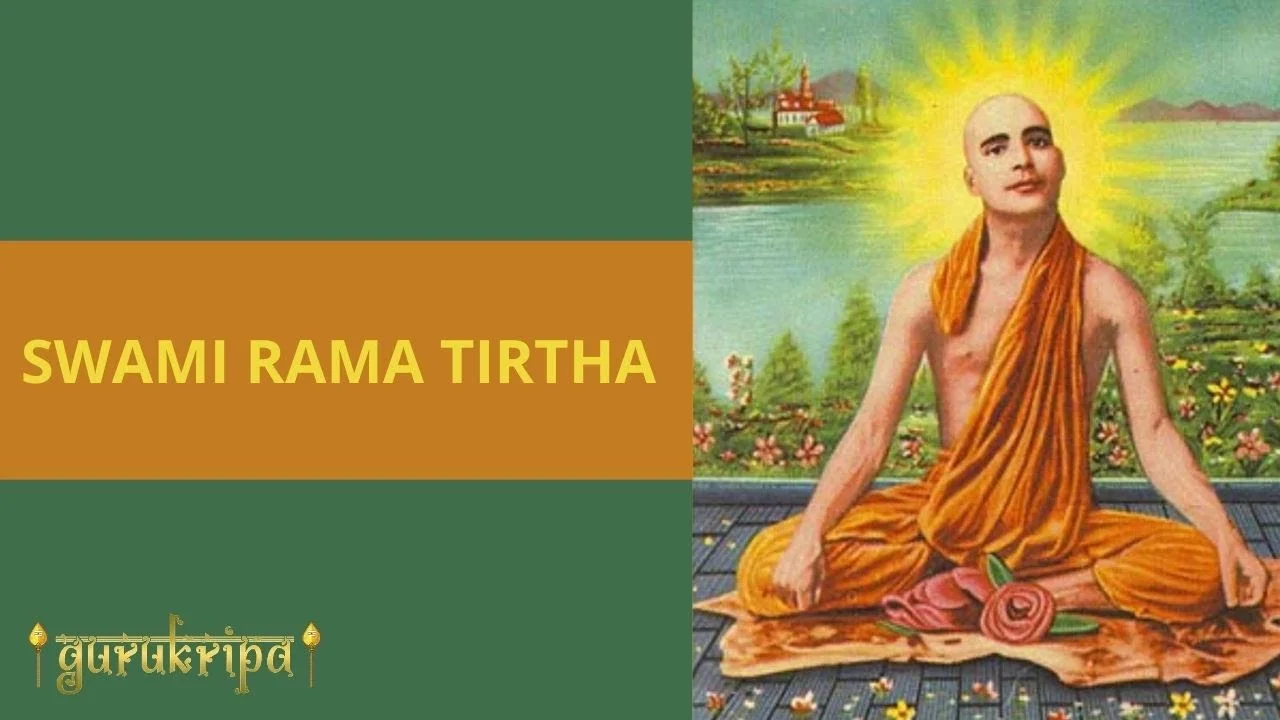
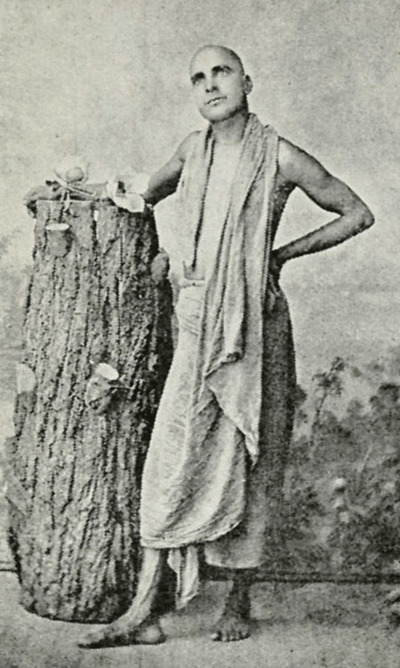
Swami Rama Tirtha, previously known as Gossain Tirtha Rama,
was born in 1873, at Murariwala, a village in the district of Gujranwala, Punjab, India. His mother passed away when he was but a few days old and he was brought up by his elder brother, Gossain Gurudas.
As a child, Rama was very fond of listening to recitations from the holy scriptures and attending Kathas. He often put questions to holy men and even offered explanations. He was very intelligent and loved solitude.
Rama was barely ten years old when his father got him married. His father left him under the care of his friend, Bhakta Dhana Rama, a man of great purity and simplicity of life. Rama regarded him as his Guru, and offered to him his body and soul in deep devotion. His surrender to his Guru was so complete that he never did anything without first consulting him. He wrote numerous loving letters to him.
Swami Rama Tirtha was one of the most radiant and fearless spiritual philosophers of modern India, whose life and teachings awakened the Vedantic spirit of self-realization across the world. Born in 1873 as Tirtha Ram Goswami in Punjab, he was a brilliant scholar in mathematics, yet from an early age he possessed an intense longing for spiritual truth. His deep study of the Upanishads and Advaita Vedanta transformed him into a living embodiment of divine wisdom. Renouncing worldly life at a young age, he became Swami Rama Tirtha and dedicated himself to proclaiming the truth of man’s divine nature.
The central message of Swami Rama Tirtha was “Thou art That.” He boldly declared that every human being is inherently divine, infinite, and free. According to him, ignorance alone makes people feel weak, limited, and unhappy. He taught that happiness does not come from possessions, status, or external circumstances, but from the realization of one’s own true Self. His teachings were filled with courage, joy, and spiritual strength, encouraging individuals to rise above fear and live with self-confidence and inner freedom.
Despite his growing fame, Swami Rama Tirtha lived with extreme simplicity and detachment. He found joy in nature, solitude, and contemplation, often retreating to the banks of the Ganges or the Himalayan forests. In 1906, he attained Mahasamadhi at a young age, merging into the Infinite he so joyfully proclaimed. Swami Rama Tirtha’s life and teachings continue to inspire seekers worldwide, reminding humanity that true freedom, bliss, and strength arise from the realization of one’s own divine Self.
Swami Rama Tirtha was a luminous embodiment of Vedantic truth whose life radiated joy, fearlessness, and spiritual freedom. Unlike many spiritual teachers who emphasized austerity and renunciation alone, he revealed Vedanta as a path of inner celebration and strength. To him, spirituality was not an escape from life but a bold affirmation of its divine essence. He spoke with the conviction of one who had directly realized the Self, and this authenticity made his words deeply transformative for all who heard or read them.
The heart of Swami Rama Tirtha’s teaching was the realization of absolute oneness. He proclaimed that the individual is not a weak, sinful being but the very expression of infinite consciousness. According to him, all limitations arise from false identification with the body and mind. When this ignorance is removed through knowledge, one naturally experiences peace, bliss, and freedom. He encouraged seekers to constantly affirm their divine nature and live with dignity, courage, and inner authority.
“If you did not love the supreme Reality
You did not do anything at all.
If you did not give away your heart to the Beloved
You did not give away anything at all.”
― Swami Rama Tirtha
Swami Rama was a living Vedantin. He saw and felt God in all names and forms. His beautiful words are often addressed to the trees, rivers and mountains. Rama soon resigned his post and left for the forest. His wife and two children and a few others accompanied him to the Himalayas. Owing to ill-health, his wife later returned with one of her sons. The other was left at Tehri for his schooling there.
Rama Tirtha took Sannyas a few days before the passing of Swami Vivekananda. Swami Madhava Tirtha had already allowed him to take Sannyas whenever he wished.
A few years later he returned to the plains to preach. The effect of his presence was marvellous. His infectious joy and his bird-like warbling of Om enchanted everyone.
Swami Rama’s burning desire to spread the message of Vedanta made him leave the shores of India for Japan. He went with his disciple Swami Narayana. After a successful visit to Tokyo, he departed for the U.S.A. He spent about a year and a half in San Francisco under the hospitality of Dr Albert Hiller. He gained a large following and started many societies, one of them being the Hermetic Brotherhood, dedicated to the study of Vedanta. His charming personality had a great impact on the Americans. Devout Americans even looked upon him as the living Christ
On his return to India, Swami Rama continued to lecture in the plains, but his health began to break down. He went back to the Himalayas and settled at Vasishtha Ashram. He gave up his body in the Ganges on 17 October, 1906, when he was only thirty-three.
The Rama Tirtha Publication League has brought out most of the writings of this great saint of India. They are given in several volumes, entitled, In the Woods of God-realisation. His inspiring writings show us that he saw his Beloved Lord in all names and forms. In many of his poems he sings the glory of nature.
Swami Rama Tirtha’s biography above has been reproduced from Swami Sivananda’s “Yoga Lessons for Children (Vol. 7)”, published by the Divine Life Society of South Africa.

More on Swami Rama Tirtha’s life and teachings from Swami Sivananda’s Life of Saints.
Swami Rama Tirtha, a direct descendant of Gosain Tulsi Das, the immortal author of the widely read Hindi Ramayan, was born in 1873, at Muraliwala, in the district of Gujranwala, Punjab.
Rama Tirtha was a very bright student, a genius possessing unusual intelligence, contemplative nature and an intrinsic love of mathematics and solitude. He topped the list in B.A. and took his M.A. degree in Mathematics, a subject in which he was exceptionally bright.
For two years, Rama Tirtha was a Professor of Mathematics in the Lahore Foreman Christian College, and he acted as a Reader for a short time in the Lahore Oriental College.
In the year 1900, Rama Tirtha went to the forest and soon became a Sannyasin. He went to America and Japan and thrilled the Americans and the Japanese with his inspiring and soul-elevating speeches. In Egypt he was accorded a hearty welcome by the Mohammedans, to whom he delivered a lecture in Persian in their mosque. Rama Tirtha was ever cheerful and brilliant with eyes beaming with divine lustre and joy. He was perfectly at home in Persian, English, Hindi, Urdu and Sanskrit literature.
Swami Rama Tirtha’s discourses were unique in their style—vibrant, poetic, and full of spiritual enthusiasm. He spoke of Vedanta not as a dry philosophy but as a living experience to be celebrated with joy. He urged people to see the Divine in all beings and in all situations. For him, life itself was a divine play, and one who realizes the Self can move through the world with laughter, peace, and compassion. His words carried the power of direct realization, inspiring deep transformation in listeners.
Today Rama Tirtha is not present amongst us in his mortal coil, but he is truly ever alive, eternal and imperishable, ever shining as a beacon-star in the spiritual firmament of the world. He had the highest realisation of the Satchidananda as the all-inclusive Bliss-supreme. The ancient sages and modern saints have proved this ineffable nature of the Supreme, not by logical proofs of perception and knowledge, but by actual experience of it which cannot be communicated to others for want of means. And Swami Rama Tirtha was one among such Experiencers of the Ultimate Bliss.
Under the holy guidance of Sri R.S. Narayana Swami, a direct disciple of Swami Rama Tirtha, the Ramatirtha Publication League was established at Lucknow. Every lover and admirer of Sri Rama Tirtha’s soul-inspiring teachings owes a deep debt of gratitude to Sri Narayana Swamiji and the League for taking immense pains in making Rama Tirtha’s works available to the world.
Sri Swami Rama Tirtha is one of the brightest jewels of India’s genius. Rama belongs to that prophetic group of inspired seers who rang up the curtain of Indian Renaissance and ushered in the era of a strongly positive, aggressive and all-conquering spirituality. His advent into Bharatavarsha was potent with a great significance to man in modern times.
From Rama India has inherited the dual gems of Vedantic boldness and spiritual patriotism. The spiritual patriotism of Rama is something unique and grand. Every son of India should absorb it and make it his own. Swami Rama emphatically declared that if you must have intense and real patriotism, then you must deify the Motherland, behold Bharatavarsha as the living Goddess. “If you must realise unity with God, realise first your unity with the Whole Nation. Let this intense feeling of identity with every creature within this land be throbbing in every fibre of your frame” said Rama, “Let every son of India stand for the Whole, seeing that the Whole of India is embodied in every son. When streams, stones and trees are personified and sacrificed to in India, why not sanctify, deify the great Mother that cradles you and nourishes you? Through Prana-pratishtha you vitalize an idol of stone or an effigy of clay. How much more worthwhile would it be to call forth the inherent glory and evoke fire and life in the Deity that is Mother India?”.
One of the most remarkable aspects of Swami Rama Tirtha’s life was his international influence. In the early twentieth century, he traveled to the United States and Japan, where he delivered powerful lectures on Vedanta, leaving a deep impression on Western audiences. He presented Indian spirituality as a universal science of consciousness rather than a religious belief system. His fearless proclamation of spiritual unity helped bridge cultural and philosophical divides, earning him great respect abroad.

Thus, to Rama, the national Dharma of love to the motherland was a spiritual Dharma of Virat Prem. Let every Indian today fervently take this legacy into his heart. By this act show your real appreciation of the great seer; show your gratitude to the great seer. Thus can you glorify his life and his teachings.
The highest realisation of patriotism, Rama believed, lay in fully identifying yourself with the land of your birth. Remember his words: “Tune yourself in love with your country and people”. Be a spiritual soldier. Lay down your life in the interest of your land abnegating the little ego, and having thus loved the country, feel anything and the country will feel with you. March and the country will follow. This, indeed, is practical Vedanta.
Rama Tirtha infused in the minds of people a new joy, a happy conviction that it was not for nothing that we lived in a miserable earth, and that we did not, after a long struggle in the sea of life, reach a waterless desert where our sorrows would be repeated. He lived practical philosophy, and through that showed to the world that it was possible to rejoice in the bliss of the Self even in this very life, and that everyone could partake of this bliss if one sincerely strived for it.
Swami Rama was an exemplary figure in the field of Vedantic life. He was a practical, bold Vedantin. He lived a dynamic life in the spirit of the Self. Very high were his ideals, sublime were his views, and perennial and spontaneous was his love. He was Divinity personified and love-incarnate. He is ever alive as a dynamic soul-force, ever shedding the spiritual effulgence in the heart of every seeker after Truth. His teachings are inspiring, elevating and illuminating—a fountain of his intuitive experiences.




