




























Valmiki

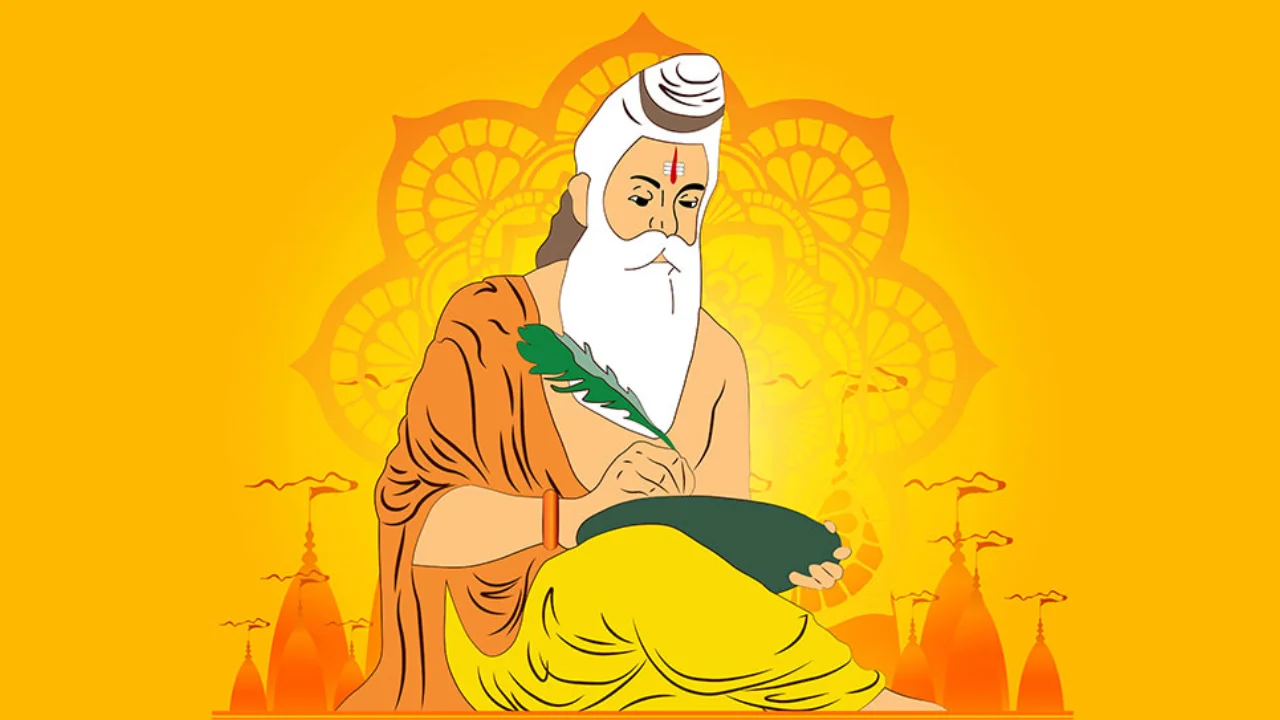

Writing Ramayana.
Narada visited Maharishi Valmiki in his ashram once and there: he narrated the story of Lord Rama. After that, he received a vision from Lord Brahma in which the Lord instructed him to write Ramayana in shlokas, which the sage readily followed.
Valmiki had the fortuity of receiving Lord Ram along with his wife Goddess Sita and younger brother Lakshman at his ashram. On Valmiki’s request, Lord Rama built his hut on Chitrakut hill, near his ashram.
Over the course of the epic, Rāmā maintains a firm and, some would say, uncompromising, allegiance to duty—to his mother, his father, his brothers, his wife, and, most importantly as a ruler, his subjects. Performance of duty in the right spirit is essential to virtuous governance, and Rāmā exemplified this for the people of his age and clime.
“There is no deity superior to the Guru, no gain better than the company of the wise.”
― Valmiki
Vālmīkī is an ancient poet-sage to whom the Rāmāyana is often attributed, though it is worth noting that there are myriad versions of the Rāmāyana on the Indian subcontinent in various languages.
The Sage Valmiki Describing the Origin of the Verse Form He Later Used to Compose the Rāmayanā to His Pupil Bharadvaja, Folio from the “Shangri” Rāmāyana (Adventures of Rāmā) India, Jammu and Kashmir, Bahu, circa 1700-1710.
The most ancient language in which it was rendered, however, was Sanskrit, the language of the Indo-Aryans. In his 1900 to the Shakespeare Club in Pasadena on the Rāmāyana, the Hindu monk Swami Vivekananda observed that “a great many poetical stories were fastened upon that ancient poet; and subsequently, it became a very general practice to attribute to his authorship very many verses that were not his.” As the French poet Leconte de Lisle put it in his poem “La mort de Valmiki,”
The Rāmāyana is divided into seven kāndas or sections: Bala Kānda, Ayodhya Kānda, Aranya Kānda, Kishkindhā Kānda, Sundara Kānda, Yuddha Kānda, and Uttara Kānda. Each kānda depicts a major episode in the life of Rāmā. Bāla Kānda narrates the story of Rāmā’s auspicious birth and his childhood and his marriage to Sītā. Ayodhya Kānda depicts their life in Ayodhya. Here, the maid Manthara poisons Rāmā’s stepmother Kaikeyi’s mind on the eve of his coronation, when she convinces Kaikeyi that her son Bharatā should be ruling instead. Rāmā’s father Dasaratha banishes him to the forest, where he is joined by his wife Sītā and his younger brother Lakshmanā.
Aranya Kānda focuses on the journey of the three exiles into the forest, where they encounter various personages, including demons (rākshasas) who are attacking the hermitages of sages (rishis). Sītā is abducted by Rāvana, king of these rākshasās. Kishkindā Kānda is about Rāmā and Lakshamā’s search for Sītā, which leads them to the Vānara kingdom, where they enlist the aid of the chieftain, Sugrīva. Sugrīva is himself besieged by his brother’s usurpation of his throne. Rāmā and Lakshamā’s powerful ally Hanumān bravely ventures in search of Sītā with the Vānara army.
Sundara Kānda focuses on Hanumān’s discovery of Sītā’s location in Rāvana’s kingdom in Lanka. Yuddha Kānda relays the great battle between Rāmā and Rāvana, culminating in the death of Rāvana and the victory of Rāmā. Rāmā returns with Sītā and Lakshmana to rule Ayodhyā, the subject of the Uttara Kānda.

Many interpretations of the Rāmāyana understand Rāmā to be an avatar, specifically the seventh avatar of Vishnu, the deity presiding over the principle of preservation in the cosmic cycle of creation, preservation, and destruction.
Though his divinity is recognized by many characters in the story, Rāmā retains a profound sense of his humanity, simply for the benefit of imparting dharma in human relations.
Performance of duty in the right spirit is essential to virtuous governance, and Rāmā exemplified this for the people of his age and clime.
Source: apnisanskriti




