


























Swami Samarth

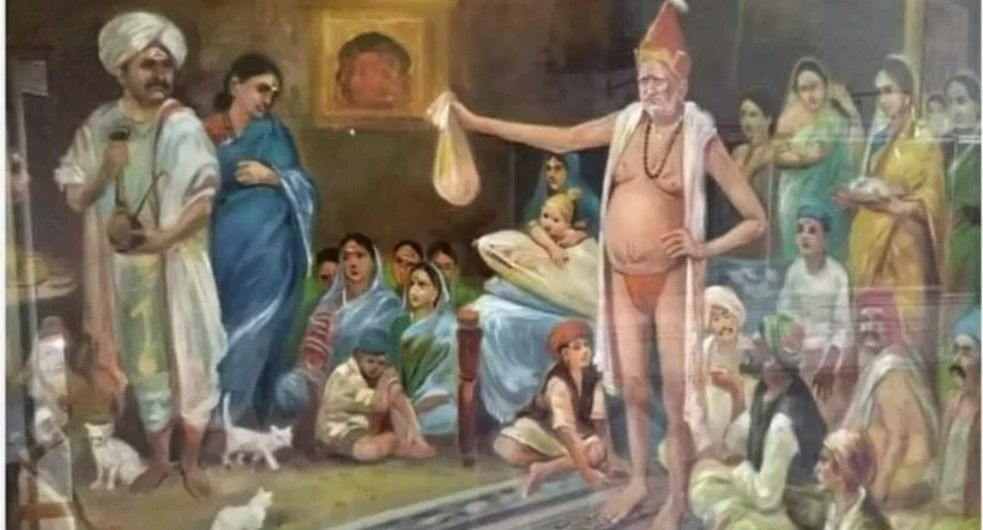

In a place called Karanja Nagar (Karnataka State) in Southern India, there lived a pious Brahmin couple, Madhava and Ambabhavani, in the 13th century.
To this God-fearing & religious couple, was born a son around 1275 A.D. This child was the incarnation of Lord Dattatreya and came to be known as the great sage Shrimad Nrusimha Saraswati. The child was unique in the sense that, he was chanting only ‘Aum’ (the Hindu holy chant) since his birth. The parents were concerned about his dumbness till his ‘Vratabandha’ (the sacred thread bearing ceremony), when this child was merely eight years old, he started reciting all the four Vedas (the Holiest Hindu scriptures) to the great astonishment of all the learned people.
After the aforesaid incident, the child left for Kashi (Uttar Pradesh State, Northern India) for Tapas [penance]. Pleased with his rigorous tapasya [penance], a learned ascetic named Shree Krishna Saraswati Swami, initiated him into Sanyasashram (Ascetism) and gave him the name, Shrimad Nrusimha Saraswati.
Swami Samarth taught that God does not reside merely in temples or rituals but dwells within the heart of every being. According to him, ignorance of one’s true nature is the root cause of suffering. He constantly reminded his devotees that attachment to the body, ego, and desires binds the soul to misery, while surrender to the Divine leads to freedom and peace. His teachings emphasized the harmonious path of karma (selfless action), bhakti (devotion), and jnana (knowledge). Through simple yet profound words, he urged people to recognize the Atman within and realize their unity with the Supreme Reality.
Many miraculous incidents are associated with Swami Samarth, including healing the sick, protecting devotees from danger, and revealing hidden truths. However, he never encouraged the pursuit of miracles. He often stated that miracles distract the seeker from the ultimate goal of self-realization. For Swami Samarth, inner transformation was far more important than outward displays of divine power. His methods of teaching were unique—sometimes gentle, sometimes strict—designed to break the ego of the disciple and instill humility, faith, and courage.
Even today, the name “Shri Swami Samarth” is a powerful mantra for millions of devotees. His blessings are believed to provide strength in adversity, clarity in confusion, and peace in inner turmoil. The temple at Akkalkot continues to be a sacred center of devotion and faith. Swami Samarth’s life and teachings remind humanity that a true guru does not merely give comfort but transforms consciousness. He remains a living presence in the hearts of devotees, guiding them toward truth, fearlessness, and eternal bliss.
gives us the details of his work in guiding the devotees and the various miracles he performed to help the devotees. He stayed at Ganagapur (Karnataka State, Southern India) for a long time and then gave his “Nirguna Padukas” to his disciples and devotees,
The biography of Shrimad Nrusimha Saraswati “Shree Gurucharitra”,
before leaving for the Kardali forests to perform Tapas [penance]. His disciples prepared a floating seat of flowers for him on which he sailed against the current of the river Patalganga and disappeared.
He performed rigorous tapasya [penance] on the Shree Shail mountain in the Kardali forests for nearly 150 years. After this he took an extensive pilgrimage, covering even places, now known as Jawa, Sumatra, Indonesia, China, Japan, Australia etc., relieved many people from their miseries, and guided them on the spiritual path. Finally, he came to the ranges of Himalayas where he enlightened many devotees. Later he sat under a Deodar tree for tapasya [penance]. This Tapasya [penance] in the Himalayas lasted for nearly 250 years, but a woodcutter unknowingly axed the anthill enveloping the body of Shrimad Nrusimha Saraswati. This resulted in the break in Tapasya [penance] and Shrimad Nrusimha Saraswati then left for an extensive travel throughout the Indian sub-continent guiding the devotees.
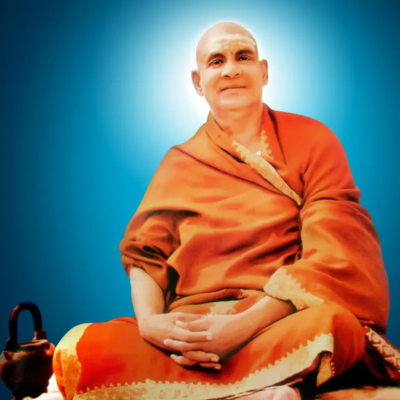
Swami Samarth, also known as Shri Swami Samarth of Akkalkot, was one of the greatest spiritual masters of Bharat and is revered as an incarnation of Lord Dattatreya. He appeared in the nineteenth century and spent much of his divine life in Akkalkot, Maharashtra. Swami Samarth lived as an avadhuta, beyond social conventions and worldly attachments. His outward behavior often appeared stern, unconventional, and unpredictable, yet behind this seemingly harsh exterior was an ocean of compassion and unconditional love for his devotees. His life was dedicated to awakening humanity to higher spiritual truths and guiding seekers toward self-realization.
Swami Samarth extended his grace equally to all, regardless of caste, status, or background. The poor, the suffering, and the troubled found solace in his presence. Although he occasionally used sharp words or severe actions, devotees understood that such behavior was meant for their spiritual upliftment. It is believed that he accelerated the working of karma for his followers, helping them exhaust their past burdens quickly and progress on the spiritual path.
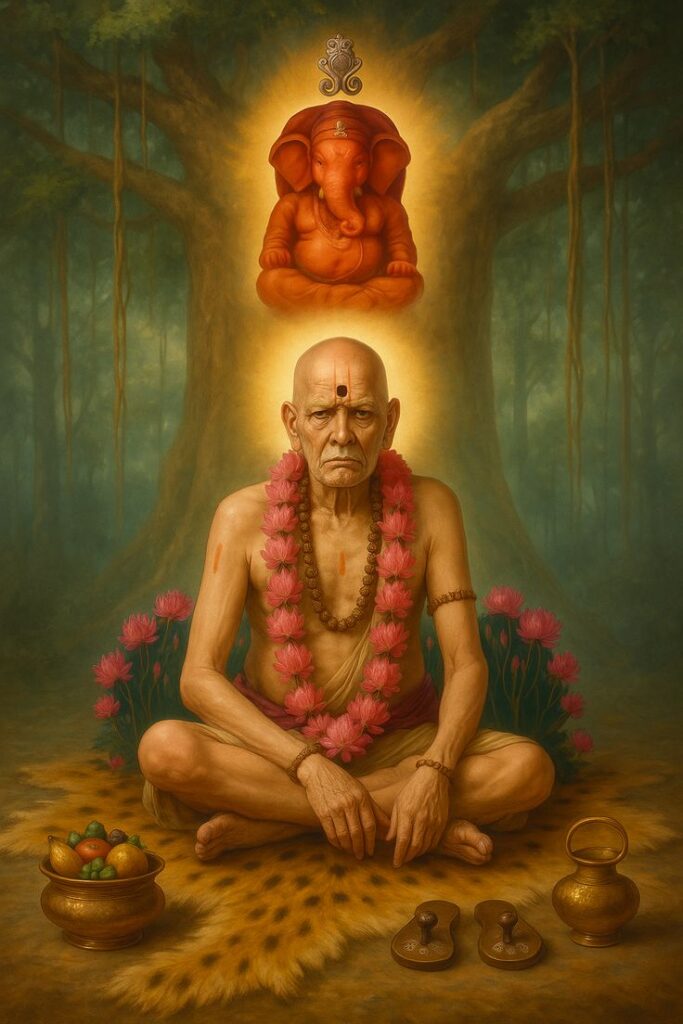
During this travel, he became popular by various names at various places. Thus at one place he was known as Chanchal Bharati and at another place he would be called Digambar Swami. As he travelled and stayed at various places, he became the Guru (preceptor) of many great souls like Shree Ramkrishna Paramahansa, Shree Saibaba of Shirdi, Shree Shankar Maharaj, Shree Gajajan Maharaj of Shegaon etc. Finally he settled down at Akkalkot (Maharashtra State) and stayed there for 24 years from 1854 A.D. to 1878 A.D. and thus came to be known as the Akkalkot Niwasi Shree Swami Samarth Maharaj (the great sage of Akkalkot).
“O my companion, worldly comfort is illusion, As soon you get it, it goes. I have chosen the indestructible for my refuge, Him whom the snake of death will not devour.”
Here he enlightened many disciples, such as Shree Dev Mamledar, Shree Balappa Maharaj, Shree Cholappa Maharaj, Shree Nrusimha Saraswati Maharaj of Alandi, Shree Ramanand Beedkar Maharaj of Pune etc.

For Swamiji, there was no difference between earth and gold.
Sometimes he would sleep on a mattress and sometimes on stone. He would ride on a horse or elephant with a parasol or sometimes sit on a heap of rubbish. Sometimes he would take bath many a times a day or sometimes would not take bath for days on end. Sometimes he would live in a palace and sometimes go to a temple and live there. He always remained engrossed in his world.
Shri Swamiji was an ocean of knowledge. Many great scholars’ egos used to break off in front of him. Just by keeping his hand over a mad child, he would make him speak Vedas, Upanishads and Gita. He strongly opposed casteism.
Normally, Swamiji spoke very less. Many a time he liked to keep mum. He spoke Marathi and also Sanskrit. He was very blunt in talking and showered bad words at times. Whether it was a rich man or a woman, he would bluntly speak in front of everyone.
As he was the incarnation of Lord Dattatreya, Swamiji had all the powers. He used to fill up dried well with water, cure the incurable disease within seconds, make a poor man rich immediately, and bring a dead person back to life. Swamiji performed infinite miracles during his life. Sometimes just for the sake of it or sometimes to favour his devotees. There is an infinite number of people living their life with his grace. Swamiji is the father of orphans, protection of the unprotected and strength of the weak.
Swami Samarth extended his grace equally to all, regardless of caste, status, or background. The poor, the suffering, and the troubled found solace in his presence. Although he occasionally used sharp words or severe actions, devotees understood that such behavior was meant for their spiritual upliftment. It is believed that he accelerated the working of karma for his followers, helping them exhaust their past burdens quickly and progress on the spiritual path.
One of the most remarkable aspects of Swami Samarth was his equal compassion for all. Kings and commoners, scholars and illiterate villagers, the wealthy and the destitute—all were treated alike in his presence. He looked not at social identity but at the soul’s readiness. It is believed that Swami Samarth had the power to alter karmic patterns, often allowing devotees to undergo short-term hardship to free them from greater future suffering. This made his guidance intense but deeply transformative.
Right from an ordinary man to Kings Swamiji had an infinite number of followers. The Kings who were his followers were the King of Akkalkot Maloji Raje, King of Gwalior Jayajirao Sindhiya, King of Indore Tukojirao Holkar and King of Baroda Malharrao Gayakwad etc.
Shri Swamiji had many great people as his disciple, to name the few- Shri Krishna Saraswati (Kumbhar Swami), Swami Nrisingh Saraswati of Alandi, Vamanbua Vamorikar or Badodekar, Gajanan Maharaj of Shegaon and Saibaba of Shirdi.
There was complete lustre, power and virtues of the lord in the incarnation of Shri Swamiji. It is difficult to describe these in words. One can only feel these with pure devotion.
After doing good to many of his followers, on the thirteenth day of the dark fortnight of Chaitra month in 1878, Shri Swami Samarth left for his heavenly abode. He kept on reciting Lord Shiva’s name eight days before his death. Every devotee who heard about his death ran to pay him last homage. Swamiji’s tomb was established at Chollapa’s house where Swamiji had once stayed at.
The core of Swami Samarth’s teaching was self-realization. He repeatedly emphasized that the true Self is not the body or the mind but the eternal Atman. According to him, human suffering arises from ignorance of this truth. He discouraged blind rituals and empty religious formalities, urging seekers instead to cultivate inner purity, faith, and surrender. Swami Samarth taught that God is ever-present and that sincere remembrance of the Divine, combined with righteous action, leads to liberation. His words were simple but carried deep spiritual power, capable of transforming lives.
\Swami Samarth’s life was marked by numerous divine experiences and miracles. He healed incurable diseases, protected devotees from danger, and guided people through impossible situations. Yet he never allowed miracles to become the focus of devotion. He often reminded devotees that miracles are temporary, while spiritual awakening is eternal. His aim was not to impress but to elevate, not to attract attention but to dissolve ego. Many times, he tested the patience and faith of devotees through harsh words or unexpected behavior, only to later shower them with boundless grace.

After his death also Shri Swamiji had given his darshan to many of his devotees and even today he gives them darshan. Apart from Akkalkot, Swamiji’s temples are there in many other places signifying that Swamiji is present in every place. It is only a matter of a devotee calling him- Swamiji graces his devotees everywhere and at all times.
On April 30, 1878 (Chaitra Vadya Trayodashi of Hindu year 1800) after nearly 600 years of the incarnation, the great sage adopted MahaSamadhi [the last conscious communion with God] under his favourite Banyan tree.
Devotees still experience his divine presence and feel reassured because of his quote “I have not gone, I am still present”.




