








Hari Om

Menu

February 16, 2026

images 2026 02 16T155022.074
Religions of the World, Swami Sivananda

Hinduism

Hinduism by Swami Sivananda Introduction Hinduism is the religion of the Hindus. It is the oldest of all living religions. Hinduism is not a man-made religion. It was not founded by any single person. It is not based on a set of dogmas preached by a particular set of teachers. It was not started as a system, like Islam or Christianity. It is the product of the seers of the Vedas. It was developed from age to age by the teachings of Avataras, Rishis, Vedas, the Upanishads, the Gita and the Itihasas. It will exist as long as the world lasts. There is a peculiar, mysterious spiritual force that is ingrained in the heart of every Hindu. Hinduism is also known by the names Sanatana Dharma and Vaidika Dharma. Sanatana Dharma means eternal religion, the Ancient Law. Vaidika Dharma means the religion of the Vedas. The Vedas are the foundational scriptures of Hinduism. A Religion of Freedom Hinduism allows absolute freedom to the rational mind of man. Hinduism never demands any undue restraint upon the freedom of human reason, the freedom of thought, feeling and will of man. Hinduism is a religion of freedom. It allows the widest freedom in matters of faith and worship. It allows absolute freedom to the human reason and heart with regard to questions such as the nature of God, soul, creation, form of worship, and goal of life. It does not force anybody to accept particular dogmas or forms of worship. It allows everybody to reflect, investigate, enquire and cogitate. Hence, all sorts of religious faiths, various forms of worship or Sadhana, diverse kinds of rituals and customs, have found their honourable place side by side within Hinduism, and are cultured and developed in harmonious relationship with one another. Hinduism, unlike other religions, does not dogmatically assert that the final emancipation is possible only through its means and not through any other. It is only a means to an end, and all means which will ultimately lead to the end are equally approved. The religious hospitality of Hinduism is proverbial. Hinduism is extremely catholic and liberal. This is the fundamental feature of Hinduism. Hinduism pays respects to all religions. It does not revile any other religions. It accepts and honours truth, wherever it may come from and whatever garb it may put on. Hindu Mythology In every religion, there are three parts, viz., philosophy, mythology and ritual. Philosophy is the essence of religion. It sets forth its basic principles or fundamental doctrines or tenets, the goal, and the means of attaining it. Mythology explains and illustrates philosophy by means of legendary lives of great men or of supernatural beings. Ritual gives a still more concrete form of philosophy so that everyone may understand it. Ritual consists of forms and ceremonies. Mythology is a part of every religion. Mythology is concretized philosophy. Mythology is the science which investigates myths or fables or legends founded on remote events, especially those made in the early period of a people’s existence. Mythology inspires the readers through precepts and laudable examples, and goads them to attain perfection or the highest ideal. The abstract teachings and subtle ideas are made highly interesting through the garb of stories, parables, legends, allegories and narratives. The sublime and abstract philosophical ideas and ideals of Hinduism are taken straight to the heart of the masses through impressive stories. Mythology is slightly mixed up with a little history. It is difficult to make a fine distinction between history and mythology. There are great truths behind the ancient mythology of Hinduism. You cannot ignore a thing simply because it has a garb of mythology. Do not argue. Keep your intellect at a reasonable distance when you study mythology. Intellect is a hindrance. It will delude you. Give up arrogance, vanity. Cultivate love for imagery. Sit like a child and open your heart freely. You will comprehend the great truths revealed by mythology. You will penetrate into the hearts of the Rishis and sages who wrote the mythology. You will really enjoy mythology now. You study geography through maps. There is no real country or town in a map, but it helps you to know a great deal about the different countries. Similar is the case with myths. You can grasp the subtle, philosophical truths through myths only. The object of myth and legend is merely to lure the mind to the truths of religion. Emphasis on Practice Hinduism is not a religion of mere theories. It is eminently practical. In no religion will you find such a variety of Yoga practiced, and such sublime unique philosophy expounded. Hinduism provides spiritual food and Yoga Sadhana for all sorts of people to suit their temperaments, capacities, tastes, stages of spiritual development, and conditions of life. It prescribes Yoga Sadhana even for a scavenger or a cobbler to attain God-realization, while doing his ordinary avocation in the world. Hindu Yoga and Vedanta teachers lay great stress on self-restraint, Tapas, renunciation and practical Sadhana, which are best calculated to control the mind and the senses and unfold the Divinity within or attain Self-realization. Religion is the practical aspect of philosophy. Philosophy is the rational aspect of religion. The philosophy of Hinduism is not armchair philosophy. It is not meant for intellectual curiosity and vain discussion. Hindu philosophy is a way of life. The philosopher of Hinduism seriously reflects after hearing the Srutis (Vedas), does Atma-vichara (enquiry into the nature of the Self), constantly meditates, and then attains Self-realization or Atma-sakshatkara. Moksha (liberation from birth and death) is his goal. He attempts to attain Jivanmukti (liberated being) now and here. Law of Karma The Law of Karma is one of the fundamental doctrines of not only Hinduism, but also of Buddhism and Jainism. As a man sows, so shall he reap. This is the law of Karma. Desire produces Karma. You work and exert to acquire the objects of your desire. Karma produces its fruits as pain and pleasure. You
Hinduism Read Post »

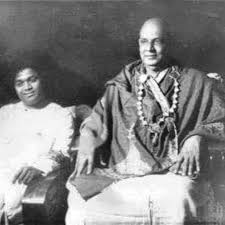
Swami Sivananda seated with companion portrait image
Sivananda Ashram, Swami Sivananda

Samadhi Shrine

Samadhi Shrine The Spiritual Hub Samadhi Mandir is the central place of spiritual activities of Sivananda Ashram. The two main activities – early morning meditation, and the evening Satsanga – are held here. This place is the source of spiritual vibrations and inspirations for all the seekers. Even when no programme is going on, devotees prefer to sit under this holy atmosphere and do japa, prayer and meditation. Let us also peep into it. The Samadhi Shrine is at the end of a long big hall. Above the Samadhi is Swami Sivanandaji Maharaj’s Murti is in the lotus posture seated in a beautiful lotus. The imposing sight leaves you captivated and spellbound. You forget to enter into the Hall and are stuck up on the steps only. Thank God that you are stuck up. Now you are able to notice the beautiful carvings on the main door. The eight outer squares on the doors depict symbols of various religions and faiths. The inner eight squares depict eight significant words, as if they were the quintessence of all religious teachings or the fundamental universal principles of all religions and faiths. The eight words are Serve Love Give Purify Meditate Realise Be Good Do Good. The meaning and significance of these words have been explained in “Swami Sivananda – Philosophy and Teachings”. It is sufficient to note here that this Shrine is of a saint who respected all religions and accepted all that is good from all the sources. The first thing you notice after entering the Hall is oil paintings with appropriate short write-ups on both the sidewalls. This place is source of inspiration for innumerable devotees. One Mr. Allen from Britain, on his for his personal satisfaction, went on creating oil paintings show the various episodes from the life of Swami Sivananda. And when he showed these painting to the President Swamiji Maharaj, the latter immediately arranged to put them in the Samadhi Mandir. As a first time visitor, you are engrossed in them. And you also notice below the paintings some very appealing thoughts from the writings of Swami Sivananda. When the visitor is little tired he looks up for some change, and finds a big volume of Vedas very carefully preserved in a glass case, and a charming Murti of Lord Vishnu. This volume is treated as the living presence of Veda Bhagavan and is a special worship is offered fortnightly. Chanting of the mantra “Om Namo Narayanaya” and recitation of Sri Vishnu-sahasrsa-nama Stotram is done here regularly. On the right side there is a huge picture of Swami Sivananda, presented by devotees from Argentina. The innermost part is the sanctum sanctorum, the Samadhi of this great saint. You observe devotees coming with deep faith, overwhelmed with emotions approaching the Shrine, before entering it, they touch the feet of Ganesh seated over the entrance door. They bow down very reverentially, and then do circumambulation of the Shrine, bow down again and after coming out apply holy ashes. In the evening, you come again to the Samadhi Mandir to attend Satsanga, the main programme of the Ashram. Satsanga starts with prayers of all deities, and is followed by recitations of various Stotras (hymns). Then there is a spiritual discourse. It is followed by bhajans (devotional song), prayers for all those who are suffering, prayers for peace, and for the welfare of the entire mankind. After the concluding prayers, there is Arati and prasad distribution. A senior Swamiji takes up his seat one again and many devotees are also seated. Swamiji calls the devotees who had given their names in advance. The devotees come one after other, ask spiritual or even personal questions. Then, Swamiji takes a look around, inquires about the stay and comforts of the newly arrived visitors. The intimacy shown by the senior Swamiji is unique. You feel it is a sort of family gathering. Swamiji calls you also, and shows such intimacy that you feel that you are meeting your own father and you feel you are a part of the Sivananda family. Now you decide never to miss the Satsanga. It is a pleasant surprise for you that on most of the days the discourses are in English, and even when a discourse is in Hindi, its gist is given in English. The morning meditation session is from 5 to 6. But you come a little early and see many devotees already sitting in meditation. After brief prayer, the group meditation begins, at the end of it there is a little kirtan. Following early morning meditation, Revered Swami Atmaswarupananda gives a sparkling short talk. Sometimes some senior Swamiji is also gives a brief talk. The atmosphere is so much charged that everyone is inward drawn, no one speaks with anyone else, and no one looks here and there. Next, devotees hustle over to the Lord Visvanatha Temple and join the “Om Namah Shivaya” kirtan there while the puja of Siva is in progress. It may be noted that most worshipful Swami Chidanandaji Maharaj gives the highest priority to this morning programme and he is invariably attending it when he is in the Ashram. His morning talks are so inspiring that they are complied and published in many books.

Samadhi Shrine Read Post »

images 2026 02 16T154723.929
Religions of the World, Swami Sivananda

Religions of the World

Religions of the World We live in a time of great religious intolerance, wherein one religious faction cannot see the virtues of the other. However, fanaticism, sectarianism and narrow-mindedness are not actually the fundamental messages of the great world religions. If one studies each of the traditions, one finds so many similarities that one cannot doubt that they are pointing to the same final truth, even if their individual viewpoints may vary. An ancient story tells of several blind men who each touched a different part of an elephant and, ased on where exactly on its body they had felt, came to all sorts of erroneous conclusions as to what shape the elephant was. But a wise man or woman knows the “elephant” in its entirety. In the eyes of a saint, all religions in their highest expression lead eventually to the same goal. “Paths are many, goal is One” is surely the realisation of one who has seen into the deeper implications of the religious search.Swami Sivananda’s life, message and mission were all carried out with the highest respect for other faiths, and he made sure that the various holy days, such as Christmas, Guru Nanak’s Birthday and the Moslem holidays were celebrated in his Ashram. He wrote extensively about the saints and spiritual significance of all the different world religions. This section consists primarily of the writings of Swami Sivananda. We are presenting his essays, talks or selections from his books having to do with all the major world religions. This includes an extensive section on his own tradition of Hinduism, but also others on Christianity, Buddhism, Jainism, Sikhism, Judaism, Islam, Taoism, Zoroastrianism, Confucianism and Shinto.

Religions of the World Read Post »

Swami Sivananda raising hands near river image
Sivananda Ashram, Swami Sivananda

Daily Activities

Daily Activities The ashram offers a myriad of activities for serious seekers of all levels and backgrounds on the path of the truth to strengthen their sadhana and further their spiritual progress. Visitors are encouraged to attend as many of the programmes as possible and make fullest use of the uniqueness of location as well as activities. DAILY MORNING PROGRAMMES 5:00 – 6:00Jai Ganesh, Guru Stotra, Shanti Path,Pratah Smarana Stotram, Silent Meditation(30 minutes), short talk (English)6:00 – 7:00 First Worship 6:00 – 7:00First Worship of Lord Viswanath,Chanting of OM NAMAH SIVAYA & Aarati 6:00 – 7:00Yoga Asana & Pranayama Class,Only for Men(Except Sundays) 7:30 – 9:00Vishnu Sahasranama &Chanting : Om Namo Narayanaya 9:30 – 10:30Second Worship Gruedev’s Samadhi ShrinePaduka Puja(Every Thursday & 8th of Every Month) 9:30 – 10:15Second Worship Lord ViswanathArati & Puja Worship8:00 – 9:00 (Morning)6:30 – 7:30 (Evening) Worship8:00 – 9:00 (Morning)6:30 – 7:30 (Evening) 8:00 – 11:00 (Morning)2:00 – 4:00 (Afternoon)(Except Sundays) DAILY EVENING PROGRAMMES 1:00 – 3:00Sivananda Music Hall(Except Sundays) 4:30 – 5:30 (Winter)5:00 – 6:00 (Summer)Chanting: Om Namo NarayanayaArati & Puja 5:15 – 6:00(Winter)5:45 – 6:30(Summer)Bhajans, Kiratans at Gurudev’s KutirGanga Arati & Puja 5:30 – 6:00(Winter)6:00 – 6:30(Summer)Third Worship Gurudev’s SamadhiArati & Puja 5:00 – 6:00(Winter)5:30 – 6:30(Summer)Third Worship Lord ViswanathArati & Puja 7:30 – 9:30Evening Satsang: Lectures, Kirtans & Bhajans(English and Hindi)

Daily Activities Read Post »

Swami Sivananda playing veena by riverside image
Religions of the World, Swami Sivananda

PRESIDENT – The Divine Life Society

PRESIDENT – The Divine Life Society H.H. Sri Swami Yogaswarupanandaji Maharaj His Holiness Sri Swami Yogaswarupanandaji Maharaj, a senior monk of the Sivananda Ashram Rishikesh, Uttarakhand, has been elected as the chairman Of the Divine Life Trust Society and ex-officio President of the Divine Life Society with effect from 7th July 2019. Sri Swamiji was born in Channai and was known as Krishnamurthy in his pre-monastic life. After completing his education, he worked for a brief period. During that time, he read an abridged edition of mahabharata. After this reading, a desire to lead spiritual life in the Himalayan region arose in his heart. He left hearth and home and came to Rishikesh in 1964. But, to his much disappointment, he could hardly find thick and dense forests, thatched huts or snow-capped mountains, as he had envisaged in his mind. The grace of God brought him to Sivananda Ashram, the sacred abode of Sri Gurudev. He was 25 years old at that time. Pujya Sri Swami Krishnanandaji Maharaj was glad to take Sri Krishnamurthy into his fold. Pujya Swamiji Maharaj asked Krishnamurthy to assist him with correspondence work in the morning hours and help Sri Swami Sharadanandaji Maharaj in the afternoons at the Sivananda Publication League. It was Sri Swami Sharadanandaji Maharaj who introduced him into the Science of Yoga and taught him Yogasanas and Pranayamas in a systematic way. In the evenings, he used to attend Bhagavad Gita classes conducted by Sri Swami Hridayananda Mataji. Eventually, Sri Krishnamurthy started conducting Ashram’s Morning Prayer and Meditation Session from 4.30 to 5.30 and Yoga Classes from 6.00 to 7.00 at the Bhajan Hall. Later on, from the year 1966 to 1968, he received regular personal guidance from Worshipful Sri Swami Chidanandaji Maharaj on Yoga, Pranayama and other spiritual matters. His daily routine during the initial years in the Ashram was to conduct Morning Prayer and Meditation Session followed by Yoga classes, assist Pujya Sri Swami Krislananandaji Maharaj in the morning office hours, serve in the SPL in the afternoons and then attend Gita classes in the evenings. Over the years, he became an adept in the subjects of Yoga and Srimad Bhagavad Gita. He was initiated into the holy order of Sannyas by Worshipful Sri Swami Chidanandaji Maharaj on the Sivaratri Day of the year 1979 and was given the monastic name Swami Yogaswarupananda Saraswati. In 1973, Worshipful Sri Swami Chidanandaji Maharaj deputed Swamiji to conduct Yoga classes for the IAS Trainees at the prestigious institute, Lal Bahadur Shastri National Academy of Administration, Mussorie. Before sending him for this noble Seva, Swamiji Maharaj called him and gave abundant blessings and also detailed guidance regarding conducting the Yoga classes, Swarmiji used to conduct 9 courses in a year, each course lasting for 3 weeks. This honorary Seva of Swamiji, done in the name of Sri Gurudev, continued for 30 years, i.e. till the yew 2003. Revered Swami Hridayananda Mataji the direct disciple of Sri Gurudev, who had settled in Holland, invited Swamiji to visit Holland in 1983. With the blessings of Worshipful Sri Swami Chidanandaji Maharaj, Swamiji embarked on his foreign tour. Pujya Swamiji Maharaj himself took him around and introduced him to various devotees and Centres in Europe and also guided him to conduct Satsang. Following that, Swamiji travelled extensively in the coming years and has been travelling regularly to many countries in Europe, South America, USA, Canada, Zimbabwe, Kenya, Ghana, Mauritius, Hong Kong, Japan, Singapore, Malaysia, Australia, etc to conduct Yoga classes, spiritual seminars and conferences and to give personal guidance to the devotees as well. In the year 2002, Worshipful Sri Swami Chidanandaji Maharij entrusted Swamiji with the new responsibilities by nominating him as a Trustee of the Divine Life Trust Society. In the following years, Annual General Body Meeting, Swamiji was formally elected as the Vice President of the Divine Life Society. Sri Swamiji continued this Seva till he became the President of the Divine Life Society. Swamiji Maharaj once again seeks blessings of Sri Gurudev and conveys his heartiest greetings to all the devotees and members of the Divine Life Society. VICE-PRESIDENT – The Divine Life Society H. H. Sri Swami Padmanabhanandaji Maharaj Sri Swami Padmanabhanandaji, born in 1935, in an orthodox Brahmin family to pious parents in Kottayam, Kerala, is a disciple of Brahamaleen Parama Pujya Sri Swami Chidanandaji Maharaj, Past President, The Divine Life Society (Headquarters). An Engineer in the Government of Kerala, he renounced his career and took to life of renunciation to qualify himself for ministering to the Soul of man. He studied Vedanta (Prastanatrayi) and Scriptures in typical Gurukula Samparadaya under a great Master in a Gurukula on the bank of Kaveri River, Tamil Nadu. Swamiji is a scholar in Vedic Scriptures as well as in Puranic texts. His deep knowledge and lucid exposition of Srimad Bhagavata,Upanishads, Bhagavad Gita, Narada Bhakti Sutra and Patanjali Yoga Sutras and other Scriptural texts has made him a popular guide to Spiritual aspirants. He has been conducting classes on Upanishads and Gita with Sankara Bhasya to the inmates of the Ashram and in the Yoga Vedanta Forest Academy and also guides on Meditation and Stress Management in Corporates. He has been contributing articles on scriptures to well known magazines. His simplicity, transparent deep faith in the Divine force and surrender to the Supreme has made him a combination of Jnana, Bhakti and Vairagya. Swamiji is doing his Seva to his Master after elected by the Trust as the Vide-President of the Divine Life Society Headquarters, Shivanandanagar, Rishikesh since 04-01-2024. A senior monk of the Divine life Society under the leadership of the present President, Sri Swami Yogaswarupanandaji Maharaj, Sri Swami Padmanabhanandaji continues to work vigorously to spread the Divine Life Gospel, summed up by the Grand Master, Sri Swami Sivanandaji in six succinct words:“Serve, Love, Give, Purify, Meditate, Realize.” VICE-PRESIDENT – The Divine Life Society H.H. Sri Swami Nirliptanandaji Maharaj – GENERAL SECRETARY – The Divine Life Society H.H. Sri Swami Advaitanandaji Maharaj TREASURER –

PRESIDENT – The Divine Life Society Read Post »

Swami Sivananda close-up black and white portrait image
Sivananda Ashram, Swami Sivananda

Sivananda Ashram – Spiritual Field

Sivananda Ashram – Spiritual Field Sivananda Ashram is a place for sadhana (spiritual practice) preferred by aspirants from all over the world. Everyone – whether a beginner or a very advanced level sadhaka (spiritual aspirant) – has found this Ashram as an ideal place for sadhana, a place highly charged with the spiritual vibrations. Any person who wants to pursue sadhana as per his pre-planned sadhana programme with advance intimation is given permission to stay for a some days, if accommodation is available, without any discrimination with regards to caste, religion, country, social/economic status, etc. What has contributed to such a wonderful spiritual atmosphere? Several factors, such as: 1. Sivananda Ashram is situated in the foothills of Himalaya on the right bank (which is considered to be very sacred) of holy Ganga. This brings in some divine splendour as the background. 2. According to mythology, the pot containing the Divine Nectar was put on the bank of Ganga at Haridwar. The Divine Nectar sprinkled around covering this Ashram area as well, leaving Divine vibrations permanently. 3. The name Rishikesh was given to this place because Hrishikesh (Lord Krishna) gave here His admonitions to Uddhava. This Uddhava Gita (book XI, Ch. 6-29) is a top jewel not only of Srimad Bhagavatam, but also of the entire gamut of Indian philosophy. 4. Lord Rama’s brother Laxman had practised the most intense austerities for twelve years here (at a place only 150 meters from the Ashram). 5. This area on the outskirts of Rishikesh is known as Muni-ki-reti, – Muni (sage), ki (of) and reti (sand) – indicating that here on the sands of Ganga bank sages practise austerities and sadhana. 6. During the intense sadhana period (1024-34) of Swami Sivananda, the Ashram area was a hilly jungle and here (at the site of Vishwanath Temple); he used to practise meditation and had attained transcendental Experience. Also, after the Ashram was established, many sages have done sadhana here and are still doing. There are many buildings on the slope of a hill making it possible to have a view of Himalaya and Ganga from most of the buildings and even from good many rooms as well. The construction is done economically to provide moderate accommodation providing basic requirements to sincere sadhakas. A visitor must inform well in advance his programme to the General Secretary, The Divine Life Society,Shivanandanagar,PIN: 249 192 Uttaranchal, India.Fax:0135-442046E-mail:generalsecretary@sivanandaonline.org,Website: www.sivanandaonline.org. The decision about whether the application should be approved or rejected and for what duration the visitor would be permitted to stay is solely the discretion of the General Secretary. The visitor should confirm his visit to the Reception-in-charge (ph: 0135-430040) and contact him on his visit.A Typical Day at Sivananda Ashram The first thing that one would have to say about a “typical day at the Sivananda Ashram” is that there is definitely no typical day at Sivananda Ashram! This is true for various reasons. One is due to the absolute large-heartedness and tolerance of Swami Sivananda himself. He did not demand that people hold to a definite daily schedule, although he did lay out very specific suggestions in his writings. Finally though, every individual seeker was free to formulate his own daily programme, in whatever way he thought best. Another reason why it is hard to chart out a typical day is that there are so many festivals, special worships and activities, and one might be hard-pressed to rigidly hold to one routine. Having said that, here is what a typical day might look like. Gurudev believed very firmly that one should rise early, preferably at 4 am if possible. Each morning beginning at 5 am there is morning meditation in the Samadhi Shrine with chanting, 30 minutes of meditation and a 10-minute talk in English. Following this, many people go next door to the Viswanath Mandir (Temple of Lord Siva) for the morning puja and prayer. The puja begins promptly at 5:40 am, and while the puja is going on the devotees will be chanting the sacred mantra of Lord Siva, “Om Namah Sivaya.” The puja and chanting conclude at 7 am with the distribution of prasad. Breakfast follows from 7 to 7:30 am. If one is feeling especially energetic, one could leave the worship early and attend a Hatha Yoga class from 6:30-8:00 am. (Missing breakfast may not be a problem as lunch is served at the relatively early hour of 11 am.) Having invigorated oneself physically, one could turn one’s attention to the highest Vedanta philosophy, and that opportunity is provided in a small class that is offered from 8:20 till 9:00 am. Morning is also a good time to offer some service. Swami Sivananda himself worked tirelessly for the benefit of all and advocated extensive Karma Yoga (selfless service). One could inquire in the various departments if any regular assistance were needed. For seekers inclined to the devotional path, each morning at 7:30-8:30 am, the mantra “Om Namo Narayanaya” is chanted in the Samadhi Shrine. One could also attend a mid-morning worship service in either the Samadhi Shrine or the Viswanath Mandir. On Thursday, Guru’s day, pada puja worship is performed beginning around 9:30 am in the Samadhi Shrine. For the more philosophically minded, there is a discussion and meditation from 9:30 to 11 am in the Academy. After such a busy morning, one would surely be ready for lunch in the Dining Hall. There are two sittings: 11 and also 11:30 am to accommodate people’s different schedules. The sannyasi, brahmacharis, sadhaks, guests and workers are seated in rows on the floor with a thali (steel plate), a cup for water and a small bowl for dhal. The Mahamantra is chanted along with the 15th Chapter of the Bhagavad Gita as the food is being served. The Dining Hall attendants come around with vegetables, dhal (lentils), rice and chapattis (unleavened bread) and one can have as much as one likes, as long as the food is not wasted. The food should be eaten

Sivananda Ashram – Spiritual Field Read Post »

Swami Sivananda Collage of Janmashtami images with Krishna image
Religions of the World, Swami Sivananda

Membership of the Divine Life Society

Membership of the Divine Life Society Anyone devoted to the ideals of truth, non-violence and purity can become a Member of The Divine Life, which is a non-sectarian institution, embodying in its wide perspective the common fundamental principles of all the religions of the world, and of spiritual life in general. The Society accords equal place of honour to all faiths and religious traditions, and its Members recognise no distinction or disruptive sentiment on account of each other’s different traditional background, or religious affiliation, all of which are integrated with each other and with the principles, philosophy and teachings of the Society. Through the pages of the various books and periodicals of the society, what is endeavoured is to reveal the secret of spiritual action, namely, that it lies in the knowledge of the true Self and in the effacement and transcendence of the ego; and to present H.H. Sri Swami Sivananda’s profound teachings that each soul is potentially Divine and that everyone’s goal is to strive to manifest that Divinity within by controlling the internal and external nature by BEING GOOD AND DOING GOOD. The Society is dedicated to humanitarian, cultural and spiritual service. Anyone aged 21 years and above, subscribing to the above ideals is welcome to become a Member of The Divine Life Society. For more details write to: Mailing AddressThe General SecretaryTHE DIVINE LIFE SOCIETYHqrs, RishikeshP.O. Shivanandanagar -249 192,District Tehri-Garhwal, Uttarakhand. India.Phone: (91)-135-2430040 / 2431190Fax: (91)-135-2442046 (9:00 am to 5:00 pm IST) Email to: generalsecretary@sivanandaonline.org�

Membership of the Divine Life Society Read Post »

Swami Sivananda Spiritual leader with follower portrait image
Sivananda Ashram, Swami Sivananda

Introduction to the Sivananda Ashram

Introduction to the Sivananda Ashram On the one hand, the Sivananda Ashram is a physical place, located somewhere with buildings, residents, and offices. On the other hand, it is not a place at all. It is the spiritual expression of the divine mission of its founder, Swami Sivananda. If a natural calamity was to occur, and all the buildings were destroyed and all the residents dispersed, there would still be a Sivananda Ashram. To the extent that people devoted to carrying on his work share Swami Sivananda’s vision, to that same extent Sivananda Ashram would continue to exist. So often people in the Ashram will remark how they still feel the spiritual presence of Swami Sivananda and see his hand in the affairs of the Ashram. They will say, “It is not I who works, but Gurudev who works through me.” The residents also feel that it is in this very place that they can be led more firmly to their goal of God-realisation. In this place of selfless service, contemplation and ego-annihilation, is an atmosphere vibrant with the spiritual power that can carry the aspirant to that realisation. Swami Chidanandaji once said in response to a request of an Ashram resident to go elsewhere to do sadhana, “Yes, there may be many other places more suited for good spiritual practice. But if it is God-realisation you want, there is no better place than here.” The Sivananda Ashram is the headquarters and spiritual focal point of a vast worldwide organisation called “The Divine Life Society.” The Society encompasses more than 300 branches around the world, as well as individual devotees in India and abroad. At the centre of this vast network of spiritual uplift throughout the world, in the form of the Divine Life Society, stands the Sivananda Ashram as the guiding light. The Ashram is dedicated to the service of all and is itself benefited by the generous donations of the devotees who want to see that service continue. It is in the Ashram that any person interested in the spiritual life, whether a member of the DLS or not, can come and be nurtured by the spirit that pervades this place. THE SIVANANDA PILLAR INSCRIPTIONS – I OM CARDINAL DOCTRINES OF THE MAIN RELIGIONS OF THE WORLD Know the Self and be free – Hinduism The Kingdom of Heaven is within you – Christianity There is no God but Allah, and Mohammed is the prophet of Allah – Islam For the whole world this is the law: all is impermanent – Buddhism Non‑injury is verily the only religion – Jainism Purity of thought, word and deed is the essence of religion – Zoroastrianism I am that I am – Judaism He who has overcome himself is mighty – Taoism Blame yourself as you would blame others. Excuse others as you would excuse yourself – Confucianism There is but one God and His name is truth; wonderful is the guru – Sikhism I am that Real – Sufism See no evil. Hear no evil. Speak no evil – Shintoism All religions are one. They teach a divine life. Love all. Serve all. Practise ahimsa, satya, brahmacharya. Be selfless. Seek the Immortal – Divine Life Heart of Religion God is love. The only true religion is the religion of love or the religion of the heart. Feel for others as you feel for yourself. This universal religion will bring world‑peace and happiness. SEEK FIND ENTERREST IN GOD INSCRIPTIONS -II OM TWENTY INSTRUSTIONS 1. Get up at 4. a.m. daily. Do japa and meditation. 2. Sit on padma or siddha asana for japa and dhyana. 3. Take sattvic food. Do not overload the stomach. 4. Do charity ‑ one tenth of your income or one anna per rupee. 5. Study daily one chapter of the Bhagavad Gita. 6. Preserve veerya (vital force). Sleep separately. 7. Give up smoking, narcotics, intoxicant drinks and rajasic food. 8. Fast on Ekadasi days or take milk and fruits only. 9. Observe mouna for two hours daily and during meals also. 10. Speak the truth at any cost. Speak a little and sweetly. 11. Reduce your wants. Lead a happy, contented life. 12. Never hurt the feelings of others. Be kind to all. 13. Think of the mistakes that you have made (self‑analysis). 14. Do not depend upon servants. Have self‑reliance. 15. Think of God as soon as you wake up and when you go to bed. 16. Have always a japa‑mala on your neck or in your pocket. 17. Adhere to the motto ‑ ‘Simple living and high thinking’. 18. Serve the sadhus, sannyasins and the poor, the sick and the suffering. 19. Have a separate meditation room under lock and key. 20. Keep a daily spiritual diary. Stick to your routine. These 20 instructions contain the essence of yoga and vedanta. Follow them strictly. Do not be lenient to your mind. You will attain supreme happiness.Swami Sivananda BE GOOD DO GOOD INSCRIPTIONS – III OM UNIVERSAL PRAYER 0 Adorable Lord of mercy and love!Salutations and prostrations unto Thee.Thou art Satchidananda.Thou art Omnipresent, Omnipotent and Omniscient.Thou art the Indweller of all beings. Grant us an understanding heart,Equal vision, balanced mind,Faith, devotion and wisdom.Grant us inner spiritual strengthTo resist temptations and to control the mind.Free us from egoism, lust, greed, anger and hatred.Fill our hearts with divine virtues. Let us behold Thee in all these names and forms.Let us serve Thee in all these names and forms.Let us ever remember Thee.Let us ever sing Thy glories.Let Thy name be ever on our lips.Let us abide in Thee for ever and ever. The above non‑sectarian prayer is most suitable for being repeated during all common gatherings. It is cosmopolitan and all‑embracing. This is a beautiful universal prayer that you should repeat daily at home as well as on public occasions. This is a prayer that will unite all, spiritualise your activities and reveal the golden Secret of Divine Living.Swami Sivananda INSCRIPTIONS – IV OM SRI SWAMI

Introduction to the Sivananda Ashram Read Post »

Swami Sivananda seated between two Hindu deities near river image
Bhakti Yoga, Swami Sivananda

Places for Meditation

Places for Meditation by Swami Sivananda 1. Simhachal (A. P. ): This is the next station to Waltair Jn. You can get pineapple, cocoanuts and cashew nuts in plenty here. There are many waterfalls. This place is very solitary and secluded. There are thick forests. There are educated people leading godly life. This place is quite suitable for meditation. 2. Puri (Orissa): You can find good places for meditation near Chakra-Tirth and on the sea-side. The sea-breeze is elevating. 3. Ramghat (U. P): This is on the banks of the Ganga in the Bulandshahar district. The nearest railway station is Babrala (Chandosi line). It is only three miles from Ramghat. Bhiksha can be had for Sadhus and Sannyasins. There is Kshetra where free food is given for Sadhus, Sannyasins, Vanaprasthis and Brahmacharins. Pukka Kutirs can be had. Bihari Ghat is another place equally good near Ramghat. There is the Ganga also. You can get free food and Kutirs. 4. Karnavash: This is a place on the banks of the Ganga near Ramghat. Free food and free Kutirs are available. 5. Achpal: This is a nice solitary place in Kashmir. Bhiksha can be had from the neighbouring villages. There is a nice spring and a fine garden. 6. Bhrigu Kshetra: This is near Anupshire in the Bulandshahar district. There are good cottages on the banks of the Ganga. Free food can be had for Sadhus and Sannyasins. There is a Kshetra. 7. Chitrakut: This is an ideal place for devotees of Rama. “He who does Japa of Rama Mantra here for six months living on milk and fruits, will have Darshan of Lord Rama, ” so says Sri Tulasidasji. It is on the banks of the Mandakini river. There are Darmashalas and good rooms. 8. Rajpur: This is at the foot of Mussoorie hills, eight miles from Dehradun. This is a cool place. There are Pukka Kutirs here. 9. Jhusi: This is a solitary place at the junction of the Yamuna and the Ganga in Allahabad. There are good Kutirs and Dharmasalas. This is a beautiful place for divine contemplation. Just try for six months. 10. Naimisaranya: This is on the banks of the Gomati river. There is a railway station. There are good Kutirs and Dharmasalas. There is plenty of solitude. It is situated between Sitapur and Balamau (U. P. ). 11. Mohavan: This is a solitary place on the banks of the Yamuna near Mathura in U. P. There are good rooms. N. B-Householders and Vanaprasthis also can have comfortable accommodation in the above places.

Places for Meditation Read Post »

Swami Sivananda seated with devotees around image
Swami Sivananda, The divine life society

Swami Sivananda and The Divine Life Society

Swami Sivananda and The Divine Life Society Swami Sivananda could almost be considered a revolutionary in his view of Hindu spirituality and the place of sannyasins in Hindu Dharma. Swami Sivananda was dedicated to the spiritual upliftment of all mankind and considered it the unique role and privilege of sannyasins to serve the world rather than be served. Traditionally, the deepest spiritual truths were not accessible to all as the scriptures were written in Sanskrit, usually known only by the Brahmin caste. In addition, if one left the secular world to dedicate one’s life to God, one no longer had any concern or responsibility for the world. On the other hand, it was considered the duty of a householder to provide alms for the renunciate and support running costs of an ashram. Sannyasins were treated and served with great respect by the other classes of society. Even today this view is prevalent among many. However, this was not the vision of Swami Sivananda or his spiritual successor Swami Chidananda. To Swami Sivananda, the only worship he knew was the awakening of all beings to the consciousness of their essential divine origin. What was at core of his mission?. Swami Chidananda observed the following: It was the popular view of the theorist that to think on strict Vedantic lines was to regard the external world as a purely self-created illusion, non-existent in fact; therefore, the outside world could well be ignored. However, Swami Sivananda had the opposite view. He ignored himself and recognised the whole world as the Eternal Living Reality, the grandest, most sublime Truth. His sadhana seemed to be one of effacing his own entity in an unreserved dedication before the altar of Divinity manifest as the visible cosmos. This made some of his more orthodox brethren to take Swami Sivananda for a busybody, giving unjustifiable precedence to karma, activity, to the detriment of jnana, Knowledge. However, in the view of Swami Sivananda, real Vedanta could never make one narrow or self-centred for it is a process of infinite expansion of consciousness. He would assert that the test of real advaita bhava (non-dual realisation) was the destruction of the last vestige of selfishness and the development of cosmic love. To feel all creation as one’s own and to destroy all barriers that separate man from man would result from a rational practice of Vedanta. No idea of differentiation, of superiority and inferiority could remain when the knowledge was that the whole cosmos is Brahman. To live along these lines would at once mean coming out of the murky darkness of the self-world into the resplendence of a divine life. Though Swami Sivananda respected all the best of tradition, his life and teaching departed radically from custom and convention when necessary. One of Swami Sivananda’s most revolutionary ideas was that striving for liberation could be done in the home. In speaking about Swami Sivananda’s gospel of divine life, Swami Chidananda said: “The central theme of Swami Sivananda’s gospel of divine life is that one need not leave home, family, profession in order to lead the divine life. Essentially what has to be left behind is ahamkara, the wrong idea that ‘I am the body, I am so and so. I am such and such,’ attachment to the body, selfishness etc. It requires an inner change of location, not an outer one. One shifts one’s consciousness from being centred in the body and mind to a higher dimension where the consciousness is aware of its true divine nature. To express this in daily life constantly is divine life.” To propagate his message to all, Swami Sivananda wrote 300 books in English on every conceivable aspect of Yoga and Vedanta as well as Indian culture, ethics etc. He began his writing mission using whatever paper he could find to pen down his thoughts-sometimes using the blank side of used envelopes! His first pamphlet was published using a Rs 5 donation given to him for milk. Today in the heart of Sivananda Ashram is the Yoga Vedanta Forest Academy Press with all modern facilities producing thousands of Swami Sivananda’s books, sold not only all over India but reaching every continent on the globe. The prices are low and many books are given freely. Dissemination of spiritual knowledge also took the form of the Yoga Vedanta Forest Academy which Swami Sivananda inaugurated in 1948. Today there are three, 2-month courses offered annually. The Academy is situated in a quiet garden/forest setting. Participants are trained in both theoretical and practical aspects of Yoga, Vedanta, Eastern and Western Philosophy and Meditation. In addition, throughout the year, senior swamis are also available to share their knowledge with individual aspirants as well as offer classes in both Hindi and English. At times like-minded people will come together to study a scripture or text of a great teacher. Another characteristic of Swami Sivananda was that although he wrote 300 books to spread his message of divine life, he, and his leading disciples, preached the unity of all religions and had great respect for all teachers. His main concern and was that people get their connection with God. As Swami Chidananda once said, “I don’t care how you get your connection with God. Do it by any means. But, by any means, do it!” This profound generosity of heart is reflected in the ashram’s beautiful octagonal library and newly inaugurated audio-visual library where 17,000 books, audios, videos, are housed from all the religious traditions and great teachers worldwide. Furthermore, along with all the traditional Hindu worships conducted throughout the year, special worship is offered on Buddha Jayanti and Guru Nanak Jayanti. Christmas Eve is a major celebration every year, and is followed by a one-week retreat for devotees from abroad. Swami Sivananda was a great doer; he was untiring in his mission to bring about a spiritual awakening. He said the goal of life is God-realisation. The four words in The Divine Life Society crest-Serve, Love, Meditate, Realise-represent the

Swami Sivananda and The Divine Life Society Read Post »