







Hari Om

Menu

Teachings

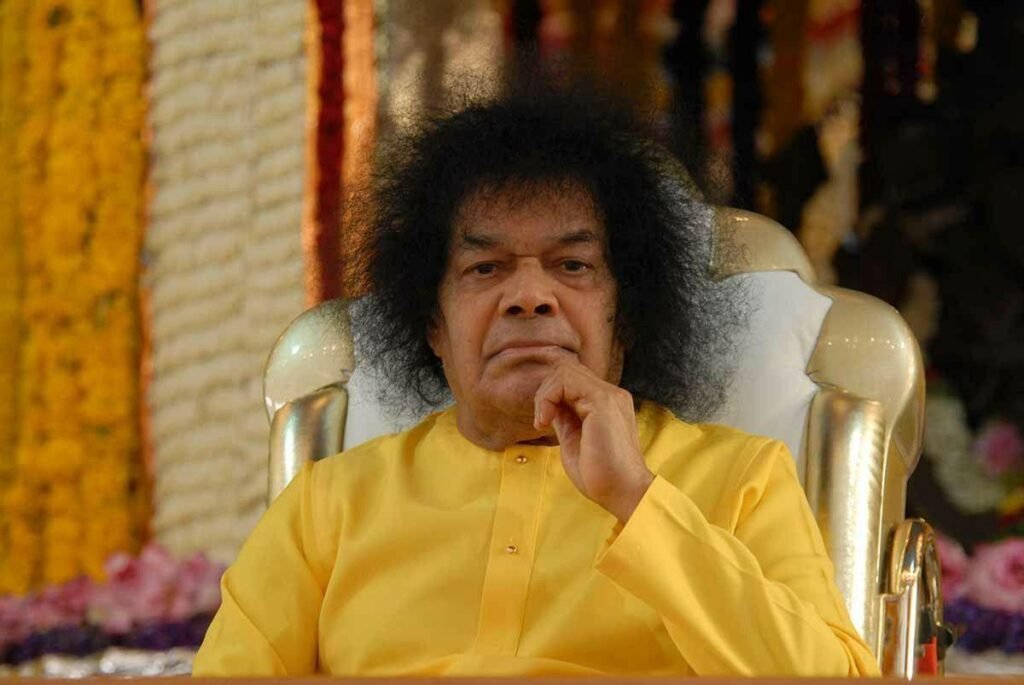
shri sathya sai baba Spiritual leader smiling with A.P.J. Abdul Kalam image
Teachings

Thoughts and Destiny…

Thoughts and Destiny… Man today looks at physical forms superficially, without examining their Inner basis. This is the secular or temporal approach to knowledge. In Spirituality, however, one looks beneath the “surface”. Excellence in secular knowledge may lead to great achievements and positions of power and authority; but it can never bring enduring respect to the achiever. By contrast, one who is totally immersed in God never fails to elicit respect and adoration wherever he goes. Knowledge is truly meaningful only when it leads to good thoughts. You sow thoughts and reap actions; you sow actions and reap habits; you sow habits and reap character; you sow character and reap a fortune. Thus, fortune depends on character, character depends on habits, habits depend on actions and actions depend on thought. It all comes back to thoughts and in the ultimate analysis, thoughts shape one’s future as well as fortune. Good fortune is always the result of good and positive thoughts whereas bad and negative thoughts lead eventually to bad fortune, via bad actions, bad habits and evil character. Since thought is the true basis of fortune, it is obvious that one must cultivate good and positive thoughts if one is looking for a good fortune. Thoughts and Destiny are inter-connected. Good thoughts alone would lead to good action. What is the meaning of good action? A good action is that which would please God. Whatever you do, you should always have the feeling that you are doing God’s work. Further, you should never forget to dedicate your actions to God. He who in this manner always lovingly offers all his actions to God would get only good thoughts and feelings; evil thoughts and feelings would never enter his Mind. All worldly activities must be inspired by noble feelings emanating from the Heart. Cultivate noble feelings, seek the Divine, and realise that the Divine transcends all attributes. What is Divinity? Who is God? The Love that is immanent in all beings is God. Love is God, and this Love is inherent in every being. Man should give expression to the Love latent in him in the same way God gives expression to His Love and shares it with all. Love is most adorable, beautiful, infinite and beyond all measure. Pure and unselfish Love must be treated as an aspect of the Divine. It cannot be commanded or demanded, or purchased or acquired through raw physical might. You cannot hire it or obtain it on lease. No one can lend Love or borrow Love. Love is immanent and infinite. Love between beings cannot be like a business transaction, as people often tend to imagine. Pure Love can be attained only through Pure Love. Love should be the basis of life. Today, no one thinks of true, Selfless Love. People seek all kinds of specialised education, positions of authority and power. All this is a complete waste of time and an exercise in futility. Actions become meaningful only when they are born of good thoughts and rooted firmly in Pure Love. Excerpts from a Discourse of Bhagawan Sri Sathya Sai Baba

Thoughts and Destiny… Read Post »
IMG 20250924 WA0179
Teachings

Being Near and Dear to God…

Being Near and Dear to God… Whatever a man sees in the world arouses fear in him. Detachment alone can free him from fear. Failing to grasp this profound truth, man is allowing his desires to multiply, without realising that desires promote attachment instead of detachment. As long as man is attached to the body, he cannot get over the desire to possess the objects that attract him. A man afflicted with the acquisitive impulse can never get rid of worries. To overcome this attachment and possessiveness, ancient sages tailored their educational system so that it promoted self-control. Self-control also developed humility and thus, humility became the true index of right education. Control of the senses is absolutely essential for achieving humility, and education must promote such control. Today’s educational system is concerned mostly with imparting bookish knowledge, and students seek education only as a means for earning a living. This link between education and employment has to be severed, and education must instead be transformed into the process of acquiring True Wisdom. In life, there are two aspects that have to be considered, rights and duties. Most people are concerned only with their rights and engage in struggles to secure them. Seldom do they recognise their responsibilities. This is true of all fields of human activity – social, political, economic and even spiritual. Lack of self-control is responsible for all this. Men should regard their senses as potential enemies and not allow senses to have their own way. They should be subject to one’s control and direction. What is the easiest way to achieve this mastery? Only the spiritual path. If there is real faith and devotion in man, the senses would be powerless against him. It is the decline in faith and devotion that has led man to become a slave of the senses. The prompting of intellectual reasoning should not be identified with the dictates of the Conscience. Rather, the directives should come from the Heart. When you dive deep into a problem and enquire whether what you do is in the interests of your friends and Society in general, your Conscience will give you the right answer. Man is made up of three constituents, the body, the Mind and the Atma. Man needs the body for performing actions. But, if the actions are done without using the discriminating power of the Mind, man would be behaving like an animal, which acts on impulse. Moreover, if the Mind, without relying on the eternal and ever pure Atma, follows the demands of the body and the senses, the actions would be demonic. Bereft of the influence of the Atma, the combination of the Mind and the body can lead to demonic qualities. However, when one is installed in the Atmic principle, transcending the body and the Mind, one attains the Divine. Hence, sanctify all your words, thoughts and deeds. Make your Heart pure so that it becomes a worthy abode for the Divine. Excerpts from a Discourse of Bhagawan Sri Sathya Sai Baba

Being Near and Dear to God… Read Post »

shri sathya sai baba in orange robe smiling with hand near chin image
Teachings

A to Z of life

A to Z of life A Always depend on God B Bear insult, near injury C Control the tongue D Do not cheat anybody E Evil company is dangerous F Fear nothing G Give, give, give. God will Love, Love, Love H Helping others is virtue I Injury is vice J Japa is your coat of arms K Knowledge is the fruit L Live for others M Mind deceives, beware N Now is the best time to utilize O Overcome grief by liberality P Pure mind is your friend Q Quietness will lead you to progress R Recite the name of God S Speak sweetly, speak softly T To love is to Serve U Understand yourself V Virtue is the staff of life W Within you is bliss X (E)xert yourself for Good Y Your treasure is God Z Zero has no value, if not attached to a unit. So life has no value if not attached to God.

A to Z of life Read Post »

satyasaibabaji 1
Teachings

Thoughts for the day

Thoughts for the day January 1 The year becomes new, the day becomes holy, when you sanctify it by Spiritual discipline, not otherwise. January 2 All life is One My Dear Son Be Alike to everyone January 3 Money comes and goes; Morality comes and grows January 4 Do not crave for recognition and respect from others; Crave rather for winning grace from the Lord. January 5 God is Love. Live in Love. January 6 The Lord will be watching with a thousand eyes the least activity of man to discover any slight trace of selfless love sweetening it. January 7 A sound mind ensures a sound body; A sound body ensures a sound mind. January 8 Do good. See good. Be good. This is the way to God. January 9 The body will shine it the character it fine; service of man worship of God will preserve its charm. January 10 Man must be unmade and remade. January 11 The Divine is manifest in society. January 12 Love lives by giving and forgiving. Self lives by getting and forget- ting. January 13 Love is selflessness. Selfishness is loveless. January 14 You are three people: The one you think you are – body. The one others think you are – mind. The one you really are – divine. January 15 The peace that pervades the heart can never be shaken for any reason; only peace of this kind is worthy of the name. January 16 Love all beings; that is enough. January 17 The grace of God is like insurance. It will help you in your time of need without any limit. January 18 It is not the standard of living that is important, but the manner of living. January 19 You must render service out of spontaneous urge from within, with a heart filled with love. January 20 A chance conglomeration of humans does not become a Society. January 21 A society has to be welded into a unit by the consciousness of kinship in God. January 22 The service of man is the only means by which you can serve God. January 23 God is in you, God is in every word of yours, every deed and thought. Speak, do and think as befits Him. January 24 If one student is bad, only that student is affected… But is one teacher is bad, hundreds of students get spoiled. January 25 You thoughts play a vital role in shaping your life. January 26 Unity is divinity; Purity is enlightenment. January 27 Reform the body, reconstruct the mind, regulate the way of living, then, the country will become automatically strong and prosperous. January 28 Forget the harm that anyone has done to you, and … Forget the good that you have done to others. January 29 There is only one royal road for the spiritual journey … Love. January 30 Religion is three-fourth character. January 31 The present is a product of the past, but is also the seed for for the future. February 1 There is only one God. He is Omnipresent. February 2 There is only one race, the race of Mankind. February 3 There is only one religion, the religion of love. February 4 There is only one language, the language of the Heart. February 5 The mind sees separateness, Love sees unity. February 6 Every experience that is drawn through any of the senses has an effect on one’s health. February 7 Head in the Forest; Hands in Society. February 8 Today’s man is pursuing unrestrained sense cravings. These pursuits drag man’s mind into the gutter. February 9 A man’s well-being depends upon his degree of contentment. February 10 Every living being in this world is knowingly or unknowingly on a spiritual pilgrimage. February 11 Every man is the embodiment of God. February 12 The Divine is manifest in society. February 13 Life is a challenge, meet it! Life is a dream, realize it! Life is a game, play it! Life is Love, enjoy it! February 14 You are all members of the same family, bound by the Religion of Love. February 15 Do not seek to discover or discuss the evil in others, for the attempt will tarnish your own minds! February 16 True education is not for a mere living, But for a fuller and meaningful life. February 17 Devotion is not a uniform to be worn on certain days and than to be put aside. February 18 If the mind of man is not reformed and purified then all the plans to reform the world will be futile. February 19 What God gives is never exhausted. What man gives never lasts. February 20 Love must express itself as Service. February 21 Man has to recognize the indebtedness to society and his duty towards it. February 22 WATCH your Words February 23 WATCH your Words. Watch your Action February 24 WATCH your Words. Watch your Action. Watch your Thought February 25 WATCH your Words. Watch your Action. Watch your Thought. Watch your Character February 26 WATCH your Words. Watch your Action. Watch your Thought. Watch your Character. Watch your Heart. February 27 Follow the Master. Face the Devil. Fight to the end. Finish the game. February 28 You must make the mind the servant of God, not the slave of the senses. February 29 “LIFE IS: LOVING, LISTENING, LIFTING, LEARNING, LIVING” March 1 Good company is important, it helps to cultivate good qualities. March 2 As close as you are to God, so close is God to you. March 3 The synthesis of pure, calming food is breathing pure air, listening to good sounds, looking at good sights, and touching pure objects. March 4 I – Want – Peace: “I” is ego. “Want” is desire. Remove ego and desire and you have peace. March 5 The gift of food to the hungry, is the noblest of all gifts. March 6 We must control our desires. Don’t waste money. Don’t time. Don’t waste food.

Thoughts for the day Read Post »

IMG 20250924 WA0181
Teachings

A Taste of His Teachings

A Taste of His Teachings Baba’s teachings cover many viewpoints, and seem to primarily be a resounding, world-emboldening ‘Yes!’ to all legitimate spiritual paths and the basic truths of all religions.  Most of Baba’s teachings focus on love – love for God and for all beings – as the essential core of spirituality:  “Start the day with Love.  Spend the day with Love.  Fill the day with Love.  End the day with Love.  This is the way to God!”  And this Love is to be given to everyone, always, without exception: “Love all, serve all!  Help ever, hurt never!” Yet as I explored His teachings more deeply, I found that He is also a Master of advaithic philosophy, and a strong exponent of the jnana path (the path of Atmic wisdom).  “The main aim of human life is to acquire the knowledge of the Atman.  This is the true Purushartha [goal of life].  Human life will find fulfillment only if this goal is attained.”1  The various approaches are beautifully balanced in His discourses, with devotion and Atmic abidance given equal importance. Baba also stresses the practice of what He calls the five primary human values, namely, Love, Truth, Peace, Righteousness, and Non-violence.  In many of His discourses He asks us to dedicate all our actions to God and live in tireless selfless service to humanity.  He also lays importance on the practice of kindness, and the use of sweet speech under all circumstances, saying, “You cannot always oblige; but you can always speak obligingly.”  Baba advocates daily meditation for all, as well as repetition of God’s Names with love, devotional singing, and the practice of seeing and serving God within everyone, laying particular emphasis on continual remembrance of the Divine Reality.  “Spirituality means constant integrated awareness.” Interestingly, He does not encourage His non-Hindu devotees to become Hindus, but rather, to use His teachings to become the best Christians, Jews, Muslims or Buddhists they can be.  Many of the devotional songs sung at Baba’s ashrams contain the names of Allah, Jesus, Zaroaster, Mahavir, Moses, Guru Nanak and the Buddha, in addition to the Hindu Avatars.  It seems to be a clear a way of saying, ‘Hear, O world!  The Lord is One!’   “There is only one Religion, the Religion of Love.There is only one caste, the caste of Humanity.There is only one language, the language of the Heart.There is only one God, and He is omnipresent.” As an aid to the realization of His primary teaching – that we are God – He often recommends use of the mantra ‘So Ham’ (meaning “I am He”, or “I am God”).  He has also offered His devotees the following maha-affirmation: I am God!  I am God!  I am not different from God! I am the eternal undifferentiated Absolute! Grief and anxiety cannot effect me. I am always content.  Fear cannot enter me. I am Satchidananda!  I am pure Existence, Knowledge and Bliss. I am Omnipotent!  I am all-powerful; nothing is impossible for me! I am Omniscient! I am all-knowing;  there is nothing which is not known to me. I am Omnipresent!  I am present everywhere.  I pervade this universe! I am Krishna!  I am Christ!  I am Buddha! I am Sai!  I am Sai!  I am Sai! I am God!  I am God!  I am God! (Try saying that ten times a day, and see how fast your life changes…!)   

A Taste of His Teachings Read Post »

IMG 20250924 WA0183
Teachings

Answers from the Divine Guru

Answers from the Divine Guru (Compiled from various meetings with Sri Sathya Sai Baba) Question 1Why are some people born more beautiful, or more intelligent, than others are? Why does not God give everyone equal beauty, abilities and talents? Sri Sathya Sai Baba:It is not God’s partiality or fault. It is the human being who is responsible. His actions, thoughts and words are responsible for all good and bad. It is the mind that creates the differences. Pleasure is an interval between two pains. It is the way you look at things that matters. There is a vast ocean of talents and qualities. All human beings have vessels to fill. Some people, through their actions, are able to fill the vessels to the brim; some fill only half; others can fill only a quarter, or less. They possess intelligence, beauty, talents, and etceteras, according to how much they can fill their vessels. You even judge beauty these days, as in Miss India, Miss World. But, that is all physical beauty, which is transient. What is important is the beauty of the atma (Self). Question 2How are good or bad actions carried into the next birth? Sri Sathya Sai Baba:Swaasha (breath) carries the actions, for the breath stops when a person dies. The body is still there after death and we call it a corpse and burn it as useless. So, the body cannot carry anything with it, just as a flower cannot carry its fragrance. It is a breeze that wafts the scent of the flower and makes its fragrance reach you. Similarly, imagine a municipal lorry, the breeze carries the bad odour to you again! In the same manner, good and bad actions are carried by the breath and surround you in the next birth like an invisible garland. The pattern of your life is then governed by what the garland has good or bad scent. That is why man must understand that everything he does has a reaction, a reverberation and a reflection. It is he who writes his own destiny by his actions. It is essential for man to live a good life with good thoughts and good actions. Only through such a life can he realise the divinity in him. The concept Aham Brahmasmi (I am Brahma = God) is also incorrect, since it indicates duality. Aham (I) and Brahma (God) become separate. The statement ought to he Aham Aham (I am I). Question 3Many people feel that Hindus worship countless gods. How did this happen? Sri Sathya Sai Baba:India has a wonderful religious tradition. It has something for everyone, to suit everyone’s needs. Many people do not understand this excellent idea and make derisory comments on our having too many gods. This tradition has evolved to suit the needs of different people, just as we have shirts of varying types and sizes to fit different people. With the ideal of One God, there is only one shirt and, if it does not fit or if it is unsuitable, people turn away from God. But, here, if someone likes Krishna, they can worship Krishna; others can worship Rama, or Narayana, or Shiva, or even snakes and lions! What more do you need to propagate the idea that God is in everything everywhere? That is why I often say don’t worship God as a picture, but worship the picture as God. This will slowly lead to the realization of God in you. That is where the Hindu spiritual path is practical and good. Question 4Why does not God prevent cruelties in the world? Sri Sathya Sai Baba:God is only a witness (saakshibhoota). He does not act. Man acts according to the dictates of his intellect (buddhi) and himself suffers the consequences of his actions (karma). There is neither good nor bad for God. Take the knife as an example. A murderer uses a knife to kill another man, a slaughterer uses a knife to slay animals, a surgeon uses a knife to amputate, and a cook uses a knife to chop vegetables. If a magnet is placed among all these knives, it will attract them all equally and not according to the kind of tasks they perform. God is like this magnet. All knives are the same to Him. However, the hands that wield the knives have to bear the consequences of their actions, dependent on right and wrong. Question 5When we have troubles and are in difficulties and we pray to God, why does He not take them away’? Sri Sathya Sai Baba:Troubles and difficulties are part and parcel of human life. They are the results of your karmas. There is no point in praying to God to wipe away all such troubles and difficulties. The right type of prayer would be to ask God for courage and strength to bear all the difficulties, problems and tragedy with equanimity. Question 6What is the difference between the politics of yesterday and those of today? Sri Sathya Sai Baba:The present state of affairs can be described as the state of jumps and bumps. Now, take the example of your body and limbs. Each limb is important in forming the composite whole. All the limbs joined together make up the body, which is the deha (body, person). Similarly, in the desha (country, nation), every aspect should be tended to, just as one takes care of every part of the body. Question7The view that women should not take ups Brahma vidya (spiritual knowledge), nor chants the Omkara. Is this correct? Also, in ancient times, were spiritual sadhanas (endeavours) forbidden to women? Sri Sathya Sai Baba:Brahma vidya and chitta shuddhi (spiritual knowledge and purity of consciousness) do not depend on whether a person is a man or a woman. All have an equal right to benefit from Brahma vidya provided only they are able to take it up with discipline and dedication. At no time have there been any taboos against women. Lord Vishnu (the Preserver) taught Bhu Devi (the Goddess Earth) the glory of the Bhagavad- Gita. Parameshwara (Shiva) taught Parvati the Brahma tatva (divine essence) through the Guru Gita. Ishwara (Shiva) initiated Parvati into yoga shastra and mantra shastra (science of yoga and science of mantra). The Brihadaranyaka Upanishad mentions Yajnavalkya teaching Maitreyi the Brahma vidya. So, women in ancient times were not denied the pursuit of spirituality. The Brihadaranyaka Upanishad mentions Ciargi and Maitreyi hasking in the splendour of sannyasa (renunciation) and brahmacharya (celibacy, chastity). Madaalasa Chudaala and others were able to receive Brahma jnana (divine wisdom) while in the grahastha (householder, i.e. married) stage of life. Even today, there are many that belong to this vast category. It is sheer absurdity to deny women the right to earn Brahma jnana. But, in worldly matters, it is necessary for them to maintain certain limitations in the interests of dharma (righteousness) and loka kalyana (the good of the people/world). For the sake of safeguarding morality and for the

Answers from the Divine Guru Read Post »

shri sathya sai baba in orange robe looking down at his hand picture
Teachings

Yoga Suthras of Pathanjali

Yoga Suthras of Pathanjali Excerpt from book of Sri Sathya Sai Baba “Prashaanthi Vaahini” about Yoga Suthras of Pathanjali Yoga too is of two varieties: Rajayoga and Jnanayoga. In Rajayoga, there are Eight Stages which have to be well cultivated, and realised. Of these, some are external, some internal. This is the Aryan path. In the Jnana Yoga, there is no “external” at all. Both these yogas have as their goal, the stilling of the agitations of all levels of Consciousness. For those who have calmed all these agitations, everything is Brahmam. Primary for this purpose is Jnanayoga more than Rajayoga; at least that is the opinion of the Knowers of Brahmam: they say “that is the thing to be known, to be reached”. But, according to the Wisdom of the Upanishads the direct knowledge of the Brahmam can be got by the Eightfold Yoga of Yama, Niyama, Aasana, Praanaayaama, Prathyaashaara, Dhaarana, Dhyaana, and Samaadhi. Yama: Yama includes Ahimsa (Non-violence), Sathya (Truth), Astheya (Non-stealing), Brahmacharya (Celibacy), and Aparigraha (Non-acceptance). This is the usual meaning given to Yama, but I would say instead, that it means the giving up of attachment to the body and to the senses. The Brahma entity (Which is devoid of Name and Form, and Qualities, which is without End, without Joy or Sorrow, and without modifications, which is Eternal and of the Nature, of Sat-Chith-Ananda) appears, as a result of Delusion, as all this Creation (endowed with all Qualities and Modifications, viz Name, Form, Transformation of Rise and Decline, Joy and Sorrow.) This Appearance has an End; it has various other limitations; it appears to be ever-moving and so it is called Samsaara. Thus, this Brahma entity appears in both the individual form of Vyashti and the collective form of Samashti and deludes even great Scholars and Pandits. One single Chaithanya becomes manifest in different ways as all this multiplicity. Therefore, we speak of the particular and of the Collective i.e., a collection of Particulars. Of course, the Particular (the Vyashti) is a super-imposition on the Brahmam, a super-imposition, like seeing the snake on the rope, the lake in the mirage; each of the three bodies, the Sthoola, the Sookshma, and the Kaarana, is itself for the knower of Brahmam, a super imposition. To say that it is real or unreal is not correct; it is neither, real or unreal, it is Mithya. The ignorant man caught in the meshes of this Delusion believes that Samsaara is ever lasting and a source of happiness. Falsely identifying themselves with the body, men suffer in the coils of attachment towards their mother, father, wife, children, relatives and friends. They do not realise (through the constant contemplation of the Brahmam having the characteristics of Sat-chith-ananda, through the never-ceasing discrimination between the change-less and the changing, through association with the good, the service of the wise, and the acquisition of purity of intelligence) that they have neither body nor senses, that they are Brahmam (the sustenance and Support, the Adhishtaana of the three-fold Body and everything else). The establishment of one’s intellect in this Consciousness is the real renunciation or Vairagya of the body and the senses, implied in the word, Yama, as defined by me earlier. This is what is called Yama, in the Jnanayoga. Joy in times of good fortune and sorrow in times of bad, mistaking the pain of the body and the senses as one’s own, such dual attitude and feeling must be overcome. Step by step, the identification with the body and the senses has to be given up. This is the sign of one’s acquiring the Anga of Yama. This Anga is the very foundation of Jnanayoga. Niyama: Niyama means purity, being always full of joy, engaged in Thapas or Japam. That is what is mentioned in Rajayoga; Soucha, Santhosha, Thapas, Swaadhyaaya, Eswarapranidhaana, these are the Components of Niyama. But, I would explain it in the following manner. Niyama is the condition of steady Prema in the Paramatma or Godhead, at all times and under all conditions. “Saa parama prema roopaa”, it is said in the Narada Bhakthi Sutra. “It is the highest form of Prema”. It is only when such steadfast Love towards the Absolute is gained, that the Soucha or Purity, the Santhosha or Joy, the Thapas, the Swaadhyaaya or Study, the Easwarapranidhaana or Surrender to the Lord, mentioned in the Rajayoga will also be got. When Yama is won, Ananda and Santhi will become the possession of Man through the source of all Ananda and Santhi, the Sat-Chith-Ananda Parabrahma Entity. For these two are not derived from the dry worldly material objects. “Rasovai sah” He is Sweetness, “Ananda vai brahma” Brahma is Ananda, says the Upanishads. It is in and through Brahma that the material world is endowed with even the tiniest modicum of joy. Without the basic Brahma, which is the completest and the fullest Sweetness and Joy, this fleeting evanescent Appearance thereon cannot be so sweet and joy-giving to the worldly minded! It would have been, without that basic Rasa, terribly bitter. For this little sweetness that material objects give, that Ocean of Nectar is the cause. The association with the knowers of Brahma, the discussion with them of the Nature of the Absolute in a spirit of humility and earnestness, a thirst to realise the Reality, unwavering Prema towards the Lord, these are the characteristics of those established in Niyama. Such stalwarts will not be affected by derision or praise, by wind or sun or rain, by honour or dis-honour; they will tread the path of liberation free from all attachment to anything except the one single aim of realising the Ananda of Unison with the basic Brahma. He who has realised the stage of Niyama will be ready to sacrifice everything for the acquisition of Jnana. He will run to any distance to listen to discussion of Brahmam; he will obey every instruction of the wise; he will attach himself to those who teach him the science of Ultra-consciousness or Chinmayathathwa, as if they

Yoga Suthras of Pathanjali Read Post »

IMG 20250924 WA0182
Teachings

Where is God?

Where is God? As in the sesame seed oil exists,As in milk ghee is present,As fragrance resides in a flower,As the juice exists in a fruit,As fire is latent in a faggotSo Is the Divine immanent in subtle form Oil is present throughout the sesame seed. Ghee is present in every drop of milk. Fragrance is present in an invisible form in a flower. A fruit is filled with sweet juice. In every piece of wood fire is latent. In the same manner the Divine is immanent in the entire cosmos in a subtle form. God is present not in some country or some body. Like vision in the eye and hearing in the ear, God is present in the mind as Consciousness (Chaitanya). The cosmos is the visible manifestation of the invisible Supreme Self. While the Divine is in such close proximity to him, man in his ignorance goes seeking God everywhere. The Divine is effulgent in every man as Sath-Chith-Ananda (Being-Awareness-Bliss), the Cosmic Consciousness. Reflections of the sun shining in the sky can be seen in the oceans, rivers, the lakes and in wells. Though the reflections are varied, the sun is one alone. The Divine is present in man like the unseen thread which holds a garland of gems together. The entire cosmos is permeated by the Divine and is the visible manifestation of the Divine. Nothing in the world, no object, no human being, no creature can be found wherein God is not present. Though man appears in the world in different forms, speaking different languages, his essential humanness is common to one and all. There is only one race, that is the human race. God is only one. He is Sath-Chith-Ananda. Just as a seed sprouts and grows into a plant wherein a flower blossoms, so does the Divine seed grow in the heart of man and blossoms as a flower, Sath-Chith-Ananda. Just as it is natural for a seed to become a fragrant flower, so is it natural for man to experience the bliss of the Divine (Sath-Chith-Ananda). There are many evidences to demonstrate the Divinity that is inherent in man. But few men are ready to make the sacrifice that is required to experience this Divinity. The ancient sages regarded human life as full of fragrance to be enjoyed. They considered life as full of nectarine sweetness. When man is oblivious of this sweetness, he ceases to be human. Sacrifice (Thyaga) is the sweetness in humanness (Manavathva). The scriptures declare: Only through sacrifice can man realise the eternal Divine. But, immersed in selfishness, man fails to recognise this truth.

Where is God? Read Post »

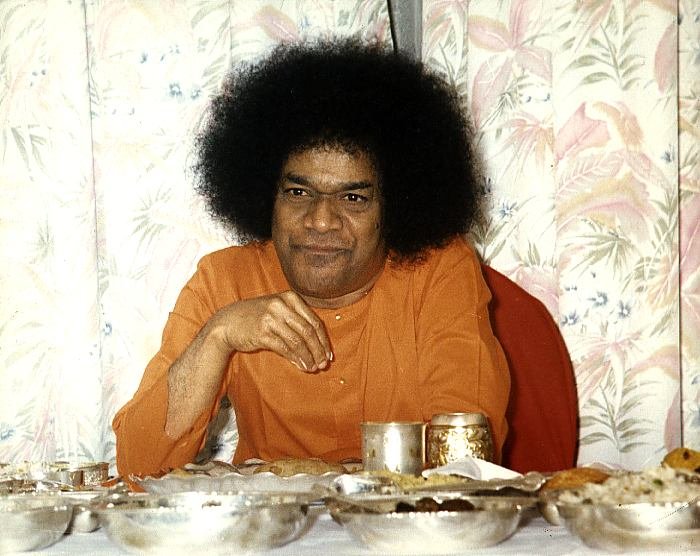
shri sathya sai baba in orange robe seated at table with food dishes image
Teachings

108 Quotations on Faith in God

108 Quotations on Faith in God From Sri Sathya Sai Baba’s Divine Discourses    The first quality every member of the Sathya Sai Seva Organisation should have is firm faith in God. This faith must be based on the awareness that God is Omnipresent. The Divine pervades everything in the Universe. This may not be understood by everyone. Some may not agree that the Divine is Omnipresent. But whether they accept this fact or not, the truth is, evidence of the presence of God can be found wherever one turns.      Is it possible for this boundless creation to be brought into existence by man, if there had been no Divine Principle behind it? For instance, fire is latent in the branches of a tree and in the tree itself. If the branches rub against each other, they may generate a fire which could burn down the tree, branches and all. Which is the power that filled the branches with the latent fire and ensured at the same time that they did not destroy themselves by releasing that fire? Is man responsible for this? Take, again, the example of the process by which the food that we take is converted into blood. Is this the invention of any man?      It is the immanent, all-pervasive power of the Divine that reveals Itself in numerous ways. We see flowers of all kinds. Men are able to make plastic flowers of the same kind. But can any one fill the plastic flowers with the native fragrance that is got from natural flowers? This is possible only by the Divine. There is sweet water inside a tender coconut. Who poured the water inside the coconut? Was it the work of any man? No. Only the Divine can do such a thing.      Examples such as these should serve to confirm your faith in the Divine. No one can probe the mystery of the power of the Divine or grasp its infinite magnitude. If members of the Sathya Sai Organisation have no faith in the Divine, there is no purpose in their remaining in the organisation. Such persons need not join the organisation or continue in it. It is with faith that one should take up social service. Society is our primary concern. The Divine is manifest in society. – Sri Sathya Sai Baba

108 Quotations on Faith in God Read Post »

0a2fbd23 1dc4 4caf 912b 7ca3037614d1
Teachings

You Will Win

You Will Win When delusion is shed, grief gets destroyed; joy is established: dukha nivrithi and aanandha prapti both happen at the same time. The mind is the villain; it is another name for desire; the texture of the mind is just desire, both warp and woof are desire and nothing else. If desire goes, the mind disappears. When you pull out all the yarn from a piece of cloth, you have no more cloth. So too, pull out desires from the mind, it disappears, and you are free. Grief and joy are the obverse and reverse of the same experience. Joy is when grief ends; grief is when joy ends. When you invite a blind man for dinner, you must set on the table two plates, for he comes along with another man who will lead him in. Grief and joy are inseparable companions. Bhakthi is very difficult to acquire; do not think it is easy to become a bhaktha. As a matter of fact, it is even more difficult than Jnaana, for it means complete surrender, full contentment whatever may happen. The river must flow back to its source; it must turn back and up. If you flow down, you will have to go down, down, down, and water becomes undrinkable. But do not despair; you have to win some day. The sooner, the better. A mango seller may seek to sell four for a rupee; but if three of them get spoiled, he should not give up hope, for, a person may come and offer a rupee for the fourth one. Having come here and listened, and secured darshan and read about Me, put into actual practice at least one of the good counsel you got; one stick is enough to light a fire; the entire box of matches need not be used. Have faith that you will win; have steadiness in the pursuit of the goal.

You Will Win Read Post »