













Hari Om

Menu

February 24, 2026

swami sivananda Black-and-white photo of monk meditating seated cross-legged image
Swami Sivananda, ⁠Three Important Sages and Avatar of Ancient Bharat

Maharshi Vyasa

Maharshi Vyasa Sri Swami Sivananda In ancient days, our forefathers, the Rishis of Aryavartha, went to the forest to do Tapasya during the four months following Vyasa Purnima–a particular and important day in the Hindu calendar. On this memorable day, Vyasa, an incarnation of the Lord Himself, began to write his Brahma Sutras. Our ancient Rishis did this Tapasya in caves and forests. But times have changed and such facilities are not common nowadays although Grihasthas and Rajas are not wanting who are able and willing to place at the disposal of the members of the fourth Ashrama such help and facilities as they can afford. The forests and caves have given place to the rooms of Sadhus in their own Gurudwaras and Mutts. One has of necessity to suit himself to time and place; and change of place and situation should not be allowed to make such a difference in our mental attitudes. Chaturmas begins from the Vyasa Purnima Day when, according to our Shastras, we are expected to worship Vyasa and the Brahmavidya Gurus and begin the study of the Brahma Sutras and other ancient books on ‘wisdom’. Our mythology speaks of many Vyasas; and it is said that there had been twenty-eight Vyasas before the present Vyasa–Krishna Dvaipayana–took his birth at the end of Dvapara Yuga. Krishna Dvaipayana was born of Parasara Rishi through the Matsyakanya–Satyavathi Devi–under some peculiar and wonderful circumstances. Parasara was a great Jnani and one of the supreme authorities on astrology and his book Parasara Hora is still a textbook on astrology. He has also written a Smriti known as Parasara Smriti which is held in such high esteem that it is quoted by our present-day writers on sociology and ethics. Parasara came to know that a child, conceived at a particular Ghatika or moment of time, would be born as the greatest man of the age, nay, as an Amsa of Lord Vishnu Himself. On that day, Parasara was travelling in a boat and he spoke to the boatman about the nearing of that auspicious time. The boatman had a daughter who was of age and awaiting marriage. He was impressed with the sanctity and greatness of the Rishi and offered his daughter in marriage to Parasara. Our Vyasa was born of this union and his birth is said to be due to the blessing of Lord Siva Himself who blessed the union of a sage with a Jnani of the highest order, although of a low caste. At a very tender age Vyasa gave out to his parents the secret of his life that he should go to the forest and do Akhanda Tapas. His mother at first did not agree, but later gave permission on one important condition that he should appear before her whenever she wished for his presence. This itself shows how far-sighted the parents and the son were. Puranas say that Vyasa took initiation at the hands of his twenty-first Guru, sage Vasudeva. He studied the Shastras under sages Sanaka and Sanandana and others. He arranged the Vedas for the good of mankind and wrote the Brahma Sutras for the quick and easy understanding of the Srutis; he also wrote the Mahabharata to enable women, Sudras and other people of lesser intellect to understand the highest knowledge in the easiest way. Vyasa wrote the eighteen Puranas and established the system of teaching them through Upakhyanas or discourses. In this way, he established the three paths, viz., Karma, Upasana and Jnana. To him is also attributed the fact that he continued the line of his mother and that Dhritarashtra, Pandu and Vidura were his progeny. Vyasa’s last work was the Bhagavata which he undertook at the instigation of Devarshi Narada who once came to him and advised him to write it as, without it, his goal in life would not be reached. Vyasa is considered by all Hindus as a Chiranjivi, one who is still living and roaming throughout the world for the well-being of his devotees. It is said that he appears to the true and the faithful and that Jagadguru Sankaracharya had his Darshan in the house of sage Mandana Misra and that he appeared to many others as well. Thus, in short, Vyasa lives for the welfare of the world. Let us pray for his blessings on us all and on the whole world. Everybody knows that there are six important systems of thought developed by our ancients known as the Shad Darshanas or the six orthodox schools of philosophy, viz., Sankhya, Yoga, Nyaya, Vaiseshika, Purva Mimamsa and Uttara Mimamsa or Vedanta. Each system has a different shade of opinion. Later, these thoughts became unwieldy, and to regulate them, the Sutras came into existence. Treatises were written in short aphorisms, called “Sutras” in Sanskrit, meaning clues for memory or aids to long discussions on every topic. In the Padma Purana, the definition of a Sutra is given. It says that a Sutra should be concise and unambiguous; but the brevity was carried to such an extent that the Sutra has become unintelligible and particularly so in the Brahma Sutras. Today we find the same Sutra being interpreted in a dozen ways. The Brahma Sutras written by Vyasa or Badarayana–for that was the name which he possessed in addition–are also known as Vedanta Sutras as they deal with Vedanta only. They are divided into four chapters, each chapter being subdivided again into four sections. It is interesting to note that they begin and end with Sutras which read together mean “the inquiry into the real nature of Brahman has no return”, meaning that “going by that way one reaches Immortality and no more returns to the world”. About the authorship of these Sutras, tradition attributes it to Vyasa. Sankaracharya, in his Bhashya, refers to Vyasa as the author of the Gita and the Mahabharata, and to Badarayana as the author of the Brahma Sutras. His followers–Vachaspathi, Anandagiri and others–identify the two as one and the same person, while Ramanuja and others attribute the authorship of all three to Vyasa himself. The oldest commentary on the Brahma Sutras is by Sankaracharya; he was later followed by Ramanuja, Vallabha, Nimbarka,
Maharshi Vyasa Read Post »

swami sivananda Devotee receiving blessings from guru image
⁠Direct Disciples of Sri Swami Sivananda Maharaj, Swami Sivananda

Dr. Devaki Kutty Mataji

Dr. Devaki Kutty Mataji Gurudev’s Letters to Dr. Devaki Kutty Mataji 2nd July 1953 OM Namo NarayanayaAdorable, Immortal SelfSalutations and adorations I am thankful to you for all your kindness. You took so much pain in going over here and did very noble service in relieving the sufferings of women who were ailing in silence. A good record. I humbly pray you will be graciously pleased to do such acts in future every year. Cordial greetings. Kindly write to me direct in future. I am not a big Swami. I am a simple sevak (servant) of humanity, very easily approachable by all. Become angry with anger itself, because anger does the greatest mischief. There is no enemy worse than anger. Glad to know you have made great progress in self-restraint. Purify. Meditate. Unfold the Divinity. This is thy foremost duty. Dharma is the gateway of Moksha. A meditative life contributes to the supreme illumination. May Lord bless you with health, long life, peace, prosperity and bliss eternal. Om Tat Sat. Thy Own Self,With regards, Prem and OmSivananda Dr. Devaki Kutty-A Legend In Her Own Life Time (Sri Swami Chidananda) Worshipful homage to the Eternal and Infinite Supreme Universal Spirit, the Param-Atma. This is a tribute to Dr. Devaki Kutty, my spiritual sister due to her discipleship to our most revered Guru Bhagavan, H.H. Parampujya Sri Swami Sivanandaji Maharaj. This special tribute is upon her completing her 75th Birthday Anniversary on 8th October 1998. But, if she told someone she was 75 years old, they would immediately retort, “Impossible! Don’t pull my leg! Tell me truly, what is your age?” Because, in her appearance Dr. Kutty belies her age. No one would believe that she is even a day older than the early sixties. She is a slim, trim and active person who even today puts in a 5-6 hours work schedule 6 days in a week from 8 am to almost 2 pm in the women section of her Gurudev’s Sivananda Charitable Hospital at Sivananda Ashram, on the sacred banks of holy river Ganga near Rishikesh. She is something of a mini-phenomenon in her own personality and daily activities. All religions in our human world believe that God, the Supreme Universal Spirit, is an ocean of compassion. God is the all-merciful, says the Holy Koran. He is ever gracious. He is infinite Love. These are the terms by which scriptures refer to God. He rescues those who are in danger. He is the reliever of pain and suffering. He removes the distress of those who are in distress. He is solace and hope to those in grief and despair. He is all these and much more. Therefore, the sorely afflicted beings fervently pray to the Lord for succour. He is the answer to our prayers. He is the one Being to whom we can turn when we have no one else to turn to. This is the truth. This is also the fact. However, in this world of human beings the Supreme Universal Spirit does not personally come down and attend to all our aches and pains and problems and life’s complications. It is only upon very very rare occasions, when some extremely grave situation arises in this world, that we hear of an incarnation taking place in order to set right such a situation by doing the needful at that critical juncture. Otherwise it is the divine plan that He manifests His divine grace, compassion and active help by and through chosen human agencies and instruments, that have proved worthy of being thus used as channels by their exemplary lives and their exceptional character, conduct and their noble and benign nature. Dr. Devaki Kutty Mataji is one such worthy person, whom the Lord Almighty decided to make a channel and an instrument for the manifestation of His kindness, compassion, solace and succour. He chose her as an instrument for the active expression of His healing, curing and pain relieving grace. He made her a super person par excellence for presiding over His work of creating new life in this human world. He blessed her with great skill in the field of Gynaecology and Obstetrics. Thus, she became well known as a top surgeon and an expert maternity specialist in the greater part of North India in Uttar Pradesh as well as in several neighbouring States. Countless couples flocked to the King George’s Hospital where she worked as well as to her residence on Jagat Narayan Road in Lucknow. They were prepared to wait for hours together for obtaining even 5 minutes of her personal professional attention. Hailing from Kerala, graduating from Madras Medical College, destiny made North India the field of her work. To her parents she was one among three sisters and two brothers, she being the eldest among the sisters. Her career took on a dual capacity as a member of the teaching staff of the Lucknow Medical College and at the same time as a member of the medical staff in the King George’s Hospital. Soon she became well known both for her academic as well as for her Hospital work. Her parents decided to live with her, because she had determined to be single in order to dedicate herself totally to her dual work as mentioned above. While living thus, a wish arose in her to take her parents on a pilgrimage to holy Badrinath in the Himalayas during her annual leave. In those days Dr. Kutty used to have an annual leave period of about 40 days. Little did she know that the wish in her mind was prompted by the Divine Indweller, Antaryami Bhagavan. For, the time had come for a transformation in her life. It was a moment of destiny in which she was to be blessed by a glance of grace from a towering spiritual personality of this Himalayan location. This great soul was no other than the saint and sage H.H. Sri Swami Sivanandaji Maharaj of Muni-Ki-Reti, Sivananda Ashram, a couple

Dr. Devaki Kutty Mataji Read Post »

images 2026 02 24T100710.960
⁠Direct Disciples of Sri Swami Sivananda Maharaj, Swami Sivananda

His Holiness Sri Swami Devananda Saraswati Maharaj

His Holiness Sri Swami Devananda Saraswati Maharaj G. Sannyasi (that was the pre-Sannyasa name of Swami Devananda) was born on the 19th of June, 1937 (Eswarnama Samvatsar Jyestha Shuklapaksha Ekadasi Day), in a pious family in Andhra Pradesh. At a very young age he left home and joined Sri Brahmananda Ashram in Andhra Pradesh and took Sannyasa in 1954. For sometime he was in the holy Vyasashram, Yerpedu, near Tirupati and then came to Rishikesh in 1957. Swami Sivananda recognized the worth of this young Swami and took him for his personal service. Certainly it is the purva-punya (meritorious deeds of past births) of Swami Devananda that gave him this blessed and rare privilege of doing all sorts of personal service to Sri Gurudev, including menial service. This close and constant association with the sage had its unfailing effect on the young monk,–he automatically imbibed the divine virtues from Sri Gurudev, particularly of the gift of ‘giving’. His service to Sri Gurudev during the last days has earned him the special blessing of the master, which has made him what he is today. A man of self-effort and determination, coupled with devotion and application, he has made himself great in his own way. He is a master Sankirtanist, who can awaken and keep thousands spell-bound by his soulful Bhajans and Kirtans, and transport them to a different realm altogether, for which he is invited every year to Orissa and Andhra Pradesh. And recently he was chief organizer of the group of Sannyasins and Sadhaks who went from the Ashram on an All-India tour, in 1985, propagating the teachings of Sri Gurudev’s work into the Telugu language. His dedication to Sri Gurudev and his Mission is total and undivided. Swami Devanandaji Maharaj left for his heavenly abode at 10.20 am on 7th January 2000.

His Holiness Sri Swami Devananda Saraswati Maharaj Read Post »

images 2026 02 24T100335.180
⁠Direct Disciples of Sri Swami Sivananda Maharaj, Swami Sivananda

His Holiness Sri Swami Premananda Saraswati Maharaj

His Holiness Sri Swami Premananda Saraswati Maharaj A saint is generally said to have no pre-saint life. Once a person takes Sanyasa, he gives up all his earlier relationships, ‘burns’ as it were, all his previous samskaras (impressions) and that is the day of his new birth. However, it is difficult for even a sanyasin to renounce completely all his earlier samskaras, and it is equally the nagging curiosity of all his devotees. Since I happen to know something about the early days of Swami Premanandji Maharaj, the task of piecing together my reminiscences about him has been given to me. As a child he lived in a sprawling house at Balrampur where he was born. The house had two main divisions–inner and outer courtyards. The inner compound itself was so large that there were many trees, including a BEL tree with a low platform around. Near by the house was a graveyard and not faraway a cremation ground close to a small rivulet. This boy would often sit with closed eyes under the bel tree for long periods. As a student at the Balrampur school, he would often slip away with his books at the graveyard, or near the burning ghats. A large number of sadhus and wandering mendicants used to visit the house. The behaviour of the child was reported to them. One of them looked at him intently and said that this boy was a saint in his two previous lives. This remark, I am told, was later reiterated by the Most Revered Gurudev Swami Sivanandji Maharaj. Premananda Ji was born as Mahabir Prasad Saxena s/o Shri Shivprasadji and Smt Parvati at Balrampur on 7th May 1920 at about 4 a.m., in Brahma Muhurta. His father had lost several children in infancy and was worried that this boy might meet the same fate. He went to various saints and peers to seek their benedictions. One muslim peer relented and said the boy shall survive but the father will have to make a sacrifice. Shivprasadji agreed, and within a few days of the birth of the boy, his wife passed away. He was closely related to my maternal uncle, Munshi Kanhaiyalalji, whose wife took charge of the infant and they adopted the child as their own. After sometime the father also expired and Mahabir was reared by them as their own son along with their daughter, Sushita, who was born a few years later. About 10 km from Balrampur was a Buddhist pilgrimage of Seht Mehet. Mahabir was very fond of visiting that place and spent quite some time there all alone. Mahabir did well at school, and at college. My grandfather, Shri Gopal Sahai, was the diwan (Prime Minister) of the Balrampur Maharaja. My maternal uncle enjoyed great respect and by dint of his honest, truthful character occupied very responsible positions in the Raj. After doing his intermediate–(now we have 10+2+3)–Mahabir joined the Survey of India and later was selected as Naib Tehsildar (revenue official). At Balrampur he never missed the satsang at the place of Lala Babu which used to begin at 4 in the morning. It was here that he met Swami Sharnanandaji Maharaj and came under his spell. Shri Trimbakeshwarlal Srivastava of Balrampur was a great devotee and had much influence in shaping the devotional propensities of young Mahabir. When war broke he joined the Army in 1943 as havildar and by the time he left Army in 1952 he had risen to the rank of Non-Gazetted Officer. Back in Balrampur he was re-appointed as Naib Tehsildar and joined his first duty at tahsil–Tarasbganj in district Gonda, not far from Balrampur. It was during his army days; when he was posted at Delhi–when we came into closer contact with him as myself and my younger brother Balbir Sahai, used to go to Ramakrishna mission every Sunday, regularly. Mahabir would join us invariably. There we came in close contact with a number of saints. As my mother was ordained by the President Maharaj of the then Ramakrishna Mission at Belurmath, the mission saints had a soft corner for us and Swami Manglanandaji Maharaj was a frequent visitor to our place. Those days Swami Ranganathanand Ji Maharaj used to hold lectures on Srimad Bhagawatgita. He would sit motionless like a statue and sloka by sloka explain lucidly the hidden meaning and philosophical import of each, lacing his discourses with suitable quotations from the latest books on western philosophy. To listen to his talks was a remarkable experience and left an indelible impression upon us all and Mahabir must have imbibed a good philosophical grounding at that time. I had two volumes on Swami Ramtirtha, entitled, In the wood of God Realisation, published by Ganeshan & Co, Madras. The books contained the lectures by the great Swami in America and elsewhere. Mahabir lapped up both the volumes which made a deep impression on his mind. Similarly, he studied the works of Swami Vivekananda and Swami Sivanandaji Maharaj. After his army days, Mahabir returned to Balrampur where thanks to his service in Armed Forces during the war, he was straightaway offered Naib-Tehsildar and soon was promoted as Tehsildar. His meticulous planning, relentless application and superb efficiency in whatever he does, I think has much to do with his military training. I had also returned to Balrampur when he was there and we again had good interaction. A number of saints used to visit our house regularly. Among them, the most important was Swami Palak Nidhiji Maharaj–‘pathik’. He was a poet of sorts and ‘pathik’ was his pseudoname. He would ask my brother, and Mahabir who has a mellifluous voice, to sing popular Film Songs. That rather astounded us but very soon we were able to divine the secret. He gave the collection of his poems, all in praise of the Lord, mentioning in bracket on the top ‘to be sung after the song…, from….film.’ That is how his prayers became very popular and were sung in many

His Holiness Sri Swami Premananda Saraswati Maharaj Read Post »

Swami Sivananda Spiritual guru with divine cosmic background picture
⁠Direct Disciples of Sri Swami Sivananda Maharaj, Swami Sivananda

Swami Sivananda-Hridayananda

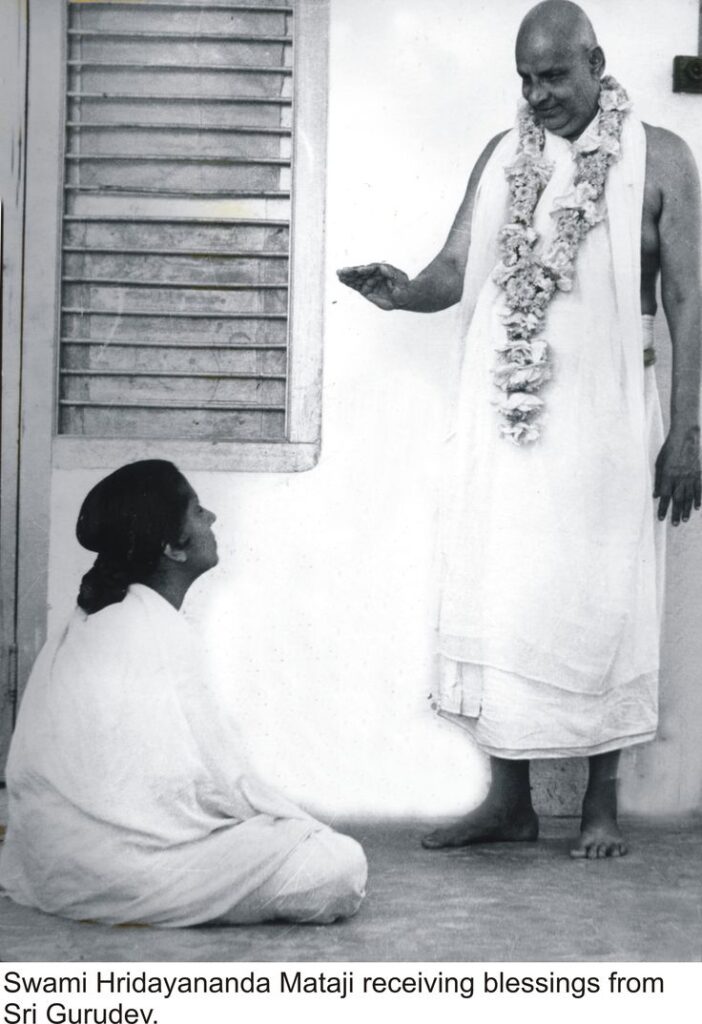
Swami Sivananda-Hridayananda Born on the 18th of April 1914, in an orthodox and pious family of Perur, in Travancore (Kerala) State, she was known as Chellamma. She passed her Senior Cambridge examination privately and then had her Inter and M.B., B.S., combined course of 7 years at the Lady Hardinge College, Delhi. She was one of the brightest students and had won many prizes and medals. In 1942 she was appointed as Asst. Surgeon in the Govt. Opthalmic Hospital, Madras. Being very efficient, she got quick promotions and became the Civil Surgeon at the same hospital. In 1951 she resigned her job and took to private practice. She happened to buy a second-hand book of Swami Sivananda at the Moore Market, Madras, and when she saw the photo of the Swami in the book, she instantaneously felt that she had known him, intimately. That book possessed her and the same evening she had a vision of Swami Sivananda in her meditation, blessing her. Since then an inner transformation was taking place in her in spite of herself. In April 1955, she came on a short visit to Rishikesh, to have Darshan of Swami Sivananda. But Sivananda played the miracle. He asked her to do some service in the hospital and when the day of her return to Madras came she decided to stay on, for ever, at Rishikesh. On the holy Guru Purnima day in 1956, she was initiated into the sacred order of Sannyasa and given the name Swami Sivananda-Hridayananda. Swami Hridayananda being an eye specialist, Sri Gurudev asked her to start a regular Eye Hospital for the benefit of everyone, as the Sivananda Charitable Hospital that was serving the people then was not a systematic hospital. Simultaneously it so happened that one Capt. Srivatsava, who was also a great devotee of Sri Gurudev, became responsible for a substantial contribution by way of donation for the construction of an Eye Hospital, which became an added incentive to step up the work. Under the instruction of Sri Gurudev himself the work of building a regular Eye Hospital commenced and progressed by leaps and bounds. Swami Hridayananda became the Medical Officer of this service wing of the Ashram and within a few years she established such a name as an expert physician and surgeon that the reputation of the expert handling of cases in the hospital reached the ears of the officials of the Government in the State and the Centre, who were eager to assist our hospital by grants given by the Government. Swami Hridayananda was very personally associated with Sri Gurudev not only as a Medical Officer but as a personal assistant and personal physician. In addition to her medical career, she was also an ardent spiritual seeker who wrote articles, essays and even books on Sri Gurudev which was an expression of her aspiration and devotion to Sri Gurudev. She became very famous as a spiritual guide to many people and seekers who came to the Ashram and a very able physician and surgeon at the same time. This fame of Swami Hridayananda Mataji as a spiritual guide particularly brought her request from various parts of the country and even abroad. Invitations came from different places and one of them was from our revered Sri Swami Sahajanandaji Maharaj of Durban, South Africa, which invitation she accepted and went to South Africa. From South Africa she toured different parts of Europe and America, where she conducted extensive series of lectures and established certain centres for spiritual guidance. Finally she is now settled in Europe (France, Belgium and Holland), which is a delight and great satisfaction to seekers in those parts.

Swami Sivananda-Hridayananda Read Post »

jyotir
⁠Direct Disciples of Sri Swami Sivananda Maharaj, Swami Sivananda

His Holiness Sri Swami Jyotirmayananda Saraswati Maharaj

His Holiness Sri Swami Jyotirmayananda Saraswati Maharaj Swami Jyotirmayananda was born on the 3rd of February, 1931 in a pious family in the state of Bihar. From his very childhood days he showed signs of his future greatness. He was calm and reflective, brilliant in his studies, as also loved by his friends and relatives. While he was studying in the Science College of Patna, when he was 18 years of age, he had read Swami Sivananda’s book “Mind, Its Mysteries and Control.” This had captured him and When Swami Sivananda visited Patna during his All-India tour in September, 1950, he had Swamiji’s first Darshan at Patna. Then on his mind was drawn towards his Master more and more. Finally in 1952 he came to Rishikesh on a short visit, but stayed on permanently. Gurudev found that he is a good speaker and entrusted him with the work of conducting classes. He also held regular discourses, very frequently, during the evening Satsangas in the Ashram in the very presence of Sri Gurudev. After being granted Sannyasa by Sri Gurudev on the 3rd of February, 1954, he took to literary side of work more intensely and became the editor of the Hindi journal of the Society known as ‘Yoga-Vedanta’. This work he did exquisitely, in addition to conducting daily classes on scriptures such as the Yoga-Vasishtha in the Ashram’s Bhajan Hall, which many visitors attended with great love and concentration and interest. His exemplary life, great command of spiritual knowledge, love towards all beings, and his very impressive and dynamic exposition of Yoga and Vedanta Philosophy attracted enormous interest all over India, and in different countries of the world. He frequently lectured by invitation at All India Vedanta Conferences in Delhi, Amritsar, Ludhiana and other parts of India. Thus he continued the work of editing the ‘Yoga-Vedanta’ journal and conducting the scriptural classes until 1962, when on an invitation from a well-wisher of him he travelled to the West. Crossing Europe, he stayed for several years in Puerto Rico and in 1969 he shifted his centre to Miami in the United States where he has established a Publishing Centre and a systematically working Yoga Research Foundation, he himself being a very good writer and speaker.

His Holiness Sri Swami Jyotirmayananda Saraswati Maharaj Read Post »

images 2026 02 24T095109.813
⁠Direct Disciples of Sri Swami Sivananda Maharaj, Swami Sivananda

His Holiness Sri Swami Satchidananda Saraswati Maharaj

His Holiness Sri Swami Satchidananda Saraswati Maharaj Ramaswamy, as he was named by his parents, was born on the 22nd December, 1914, as the second son of a very devout couple Sri Kalyanasundaram and Smt. Velammai, at Chettipalayam, Tamilnadu. After pursuing a highly successful business career, he gave up worldly life on the death of his wife. He visited many sacred places of pilgrimage, stayed in Ashrams with holy saints like Sadhu Swamigal, Sri Aurobindo, Swami Chidbhavananda and Sri Ramana Maharshi, and finally arrived at Rishikesh in 1949 and met Swami Sivanandaji Maharaj upon which he felt he has reached his final destination and his Guru. He was initiated into the holy order of Sannyasa by Swami Sivananda giving him the monastic name of Swami Satchidananda, on the 10th of July, 1949. In February, 1951, Sri Gurudev asked him to undertake an All-India Tour, during which he gave lectures, taught Yoga Asanas and organised Branches of the Divine Life Society. Knowing his ability in the work of management and also proficiency especially in Hatha Yoga, Swami Satchidananda was asked by Sri Gurudev to go to Ceylon, now known as Sri Lanka, to build up a centre of the Divine Life Society, in response to an ardent request by a lady called Swamy Satchidananda Mata. She was a very devoted lady and considered Gurudev as God himself. But she had not the ability to maintain the Centre being a lady herself and not very much acquainted with the knowledge of the Sastras, much less of Yoga. So Swami Satchidananda’s going there was a God-sent, and he actually fulfilled this pious wish of Sri Gurudev. Having seen that the Centres in Sri Lanka are raised to the status expected by Sri Gurudev, he moved further to the West until he established himself in the United States of America where he has his Yoga capital in Buckingham, Virginia. This Swami has also veritably worked a miracle in the West, and in one of the movies that he has produced he has portrayed the difficulties which he had to face in doing any good at all to people there as also the achievements which were to his credit by the grace of Sri Gurudev; because materialism, atheism and total non-acquaintance with the higher values of life etc., etc., were some of the negative sides which he had to face in Western youth especially, all which he handled very dexterously with his calm, quiet and poised nature, speaking slowly, powerfully, cogently and touchingly whatever be the disciples, students and enquirers that came to him for guidance. Today he has a vast Ashram with a land extended to some hundreds of acres where he has recently built a temple of all faiths, called the LOTUS (Light of Truth Universal Shrine), which is the work of several years of many people’s cooperation and thinking under his guidance. The construction of this was completed recently and inauguration of it was done in July 1986 in a most grand manner attended by many dignitaries both in the West as well as in the East. Swami Satchidananda is also a staunch devotee of Sri Gurudev though he stands by himself, on his own legs, in reputation as well as material security. He is one of the stalwarts who succeeded to the point of perfection in carrying the message of Sri Gurudev, in the West.

His Holiness Sri Swami Satchidananda Saraswati Maharaj Read Post »

Swami Sivananda Indian yoga guru and saint picture
⁠Direct Disciples of Sri Swami Sivananda Maharaj, Swami Sivananda

His Holiness Sri Swami Satyananda Saraswati Maharaj

His Holiness Sri Swami Satyananda Saraswati Maharaj Swami Satyananda was a teenager, a little boy, when he came to the Ashram, but very active and proficient in Hatha Yoga right from the beginning. Many were the departments of the Ashram in which he rendered service, particularly during the later days in the Hindi department of the Ashram. He edited the Hindi journal and wrote articles and was proficient even in composing poems in Hindi and Sanskrit, language; very active and tireless in his service. One of the great contributions of his, which is to be remembered for all times, is the hard work that he did in bringing about a translation and commentary in the English language of the Brihadaranyaka Upanishad by Sri Gurudev. He was actively connected with this work and, but for his struggle day and night in seeing to it that the manuscript was made ready, the book would not have actually come out. He was solely responsible, one may say, for the coming out of this book–the commentary on the Brihadaranyaka Upanishad of Sri Gurudev. Later on, he left the Ashram on an inner feeling of establishing himself separately in a secluded place and he found himself somehow landed in Bihar, a place called Monghyr, where devotees somehow recognised some value and worth and intrinsic merit in him, collaborated with him and the result was a very magnificent well-planned Institution of Yoga teaching, which became the venue for imparting instructions not only to hundreds of seekers in India, but also countless seekers came from the West, many of whom took Sannyasa, under Swami Satyananda. He did such active and intensive work in the field of Yoga that his name is known in many places even in the West as a very competent and effective teacher of Yoga and the way of spiritual life. Now he is retired and has handed over the active work of his Ashram to an assistant of his.

His Holiness Sri Swami Satyananda Saraswati Maharaj Read Post »

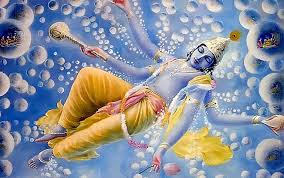
Lord Vishnu floating in cosmic ocean with divine aura image
Swami Sivananda, The Ultimate Goal of Mankind - Self Realization

Creation

Creation By Sri Swami Sivananda The universe is a mystery. No one can say how it came to be. You will find in the Rig-Veda: “Who knows here, who can here state whence came all this multifarious universe? Even the Devas are posterior to its creation; who then knows whence this came out?”. Some hold that the universe was created out of nothing by a fiat of God and that it will again lapse into nothing at the period of deluge. This dogma of creation ex nihilo is not endorsed by scientists. They say emphatically that what exists now should have existed always and will continue to exist always in some form or the other. In Sankhya philosophy also you will find: “That which is cannot come out of that which is not”. The Gita also states: “There can be no existence out of non-existence, nor can the existent cease to be. The truth about both has been perceived by seers”. Something cannot come out of nothing. Something can come out of something only. The grass comes out of the earth and is absorbed into the earth. Even so, this universe comes out of Brahman, rests in Brahman, and dissolves in Brahman. The Cause of This Universe In the beginning, Brahman who is one without a second, alone exists. When darkness was rolling over darkness, there was existence alone. In Brahman, there was a Spandana or vibration before the world was projected. This is the Sankalpa of Brahman. He thought or willed: “Ekoham Bahu Syam: I am one; may I become many”. This vibration corresponds to the bulging of the seed within the ground when it is soaked with water. Then the whole world was projected. When an ordinary, meagre juggler can bring forth mangoes, fruits, money, sweetmeats, an imaginary palace, etc., through Indrajala or Sammohana-vidya, can He–the omnipotent, omniscient Ruler–not create this insignificant world for His own play? When a mortal king adorns his palace with furniture, pictures, curios, garden, fountain, etc., can He not furnish this world with beautiful landscape, brilliant sun, moon and stars, mighty rivers and oceans? Nature of the Creative Process This visible world is God’s jugglery. This world is not chaos. It is an organised, divine institution. The world is a shadow of God. Brahman creates this unthinkable universe through His illusive power of Maya for His own Lila or sporting. The phenomenon of this universe is due to the power called Maya, by which the Absolute, without undergoing any change in or by Itself, appears as an ever-changing succession of phenomena conditioned by time and space. Brahman has projected this universe without being affected in any way. The Absolute is not affected by the world-process that is going on within It, just as the rains from a cloud do not wet the sky. The one Brahman, through His Sakti, can put on all these countless names and forms and appear as many. There is no change in Himself. The world is mere appearance. Brahman does not require any instruments or hands for making these forms. He is Chaitanya, self-luminous intelligence. By mere willing, He can bring forth countless worlds. Just as the potentiality of a seed brings forth a tree, so also, the Svabhava or potentiality of Brahman brings forth this universe. Projection co-exists with existence. God and the Universe This whole universe is the body of God. This entire world is God or Virat-Svarupa. This world is not a world of dead matter, but a living Presence. Brahman or the Absolute manifests Itself as the universe through forms. Creation is a joyous self-expression of the One. A king played the part of a beggar for his own sporting. A sage played the part of a fool for his own sporting. Even so, this world is a sport or Lila of Brahman. Brahman appears as the world. It is Brahman alone that shines as the world of variegated objects. Brahman Himself appears as stone, tree, stars, etc. The One Consciousness alone appears as the universe of plurality. Just as one man alone becomes many in dream, so also the one God exists as many. The whole universe is Brahman only in essence. All this is Brahman only, appearing in Brahman and through Brahman. Earth, food, fire and sun are forms of Brahman. East, west, north and south are parts of the Lord. The sky, heaven, ocean are portions of Brahman. Breath is a part of Brahman. Sight is a part of Brahman. Hearing is a part of Brahman. Mind is a part of Brahman. This life is Brahman. Brahman or Truth is the essence in which the universe has its being, from which it is born, and in which it dissolves at the end of each world-cycle. An effect does not exist apart from its cause. A pot does not exist apart from clay. This universe does not exist apart from Brahman. It has no independent existence. It is one with Brahman. If you have a candle light, and from it you light a thousand other candles, is not the first light in all the other candles? So it is with God. Creating all things, He is in all by spirit, breath and being. The world is charged with the splendour, glory and grandeur of God. Just as sugar-cane juice pervades the sugar-cane, just as salt pervades the water when a lump of salt is dissolved in it, just as butter pervades milk, so also, Brahman pervades all the objects, animate or inanimate. Brahman is one. Manifestation is many. One has become many. As from a blazing fire, sparks all similar to one another, come forth in thousands, so also, from the one imperishable Brahman proceed all breathing animals, all worlds, all the gods, and all beings. Evolution of the Elements By dint of His will, the Lord, the undecaying substratum or reality of the universe, gave the first impetus to Nature to shake off her state of primal equipoise and to be gradually and

Creation Read Post »

image 30
Uncategorized

Caste Problem in India

Caste Problem in India “I have a message for the world, which I will deliver without fear and care for the future. To the reformers I will point out that I am a greater reformer than any one of them. They want to reform only little bits. I want root-and-branch reform.” – Swami Vivekananda CASTE IN SOCIETY AND NOT IN RELIGION Though our castes and our institutions are apparently linked with our religion, they are not so. These institutions have been necessary to protect us as a nation, and when this necessity for self-preservation will no more exist, they will die a natural death. In religion there is no caste. A man from the highest caste and a man from the lowest may become a monk in India and the two castes become equal. The caste system is opposed to the religion of Vedanta. Caste is a social custom, and all our great preachers have tried to break it down. From Buddhism downwards, every sect has preached against caste, and every time it has only riveted the chains. Beginning from Buddha to Rammohan Ray, everyone made the mistake of holding caste to be a religious institution and tried to pull down religion and caste altogether, and failed. In spite of all the ravings of the priests, caste is simply a crystallized social institution, which after doing its service is now filling the atmosphere of India with its stench, and it can only be removed by giving back to people their lost social individuality. Caste is simply the outgrowth of the political institutions of India; it is a hereditary trade guild. Trade competition with Europe has broken caste more than any teaching. THE UNDERLYING IDEA OF THE CASTE SYSTEM The older I grow, the better I seem to think of caste and such other time-honored institutions of India. There was a time when I used to think that many of them were useless and worthless, but the older I grow, the more I seem to feel a difference in cursing any one of them, for each one of them is the embodiment of the experience of centuries. A child of but yesterday, destined to die the day after tomorrow, comes to me and asks me to change all my plans and if I hear the advice of that baby and change all my surroundings according to his ideas I myself should be a fool, and no one else. Much of the advice that is coming to us from different countries is similar to this. Tell these wiseacres, “I will hear you when you have made a stable society yourselves. You cannot hold on to one idea for two days, you quarrel and fail; you are born like moths in the spring and die like them in five minutes. You come up like bubbles and burst like bubbles too. First form a stable society like ours. First make laws and institutions that remains undiminished in their power through scores of centuries. Then will be the time to talk on the subject with you, but till then, my friend, you are only a giddy child.” Caste is a very good thing. Caste is the plan we want to follow. What caste really is, not one in a million understands. There is no country in the world without caste. Caste is based throughout on that principle. The plan in India is to make everybody Brahmana, the Brahmana being the ideal of humanity. If you read the history of India you will find that attempts have always been made to raise the lower classes. Many are the classes that have been raised. Many more will follow till the whole will become Brahmana. That is the plan. Our ideal is the Brahmana of spiritual culture and renunciation. By the Brahmana ideal what do I mean? I mean the ideal Brahmana-ness in which worldliness is altogether absent and true wisdom is abundantly present. That is the ideal of the Hindu race. Have you not heard how it is declared he, the Brahmana, is not amenable to law, that he has no law, that he is not governed by kings, and that his body cannot be hurt? That is perfectly true. Do not understand it in the light thrown upon it by interested and ignorant fools, but understand it in the light of the true and original Vedantic conception.. If the Brahmana is he who has killed all selfishness and who lives to acquire and propagate wisdom and the power of love – if a country is altogether inhabited by such Brahmanas, by men and women who are spiritual and moral and good, is it strange to think of that country as being above and beyond all law? What police, what Military are necessary to govern them? Why should any one govern them at all? Why should they live under a government? They are good and noble, and they are the men of God; these are our ideal Brahmanas, and we read that in the SatyaYuga there was only one caste, and that was the Brahmana. We read in the Mahabharata that the whole world was in the beginning peopled with Brahmanas, and that as they began to degenerate they became divided into different castes, and that when the cycle turns round they will all go back to that Brahmanical origin. The son of a Brahmana is not necessarily always a Brahmana; though there is every possibility of his being one, he may not become so. The Brahmana caste and the Brahmana quality are two distinct things. As there are sattva, rajas and tamas – one or other of these gunas more or less – in every man, so the qualities which make a Brahmana, Kshatriya, Vaishya or a Shudra are inherent in every man, more or less. But at time one or other of these qualities predominates in him in varying degrees and is manifested accordingly. Take a man in his different pursuits, for example : when he is engaged

Caste Problem in India Read Post »