














Hari Om

Menu

2025

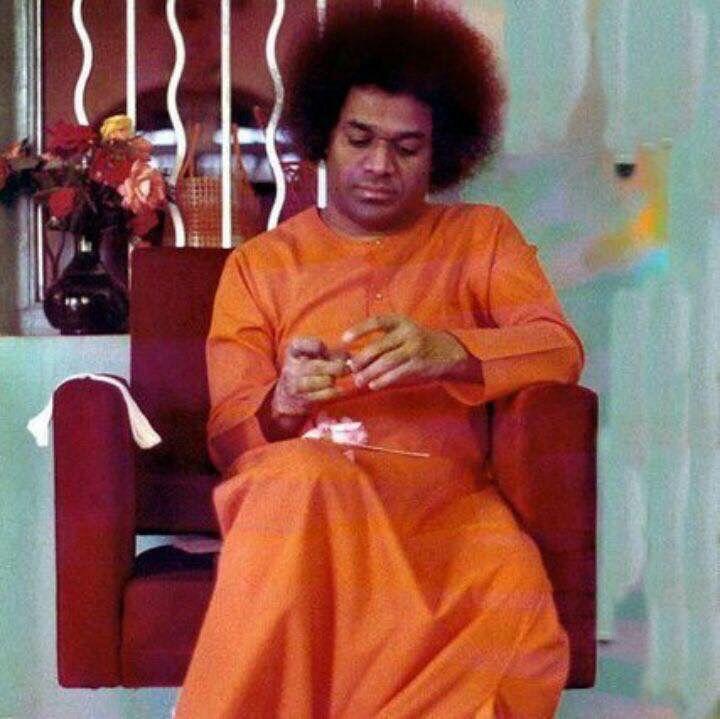
Shri Sathya Sai Baba Meditation Spiritual Portrait Picture
Miracles

Message from Yore

Message from Yore His Student When I first joined Sri Sathya Sai College, Brindavan in 1978 I was full of wonder at the new spiritual experience that I was going through amidst the sylvan surroundings and the Divine Presence. Being a new devotee I felt like a sponge soaking up every tiny detail about Sweet Sai’s Leelas and Mahimas. Every story about how Swami’s Love and Grace that had intimately touched the lives of devotees near and far fascinated me as it did all the other students studying with me. We frequently heard these Sai experiences during evening bhajans at the Hostel, the morning assembly at the College or during the room meetings just before lights out. During a particular Thursday morning assembly, our (late) Principal Narendra read out a fascinating article that he received from UK which made a deep impression on my mind. It was a unique story of how our Dear Lord touches not just the lives of human beings on earth but also those beings on other planes of existence. I take this opportunity to share that article with all who love Sweet Sai. Mrs. Betty Gisner of California is a healer and an automatic writing medium of the highest integrity. Her husband is a professor of Psychology, now devoting his time to regressed hypnosis healing many sufferers. While staying at the Seeker’s Trust, Addington Park, Trent, England, she went into one of the meditation chapels there with a pad and pen hoping to come in contact with her healing helpers, and was very surprised when she found what she had written. She had not asked any question about Sri Sathya Sai Baba, though she and her husband were planning to go to India. The communicator gives the name as AMKSORE and that he was a server (monk) at Glastonbury long ago and was later with St Francis of Assisi. He signed his communication with a capital ‘A’ interspersed with a cross. This is the communication. “On the question of the divinity of Baba, we would comment. This being of light is ineffaceable in his radiance which suffuses and envelopes all those who are fortunate enough to come within his radiance. He is truly a Divine Being. We would have you realize that those who are on our planet of living are very far from perfection of one such as this ‘Holy Man’ among men, the Healer of those who desperately need His help. We are nothing when compared with this Flame of Truth. We bow in adoration at the feet of this Divine Being. We feel love, the all encompassing love, which he inherently has at the core of His very Being, the love that sustains, the love that comforts, the love that encourages and envelopes those who travel from far places to be in His Presence. We rarely wish to be incarnated in flesh once again, but to experience the glory of His Presence we would be willing to don once again the cloak of your human condition. As we see the ever-increasing numbers of devotees that now come to Prasanthinilayam we cannot help noticing that what used to be a ‘festival crowd’ in the 70’s and 80’s is now a ‘daily darshan crowd’. When we are part of this multitude of devotees it is such a humbling experience to realize that we are merely a speck of sand on this beach. And we have yet not included the millions of souls on other planes of existence that grace Prasanthinilayam with their invisible presence. It is again Sweet Sai’s grace that He let us all have a peek through this article at His power and Glory which is beyond our human comprehension.

Message from Yore Read Post »

Shri Sathya Sai Baba Floral Garland Blessing Image
human values

The Message i bring

The Message i bring The Message I Bring – Milestone Speech This has been called the “milestone” discourse. However, it is believed to be not a real discourse by Sri Sathya Sai Baba but a series of sentences crafted from previous discourses by N. Kasturi. This speech does not appear in the Sathya Sai Speaks series, and no old-timer at Prasanthi NIlaym remembers it. This article indicates where each sentence came from. This video was developed by the late Richard Bock in 1968-69. Kasturi reads this “discourse” while we see darshan scenes. The speech also appeared on a long-playing (33RPM) record and appears in Sam Sandweiss’s book The Holy Man and The Psychiatrist. Audio (Kasturi reciting the “discourse”): mp3 file (22MB)   mp3 file (2.2MB)

The Message i bring Read Post »

Shri Sathya Sai Baba sacred bhajan session photo
Miracles

Sun Darshan

Sun Darshan We all proclaim that Swami is God, that He is Omnipresent etc. Yet, in practical terms, we scarcely appreciate this Omnipresence in the real sense of the word. This is a topic on which we have commented many times but for the present we wish to present the story of a manifestation of Swami in far off Central America, reported for us by John Behner of El Salvador. Some of you may have heard an interview with him which we have broadcast over Radio Sai. Occasions are many when devotees are transported with joy when Swami reveals Himself in subtle manner – like a flower falling from His picture, for example. John’s account describes a more spectacular manifestation. We present below the report that he sent to us. In the Gita, the Lord is described as brighter than a thousand Suns. But the Lord is also the Sun. But because we fail to see the Lord in the Sun that daily shines for us with so much consideration, Swami revealed Himself via the Sun in a most unusual manner on two distinct occasions. Some may recall an account by Hislop of another such manifestation via an unusual natural phenomenon. Hard-boiled sceptics would dismiss all explanations based on the manifestation of the Divine. OK, but why did this happen just when the Sai devotees were about to commence a major function? “Oh, that’s a mere coincidence!” You know what Swami says about coincidence? He says: “Coincidence is a miracle where I hide Myself!” So there it is! For the non-believers He is simply not there. The doubting Thomases are left wondering: “Did Swami really appear or was it a mere coincidence?” On the other hand those of firm faith rejoice saying, “Our beloved Swami came here to tell us that He is blessing what we are doing!” The stage for the Public Meeting in Mexico city in 1991 A close up of the stage and the panel of speakers in the Mexico meeting The group of Sai Sevaks doing volunteer duty outside the theatre

Sun Darshan Read Post »

10 akhand bhajan la usa
human values

Glorify the Name of the Lord – By Bhagavan Sri Sathya Sai Baba

Glorify the Name of the Lord EMBODIMENTS of Love! Only when we realise the preciousness of the diamond will we take care to safeguard it. Likewise only when we are aware of the value of chanting the Lord’s name will we make the effort to practise it and benefit from it. Devotees recite or sing the names of the Lord in two ways. One is Keerthanam and the other is Sankeerthanam. Keerthanam is done individually and benefits only the devotee concerned.’ Sankeerthanam is done collectively for the good of the world as a whole. Keerthanam is of various kinds. First is Guna Keerthana – praising the qualities and attributes of God through song. Second is Bhava Keerthana – expressing the inner feelings and emotions of the devotee. Reflecting the feelings of peace, companionship, yearning, filial love or sweetness experienced by the devotee, these songs give vent to the emotional outpouring of the devotee. The third is Leela Sankeerthanam – praising in song the sports and divine play of the Lord. This is done through singing the Ashtapadi (of Jayadeva) or describing the sports and miraculous deeds of the Lord. The rasa krida is also in this category. The fourth is Nama Sankeerthanam – singing the names of the Lord. This is the most efficacious of all forms of devotional singing. But in actual practice the devotees derive joy from singing all types of devotional songs. Special Significance Of Nama Sankeerthana What is the special significance of Nama Sankeethana – singing the names of the Lord? “Nama” is made up of three letters: “Na” “a”, “ma”. All music is based on the seven swaras – the seven notes. According to the science of numerology the letters “Na”, “a” and “Ma” have the numerical values: 0, 2 and 5 making up seven in all. The seven notes are Sa, ri, ga, ma, pa, da, ni. The Gopikas made use of these seven notes to combine music, rhythm and devotion in the Rasa Krida dance with Krishna. In this group dance, the Gopikas were so completely lost in devotion and song that they experienced oneness with the Divine. In this way, Sankeerthan (community singing) in praise of Krishna became popular and helped to develop devotion and promote collective prayers for the welfare of the world. Similarly community singing in the name of Rama also came into vogue. Numerologically, the letters in the name of Rama (Ra+a+ma) add up to seven. Besides the seven notes, the mystic number seven is associated with many sacred things like the seven islands, the seven oceans, the seven sages and so on. In accordance with this concept, seven-day festivals and yajnas are held. Threefold Purity Essential Not all realise the potency and efficacy of reciting the Lord’s name. The first requisite is purity of thought, word and deed. The name that is uttered by the tongue should be meditated upon by the mind. What is uttered and dwelt upon should be hailed by clapping the hands. This threefold concentration on the Divine name – unity of mind, speech and action – purifies the heart and nourishes the feeling of devotion. Better than recounting the qualities of the Lord, singing His glories or relating His exploits and teachings, the chanting of the name is supremely edifying. If merely the Lord is described as Dayamaya (the embodiment of kindness) there may be many who qualify for that description. If the term “Leelamanusha vigrahudu” (One who has assumed the human form as a sport) is used, it may apply to any number of persons. Guru Nanak was the initiator of the practice of community singing of devotional songs. He believed that through such community singing the common man can ennoble his life and experience the presence of the Divine in everyone. Through that experience, one can become a knower of the Brahman (jnani). Ratnakara, who led the life of a highway man, became the sage Valmiki after prolonged meditation on the name of Rama. He got the illumination out of which the Ramayana was born. Moses was another great figure of old times who achieved God Realisation by continuously dwelling on the name of God. Community Singing Of Bhajans When the chanting of the Name is done in community singing, it should be in a form in which the entire group can participate easily. The tune, the rhythm, etc. should be such that all can follow the bhajan. If the lead singer takes up a song that is not familiar to others, the response from the group will be poor. There will be no enthusiasm or genuine participation. Their minds, will be distracted. When all the devotees participate in the bhajan, the vibrations that are produced will generate joy and harmony. Many who organise mass singing on special occasions are not aware what kind of bhajans should be sung then. A person who has an individual style of his own may sing as he likes in private, but he is not suitable for community singing. There are some rules to be observed in conducting community bhajans. Alapana (elaboration of a raga) may be done in keerthana (individual singing), but it is wholly out of place in community bhajans. Hence, in such bhajans the accent should be entirely on the Name. Today we are having the Akhanda Bhajan (nonstop twenty-four-hour global bhajan by Sai devotees all over the world). This is being done not for the sake of one individual, one nation or one community. It is for the welfare of humanity as a whole. The bhajans that are sung permeate the ether in the form of sound waves and fill the entire atmosphere. Thereby the whole environment gets purified. Breathing in this purified atmosphere, our hearts get purified. Reciting the Lord’s name is a process of give and take. Singing the Lord’s name should become an exercise in mutual sharing of joy and holiness. It should be remembered that the sounds we produce reverberate in the atmosphere. They remain permanently in the ether as waves and outlast the individual uttering the sounds. Today the atmosphere is polluted by unholy and vicious sounds. This results in the growth of evil thoughts and feelings, which lead to evil deeds. If the atmosphere has

Glorify the Name of the Lord – By Bhagavan Sri Sathya Sai Baba Read Post »

Two individuals in vibrant clothing.
Miracles

A Dreamy New Beginning in New Zealand

A Dreamy New Beginning in New Zealand the love of Sai comes to the refuge of the Bhutanese refugees No one wanted them, neither the country of their origin nor the land to which they had given their sweat and blood for years. More than a lakh of such Bhutanese refugees have lived a miserable existence in the north-east of Nepal for nearly two decades now. But now, when there was an opportunity to end this desperate situation of at least a few of them, the Sai devotees in New Zealand grabbed this opportunity and opened their hearts out to embrace them in the love of Sai. This is one heart warming account which demonstrates how through little kinds of kindness and genuine love we can make profound and powerful impact in the lives of our brethren, no matter who they are or where they come from. It is a country which is often referred to as one which is “scarcely touched by the modern age.” Progress, in this nation, is not measured by Gross National Product, but by Gross National Happiness. The people of this land take great measures to preserve their old culture, rich traditions, and more importantly, their literally ‘top of the world’ natural environment. Yes, this tiny landlocked nation is perched right on the roof of the world. Nestled in the eastern Himalayas, Bhutan is one of those rare countries of this world where people live in great harmony with nature and where the environment is still pristine even today. In fact, the country has been identified as one of the 10 bio-diversity hot-spots in this world. But what is more interesting is the fact that it was rated as the happiest country in Asia by Business Week in 2006. Yes, the majority of Bhutanese are pleased and proud of their country, and the way their land is governed, even though only in the previous year, in 2008, this nation moved from absolute monarchy to constitutional monarchy. But, at the same time, this is not the story of every Bhutanese. At least one-sixth of the population of this mountainous nation lead a precarious existence in refugee camps, all from the ethnic Nepalese group. A large number of them are actually descendants of Nepali settlers (Nepal is a neighbouring country) who came to work in the southern valleys of Bhutan in the late 19th and early 20th century. They are referred to as Lhotshampas (literally translated as “people from the south”), and in many ways are different from the indigenous population. They speak Nepali, while Dzongkha is the country’s national language; most Nepalese are Hindus, while Buddhism is the state religion, which is followed by two-thirds of its population. But at the same time, they constitute almost 35% of the population of Bhutan and for generations had a ‘perfect life’ in this peaceful kingdom working as farmers. In fact, the government encouraged the integration of this significant group into mainstream Bhutanese society in many ways, from teaching in Nepali in the schools of the southern Bhutan, to inter-ethnic group marriages. But after 1980, the attitude of the Bhutan rulers changed for various reasons and the government started a series of “ethno-nationalist” policies in the 1990s. Since then hundreds of thousands of Nepalese-Bhutanese have become stateless and have been living in seven refugee camps in South-eastern Nepal. But after 1980, the attitude of the Bhutan rulers changed for various reasons and the government started a series of “ethno-nationalist” policies in the 1990s. Since then hundreds of thousands of Nepalese-Bhutanese have become stateless and have been living in seven refugee camps in South-eastern Nepal. The United Nations Commission for Refugees stepped in to help these homeless people and began discussions with the Bhutanese and Nepalese governments to provide the exiled people a home in either country, but met with little success. However, in 2006, the US government generously offered to resettle more than 60,000 of these refugees over the next five years.

A Dreamy New Beginning in New Zealand Read Post »

Shri Sathya Sai Baba Folded Hands Greeting Image
human values

Love Divine

Love Divine If one word could sum up the essence of Sri Sathya Sai Baba’s life and teachings, that word would be “love”. Sri Sathya Sai Baba’s life, His message, His ideals and His humanitarian works can all be enshrined in one word—Love. His life is His message and His message is love. He is truly the incarnation of love—Love walking on two legs. He says, “God is love; live in love,” and exhorts us to “Start the day with love; fill the day with love; spend the day with love; end the day with love—this is the way to God.” Just as the moon can be seen only by moonlight and not with the help of a candle, God who is the embodiment of love, can be experienced only through love. “But this love,” Baba says, “is unconditional, pure, selfless love which is directed towards God with one-pointedness.” Lord Jesus Christ, when asked what is the greatest commandment, said, “The greatest and the first commandment is love thy God with all thy heart, mind, soul and strength; and love thy neighbour as thyself.” The great apostle St. Paul, in his letter to the Corinthians says, “Faith, hope and love abide, but the greatest of these is love.” Swami says, “Love is the source; love is the path; and love is the goal.” So, when we live our lives saturated with love, our lives get sanctified. Sri Sathya Sai Baba says, “The greatest examples of pure, pristine love are the gopis (cowherd girls of Brindavan) of yore.” There are some other examples of pure, unconditional, Divine Love in this compendium. If one could master this single Divine Principle, the other four human values—Truth, Peace, Righteousness and Non-violence—would also, automatically be mastered. Perfect mastery of love amounts to nothing less than Self-realisation. This study guide is a compendium of quotes from the following works of Sri Sathya Sai Baba: Sri Sathya Sai Speaks, Vahinis, Summer Showers. The editors have attempted to remain faithful to the presentation of the quotes as they occur in the online editions of the works from which they come, with the following exceptions: 1) correction of typos; 2) correction of grammar and syntax; 3) changes that incorporate gender-inclusive language; 4) standardisation of the transliteration of Sanskrit; and 5) minor changes to facilitate readability and coherence in the context of the study guide.

Love Divine Read Post »

Sathya Sai Baba divine inspiration
human values

Selfless Love

Selfless Love “The act of service is not to be judged, according to the cost or publicity it entails; it may be only the offering of a cup of water in the depth of a jungle. But the need of the recipient, the mood of the person who offers—these decide whether the act is gold or lead. Fill every act of yours with love. Let no one suffer the slightest pain as a result of your thought, word or deed. Let this be your sādhanā (spiritual discipline). It will surely help you to achieve the goal.” – Sri Sathya Sai Baba. Selfless service is perhaps the single, most efficient and universal tool for understanding, experiencing and expressing this Divine Principle of Love. Service is love in action. Sri Sathya Sai Baba says that the best way to love God is to love all; serve all. The main purpose of the Sri Sathya Sai Organisation is to help one realise one’s innate Divinity by the practice of Divine Love through selfless service. Baba has also made it clear that the quality of service is most important, not the quantity. The spirit or the motive behind service is the deciding factor. When we render service, we should feel that we are serving God. This is why He says, “Service to man is service to God”. Service done in this manner makes us realise that “service is done by God, to God, and for God”. The person who is serving, the recipient of the service and the process of serving are all one—and are all divine. Just as the proof of rain is in the wetness of the ground, pure, self- less, loving service transforms and we enjoy supreme peace and equanimity – the “peace that passeth understanding”. Sri Sathya Sai Baba cautions us about major obstacles that stand in the way of selfless service: ego and attachment; and the feeling of doer-ship and enjoyer-ship. A true Sri Sathya Sai volunteer strives to overcome these obstacles through selfless service. Service done in a pure, selfless manner then becomes yoga—leading to union with God. Baba says that when we realise “service to man is service to God”, we also experience the ultimate truth – “God pervades everything”. This study guide is a compendium of quotes from the following works of Sri Sathya Sai Baba: Sri Sathya Sai Speaks, Vahinis, Summer Showers. The editors have attempted to remain faithful to the presentation of the quotes as they occur in the online editions of the works from which they come, with the following exceptions: 1) correction of typos; 2) correction of grammar and syntax; 3) changes that incorporate gender-inclusive language; 4) standardisation of the transliteration of Sanskrit; and 5) minor changes to facilitate readability and coherence in the context of the study guide. Since every quote occurs with a citation indicating its online source,

Selfless Love Read Post »

Bhagwan Shri Sathya Sai Baba sacred temple darshan picture
Miracles

Stirring Sai Seva In Malaysia

Stirring Sai Seva In Malaysia Two Inspiring Accounts Here are two accounts of seva carried out at mammoth gatherings of devotees at Lord Murugan’s shrines in Malaysia. It is heartwarming to learn how, in one instance, the Sai volunteers made every effort to help those unable to have Darshan, and in the other, break a Malaysian national record – read on to know more! ‘The spark of tears in their eyes gave me the happiness of a lifetime, not because I have achieved something great but to remind me to be more grateful to God for having an able body.’ This was the moving comment from a volunteer who had helped physically and/or mentally challenged pilgrims have Darshan of Lord Murugan during the festival of Thaipusam, at a hill top temple in Malaysia. Thaipusam is celebrated on the full moon in the Tamil month of Thai (Jan/Feb). Pusam refers to a star that is at its highest point during the festival. The festival commemorates both the birthday of Lord Murugan, the youngest son of Lord Shiva and Mother Parvati, and the occasion when Parvati gave Murugan a vel (lance) so he could vanquish the demon Soorapadam. In Malaysia, Thaipusam attracts mammoth numbers of devotees. Over 1,000,000 people congregate at Batu Caves, Kuala Lumpur and 200,000 at the Waterfall Temple, Penang . Heart2Heart is pleased to inform you about the wonderful seva carried out by the Malaysian Sai devotees at these two sites during the festival period from 10th-11th February, 2006 . The Waterfall Temple is located at the top of a steep hill. Many devotees make their way there to worship Lord Murugan and to climb up is part of the ritual and penance. But the Sai devotees of Brown Garden Centre, Penang, became concerned for those people who are unable to climb up due to physical disabilities. They are forced to remain frustrated at the bottom, while their relatives go up to the top to receive the blessings on this holy day. It was indeed a sight to pity. Emboldened by the teachings of Lord Sai to help those in need, they formed themselves into special palanquin teams to convey the yearning physically challenged pilgrims to have Darshan of Lord Murugan. This seva activity was aptly called ‘Journey to God’ and it became so for both the sevaks and the disabled people. The palanquins were handmade by the Sai volunteers themselves and each was carried by 4 devotees with one man to oversee the safety of the disabled devotee and to make way through the crowds up the steps. Upon reaching the bottom of the hill the disabled pilgrims were given food by the lady volunteers. Then, to invoke Swami’s blessings before commencing the climb the volunteers chanted Ganapati Prarthana, Ganapati Atharva Shirsha Upanishad, Narayana Upanishad, Sai Gayatri and performed Arthi to Swami’s picture. Then, they began the ascent and reached the temple after one hour.

Stirring Sai Seva In Malaysia Read Post »

Shri Sathya Sai Baba peaceful presence
human values

The Sadhana of Love

The Sadhana of Love The Sadhana of Love programme has been developed for Sathya Sai adults, young adults, and children to support the realisation of our inherent divinity – our true nature as pure love. The Young Adults 2020 Sathya Sai Sadhana of Love Programme is here There are four key principles needed on our journey to achieving this: Self-confidence, Self-satisfaction, self-sacrifice and Self-realisation. Within the Sadhana of Love – Choose Your Sadhanas, each step includes Swami’s definition of that step and 18 supporting sadhanas (spiritual practices) with explanatory quotes from His teachings. Guidelines With love as the focus, you are encouraged to listen to your conscience and choose sadhanas that you feel will manifest the most love and lead to the realisation that the same divinity dwells in all as love. Once your selected sadhanas are well established in your daily life, you can make further selections to help expand your love. In addition to these personal sadhanas, groups can choose group-based sadhanas to practise. Leaders are encouraged to discuss options with adults, young adults, young adult advisors, children, SSE teachers, and centre and regional presidents. Devotees may determine their own ways of promoting the understanding and practice of the Sadhana of Love. Devotees can identify tools and techniques to implement, monitor and discuss the benefits of practising their sadhanas. Methods proven to be successful in the past include: The sharing of successful practices and positive outcomes is encouraged. Start your Sadhana of Love journey now.

The Sadhana of Love Read Post »

shri sathya sai baba
human values

Love My Uncertainty Bhagavan Sri Sathya Sai Baba

Love My Uncertainty Bhagavan Sri Sathya Sai Baba It is my perception—drawn from listening to many individuals relate their personal histories—that insecurity is the most common underlying cause for the majority of the problems from which we suffer. So we need to find a remedy for this condition if we hope to be able to make practical spirituality our way of life. Such widespread insecurity is understandable when we consider the manifold symbols of hoped-for security that people strive to attain—none of which are lasting or can guarantee permanent security. The more people strive to attain some measure of the security they crave, the further it recedes, like a will-o’-the-wisp, forever beyond their reach. Different individuals express insecurity in various ways, according to their supposed needs. Some people think they will feel secure if they find the perfect partner, while others concentrate on securing a safe occupation, or a certain amount of money. Still others believe they can achieve their goal by attaining a degree from an accepted college, or through promotions to important and influential positions at work or in the community. So many people are desperately trying to find that magical and mystical state in which they will feel safe and secure. One’s heritage, education, and the opinions and values current in the world all point to specific panaceas for this chronic disease of insecurity. We are persuaded by the media that if we buy a particular product or attain a specific goal, we will feel satisfied and fulfilled. But the reverse is the inevitable result, and we are forced to look further and more feverishly for the illusive state of security. As this situation persists, more and more people exhibit signs of insecurity in their behavior, both consciously and unconsciously. This results from a desire to convince others, but primarily themselves, of their own value, ability, prowess, knowledge, importance, attractiveness, or any other proof of their superiority that they can accept as convincing. Often this attitude smacks of “protesting too much”; assuming a role of appearing utterly secure and sure of themselves, their attitude is actually but a mask concealing their self-doubt. Some people resort to the cruel habit of criticizing others, not only to boost their own importance, skill, brilliance, or other attribute in the eyes of others, but also to reassure themselves of their own superiority. Other people openly reveal their lack of confidence and self-esteem in bids for reassurance from others that they are worthy of approval, since they themselves have no confidence in their own value. Still others consort with people whom they consider to be important in some way, erroneously believing that this “importance” will reflect onto them, but this establishes only a temporary, borrowed sense of security. Such are the hangers-on who gather around famous people, hoping to ride to fame or fortune on another’s coattails. These are just a few of the many ways people fool themselves in efforts to overcome the gnawing feeling caused by insecurity. What Is Security? But what actually is security? Is it so important or worth all the effort expended to attain it? And why does worldy security always seem beyond our reach, despite every effort to achieve it? The answer lies in yet another question that Sri Sathya Sai Baba repeatedly urges us to ask ourselves: “Who am I?” He supplies the answer in many different ways, usually by showing us what we are not. When we have discarded at last all the things we are not, we can be free to discover who we are, for Baba assures us that we are all God. But this assertion is difficult for most people to believe, since they are accustomed to identifying themselves with their physical-body-mind-personality-ego complex, forgetting that this is merely an illusory container for the real Self. Insecurity is completely unnecessary; in fact, it is a futile waste of time and energy, simply because people have sought their security in the wrong direction—in the outer world instead of within themselves. If we expect security to be granted to us by attachment to anyone or anything outside ourselves, we are doomed to disappointment. Security can be found only when we identify ourselves with who we really are: the unseen Spark within the outer observable sheath in which we exist in the world, which is of equal value to the Spark in everyone else. So, where is the need for insecurity, if we are all equal in value? And why do we try to be “better” than anyone else? Our heritage and early conditioning are the cause of our mistaken identity and the resulting insecurity that it causes. We have been taught in each recurring birth into this world to identify ourselves with our physical bodies and its attendant thoughts, feelings, speech, acts, desires, and senses. We have all been taught untruths about our true identity, from the very beginning of our many sojourns on earth, resulting in the haunting sense of insecurity that we have suffered continuously. In each successive life we have continued to seek security, only to be left even more insecure by having failed to find it. Many people have been driven to depression, insanity, and even suicide by the failure of their search. And in each new age, the situation has worsened, as this pattern has become more deeply etched on the human psyche. The resulting dejection leads to even more control by the “monkey mind” in its search for security. Relying on the Inner Reality Now the time is approaching for a new and very different way of life to be ushered in, heralded in large part by Baba’s life and ministry. In the coming New Age, we shall all be taught who we really are, and our erstwhile hidden identity will be revealed to everyone, so we can learn to feel secure in the knowledge that we are all equal in our God-selves—none better or worse, wiser or more stupid, stronger or weaker, richer or poorer—but all one,

Love My Uncertainty Bhagavan Sri Sathya Sai Baba Read Post »