Hari Om

Menu

Uncategorized

Swami shivanand
Uncategorized

New Year Message

New Year Message By the command of the Indestructible Being, minutes, hours, days and nights, stand apart. By the command of the Immortal Brahman, months, years, seasons and solstices stand apart. He who knows this Indestructible Being is a liberated sage or Jivanmukta. Time rolls on. New becomes old and old becomes new again. Today is the most auspicious New Year’s day. God has given you another chance this year to enable you to strive for your salvation. Today man is. Tomorrow he is not. Therefore avail yourself of this golden opportunity, struggle hard and reach the goal of life. Make the best use of every moment of this New Year. Unfold all latent faculties. Here is a chance to begin life anew, to grow and evolve and become a superhuman or a great dynamic Yogi. On this glorious New Year’s day make a strong resolve to wipe away all the old worldly Vasanas or tendencies and bad impressions and to control the senses and the mind. Know the value of time. Time is most precious. Utilise every second profitably. Live every moment of your life for the realisation of your ideal and goal. Do not procrastinate. That “tomorrow” will never come. Now or never. Abandon idle gossiping. Kill egoism, laziness and inertia. Forget the past. A glorious and brilliant future is awaiting you. Equal vision is the touchstone of knowledge. Unselfishness is the touchstone of virtue. Brahmacharya is the touchstone of ethics. Oneness is the touchstone of Self-realisation. Humility is the touchstone of devotion. Therefore, be unselfish, humble and pure. Develop equal vision. Be in tune with the Infinite. Satyam (truth) is the seed. Ahimsa is the root. Meditation is the shower. Santi (peace) is the flower. Moksha (salvation) is the fruit. Therefore, speak the truth, practise Ahimsa and meditation. Cultivate Santi. You will attain the final emancipation or freedom from the trammels of births and deaths, and enjoy Eternal bliss. Be thou a spiritual warrior of Truth. Put on the armour of discrimination. Wear the shield of dispassion. Hold the flag of Dharma. Sing the song of Soham or Sivoham. March boldly with the band of Pranava–Om Om Om. Blow the conch of courage. Kill the enemies of doubt, ignorance, passion and egoism and enter the illimitable kingdom of blissful Brahman. Possess the imperishable wealth of Atma. Taste the divine immortal essence. Drink the nectar of Immortality. May this bright New Year’s day and all the succeeding days of this year and all the future years also bring you all success, peace, prosperity and happiness. May you all tread the path of Truth and righteousness! May you enjoy the eternal bliss of the Absolute, leading a divine life, singing Lord’s name, sharing what you have with others, serving the poor and the sick with Atma Bhava and melting the mind in silent meditation in the Supreme Self.

New Year Message Read Post »

images 2026 02 24T122613.133
⁠Rare Gems on Religion & Faith, Swami Sivananda, Uncategorized

Is Modern Science a Challenge to Religion?

Is Modern Science a Challenge to Religion? By SRI SWAMI KRISHNANANDA The subject that has been suggested is somewhat an involved one, and I do not know how far this would be a very appropriate theme to discuss before an audience of this kind who are basically devotees of God and aspirants of the spiritual ideal of life. However, all visions of life can be consolidated into a system of integrated organisation, and nothing conceivable can be regarded as extraneous to the methodology to be adopted in the pursuit of the spiritual ideal. “Is there a conflict between the scientific method and the religious aspiration of the soul?” is a moot question. Generally, when people speak of science, what the common populace understands is the comfort that has been provided by applied science, such as fast travelling, telephone, telegraph, Internet, satellite, and television. These are the things that are in the minds of people when they speak of the technological advance science has made; but science does not mean technology. It is a vision of life itself. What clashes or appears to come in conflict with religion is not the comfort that has been brought to us by these technological inventions of applied science, but the theory of science, which is something very deep, and bordering upon philosophical and metaphysical foundations of life itself. That the world is external to everyone is the basic foundation of all scientific perception. Observation and experiment being the methods of a scientific process, it goes without saying that what is observed and experimented upon has to be outside. The outsideness of the world is a very important aspect to be considered here, but we may put a question to our own selves: “Is the world really outside us, so that what happens in the world does not affect us in any way, and the world does not care for what is happening to us in our own internal operations? Are the individual and the world, the two principles of consideration here, segregated from each other? Has the world nothing to do with the individual, and has the individual nothing to do with the world?” It looks that there is no communication possible between the individual and the world. The world may not know at all that some individual is dead and gone, and the individual is not concerned in any manner if a star in heaven cools down and extinguishes itself. Let anything happen to the heavens; what does it matter to us? But, “Is it so?” is the question. This supposed conflict between physical science and religion may be said to have begun somewhere toward the end of the nineteenth century, when the geocentric interpretation of the heavenly bodies was replaced by the heliocentric concept on the discovery of Copernicus. This discovery clashed with the biblical belief and tradition, which holds that the earth is the foundation, and the sun and the moon and the stars move round this earth. The second thing that opposed religion as it was understood in those days was that the world was created, according to the biblical tradition, some four thousand years ago, but the scientific discovery declares that the beginning of the world must be traced back to aeons and aeons of time process earlier, and the earth is several millions of years old. This again was a challenge to the medieval concept of religion. But the third thing is most important. When Newton discovered the law of gravitation and concluded that everything that is happening in the physical world can be mathematically deduced by the logical process of conclusion drawn from premises, and the world which is physical in its nature is contained within the cup of space and time, and when his successor or follower Laplace wrote the five volumes on ‘Celestial Mechanics,’ the war between science and religion appeared to have commenced. We are told that the writings of Laplace were presented to Napoleon for his consideration. Napoleon seems to have declared, “Monsieur, I do not see God in your scheme”; and the answer of Laplace seems to have been, “Your highness, I have used the best of telescopes, but I have not found God anywhere.” This is classical science: God has to be seen in order to be believed. Does it follow then that whatever we see with our eyes really exists? Can we establish logically or scientifically that the world exists at all? Which scientific procedure can establish the truth of the externality of the world? Science is against any kind of hypothesis and taking for granted anything unproved. But is there any proof to substantiate the belief that the world exists, except the assertion that it is seen? The senses come in contact with what we call the panorama of the external world. That is the proof! Here, science fumbles. It is trying to cut the ground from under its own feet. Taking anything for granted is not the beginning of science. We cannot even take for granted that the world exists unless we prove that it exists. One cannot prove one’s own existence even. How do you know that you are existing? Where is the syllogism by which you have deduced the consequence of your existence from a premise? What is the proof that can establish the truth of your own existence? Bring the argument and let us see what it is that tells you that you really exist. It was the French philosopher Rene Descartes who took up this question of doubting the existence of his own self: “Some devil may be working in my mind. It may be telling me everything in a topsy-turvy way. The world may not be there. I may not be here. Everything is doubtful. There is no certainty of anything. I can doubt the validity of anything and everything.” But he went deeper into this phenomenon of doubt and discovered that doubt is not possible unless there is someone who is

Is Modern Science a Challenge to Religion? Read Post »

Uncategorized

Dare to give up the Illusion of Time

Dare to give up the Illusion of Time A dialogue with Swami Krishnananda Swami Krishnananda (to Andrew Cohen): There are many people sitting here and they want to listen to you. Andrew: So the message for today is: dare to give up the illusion of time. Give up the belief that there is any distance or gap between oneself and one’s true Self, and between oneself and the rest of life, the rest of existence. This takes a lot of courage. It takes a willingness to die absolutely and unconditionally right now. So my message for today, and for every day, for every moment, is not to wait one second longer. That’s my message. K: So short! Please expand it with a little bit more detail. A: Expand it? Okay. Well, many many seekers believe with fervor and with great conviction that it will take them a very long time and much hard work to bridge the gap between where they are now and where they want to be. But it is this belief and conviction that there is this gap in the first place that creates the illusion of separation. Now if we have the courage to give up the illusion of separation, then we will find that we have no place to stand. And as we look and look we will not be able to locate ourselves. Everywhere we look we’ll see nothing. We’ll see nothing, and we’ll see everything at the same time. So to come to this point, it takes great courage. Because if we want to know that much and see that much and be that much, we have to be willing to let go of every thought, notion or idea that we have about who we are, or about what’s true. In order to do this we have to be willing to die unconditionally to the Absolute, and we have to be willing to give everything–and everything and everything and everything–to that and that alone; even our sadhana [spiritual practice], even that which we hold most precious and most dear to us. So that we’re left empty and naked, and we have nothing and nothing and nothing at all. K: You said one sentence that was very beautiful: we should remove the idea of the distance between what we are and what we ought to be. A: Yes, time. K: Ah, that is called time. Is there a distance/time process between what we are and what we ought to be? There is this belief that there is a long, long time. “I would like to be an emperor,” one might say, “and how long will it take for me to become one?” One doesn’t believe that it is timeless, gapless. We wish to become an emperor. The wish is in the process of time itself, and therefore it appears that there is a long distance temporally from the present condition to the one we want in the future. All that we seek in this world is like moments inside a dream. So what is the value or worth of anything in this dream world? One may be a beggar or one may be a king in a dream, but both the beggar and the king in the dream are made of the same meaningless substance, of what we call the dream stuff. Even though you are a king in a dream and another person is a beggar in a dream there is basically no distinction between them. They are made up of the same substance. I shall bring an elephant made of sugar and a rat made of sugar. Do you find any difference between them? A rat made of sugar and an elephant made of sugar: there is a great difference indeed, yet there is no difference. So this little sentence that you said–about removing the distance between what we are and what we ought to be– is difficult to grasp. Time-bound as we are, and limited as we are by the process of thinking only in terms of time, we cannot understand what it means to say that there is no distance between what we are and what we ought to be. For example, we are mortals and we want to be immortal. How much time will it take in order for the mortal to become immortal? Endless ages of births and deaths, people generally say, in the scriptures at least. The unfortunate or fortunate thing is that what you ought to be is exactly what you are. What you ought to be already is hidden in that which you are just now. You mentioned also the lower self and the higher self briefly. For many of us there is the higher self and the lower self. What you are is the lower self, what you ought to be is the higher self, and both are in the same place at the same time. So how much time will you take to transcend the lower self and become the higher self? It is like, to give a small humorous example, the distance between foolishness and wisdom; how far is wisdom from foolishness? How many kilometers away? There is a tremendous distance, isn’t there? It is said that “great wits are sure to madness near allied.” But can you say great wit, or genius, is deeper than madness? Because of the unsurpassable quality of genius, it looks as if it is not a normal condition. Can anybody think like Albert Einstein for instance? E=MC2 is his great equation. To some extent you can make sense out of this equation, but there are things about it out of which no sense can be made. For ex-ample, there is no such thing as past, present and future. In a realm far, far beyond the gravitation of the earth where time does not exist, you cannot know which was yesterday, which is today, which is tomorrow. In the Bhagavad Gita, the great war of the Mahabharata was about to take place. It

Dare to give up the Illusion of Time Read Post »

image 30
Uncategorized

Caste Problem in India

Caste Problem in India “I have a message for the world, which I will deliver without fear and care for the future. To the reformers I will point out that I am a greater reformer than any one of them. They want to reform only little bits. I want root-and-branch reform.” – Swami Vivekananda CASTE IN SOCIETY AND NOT IN RELIGION Though our castes and our institutions are apparently linked with our religion, they are not so. These institutions have been necessary to protect us as a nation, and when this necessity for self-preservation will no more exist, they will die a natural death. In religion there is no caste. A man from the highest caste and a man from the lowest may become a monk in India and the two castes become equal. The caste system is opposed to the religion of Vedanta. Caste is a social custom, and all our great preachers have tried to break it down. From Buddhism downwards, every sect has preached against caste, and every time it has only riveted the chains. Beginning from Buddha to Rammohan Ray, everyone made the mistake of holding caste to be a religious institution and tried to pull down religion and caste altogether, and failed. In spite of all the ravings of the priests, caste is simply a crystallized social institution, which after doing its service is now filling the atmosphere of India with its stench, and it can only be removed by giving back to people their lost social individuality. Caste is simply the outgrowth of the political institutions of India; it is a hereditary trade guild. Trade competition with Europe has broken caste more than any teaching. THE UNDERLYING IDEA OF THE CASTE SYSTEM The older I grow, the better I seem to think of caste and such other time-honored institutions of India. There was a time when I used to think that many of them were useless and worthless, but the older I grow, the more I seem to feel a difference in cursing any one of them, for each one of them is the embodiment of the experience of centuries. A child of but yesterday, destined to die the day after tomorrow, comes to me and asks me to change all my plans and if I hear the advice of that baby and change all my surroundings according to his ideas I myself should be a fool, and no one else. Much of the advice that is coming to us from different countries is similar to this. Tell these wiseacres, “I will hear you when you have made a stable society yourselves. You cannot hold on to one idea for two days, you quarrel and fail; you are born like moths in the spring and die like them in five minutes. You come up like bubbles and burst like bubbles too. First form a stable society like ours. First make laws and institutions that remains undiminished in their power through scores of centuries. Then will be the time to talk on the subject with you, but till then, my friend, you are only a giddy child.” Caste is a very good thing. Caste is the plan we want to follow. What caste really is, not one in a million understands. There is no country in the world without caste. Caste is based throughout on that principle. The plan in India is to make everybody Brahmana, the Brahmana being the ideal of humanity. If you read the history of India you will find that attempts have always been made to raise the lower classes. Many are the classes that have been raised. Many more will follow till the whole will become Brahmana. That is the plan. Our ideal is the Brahmana of spiritual culture and renunciation. By the Brahmana ideal what do I mean? I mean the ideal Brahmana-ness in which worldliness is altogether absent and true wisdom is abundantly present. That is the ideal of the Hindu race. Have you not heard how it is declared he, the Brahmana, is not amenable to law, that he has no law, that he is not governed by kings, and that his body cannot be hurt? That is perfectly true. Do not understand it in the light thrown upon it by interested and ignorant fools, but understand it in the light of the true and original Vedantic conception.. If the Brahmana is he who has killed all selfishness and who lives to acquire and propagate wisdom and the power of love – if a country is altogether inhabited by such Brahmanas, by men and women who are spiritual and moral and good, is it strange to think of that country as being above and beyond all law? What police, what Military are necessary to govern them? Why should any one govern them at all? Why should they live under a government? They are good and noble, and they are the men of God; these are our ideal Brahmanas, and we read that in the SatyaYuga there was only one caste, and that was the Brahmana. We read in the Mahabharata that the whole world was in the beginning peopled with Brahmanas, and that as they began to degenerate they became divided into different castes, and that when the cycle turns round they will all go back to that Brahmanical origin. The son of a Brahmana is not necessarily always a Brahmana; though there is every possibility of his being one, he may not become so. The Brahmana caste and the Brahmana quality are two distinct things. As there are sattva, rajas and tamas – one or other of these gunas more or less – in every man, so the qualities which make a Brahmana, Kshatriya, Vaishya or a Shudra are inherent in every man, more or less. But at time one or other of these qualities predominates in him in varying degrees and is manifested accordingly. Take a man in his different pursuits, for example : when he is engaged

Caste Problem in India Read Post »

image 22
Uncategorized

Devi

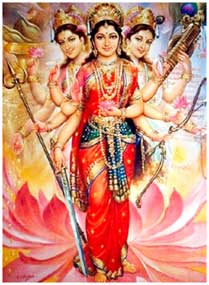
Devi By Sri Swami Sivananda O Devi! O Mother auspicious!Thou art the Lord’s Maya.Thou art His inscrutable form.Thou art the Mother of this world.Thou art the great primal energy.Thou art the seed of this world.Thou art the Light of Knowledge.Thou art the giver of refuge.Thou art beauty, love, and mercy.Thou art Prakriti, Durga.Salutations unto Thee. DEVI or Maheswari or Parasakti is the Supreme Sakti or Power of the Supreme Being. When Vishnu and Mahadeva destroyed various Asuras, the power of Devi was behind them. Devi took Brahma, Vishnu, and Rudra and gave them necessary Sakti to proceed with the work of creation, preservation, and destruction. Devi is the Creatrix of the universe. She is the Universal Mother. Durga, Kali, Bhagavati, Bhavani, Ambal, Ambika, Jagadamba, Kameswari, Ganga, Uma, Chandi, Chamundi, Lalita, Gauri, Kundalini, Tara, Rajeswari, Tripurasundari, etc., are all Her forms. She is worshipped, during the nine days of the Dusserah as Durga, Lakshmi, and Saraswati. Devi is the Mother of all. The pious and the wicked, the rich and the poor, the saint and the sinner–all are Her children. Devi or Sakti is the Mother of Nature. She is Nature Itself. The whole world is Her body. Mountains are Her bones. Rivers are Her veins. Ocean is Her bladder. Sun, moon are Her eyes. Wind is Her breath. Agni is Her mouth. She runs this world show Manifestations of Sakti Sakti is symbolically female; but It is, in reality, neither male nor female. It is only a Force which manifests Itself in various forms. The five elements and their combinations are the external manifestations of the Mother. Intelligence, discrimination, psychic power, and will are Her internal manifestations. Humanity is Her visible form. She lies dormant in the Muladhara Chakra in the form of serpentine power or coiled-up energy known as the Kundalini Sakti. She is at the centre of the life of the universe. She is the primal force of life that underlies all existence. She vitalises the body through the Sushumna Nadi and nerves. She nourishes the body with chyle and blood. She vitalises the universe through Her energy. She is the energy in the sun, the fragrance in the flowers, the beauty in the landscape, the Gayatri or the Blessed Mother in the Vedas, colour in the rainbow, intelligence in the mind, potency in the homoeopathic pills, power in Makaradhvaja and gold oxide, will and Vichara Sakti in sages, devotion in Bhaktas, Samyama and Samadhi in Yogins. Vidya, Shanti, lust, anger, greed, egoism, pride are all Her forms. Her manifestations are countless. Siva And Sakti The Supreme Lord is represented as Siva, and His power is represented as His wife–Sakti, Durga, or Kali. Mother Durga is the energy aspect of the Lord. Without Durga, Siva has no expression; and, without Siva, Durga has no existence. Siva is the soul of Durga. Durga is identical with Siva. Lord Siva is only the Silent Witness. He is motionless, absolutely changeless. He is not affected by the cosmic play. Durga does everything. Siva is omnipotent, impersonal, inactive. He is pure consciousness. Sakti is dynamic. The power, or active aspect, of the immanent God is Sakti. Sakti is the embodiment of power. Siva and Sakti are related as Prakasa and Vimarsa. Sakti or Vimarsa is the power that is latent in the pure consciousness. Vimarsa gives rise to the world of distinctions. In other words, Sakti is the very possibility of the Absolute’s appearing as many, of God’s causing this universe. God creates this world through Srishti-Sakti, preserves through Sthiti-Sakti, and destroys through Samhara-Sakti. There is no difference between God and His Sakti, just as there is no difference between fire and its burning power. Sakti is inherent in God. Just as you cannot separate heat from fire, so also you cannot separate Sakti from God, the possessor of Sakti. Sakti is Brahman Itself. Siva and Sakti are one. Siva is always with Sakti. They are inseparable. Worship of Durga or Parvati or Kali is worship of Lord Siva. Matter, Energy, And Spirit Mother is the creative aspect of the Absolute. She is symbolised as Cosmic Energy. Energy is the physical ultimate of all forms of matter, and the sustaining force of the spirit. Energy and spirit are inseparable. They are essentially one. Matter is reducible to energy. The Prasnopanishad says that Rayi and Prana–matter and energy–constitute the whole of creation. Matter is the outward index of the inward Power that its expressed by God. The Power that originates and sustains the universe is not the Jada Sakti or the electrical energy which is the ultimate reality of the scientists, but Chaitanya Sakti, the Power of the immutable Consciousness of Brahman. In fact, it is not a Power which is of Brahman, but a Power which is Brahman. The Divine Mother Sakti may be termed as that by which we live and have our being in this universe. In this world, all the wants of the child are provided by the mother. The child’s growth, development, and sustenance are looked after by the mother. Even so, all the necessaries of life and its activities in this world, and the energy needed for it, depend upon Sakti or the Universal Mother. The human mother is a manifestation of the Universal Mother. All women are forms of the Divine Mother. You are more free with your mother than with anybody else. You open your heart more freely to your mother than to your father. There is no God greater than the mother. It is the mother who protects you, nourishes you, consoles you, cheers you, and nurses you. She is your first Guru. The first syllable which almost every quadruped, or human being, utters is the beloved name of the mother–Ma. She sacrifices her all for the sake of her children. A child is more familiar with the mother than with the father, because the former is very kind, loving, tender, and affectionate, and looks after the wants of the child. Whenever the


Devi Read Post »

Makar Sankranti
Uncategorized

Makara Shankranti

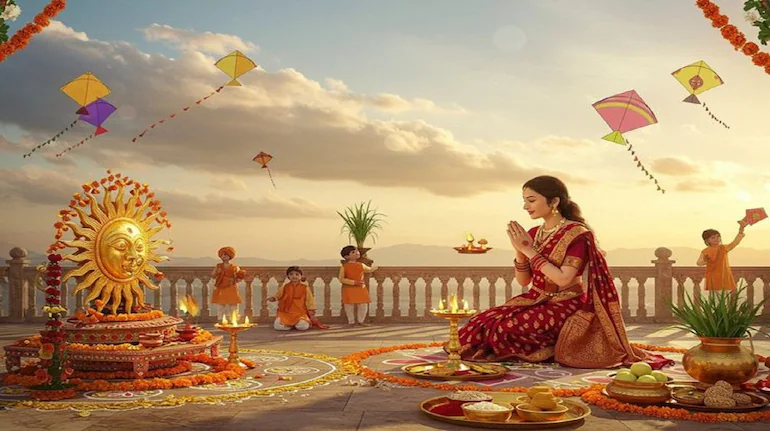
Makara Shankranti By SRI SWAMI SIVANANDA SALUTATIONS and adorations to the Supreme Lord, the primordial power that divided the year into the four seasons. Salutations to Surya, the Sun-God, who on this great day embarks on his northward journey. The Sanskrit term “Shankramana” means “to begin to move”. The day on which the sun begins to move northwards is called Makara Shankranti. It usually falls in the middle of January. Among the Tamilians in South India this festival is called the Pongal. To many people, especially the Tamilians, Makara Shankranti ushers in the New Year. The corn that is newly-harvested is cooked for the first time on that day. Joyous festivities mark the celebration in every home. Servants, farmers and the poor are fed and clothed and given presents of money. On the next day, the cow, which is regarded as the symbol of the Holy Mother, is worshipped. Then there is the feeding of birds and animals. In this manner the devotee’s heart expands slowly during the course of the celebrations, first embracing with its long arms of love the entire household and neighbours, then the servants and the poor, then the cow, and then all other living creatures. Without even being aware of it, one develops the heart and expands it to such proportions that the whole universe finds a place in it. As Shankranti is also the beginning of the month, Brahmins offer oblations to departed ancestors. Thus, all the great sacrifices enjoined upon man find their due place in this grand celebration. The worship of the Cosmic Form of the Lord is so well introduced into this, that every man and woman in India is delightfully led to partake of it without even being aware of it. To the spiritual aspirants this day has a special significance. The six-month period during which the sun travels northwards is highly favourable to them in their march towards the goal of life. It is as though they are flowing easily with the current towards the Lord. Paramahamsa Sannyasins roam about freely during this period, dispelling gloom from the hearts of all. The Devas and Rishis rejoice at the advent of the new season, and readily come to the aid of the aspirant. When the renowned Bhishma, the grandfather of the Pandavas, was fatally wounded during the war of the Mahabharata, he waited on his deathbed of nails for the onset of this season, before finally departing from the earth-plane. Let us on this great day pay our homage to him and strive to become men of firm resolve ourselves. As already mentioned, this is the Pongal festival in South India. It is closely connected with agriculture. To the agriculturalist, it is a day of triumph. He would have by then brought home the fruits of his patient toil. Symbolically, the first harvest is offered to the Almighty–and that is Pongal. To toil was his task, his duty, but the fruit is now offered to the Lord. This is the spirit of Karma Yoga. The master is not allowed to grab all the harvest for himself either. Pongal is the festival during which the landlord distributes food, clothes and money among the labourers who work for him. What a noble act! It is an ideal you should constantly keep before you, not only ceremoniously on the Pongal day, but at all times. Be charitable. Be generous. Treat your servants as your bosom-friends and brother workers. This is the keynote of the Pongal festival. You will then earn their loyalty and enduring love. The day prior to the Makara Shankranti is called the Bhogi festival. On this day, old, worn-out and dirty things are discarded and burnt. Homes are cleaned and white-washed and lovely designs are drawn with rice-flour on the door front. The roads are swept clean. These practices have their own significance from the point of view of health. But, here I remind you that it will not do to attend to these external things alone. Cleaning the mind of its old dirty habits of thought and feeling is more urgently needed. Burn them up, with a wise and firm resolve to tread the path of truth, love and purity from this holy day onwards. This is the significance of Pongal in the life of the spiritual aspirant. If you do this, then the Makara Shankranti has a special significance for you. The sun, symbolising wisdom, divine knowledge and spiritual light, which receded from you when you revelled in the darkness of ignorance, delusion and sensuality, now joyously turns on its northward course and moves towards you to shed its light and warmth in greater abundance, and to infuse into you more life and energy. In fact, the sun itself symbolises all that the Pongal festival stands for. The message of the sun is the message of light, the message of unity, of impartiality, of true selflessness, of the perfection of the elements of Karma Yoga. The sun shines on all equally. It is the true benefactor of all beings. Without the sun, life would perish on earth. It is extremely regular and punctual in its duties, and never claims a reward or craves for recognition. If you imbibe these virtues of the sun, what doubt is there that you will shine with equal divine lustre! He who dwells in the sun, whom the sun does not know, whose body the sun is, and by whose power the sun shines–He is the Supreme Self, the indweller, the immortal Essence. Tat Twam Asi–“That thou art”. Realise this and be free here and now on this holy Pongal or Makara Shankranti day. This is my humble Pongal prayer to you all. During Shankranti, puddings, sweet rice and other delicacies are prepared in every home, especially in South India. The pot in which the rice is cooked is beautifully adorned with tumeric leaves and roots, the symbols of auspiciousness. The cooking is done by the women of the household with great faith





Makara Shankranti Read Post »

swamisivananda
Swami Sivananda, Uncategorized, Yoga

What Is Bhakti?

What Is Bhakti? by Swami Sivananda Bhakti comes from the word “Bhaj” which means ‘to be attached or devoted to’. It is pure unselfish love mixed with reverence. Bhakti is the basis of all religious life. Bhakti destroys Vasanas and egoism. Bhakti elevates the mind to magnanimous heights. Bhakti is the master-key to open the chambers of wisdom. Bhakti culminates in Jnana. Bhakti begins in two and ends in one. Those who fight on the point: “Which is superior Bhakti or Jnana?” are groping in darkness. They have not understood the real Tattva. Para Bhakti and Jnana are one. Bhakti or devotion in the form of Anuraga or attachment to the Lord leads to the highest good or the attainment of God-realisation. The stronger the attachment, the quicker the realisation. Prahlada says: “O Lord Hari, may I have the same sort of profound abiding love for Thee, which the worldly people cherish for the fleeting sensual objects of this universe. May not that Bliss disappear from my heart, when I think of Thee.” What a beautiful definition of Bhakti. These thoughts have emanated from the core of Prahlada’s heart. They are charged with intense feeling and devotion. It is easy to have a thing that is beautiful. God is Beauty of beauties. God is the source for all beauties. God is an embodiment of undecaying beauty. So it is very easy to love God. If you are attached to a finite, perishable object as wife or son, you become miserable when your wife or son dies. But if you are attached to God you get eternal, infinite Bliss and peace. A Bhakta aspires, therefore, to something imperishable and infinite. Without love man’s life is empty. Without love man lives in vain. Love is vital. It is all-pervading. Love is a great power. Love is the sap of life. Give love. It shall be given unto you. Cultivate this love through service, Japa, Satsanga and meditation. Human love is all hollow. It is mere animal attraction. It is passion. It is carnal love. It is selfish love. It is ever changing. It is all hypocrisy and mere show. The wife does not care for her husband when he is in the role of unemployment. She frowns at him. The husband dislikes his wife when she loses her beauty on account of some chronic disease. You can find real, lasting love in God alone. His love knows no change. A selfish man loves his body only. Then he extends his love to his wife, children and friends. When he evolves a bit, he begins to love his own caste people and those who belong to his own district. Afterwards he loves people of his own province. His heart further expands. Then he loves the people of his own country. In the long run, he develops the feeling of universal brotherhood. He begins to love any man in any part of the world. Devotion is the seed. Faith is the root. Service of Bhagavatas is the shower. Self-surrender is the flower. Communion with the Lord is the fruit. This is the path of Bhakti Yoga. In Bhakti Yoga, no learning, no deep erudition of Vedas is needed. What is wanted is a devotional, sincere heart. Anyone can sing or repeat His Name. Tukaram was an illiterate peasant. He could not even sign his name. Through devotion and grace of Lord Krishna he had super-intuitional knowledge. His famous Abhangas or songs are texts for M.A. students in Bombay University. Sri Ramakrishna Paramahamsa also was an illiterate. When he lived in Dakshineshwar temple, he got divine knowledge through the Grace of Mother Kaali and Advaita Guru Sri Swami Totapuri. From a careful study of the lives of these two saints, it is quite clear that there is the fountain of knowledge within the heart and that any one can tap this source through sincere devotion. “I bow to Lord Narayana or Lord Siva or Lord Krishna.” This is Bhakti Yoga. “I am the Self in all.” This is Jnana Yoga. Men in their social and domestic relation develop love, affection, Prema, Preeti, admiration, reverence, awe and other sentiments. This cannot serve the purpose of life. It is only when one develops devotion or Bhakti for God that ones real purpose of life is gained. Devotion is the consummation of the above emotions. He does not practise Pratyahara. He tries to get himself drowned in the Prema of the Lord. He attempts to fix his mind either at His lotus-feet or charming face. Consequently Pratyahara follows unconsciously. A Raja Yogi practises Pratyahara deliberately. A Jnana Yogi does not practise Pratyahara, but tries to identify himself with the hidden self in all objects. He tries to remove the veil that covers the Atman within the objects by the force of Vedantic Nididhyasana. He negates the names and forms and identifies himself with the all-pervading hidden consciousness. A sage says: “This world has come out of Ananda (bliss); it subsists in Ananda and it dissolves in Ananda.” A devotee says: “This world has come out of love; it subsists in love and it dissolves in love.” In Ananda love is hidden. The sage loves his own Atman. He is devoted to his Atman. In love, Ananda is hidden. The devotee loves his Beloved and dances in joy. Dvaita (dualism), Vishishtadvaita (qualified monism) are different stages or different rungs in the philosophical ladder. The highest summit is Advaita. The realisation of Dvaitins and Vishishtadvaitins is also quite true and correct from their standpoints. A little more Sadhana and understanding will make them land in pure Advaitic realisation. In Bhakti Yoga, there are three things, viz., Lover, Beloved and Love. As soon as the Lover knows that he is identical with the Beloved, there is an end for Bhakti. Jnana dawns. Duality vanishes. Who is to love whom now? According to Advaita Vedanti, devotion is constant thinking on the formula, “I am he” or “I am Brahman.” A Bhakta

What Is Bhakti? Read Post »

images 2026 02 17T151447.609
Uncategorized

God Exists

God Exists by Swami Sivananda The notion of God means an absolutely perfect being. An absolutely perfect being must have all the positive attributes, including the attributes of existence. So God must exist. The existence of God cannot be proved by scientific experimentation. It is purely a question of faith and refers to the intuitive side of man. The deepest craving, the deepest aspiration in man is for eternal happiness, eternal knowledge and eternal Truth. Man should search for some supernatural entity which can satisfy his deepest craving and aspirations. As we explain everything within Nature by the law of cause and effect, so also Nature as a whole must be explained. It must have some cause. This cause must be different from the effect. It must be some supernatural entity, i.e., God. Nature is not a mere jumble of accidents, but an orderly affair. The planets move regularly in their orbits, seeds grow into trees regularly, the seasons succeed each other in order. Now Nature cannot order itself. It requires the existence of an intelligent being, i.e. God, who is responsible for it. Even Einstein, the great scientist, was strongly convinced of the creation of the universe by a Supreme Intelligence (Click Here for some of Einstein’s quotes on spirituality). Everything in Nature has some purpose. It fulfills some function or other. Certainly every object by itself cannot choose a function for itself. Their different functions ought to have been planned or designated by a single intelligent being or God. Albeit everything is transitory in this world, people purchase enormous plots of land, build bungalows in various places and erect five-storeyed houses. They want to establish eternal life in this sense-universe. This shows that man is essentially immortal. In spite of the knowledge that everyone has to die, man thinks that he will live for ever and make very grand arrangements to live here perpetually. Further, nobody wants death. Everybody wants to live, and takes treatment when ill, spending any amount. Hence, the essential nature of man should be eternal existence. Even a fool thinks that he is wise. Everyone wants to show that he knows more than others. Nobody likes to be called a fool. Children tease their parents with various sorts of questions. The desire to know is ingrained in them. These indicate that our essential nature is knowledge. When a man laughs, people seldom ask why he is laughing. On the other hand when a man cries, everybody asks why he is crying. This shows that our essential nature is bliss. No one wants misery, but everyone want happiness, and all one’s activities in life are directed towards the acquisition of happiness. This also proves that our real nature is bliss. In deep sleep when there are no objects, senses or mind, we feel bliss; hence our essential nature should be bliss. That again is the reason why people ailing from painful maladies even desire to give up their bodies and thus get rid of the pain. If everyone then is of the nature of existence-knowledge-bliss, there should be an all-pervading principle having these characteristics and different from the perishable, inert pain-giving physical bodies. Therefore, Brahman or God, whose nature is Existence-Knowledge-Bliss (Sat-Chit-Ananda), should exist. The existence of God or the Self is determined or indicated by the existence of the Upadhis or limiting adjuncts, viz., body, mind, Prana and the senses, because there must be self-consciousness behind their activities. You always feel that, despite your possessions and all sorts of comforts, you are in want of something. There is no sense of fullness. Only if you add to yourself the all-full God, you will have fullness. When you do an evil action, you are afraid. Your conscience pricks you. This also proves that God exists and witnesses all your thoughts and actions. To define Brahman is to deny Brahman. The only adequate description of Brahman is a series of negatives. That is the reason why the sage Yajnavalkya declares in the ‘Brihadaranyaka Upanishad’ about Brahman as neti, neti, or ‘not this’, ‘not this.’ This means that the residue left after sublating the names and forms is Brahman. Brahman or the Self or the Immanent God cannot be demonstrated as He is beyond the reach of the senses and mind but His existence can be inferred by certain empirical facts or common experiences in daily life. Sometimes you are in a peculiar dilemma or pressing pecuniary difficulty. Help comes to you in a mysterious manner. You get the money just in time. Most of you might have experienced this. You exclaim at that moment in joy “God’s ways are mysterious indeed; I have got now full faith in God. Up to this time I had no faith in God.” An advocate had no faith in God. He developed double pneumonia. His breath stopped. His wife, son and relatives began to weep. But he had a mysterious experience. The messengers of Yama caught hold of him and brought him to the court of Lord Yama. Lord Yama said to his messengers: “This is not the man I wanted. You have brought a wrong person. Send him off.” He began to breathe after some time. He actually experienced that he left the body, went to the court of Yama and again re-entered his physical body. This astonishing experience changed his entire nature. He developed an intense faith in God and became a religious man. Another educated person had a similar experience, but there was some change in this case. He was also an atheist. His soul was brought by the messengers of Yama to his court. This person asked Yama: “I have not finished my work in the physical plane. I have to do still more useful work. Kindly spare my life now.” His boon was granted. He was struck with wonder on this strange experience. His nature also was entirely changed. He left his job at once. He devoted the remaining portion of his life in

God Exists Read Post »

images 54
Our Heritage, Swami Sivananda, Uncategorized

Swami Sivananda Radha

Swami Sivananda Radha Swami Sivananda Radha, (Sylvia Hellman), was born in Germany in 1911 and lived there until after World War II. Always of a very questioning nature, she soon realized that worldly success brought little of enduring value. The disruptive events in Germany through the War years only increased her desire to find a lasting and meaningful purpose in life. In 1951 she emigrated to Canada and became a Canandian citizen. A visionary experience led her to her Guru (Spiritual teacher)- Swami Sivananda Saraswati – In Rishikesh, India. At the time of her first visit she spent six months at his Ashram, and received a very intense training in the philosophy and practice of Yoga and the spiritual life. It was there that she choose to dedicate her life to the service of others, and in 1956 was initiated into the sacred order of Sannyas as Swami Sivananda Radha. Sannyasins renounce all worldly ambitions and emotional attachments, directing their life and energy to the ideals of selfless service and the search for the spiritual understanding and enlightenment. At her Guru’s request she returned to Canada to bring the Yogic teachings to the West. In the 1956 she hounded as Ashram in Burnaby, British Colombia, which moved to its present location in Kootenay Bay, B.C. in 1963. since then Swami Radha’s major emphasis has been to interpret the ancient teachings so they can be understood and applied in the daily life of the Westerners. Many of her recordings have been classified as educational material by Canadian Government. She is the author ofKundalini: Yoga for the West, Mantras: Words of Power, and the Divine Light invocations. Swami Radha sees Yoga not as a Religion, but rather as a science to help human beings realize their fullest potentials, to live with concern for others as well as themselves. She lectures as gives workshops throughout North-America and Europe, and training others to share the teaching as she has done. Much of her times were spent in writing and giving spiritual guidance to those that seek the light.

Swami Sivananda Radha Read Post »

ChatGPT Image Feb 13 2026 05 10 27 PM
Our Heritage, Swami Sivananda, Uncategorized

Swami Devananda

Swami Devananda G. Sannyasi (that was the pre-Sannyasa name of Swami Devananda) was born on the 19th of June, 1937 (Eswarnama Samvatsar Jyestha Shuklapaksha Ekadasi Day), in a pious family in Andhra Pradesh. At a very young age he left home and joined Sri Brahmananda Ashram in Andhra Pradesh and took Sannyasa in 1954. For sometime he was in the holy Vyasashram, Yerpedu, near Tirupati and then came to Rishikesh in 1957. Swami Sivananda recognized the worth of this young Swami and took him for his personal service. Certainly it is the purva-punya (meritorious deeds of past births) of Swami Devananda that gave him this blessed and rare privilege of doing all sorts of personal service to Sri Gurudev, including menial service. This close and constant association with the sage had its unfailing effect on the young monk,-he automatically imbibed the divine virtues from Sri Gurudev, particularly of the gift of ‘giving’. His service to Sri Gurudev during the last days has earned him the special blessing of the master, which has made him what he is today. A man of self-effort and determination, coupled with devotion and application, he has made himself great in his own way. He is a master Sankirtanist, who can awaken and keep thousands spell-bound by his soulful Bhajans and Kirtans, and transport them to a different realm altogether, for which he is invited every year to Orissa and Andhra Pradesh. And recently he was chief organizer of the group of Sannyasins and Sadhaks who went from the Ashram on an All-India tour, in 1985, propagating the teachings of Sri Gurudev’s work into the Telugu language. His dedication to Sri Gurudev and his Mission is total and undivided. Swami Devanandaji Maharaj attained Mahasamadhi and left for his heavenly abode at 10.20 am on 7th January 2000.

Swami Devananda Read Post »