













Hari Om

Menu

⁠Rare Gems on Religion & Faith

image 50
⁠Rare Gems on Religion & Faith, Swami Sivananda

The Search for Truth

The Search for Truth By SRI SWAMI KRISHNANANDA The outlook of one’s life depends upon one’s conception of reality. The structure of the universe decides our relationship with things. What is known as a vision of life is just the attitude which the individual is constrained to develop in regard to the atmosphere of the universe. Such an exalted conception of the totality of experience may be designated as the philosophy of life. It is, thus, philosophy which determines human conduct and enterprises of every kind in the social field as well as in one’s own person. Not merely this; the psychological pattern of the apparatus of perception and inference and the like is also conditioned by the relationship that obtains between the universe and the individual. As such, it can be safely said that psychology and ethics are rooted in metaphysics. It is often said that the programme of human life may be carried on with an amount of success without straining one’s consciousness to the distant depths of the structure of the universe. People mostly prefer to live on the surface and move with the current of the river, with the least effort involved in the vocations of their personal and social existence. But, it is not difficult to notice that a sort of merely getting on with life through the vicissitudes of history is not only soul-less in its effect, by which the spirit of existence gets converted into a lifeless skeleton, but life, in the end, whether psychological, social or physical, would be impracticable if action is not fixed upon its proper relation with the environment of the entire pattern of life. Even as the working arrangement and the day-to-day performance of administration is based on Governmental Constitution along the lines of which contemplated programmes are carried on smoothly, life’s enterprise would not be a possibility if the same is not rooted in a standard picture of the whole pattern of existence which directs and determines the nature as well as the details of activity. Hence it is necessary to bestow a further thought on the facile formula of the commonplace of mankind that one can go on with the winds of the world blow, because, without a stable ideology and a lofty idealism, no movement is conceivable. If this is the aim behind all enterprises and programmes, no worth-the-while action of any kind would be possible without it even in contemplation. It is not the activities of life are to be psychological meditations in an academic sense, or in the way in which people wrongly try to understand philosophy. Often, the erroneous notion goes that philosophy is an abstract thought-process which idealises life into an ethereal and, perhaps, an unknown something, while life is concrete and substantial. It is surprising that the world of matter should be taken as a solid substance while the ideas are regarded as airy nothings, even in the light of the astounding discoveries of modern researches in the field of science, which have swept off matter from the region of solidity, and matter appears to be evaporating into an undivided continuum of what is sometimes called a space-time extension, transcending the notions of a three-dimensional distance and a time-process divided into the partiteness of past, present and future. There is something more about this interesting discovery. If the continuum mentioned is indivisible by the very nature of its impartite and non- durational structure, naturally, it would follow that the individual observer of things cannot stand outside the continuum. The consequences of this deduction are, again, startling, while being obvious, again. The observing individual merges, as it were, into the vast indivisibility of the continuum, and the events of the universe knowing itself and the individual knowing himself, as well as the individual knowing the universe, cannot be separated from one another. It would appear that the universe, in this analysis, is itself a measureless conflagration of intelligence, knowing itself, and nothing outside it be noticed as an object of sensory perception of psychological cognition. We find ourselves entering into the bottom of an ocean of force and existence which is inseparable from intelligence, and to know the universe would be the same as to know one’s own Self. In the act of Self-knowledge, the universe is known at once, and the knowledge of the universe, on the other hand, is the knowledge of the Self. In this circumstance of a new vision that we seem to be confronting before us, our personal and social life should be, indeed, a mirror-like clarity, which would include the type of relationship that we should adopt with other people, in our day-to-day existence. What we call the ethics or morality of human relationship as well as of personal behaviour amounts, from the above analysis, to a conscious participation in the pattern of things in general, which is only the face of the brooding Spirit of the Cosmos as a whole. Love becomes spontaneously unselfish. Love, then, cannot be directed exclusively to any person, or thing or an isolated ideal, but becomes a spring of joy arising from the recognition of the fullness of existence. Hatred of any kind gets abolished from the surface of life by the very fact of the unity of procedure and purpose involved in the structure and programme of creation. Human history can transfigure itself into a saga of the dramatic evolution of the particulars to the Universal through the various levels and degrees of its manifestation. What people have been dreaming of as the glorified ideal of Rama-Rajya or the Golden Age of Satya-Yuga, of the divine and eternal perfection, would not, indeed, be a far-off object to be realised. It was a perennial message which Plato proclaimed with the conviction of a genius when he declared that no peace of earth can ever prevail unless philosophy goes with administration and administration with philosophy. We have a glorious day ahead. Humanity! Be prepared to extend it a warm welcome. 1. PREFATORY

The Search for Truth Read Post »
veda vyasa
⁠Rare Gems on Religion & Faith, Swami Sivananda

The Royal Science of Brahma-Vidya

The Royal Science of Brahma-Vidya By SRI SWAMI SIVANANDA “Kingly science, kingly secret, the supreme purifier is this, realisable by direct intuitional knowledge, according to righteousness, very easy to perform, imperishable.” Bhagavad-Gita IX-2 Brahma-Vidya (science of God), is the Science of sciences. The knower of Brahma-Vidya or the Science of Brahman or the Science of the Absolute, knows everything. His knowledge is full. He has the whole experience through intuition or revelation. Take your firm seat on the rock-bottom of the Upanishadic truths and accept the findings of science only if they tally with the Upanishadic truths, otherwise reject them ruthlessly. All secular sciences have their own limitations. A scientist works on the physical plane with a finite mind and with instruments. He knows the physical laws. He has some knowledge of the elements, atoms and physical energy. His knowledge is fragmentary. He has no experience of the whole. He has no knowledge of transcendental or supersensual things. Science is only a partially unified knowledge. A scientist infers, investigates and draws exact conclusions from his observations. He understands Nature but he knows nothing of the origin or destiny of Nature. Who made the sun and gave power to its rays? Who combined four parts of nitrogen with one part of oxygen? Who gave power to the electrons? Who gave power to the atoms to combine into molecules? Who or what made and bestowed upon the ultimate particles of matter their marvellous power of varied interaction? Science does not know this great mystery. On the contrary, Yoga is completely unified knowledge. A Yogi gets inner, divine realisation. He clearly sees with his inner Yogic eye the subtle rudiments of matter. He identifies himself with the Supreme Being who is the Lord of Prakriti or matter. He gets control over the five elements. He clearly understands the whole mystery of creation through direct intuitional knowledge. The scientist lacks this sort of knowledge. He has only experimental knowledge. In the matter of evidence in psychological questions, the sense-perceptions with which science naturally deals are only second-rate criteria and are therefore to be received with caution. The closing of the external channels of sensation is usually the signal for the opening of the psychic and, from all evidence, it would seem that the psychic sense is more extensive, acute and in every way more dependable than the physical. The business of science is generalisation of phenomena; it is the function of philosophy and Yoga to explain. Religion is the practical aspect of philosophy. Philosophy is the rational aspect of religion. The scientist tries to answer the “how” of the problem; the philosopher and the Yogi attempt to answer the “why” of it. It is a mistake to say that such and such an event occurs because of certain laws of Nature. The laws of Nature do not give any real explanation of the phenomena. A law of Nature is simply a statement, in terms as general as possible, of what happens under given circumstances in a natural phenomenon. Science is only concerned with the phenomena. Science shows a marvellous harmony of Nature. But it is the problem of philosophy and Yoga to solve the why” of Nature’s harmony. Scientists possess a partial knowledge of the universe. They have not understood the whole code of Nature’s laws. They have no knowledge of the occult side of things. They have no knowledge of the astral, mental and higher planes such as Brahma-Loka or the world of Brahma. The unseen world is of far greater importance than the sense-universe which is visible to the naked eye. A fully developed Yogi can function on all planes and so he has full knowledge of the manifested and the unmanifested Nature. The senses, by which you get a knowledge of the external objects, are not fully developed. Therefore, the knowledge obtained is partial. The external senses are exact counterparts of the internal astral senses. Scientists have no knowledge of the subtle rudiments of matter. Life will become fuller and richer when one develops this inner eyesight by the practice of Yoga. Just as blood, when seen under the microscope, reveals many mysterious things, such as leucocytes, nuclei, pigment, germs and bacilli, so also the inner Yogic eye reveals many a mystery to the hidden side of things. The knowledge of the scientists is only fragmentary or partial, whereas the knowledge of the Yogis who have realised the Truth is full and perfect. In its outlook, science differs radically from philosophical musings. Consequently, the mode of approach of science to its specific problems is different from that of philosophy. Yet there is some similarity in the findings of both science and philosophy when some broad questions are discussed. Scientists have to learn many things from the seers of the East. Who gave power to the electrons to revolve? What is at the bottom of these electrons? Who gave life to the cell or the protoplasm? Who gave intelligence to the cells to secrete milk or bile or gastric juice from the blood? The scientists are still observing and experimenting. They are still groping in darkness. What is the cause of the origin of an impulse? Who is the director of the mind? What is the cause of the origin of thought? Even if all the living scientists were to put their heads together to solve these questions, they cannot give definite and conclusive answers. The mind of a scientist cannot work on higher spiritual planes. It is gross and impure. it has outgoing tendencies. It is filled with desires, passions and worldly impressions. The scientist cannot look within, introspect and meditate. He can analyse the atoms of different elements but he cannot do self-analysis. He can bombard the atoms, watch the movements of the electrons and make discoveries in Nature. But the mind of a Rishi or a Yogi is subtle and pure. It is free from worldly desires and passions, from selfishness, lust and hatred. It is equipped with

The Royal Science of Brahma-Vidya Read Post »

images 2026 02 24T163033.912
⁠Rare Gems on Religion & Faith, Swami Sivananda

Seven Reasons Why a Scientist Believes in God

Seven Reasons Why a Scientist Believes in God By A. CRESSY MORRISON,Former President of the New York Academy of Sciences WE ARE STILL IN THE DAWN of the scientific age, and every increase of light reveals more brightly the handiwork of an intelligent Creator. We have made stupendous discoveries; with a spirit of scientific humility and of faith grounded in knowledge we are approaching ever nearer to an awareness of God. For myself, I count seven reasons for my faith: First: By unwavering mathematical law we can prove that our universe was designed and executed by a great engineering intelligence. Suppose you put ten pennies, marked from one to ten, into your pocket and give them a good shuffle. Now try to take them out in sequence from one to ten, putting back the coin each time and shaking them all again. Mathematically we know that your chance of first drawing number one is one in ten; of drawing one and two in succession, one in 100; of drawing one, two and three in succession, one in 1000, and so on; your chance of drawing them all, from number one to number ten in succession, would reach the unbelievable figure of one in ten billion. By the same reasoning, so many exacting conditions are necessary for life on the earth that they could not possibly exist in proper relationship by chance. The earth rotates on its axis 1000 miles an hour at the equator; if it turned at 100 miles an hour, our days and nights would be ten times as long as now, and the hot sun would likely burn up our vegetation each long day while in the long night any surviving sprout might well freeze. Again the sun, source of our life, has a surface temperature of 10,000 degrees Fahrenheit, and our earth is just far enough away so that this “eternal life” warms us just enough and not too much ! If the sun gave off only one half its present radiation, we would freeze, and if it gave as much more, we would roast. The slant of the earth, tilted at an angle of 23 degrees, gives us our seasons; if the earth had not been so tilted, vapors from the ocean would move north and south, piling up for us continents of ice. If our moon were, say, only 50,000 miles away instead of its actual distance, our tides might be so enormous that twice a day all continents would be submerged; even the mountains could soon be eroded away. If the crust of the earth had only been ten feet thicker, there would be no oxygen, without which animal life must die. Had the ocean been a few feet deeper, carbon dioxide and oxygen would have been absorbed and no vegetable life could exist. It is apparent from these and a host of other examples that there is not one chance in billions that life on our planet is an accident. Second: The resourcefulness of life to accomplish its purpose is a manifestation of an all-pervading Intelligence. What life itself is, no man has fathomed. It has neither weight nor dimensions, but it does have force; a growing root will crack a rock. Life has conquered water, land and air, mastering the elements, compelling them to dissolve and reform their combinations. Life, the sculptor, shapes all living things; an artist, it designs every leaf of every tree, and colors every flower. Life is a musician and has taught each bird to sing its love song, the insects to call one another in the music of their multitudinous sounds. Life is a sublime chemist, giving taste to fruits and spices, and perfume to the rose, changing water and carbonic acid into sugar and wood, and, in so doing, releasing oxygen that animals may have the breath of life. Behold an almost invisible drop of protoplasm, transparent, jellylike, capable of motion, drawing energy from the sun. This single cell, this transparent mist-like droplet, holds within itself the germ of life, and has power to distribute this life to every living thing, great and small. The powers of this droplet are greater than our vegetation and animals and people, for all life came from it. Nature did not create life; fire-blistered rocks and a saltless sea could not meet the necessary requirements. Who, then, has put it here? Third: Animal wisdom speaks irresistibly of a good Creator who infused instinct into otherwise helpless little creatures. The young salmon spends years at sea, then comes back to his own river, and travels up the very side of the river into which flows the tributary where he was born. What brings him back so precisely? If you transfer him to another tributary he will know at once that he is off his course and he will fight his way down and back to the main stream and then turn up against the current to finish his destiny accurately. Even more difficult to solve is the mystery of eels. These amazing creatures migrate at maturity from ponds and rivers everywhere – those from Europe across thousands of miles of ocean – all bound for the same abysmal deeps near Bermuda. There they breed and die. The little ones, with no apparent means of knowing anything except that they are in a wilderness of water, nevertheless start back and find their way not only to the very shore from which their parents came but thence to the selfsame rivers, lakes or little ponds. No American eel has ever been caught in Europe, no European eel in American waters. Nature has even delayed the maturity of the European eel by a year or more to make up for its longer journey. Where does the directional impulse originate? Fourth: Man has something more than animal instinct – the power of reason. No other animal has ever left a record of its ability to count ten, or even to understand the meaning of ten. Where instinct is like

Seven Reasons Why a Scientist Believes in God Read Post »

df9719 e09bfba70ca04b4faf4cc9ba8f7e71a3mv2 e1771930364550
⁠Rare Gems on Religion & Faith, Swami Sivananda

Religion and Science

Religion and Science By SRI SWAMI SIVANANDA Some scientists, and some so-called educated persons, believe that science can explain everything and can solve the riddle of the universe and all problems of life. They also think that the scientific method is the only method of finding out the truth, and that the scientific training and discipline alone can very efficiently build the character of man. They have ignored ethical discipline, morality and religion altogether, and given religion an inferior position. One scientist came to me and said: “The Upanishads and the Brahma-Sutras have not been written scientifically. I am trying to give a scientific approach to this vital subject .” I laughed and said : “My dear scientist-friend! The Upanishads are revelations. Brahma-vidya is transcendental. The Atman is transcendental. You cannot take your test-tubes and spirit lamps near Him. The scientists’ conclusions cannot approach His region. Their observations are one-sided, as they concern the waking state alone. Their experiences are relative experiences.” The scientist kept quiet, put down his head in shame, and walked away quietly. Three blind people touched the different parts of an elephant. One touched the foot, and said: “The elephant is like a pillar”. Another touched the ear, and said: “The elephant is like a fan”. A third touched the belly, and said: “The elephant is like a pot”. Even so, a scientist explores the physical plane, and speaks of atom, energy, and physical laws. He is also like a blind man. He has knowledge of one dimension alone. He has ignored the dreaming and deep sleep states. He has no all-comprehensive knowledge. A Vedantin alone has full knowledge of everything. THE EASE-LOVING NATURE OF MAN As life has been made physically comfortable and comparatively effortless by modern inventions, the ease-loving man is prone to disregard the place of religion in his life and exalt the values of materialistic civilization. But events have always disclosed the unreliability of the purely objective views and methods of physical science, the experience of man that he is not really happier, and the world is not in fact better, even after his arduous attempts at extracting out of external nature its latent resources in order to utilize them for his own purposes. Where is satisfaction, where is happiness, and where is peace then? Some wise scientists are fully conscious now of the limitations of science, and of its methods, in the investigation of phenomena in planes of subtler states of matter. The reality of the spiritual world is closed book to them. They are equally conscious of the limitations of science in the regeneration of unregenerate human nature, and in the attainment of the Supreme Good or Eternal Bliss, the summum bonum of life. WHAT HAS SCIENCE DONE TO US? Can scientific inventions make us really happy? That is the question of questions now. What has science done to us? Science has now removed time and space. You can go to London even within ten hours (from India). What a great marvel ! This earth has become very, very small. But, has science really contributed to human happiness ? The answer is an emphatic no, no. It has multiplied human wants and luxuries. A luxury of today becomes a necessity of tomorrow. It has made man a beggar. Science has invented many marvellous things. Scientists are labouring day and night in their laboratories to invent many more things. But, science has made life very complex, and rendered very keen the struggle for existence. It has increased the restlessness of the mind. It has not contributed to the peace of man. Everybody admits this solid fact. The scientists have made tremendous progress in the twentieth century. The atomic bombs can devastate a large country in the twinkling of an eye. Radios, telephones, telepathy, television, aeroplanes without pilots, mines, tanks, pocket radios, bombs in fountain-pens and cigarettes, underground palaces, shafts, V-bombs, fighters, bombers, anti-aircraft guns, gas bombs, torpedoes, submarines are all astounding marvels. But, the scientists have not improved the ethical condition of the people. They have not solved the problem of unemployment, poverty, war, starvation, disunity among communities, nations, and governments. Science has analyzed man. He is supposed to be a creature composed of various physical and chemical substances. Yet, no scientist has yet been able to assemble these constituent chemical elements of a man’s body into one homogeneous creature which lives, talks, and acts like a man. The scientist bombards the atoms, watches the movement of the electrons in his laboratory, spends his whole life in understanding the nature and secret of matter and energy, invents many things, studies the laws of nature; and yet, he is not able to comprehend the mystery of creation and of the Creator, and the meaning of life. SCIENCE IS DEFECTIVE Scientists are very, very busy in studying the external world. They have entirely forgotten to study the internal world. Science gives you knowledge only of the phenomenal appearances, and not of the Reality behind them. Science has not been able to solve the ultimate questions: What is the ultimate stuff of the world ? Who am I ? What is the ultimate truth ? Science tells us that the ultimate goal of everything is unknown, and unknowable. But, Vedanta teaches that the ultimate goal is Brahman or the Infinite, and that It can be realized through hearing, reflection and meditation. The knowledge of the scientist is limited. It is only superficial. It is not real knowledge of the Truth. Scientists are immersed in transitory phenomena. They rely on external instruments, lenses, etc., for their knowledge. Their old theories are exploded by new theories. Their knowledge is not as infallible and true as the knowledge of the Self of the sages and Yogins. MATTER AND SPIRIT Science has got its limitations. Science does not have an instrument by which they could just collect the supersensual or spiritual data, or those divine facts which exist in a subtle form but which we cannot see. True experiences include the experiences of the three states, namely, the waking, dream and deep sleep

Religion and Science Read Post »

image 48
⁠Rare Gems on Religion & Faith, Swami Sivananda

Quotes of Albert Einstein on Spirituality

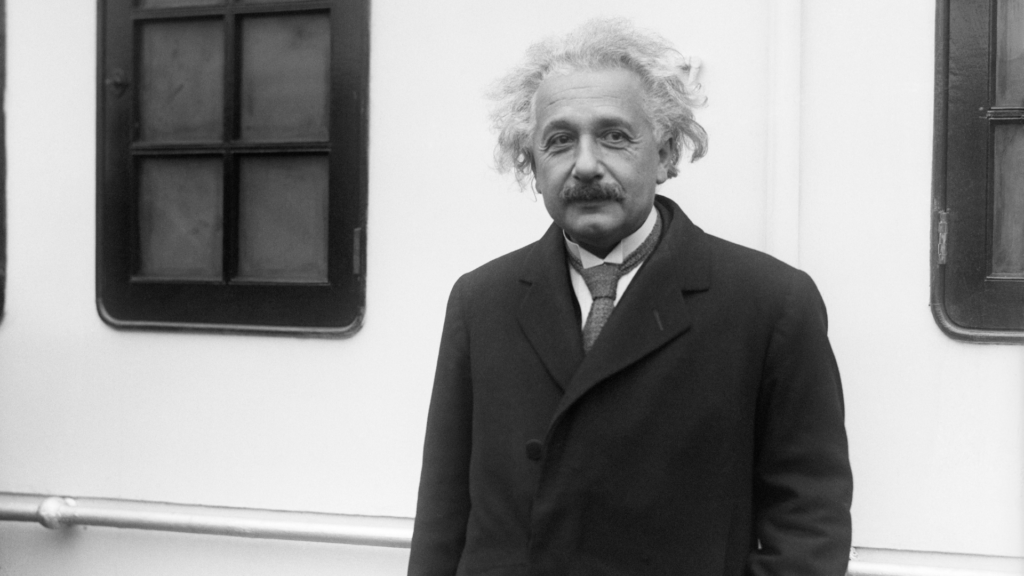
Quotes of Albert Einstein on Spirituality I want to know God’s thoughts; the rest are details. Science without religion is lame. Religion without science is blind. My religion consists of a humble admiration of the illimitable superior spirit who reveals himself in the slight details we are able to perceive with our frail and feeble mind. The further the spiritual evolution of mankind advances, the more certain it seems to me that the path to genuine religiosity does not lie through the fear of life, and the fear of death, and blind faith, but through striving after rational knowledge. Every one who is seriously involved in the pursuit of science becomes convinced that a spirit is manifest in the laws of the Universe-a spirit vastly superior to that of man, and one in the face of which we with our modest powers must feel humble. The scientists’ religious feeling takes the form of a rapturous amazement at the harmony of natural law, which reveals an intelligence of such superiority that, compared with it, all the systematic thinking and acting of human beings is an utterly insignificant reflection. There is no logical way to the discovery of elemental laws. There is only the way of intuition, which is helped by a feeling for the order lying behind the appearance. The intuitive mind is a sacred gift and the rational mind is a faithful servant. We have created a society that honors the servant and has forgotten the gift. The most beautiful thing we can experience is the mysterious; It is the source of all true art and science. We should take care not to make the intellect our god; it has, of course, powerful muscles, but no personality. Whoever undertakes to set himself up as a judge of Truth and Knowledge is shipwrecked by the laughter of the Gods. When the solution is simple, God is answering. God does not play dice with the universe. God is subtle but he is not malicious. A human being is a part of the whole, called by us Universe, a part limited in time and space. He experiences himself, his thoughts and feelings as something separated from the rest-a kind of optical delusion of his consciousness. This delusion is a kind of prison, restricting us to our personal desires and to affection for a few persons nearest to us. Our task must be to free from this prison by widening our circle of compassion to embrace all living creatures and the whole nature in its beauty. Nothing will benefit human health and increase the chances for survival of life on Earth as much as the evolution to a vegetarian diet. The man who regards his own life and that of his fellow creatures as meaningless is not merely unfortunate but almost disqualified for life. Peace cannot be kept by force. It can only be achieved by understanding. Only a life lived for others is a life worth while. The human mind is not capable of grasping the Universe. We are like a little child entering a huge library. The walls are covered to the ceilings with books in many different tongues. The child knows that someone must have written these books. It does not know who or how. It does not understand the languages in which they are written. But the child notes a definite plan in the arrangement of the books—a mysterious order which it does not comprehend, but only dimly suspects. The important thing is not to stop questioning. Curiosity has its own reason for existing. One cannot help but be in awe when he contemplates the mysteries of eternity, of life, of the marvelous structure of reality. It is enough if one tries merely to comprehend a little of this mystery every day. Never lose a holy curiosity. What I see in Nature is a magnificent structure that we can comprehend only very imperfectly, and that must fill a thinking person with a feeling of humility. This is a genuinely religious feeling that has nothing to do with mysticism. The finest emotion of which we are capable is the mystic emotion. Herein lies the germ of all art and all true science. Anyone to whom this feeling is alien, who is no longer capable of wonderment and lives in a state of fear is a dead man. To know that what is impenatrable for us really exists and manifests itself as the highest wisdom and the most radiant beauty, whose gross forms alone are intelligible to our poor faculties – this knowledge, this feeling … that is the core of the true religious sentiment. In this sense, and in this sense alone, I rank myself amoung profoundly religious men. The real problem is in the hearts and minds of men. It is easier to denature plutonium than to denature the evil spirit of man. True religion is real living; living with all one’s soul, with all one’s goodness and righteousness. Intelligence makes clear to us the interrelationship of means and ends. But mere thinking cannot give us a sense of the ultimate and fundamental ends. To make clear these fundamental ends and valuations and to set them fast in the emotional life of the individual, seems to me precisely the most important function which religion has to form in the social life of man.

Quotes of Albert Einstein on Spirituality Read Post »

images 2026 02 17T145035.733
⁠Rare Gems on Religion & Faith, Swami Sivananda

God Exists

God Exists By SRI SWAMI SIVANANDA The notion of God means an absolutely perfect being. An absolutely perfect being must have all the positive attributes, including the attributes of existence. So God must exist. The existence of God cannot be proved by scientific experimentation. It is purely a question of faith and refers to the intuitive side of man. The deepest craving, the deepest aspiration in man is for eternal happiness, eternal knowledge and eternal Truth. Man should search for some supernatural entity which can satisfy his deepest craving and aspirations. As we explain everything within Nature by the law of cause and effect, so also Nature as a whole must be explained. It must have some cause. This cause must be different from the effect. It must be some supernatural entity, i.e., God. Nature is not a mere jumble of accidents, but an orderly affair. The planets move regularly in their orbits, seeds grow into trees regularly, the seasons succeed each other in order. Now Nature cannot order itself. It requires the existence of an intelligent being, i.e. God, who is responsible for it. Even Einstein, the great scientist, was strongly convinced of the creation of the universe by a Supreme Intelligence (Click Here for some of Einstein’s quotes on spirituality). Everything in Nature has some purpose. It fulfills some function or other. Certainly every object by itself cannot choose a function for itself. Their different functions ought to have been planned or designated by a single intelligent being or God. Albeit everything is transitory in this world, people purchase enormous plots of land, build bungalows in various places and erect five-storeyed houses. They want to establish eternal life in this sense-universe. This shows that man is essentially immortal. In spite of the knowledge that everyone has to die, man thinks that he will live for ever and make very grand arrangements to live here perpetually. Further, nobody wants death. Everybody wants to live, and takes treatment when ill, spending any amount. Hence, the essential nature of man should be eternal existence. Even a fool thinks that he is wise. Everyone wants to show that he knows more than others. Nobody likes to be called a fool. Children tease their parents with various sorts of questions. The desire to know is ingrained in them. These indicate that our essential nature is knowledge. When a man laughs, people seldom ask why he is laughing. On the other hand when a man cries, everybody asks why he is crying. This shows that our essential nature is bliss. No one wants misery, but everyone want happiness, and all one’s activities in life are directed towards the acquisition of happiness. This also proves that our real nature is bliss. In deep sleep when there are no objects, senses or mind, we feel bliss; hence our essential nature should be bliss. That again is the reason why people ailing from painful maladies even desire to give up their bodies and thus get rid of the pain. If everyone then is of the nature of existence-knowledge-bliss, there should be an all-pervading principle having these characteristics and different from the perishable, inert pain-giving physical bodies. Therefore, Brahman or God, whose nature is Existence-Knowledge-Bliss (Sat-Chit-Ananda), should exist. The existence of God or the Self is determined or indicated by the existence of the Upadhis or limiting adjuncts, viz., body, mind, Prana and the senses, because there must be self-consciousness behind their activities. You always feel that, despite your possessions and all sorts of comforts, you are in want of something. There is no sense of fullness. Only if you add to yourself the all-full God, you will have fullness. When you do an evil action, you are afraid. Your conscience pricks you. This also proves that God exists and witnesses all your thoughts and actions. To define Brahman is to deny Brahman. The only adequate description of Brahman is a series of negatives. That is the reason why the sage Yajnavalkya declares in the ‘Brihadaranyaka Upanishad’ about Brahman as neti, neti, or ‘not this’, ‘not this.’ This means that the residue left after sublating the names and forms is Brahman. Brahman or the Self or the Immanent God cannot be demonstrated as He is beyond the reach of the senses and mind but His existence can be inferred by certain empirical facts or common experiences in daily life. Sometimes you are in a peculiar dilemma or pressing pecuniary difficulty. Help comes to you in a mysterious manner. You get the money just in time. Most of you might have experienced this. You exclaim at that moment in joy “God’s ways are mysterious indeed; I have got now full faith in God. Up to this time I had no faith in God.” An advocate had no faith in God. He developed double pneumonia. His breath stopped. His wife, son and relatives began to weep. But he had a mysterious experience. The messengers of Yama caught hold of him and brought him to the court of Lord Yama. Lord Yama said to his messengers: “This is not the man I wanted. You have brought a wrong person. Send him off.” He began to breathe after some time. He actually experienced that he left the body, went to the court of Yama and again re-entered his physical body. This astonishing experience changed his entire nature. He developed an intense faith in God and became a religious man. Another educated person had a similar experience, but there was some change in this case. He was also an atheist. His soul was brought by the messengers of Yama to his court. This person asked Yama: “I have not finished my work in the physical plane. I have to do still more useful work. Kindly spare my life now.” His boon was granted. He was struck with wonder on this strange experience. His nature also was entirely changed. He left his job at once. He devoted the remaining portion of his life in

God Exists Read Post »

image 46
⁠Rare Gems on Religion & Faith, Swami Sivananda

Alice in Wonderland

Alice in Wonderland By SRI SWAMI KRISHNANANDA We have an inveterate obsession in our minds which prevents us almost entirely from conceiving the goal of life as a practical reality. For us, the goal mostly remains as a kind of concept and an idea, an ideal which is not easily reconcilable with the hard realities of the workaday a world. The goal may be God Himself, and nevertheless, He is only an idea an ideal, a concept, an imagination, a possibility, a may-be or may-not-be. This suspicious outlook is not absent even in the most advanced persons due to the strength of the senses, the power of the mind, and the habit of the intellect in understanding things in a given fashion. We are discussing in these lessons a subject called Comparative Philosophy, and in this context, we would be benefited by bestowing a little thought on the conclusions arrived at by certain thinkers also, apart from Vedantic philosophers like Sankara, with whom we have a good acquaintance and about whose thinking we have spoken enough. There was a great man called Plato in Greece. According to Paul Deussen, the whole world has produced only three philosophers-Plato, Kant and Sankara. There is some truth in what he says. There cannot be a greater philosopher than these three persons-Plato, Kant and Sankara-, says Paul Deussen. I was thinking about this statement. Why does he make this statement? Finally I felt that there is some truth in it, whatever it is. The idea of the Ultimate Reality is the principal doctrine of Plato; and I started by saying that we are living in a world of ideas when we live a spiritual life, when we behave religiously, conduct worship and chant Mantras, do prayers, do Japa and even meditation; but there is a very uncomfortable consequence following the idea that, after all, the Reality is an idea. Ideas are abstractions, notions which are supposed to correspond to realities, and as long as ideas correspond to realities, they are valid. I have an idea that there is a building in front of me. This idea is a valid idea, because it corresponds with the real existence of the building outside. So, the validity of my idea depends upon the reality of the object which is in front of it, but my idea itself has no reality. It is borrowed reality. It hangs on the existence of something else outside, in this case, the building. So, if the idea of the Ultimate Reality or God is to hang on the existence of another thing, God is not a real being. This is a very subtle difficulty that may trouble the minds of even sincere seekers. Don’t you think that the world is real? It is not merely real, it is very, very real, hard to the core, flint-like and no one can gainsay that it is. Perhaps that alone is. God is an idea that has been introduced in our minds by our ancestors, by our books, by our scriptures, by our professors and our teachers and parents, and somehow, we have been forced by the logic of this teaching to believe there should be such a thing as an ‘other-worldly existence’ and we have somehow reconciled ourselves to it-God must be there. But we are accepting the existence of God against our own will. We are hungry and thirsty and this hunger and thirst of the body is more real than the idea of God. No one can say that it is not so, whatever be our devotion to God. This is so even in the case of advanced seekers and sincere Sadhaks (aspirants). This subject is the principal theme of Plato’s doctrine. Ideas precede reality: this one sentence is the entire philosophy of Plato. The reality of the objective universe is subsequent to the idea of the universe. Here we have an echo of the great philosophy of Vedanta that the Hiranyagarbha (cosmic intelligence) is prior to the cosmos of physical appearance. The Panchadasi, The Upanishads and the other systems of Vedantic thinking tell us that in Hiranyagarbha the world does not exist in a concrete form as it appears, that is only an idea cosmically manifested by Isvara (God) who is even subtler than the idea. Isvara is only a possibility of the very idea that there should be a thing called the universe. So, Isvara is subtler than the idea which is Hiranyagarbha, and Virat is supposed to be the animating consciousness behind the so-called physicality of creation. So, even in the Vedantic Philosophy, there is the same doctrine of idea preceding concrete existence. But we can never believe this. My idea that there is a desk in front of me cannot be said to be harder in its concreteness than the desk itself. I have an idea that there is a little table in front of me. Is the table more real or the idea that the table is there more real? Any man with common-sense will say that the idea is subsequent to the existence of the object called table and the idea is not preceding the object. Because there is a table, you think there is a table. You have an idea that there is an object. So, the idea that there is an object is the consequence of the existence of the object. So, the idea of God must be subsequent and not precedent. These questions arose before Socrates. How can you say that idea is prior to the universe? How could there be an idea unless the universe exists? How can you have a thought about a thing unless the thing exists? How can you say that things are subsequent and ideas are precedent? If God is supreme consciousness, how could consciousness be prior to existence? Consciousness is always of something. If the something is not there, there cannot be consciousness. What do you mean by merely saying consciousness, awareness, understanding, thinking, feeling? They cannot have any

Alice in Wonderland Read Post »

images 2026 02 24T122613.133
⁠Rare Gems on Religion & Faith, Swami Sivananda, Uncategorized

Is Modern Science a Challenge to Religion?

Is Modern Science a Challenge to Religion? By SRI SWAMI KRISHNANANDA The subject that has been suggested is somewhat an involved one, and I do not know how far this would be a very appropriate theme to discuss before an audience of this kind who are basically devotees of God and aspirants of the spiritual ideal of life. However, all visions of life can be consolidated into a system of integrated organisation, and nothing conceivable can be regarded as extraneous to the methodology to be adopted in the pursuit of the spiritual ideal. “Is there a conflict between the scientific method and the religious aspiration of the soul?” is a moot question. Generally, when people speak of science, what the common populace understands is the comfort that has been provided by applied science, such as fast travelling, telephone, telegraph, Internet, satellite, and television. These are the things that are in the minds of people when they speak of the technological advance science has made; but science does not mean technology. It is a vision of life itself. What clashes or appears to come in conflict with religion is not the comfort that has been brought to us by these technological inventions of applied science, but the theory of science, which is something very deep, and bordering upon philosophical and metaphysical foundations of life itself. That the world is external to everyone is the basic foundation of all scientific perception. Observation and experiment being the methods of a scientific process, it goes without saying that what is observed and experimented upon has to be outside. The outsideness of the world is a very important aspect to be considered here, but we may put a question to our own selves: “Is the world really outside us, so that what happens in the world does not affect us in any way, and the world does not care for what is happening to us in our own internal operations? Are the individual and the world, the two principles of consideration here, segregated from each other? Has the world nothing to do with the individual, and has the individual nothing to do with the world?” It looks that there is no communication possible between the individual and the world. The world may not know at all that some individual is dead and gone, and the individual is not concerned in any manner if a star in heaven cools down and extinguishes itself. Let anything happen to the heavens; what does it matter to us? But, “Is it so?” is the question. This supposed conflict between physical science and religion may be said to have begun somewhere toward the end of the nineteenth century, when the geocentric interpretation of the heavenly bodies was replaced by the heliocentric concept on the discovery of Copernicus. This discovery clashed with the biblical belief and tradition, which holds that the earth is the foundation, and the sun and the moon and the stars move round this earth. The second thing that opposed religion as it was understood in those days was that the world was created, according to the biblical tradition, some four thousand years ago, but the scientific discovery declares that the beginning of the world must be traced back to aeons and aeons of time process earlier, and the earth is several millions of years old. This again was a challenge to the medieval concept of religion. But the third thing is most important. When Newton discovered the law of gravitation and concluded that everything that is happening in the physical world can be mathematically deduced by the logical process of conclusion drawn from premises, and the world which is physical in its nature is contained within the cup of space and time, and when his successor or follower Laplace wrote the five volumes on ‘Celestial Mechanics,’ the war between science and religion appeared to have commenced. We are told that the writings of Laplace were presented to Napoleon for his consideration. Napoleon seems to have declared, “Monsieur, I do not see God in your scheme”; and the answer of Laplace seems to have been, “Your highness, I have used the best of telescopes, but I have not found God anywhere.” This is classical science: God has to be seen in order to be believed. Does it follow then that whatever we see with our eyes really exists? Can we establish logically or scientifically that the world exists at all? Which scientific procedure can establish the truth of the externality of the world? Science is against any kind of hypothesis and taking for granted anything unproved. But is there any proof to substantiate the belief that the world exists, except the assertion that it is seen? The senses come in contact with what we call the panorama of the external world. That is the proof! Here, science fumbles. It is trying to cut the ground from under its own feet. Taking anything for granted is not the beginning of science. We cannot even take for granted that the world exists unless we prove that it exists. One cannot prove one’s own existence even. How do you know that you are existing? Where is the syllogism by which you have deduced the consequence of your existence from a premise? What is the proof that can establish the truth of your own existence? Bring the argument and let us see what it is that tells you that you really exist. It was the French philosopher Rene Descartes who took up this question of doubting the existence of his own self: “Some devil may be working in my mind. It may be telling me everything in a topsy-turvy way. The world may not be there. I may not be here. Everything is doubtful. There is no certainty of anything. I can doubt the validity of anything and everything.” But he went deeper into this phenomenon of doubt and discovered that doubt is not possible unless there is someone who is

Is Modern Science a Challenge to Religion? Read Post »

images 2026 02 23T161223.165
⁠Rare Gems on Religion & Faith, Swami Sivananda

God

God By SRI SWAMI SIVANANDA Who is God? What is God? Is there a God? Where is God? How to realise God? Man wants an answer to these eternal questions. Certainly there is God. God exists. He is the only reality. God is your creator, saviour, and redeemer. He is all-pervading. He dwells in your heart. He is always near you. He is nearer to you than your jugular vein or nose. He loves you. He can talk to you. You cannot find God by the intellect. But, you can find Him by feeling, meditation, experience, and realisation. WHO IS GOD? The Petromax does not talk, but it shines and sheds light all around. The jessamine does not speak, but it wafts its fragrance everywhere. The lighthouse sounds no drum, but sends its friendly light to the mariner. The Unseen beats no gong, but Its omnipresence is felt by the dispassionate and discriminating sage. Behind all names and forms is the one nameless, formless Essence. Behind all governors is the one Supreme Governor of governors. Behind all lights is the one Light Of lights. Behind all sounds, there is the soundless Supreme Silence. Behind all teachers is the one Supreme Guru of Gurus. Behind all these perishable objects is the one imperishable Absolute. Behind all these motions is the one motionless Infinite. Behind time, minutes, and days is the one timeless Eternity. Behind hatred, riots, and wars is the one hidden Love. God is the totality of all that exists, both animate and inanimate, sentient and insentient. He is free from ills and limitations. He is omnipotent, omniscient, and omnipresent. He has no beginning, middle, or end. He is the indweller in all beings. He controls from within. God is all in all. God is the only reality in this universe. The existence of things is by the light of God. God is ever living. All depend on Him. He is not depending on any. He is the Truth. God is the end or goal of all Yoga Sadhanas. He is the Centre towards which all things strive. He is the highest purpose or highest good of the world. You have the urge of hunger. There is food to appease the hunger. You have the urge of thirst. There is water to quench the thirst. There is the urge to be always happy. There must be something to satisfy this urge. This something is God, an embodiment of happiness. God, Immortality, Freedom, Perfection, Peace, Bliss, Love are synonymous terms. WHAT IS GOD? What is God? It is hard to tell. But, when I look at the Ganga, I know it is God. When I see the jessamine, I know it is God. When I behold the blue sky, I know it is God. When I hear the chirping of birds, I know it is God. When I taste honey, I know it is God. The Supreme is indefinable, though scholars give intellectual accounts of It which are not absolutely true. Every man has his own conception of God. The God of a military man wears a helmet. The God of a China-man has a flat nose and a pipe for smoking opium. The God of a Hindu has marks on his forehead, and wears a rosary and a garland of flowers. The God of a Christian wears a Cross. For some, God has wings. A buffalo will think that God is a very big buffalo. Such an anthropomorphic conception of God is obviously puerile. The greatest and most important thing in all the world is to get a right concept of God, because your belief about God governs your entire life. IS THERE A GOD? God is beyond human imagination, but he is a living reality. Brahman is no metaphysical abstraction. It is the fullest and the most real being. The existence of God cannot be proved by scientific experimentation. The Absolute baffles the mind of even the greatest scholar. It eludes the grasp of even the mightiest intellect. It is experienced as pure consciousness, where intellect dies, scholarship perishes, and the entire being itself is completely lost in It. All is lost, and all is found. You want laboratory proofs? Very fine, indeed! You wish to limit the illimitable, all-pervading God in your test-tube, blow-pipe, and chemicals. God is the source for your chemicals. He is the substratum for your atoms, electrons, and molecules. Without Him, no atom or electron will move, He is the inner ruler. It is God who lends power to our senses, perception to our mind, discernment to our intellect, strength to our limbs. It is through His will that we live and die. But man vainly imagines that he is the actor and the enjoyer. Man is a mere nothing before the almighty, governing Power that directs the movement in the universe. God’s will expresses itself everywhere as law. The law of gravitation, cohesion, relativity, cause and effect, the laws of electricity, chemistry, physics, all the psychic laws, are expressions of God’s will. As we explain everything within nature by the law of cause and effect, so also, nature as a whole must be explained. It must have some cause. This cause must be different from the effect. It must be some supernatural entity, i.e., God. Nature is not a mere chance collection of events, a mere jumble of accidents, but an orderly affair. The planets move regularly in their orbits; seeds grow into trees regularly; the seasons succeed each other in order. Now, nature is Jada, insentient. It cannot order itself. It requires the existence of an intelligent being-God-who is responsible for it. Even Einstein, the scientist, was strongly convinced of the creation of the universe by a Supreme Intelligence. Though you do not see the stars in the daytime, yet they do exist. Though you cannot see the sun during a cloudy day, yet it does exist. Even so, though you cannot see God with these physical eyes, yet He does

God Read Post »