














Hari Om

Menu

Our Heritage

Swami Sivananda side profile outdoors image
Our Heritage, Swami Sivananda

Swami Sivananda-Hridayananda

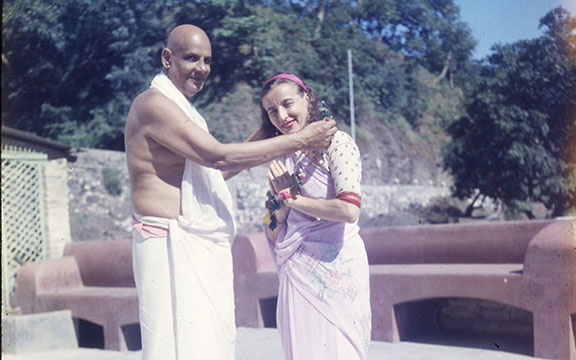
Swami Sivananda-Hridayananda Born on the 18th of April 1914, in an orthodox and pious family of Perur, in Travancore (Kerala) State, she was known as Chellamma. She passed her Senior Cambridge examination privately and then had her Inter and M.B., B.S., combined course of 7 years at the Lady Hardinge College, Delhi. She was one of the brightest students and had won many prizes and medals. In 1942 she was appointed as Asst. Surgeon in the Govt. Opthalmic Hospital, Madras. Being very efficient, she got quick promotions and became the Civil Surgeon at the same hospital. In 1951 she resigned her job and took to private practice. She happened to buy a second-hand book of Swami Sivananda at the Moore Market, Madras, and when she saw the photo of the Swami in the book, she instantaneously felt that she had known him, intimately. That book possessed her and the same evening she had a vision of Swami Sivananda in her meditation, blessing her. Since then an inner transformation was taking place in her in spite of herself. In April 1955, she came on a short visit to Rishikesh, to have Darshan of Swami Sivananda. But Sivananda played the miracle. He asked her to do some service in the hospital and when the day of her return to Madras came she decided to stay on, for ever, at Rishikesh. On the holy Guru Purnima day in 1956, she was initiated into the sacred order of Sannyasa and given the name Swami Sivananda-Hridayananda. Swami Hridayananda being an eye specialist, Sri Gurudev asked her to start a regular Eye Hospital for the benefit of everyone, as the Sivananda Charitable Hospital that was serving the people then was not a systematic hospital. Simultaneously it so happened that one Capt. Srivatsava, who was also a great devotee of Sri Gurudev, became responsible for a substantial contribution by way of donation for the construction of an Eye Hospital, which became an added incentive to step up the work. Under the instruction of Sri Gurudev himself the work of building a regular Eye Hospital commenced and progressed by leaps and bounds. Swami Hridayananda became the Medical Officer of this service wing of the Ashram and within a few years she established such a name as an expert physician and surgeon that the reputation of the expert handling of cases in the hospital reached the ears of the officials of the Government in the State and the Centre, who were eager to assist our hospital by grants given by the Government.Swami Hridayananda was very personally associated with Sri Gurudev not only as a Medical Officer but as a personal assistant and personal physician. In addition to her medical career, she was also an ardent spiritual seeker who wrote articles, essays and even books on Sri Gurudev which was an expression of her aspiration and devotion to Sri Gurudev. She became very famous as a spiritual guide to many people and seekers who came to the Ashram and a very able physician and surgeon at the same time. This fame of Swami Hridayananda Mataji as a spiritual guide particularly brought her request from various parts of the country and even abroad. Invitations came from different places and one of them was from our revered Sri Swami Sahajanandaji Maharaj of Durban, South Africa, which invitation she accepted and went to South Africa. From South Africa she toured different parts of Europe and America, where she conducted extensive series of lectures and established certain centres for spiritual guidance. Finally she is now settled in Europe (France, Belgium and Holland), which is a delight and great satisfaction to seekers in those parts.

Swami Sivananda-Hridayananda Read Post »
ChatGPT Image Feb 13 2026 05 10 27 PM
Our Heritage, Swami Sivananda, Uncategorized

Swami Devananda

Swami Devananda G. Sannyasi (that was the pre-Sannyasa name of Swami Devananda) was born on the 19th of June, 1937 (Eswarnama Samvatsar Jyestha Shuklapaksha Ekadasi Day), in a pious family in Andhra Pradesh. At a very young age he left home and joined Sri Brahmananda Ashram in Andhra Pradesh and took Sannyasa in 1954. For sometime he was in the holy Vyasashram, Yerpedu, near Tirupati and then came to Rishikesh in 1957. Swami Sivananda recognized the worth of this young Swami and took him for his personal service. Certainly it is the purva-punya (meritorious deeds of past births) of Swami Devananda that gave him this blessed and rare privilege of doing all sorts of personal service to Sri Gurudev, including menial service. This close and constant association with the sage had its unfailing effect on the young monk,-he automatically imbibed the divine virtues from Sri Gurudev, particularly of the gift of ‘giving’. His service to Sri Gurudev during the last days has earned him the special blessing of the master, which has made him what he is today. A man of self-effort and determination, coupled with devotion and application, he has made himself great in his own way. He is a master Sankirtanist, who can awaken and keep thousands spell-bound by his soulful Bhajans and Kirtans, and transport them to a different realm altogether, for which he is invited every year to Orissa and Andhra Pradesh. And recently he was chief organizer of the group of Sannyasins and Sadhaks who went from the Ashram on an All-India tour, in 1985, propagating the teachings of Sri Gurudev’s work into the Telugu language. His dedication to Sri Gurudev and his Mission is total and undivided. Swami Devanandaji Maharaj attained Mahasamadhi and left for his heavenly abode at 10.20 am on 7th January 2000.

Swami Devananda Read Post »

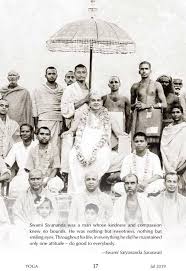
Swami Sivananda Large group of monks with guru picture
Our Heritage, Swami Sivananda

Swami Brahmananda

Swami Brahmananda Swamiji’s pre-monastic name was Sri K. Nilakantha Iyer. He was born at Thonnakkal village of Tiruvanantapuram district, Kerala, to the pious Brahmin parents Sri Krishna Iyer and Srimati Rukmini Ammal on 26th June 1910. He was the eldest of five children. He studied at Tiruvanantapuram. After graduating from Travancore University (now Kerala University), he joined the service of the erstwhile princely state of Travancore. He was married and had a son. His wife passed away in 1944. His parents pressed him to marry again, but he declined. Sometime in 1946, he bought the book �Practice of Yoga – Vol I’ of Gurudev Swami Sivananda at Tiruvanantapuram railway station. Inspired by the book he came to Rishikesh the same year to have Darshan of Gurudev and had Mantra Diksha from him. Thereafter he regularly came to the Ashram once every year except 1950. In 1947 Swamiji thought of giving up home. But Gurudev advised him to continue on the job till he had full eligibility for pension. He organised the Divine Life Society branch at Tiruvanantapuram. It was functioning in his house. In 1950 he also organised Gurudev’s All India and Ceylon Tour in Tiruvanantapuram circle. His father was a member of the Tour Organising Committee. Gurudev went to their house and performed Arati in the Puja-room. Around 1951 he made a trip to Kedar etc. with his son. At Kedar, something pricked and wounded his son’s left heel. The wound became septic. Despite treatment it got worse. The heel turned black and caused excruciating pain. Amputation at a Dehradun hospital was planned. But the next day, the Ashram doctor noticed miraculous improvement and said that amputation would not be necessary. What had happened meanwhile? Nilakantha Iyer asked his son. The boy said that Gurudev came to him the previous day, ordered opening of the bandage, looked at the wound and recited Mahamrityunjaya Mantra for a while. Nilakantha Iyer took voluntary retirement on 1st October 1957, and retired as a Class I officer, Superintendent of the Kerala Government Press, Tiruvanantapuram. He shifted to Rishikesh in 1958. But he was the only surviving son of his aged parents. And he had the only son who was young. He had his responsibilities towards them. So he divided his time between Rishikesh and Tiruvanantapuram. He used to spend eight or nine months at Rishikesh and three or four months at Tiruvanantapuram. During the early years of his life at Rishikesh, he lived at Ram Nagar and then shifted to Muni-ki-reti. Along with some fellow-disciples he lived in a thatched but in the Ramashram premises. He also stayed for a while at Hanuman Mandir near the Ashram. Once Sringeri Sankaracharya H.H. Sri Abhinava Vidyateertha came to Tiruvanantapuram. A group of devotees including Nilakantha Iyer went for his Darshan. The Acharya advised them to worship Lord Subramanya. During the subsequent discussion on this advice by the group, Nilakantha Iyer suggested building a temple of the Lord. He was entrusted the responsibility as convenor of the construction committee. The temple was constructed in accordance with the Pancharatra Agama and the Kumbhabhisheka was done in June 1964. Swami Sivanandaji Maharaj had given him ochre cloth and Sannyasa Mantras. He even gave the monastic name Swami Brahmananda Saraswati. But Viraja Homa had not been done. Gurudev shed his mortal coil in July 1963. Nilakantha Iyer was at Tiruvanantapuram then. In August 1963, his father also passed away. The temple construction had been completed. Now he decided to stay permanently at Rishikesh. His death some years hence was predicted according to the horoscope. He was anxious to become a full-fledged Sannyasi before this happened. At his request H.H. Sri Swami Krishnanandaji Maharaj initiated him into Sannyasa in July 1968 on Guru Purnima day with Viraja Homa, etc. After Sannyasa he started living in the Ashram premises. For many years Swamiji was conducting a study group in the Ashram. The group met daily and went through the scriptures. The members knew Tamil, Malayalam, English and some Sanskrit and Hindi. They used to read different commentaries in all these languages. The pace was quite unhurried and the grasp was thorough. They took one-and-a-half years to study the first six chapters of the Bhagavadgita. Swamiji also attended the early morning prayer of Swami Vidyanandaji Maharaj for ten years. The prayer session would start at 3.30 a.m. daily. Swamiji scrupulously observed purity, dispassion and aspiration-the marks of the Sannyasa Ashrama. He used to instruct his students later: �If one lives a pure life according to his station in life, liberation will be waiting for him at the end.’ On 18th July 2002, Swamiji had been to Dehra Dun for seeing H.H. Sri Swami Chidanandaji Maharaj, the Revered President of the Ashram. The latter told an attendant of Swamiji: “I have had darshan of a Jnani on Guruvar (the day of the Guru, i.e., Thursday)”. Swamiji was a great scholar of Vedanta. He taught Vedanta at the Yoga-Vedanta Forest Academy of the Ashram for many years. Also he used to hold two or three classes a day in or near his room for the residents and visitors. In addition to Vedanta, Swamiji taught Itihasa, Purana etc., but with the touch of Vedanta. Many times Swamiji would hold classes even going against the medical advice to rest. Thus Swamiji taught till December 1995, when he was running 86. He loved questions and encouraged students to clear their doubts. Over the decades, hundreds of students have benefited from his classes. Yoga Vasishtha was a favourite text of Swamiji. Once Swamiji taught it continuously four times-for six years. With absolute conviction and unending patience he would urge his listeners to reflect over their own daily experience of deep sleep, dream and waking. He has written five books which are of a very high order. Swamiji was a living embodiment of what he taught. His very being and life expressed perfect humility and simplicity, deep inner strength and peace, innocence and keen alertness. He was gentle,

Swami Brahmananda Read Post »

Swami Sivananda seated with musical instrument image
Our Heritage, Swami Sivananda

Swami Vidyananda

Swami Vidyananda Born in a pious and religious family in Kerala in the year 1914, he was known as Ramanathan, the second son of a big family consisting of 2 sons and five daughters. The influence of the mother over the boy was very profound in creating spiritual Samskaras in him. At the age of eight, his mother took both her sons on a long pilgrimage for three years, all over India, during which period the young boy had the opportunity of receiving the blessings of many Siddha-purushas and holy saints. After an unsuccessful business-career, he went to Chidambaram, in Tamilnadu, where he came in contact with his music Guru, Sri P. Srinivasa Iyer, who was himself a Naishthika Brahmachari and a saintly soul. He taught him Veena for 12 days after which he asked him to practice on his own, but the Guru’s power and grace was such that he soon not only mastered the subtle art but also could connect music with Vedantic thoughts. In order to help his student support his large family, Sri Srinivas Iyer put him in the Cinema field, in which Sri Ramanathan worked for nearly 25 years, in Bombay and Madras. This was more a period of Sadhana for him than earning money. In 1950, he became a member of the Divine Life Society and in 1954; he came to Rishikesh along with his music Guru for Swami Sivanandaji’s Darshan. Sivananda asked him to stay here permanently and said that he had been praying to Goddess Saraswati to send a person who could play on the Veena. However, he had to go back to Madras to complete his contracts and other pending works, and joined the Sivananda Ashram in 1956. On the holy Guru Purnima of the Same year, Sivananda gave him Sannyasa and named him Swami Vidyananda. Since then Swami Vidyananda has been teaching music, Bhajans and Kirtans on the Veena to many students, as an integral part of his Sadhana. He holds an early morning Bhajan class and afternoon study-class in his own room, every day, in which interested Ashramites and derive the much needed peace and solace. His feelingful Bhajans and mastery in Veena have endeared him to countless visitors, who make an annual visit to the Ashram, primarily to recharge themselves with the divine vibrations in his Bhajan-class. His Bhajans are a treat to the souls and many are the foreign students who were enchanted by his soulful songs that wished to take him to their countries. But the Swami is happy and contented with his simple life of Bhajan, Kirtan and study in his tiny room, on the banks of the Ganga, in the holy Ashram of Sri Gurudev, keeping himself in continuous remembrance of the Lord. It is not unusual to see him go into a trance while singing Bhajans and Kirtans.

Swami Vidyananda Read Post »

Swami Sivananda Guru surrounded by devotees in gathering image
Our Heritage, Swami Sivananda

Swami Nadabrahmananda

Swami Nadabrahmananda Sri Basavaraj Puranik was born on May 5, 1896, in Mysore State, South India. He began his formal musical training at the age of 20, and continued seventeen years of arduous discipline and austerity under three illustrious masters: Sri Sadashiva Bua of Nargund (Karnataka), Ustad Alladia Khan of Kolhapur, and Tata Bua of Benares. He became professor of music at Benares Hindu University, and was appointed court musician for the Maharaja of Mysore. His fame spread throughout India and he received numerous commercial offers, but in accordance with a vow made to his Guru, he steadfastly refused to compromise the spiritual purity of his music. Sri Puranik came and joined the Ashram on the 13th of December, 1952 and he was initiated into the order of Sannyasa by Sri Gurudev in 1953, with the monastic name of Swami Nadabrahmananda. He was the principal of the Music Centre in our Ashram which virtually was raised to the status of a Music College under the patronage of Sri Gurudev and Nadabrahmananda. A beautiful singer, master of the art of Music due to which proficiency of his people used to call him modern ‘Tabala’. Such was his confident touch in the Ragas of Music as well as handling of Tabala! His expertness in the various technicalities of musical performance earned him great name in different parts of the country and from many devotees who came to the Ashram, hundreds and thousands in number. He lived for sometime in Dehradun among the devotees of the Society and became responsible for starting a little Branch of the Divine Life Society at that time in Krishnanagar (Dehradun), after which again he came back to the Ashram and settled down. He lived in this Ashram for years and years like this, teaching Music and conducting Music Concerts under the auspices of Sri Gurudev. Years after the passing of the great Master, he went to the West, firstly to the United States and thin to several other states and Europe also. His ability to present himself as a master musician was really superb and people got thrilled and thousands of devotees and eager students were trained by him, who all remembers him with great reverence and devotion, love and affection even today. His departure from the United States due to age and fatigue and his coming back to the Ashram on that account brought a sense of bereavement, as it were, among the students in Guru and almost a God-man in the field of Music. He is now in the Headquarters Ashram living alone to himself and confining himself to his own Kutir.

Swami Nadabrahmananda Read Post »

Swami Sivananda with devotee in gathering image
Our Heritage, Swami Sivananda

Swami Jyotirmayananda

Swami Jyotirmayananda Swami Jyotirmayananda was born on the 3rd of February, 1931 in a pious family in the state of Bihar. From his very childhood days he showed signs of his future greatness. He was calm and reflective, brilliant in his studies, as also loved by his friends and relatives. While he was studying in the Science College of Patna, when he was 18 years of age, he had read Swami Sivananda’s book “Mind, Its Mysteries and Control.” This had captured him and When Swami Sivananda visited Patna during his All-India tour in September, 1950, he had Swamiji’s first Darshan at Patna. Then on his mind was drawn towards his Master more and more. Finally in 1952 he came to Rishikesh on a short visit, but stayed on permanently. Gurudev found that he is a good speaker and entrusted him with the work of conducting classes. He also held regular discourses, very frequently, during the evening Satsangas in the Ashram in the very presence of Sri Gurudev. After being granted Sannyasa by Sri Gurudev on the 3rd of February, 1954, he took to literary side of work more intensely and became the editor of the Hindi journal of the Society known as ‘Yoga-Vedanta’. This work he did exquisitely, in addition to conducting daily classes on scriptures such as the Yoga-Vasishtha in the Ashram’s Bhajan Hall, which many visitors attended with great love and concentration and interest. His exemplary life, great command of spiritual knowledge, love towards all beings, and his very impressive and dynamic exposition of Yoga and Vedanta Philosophy attracted enormous interest all over India, and in different countries of the world. He frequently lectured by invitation at All India Vedanta Conferences in Delhi, Amritsar, Ludhiana and other parts of India. Thus he continued the work of editing the ‘Yoga-Vedanta’ journal and conducting the scriptural classes until 1962, when on an invitation from a well-wisher of him he travelled to the West. Crossing Europe, he stayed for several years in Puerto Rico and in 1969 he shifted his centre to Miami in the United States where he has established a Publishing Centre and a systematically working Yoga Research Foundation, he himself being a very learned scholar, a prolific writer and a gifted speaker.

Swami Jyotirmayananda Read Post »

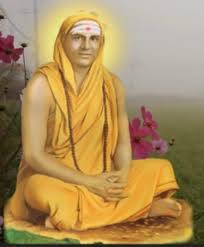
Swami Sivananda seated in yellow robes with glowing halo image
Our Heritage, Swami Sivananda

Swami Omkarananda

Swami Omkarananda Swami Omkarananda hails from Andhra Pradesh, he was born in Hyderabad on the 25th of December, 1929. He came to the Ashram as a small boy 17 years of age in the year 1946 and Sri Gurudev immediately entrusted him with the work of type-writing, copying and editing. He had an insatiable desire for reading books which desire of his he fulfilled by pouring over tomes throughout the night with a little chimney lamp during those days when electricity was not in the Ashram and had almost a passion to become a literary specialist in the English language which wish of his was partially fulfilled to the satisfaction of Sri Gurudev himself. He was entrusted with the management of the Ashram’s printing press in the year 1953, in which capacity he worked for about a year. Later on like a devil he worked day and night without taking rest, taking only tea, in which work Sri Narasimhulu of the Ashram assisted him very effectively, especially in type-writing manuscript, copying manuscript, etc., of Sri Gurudev. Apart from editing and compiling such massive works like Sadhana, Swami Omkarananda also is known as the author of some independent productions like the Foundation of Swami Sivananda’s literature, etc., during the days of his life in the Ashram, till about 1966.

Swami Omkarananda Read Post »

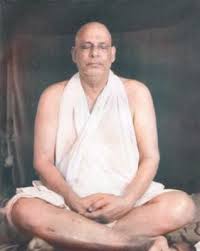
Swami Sivananda sitting in meditation pose image
Our Heritage, Swami Sivananda

Swami Chinmayananda

Swami Chinmayananda Known as Balakrishnan, he was born of noble parents at Ernakulam (Kerala) on the 8th of May, 1917. The rigidity of the family daily routine of worship, lasting for quite a few hours, became part and parcel of the mental and moral make-up of the young lad. And, added to this, he had the rare chance of coming under the influence of his family-Gurus who were saintly souls Right from young age he had the inquiring mind which critically questioned everything. He was equally brilliant in his studies and emerged out of the Lucknow University as a Master of Arts. Like many of the highly learned youths who find them selves in a dilemma as to what to do with life when they come out of the universities, Balakrishnan too was assailed by doubts with conflicting ideologies. But providence guided him properly; he studied the great works of Swami Vivekananda, Aurovindo and others, and found his way to his Master, Swami Sivananda. Swami Sivanandai Maharaj knew that he was an exceptionally gifted person and entrusted him with conducting a Gita Committee, as Gurudev called it, which consisted of some members,-the members being Sri Balakrishna Menon (Swami Chinmayananda), Swami Krishnananda (II), a very learned philosopher from Bihar called Sri Nanda Kishore Srivastava, etc. He used to conduct classes in the Ashram, now and then. He was ordained into Sannyasa by Sri Gurudev on 25th February, 1949 to pursue further studies of scriptures under Swami Tapovanamji Maharaj, in Uttarakashi where he stayed with the great Master studying panchadasi and other Vedanta Texts as well as Upanishads. Having mastered these texts. Swami Chinmayananda started his own Jnana Yajna Mission and moved from corner to corner of India conducting Gita Yajna classes, Upanishad classes and discourses on the scriptures, which earned him great reputation as an extraordinary orator and a masterly exponent of India’s culture, its literary heritage and scriptural lore. Swami Chinmayananda has also travelled to the West many a time. He has Centers in various places in India and also abroad. Today he is one of the world-figures who have hoisted the flag of India’s spiritual heritage not only in this country but also in the other countries of the world.

Swami Chinmayananda Read Post »

Swami Sivananda collage with Spiritual teachers picture
Our Heritage, Swami Sivananda

Swami Madhavananda

Swami Madhavananda Born on the 15th of December 1917, and known as Karunanidhi, he hails from Andhra Pradesh. As he lived in both the outskirts of Andhra Pradesh and Karnataka, he is very conversant with the atmosphere of both the States and knows Telugu and Kannada languages. When Karunanidhi arrived at the Ashram, he found that revered Sri Gurudev was away upon his “All-India Spiritual Awakening Tour”. He was cordially received by Swami Krishnananda who was the in-charge of the Ashram during the absence of Gurudev and all the other office-bearers. He awaited Gurudev’s return and met him for the first time on 8th November, 1950. It would appear that right at this first brief meeting and talk Gurudev immediately recognised his potentialities. Very surprisingly and to the wonder of many people, Sri Gurudev at once gave him the work of the Cashier of the Ashram. Those were very hard days as the funds were almost nil, and it was not easy for anyone to perform the duties of the Cashier. Karunanidhi as a Cashier, prior to his being ordained a Sannyasin, spent very difficult times of course with shop-keepers who were creditors of the Ashram. But with his calm, quiet and reticent nature he managed his little function of the Cashier those days very well. Recognising his spiritual worth, Sri Gurudev gave him Sannyasa within months of his arrival, i.e., on Mahasivaratri, the 6th of March, 1951 and named him Swami Madhavananda. After two or three years of his service as a Cashier, he was appointed by Gurudev by nomination as a Secretary, which, of course, increased the weight of the work he had to perform. This position of responsibility he ungrudgingly accepted and immediately commenced this performance spread over a wide area of the different departments of the Institution. Not only this; together with the responsibilities as Secretary, he took upon himself, of his own accord, the additional burden of supervising the construction works of the Ashram, sheerly with the intention of seeing that there is no wastage of any kind and the building works are efficiently carried on in the interest of public good. Those were days when the Ashram was inordinately hard-pressed with inadequacy of financial resources and the work of the Secretary was indeed not a happy job. It was something which would wear out anyone and fatigue even a strong personality. The Swami indeed worked very hard and steered the course of The Divine Life Society’s functions at the Headquarters during those difficult days when the income side of the Institution was hardly worth mentioning. There were many occasions when it looked that it was difficult for the Ashram to make both ends meet and one could not predict the fate of the Ashram the next day. Such was the nature of the problem created by the financial stress. Swami Madhavananda did indeed bear the brunt of the pains that an Executive of the Institution would have to undergo under such circumstances. The entire saga of the history of the Ashram at its Headquarters during those years would speak eloquently of the sacrifice which the Swami personally did, as the times required, without rest and without even adequate sleep. The several years of such strenuous work naturally told upon his system, particularly the condition of his heart, which called for special attention by way of medical treatment. All this did not deter the Swami from continuing his Seva to the Institution, and it, indeed, did not cease at any time. At the same time, he is a very religious type of person, meticulously following a daily routine of prayer and worship for several hours. He is a reserved type of person who minds his own business, as one may say, not interfering and unconcerned with anything in the world, except whatever work is entrusted to him, and always confined to his own Kutir of prayer and worship. Swami Madhavananda was elected as the Treasurer of the Divine Life Society in August 1963, soon after the Mahasamadhi of the Master. And in due recognition of his glorious services, he was elected as the Vice-President of the Divine Life Society, in the year 1975, which position he continues to hold till this day. This was really as it ought to have been, considering not only his elderly personality but also the intense sincerity with which he has always been identifying himself with the Ashram’s spiritual ideals, the amiableness of his nature and the goodness of his hearth to mention only a few of the exemplary characters which are embodied in his person.

Swami Madhavananda Read Post »

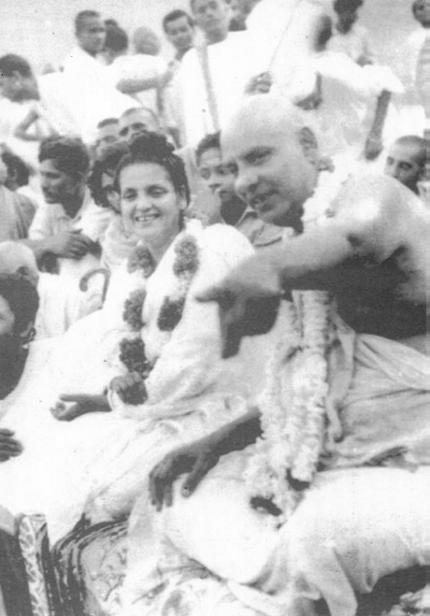
Swami Sivananda garlanding woman outdoors image
Our Heritage, Swami Sivananda

Swami Dayananda

Swami Dayananda Born in Bhimavaram, Andhra Pradesh, in the year 1923 to prosperous parents, he was known as Ramalinga Raju. Even when he was studying in college, he was interested in the literary side, particularly philosophy and religion, and he was an admirer of Dr. Radhakrishnan, especially. Suddenly he felt an urge to renounce the world and found himself at the feet of Swami Sivananda, in the year 1946. Reading, doing Japa and meditation were his specialities. Swami Sivananda recognised the great spirit of renunciation in the young man and initiated him into the holy order of Sannyasa within two years of his joining the Ashram, on 14th January, 1948 and gave him the monastic name of Swami Dayananda. He accompanied Sri Gurudev during the All-India tour in 1950 and did untiring service to him, day and night, with great love and care. Swami Dayananda is known as the active participant in the work of The Divine Life Society from the time Sri Gurudev felt it necessary to have a wing of the Ashram helping in printing work. The very seed of the Printing Press, it may be said, was sown by Swami Dayananda. Over night he worked a miracle, as it were, and brought a printing machine (a tradle machine) from Rishikesh town and saw to it that the very next day (20th September, 1951) the inauguration of the Printing Press so dear to Sri Gurudev was performed. He also worked and struggled tooth and nail to bring electricity to the Ashram, which he succeeded in bringing, a few years after the founding of the Printing Press. Actually the manner in which he brought electricity to the Ashram is an epic, a saga by itself. No person would have succeeded easily in doing that work, since it required permission from the Government which was not eager to spend money, for the sake of bringing connection to the Ashram. Anyhow by moving the District Magistrate of Dehra Dun, Swami Dayananda succeeded in doing this work. Thereafter he concentrated himself entirely on the Printing Department, even till today. Due to his persistent and tenacious concentration on this work the Press has increased its dimension. It has become one of the top-most Printing plants in the Garhwal region, which is all due to his indefatigable work and totally unselfish labour. Sri Gurudev loved him so much that once he said, “Ah! I am proud of you, Swami Dayananda,” and added, “You are an embodiment of Nishkama Seva.” Today, he is the main-spring behind the management of the Printing Press. Swami Chidananda paid his tribute thus: “Swami Dayanandaji Maharaj has been a pillar of this Institution over these decades. Today he is a �Veetaragi’, a �Nirlipta’, �Tyagi’ Saint. He is a rare Sadhu who in the midst of intense Guruseva is yet ever engaged in trying to abide constantly in the state of �Atma-samsthiti’. He is also �Iccha Rahita’ Yogi in the sense that he has no personal self-desire of any sort in his life. He has one overwhelming desire and that is Sri Gurudev’s Jnana Yajna. Other than his desire to meditate, meditate, meditate, his only second ambition in life is to see each and everyone of Holy Master Sivananda’s books in print and to make them available to thirsting spiritual aspirants all over the world.” In the year 1970, Swami Dayananda was appointed as one of the Secretaries of the Divine Life Society, in which post he continued till September, 1975 when he was elected by the Board of Trustees as a member of the Trust Board and Treasurer of the Divine Life Society. Revered Swami Dayanandaji Maharaj attained Mahasamadhi on Monday, 4 February, 2002.

Swami Dayananda Read Post »