Hari Om

Menu

Karma Yoga

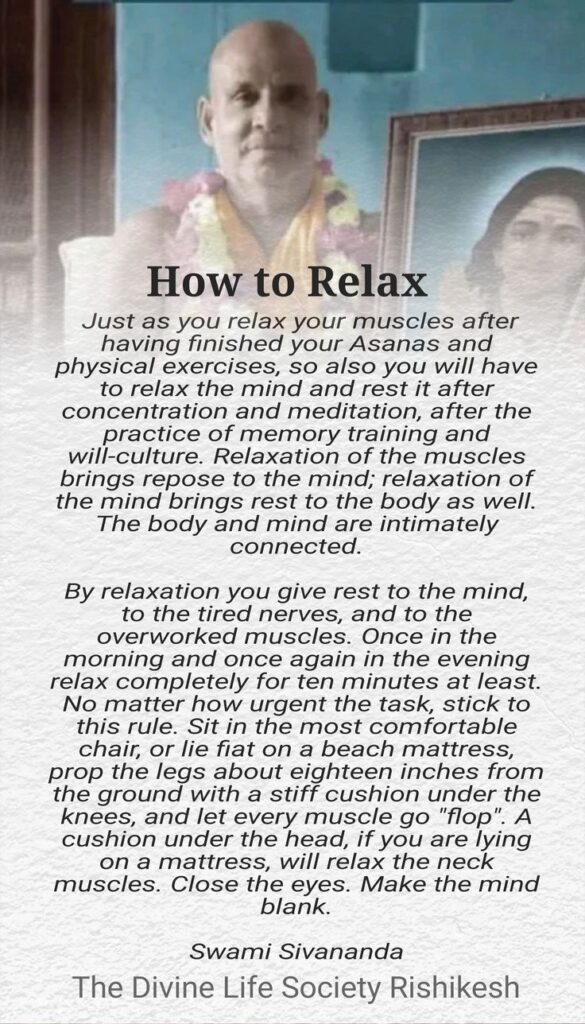
Swami Sivananda relaxation guidance poster image
Karma Yoga, Swami Sivananda

Sin is a Mistake Only

Sin is a Mistake Only The ignorant man only says: “I am a great sinner.” This is a serious mistake. Never for a moment think that you are a sinner. You are the most holy one, you are the ever-pure Atman. Sin cannot touch you. You are above vice and virtue, Dharma and Adharma. Punya and Papa are mental creations only. Sins are mistakes only. An ignorant Jiva commits these mistakes during the course of his journey in this world on account of Avidya or ignorance. Through mistakes he gains experiences and marches forward in his path of spirituality. Every mistake is your best teacher. One has to evolve through sins and mistakes. These mistakes are inevitable. Some people become a prey to thoughts of sin. They ever brood: “We are great sinners. We have committed many crimes.” This is a great blunder. Whenever thoughts of this nature worry you, you should think: ‘I am doing Japa of Om. This will burn all old sinful actions. This will purify my mind. I am doing Tapas, fasting and charity. These are all great purifiers. I am becoming purer and purer. Nothing can affect me now. I am like the effulgent fire. I have become a holy person.’ Assert, whenever such negative thoughts of sin trouble you: ‘I am the Nitya Suddha, ever-pure Atman.’ Hear the words of assurance of Lord Krishna in the Gita: “Even if thou art the most sinful of all sinners, yet shall thou cross over all sin by the raft of wisdom. As the burning fire reduces fuel to ashes, O Arjuna, so doth the fire of wisdom reduce all action to ashes. Verily, there is no purifier in this world like wisdom; he that is perfected in Yoga finds it in the Self in due season.” Ch. IV-36, 37, 38. “Even if the most sinful worships Me with undivided heart, he too must be accounted righteous, for he hath rightly resolved. Speedily he becometh dutiful and goeth to eternal peace. O Kaunteya, know thou for certain that My devotee perisheth never. They who take refuge in Me, O Partha, though of the womb of sin, women, Vaishyas, even Sudras, they also tread the highest path. How much more easily, then, the holy Brahmins and devoted royal saints (attain the goal); having obtained this impermanent and unhappy world, do thou worship Me. Fix thy mind on Me, be devoted to Me, sacrifice unto Me, bow down to Me, having thus united thy whole self in Me, taking Me as the supreme goal, thou shalt come to Me.” Ch. IX-30

Sin is a Mistake Only Read Post »

Swami Sivananda feet Devotee bowing image
Karma Yoga, Swami Sivananda

Doctrine of Reincarnation

Doctrine of Reincarnation The doctrine of reincarnation is accepted by the majority of mankind of the present day. It has been held as true by the mightiest Eastern nations. The ancient civilisation of Egypt was built upon this doctrine, and it was handed over to Pythagoras, Empedocles, Plato, Virgil and Ovid who scattered it through Greece and Italy. It is the keynote of Plato’s philosophy when he says that all knowledge is reminiscence. It was wholly adopted by the Neo-Platonists like Plotinus and Proclas. The hundreds of millions of Hindus, Buddhists and Jains have made this doctrine the foundation of their philosophy, religion, government and social institutions. It was a cardinal point in the religion of the Persian Unagi. The doctrine of metempsychosis was an essential principle of the Druid faith and was impressed upon the Celts, the Gauls and the Britons. Among the Arab philosophers it was a favourite idea. The rights and ceremonies of the Romans, Druids and Hebrews expressed this faith forcibly. The Jews adopted it after the Babylonian captivity. John the Baptist was to them a second Elijah. Jesus was thought to be a reappearance of John the Baptist or one of the old prophets. The Roman Catholic purgatory seems to be a makeshift, contrived to take its place. Philosophers like Kant, Schelling and Schopenhauer have upheld this doctrine. Theologians like Julius Muller, Dorner and Edward Beecher have maintained it. And today it reigns over the Burmese, Siamese, Chinese, Japanese, Tartar, Tibetan, East Indian and Ceylonese including at least 750 millions of mankind or nearly two thirds of the human race. Is it not wonderful than that this great and grand philosophical education which the Hindus, Buddhists and Jains gave to the world centuries and centuries before the Christian era should or could be blotted out of existence from the Western and European world by the soul-blighting and absurd dogmas of the dark ages that supervened? By the persecution of the wise men and destruction of innumerable works in the library of Constantinople, the Church hierarchy managed to plunge the whole of Europe into mental darkness which has given the world the black record of the inquisition and the loss of millions of human lives through religious wars and persecutions. Here is a challenge to the non-believers of the Hindu theory of transmigration. Recently a little girl Santi Devi gave a vivid description of her past lives in Delhi. There was a great sensation in Delhi and Muttra, nay, throughout the United Provinces. There was a great assembly of persons to hear her statements. She recognised her husband and child of her previous birth who are living in Muttra. She pointed out the place where money was kept, and an old well in the house which is covered now. All her statements were duly verified and corroborated by respectable eye-witnesses. Several cases like this have occurred in Rangoon, Sitapur and various other places. They are quite common now. In such cases the Jiva takes immediate rebirth with the old astral body or Linga Sarira. That is the reason why memory of previous birth comes in. He did not stay in the mental world for a long time to rebuild a new mind and astral body according to his previous experiences of the world. Transmigration made its appearance in the early Christian church. Elijah was reborn as John the Baptist. “Did the blind man sin, or his parents, that he was born blind?” ask the believers in transmitted retribution. There is a period of anxiety immediately after death, when angels contend with demons for the possession of the departing soul on its way to purgatory. Pythagoras and others obtained their belief in metempsychosis from India only. Pythagoras who flourished in the sixth century also taught a doctrine of transmigration; and, curiously enough, prescribed abstinence from the eating of flesh. The suckling of a child and the act of swimming of a duckling-these instinctive acts are proofs of memory which must be the result of their corresponding and inseparable impressions left by the same acts in a previous incarnation, never mind when and where. Every act leaves Samskaras in the Chitta, which causes memory. Memory in its own turn leads to fresh actions and fresh impressions. This cycle or Chakrika goes on from eternity like the analogy of the seed and tree. There is no beginning for them, the desire to live being eternal, ‘for them’, i.e., for the desires. Desires have no beginning or end, every being has clinging to this physical life (Abhinivesa). This “will to live” is eternal. Experiences are also without beginning. You cannot think of a time when this feeling of ‘Aham’ or ‘I’ has not existed. This ‘I’ exists continuously without interruption. From this we can very easily infer that there have been previous births for us. Now, could there be fear of death to avoid pain in any being who has only been born, if he has had no experience of liability to death, it being understood that desire to avoid anything is only caused by remembrance suffered in consequence thereof? Nothing which is inherent in anything stands in need of a cause. How could it be that a child, who has not experienced this liability to death in the present life, should, as he is falling down from the mother’s lap, begin to tremble and hold with his hands tightly the necklace hanging on her breast? How is it that such a child should experience the fear of death, which can only be caused by the memory of the pain consequent upon aversion to death, whose existence is conferred by the trembling of the child? We have boy-geniuses. A boy of five becomes an expert on the piano or violin. Sri Jnanadev wrote his commentary “Jnaneshwari” on the Gita when he was fourteen years old. There have been boy-mathematicians. There was the boy-Bhagavatar in Madras who conducted Kathas when he was eight years old. How could you explain these

Doctrine of Reincarnation Read Post »

swami sivananda Illustration of spiritual saint seated with Om symbol
Karma Yoga, Swami Sivananda

True Evolution

True Evolution What then is true evolution? It is, as once before stated, the progress of the thinker in man from his present condition of limitedness to the state of the unlimited Self. Progress of the thinker means improvement and growth of mind through which he thinks. In the physical plane, all vegetable and animal bodies develop out of the life-germ, the unit cell. The embryonic cell sometimes divides itself into two or more cells and sometimes, as in the case of the lower forms of life, becomes associated with new cells drawn from outside. In any case, development of the embryo implies multiplication of the cells. Mere multiplication of the cells again cannot make a living body. Along with it, there is also the widening or expansion of the life within so as to control all the cells together. Similarly, a man’s mind is said to grow or expand when his thoughts extend beyond his physical body and beyond his limited personality. As the original unit cell is the earliest and lowest state of the physical body, thoughts of one’s own interests alone belong to the lowest stage of the mind. The mind grows when the interests of others are also considered, as the physical body grows up packing together more cells. As there is connecting life for all the cells together, selfless thoughts or thoughts of others’ interests should be bound up together by a connecting and unifying knowledge that all are only the Self. The end of the evolution of the thinker is reached when the evolving mental life becomes, by expansion, identical with the all-including life, the universal Self. If, however, his thoughts and actions are directed exclusively towards personal and selfish ends, his mind contracts more and more and recedes still further from the path of evolution. He should therefore think only such thoughts and do only such actions as may widen his mind and raise him up in evolution. The mind has to expand and expand until the limiting mind-covering, becoming very thin, is torn asunder when, the limitations of the thinker ceasing to exist any longer, his inner Self shines in his infinitude of existence, consciousness and bliss, for it was only he, the only one and the real Self that was appearing till then as enclosed in a covering made of mindstuff.

True Evolution Read Post »

images 94
Karma Yoga, Swami Sivananda

Who Evolves

Who Evolves Further, what is the cause of growth or evolution? Why should an entity which was sometime ago in the vegetable stale now appear in an animal body? Is its advancement or promotion to a higher state of being only accidental? If not, in what way did it merit the promotion? Is the vegetable capable of doing any responsible act or Karma for which it is rewarded? If it is itself not capable of doing any, is its ascent in evolution compulsory and due to the act of another agent? If so, does it mean that the fruits of action may go to one who did nothing to merit them? Among the lower animals themselves one is found happier throughout its life-span, from the moment of its birth, than another? Why should it be so? The differences in the animal’s experience of pain and pleasure must have their own causes. What are they? The causes must relate to the previous existence of every such Jiva in question. This previous life could not have been that of a lower animal, for lower animals can do no responsible Karma. The law of Karma and justice, if it is true at all, shows unmistakably that there is no real foundation for the notion that there is evolution going on below the stage of man. Every brute, every little insect and every one of the plants and trees, all were, and are going to be again human beings themselves. They are all temporarily only suspended from the class of humanity for some offences. It may be asked, if all non-human states of being are only the results of the previous human Karma, in the beginning stage of the universe, there must have been only men and nothing else; is there any authority to show that there was a time when there were men alone and that the non-human states of being appeared only later on? The question assumes that there was a beginning for the universe. It may be that every Kalpa or Cycle of the universe has a beginning; but at the beginning of a Kalpa the universe takes the appearance in the condition in which it was just before the Pralaya or dissolution that preceded the Kalpa in question. The universe, with this alternate existence of Kalpa and Pralaya has had no beginning at all. None can say that there was a beginning for the existence of the power of Maya in the Self. As there was no beginning for the universe, there could not have been any period of time when there were men alone. At all times there have been human as well as non-human states of being in the manifested universe.

Who Evolves Read Post »

Swami Sivananda cheerfulness quote with portrait image
Karma Yoga, Swami Sivananda

The Western Theory of Evolution is Unsound

The Western Theory of Evolution is Unsound Thus evolution and involution can be, strictly speaking, postulated only of the thinker. While so, some of the Western philosophers propound a theory that there is gradual progress from the mineral condition to the vegetable, from the vegetable to the animal, and from the animal to the human, and call it the theory of evolution. In the first place no religion of the world supports such a theory, and, as Benjamin Kidd in his Social Evolution says: “The tendency of the doctrine of evolution has been generally considered to be on the whole anti-religious.” They say that evolution is going on in the universe; but what it is that is evolving they have nothing to say about. They observe different natures, bodies and objects in the universe occupying different positions in some respects and seeing that one is more ‘advanced’ than another, they make regular scales noting the different degrees of advancement. But they do not say that what is now found in the more advanced state of being must, in its essence, have been in existence formerly and must have been then in a less advanced condition. In other words, they do not say that the underlying entity which bears a more advanced form or exhibits a higher state or condition today is the same that formerly appeared in a coarser garb or functioned in a lower kind of existence. In fact, they have in general ignored the necessity, nay, even the possibility, of the continuing presence of the subsisting reality and have only directed attention to some stations on the road of evolution without caring to know whether there is anyone journeying along the road, and if so, who he is and how he is going on. In fact no evolution is possible from the stage of the mineral to that of the vegetable, for there is nothing in the mineral that can evolve. Dr. Bose’s discoveries of the modern day can have reference only to the Isvaric life, not the life of any Jiva in the mineral. The whole mineral kingdom has emerged out of the Tamasic aspect of Maya and it forms the material which goes to make the bodies of the Jivas and their means and places of support; mineral matter not composing the body of any Jiva is called ‘inanimate’ or ‘inorganic’, not because there is no life at all in it-for it has its very existence in the life of Isvara-but because there is no separate co-ordinating life-principle connecting together the several atoms in harmonious co-operation for serving some common end. It is the presence or the absence of such a separate connecting life that makes, in fact, all the difference between the organic and the inorganic sides of Nature. The view that is now and then expressed from the modern Theosophical platform: ‘every grain of sand has its Jivatma’ is clearly wrong and opposed to the clear statement in the holy books that the Jivas are to be found only in four classes of bodies, viz., Jarayuja (mammals), Andaja (egg-born), Svedaja (sweat-born) and Udbhijja (earth-born). Again, as regards the alleged evolution from the vegetable to animal and from the animal to the human, the Western evolutionists do not actually trace the passage of any entity from a lower to a higher state of being. They are only able to see that one being is more ‘advanced’ than another and that this universe is inhabited by beings of manifold gradation of advancement, physical and mental. They mentally arrange the beings under different groups and these groups as well as the beings placed in each of these groups are then arranged according to a regular and graduated scale of advancement. They then perceive that the ladder of advancement created by them in their imagination presents a really beautiful appearance and they infer that Nature, beautiful as She is, must have brought about the advancement of beings only in the order in which the rungs of the ladder appear. A big library may contain a large number of books of different gradations of thought or size. They may be arranged in some regular order. Will it be proper to infer that a book written by an advanced author has ‘evolved’ out of a book written by an ordinary man, or that a big volume has come out of a small booklet? The present-day theory of evolution has no strong foundation.

The Western Theory of Evolution is Unsound Read Post »

Swami Sivananda Framed portrait of Swami Sivananda imge
Karma Yoga, Swami Sivananda

Karma

Karma Sri R. Krishnaswami Aiyer, M.A., B.L., writes about Karma in the Hindu Mind dated October, 1935: a. Karmas Classified Karmas are good, bad or mixed. The results of good Karmas are: 1. Purification of the mind, that is to say, the removal from the mind of its drossness which is the effect of thoughts of narrow selfishness and gross sensuality. 2. Happiness in the higher regions, during the period between the death and rebirth in this physical world. If the Karma is of an exceptional nature, the thinker may even be made an office-bearer with an authority in such higher regions. 3. Coming back, as man again, to earth-life with facilities for further purification of mind. If the Karma, however, is done without attachment to its fruits and the thinker has been going along the path of Jnana (knowledge) or along the higher regions of the path of Bhakti (devotion to the supreme universal Soul) having his mind completely purified and possessing faith in the revealed truth that he and the Divine Object of his devotion are in fact one in the self, he is not bound to return again to earth-life. The results of bad Karmas are: 1. The mind becomes more and more impure. 2. Suffering in the nether region or hell during the period between the death and rebirth here. 3. If the Karma is very bad, after suffering in the nether region, the thinker is made to take his birth in this world in the lower animal or vegetable kingdom as part of his punishment. In some cases these lower births immediately follow the previous earth-life. 4. After undergoing his sufferings in hell or as a sub-human Jiva, the thinker comes again to assume a human body. He is then placed amidst very unfavourable environments to his progress onwards. These bad environments or impediments to advancement are in consequence of his own previous errors and misdoings. Mixed Karmas are partly bad and its results are: 1. The mind becomes pure in certain respects and more impure in certain others. 2. The thinker suffers for some time in hell, and enjoys for some time in the happy regions above. Afterwards he ordinarily takes birth here again as man.

Karma Read Post »

Swami Sivananda teaching disciple with motivational quote image
Karma Yoga, Swami Sivananda

As you Sow so shall you Reap

As you Sow so shall you Reap This world runs on well-established laws. There is no chaos. There is no such thing as accident or chance in life. Events occur in succession or order. There is perfect harmony. The child grows, attains boyhood and adolescence, begets children, decays and dies. The child becomes a father and the father brings forth a child. How is it that a human being is born of a human being, a horse of a horse, a cat of a cat, a dog of a dog, and a monkey of a monkey. A seed sprouts and comes out with leaves, stems, twigs and flowers. It brings forth fruits and seeds in due seasons. A seed from this fruit brings forth a tree like the parent tree. The seed of a mango tree cannot give rise to the growth of a Jambu tree. How is it that only a mango tree comes out of a mango seed, a Jambu tree from the Jambu seed, an apple tree from an apple seed? This is a great mystery indeed. There is some mysterious power that is working behind all these phenomena. That mysterious, all-pervading power or intelligence is God. He who sows paddy reaps paddy. He who sows green gram reaps green gram. He who sows oranges reaps oranges. Man sows the seed to attain what he desires to reap. Even so, man does evil deeds and reaps the fruits of pain. He who does virtuous actions reaps good fruits. One reaps the fruits according to his Karmas or actions. How is it that one man is a king, another is a beggar, one is a genius while another is a fool, one man is very wealthy while another is in want, one is always in good health while another is constantly ailing, one is handsome while another is ugly, one man is wicked while another is a saint, one dies at the age of ten while another dies at the age of ninety? Is this due to heredity? Certainly not. The operating cause is Karma. He who has done Tapas, meditation, had Satsanga with Mahatmas, served saints and devotees and lead a life of purity is born as a Yogi or a saint in this birth. He who had done vicious actions in his previous birth is born as a wicked man. He who had done a lot of charity in his previous birth is born as a king. It is only the theory of Karma that can explain things beautifully and satisfactorily. Lord Krishna says: “Whosoever at the end leaves the body, thinking of any being, to that being only does he go, O son of Kunti, because of his constant thought of that being.” Ch. VIII-6. Avidya (ignorance), Kama (desire), and Karma (selfish action) are the three Granthis or knots which bind a man to the wheel of Samsara. Man first entertains a desire to have a blanket. He says: ‘Winter is very severe now. I desire to get a blanket.’ Then he begins to think where he can get it. He now decides to get it from the local departmental store. He takes the money, proceeds to the store and purchases the blanket. He had desire at first. Then the thought made its appearance. Then there was Karma or action of moving and purchasing. The three things, viz., the desire, the thought and the action always go together. Desire and thought are internal acts. Action is external. If a man entertains good desires, he gets good thoughts and does good actions. If a man cherishes evil desires, he develops evil thoughts and does evil actions. It is the thought that develops the character of a man. If one cultivates thoughts of mercy, love, tolerance, generosity and understanding he exhibits these virtues in his character and behaviour towards others in society. The same rule applied to the sowing of seeds in the soil also applies here. If one sows the virtue of mercy, he reaps a good harvest of mercy. He becomes a merciful man. If one sows cruelty, he reaps a good harvest of cruelty. He does cruel deeds. One can change his habits, thoughts and character by developing good habits and thoughts. It is the thought that moves the body to action. There is thought behind every action. There is desire behind thought. Do not allow the desires to control your thoughts. Do not be carried away easily by all sorts of desires through emotion. When a desire manifests, cogitate, think well. Reason out whether this particular desire towards the particular object will bring maximum happiness and minimum pain. If it is otherwise, reject it ruthlessly. Do not try to fulfil it. You must control desire through thoughts. You must not allow a desire to overrule the thought. You must slowly gain the strength to control a desire. A desire, when controlled, becomes transmuted into will. You will gain will-force. Many people fall a prey to their desires and are tossed about hither and thither helplessly like a straw in the wind. This is a great pity. That man who has gained control over desires and thoughts is really a powerful and happy man. Learn to become wise. Learn to discriminate. Learn to control thoughts and desires. Watch your thoughts carefully. Do not allow any evil thought to enter the gates of the mental factory. Nip it in the bud. Always entertain holy, sublime thoughts and desires. Renounce unholy thoughts and unholy desires. Develop passion for Self-realisation. This one strong and holy desire will annihilate all other worldly desires. Understand well the theory of Karma. Cut the three knots of Avidya and realise Satchidananda. Then you are beyond the operation of the law of Karma. Then you are a Jivanmukta or a liberated sage even while living. This is the highest goal of life. This is your highest duty. All other duties are secondary and self-imposed through Abhimana, ignorance and delusion.

As you Sow so shall you Reap Read Post »

Swami Sivananda reading book by riverside mountains image
Karma Yoga, Swami Sivananda

Free Will versus Fatalism

Free Will versus Fatalism The controversy between free will and fatalism is still going on in the West and no one has come to any definite conclusion. It is a great pity that the doctrine of Karma is mistaken for fatalism. Fatalism is the doctrine that all events are subject to fate and happen by unavoidable necessity. Fate is otherwise known as luck or fortune. That indefinable mysterious something which brings trials, successes and failures to man, which shapes and moulds him by teaching lessons of various sort, which takes care of him like a mother, which brings various sort of experiences, which brings cloudy days and days of bright sunshine, which raises a beggar to the level of a landlord and hurls down a mighty potentate to the level of a street-beggar, which gives different kinds of fruits and experiences to two people of equal talents and capacities, which made Napoleon at one time a terror in the eyes of the people and at another time a prisoner, and which makes a certain portion of the life of a man quite stormy and another portion quite smooth, is called fate. Fate educates and instructs man. However whimsical the fate may appear to operate, it works in harmony with the law of causation. Fate is one’s own creation. Man acts and thinks and develops his own character. He creates a web like the spider or a silk-worm and entangles himself in its meshes on account of the three knots, viz., Avidya, Kama and Karma. He himself has enthroned fate to the level of a king and obeys its order owing to his ignorance and its effects. The doctrine of Karma is diametrically opposed to the doctrine of fatalism. Fatalism causes inertia, lethargy, weakness of will and bondage. Fatalism annihilates faith. It induces terrible fear in the people. It destroys ethics. It checks growth and evolution, whereas the doctrine of Karma is an incentive to action to better one’s condition. It is a source of solace. It gives man an assurance of a broader and happier life. It presupposes freedom of the will. Freedom is the essence of Karma. It gives opportunities for growth and evolution. The doctrine of Karma affords a most rational and scientific explanation of what is called fate. It gives a positive definite word of assurance that, although the present of which he himself is the creator or the author, is unalterable and irrevocable, he may better his future by changing his thoughts, habits, tendencies and mode of action. Herein lies great comfort, strength, encouragement and consolation to the desperate man. Herein lies a strong impetus for the man to struggle and exert for improving himself. Even a forlorn and helpless man is made cheerful when he understands this doctrine of Karma. The doctrine of Karma brings hope to the hopeless, help to the helpless, joy to the cheerless and new strength to the weak. It braces up a sunken man. It is an ideal “pick-me-up” for the depressed and gloomy. The doctrine of Karma teaches: “Do not blame anybody when you suffer. Do not accuse God. Blame yourself first. You will have to reap what you have sown in your previous birth. Your present sufferings are due to your own bad Karma in your past life. You are yourself the author of the present state. The present is unchangeable. Do not weep. Do not cry over spilt milk. There is no use. You will not gain anything by so doing. Instead of weeping over the failure of crops during last year, go on ploughing this year. You will get abundant rain this year and rich harvest. Do virtuous actions now. Think rightly. Act rightly. You will have a brilliant and a glorious future.” How beautiful and soul-stirring is this magnanimous doctrine of Karma! The doctrine of Karma develops faith and supports ethics. It says: “If you hurt another man, you hurt yourself.” Every act produces in the performer a double effect, one in the inner nature in the form of a tendency, good or bad, and the other in the form of fruit, reward or punishment. The past Karma influences the present life in two ways, first in the form of character or tendency internally and as fate externally. If you do an action, it creates a Samskara or subtle impression in the subconscious mind or Chitta. The Samskara causes a tendency. Tendency develops into a habit by repetition of the actions. The habit manifests as character. Character develops into destiny. This is the order: Samskara, tendency, habit, character, and destiny. The faculty of choosing is termed will. This will is free by its own nature. Man has a free will by his birthright. It asserts itself at every moment of our lives. Bear in mind that every small act that you perform is the resultant of triple conjoint forces, viz., freewill, character and fate. The sphere of activity varies according to the nature of your Karma and the character formed by it. If you have done virtuous actions in your previous birth and if you have developed an exemplary character, your will have a wider field of activity and vice versa. Determinism is the doctrine that all things, including the will, are determined (limited) by causes. This is the converse of free will. It is otherwise known as necessitarianism. Man has power to choose between the alternatives which fate brings before him. In choosing between them he may either follow his tendencies produced by his past actions or struggle against them. The will of a man is ever free. The arguments which are advanced by determinists in saying that human will is determined are not sound and tenable; they fall to the ground. Dear friends! Man is the master of his destiny. Wake up now from the deep slumber of ignorance. Never become a fatalist. Think rightly. Act rightly. Lead a virtuous life. Never hurt the feelings of others. Mould your character. Purify your



Free Will versus Fatalism Read Post »

images 92 1
Karma Yoga, Swami Sivananda

Man Can Outgrow Environments

Man Can Outgrow Environments It is often said that man is the resultant of his environmental forces. This is not true. We cannot believe this, because the facts always prove the contrary. Many of the world’s greatest men have been born in poverty and in adverse circumstances. Many who have been born in slums and filthy surroundings have risen to the highest status in the world. They have won laurels of fame and distinguished themselves in politics, literature and poetry. They have become brilliant geniuses and beacon-lights of the world. How do you account for this? Sri T. Muthuswamy Aiyer, the first Indian High Court judge in Madras was born in absolute poverty. He had to study at night under municipal lanterns. He had insufficient food. He was clad in rags. He struggled hard and achieved greatness. He rose above the environmental forces by his strong will and iron determination. In the West sons of cobblers and fishermen have risen to high positions. Boys who did polishing of boots in the streets and who were selling beer in bars and were cooking in hotels became famous poets and able journalists. Johnson was placed in quite adverse environments. Goldsmith was “passing rich with forty pounds a year.” Sir Walter Scott was very poor. He had no place to live in. The life of James Ramsay Macdonald is worth mentioning. He was a man of great Purushartha. He rose from poverty to power, from a field-labourer to the status of Prime Minister of Britain. His first job was addressing envelopes for ten shillings a week. He was so poor to buy tea that he drank water instead. His main meal every day for months was a three-penny beefsteak pudding. He was a pupil-teacher. He took great interest in politics and science. He was a journalist. Gradually, through right exertion (Purushartha), he rose to the position of a Prime Minister. Sri Sankaracharya, the exponent of Advaita philosophy, a spiritual giant and a brilliant genius was born in very poor, unfavourable environment and circumstances. There are thousands of instances like these. It is quite obvious, therefore, that unfavourable environments cannot annihilate the potential greatness and excellence of the future geniuses and that one can outgrow environments through diligent application, integrity, sincerity of purpose, iron will and strong determination. Every man is born with his Samskaras. The mind is not a Tabularasa or a blank sheet of paper. It contains the impressions of thoughts and actions of the previous births. Samskaras are the latent potentialities. These good Samskaras are valuable assets for a man. Even though he is placed in unfavourable environments, these Samskaras give him protection against extraneous, undesirable, hostile influences. They help his growth and evolution. In the Gita Lord Krishna says: “There he recovereth the characteristics belonging to his former body and with these he again laboureth for perfection, O joy of the Kurus.” Ch. VI-43. Miss not any opportunity. Avail yourself of all opportunities. Every opportunity is meant for your uplift and development. If you see a sick man lying down on the roadside in a helpless condition, take him on your back or tonga to the nearest hospital. Nurse him. Give him hot milk or tea or coffee. Shampoo his legs with divine Bhava. Feel the all-pervading, all-permeating, interpenetrating indwelling God in him. See divinity in the glow of his eyes, in his cry, in his breath, in the pulsation and motion of his lungs. God has given this opportunity to you to develop mercy and love, to purify your heart and to remove Ghrina, hatred and jealousy. Sometimes if you are very timid, God will place you in such circumstances wherein you will be forced to exhibit courage and presence of mind by risking your life. Those world figures who have risen to eminence have utilised all opportunities to the best advantage. God shapes the mind of human beings by giving them opportunities. Remember that in your weakness lies the strength, because you will be always on your alert to safeguard yourself. Poverty has its own virtues. Poverty infuses humility, strength, power of endurance and the spirit of struggle and perseverance, whereas luxury begets laziness, pride, weakness, inertia and all sorts of evil habits. Do not grumble, therefore, of bad environments. Create your own mental world and environments. That man who tries to evolve or grow in adverse environments will be a very strong man indeed. Nothing can shake him. He will be of a sterner stuff. He will have strong nerves. Man is certainly not a creature of environments or circumstances. He can control and modify them by his capacities, thoughts, good actions and right exertions (Purushartha). Theevra Purushartha can change the destiny. That is the reason why Vasishthaji and Bhishma have placed Purushartha above destiny. Therefore, dear brothers, exert, conquer nature and rejoice in the eternal Satchidananda Atman.

Man Can Outgrow Environments Read Post »

Swami Sivananda meditating outdoors on mat image
Karma Yoga, Swami Sivananda

Philosophy of Right and Wrong

Philosophy of Right and Wrong Right and wrong, Dharma and Adharma, are both relative terms. It is very difficult to define these terms precisely. Even sages are bewildered sometimes in finding out what is right and what is wrong in some special circumstances. That is the reason why Lord Krishna says in the Gita: “What is action, what is inaction? Even the wise are herein perplexed. Therefore I declare to thee the action by knowing which thou shalt be liberated from evil. It is needful to discriminate action, to discriminate unlawful action, and to discriminate inaction; mysterious is the path of action. He who seeth inaction in action, and action in inaction, he is wise among men, he is harmonious, even while performing all actions.” Ch. IV-16, 17, 18. I shall try to explain the terms right and wrong. Rishi Kanada, the author of Vaiseshika philosophy says in the opening Sutra: “That which brings Nisreyasa and Abhyudaya (supreme bliss and exaltation), is Dharma. That which elevates you and brings you nearer to God is right. That which takes you down and away from God is wrong. That which is done in strict accordance with the injunctions of the Sastras is right, and that which is done against the injunctions of the Sastras is wrong.” This is one way of defining these terms. To work in accordance with the Divine Will is right; to work in opposition to the Divine Will is wrong. It is very difficult to find out by the man in the street what exactly the Divine Will is in certain actions. That is the reason why wise sages declare that people should resort to Sastras, learned Pandits and realised persons for consultation. A pure man who has done Nishkamya Karma Yoga for several years and who has done worship of Isvara for a long time can readily find out the Divine Will when he wants to do certain actions. He can hear the inner shrill, small voice. Ordinary people should not attempt to hear this Divine Voice, the voice of God-they may mistake the voice of the impure mind for the voice of God. The lower instinctive mind will delude them. That work which gives elevation, joy and peace to the mind is right; that which brings depression, pain and restlessness to the mind is wrong. This is an easy way to find out right and wrong. Selfishness clouds understanding. Therefore if a man has even a tinge of selfishness he cannot detect what is right and wrong. A very pure, subtle, sharp intellect is needed for this purpose. The Gita describes the nature of Sattvic, Rajasic and Tamasic natures in chapter eighteen as follows: “That which knows the path of work and renunciation, what ought to be done, fear and fearlessness, bondage and liberation-that intellect is Sattvic (pure), O Arjuna. That by which one wrongly understands Dharma and Adharma and also what ought to be done and what ought not to be done-that intellect, O Arjuna, is Rajasic. That which, enveloped in darkness, sees Dharma as Adharma, and all things perverted-that intellect is Tamasic.” Various other definitions are given by wise men to help the students in the path of righteousness. In the Bible it is said: “Do unto others as you would be done by.” This is a very good maxim. The whole gist of Sadachara or right conduct is found here. If one practises this very carefully he will not commit any wrong act. Ahimsa Paramo Dharmah-non-injury is the highest virtue. If one is well established in Ahimsa in thought, word and deed, he can never do any wrong action. That is the reason why Patanjali Maharshi has given Ahimsa great prominence in his Raja Yoga philosophy. Ahimsa comes first in the practice of Yama or self-restraint. To give pleasure to others is right; to spread misery and pain to others is wrong. One can follow this in his daily conduct towards others and can evolve in the spiritual path. Do not perform any act that brings shame and fear. You will be quite safe if you follow this rule. Stick to any rule that appeals to your reason and conscience and follow it with faith and attention. You will evolve and reach the abode of eternal bliss. Now I shall talk to you on another important point. I have already pointed out in the beginning of this chapter that ‘right’ and ‘wrong’ are relative terms. They vary according to time, special circumstances, Varna and Ashrama. Morality is a changing and relative term. To kill an enemy is right for a Kshatriya king. A Brahmin or a Sannyasin should not kill anyone even for protecting himself during times of danger. He should practise strict forbearance and forgiveness. To speak an untruth to save the life of a Mahatma or one’s Guru who has been unjustly charged by an unjust officer of a state is right. Untruth becomes a truth in this particular case. To speak a truth which brings harm to many is untruth only. To kill a dacoit who murders wayfarers daily is Ahimsa only, Himsa becomes Ahimsa under certain circumstances. There are special Dharmas during critical and dangerous circumstances. They are called Apat-Dharma. Rishi Vishwamitra took forbidden meat from a Chandala when there was severe famine and offered this in his sacrifice to the Devas. Ushashti, a learned sage took the Ucchishta beans from the hands of an elephant-driver when he was suffering from acute hunger and when he was not able to get food from anyone. Performance of one’s own duties brings happiness, quick evolution and freedom.

Philosophy of Right and Wrong Read Post »