Hari Om

Menu

Jnana Yoga

The Divine Life Society Rishikesh 9
Jnana Yoga

Advaita and Vishishtadvaita

Advaita and Vishishtadvaita Both systems teach Advaita, i.e., non-duality or monism. There exist not several fundamentally distinct principles, such as the Prakriti and the Purusha of the Sankhyas, but there exists only one all-embracing being. While, however, Advaita taught by Sri Sankara is a rigorous absolute one, Sri Ramanuja’s doctrine has to be characterised as Vishishta Advaita, i.e., qualified non-duality, non-duality with a difference. According to Sankara, whatever is, is Brahman, and Brahman itself is absolutely homogeneous, so that all difference and plurality must be illusory. According to Ramanuja also, whatever is, is Brahman; but Brahman is not of a homogenous nature, but contains within itself elements of plurality owing to which it truly manifests itself in a diversified world. The world with its variety of material forms of existence and individual souls is not unreal Maya, but a real part of Brahman’s nature, the body investing the universal Self. The Brahman of Sankara is in itself impersonal, a homogeneous mass of objectless thought, transcending all attributes; a personal God it becomes only through its association with the unreal principle of Maya so that strictly speaking Sankara’s personal God, his Isvara, is himself something unreal, Ramanuja’s Brahman, on the other hand, is essentially a Personal God, the all-powerful and all-wise ruler of a real world permeated and animated by his spirit. There is thus no room for the distinction between Parama Nirguna and an Aparama Saguna Brahman, between Brahman and Isvara.

Advaita and Vishishtadvaita Read Post »

The Divine Life Society Rishikesh 8
Jnana Yoga

The Royal Science and Brahma Vidya

The Royal Science and Brahma Vidya By Swami Sivananda “Kingly science, kingly secret, the supreme purifier is this, realisable by direct intuitional knowledge, according to righteousness, very easy to perform, imperishable.” -Bhagavad-Gita IX-2 Brahma-Vidya (science of God), is the Science of sciences. The knower of Brahma-Vidya or the Science of Brahman or the Science of the Absolute, knows everything. His knowledge is full. He has the whole experience through intuition or revelation. Take your firm seat on the rock-bottom of the Upanishadic truths and accept the findings of science only if they tally with the Upanishadic truths, otherwise reject them ruthlessly. All secular sciences have their own limitations. A scientist works on the physical plane with a finite mind and with instruments. He knows the physical laws. He has some knowledge of the elements, atoms and physical energy. His knowledge is fragmentary. He has no experience of the whole. He has no knowledge of transcendental or supersensual things. Science is only a partially unified knowledge. A scientist infers, investigates and draws exact conclusions from his observations. He understands Nature but he knows nothing of the origin or destiny of Nature. Who made the sun and gave power to its rays? Who combined four parts of nitrogen with one part of oxygen? Who gave power to the electrons? Who gave power to the atoms to combine into molecules? Who or what made and bestowed upon the ultimate particles of matter their marvellous power of varied interaction? Science does not know this great mystery. On the contrary, Yoga is completely unified knowledge. A Yogi gets inner, divine realisation. He clearly sees with his inner Yogic eye the subtle rudiments of matter. He identifies himself with the Supreme Being who is the Lord of Prakriti or matter. He gets control over the five elements. He clearly understands the whole mystery of creation through direct intuitional knowledge. The scientist lacks this sort of knowledge. He has only experimental knowledge. In the matter of evidence in psychological questions, the sense-perceptions with which science naturally deals are only second-rate criteria and are therefore to be received with caution. The closing of the external channels of sensation is usually the signal for the opening of the psychic and, from all evidence, it would seem that the psychic sense is more extensive, acute and in every way more dependable than the physical. The business of science is generalisation of phenomena; it is the function of philosophy and Yoga to explain. Religion is the practical aspect of philosophy. Philosophy is the rational aspect of religion. The scientist tries to answer the “how” of the problem; the philosopher and the Yogi attempt to answer the “why” of it. It is a mistake to say that such and such an event occurs because of certain laws of Nature. The laws of Nature do not give any real explanation of the phenomena. A law of Nature is simply a statement, in terms as general as possible, of what happens under given circumstances in a natural phenomenon. Science is only concerned with the phenomena. Science shows a marvellous harmony of Nature. But it is the problem of philosophy and Yoga to solve the why” of Nature’s harmony. Scientists possess a partial knowledge of the universe. They have not understood the whole code of Nature’s laws. They have no knowledge of the occult side of things. They have no knowledge of the astral, mental and higher planes such as Brahma-Loka or the world of Brahma. The unseen world is of far greater importance than the sense-universe which is visible to the naked eye. A fully developed Yogi can function on all planes and so he has full knowledge of the manifested and the unmanifested Nature. The senses, by which you get a knowledge of the external objects, are not fully developed. Therefore, the knowledge obtained is partial. The external senses are exact counterparts of the internal astral senses. Scientists have no knowledge of the subtle rudiments of matter. Life will become fuller and richer when one develops this inner eyesight by the practice of Yoga. Just as blood, when seen under the microscope, reveals many mysterious things, such as leucocytes, nuclei, pigment, germs and bacilli, so also the inner Yogic eye reveals many a mystery to the hidden side of things. The knowledge of the scientists is only fragmentary or partial, whereas the knowledge of the Yogis who have realised the Truth is full and perfect. In its outlook, science differs radically from philosophical musings. Consequently, the mode of approach of science to its specific problems is different from that of philosophy. Yet there is some similarity in the findings of both science and philosophy when some broad questions are discussed. Scientists have to learn many things from the seers of the East. Who gave power to the electrons to revolve? What is at the bottom of these electrons? Who gave life to the cell or the protoplasm? Who gave intelligence to the cells to secrete milk or bile or gastric juice from the blood? The scientists are still observing and experimenting. They are still groping in darkness. What is the cause of the origin of an impulse? Who is the director of the mind? What is the cause of the origin of thought? Even if all the living scientists were to put their heads together to solve these questions, they cannot give definite and conclusive answers. The mind of a scientist cannot work on higher spiritual planes. It is gross and impure. it has outgoing tendencies. It is filled with desires, passions and worldly impressions. The scientist cannot look within, introspect and meditate. He can analyse the atoms of different elements but he cannot do self-analysis. He can bombard the atoms, watch the movements of the electrons and make discoveries in Nature. But the mind of a Rishi or a Yogi is subtle and pure. It is free from worldly desires and passions, from selfishness, lust and hatred. It is equipped with

The Royal Science and Brahma Vidya Read Post »

GLORY OF LORD SIVA 4 SWAMI SIVANANDA
Jnana Yoga

Brahma-Vidya and Upanishads

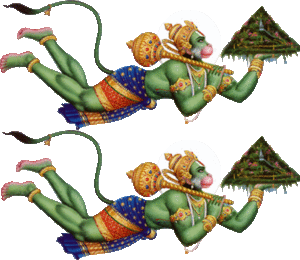
Brahma-Vidya and Upanishads by Swami Sivananda The school of philosophical thought known as the Vedanta is also called Uttara-mimamsa. The founder of the Vedanta system of philosophy was Badarayana Vyasa. The founder of Purva-mimamsa school was Jaimini, the disciple of Sri Vyasa. Of these two, Purva-mimamsa is generally understood to imply the inquiry into the Mantra portion of the Vedas, while Uttara-mimamsa is understood to mean an inquiry into the Upanishad portion of the Vedas. In other words, Purva-mimamsa treats of Karma Kanda; Uttara-mimamsa deals with Jnana Kanda. The Brahma Sutras of Badarayana or Sri Vyasa are termed as the Vedanta Darshana. They are called by this name, because they are based upon the Upanishads, the end or the final part of the Veda. These Brahma Sutras are the outcome of the harmonising of the apparently conflicting Upanishadic texts by Badarayana. The Bhashya written by Sri Sankaracharya on the Brahma Sutras is known as Sariraka Bhashya. The Vedas, each of which has a Samhita, Brahmana, Aranyaka and Upanishad, are again subdivided into two parts viz., the Karma Kanda or the work-portion and the Jnana Kanda or the knowledge-portion. The former leads man to world by happiness and enjoyment in Svarga or heaven and the latter to Moksha or liberation. The Samhita and the Brahmana sections go to make up the Karma Kanda and the Aranyaka and the Upanishad sections form the Jnana Kanda. Brahma Vidya or that knowledge by which the Brahman is attained is dealt with in the Upanishads. The Upanishads as the final part of the Vedas are Vedanta, the end of the Vedas. Through the divisions of Rig Veda and others, the Vedas are said to be four in number. Their branches are many. So also the Upanishads. In Rig Veda, there are twenty one branches. There are 109 branches in Yajur Veda. There are 1000 branches in Sama Veda. There are fifty branches in Atharvana Veda. In each branch there is one Upanishad. The word Upanishad is formed by adding the Krip suffix and the prefixes Upa and Ni to the root Shad meaning (1) to shatter or kill, (2) to attain and (3) to loosen. By the word Upanishad is denoted the knowledge of the knowable entity inculcated by the work which is to be commented upon. By what etymological process this knowledge is denoted by the term Upanishad is now explained. This knowledge is called Upanishad by virtue of its signification that it shatters or destroys the seed of Samsara such as ignorance and the rest, in those seekers after emancipation, who, devoid of all desires for objects seen and heard of, acquire the knowledge called Upanishad to be hereafter explained, and with their mind firmly concentrated therein meditate on it; for it will also be said later on well ascertaining that he will be freed from the jaws of death or the knowledge of Brahman is called Upanishad because of the fact that it leads to Brahman, in that it makes the seekers after emancipation just above described attain the highest Brahman; for it will be said later on, having attained the Brahman he becomes untainted and immortal; or, even the knowledge of Agni is denoted by the term Upanishad, because of its connection with the meaning of the root, to loosen; for, the knowledge of Agni, the first born, the knower, born of Brahman the subject matter of the second of the boons asked for leads to the attainment of heaven and thus loosens or enfeebles the lot of misery; such as residence in the womb, birth, old age, etc., continually recurring in this world. It will also be said later on, having reached heaven, they enjoy Immortality. It may be argued that students apply the term Upanishad even to the book, as when they say, we shall study or teach the Upanishad. This is no fault, as the meaning of the root Shad, i.e., the killing of the cause of Samsara, etc., cannot be attached to the mere work but is attached to knowledge; and even the mere work may also be denoted by that word, because it serves the self-same purpose, as when it said ghee verily is life. The word Upanishad therefore is used in its primary sense when it is used to denote knowledge; but it is used by courtesy, i.e., in a secondary sense to denote the work. Thus by the mere analytical explanation of the word Upanishad, those who are fully competent to acquire knowledge have been stated. The whole subject matter of knowledge has also been stated to be the thorough release from the bondage of Samsara consisting in the attainment of the Brahman. The meaning of the Upanishad may be either because it lessens the numerous evils of conception, birth, old age, disease, etc., in persons who take kindly to this knowledge of Brahman and approach it with faith and devotion, or because it makes them reach Brahman, or because it totally destroys the cause of Samsara such as ignorance, etc., thus from the several meanings of the root Shad preceded by Upani. Sri Rama says to Hanuman: The only means by which the final emancipation is attained is through Mandukya Upanishad alone, which is enough for the salvation of all aspirants. If Jnana is not attained thereby, by the study of ten Upanishads thou shalt soon attain Jnana and then My seat. O son of Anjana, if thy Jnana is not made firm, study well the 32 Upanishads. Thou shalt get release. If thou longest after Videha Mukti, study the 108 Upanishads. The Upanishads are the mystic experiences of the Rishis. The Upanishads, the Gita and the Brahma Sutras are technically called the Prasthanatraya. These are the three authoritative books on Hindu Philosophy. Any teacher who claims himself as an Acharya and who wants to open a new school of thought must write a commentary on these three important books. All the previous Acharyas, Sri Sankara, Ramanuja and Madhva have written commentaries
Brahma-Vidya and Upanishads Read Post »

Swami Sivananda Saraswati
Jnana Yoga

The Great Reality and its Nature

The Great Reality and its Nature By Swami Sivananda The Struggle for the Infinite The empirical examination of experience shows that the individual is compelled to develop a relation with objective existence. This is clear proof of the insufficiency and the finitude and, consequently, the transient character of the individual. But the urge for perfection points to the existence of a supremely unlimited Being beyond which there can be nothing. The analysis of the Self discloses the existence of the conscious Self as distinct from unconscious matter and mind. But the eternal nature of the Self requires it to be secondless and, hence, the existence of unconscious matter becomes unwarranted. The practical moral urge and the purified reason are corroborated by intuition which proclaims the existence of an indivisible, secondless, conscious Being. This supreme conception of the Reality necessitates life to be lived according to strict righteousness and moral discipline. The better the conception of the Truth, the more quickly is it realised. The First ObservationHuman consciousness at once presupposes the authenticity of the existence of the personal being which is the root of this consciousness. The very meaning of human consciousness is objectivity which sets in opposition a subject or the self against the non-subject or the not-self. Individuality of the subject and the object is the necessary condition of all forms of perception or knowledge in the world. Individual consciousness and individual existence are inseparable. The very first factor that the individual is faced within experience is the awareness of the existence of something which it cannot consider as the self. This is the starting point of active thinking and action. The individual is confronted with the urgent need of developing a relationship with the vast universe which stares at it as the not-self. This need marks the nature of the struggle of life as a whole, its purpose, method and goal. The need for external relation, however, is the outcome of a practical want in oneself, a want of thoroughness and genuineness in one’s own being. This is the hypothesis upon which is constructed the edifice of philosophical speculation. Self-consciousness refuses to rest blind and idle. It stimulates mental and physical activity, a postulate which demands no reason. The value of life is determined by the characteristics of the effects of this activity. The sense of value is based on the extent, the depth and, consequently, the longevity of the experience of conscious satisfaction in the self. The worth and the righteous nature of all activity is, therefore, dependent on how far it nears the most supreme form of happiness which is the standard set by the results of the computation of perfection as determined by the irresistible urge for completeness of one’s existence. The nature of this happiness, however, remains to be found out. The acts of life show that the individual consciously and voluntarily acts because of the joys which are experienced by the self as a consequence of those acts. An action is a transformation from one condition to another, which, naturally, is the effect of the inability to rest eternally, in a particular condition. It is observed that all actions, mental as well as physical, have a special characteristic of being directed towards some or the other of the forms in which the not-self appears. The impossibility to withhold conscious action leads us to the conclusion that there must be an intimate and permanent connection between the subjective conscious being and the vast objective existence. The fact that the vaster this objective existence included in the self’s relations and the nearer it is to the self the greater is the intensity of happiness experienced by the self points the way to the true nature of the ultimate Reality. Logically the highest bliss must be the result of a self-merging of the unlimited existence in Self- consciousness. This means the dissolution of the not-self in the Consiousness of the Self, the disappearance of the hallucination of objectivity in Self-identical, objectless, absolute, Awareness merely, which exists not only including but transcending the entire realm of objective existence in quality as well as quantity. Analysis of the SelfOn carefully scrutinising the waking, the dreaming and the deep sleep states, it is observed that the Self is different from the physical body, the psychological organs and ignorance which are respectively manifested in externality, internality and nihility of consciousness. Further, consciousness must necessarily be an essential constituent of the Self, for without consciousness existence itself is valueless. This at first leads us to conclude that the Self must be a conscious witness of the physical, the psychological and the ignorant conditions. But being a witness means existing as an unconcerned observer of certain phenomena which exist apart from oneself. This compels us to make the Self an individual perceiver with its rival, the percept. Metaphysically, individuality is the opposite of eternity, for, eternity means changeless self-existence which is synonymous with completeness and infinitude. Nothing that is dependent is eternal and nothing that is finite or individualised is independent. The subject cannot hope to exist eternally and at the same time be a relative of some external existence. To be eternal, the subject must be absolute, which is the fusion of the totality of existence in the subject or the Self. In order that it should be Real, the subject must at the same time become all objects, the entire existence, in which case the subjectness of the subject is sacrificed to or rather swallowed by a larger infinity of being where the subject and the object are not separated even in the least. Hence, if the Self is eternal it cannot be something existing apart from the three empirical bodies which are objects of the witness-Self. And, the Self must be eternal, for, at no time is it possible to deny the existence of the conscious Self. Now we are led to a twofold quandary. The Self cannot be called a differentiated witness of the three bodies,

The Great Reality and its Nature Read Post »

The Divine Life Society Rishikesh 2
Jnana Yoga, Swami Sivananda

Fitness for Wisdom

Fitness for Wisdom By Swami Sivananda One who is fit for receiving Wisdom of the Self shall receive it ‘in due time’. Self-effort and passage of time work simultaneously and one cannot be dis tinguished from the other, for Providence and Personal exertion cannot be separated as they both work simultaneously and are interdependent. Rather, these are only two names for one and the same force of action. Sri Sankaracharya had already exhorted that one has to undergo the disciplinary stages of Viveka, Vairagya, Sama, Dama, Uparati, Titiksha, Sraddha, Samadhana, and Mumukshutva before getting initiated into the mystery of Existence. One should not be initiated into the Truth of the Absolute unless he is found well developed in all these qualities. Nowadays generally we find that aspirants do not have a strong desire for Liberation. They may have a ray of Viveka and Vairagya of a mild variety. But it is very difficult to find an aspirant who cares for nothing but final Emancipation, who treats the whole world and its contents as mere straw, who meditates incessantly upon how to attain Salvation from embo died existence. It is not easy to understand the mea ning of Liberation. How can it be possible for raw men of the world to realise the nullity of earthly existence and of worldly activities? Even advanced aspirants sometimes have got a strong desire for doing something wonderful in this world, something which none has done before. Such people cannot have a real desire for liberation. And such people are unfit for receiving Brahma Vidya. It is only the Uttama-Adhikari, the best qualified, who cares for nothing, who is totally indifferent to the ways of the world, who is ever silent and serene due to the dawn of pro per knowledge, who is ever the same among the di verse men of the world, who is undisturbed by the distracted activity of the world, who is calm and peaceful, who has withdrawn himself from the bustle of life, who cares not for either death or life, who is unmindful of what is happening in the world, who is careless towards either this or that, that is really fit to receive the Ultimate wisdom of the Absolute! Even if there is the slightest desire lurking inside other than for the Realisation of the Absolute, that man will not be able to comprehend the true import of the Vedantic instructions by the Spiritual Teacher (Preceptor). He will have thousand doubts and dis tractions in the mind which will entirely pull him down from Vedantic Meditation. A person should desire for nothing else, than the Realisation of Brah man. There should be no other thought throughout the day than of the way of attaining Self-realisation. Every thought, every speech, every action, nay, every breath of the person should illustrate the method of realising the Absolute. Such a person is fit to receive Vedantic Wisdom.

Fitness for Wisdom Read Post »

download 13
Jnana Yoga, Swami Sivananda

Gist of Wisdom

Gist of Wisdom by Swami Sivananda It is in the nature of man to strive for happiness but all the happiness which he can gain by his actions is only of limited duration. The enjoyments of the senses are transient and the senses themselves are worn out by too much enjoyment; further, sin generally accompanies these enjoyments and makes man unhappy beyond comparison. Even if the pleasures of the world are enjoyed as much as their nature permits, if they are as intense, as various and as uninterrupted as possible, yet old age approaches and with it death. And the enjoyments of heaven are in reality not more enviable than these pleasures of senses; they are of the same nature, although more unmixed and durable. Moreover they come to an end; for they are gained by actions and as these latter are finite, their effect must also be finite. In one word there is necessarily an end to all those enjoyments and what avails us to strive for pleasure which we know cannot sustain us beyond the moment of enjoyment. It is therefore in the nature of man to look out for an unchangeable, infinite happiness (Ananta Sukha) which must come from a ‘being’ in which there is no change-if such a ‘being’ can be found, it is only from Him that man attains an unalterable happiness and if this be so, this ‘being’ must become the sole object of all his aspirations and actions. This ‘being’ is not very far. He resides in your heart. He is the Sakshi Chaitanya who witnesses the activities of your Buddhi (intellect). He is the Nirguna (attributeless) Brahman of the Upanishads who is highly eulogised in a variety of ways by the Rishis and seers of the Upanishads. Whatever it be, it is in reality one. There truly exists only one universal Being called Brahman or Paramatman, the Highest Self. This Being is of an absolutely homogeneous nature (Ekarasa). It is a pure Being or pure Intelligence (Chaitanya Jnana). Intelligence is not to be predicated of Brahman as its attributes but it constitutes its substance. It is its Svarupa or essence. Brahman is not a thinking being, but thought itself. He is not all-knowing but knowledge itself (self-knowledge). He is not all-powerful but power itself. He is not all-beautiful but beauty itself. He is Bliss itself. Do you see the difference now? That is termed Svarupa or essence of everything. He is absolutely destitute of qualities; whatever qualities or attributes are conceivable, can only be denied of it. But if nothing exists but one absolutely simple Being, whence the appearance of the world by which we ourselves are surrounded and in which we ourselves exist as individual beings? Brahman is associated with certain power called Maya or Avidya to which the appearance of this world is due. Oh how deep, unfathomable and marvellous is this Maya, the inscrutable (Anirvachaniya) power of Brahman! Every human being, though in essence he is really Brahman, does not-though instructed-grasp the truth “I am Brahman” but feels convinced, without any instruction, that he is such a person’s son mistaking for the Atman and is only perceived like a stone or pot. Indeed, these worldly-minded persons wander in this miserable Samsara repeatedly deluded by the Maya of Brahman alone. The idea of Brahman, when judged from the viewpoint of intellect, is an abstraction, but it is concretely real for those who have the direct vision to see it (Aparoksha Anubhuti or Sakshatkara). Therefore, the consciousness of the reality of Brahman has boldly been described to be as real as the consciousness of an Amalaka fruit held in one’s palm. Even intellect can grasp only a little of the Truth. Brahman has positive attributes such as Sat-Chit-Ananda, purity, perfection, Satyam, Jnanam, Anantam, etc., They are not really attributes. They are all synonymous terms for Truth or Brahman. Sat-Chit-Ananda also is a mental Kalpana (imagination). These are the highest qualifications of Brahman which the human intellect can grasp. Generally Brahman is described by negation of qualities such as Nirakara (formless), Nirguna, Nirvikalpa (without modification of mind), etc. Are we not driven to take the same course ourselves when a blind man asks for a description of light? Have we not to say in such a case that light has neither sound, nor taste, nor form, nor weight, nor resistance, nor can it be known through the process of analysis? Of course it can be seen but what is the use of saying this to one who has no eyes? He may take the statement on trust without understanding in the least what it means, or may altogether disbelieve it, even suspecting in us some abnormality. Does the truth of the fact that a blind man has missed the perfect development of what should be normal about his eye-sight depend for its proof upon the fact that a large number of men are not blind? The very first creature which suddenly groped into the possession of its eye-sight had the right to assert that the light was reality. In the human world there may be very few who have their spiritual eyes open, but in spite of the numerical preponderance of those who cannot see, their want of vision must not be cited as an evidence of the negation of the light. In the Upanishads we find the note of certainty about the spiritual meaning of existence. In the very paradoxical nature of the assertion that we can never know Brahman-but can realise Him-there lies the strength of conviction that comes from personal experience (Anubhava). The variety of experience is not real, nay even experience itself is nowhere from the point of view of the Absolute. To lead the life wherein the variety of experience does not affect, either our weal or woe, is the highest practical rule of conduct in accordance with the proper aim of existence. The variety of experience creates distinction and sets up false limits where there

Gist of Wisdom Read Post »

The Divine Life Society Rishikesh
Jnana Yoga, Swami Sivananda, Uncategorized

The Yoga of Wisdom

The Yoga of Wisdom by Swami Sivananda The body is composed of the five elements and is unintelligent. It is made up of skin, flesh, blood and bones. It is produced by time, action and the attributes of Sattva, Rajas and Tamas. The Atman is neither born, nor does it die, nor does it stop or go anywhere. It is neither male nor female nor neuter. It is all-pervading and everlasting. It is one without a second, unblemished like ether, eternal, pure and perfect Knowledge itself. Sorrow has the body as its cause. The body has Karma for its cause. Action of Karma proceeds from man having the notion of ‘I’ in the body. The notion of ‘I’ which is unintelligent is beginningless, having Avidya for its root cause. Egoism is always associating with the reflection of Chit like a piece of iron heated in fire. Thus the body becomes independent with the Ahamkara and becomes possessed of intelligence. I am the body this notion arises by force of the connection between the Self and Ahamkara. Worldly life which is the giver of pleasure and pain has for its root this notion of ‘I’ in the body. On account of this identification of the Atman, which is without modification, with the Ahamkara, with the notion of I am the body, I am the doer of action, the individual soul always acts and is forcibly bound by the results. Possessed of virtue and vice he wanders up and down. I have surely done much good work through sacrifices, gifts and the rest, and shall therefore go to heaven and enjoy happiness there, thus he thinks. This is a false notion. He enjoys in heaven the celestial happiness for some time, and falls down as soon as the results of his meritorious deeds are exhausted. So long as there is connection of the Ahamkara or the principle of egoism and the rest with the body and the sense-organs, there are pleasure and pain and transmigratory existence for the self or the knower. Ahamkara is the notion of ‘I’ and ‘mine’ in the gross and subtle bodies. The ignorant are attached to the body. They cannot rise above the sense of ‘I’ and ‘mine’ in the gross body. The discriminating few rise above it through Knowledge. The Samsara or cause of worldly life exists so long as there is any thought of object of sense. When one awakens from the sleep of ignorance taking the unreal for the real, then it ceases to assert itself. The Samsara which has been erroneously imposed on the Self does not go of itself for one, who like a person in a dream cherishes objects of sense. Non-existence appears to exist through the force of beginningless Avidya or ignorance. Man is agitated through attachment and aversion. The sense of ‘I’ is the effect of ignorance. The mind is verily the world. The mind is bondage. The superimposition or identification of the mind with the Atman is the cause of bondage. Just as a piece of crystal which is in fact colourless takes the red or other colour from the object with which it is brought into contact, so also is the world-process or Samsara due to the contact of the Self with the intellect or the organs of sense. The mind cannot of itself cognise without a cognising Self behind it. The Self on the other hand, making the objects created by the mind as its own, takes the form of the latter like the piece of crystal when it is brought into contact with coloured objects, and thus becomes bound by the attributes of those objects and wanders about in Samsara as if helpless and powerless. Having first created the attributes of attachment and aversion to actions of diverse kinds, the mind takes in various forms, such as white, red and black (the good, the active and the passive). In this way, the Jiva or the individual soul wanders through the influence of Karma till the period of universal dissolution. At the time of universal dissolution, the Self survives with Vasanas taking impressions of past Karmas attracted under the influence of beginningless Avidya. When there is universal dissolution, there is no destruction of the individual soul. He remains in a latent form in the Mula Prakriti or Avyakta, which is the condition of the equilibrium of all the three Gunas. At the time of creation, he is born again together with the Vasanas born of the mind. In this way he is forced to go round and round like the wheel for drawing water. When, through special merit acquired by good Karmas in the past, he gets the company of pious devotees, his mind becomes directed towards the Lord. Then is produced in him faith, which is so difficult of attainment, in hearing stories relating to the Lord. Then comes to him without any trouble Knowledge of the Self. Then through the grace of the preceptor, as well as Knowledge of the meaning of the great sentences, Tat Tvam Asi Thou art That, and the like, and his own experience, he forthwith realises the distinction between the body, the organs of sense, egoism and the pure Atman and knows himself to be the intelligent and the blissful Self who is one without a second and becomes thenceforth released. Know yourself, therefore, to be separate from the three bodies and beyond Prakriti. Relinquish all sense of ‘I’ in the body and become a Sage of Wisdom. Realise your own Self to be free from the conditions of waking, dream and deep sleep, as Truth, Knowledge and Bliss Absolute.


The Yoga of Wisdom Read Post »