













Hari Om

Menu

February 24, 2026

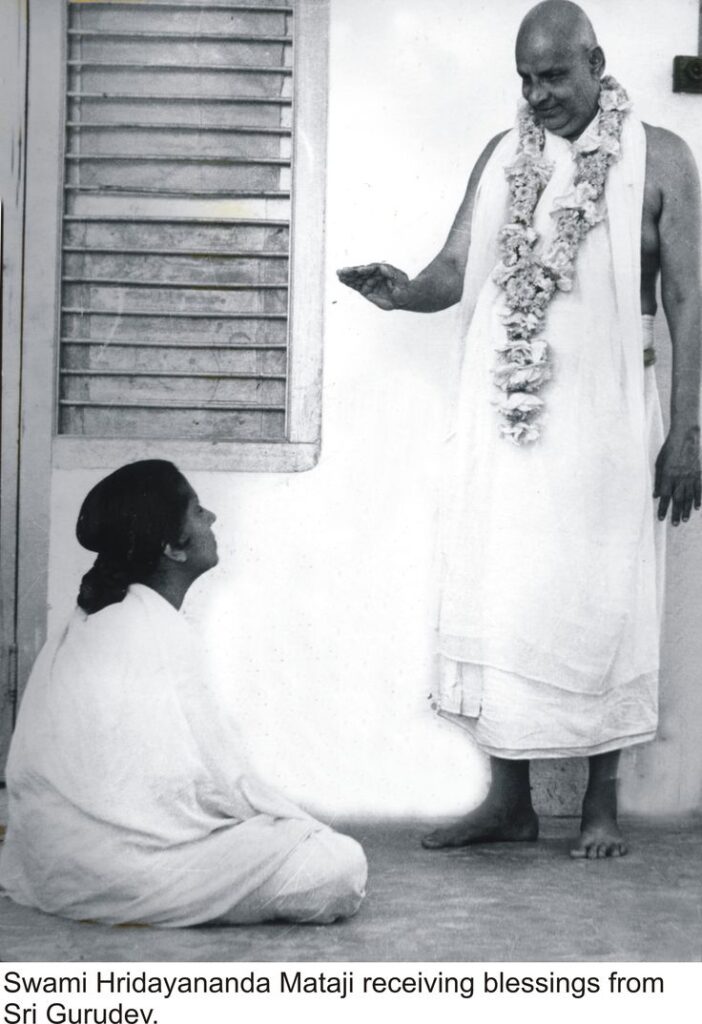
swami sivananda Devotee receiving blessings from guru image
Celestial Collection of Divine Messages - Awakening the Divinity in Man, Swami Sivananda

True Happiness

True Happiness True happiness lies in virtue and inner soul and not in earthly possessions. Man has to rise up above the world consciousness through daily meditation. He should ever attempt to enter the divine consciousness. He should manifest the divine through Sadhana or concentration. He should transform the human nature into divine nature by developing Daivi Sampat. He should cut asunder the network of desires which brings distress and misery in the end through Japa, prayer, meditation and Satsang. Blessed householders! Remember that ignorance is always the root-cause of fear. Wherever there is duality, there is fear. In Adwaita alone, there is no fear. Who is to be afraid of whom, when one beholds oneness everywhere? The spiritual journey is long and weary. There is much to be done by way of spiritual Sadhana. Life is very short. Time is fleeting. There are many obstacles on the spiritual path. One should apply oneself diligently in spiritual practices and discipline the Indriyas, in the control of mind and lead the most regulated life. Concentration and meditation are the two essential wings of the spiritual Sadhak. With these, he can simply fly round the entire world. Realise this and rest in your Satchidananda Swaroopa. Know thy real Self and be ever free. Beloved children of the Lord! Scrutinise your motives. Look before you leap. Don’t repent later on. Think very seriously. Remember Him always and attain immortality and eternal and lasting peace right now. Work unselfishly with redoubled force and energy. Universal love is the gateway to Moksha. Do not brood over the past. Live in the living present. Have intense faith. Aspire fervently. Surrender yourself at the Lotus Feet of the Lord. The Divine Grace is bound to descend upon you. Feel the same Atman that is in you or in the temple, resides in the innermost recesses of the heart of those poverty-stricken ignorant masses also. Love them as you love your own Ishta Devata. Serve them with Atma Bhav. You may meet with apathy and even hostility in the beginning. But if you always entertain thoughts of love, you will surely win. Rest assured in this simple truth. Love is life and hatred is death. Expansion of heart is life, contraction is death. Man should die, but once. A miser dies a thousand times; a weak selfish man dies a million times; one filled with hatred dies every second of his lifetime. Ever have a broad heart. Feel the Atmic strength within yourself. Be ever perfectly selfless. Love all. Sarvam Khalvidam Brahma. All indeed is Brahman. These is naught else, naught else. Blessed aspirants! You should always try to find out the defects in sensual object or sensual life. The cause of birth, death, or old age, disease, pain, etc., is only sensual desires. By entertaining Mithya Drishti (the unreal nature of worldly objects) and Dosha Drishti, the mind will not run towards worldly objects. Pratyahara will come by itself. Then only, the double withdrawal will be more effective and producing lasting results. Withdrawal of senses from objects can be done through the practice of devotion to the Lord also. When the subtle undercurrents of Vasanas die, when all Rajas is squeezed out, when the lurking appetites in the corners of your Antahkarana are destroyed, when the subtle pride or egoism is eradicated, then only, you will enjoy eternal lasting bliss. Therefore direct your efforts in purifying the mind first. Do not worry about repeated failures in your Sadhana. Despair not. Do not give up the struggle or the Sadhana. Stand up and again fight the turbulent senses and the mind. Each failure is a stepping-stone to success. You are nearer to success every time. You should succeed in the long run. Make courage your rosary, desirelessness your holy thread, discrimination your deer-skin, dispassion your silk cloth and meditation your sacred Bhasma or the holy sacred ash. Burn the fire of lust and anger through purity and forgiveness. The body idea, the sex idea, lust and egoism are very deep-rooted in men. Hence, O Man! Struggle hard to eradicate these simple enemies of your body and mind. Continue the fight unceasingly. You will succeed eventually in their annihilation. Never run away from your jobs. A man can afford to lead a well-regulated moral life in any plane he lives. Where there is will, there is a way. One should do all actions in a spirit of detachment. One should leave the world and the objects of the world, as everything is perishable. Love the Lord seated in all. It is the only Reality. Do not apply reasoning to what is unthinkable. For knowing what is beyond mind, one must not rely on logic, but on the sacred scriptures or Srutis or revelations. Do you know what are hatches, matches and despatches. Hatches are births, matches are marriages, and despatches are deaths. Find out that one Supreme undying Being who is above all these matches and despatches and live in the blissful for ever. Give the foremost place to religion and Sadhana and a very secondary place to domestic and social life. Craving is an intense desire. Through repeated action, every habit has been deeply rooted in man’s nature. Do not give any kind of leniency to your weaker mind, which is deluding you every moment. Every evil habit can be easily eradicated, provided the eradication is taken up immediately as a solemn ideal. All evil habits can be eradicated by constant Abhyas and absolute Vairagya. Ever feel they are the impediments in the spiritual path. Develop a strong desire for God-realisation only. May the Divine light lighten your spiritual path! May you enter into the Kingdom of God where alone you can have true happiness. May the blessings of your Guru be upon you!

True Happiness Read Post »

image 45
Bhrama Muhurata Meditative Talks at Swami Sivananda Ashram - Rishikesh, Swami Sivananda

Everything Is Yoga

Everything Is Yoga By Sri Swami Chidananda Early Morning Meditation Talk given in the sacred Samadhi Hall of Gurudev Sri Swami Sivanandaji Maharaj, Sivananda Ashram, Rishikesh. Worshipful homage to that supreme, eternal, universal Being who revealed Himself in a glorious personal form comprising total Divinity as the world teacher, Lord Krishna, and who revealed Himself in and through the Gita wisdom teachings that He imparted for all mankind, for all times, through His beloved devotee and disciple, the warrior prince Arjuna. He not only revealed His divine nature through His Bhagavad Gita teachings, He also revealed how man can realise Him fully, can experience Him, and, ultimately, how man can merge himself in Him to become one with Him. All this He taught within the compass of 700 brief verses contained in 18 chapters. And what is His main teaching? What is His main method of attaining the supreme human experience of our essential non-differentiation from Him, which experience liberates us forever from all sorrow, all confusion and delusion, and liberates us once and for all from a return to successive birth, death and rebirth in this mortal world? What is this method? We all know that classical Indian spiritual tradition speaks of four yogas–channelising our action potential through karma yoga for God-realisation, channelising our sentiment and emotion potential for realising God through bhakti yoga, channelising our mind’s power of concentration for attaining God-realisation through raja yoga, through meditation, and channelising our intellectual potential of analysis, logic, discrimination and reasoning to attain illumination through jnana yoga. But in the Gita we witness a strange phenomenon in that 18 yogas are mentioned, one for each chapter. It speaks only about yoga. What is this strange phenomenon? There are four classical yogas and here we have 18 yogas. Everything is yoga. He covers the whole of human life in His teaching. What is that central teaching? The central teaching is that, in fact, all life is yoga. Life is to be lived as the great sadhana, the great yoga. All actions constitute yoga. Everything that you think is yoga. Everything that you speak is yoga. Everything that you do is yoga. That is why everything that you think should be thought of as yoga. That is why everything that you utter should be regarded as yoga. That is why everything that you do must be done as yoga. There is nothing else in life except yoga and yoga alone. All of life is yoga. Life is the great sadhana. Life is the supreme yoga, every part of it. Life is to be lived as such. That is why it was given. Each and every one of our actions from morning till evening should have a Godward thrust; they are to be engaged in for attaining illumination. Everything in our life is and ought to be enlightenment oriented. Breathing, sitting, standing, running, resting, working, lying, waking, dreaming, sleeping, all constitute that one single process–yoga. So there are not merely 18 yogas. There are innumerable yogas every moment. Everything is to be regarded as yoga; it is not just eighteen. The number of yogas is legion. This is to be grasped. This is the great truth about you, about each and every one of us. May the grace of the Supreme and the benedictions of revered and beloved Holy Master Gurudev Swami Sivanandaji enable us to fully recognise this truth, fully assimilate this truth, fully live in the light of this truth, and thus become the Truth. May God bless us all!

Everything Is Yoga Read Post »

swami sivananda Collage of spiritual leader in multiple devotional scenes image
Celestial Collection of Divine Messages - Awakening the Divinity in Man, Swami Sivananda

Call Unto Divine Life

Call Unto Divine Life Sri Swami Chidananda Blessed Children of the Lord and devotees of Gurudev Swami Sivanandaji Maharaj! Salutations and prostrations unto the Most High, the one Reality that dwells in the hearts of all beings. Greetings in Divine Life! With great pleasure I send you this message for the holy Birthday Anniversary of Sri Gurudev. Sages and saints of yore have emphatically declared that it is very difficult to get a human birth. Our Gurudev also sang thus: “It is difficult to get a human birth; therefore try your best to realise in this birth.” Human birth is put down as the very rare gift of God, and having got a human birth, if you do not have a hankering to attain that state which will bestow on you eternal bliss and immortality, it means that you do not utilise this human birth to any purpose at all. Therefore, live in such a way that it will bring you perennial bliss. The attainment of this bliss is your birthright. To live is to fight for this birthright. Life is conquest. Life is a series of awakenings. Become free from the bonds of birth and death by realising your Self. Never forget your Immortal Nature. Thou art Divine! On this holy occasion I wish to remind you of a few spiritual teachings of Sri Gurudev. These teachings will greatly help you in treading the spiritual path. O Man! Follow your own religion, but stick to its fundamental spiritual ideals. Draw up a programme for your life, and that shall constitute the preparation for the journey towards Divine Life. You do not live on earth for the sake of talking about the Why, What and How of God and religion, but to lead a virtuous spiritual life with a broad feeling, careful understanding, devotion to Truth and tolerance towards all beings. Religion must educate and develop the whole man, his heart, head (intellect) and hand. Only then will he have perfection (Siddhi). There must be integral development. One-sided development is not commendable. You must have the head of Sankara, the heart of Buddha and the hands of Janaka. Vedanta without devotion is quite dry. Bhakti without Jnana is feeble. How can one who has realised his oneness with the Atman remain without serving the world, which is only the Atman. Devotion is not divorced from Jnana, but rather Jnana is exceedingly helpful to its perfect attainment. There is no hope of Immortality by means of riches. Such indeed is the emphatic declaration of the Srutis, ‘Na karmana na prajaya dhanena tyagenaike amritatvamanashuh’ (Neither by rituals, nor by progeny, nor by riches, but by renunciation alone does one attain Immortality). Mere giving up of objects will not constitute real renunciation. Dear friends! Remember, remember this point well. True Tyaga consists in renouncing egoism, mine-ness, selfishness, Moha, Deha-Abhimana, desires and cravings. Even the greatest of persons will in course of time become the lowest of the low. Countless kings, earls, barons and emperors have come and gone. Where are those distinguished poets, intellectual geniuses, reputed scientists with boasted intellects; where are Shakespeare, Kalidasa, Byron, Newton, Kant, Faraday, Gandhi, Kennedy, Nehru? In youth you are enveloped in complete ignorance, in adult age you are entangled in the meshes of sex, in old age you groan under the burden of Samsara and debility. You eventually die and pass off from the scene. Being thus always occupied, when will you, my dear friends, find time to devote yourselves to the performance of virtuous deeds, Nishkama Karma, Bhajan, Satsanga, Vichara, Kirtan and meditation? Why should you try to realise the Atman? Because Self-Realisation gives you freedom from the Samsaric wheel of births and deaths, with its concomitant evils. Hear the emphatic declaration of the Sruti: ‘This Atman (Self) which is free from sorrow, hunger and thirst, with true desires and true resolves–that is what is to be sought after, what one must wish to understand; one who has sought after this Self and understood it, obtains all worlds and all desires’, said Prajapati to Indra. Hear the forcible utterances of the Chhandogya Upanishad: ‘Yo vai bhuma tat sukham, na alpe sukham asti, Bhumaiva sukham, Bhumat eva vijijnasitavyah’ (The Infinite (the Great) is Bliss. There is no bliss in what is small (finite). The Infinite alone is Bliss. One should therefore wish to understand the Infinite). ‘Kalau Kesava-Kirtanat’–in days of yore, people had Self-Realisation by Tapas, Jnana, Yajna, etc. But in Kali-Yuga, when people lack in bold understanding, when people have not got strong, irresistible will and pure intellect, and when the vast majority of persons do not possess a strong physique to practise various Hatha Yogic Kriyas to awaken the Kundalini, Hari-Kirtan alone will help them in getting salvation easily. Suka Deva, though a Brahma Jnani, did Sankirtan. Lord Gauranga, a master of logic, an intellectual giant, dedicated his life to preaching Kirtan throughout Bengal. Mira, Tukaram, Pavhari Baba of Punjab, Ram Prasad of Bengal, Rup Kala Bhagavan of Ayodhya, all had Darshan of God through Kirtan and Kirtan alone. Sankirtan purifies and elevates the mind. Sankirtan destroys Vasanas, old vicious Samskaras, cravings, three kinds of Tapa,–the Adhyatmika, Adhidaivika and Adhibhautika,–three kinds of diseases, and brings the devotee face to face with God. Tukaram, the reputed Maharashtra saint of Deo, was an illiterate Bhakta. He could not even sign his name. His inspiring Abhangas are texts for the M.A. students in the Bombay University. What a great miracle it is! Wherefrom did the unlettered, untutored Tuka derive his knowledge? Tukaram had communion with Lord Krishna through Bhava Samadhi induced by Sankirtan. His inner eye of intuition, Divya Chakshuh, was opened. He tapped the fountain of Knowledge. He penetrated deep into the very source of Knowledge. Where is God? God is in your heart. He is in you. You are in Him. If you do not find Him there, you will not find Him anywhere else. God is Truth. God is Love. Speak the Truth–Satyam Vada. Love everyone. See God everywhere,

Call Unto Divine Life Read Post »

image 55
How to Concentrate and Meditate, Swami Sivananda

Yoga and Meditation

Yoga and Meditation The Philosophical Foundations of Yoga SRI SWAMI KRISHNANANDA PHILOSOPHICAL FOUNDATIONS I shall endeavour to portray in simple terms what one may regard as the central objective of human life and the possible methodology that could be adopted in implementing this objective, and its realisation. You must have heard a lot about what is known as Yoga. And many a text book, many a discourse must have given you varied information on this mysterious technique known as the art of the practice of Yoga. In simple terms, without involving technicalities, if Yoga is to be defined, it can be called the system of harmony. What you call harmony in the English language, for example, Yoga is in Sanskrit. It is nothing mystifying or beyond the conception of human understanding. But there is a great proviso in this simple definition of Yoga as harmony. While it is true that harmony in every field of life is what we seek in our day-to-day existence, it is necessary to know what harmony, actually, means. And when the essential of that simple fact called harmony gets imbibed into our consciousness, our personality gets stablised. Stability of personality, equilibrium of consciousness, harmony in the walks of life, is Yoga. Now, harmony implies an adjustment of oneself with an environment that is external to oneself. When there is no proper adjustment of one thing with another thing, we call it disharmony. When there is a proper adjustment, a smooth working of one principle, one fact, one object, one person with another, we regard it as harmony. Now, the question which may arise in our mind at the very outset is, why should harmony be the central objective; why should harmony be regarded as the essential of life. The reason is the very strucrture of the universe. The universe is a system of harmony. We, as human individuals, form part of this universe. We form part of it in such a way that we are integrally related to it. Before proceeding further, it would be profitable to know what it is to be integrally related to anything in the world. I shall try to give you an example from common experience. You must have seen on the roadside heaps of stones. A heap of stones is a group of small units of inanimate matter put together in one place. In that heap of stones, perhaps, each stone is touching every other stone. Though each piece of inorganic matter called stone in that heap is connected by way of contact with every other stone in the heap, we cannot say that any particular stone is integrally related to every other stone in that heap. They are mechanically connected, not vitally related. There is a difference between mechanical connection and vital, organic relationship. The contact of one stone with another stone in a heap is mechanical. There is no life in this connection. If you take one stone from that heap, the other stones will not be affected in any manner. They shall remain as they were. There shall not be any kind of harm done to the remaining stones or a diminution in their structure, if a few stones are removed from the heap. So, a mechanical group is that in which parts are so related to the whole that if some parts are removed from the whole, the remaining parts are not affected at all. That is what we mean by mechanical relationship. But organic relationship is something different. We can have the example of our body itself. You know very well that our physical body is made up of minute organisms called cells. These cells are so connected to one another that they give the appearance of a single whole called the body, similar to a heap of stones on the roadside, you may say, in one way. But what is the difference? While the removal of a few stones from the heap does not affect the remaining stones vitally, removal of a few limbs of our body will vitally affect the whole body. You know what it would be to an individual, a human being, if the limbs are to be amputated, the legs or the arms removed. You remove a portion of the body of a person–what a difference does it make! The very existence of the body is seriously affected. The harmony of the body is disturbed, to come to the point. That is what when a limb of the body is cut off, there is intense pain, agony and dislike towards it. We dislike any kind of interference with the limbs or organs of our body, because the limbs are vitally connected as a living whole in the system of our personality. So, now, you know the difference between mechanical relationship and vital relationship. What I mean to say is that we are vitally related to the cosmos, not mechanically connected. Our connection with the universe outside is not like the connection of a stone in a heap, so that we may do anything we like without affecting the world outside. That cannot be. Our connection, our relationship with the world outside is such that it can be compared to the relationship of the limbs of the body to the whole system of the body. Any meddling with the system is not warranted, nor called for. To conceive what the universe would be, you have to conceive what a human individual is. In Indian Vedic mythology, we have the concept of what is known as Purusha, the Supreme Being. ‘Purusha’ means man, the human individual. But when the Vedas speak of the Purusha in the cosmos, they mean the concept of the universe as a single individual, a Cosmic Individual, whose relationship with the parts of the cosmos is similar to the relationship of an ordinary limited individual to the limbs of the body. Can you imagine, for a moment, what it would be to remain as a cosmic

Yoga and Meditation Read Post »

Swami Sivananda sitting with veena musical instrument spiritual portrait photo
Celestial Collection of Divine Messages - Awakening the Divinity in Man, Swami Sivananda

Main Impediments To Sadhana

Main Impediments To Sadhana Sri Swami Sivananda The spiritual path is thorny, rugged, precipitous, steep and slippery. But it is nothing for a man who has virtuous qualities and a Brahma Nishtha Guru to guide him. The spiritual path is doubtless beset with various difficulties. It is the razor path. You will fall down several times. But you will have to rise up quickly and walk again with more zeal, boldness and cheerfulness. Every stumbling block will become a stepping-stone to success or ascent in the hill of spiritual knowledge. Every aspirant will have to face various sorts of difficulties in the spiritual path. You need not be discouraged. Muster all your strength and courage and march afresh on the path with redoubled vigour and energy. If you can give up idle talks and gossiping and idle curiosity to hear rumours and news of others and if you do not meddle with the affairs of others, you will be free from all sorts of obstacles that crop up in your way. If worldly thoughts try to enter the mind, reject them. Have steady devotion to the spiritual path. Know things in their proper light. Emotion is mistaken for devotion; violent jumping in the air during Sankirtan for divine ecstasy; falling down in swoon on account of exhaustion from too much jumping for Bhava Samadhi; Rajasic restlessness and motion for divine activities and Karma; a Tamasic man for a Sattvic man; movement of air in rheumatism in the back for ascent of Kundalini; Tandri and deep sleep for Samadhi; Manorajya or building castles in the air for meditation; physical nudity for Jivanmukti state. These are the obstacles in the spiritual path. A Sadhaka should discard them ruthlessly and march forward. Depression, doubt and fear are some of the main obstacles even for an advanced student in the spiritual path. They should be removed by right enquiry and good association. Sometimes depression will come and trouble you. The mind will revolt. The senses will pull your legs. The undercurrent of Vasanas will gush to the surface of the mind and torment you. Sensuous thoughts will agitate the mind and try to overwhelm you. Be bold. Stand adamant. Face these passing obstacles. Do not identify yourself with these obstacles. Increase your period of Japa. All these obstacles will pass away. Doubt or uncertainty is a great obstacle in the path of Self-realisation. It bars the spiritual progress. This must be removed by good company, study of religious books, right thinking and right reasoning. It should be killed beyond resurrection by certainty of conviction and firm unshakable faith based on reasoning. The Vasanas are very powerful. The senses and the mind are very turbulent and impetuous. Again and again the battle must be fought and won. That is the reason why the spiritual path is called the razor path. There is no difficulty for a man of strong determination and iron will even in the razor path. Passion is lurking in you. It is the deadliest enemy of a spiritual aspirant. From passion proceed anger and other evil qualities, which destroy the spiritual wealth of an aspirant. Leakage of energy, hidden under-current of Vasanas, lack of sense-control, slackness in Sadhana, waning of dispassion, lack of intense aspiration, irregularity in Sadhana are the various obstacles in the path of Self-realisation. Overloading the stomach, work that produces fatigue or exhaustion, too much talking, taking heavy food at night, too much mixing with people are obstacles for a spiritual aspirant. Give up arguing. Become silent. Do not indulge in sundry talks and miscellaneous thoughts just to ease the mind. Be serious. Think and talk of God and God alone. Power, name, fame and wealth stiffen the ego. They strengthen the personality. Hence renounce them if you want success in spiritual path. Desire for powers will act like puffs of air which may blow out the lamp of spirituality that is being carefully tended. Any slackness in feeding it due to carelessness or selfish desires for Siddhis will blow out the little spiritual light that the Yogi has kindled after so much struggle and will hurl the student down into the deep abyss of ignorance. Temptations are simply waiting to overwhelm the unwary student. Temptations of the astral, mental and Gandharva worlds are more powerful than the earthly temptations. Various psychic Siddhis and other powers come to the Yogin who has controlled his senses, Prana and mind. But these are all hindrances to Self-realisation. They are stumbling blocks. Stop the Vrittis. Still the mind. Overcome the Vrittis that rise up from the bed of impressions. Face all the obstacles boldly and come out victoriously with the crown of success, i.e., Self-realisation.

Main Impediments To Sadhana Read Post »

image 53
How to Concentrate and Meditate, Swami Sivananda

Why Meditate?

Why Meditate? By Sri Swami Venkatesananda The basic problem in the world today seems to be that there is no interest in meditation as such. It is partly the fault of people who preach and do propaganda for meditation. When you want to spread the practice of meditation and encourage people to take it up, you persuade them that there is some benefit in it. In order to do that the preachers suggest, ‘Practise meditation. You will be completely free of all tension.’ The moment that aspect enters the field of meditation, the whole practice is ruined. From there on you are not sitting completely relaxed, meditating, but you are tense, looking at the state of relaxation which the preacher suggested was your goal. Trying to reach out to it you become more tense. The moment you introduce a goal to meditation, it is gone. Happiness in life comes not by manipulating what you want to achieve but by paying attention to something seemingly totally unconnected with it. In order to make the mouth laugh, you tickle the foot. This seems to be of fundamental importance. Concentration of mind is not achieved by concentrating the mind, but by going right round doing something completely different. That is actually what the great masters of yoga suggested when they said to sit down and repeat your mantra. The problem is that our minds are in a terrible state of disorder, our attention is not steady at all. Physically we are tense, mentally we are distracted. We go to a teacher and he says–“Sit down and repeat a mantra.” While you pay attention to the mantra, which is totally unrelated and unconnected with the problem you are really trying to solve, the problem gets dissolved. You don’t have to solve the problem, the problem can be dissolved. That is much simpler, otherwise when you have a problem and someone tells you to solve it, the solution becomes another problem! The confused brain creating another solution, is in worse confusion. The mind, after all, is one thing, not a supermarket. You are happy sometimes and you are unhappy sometimes. When you are unhappy, what happens to that happy person? And when you are happy, what happens to the unhappy person? Are you one or two? It is not difficult for you to see that you are one thing. The mind is one substance which seems to assume several successively different disguises. It is not possible for the mind to be in two moods at the same time, and even when one is able to juggle the moods quickly, it only means that the mind is able to change very fast. There is no more mystification about meditation than this. The master, by suggesting that you sit down and go on repeating a mantra, has made you temporarily forget your problem. A problem that is forgotten does not exist, unhappiness that is forgotten is happiness. It can come back again, but never mind. If you have been unhappy for 6 or 7 hours at a stretch, you have at least had 20 minutes of happiness. That is marvellous; the unhappiness was a mental state, nothing more than a mood. In real life we see quite plainly that if an external situation was responsible for one’s unhappiness, that situation is not going to be changed by being unhappy. Therefore the yogi said “Free yourself from this external compulsion and realise that unhappiness is a mental mood.” The mind substance is still there, it has temporarily assumed the form of unhappiness, the character of unhappiness. You can be sure that even if you are in the worst of all moods now, the sun is not going to be veiled because of you, it will still shine brilliantly. And if you shake off your bad mood and get into the sun, it is to your advantage. You have been unhappy before, you may be unhappy later–‘so what’! All the problems are there waiting outside–let them! For the next half hour sit down and say your mantra, and as you go on in this way, suddenly you discover that the unhappiness is not there any more. Suddenly you realise that you (or something in you) is totally independent of the happiness or unhappiness that the environment imposes upon you. Coming out of your meditation room you are able to say ‘so what’, right in front of the unhappiness that faces you again. So it is possible to free yourself psychologically from external compulsion, external imposition. Sitting there in that room for half an hour you have tasted it. The mind being of one substance was fed with this mantra, or something totally unconnected with all worries and anxieties, happiness and unhappiness. You have not been struggling, you have not been praying to God to please take this problem away. (That is useless–another one will come.) But in the meantime you have discovered that it is possible for you, without changing the external environment, to be happy within yourself. You taste it. The most important thing in meditation is not to try to solve the outside problem, but to taste the present mood of peace and joy and happiness that is flowing inside. Then when you come out you are able to face this problem. I am not saying the problems we are surrounded by can ever be removed, but the inner attitude can be radically and instantly changed. It doesn’t even take half an hour. Meditation makes this possible by not dealing with the problem head on, but by turning the attention to something completely different (which happens to be beyond the source of all problems). This is not a policy of escapism. Let us take a very simple example of inter-personal conflict. You and he are working in the same organisation. You are saying something, he is saying something different, you have a little misunderstanding, a quarrel. He is too strong and powerful, so you don’t want

Why Meditate? Read Post »

image 54
How to Concentrate and Meditate, Swami Sivananda

What is Meditation?

What is Meditation? By SRI SWAMI SHIVAPREMANANDA In the West, the word meditation means a concentrated state of mind in serious reflection. The Latin root of the word meditation, mederi, means “to heal.” It is an effort to heal afflictions of the mind, the hurt ego, by trying to understand the cause of the problem and finding a way to solve it, that is, by knowing what counter-measures to take. To meditate thus, is to deepen a state of understanding. In the East, however, meditation does not mean thinking at all but fixing the mind in a spiritual ideal, to be one with it, or the thought-process dissolving in the consciousness of it. According to Zen, meditation does not involve any concept but is an awareness of inner silence. As per the Yoga of Patanjali, meditation is a combination of three steps: pratyahara or abstraction, or withdrawal of the mind from the sense-objects or attention to their memory; dharana or concentration; and dhyana or contemplation which, however, is not a thought-process but an absorption of the feeling of oneness with the ideal. Awareness of an inner silence is not something easy to achieve. It can be confused with a state of dullness or being soporific, which is not the purpose of meditation. To meditate mean does not mean to have a good rest while sitting pretty, and silence is not productive without spiritual aspiration. On the other hand, few have the capacity to think clearly, and too much of mental exercise could lead to tension and confusion. In Bhakti Yoga, meditation is visualization of the image of a chosen deity, together with mental repetition of a relevant mantra. For the Vedantin it is to contemplate on the meaning of selected verses from the Upanishads or similar scriptures. For the Catholics, it is saying the rosary, based on mantras like “Our Father which art in Heaven,” or “Hail Mary, full of grace.” For them meditation also consists in feeling close to Jesus after receiving communion and retiring into a quiet place. St. Albert the Great, the teacher of St. Thomas Aquinas, observed that meditation for philosophers is a process of perfecting a thought, and for the devotees of their love of God. Prayers said in silence as a dedication of oneself to God can also be called meditation, because it means turning the mind inward to one’s spiritual source, leading to peace. For, the Hindus, repetition of a mantra, with or without a rosary, but with a feeling of spiritual oneness, is meditation. A common Buddhist meditation consists in repeating the mantras: Buddham sharanam gachchhami, sangham sharanam gachchami (I proceed remembering the Buddha, the righteous path and the welfare of my community). The Tibetians base their meditation on the mantra Om mani padme hum (I am Om, the jewel in the lotus of my heart). For Muslims, meditation is called dhikr or repetition of selected names of God from the Quran, generally with a rosary. Feeling the breath, which is a technique in pratyahara, is an exercise in Zen meditation (the word Zen is derived from dhyana or meditation), as also counting from 1 to 20 or more, over and over again. WHY TO MEDITATE ? The two basic goals of meditation are : 1) Spiritual renewal, or the feeling of oneness with a higher source of life, no matter whether one calls it the infinite and eternal spirit, transcendent and yet immanent in everything, or a divine being called God, or supreme truth, from which flow peace, wisdom and strength. 2) The purpose of deep introversion, in a state of peace, is to search the basic truths of life, to separate reality from illusion itself, to acquire a clear understanding of reality rather than confusing it with a foggy, thoughtless state. The first is relatively easier through devotion and a sincere dedication. The second needs a long practice, to acquire philosophical maturity. Peace of mind is a product of the first goal, which helps in the understanding of the problems one faces. An expanded state of consciousness enables one to loosen the psychological thightness of attachments and rise above petty reactions by the realization that there is more to life than snobbery caused by the insecure ego and resentment by wounded vanity. A sense of elevation and oneness with a spiritual source helps to sublimate gross passions and acquire emotional maturity. The identity of oneself with the essence of one’s being, strengthens the will to act according to what should and should not be done, after having made appropriate decisions. Clarity of mind, which is a part of the second goal, helps to cultivate a sense of right and wrong, a basic purpose of education and a litmus test of any culture. The Greek root, charassein of the word character means “to engrave,” and its Sanskrit word, charita, means “to cultivate”. To engrave or to cultivate cherished ideals is what meditation is for, practiced in a state of peace and clarity of mind, instilling a love of truth, of what one wishes to be, by sowing the seeds of suggestion through an intense feeling, devotion and dedication. Purity of heart or freedom from resentment, hate, prejudice and negative thinking is another objective of meditation. Although it is said that repetition of a Mantra helps to cleanse and enlighten the mind, there is no evidence that the mental sound-form does so, but the faith in it and the sincerity to direct one’s life by the ideals behind it. Thus, it is wrong to say that Mantras are meaningless sound-forms. It is also advisable to discard the myth that no progress in meditation or spiritual life is possible without an initiation by a Guru, although a worthy teacher is a help. As the Buddha says : “By oneself alone is one purified,Purity and impurity depending on oneself,As no one can purify another,By oneself one must walk the path,The teacher merely shows the way.”WHAT IS REQUIRED TO MEDITATE ? The injunction “let your whole life be an act of meditation,” is meaningless, first because it is impossible and, secondly because the

What is Meditation? Read Post »

swami sivananda Monk sitting on rooftop in meditation
How to Concentrate and Meditate, Swami Sivananda

Signs of Progress in The Path of Meditation

Signs of Progress in The Path of Meditation by SRI SWAMI SIVANANDA The goal of life is the attainment of final beatitude or Moksha. Moksha can be attained by constant meditation with a heart that is rendered pure and steady by selfless service, Japa, etc. Meditation is the only real royal road to the attainment of salvation. Meditation kills all pains, sufferings and sorrows. Meditation destroys all causes of sorrow. Meditation gives vision of unity. Meditation induces sense of oneness. Meditation is a balloon or an aeroplane that helps the aspirant to soar high into the realms of eternal bliss, everlasting peace and undying joy. Reality or Brahman can be realised by man. Many have attained Self-realisation. Many have enjoyed the Nirvikalpa Samadhi. Sankara, Dattatreya, Mansoor, Shams Tabriez, Jesus, Buddha were all realised souls who had direct perception of the Truth or Cosmic vision. But one who has known cannot communicate it to others for want of means. Even the knowledge acquired by the five senses which are common to all cannot be communicated to others. You cannot tell the taste of sugar-candy to a man who has never tasted it. You cannot communicate the idea of colour to one born blind. All that the teacher can do is to tell his disciple the method of knowing the Truth or the path that leads to the unfoldment of intuitional faculty. These are the signs that indicate that you are growing in meditation and approaching God. You will have no attraction for the world. The sensual objects will no longer tempt you. You will become desireless, fearless, ‘I’-less and ‘mine’-less. Deha-dhyasa or attachment to the body will gradually dwindle. You will not entertain the ideas, “She is my wife; he is my son; this is my house.” You will feel that all are manifestations of the Lord. You will behold God in every object. The body and mind will become light. You will always be cheerful and happy. The name of the Lord will always be on your lips. The mind will be ever fixed at the lotus-feet of the Lord. The mind will be ever producing the image of the Lord. It will be ever seeing the picture of the Lord. You will actually feel that Sattva or purity, light, bliss, knowledge and love are ever flowing from the Lord to you and filling up your heart. You will have no body-consciousness. Even if there be body-consciousness, it will be in the form of a Samskara or a mental retention. A drunkard may not have full consciousness that he has a cloth round his body. He may feel that something is loosely hanging from his body. Even so, you will have a feeling of the body. You will feel that something is sticking to you like a loose cloth or loose shoes. You will have no attraction for the sex. You will have no sex-idea. Women will appear to you as manifestations of the Lord. Money and gold will appear to you as pieces of stone. You will have intense love for all creatures. You will be absolutely free from lust, greed, anger, jealousy, pride, delusion, etc. You will have peace of mind even when people insult you, beat you and persecute you. The reason why you are not perturbed is that you get immense spiritual strength from the Indweller or the Lord. Pain or pleasure, success or failure, honour or dishonour, respect or disrespect, gain or loss are alike for you. Even in dreams, you are in communion with the Lord. You will not behold any worldly pictures. You will converse with the Lord in the beginning. You will see Him in physical form. When your consciousness becomes cosmic, conversation will stop. You will enjoy the language of the silence or the language of the heart. From vaikhari (vocal speech) you will pass on to Madhyama, Pasyanti and Para (subtle forms of sounds) and eventually you will rest in soundless Omkara or soundless Brahman. Dispassion, Discrimination, serenity, self-restraint, one-pointedness of mind, Ahimsa, Satya, purity, forbearance, fortitude, patience, forgiveness, absence of anger, spirit of service, sacrifice, love for all, will be your habitual qualities. You will be a cosmic friend and benefactor. During meditation you will have no idea of time. You will not hear any sounds. You, will have no idea of the environments. You will forget your name and all relationship with others. You will enjoy perfect peace and bliss. Gradually you will rest in Samadhi. Samadhi is an indescribable state. It is beyond the reach of mind and speech. In Samadhi or the superconscious state the meditator loses his individuality and becomes identical with the Supreme Self. He becomes an embodiment of bliss, peace and knowledge. So much only can be said. You have to experience this yourself through constant meditation. Contentment, unruffled state of mind, cheerfulness, patience, decrease in the excretions, sweet voice, eagerness and steadiness in the practice of meditation, disgust for worldly prosperity or success and company, desire to remain alone in a quiet room or in seclusion, desire for association with Sadhus and Sannyasins, Ekagrata or one-pointedness of mind are some of the signs which indicate that you are growing in purity, that you are progressing in the spiritual path. You will hear various kinds of Anahata sounds like the sound of a bell, a kettledrum, thunder, conch, Vina or flute, the humming of a bee, etc., during meditation. The mind can be fixed on any of these sounds. This also will lead to Samadhi. You will behold various kinds of colours and lights during meditation. This is not the goal. You will have to merge the mind in that which is the source for these lights and colours. A student in the path of Vedanta ignores these sounds and lights. He meditates on the significance of the Mantra of the Upanishad by negating all forms. “The sun does not shine there, nor do the moon and the stars, nor does this lightning shine and much

Signs of Progress in The Path of Meditation Read Post »

Swami Sivananda spiritual saint and yoga master
Celestial Collection of Divine Messages - Awakening the Divinity in Man, Swami Sivananda

Aspirants—A Distinct Class By Themselves

Aspirants—A Distinct Class By Themselves Sri Swami Sivananda The spiritual aspirant class is verily a merest microscopic minority in the sum-totality of world humanity. How very distinctive and special, therefore, should be its conduct and mode of reaction to externals in comparison to that of the generality of the secular world? How very different must his motives be? It is wrong for him to continue to judge either his own or others’ actions with the same old standard as of the worldly life. What is perfectly correct there will be preposterously impossible here in the spiritual line. What is quite natural and right there will be unthinkable here. Take the case of the soldiers drafted into the Army. Just consider what a lot of severe restrictions they are subject to and have to put up with. Their entire life is ordered upon exceptional lines. Special rules govern their movements at every step. Numerous places are strictly ‘out of bounds’ to the troops. Whether they like it or not the members of the fighting forces must move about in their distinctive uniforms; they must be within ‘barracks’ before ‘lights out’ time. Any breach of these numerous Army Regulations will at once bring the M.Ps. swooping down upon him and he will find himself in the military ‘lock up’. Why all this? Just because he happens to belong to a select class particularly picked out from among millions for achieving a special purpose, i.e., to fight and to win the war. When such is the case for a group engaged in working for a mere earthly attainment as a military victory, you can imagine how very great then is the need for a thoroughly distinct and exceptional conduct for the spiritual aspirant set upon achieving something infinitely more difficult and more complicated than earthly victory over visible physical forces? Yet, what do we see among spiritual aspirants today? Is there a change of nature? Or mode of conduct, alteration of attitudes, reorientation of ideals and the substitution of a subtler sense of values in place of the gross selfish ones of a pre-novitiate days? Rather, he has hidden in him his own measuring rod and balance to assess and to estimate the quality and works of men and things, events and actions that he used before. He has brought with him as luggage all his old possessions, his old cloak, coloured spectacles, special seat, etc. His mental equipment is the identical one as of the pre-Sadhaka days. What to say it has not even received as much as a polish or a brush-up even. Nay, in too many cases, it seems as though the bestial part of the aspirant, the ‘Pasu’ as they call it, or the ‘Papa Purusha’ assumes a decidedly aggressive form with an access of virulence hitherto absent in its nature. This may be traced to the very fact that he has become a seeker. For, this fact puffs him up with a feeling that he is exceptional, privileged, something superior to the vast common majority. This sense directly supports and abets the super-arrogation of the lower ego-principle in him. Thus spiritual life, the very beginning of it is vitiated by a deliberate alliance with a wanton allegiance to the sworn enemy of spirituality. When spiritual life is thus sought to be founded upon attitudes and emotions that are the very direct antithesis of higher life and of divine culture, then one may well imagine its dire consequences. The result is the most awful, the most poignant of all tragedies in the universe. In all creation there cannot be a more fearsome or terrible occurrence than this. Of course, from the standpoint of transcendent Vedanta this is a mere nothing. For nothing has happened at all. Nothing ever took place in reality. For neither has there been any manifestation nor creation, etc. (vide Goudapada’s famous Ajata-Vada theory). But to the lesser one with a somewhat lower vision this is none-the-less a truly heart-breaking eye-opener. It is to say the least, most deeply regrettable. One stands aghast, stunned, and cruelly wounded to the core, for, the heart says, “True indeed it is that only One, the Supreme Unmanifest alone exists. There is no universe. But yet, the Supreme is Sarva as well as Sunya. Even this tragedy, therefore, is but truth. One trembles at the fate of such Sadhakas. The ladder which is to take the struggler up and higher up into heaven is kept pointing downwards and its very ascending rungs are used as descending steps to go down into the regions of Eternal Darkness. This last reason is precisely why the whole matter becomes such a great tragedy. For, the phenomenon of an essential earthly person working himself to perdition does not evoke the same shudder as a spiritual aspirant going to ruin. The worldly man proposes to do nothing else. He knows what he is about. And, he cares a hoot for the consequences. “Eat, drink and be merry, for tomorrow you may die”—is his aggressive philosophy. Then again “Each man for himself and the devil take the hindmost” is openly his conception of the best policy. But, the aspirant starts to escape this state and sets to work to become superhuman and indeed divine. All his life’s effort is therefore considered to be directed at this goal by becoming free of the state the worldling has got into. And if by identifying himself with the demoniacal side in him he starts plunging headlong into a condition, infinitely worse than that of the sinner and worldling, what then can be a more staggering sight. What then can be a more shocking revelation? Is there no help for this state of things? What is the safeguard against this? What is the antidote for this? What is the curative remedy for such a state of being? To all this, the answer is more or less the same. It is the acquiring and the active application of One Fundamental

Aspirants—A Distinct Class By Themselves Read Post »

swami sivananda Monk meditating in seated posture picture
How to Concentrate and Meditate, Swami Sivananda

Raja Yoga

Raja Yoga By Sri Swami Sivananda The Philosophy of Yoga It is said that the original propounder of classical Yoga was Hiranyagarbha Himself. It is Patanjali Maharishi who formulated this science into a definite system under the name of Ashtanga Yoga or Raja Yoga. This forms one of the Shad-Darsananas or Classical Systems of Philosophy. Vyasa has explained the original aphorisms or Yoga Sutras of Patanjali and this has been further elaborated through a gloss by a learned author named Vachaspati Mishra, and through the celebrated writings of Vijnana Bhikshu. The Yoga, in allegiance to the Sankhya, holds that there is an eternal and omnipresent inert Prakriti and a plurality of omnipresent Conscious Purusha. The Yoga accepts a third principle, viz., Ishvara. The contact of the Purusha with Prakriti makes the latter evolve itself into its various effects. The Purusha, due to Aviveka (non-discrimination), feels that it is an individual on account of its identification with Prakriti and its modifications. The Yoga concerns itself with the method of freeing the Purusha from this bondage through right effort. Yoga is, thus, more a practical way of attainment than a philosophical excursion into the realms of the Spirit. As a Darsana, it is Sa-Ishvara Sankhya, i.e., it sanctions the twenty-five Tattvas of the Sankhya and adds one more, Ishvara. In doing so, Yoga fulfills its own characteristic of being an utterly practical system of Sadhana. When covered over by the veil of ignorance (Aviveka), the Purusha imagines that He is imperfect, incomplete, and that fulfillment can be had only in His conjunction with Prakriti. The Purusha then, so to say, begins to gaze at Prakriti; and in the light of His consciousness, the inert Prakriti commences its kaleidoscopic display of objects. The Purusha, due to Prakriti-Samyoga, appears to desire for enjoyment of these objects. He acts, as it were. He seems to grasp the objects. Now bondage, though not e ssential to the Purusha, is complete and the vicious circle is kept up. Transmigration of the individual is the consequence of Aviveka and its effects. Yoga by its scientific processes cuts these three knots one by one and leads to Kaivalya Moksha which is the realization of the true Purusha as independent of Prakriti and its evolutes. Deep within everyone there is an abiding faith in a Supreme Being, someone to whom a Sadhaka can look up for help and guidance, for protection and inspiration. But the ego does not allow this to happen. Disentanglement of the Purusha from the ego alone can lead to Its release from the snares of Prakriti. The ego can hardly be subdued by subjective analysis only; but it is easy to discriminate this ego as separate from the Purusha when it is voluntarily offered as a sacrifice at the altar of self-surrender to a Supreme Being, Ishvarapranidhana. This is the hypothesis of the Yoga, in addition to its exhortation to put forth effort (Sadhana-Marga). Yoga Sutras of Patanjali Raja Yoga is the king of Yogas. It concerns directly with the mind. In this Yoga there is no struggling with Prana or physical body. There are no Hatha Yogic Kriyas. The Yogi seats at ease, watches his mind and silences the bubbling thoughts. He stills the mind, restraints the thought-waves and enters into the thoughtless state or Asamprajnata Samadhi, Hence the name Raja Yoga. Though Raja Yoga is a dualistic philosophy and treats of Prakriti and Purusha, it helps the student in Advaitic Realization of oneness eventually. Though there is the mention of Purusha, ultimately the Purusha becomes identical with Highest Self or Purusha, or Brahman of Upanishads. Raja Yoga pushes the student to the highest rung of the spiritual ladder of Advaitic realization of Brahman. Patanjali’s Yoga system is written in Sutras. A ‘Sutra’ is a terse verse. It is an aphoristic saying. It is pregnant with deep, hidden significance. Rishis of yore have expressed philosophical ideas and their realization in the form of Sutras only. It is very difficult to understand the meaning of the Sutras without the help of a commentary, a gloss or a teacher who is well-versed in Yoga. A Yogi with full realization can explain the Sutras beautifully. Literally, Sutra means a thread. Just as various kinds of flowers with different colours are nicely arranged in a string, to make a garland, just as rows of pearls are beautifully arranged in a string to form a necklace, so also Yogic ideas are well-arranged in Sutras. They are arranged into Chapters. The First Chapter is Samadhi-pada. It deals with different kinds of Samadhi. It contains 51 Sutras. Obstacles in meditation, five kinds of Vritti and their control, three kinds of Vairagya, nature of Ishvara, various methods to enter into Samadhi and the way to acquire peace of mind by developing virtues are described here. The Second Chapter is Sadhana-pada. It contains 55 Sutras. It treats of Kriya Yoga, viz., Tapas, study and self-surrender to God, the five Kleshas or afflictions, the methods to destroy these afflictions which stand in the way of getting Samadhi, Yama and Niyama and their fruits, practice of Asana and its benefits, Pratyahara and its advantage, etc. The Third Chapter is Vibhuti-pada. It contains 56 Sutras. It treats of Dharana, Dhyana and various kinds of Samyama on external objects, mind, internal Chakras and on several objects, to acquire various Siddhis. The Fourth Chapter is Kaivalya-pada or Independence. It contains 34 Sutras. It treats of the independence of a full-blown Yogi who has perfect discrimination between Prakriti and Purusha, and who has separated himself from the three Guna. It also deals with mind and its nature. Dharmamegha Samadhi also is described here. States of the Mind Raja Yoga is mainly concerned with the mind, its modifications and its control. There are five states of the mind – Kshipta, Mudha, Vikshipta, Ekagra and Niruddha. Usually the mind is running in various directions; its rays are scattered. This is the Kshipta state. Sometimes it is self-forgetful, it is full of foolishness (Mudha). When you try to practice concentration, the mind seems to get concentrated but gets distracted often. This is Vikshipta. But with prolonged and repeated practice of concentration again and again, and repeating Lord’s Name, it becomes one-pointed. This is called the Ekagra state. Later on, it is fully controlled (Niruddha). It is

Raja Yoga Read Post »