













Hari Om

Menu

February 24, 2026

swami sivananda Vintage photo of guru teaching disciples by riverside image
Celestial Collection of Divine Messages - Awakening the Divinity in Man, Swami Sivananda

Mind, World, Inner Discipline And Spiritual Progress

Mind, World, Inner Discipline And Spiritual Progress Sri Swami Sivananda I. MIND AND THE WORLD The body is the root of the tree of Samsara or the earthly existence. There was not pot in the beginning and there will not be any at the end. But if you see the pot in the middle, then your attitude towards it should be detached i.e., you should not believe in its permanence. So also, there was no body in the beginning, and there will be none at the end. But that which exists in the middle and not in the beginning or at the end, should not cause bondage to you, i.e., you should not get attached to it. Identification with the body is the cause for pleasure and pain. Where there is pleasure, pain is present in the background. The characteristics of the body, senses, vital force, mind and intellect are superimposed on the pure Atman, which, in reality you are. You labour under the false notion, “I am the doer; I am the enjoyer, I am the sufferer” in relation to your body, mind and senses, and thereby come to grief. The senses are the avenues for sense-knowledge. They are the gateways of perception for the mind. The mind works always in conjunction with the five senses. It is drawn out by the five senses to the external objects, and thus the world is perceived. Mind generates endless thoughts in relation to its perception through the senses, and the world comes into being. Thoughts and names and forms are inseparable. If thought ceases, the world also ceases. Perception gives stimulation to thought. The nature of the mind being extrovert, it tries to derive pleasure through stimulation of thoughts which are effected by the contact of the senses with the objects. Not being satisfied with one object, the mind jumps from one to another, because no object can give continued satisfaction, and therefore they have to be changed constantly. Thus the mind is restless. In a restless mind, no true knowledge, which is extra sensory supra-mundane, can dawn. Therefore, the necessity of the control of thought, and then its annihilation. Then intuition dawns, which is beyond the means of thought. Acquire mastery over the mind. Make it your servant. Allow it not to become your master. Practise Yoga. Discipline the senses and control the mind. Open the portals of intuition and let divine knowledge flood over the mind. Be bold. Be courageous. Be manly. Yield not to temptation. Be not dejected. Stand up. Gird up your loins, achieve victory over the mind. The external world cannot affect you if you have mastery over the mind. The impressions of your past actions, tendencies and aptitudes are left in your subconscious in the form of Samskaras. All your past experiences, though lost to your memory, are deeply rooted in the subconscious. These Samskaras, some of which or the most of which may have been acquired in the past birth or births, are revived in the present life. Though external environmental factors mould your propensities, the past Samskaras are not lost. They may acquire a different mode of expression but never lose themselves. The sum total of Samskaras constitutes the mind, together with its various agencies. This mind is a strong wall that stands between the individual soul and the Supreme Soul. The nature of mind is to create distinctions and differences. It separates, divides, limits. It is a storehouse of errors, cravings, doubts, delusions and the primordial ignorance. The lower mind is your real enemy, because it binds you to the Samsara. The higher mind, which is endowed with the faculty of right perception, is your aid in the spiritual path. The lower mind is filled with Rajas and Tamas, or passion and inertia or ignorance. The higher mind is filled with Sattva or purity. The Atman never feels any pleasure or pain. The mind feels the different conditions of life. If it is controlled and well-cultivated and guided in the right groove, then one attains happiness, being not entirely dependent on the external conditions. Equipoise of mind is the ideal sought by all, consciously or unconsciously. II. ANALYSIS OF MIND If the senses of perception are restrained, the mind can be greatly neutralised. For the moment the mind may be restless, not finding the service of the senses, but later on it will quiet down and be amenable to your directives. Intellect should guide and mould the emotions. The higher mind has a large measure of pure intellect which enables right understanding or evolution. Perverted intellect may cause unhealthy emotions, and is often a great obstacle to Self-realisation. Unbridled emotions can bring about a good deal of harm even to spiritual aspirations. Emotionalism is certainly not devotion. Intellect is not Self-luminous. It borrows its light from the Atman. Higher emotions that are well-cultivated and directed in the right grooves, can lead one to God-realisation. Ahamkara or “I-ness” is the core of the mental world. Ahamkara denotes identification. Identification causes the generation of Vrittis or modifications. Identification with the Atman helps one to rise above the mundane world. This is the process of Vedanta. The lower impulses are subdued and scorched out by the higher emotions through the process of Yoga. III. INNER DISCIPLINE The senses are the gates. Close the gates of the senses by the practice of Dama and Pratyahara (abstraction). You will have deep concentration. Even if the external senses are controlled, the mind will be dwelling on the sensual objects. Therefore the mind also should be fixed in the lotus of the heart or the point between the two eyebrows (Ajna Chakra). Then the thoughts can be controlled. Develop one-pointedness of mind. Fix your mind on the Lord. If the mind wanders bring it back again and again to the object of meditation. Collect all the dissipated rays of the mind. Gather all thoughts through discrimination, dispassion and concentration. You will be free from wavering or oscillation of

Mind, World, Inner Discipline And Spiritual Progress Read Post »

images 2026 02 24T114554.287
Swami Sivananda, The Ultimate Goal of Mankind - Self Realization

Encountering the Powers of Nature

Encountering the Powers of Nature By SRI SWAMI KRISHNANANDA The powers of nature are too incomprehensible and too incredibly large for the little individual to encounter them, to face them. To succeed in such an encounter with Nature, one has to develop a strength equal to the powers of Nature, which is not an ordinary job. So, we may have to apply various methods in trying to restrain the mind and should not rest content with applying only one method; just as in military manoeuvres, they apply many techniques and not only one technique. If they did not do so, there might be a retrograde movement and perhaps a defeat. Just as nature works in many ways, just as we take different types of diet on different days, it is necessary that the student of Yoga should also apply the techniques of restraint of the mind in as many ways as possible. We do not eat the same food everyday, though we eat everyday. We change the type of diet daily, because the body and the mind have their own idiosyncracies. Somehow we have to transform this process of the practice of Yoga into a happy and joyous undertaking, rather than imagine that it is painful work imposed upon us as in a prison-house. We do not try to practise Yoga as if we are captives in a concentration camp and as if Yoga is a punishment meted out to us. No. It is something that we have undertaken of our own accord with wide open eyes, with a knowledge of what it is, and how essential it is for our life. The mind refuses to concentrate on any particular object, because it has not been convinced that the object chosen for the purpose of concentration is capable of bestowing upon it all the boons that it seeks. We have only heard people say that concentration is good. We have read this in many books. We have been hammering on this matter. But, our heart has a reason which reason does not know. The heart cannot always agree with the reason’s judgement, because we are more hearts than reasons oftentimes. Our feelings gain the upper hand and put down the opinions of the reasons. Who can be really convinced at the bottom of one’s heart that all that the world can give to a person is also there in the object of concentrations? Who can believe this? How can one force oneself or persuade oneself to believe that all the wealth and the riches of creation can be acquired merely by an act of concentration on a dot on the wall, or on the flame of a candle, or a flower that is rosy, or any imagery that is conceivable? Though there is a kind of rationale behind this argument, and intellectually perhaps we are capable of being convinced that there is a point in this type of concentration that we are required to practise, yet, there is a dissatisfaction at the core of the heart–the world is so rich, so beautiful, grand and perfect. There are many things in this world which are exceedingly beautiful and worth possessing, having and enjoying. What good is this concentration? “I have been doing this concentration for years. I have been a fool, a wool-gathering individual. I have lost this world, I have lost the other world, and am in a helpless condition.”–So saying, the mind weeps. We begin to cry inwardly that we have been befooled, as it were, by the so-called advice to concentrate the mind on some point. There is a revolt and a rebellion from inside, and nothing can be worse than psychological revolution. This may happen to any person. Because Yoga is a terror, though it is also a mother and a father. Nothing can be so beneficial as Yoga is, and nothing can be so terrific and frightening as Yoga is. This is the irony of the whole matter. It is not easy for a person to feel in one’s own heart that a concentration on a form, whatever that form may be, inward or outward, is capable of bestowing the abundance of the riches of the world. Who does not wish to become a king, if it could be possible? Who does not wish to possess the whole world, if it were practicable? We know that it is not possible. So, like the fox in the story rejecting the sour grapes, we are likely to reject the world as not worth having, because we cannot have it. We all know this very well. We are not fit and we have not got the capacity to possess the treasures of the universe; we have not got the means to acquire the powers by which we can be the masters of the universe, of the world. We are defeatists, poor nothings trying to practise Yoga, for an end which also appears to be nothing. These difficulties will have to be faced one day or the other. In facing them, many have failed, have had a fall. With such a thud they had to break their heads. They would have been better without Yoga than with it. This is a sorry state of affairs. If it has come about in the lives of some, it can come about in the lives of others also. So, it is necessary once again to bring back to our own memory the necessity to go slowly, and see that we are really convinced in our hearts that what we are doing is hundred per cent correct, and that we are on the right path. “Absolutely I have no doubt in my mind, and my practice is the one that I am expected to perform. I am treading the correct way, and the fact that I do not see any light in the horizon, the fact that I have no experience whatsoever even after years of practice, is not going to deter me

Encountering the Powers of Nature Read Post »

Krishna showing Vishwaroop to Arjuna in chariot
Swami Sivananda, The Ultimate Goal of Mankind - Self Realization

Duty And Cosmic Will

Duty And Cosmic Will By Sri Swami Sadananda It is very difficult to explain what duty means. There are different notions about duty, not only in different countries, but also in the same country, among different grades of society. We may say that duty comes up only when society has been formed. In a state of nature, where society is not organised, the idea of duty does not arise because, as in the animal world, there will be the attempt on the part of the strong to subdue the weak. If you ask a tiger what its duty is, it might say that its duty is to kill all that can be killed and eaten. Therefore, it is only after human society has been organised that the idea of duty arises. It dawns upon the human mind because of the necessity to preserve oneself against one’s enemies. There is a danger of the strong attacking the weak, and, therefore, civilized man requires that some control should be exercised by the strong over themselves lest they should do harm to the weak. Basic Principles We may, therefore, say that duty varies from time to time according to the stage of development reached by society. Yet, underlying all these different forms of duty observable in different periods of time, there are certain fundamental principles which do not get changed. For instance, the idea that one should love another as oneself is a duty which underlies all other forms of duty. In short, we can say that there are one’s duty to the community and one’s duty to oneself. What should one do to make oneself happy and what should one do to see that he does not create unhappiness to his neighbours? That is the essence of real duty. When one thinks of oneself, one has to ask the question of what one is. One is not the body, or the mind, or the dweller in the body only. One is all these as long as one is in the world and alive. Therefore, one has a duty to one’s body, a duty to one’s mind, and a duty to the indweller. Aspects of Duty Likewise, when we examine what we should do, or should not do, to the people around us, we cannot think of the different indwellers in the different bodies because we cannot have a conception of them. One can only think of one’s neighbours’ bodies and neighbours’ minds. As long as a person refrains from causing any injury to another person’s body, and as long as he refrains also from causing trouble to another’s mind, he may be said to have performed a part of his duty. This is a negative aspect of one’s duty to one’s neighbours, but there is also the positive aspect. One should do as much as one can to promote real happiness in one’s neighbours. Giving solace to the afflicted and serving the sick, etc., constitute some of the positive aspects of one’s duty. Now it may be asked why one should help another. The answer is that one has already received help from many others from childhood and that at least for the purpose of returning the obligation one should help the others as much as one can. Obligations For instance, when a person was a babe, he was brought up by his parents. In his helplessness of an infant if he had been neglected by the mother, or by other persons, he would certainly not be alive to grow. This obligation which he has already received is a debt which has to be discharged. In other words, there is no human being who has not been obliged to his neighbours for something or another. Beyond the help received from the neighbours, or human beings, there is the help received from nature itself. Seasonal rains are responsible for the growth of food grains. In our scriptures they speak about the Devas, or the gods, that are responsible for the benefits conferred upon man in the form of rains, etc. Therefore, it is said in the Bhagavad Gita that if one does not discharge one’s duties to the Devas but lives only for himself, he is like a thief, because he gets something for which he does not pay anything at all. Discrimination Again there is another kind of difficulty regarding duty. We are often in a condition in which different duties come into conflict. This refers obviously to our duty to the world. It was such a conflict that Arjuna had, and he had to get his instructions from Krishna. These instructions constitute the teachings of the Bhagavad Gita. The conflict really arises because one sometimes is unable to find out which duty is to be emphasised more than the other. For instance, to take an ordinary example, we speak of Ahimsa or non-injury. Suppose a tiger is attacking a man. Is it the duty of an onlooker to kill the tiger, or to let the tiger attack the man? The principle of Ahimsa might be interpreted to mean Ahimsa or non-injury to the tiger as well. In that case the man would die. If he kills the tiger and saves the man, he will be saving one soul at the expense of another. Can he be sure that the soul of a man is superior to the soul of a tiger? In such cases what is the answer to be given? The answer must come from within oneself. If according to the best of the onlooker’s intelligence, as it has been given to him, he thinks that saving the soul of a man at the expense of the soul of a tiger is better, he must save the man. It is therefore, ultimately a solution reached by himself. There are in the world innumerable instances of conflicts of duties, all of which can be solved only by the exercise of one’s own intellect. It might be that one’s intellect is not always as high

Duty And Cosmic Will Read Post »

swami sivananda Two spiritual portraits in golden frames image
Celestial Collection of Divine Messages - Awakening the Divinity in Man, Swami Sivananda

What is The Central Message of The Gita

What is The Central Message of The Gita Sri Swami Chidananda For those who want to attain God, for those who are turning upward, what is the central teaching of the Bhagavad Gita? You see that the end citation of every chapter always says, “Thus in the Upanishad of the glorious Bhagavad Gita, the science of the Eternal, the scripture on Yoga, the dialogue between Sri Krishna and Arjuna, ends such and such discourse, entitled The Yoga of Such and Such…”. You have each chapter ending with reference to the Gita as an Upanishad, as an exposition of Supreme wisdom, as the Science of Yoga and as a personal teaching out of love from Lord Krishna to His friend Arjuna. Each chapter ultimately refers to each of the teachings as Yoga because that teaching will bring man close to God and help to unite the human with the Divine. Granted that all chapters comprise all these things, but what is the central teaching of the Gita for the seeker who wants to attain God? The essence of the Gita is that attainment of God is possible through the life that you are living! Within the selfsame pattern of life, you must bring about a spiritual awakening, a cosmic vision, a higher divine understanding. Your daily life is not in any way going to be affected, but it is going to be enriched and reoriented. The central message of the Gita is an inner revolution of the being who has been fortunate enough to come into contact with the living gospel of the Srimad Bhagavad Gita. The various views about the Gita have partial truths in them, but they lack the grasp of the central message. Some even say that the Gita is advocating war, because Krishna told Arjuna to fight. But the same Gita abounds with teachings of absolute Ahimsa, forgiveness, kindness, compassion and not hurting a single creature. The Gita advocates that you should not run away from your duties and obligations. You should be wise, and through your obligations sincerely discharged and done in a worshipful way, in a spiritual manner, you may attain that Being who is at the very heart of your work. He dwells in all obligations that you are discharging seemingly towards those of this earth, He is within the innermost core of all beings to whom you are related. Right at the very heart of all those beings abides that Divinity, that Supreme Reality, whom you want to experience: Ahamatma gudakesha sarvabhutashayasthitahAhamadishcha madhyam cha bhutanamanta eva cha (B.G. 10/20) “O Arjuna, I am the Self seated in the hearts of all beings;I am the beginning, the middle and the very end of all beings.” Where you are, there He is! As you act, He is in the middle of the activity and with whomsoever you are dealing, He is there. Why don’t you recognise this closeness and act with the awareness of this closeness? This is what He wants you to do. Work, but be aware of His immediate Presence. Then your activity becomes a consecrated offering to His immediate Presence. The central gospel of the Gita is that everyone can realise God. Everyone: the cobbler, the carpenter, the fisherman and the road mender, the butcher, the baker, the artist, the musician, the businessman, the politician and the diplomat, the doctor and the lawyer, the engineer, the architect, the housewife and the father of the family… all can realise God. Man, woman and child are all entitled to His Vision. Living the life in the same manner, they can attain Him. Doing the activities which they are required to do, they can attain Him. This is what Krishna said when He delivered His eternal message to Arjuna. And through Arjuna to each and everyone of us — today, tomorrow and into the future. The Gita is a universal scripture. Vedic wisdom is global human heritage, and the Bhagavad Gita is the very heart of the spiritual wisdom of the Vedas that is contained in the Upanishads. Arjuna is the representative human, and Krishna is the Divine, the Eternal, the Universal Soul. This is the truth. The Gita is a Gospel that comes to your doorstep, enters into your home and works with you when you go to work. It tells you how by the manner of your living your life, by the manner of dying when you are about to depart, you can realise God. It is the gospel of attaining illumination in and through the very worldly activities, which are revealed as not being worldly. It gives out an extraordinary concept: the concept of action in inaction and at the same time inaction in action. It does not speak to the Yogi, it does not speak to the Jnani, it does not speak to the Bhakta, it does not speak to any particular person, it speaks to you! It speaks to the ‘worldly’ creature caught in the net of so many duties and activities. It is not addressed to the monastic only or to the dedicated all-time seeker, it is meant for everyone. Therein lies its special relevance to people of this age, and to people of the West as well as of the East. If you want to sum up, the most important message of the Gita for modern man is God-realisation through your duties well-done, in the right spirit. Then does the Gita not have a place for spiritual Sadhana, Yoga? Most certainly it has! All the 18 chapters expound Yoga Shastra, transcendental wisdom, science of Yoga. Then how do you reconcile the statement that the central message of the Gita is God-realisation through your duties well-performed? How do you reconcile this statement with the affirmation that the Gita does speak of spiritual Sadhana? You do not have far to seek. Consider both these things: duties well performed, activities done in a spiritual way, and spiritual Sadhana on the other side. The first is that one of the most

What is The Central Message of The Gita Read Post »

swami sivananda Black-and-white photo of monk holding books and offering gesture image
Swami Sivananda, The Ultimate Goal of Mankind - Self Realization

Dream

Dream By Sri Swami Sivananda Chuang Tze, a Chinese philosopher, once dreamt that he was a butterfly. On waking, he said to himself, “Now, am I a man dreaming that I am a butterfly, or am I a butterfly that thinks, ‘I am Chuang?’” When you dream, you see the events of fifty years within an hour. You actually feel that fifty years have passed. Which is correct, the time of one hour of waking consciousness or the fifty years of dreaming consciousness? Both are correct. Pascal is right when he asserts that if the same dream comes to us every night, we should be just as much occupied by it as by the things which we see every day. To quote his words: “If an artisan were certain that he would dream every night for fully twelve hours that he was a king, I believe that he would be just as happy as a king who dreams every night for twelve hours that he is an artisan”. A Change in Consciousness Just as a large fish swims alternately to both the banks of the river, the right and the left one, or to the eastern and the western, so glides the Purusha between both the boundaries, the boundary of dream and the boundary of the waking state. Consciousness changes. This change in consciousness brings about either the waking or the dream experience. The objects do not change in themselves. There is only change in the mind. Waking, Dreaming and Deep Sleep Dream is called Sandhya or the intermediate state, because it is midway between waking and the deep sleep state, between Jagrat and Sushupti. The dream world is separate from the waking one. Deep sleep is separate from both the dream world and the world in the waking state. The sun is the source and the temporary resting place of its rays. The rays emanate from the sun and spread in all directions at the time of sunrise. They enter into the sun at sunset, lose themselves there, and come out again at the next sunrise. Even so, the states of wakefulness and dream come out from the state of deep sleep and re-enter it and lose themselves there to follow the same course again. As soon as you wake up, the dream becomes unreal. The waking state does not exist in the dream. Both the dream and the waking states are not present in deep sleep. Deep sleep is not present in the dream and the waking states. Therefore, all the three states are unreal. They are caused by the three qualities, Sattva, Rajas and Tamas. Brahman or the Absolute is the silent witness of the three states. It transcends the three qualities also. It is pure bliss and pure consciousness. It is Existence Absolute. The Mind in Dream The mind is ever rotating like a wheel. It plays with the five senses of perception and gets experiences in the waking state. It receives the different sense impressions through the avenue of the senses. The impressions are lodged in the causal body. Ajnana or the causal body is like a black sheet of cloth. In it are contained the Samskaras of all your previous births. During dream, the mind creates various kinds of objects out of the impressions produced by the experience of the waking state. Sometimes, the experiences of the previous births which are lodged in the causal body flash out during the dreaming state. The mind is the perceiver and the mind itself is the perceived in dream. The dream objects are not independent of the mind. They have no separate existence apart from the mind. So long as the dream lasts, the dream creatures will remain, just as the milkman remains so long as the milking goes on. Whereas, in the Jagrat state, the object exists independent of the mind. The objects of the waking experiences are common to us all, while those of dreams are the property of the dreamer. The mind creates the bee, flower, mountain, horses, rivers, etc., in the dream, without the help of any external means. It creates various curious, fantastic mixtures. You may witness in the dream that your living father is dead, that you are flying in the air. You may see in the dream a lion with the head of an elephant, a cow with the head of a dog. The desires that are not satisfied during the waking state are gratified in dream. Dream is a mysterious phenomenon. It is more interesting than the waking state. Desires are the rulers of all experiences in waking and also in dream. Waking is physical functioning of desires; dream is mental functioning of desires. The senses are moved by desires in waking; the mind is moved by desires in dreaming. In waking, the mind experiences through the senses; in dream, the mind alone experiences. The dreamer creates the world of his own in the dreaming state. Mind alone works independently in this state. The senses are withdrawn into the mind. The senses are at rest. The mind is then like a furious elephant let loose. Just as a man withdraws himself from the outside world, closes the door and windows of his room, and works within the room, so also, the mind withdraws itself from the outside world and plays in the dream world with the Vasanas and Samskaras and enjoys objects made up of fine or subtle ideas which are the products of desire. Dream is a mere play of the mind only. Just as pictures are painted on the canvas, so also, the impressions of the waking state are painted on the canvas mind. The pictures on the canvas seem to possess various dimensions though it is all on a plane surface only. Even so, though the dream-experiences are really states of the mind only, the experiencer experiences internality and externality in the dream world. He feels, while dreaming, that the dream world is quite real.

Dream Read Post »

Swami Sivananda spiritual saint and yoga master
Celestial Collection of Divine Messages - Awakening the Divinity in Man, Swami Sivananda

Glory of Satsang

Glory of Satsang Speech at the Gita Mandir Dehra Dun, on 7th March, 1954 This is a dream within a dream. They say that the world itself is a long dream. This is a dream within a dream. My health does not permit me to tour about. I like to go about; I like to work. I want to do intense work. But my present health does not permit this kind of touring work. Yet remaining in my Kutir in Rishikesh, I try to do very good work. I am very fond of selfless service. I wish to tour throughout the world. Nowadays the physical condition compels me to confine myself to my room. However, through correspondence and at heart, I am in touch with the whole world. I did not know that I was coming here. My disciples cheated me. They said: let us go to the Leper Colony in Rishikesh. I like to go and meet sick people. So I agreed. Then I found that they had arranged for a Prabhat Pheri. I like Kirtan. So I joined them. Kirtan is a very good tonic; it is the best Makaradhwaja and Chyavanprash. In this Kali Yuga the Lord’s Name is our sole refuge. To destroy all your old sins, the old Vasanas, a single repetition of the Lord’s Name, of Ram-Nam, is enough. But, because there is a great accumulation of evil Vasanas, it requires a great number of repetitions of the Lord’s Name in order to attain perfect purity of mind and heart. I visited the Leper Colony. I think that social workers and leaders should frequently visit these places and acquaint themselves with what is going on there, what sort of arrangements are made for the lepers, for their comforts and treatment and what they need. When we go there, we can find out their grievances, and the authorities also take more interest in their welfare. Then we went to the Vishwanath Bagh. From there we went to the Shivalaya. Then suddenly I found myself in the Gita Mandir! I am very happy to be in your midst. Sohanlalji has invited me to the Gita Mandir several times. But I was pleasantly surprised to see Sohanlalji and others come towards the car with garlands! I did not know who informed the people of Dehra Dun that I was coming! But I am glad that I have this opportunity of serving you all. This opportunity has been granted to me by my senior most disciple and now the great “cheat” Sri Swami Paramanandaji! God is the greatest cheat! He is One, but appears to be many. He is all Ananda, but has projected out of Himself this universe of birth, death and misery. Let us all repeat Ram-Nam. Ram Ram Ram Ram Ram Ram Ram Ram Ram Ram Ram Rama Ram Ram Ram Ram Ram Ram Ram Ram Ram Ram Ram Ram. Even during work, go on repeating Ram-Nam. It is a great tonic. It will destroy the Pancha-Kleshas; Avidya, Asmita, Raga-Dwesha and Abhinivesha. There is a great power hidden in Ram-Nam. It will bestow bliss upon you. Do and experience it yourself! Just as in order to derive the maximum benefit from a medicine you are taking, you have to observe some dietetic restrictions also; so also, if you are to derive the maximum benefit out of Japa and Kirtan, you should side by side observe some Niyamas. You should never utter falsehood. You should not become angry. Purification of the heart is necessary in order to get quick results from Japa and Kirtan. Sri Sohanlalji is a great Kirtanist. Perhaps you think that we belong to that great association known as the Mutual Admiration Society: he sang songs in my praise, and now I glorify him! But, no! I know him from the days when he was at Rawalpindi. He does wonderful Kirtan. He has also composed many songs. He had a great desire to construct a Gita Mandir; and it has sprung up here! This is a great need of the hour. Many people can gather together. When people join together and sing the Lord’s Name and pray, a great spiritual force is generated. That is the glory of Satsang. If you shut yourself up in your room and do Japa and meditation, you may not progress so fast; if you form a small Satsang group and all of you do Japa together and meditate together, the spiritual force generated will help you all. You will make rapid and wonderful progress. When you attend a Satsang, you will forget the worries of the world. You are in an entirely different atmosphere. It is Satsang alone that can transform man in these days. Sublime ideas must be constantly dinned into the ears of man. Then only will his heart be transformed. Pundit Thakur Duttji said during the course of his speech at the Parliament of  Religions that nowadays there is such dishonesty in business that every article is adulterated. Adulteration of foodstuffs is rampant everywhere. Man is selfish and has no sense of duty. At the moment of death, your conscience will prick you. You will have no peace of mind either now or at the time of death or ever afterwards. Dishonesty kills your conscience; it is worse than Atma-Hatya. It is like killing yourself. Be honest. Have a pure heart, clean mind and clear conscience. Even if you are poor, you will be happy. If you are honest, the whole wealth of the world will belong to you. A man is not rich because he has a lot of money in the bank; only that man is really rich whose heart is rich. Each virtue is worth more than a crore of rupees. Cultivate a charitable heart. You are spending a lot of money on the clothes for your wife and children; give plenty of money in charity, for the construction of temples and Satsang Bhavans! They are great assets for the

Glory of Satsang Read Post »

Swami Sivananda spiritual saint and yoga master
Celestial Collection of Divine Messages - Awakening the Divinity in Man, Swami Sivananda

The Call of The Higher Life

The Call of The Higher Life Sri Swami Sivananda The New Year heralds to you the advent of a time when you have to cast a retrospective look at your experiences and achievements of the past and use your higher reason to direct the course of your life towards better aims and ideals and better methods of endeavour. The past leaves its impressions on the present, and the present contains the future as a potentiality. Let the future, therefore, be the result of a natural opening of the bud of the present and let it blossom into the flower of nobler experiences yielding the fruit of the achievement of the goal. Offer your prayers to the Lord as the Supreme Measurer, and step into a newer mode of living. The grace of the Sovereign of the universe is upon you. It is flowing perennially and you have only to be ready to receive it and be ever blessed. Cleanse your feelings and invite the Divinity within. Forget the past and its failures, and try to rectify errors. Memory of past misfortunes is a hindrance to furthering the great work on hand. Gain fresh strength and be a new person. Try to be reborn now in your consciousness. Breathe the spirit of higher aspiration and vivify yourself. Muster in hope and courage and utilise all your God-given powers to develop all the sides of your personality. Become whole. Let all the parts get harmonised. You have to enter the Infinite, and a mind with crumpled notions, religious perversities, and caste bigotry cannot gain access into It. To enter the Infinite is to comprehend It, which means to become the Infinite. To expand the mind to the Infinite is to cast aside the shell of cramped individuality. It means to become a changed being altogether. To attain the fellowship with other beings, to think in terms of everything that is around, to share in the feelings of the different contents of the universe, in other words, to give freedom to your inner expressions and potentialities, to raise yourself from narrow thinking, and to surrender the physical and the mental consciousness to the still higher unifying substance, is indeed the precondition of the truly happy and perfect life. It is wrong to act against the law of Nature, and it is this trespass on the part of man that is the cause of all his miseries. Let this New Year begin with a lesson to follow the course of the higher nature. Let not what ‘I think’, or ‘you think’, or ‘anyone thinks’ be the law; the law is what Nature is, not what one thinks of it. Remember that Nature’s law is freedom not bondage, knowledge not ignorance, universality not individuality, love and unity not hatred and separation. Love is the supreme rule of the virtuous life. Love is the heart of truth, goodness and beauty. Wisdom and justice melt in love of the Divine in all things. The moral law is the command of God and it is based on the knowledge and love of God. Ethics is rooted in the science of Reality. The road is not known when the destination is not known. The means loses its meaning and value when the end is cut off from it. Virtue, which is the art of the life of freedom, has its foundation in the consciousness of Truth. There is no righteousness without virtue. Virtue has Divinity behind it, and wherever is Divinity, there is virtue. Open yourself to the God within and without. You shall be an embodiment of virtue. Let not the vicissitudes of life move you out of the balance of your consciousness. Let not social and political dissatisfaction break down the city of God within you. The world shall be a haven of rejoicing when all men and women take interest in hearing the voice of the Silence which rings through all created things. Believe not in your earthly powers. They are vain and mortal. They may desert you any moment. They may leave you at sea. The only power that can sustain the nations of the world is a wholehearted recognition of the innate divinity in man, selfless service and prayer. The message of the New Year is courage, hope, effort, cheerfulness, perseverance and nobility of aspirations. The message is of the profoundest world-and-life-affirmation in which one lives his life in the loftiest spiritual and ethical plane. It is a dynamic life of extreme usefulness, not an idealism. The highest fulfillment is the result of self-surrender to the Almighty Lord, a negation of the ego-sense, not complacence. If the retina of perception is cleansed, everything would reveal its infinite nature. Therefore, the New Year gives the message of opening the avenues of consciousness. It is the message of spiritual awareness, selflessness, restraint and illumination. Individual life, family life, social life and national life are one in respect of obedience to the inner spiritual urge. Society and nation are made up of individuals as cloth is made of threads. The cultural regeneration of the individuals, particularly the younger generation, is the betterment of the whole nation. Each person will have to reform himself or herself and sweep the nation clean of its dirt and impediments, of narrow outlook, racial prejudice, and fanatic adherence to man-made, unhealthy conventions. If the threads are clean, the whole cloth shall be clean. Let each one recognise in himself a citizen of the world and act in allegiance to the order of the oneness of the spirit. It will facilitate a general, gradual advancement of the individual, in himself and in society, intellectually, morally, and spiritually. The message of the New Year is the call of the higher life, the beckoning from the spiritual Presence. To respond to it, is your duty. To realise it, is your right. Sadhana is your duty. God-realisation is your right. Assert the right and plod on with your pursuits. Strive, and you shall triumph. Maintain

The Call of The Higher Life Read Post »

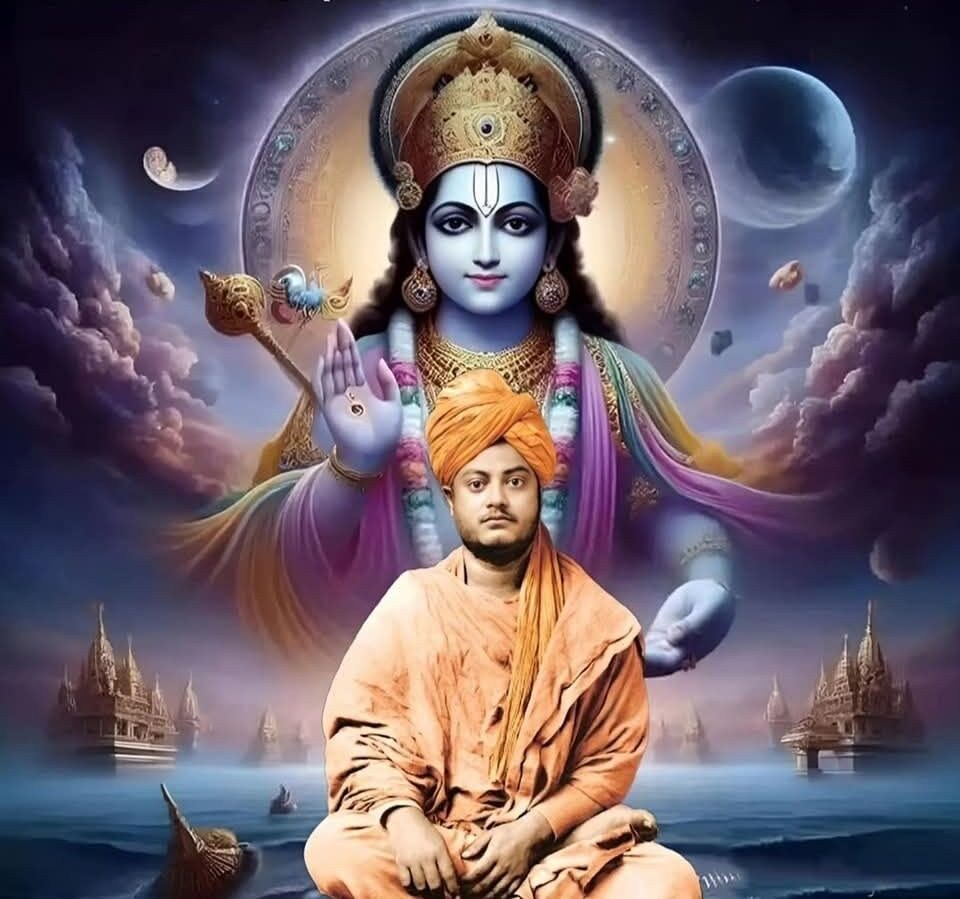
Spiritual guru meditating with Vishnu divine form behind image
Swami Sivananda, The Ultimate Goal of Mankind - Self Realization

Do you aspire for God Realization?

Do you aspire for God Realization? A talk by Swami Krishnananda Do you aspire for God realization? What is your aim? Do you aspire for God realization? Do you want to enter into the bosom of the creator of the cosmos? What is it that you are thinking? What are you keeping in your mind? Suppose the Absolute calls you, saying, “Come on, I want you.” Will you go? And will you leave this gentleman or this lady here who is with you? You don’t care for them, hmm? Or will you take them also? The Absolute calls every atom of the universe. This is what you call evolution, as scientists would say. Every atom is moving in some direction. This is the evolutionary process. It is a call from the almighty supreme that the world has refused. We are restless; nobody has peace of mind. This restlessness is caused by the finitude of the personality. You feel limited. You are limited physically, intellectually, emotionally, socially, politically, and finally your span of life is also limited. So there is nothing unlimited in this world. But there is a longing from inside to break this limitation, to break the limitation of space and time itself. You do not like to be confined to a little space. You would like to conquer the whole of space. You want to go to the sun and the moon and the stars and beyond even the limits of space itself. And you would like to defy time by trying to be immortal. This is the urge for expansion in man, due to which he wrongly tries to grab things and become the emperor of the whole world. He would like to conquer everything and make it his own. Even space and time he won’t leave alone. That also must be his because space and time limit him. Spatial delimitations cause a sense of location in our personality. You locate yourself someplace because of spatial delimitation. And you don’t live eternally because of temporal limitation. So the whole effort of man is to defy spatial limitation and temporal limitation. When you defy space and overcome it, you become infinite. When you defy time, you become immortal. So the whole search of the universe seems to be only to bring you over the brink of infinity and eternity, endless existence and infinite existence. Existence should not be finite; it should be infinite. And not just for a few minutes; endlessly. Suppose you are the king of the whole world for one second. Would that be all right? Everybody wants to be king of the world, so okay, you are king of the whole world–but for only one second! Or suppose you could live for endless years, but like a pig–would you like that? So what do you want? You want neither short life nor long life. What do you say? I will give you the longest life, but like a pig or a tree; or a short life like a king. Do you want a long life or a short life? See, actually you have some difficulty expressing your requirements. What you really want is to have the longest duration of existence, endless permission to live, together with the greatest of intelligence, not like a tree or a stone or a pig. And the greatest of intelligence implies the highest power also. The greater the knowledge, the greater the power. So omniscience, omnipotence and omnipresence is what you want. Here is the essence of the whole matter. You are searching finally for that peculiar, intriguing something called omnipresence, omniscience and omnipotence, which includes infinity and eternity. And when you get it, the mind cannot conceive what will be your destiny. Suppose this state is at hand. Christ said, “The kingdom of heaven is at hand.” Suppose this little thing that I told you is immediately practicable; what will you do? You will burst into the substance of the cosmos and the bliss of it and the glory of it, the grandeur of it, the majesty of it, which no human mind can conceive. Now, briefly, they say this is God. One word. It is impossible to describe what it means. It is a word connoting something which is indescribable and yet impossible to avoid. You are searching for that. In that you will never be cut off by the time process and you will not be limited to a little space. There will be all space and all time and all knowledge. This is attributed to what people generally call the Supreme Absolute. That Supreme Absolute is hearing what we are saying right now. We are not talking in a corner of which it has no knowledge. It has got all eyes. Everywhere are its eyes, everywhere its hands and feet, everywhere its legs, everywhere its everything. Our eyes are only in one place. Where the eyes are, the nose cannot be; where the nose is, the hands cannot be; where the hands are the legs cannot be; where the heart is the brain is not-and so on and so forth. This is limitation. That is not like that. Everywhere is its brain, everywhere its heart, everywhere its hands, everywhere its eyes, everywhere everything. It is all everywhere everything, at all times. What do you call this condition? At all times everywhere everything. Can you contain this thought? If you can contain this you are a super-person, you are not a human being. And you will not be a human being after all. You are something different. The whole world will be reflected in you. We can call this cosmic man, superman, divine incarnation, God-man–there are all sorts of names for this person. When he moves, when he walks on the road, he will feel the whole universe is moving with him. And it is not a joke. There is a connection between a flower in the garden and the stars in heaven. Where are the stars? Where is your garden?

Do you aspire for God Realization? Read Post »

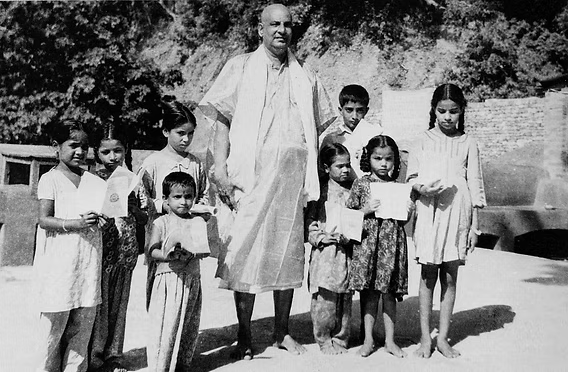
Swami Sivananda standing with children sharing blessings and spiritual guidance
Celestial Collection of Divine Messages - Awakening the Divinity in Man, Swami Sivananda

The Key Stone in Sadhana

The Key Stone in Sadhana Sri Swami Sivananda Having checked all other operations of the mind, bring it to bear upon a single point. This gathering together and bringing to bear upon of a force at a given point on any object, idea or act, forms the process of concentration. The concentrated application of a force makes for maximum results with minimum time and effort. This law is equally applicable to man in all branches of his life’s activities. With the utmost concentrated and careful attention the surgeon executes minute operations. The deepest absorption marks the mental state of the technician, the engineer, the architect or the expert painter, engaged in drawing the minute details of a plan, chart or sketch where accuracy is of paramount importance. A like concentration is displayed by the skilled Swiss workman that fashions the delicate parts of watches and other scientific instruments. Thus in every art and science. The tremendous power that any force develops when collected and directed through a given point is fully recognised. This is seen in the rush of the water at the sluices of dams, in the impelling power of steam from a railway boiler. As the sunlight when passed through a lens emerges as a single fiery ray of intense power, the whole mind attains a single-pointedness through Dharana. Now experience has shown that interest and attention of the mind is attracted by three distinct means viz., sound, vision (physical or mental) and imagination or idea. The Yogi enters into deep meditation by concentrating his mind upon the mystic inner sound of Pranava. This is the Anahata Nada which becomes audible when the inner sheaths are perfectly purified and harmony established; or again a Mantra is repeated in a harmonious tone and the mind is concentrated on the continuous unbroken sound. A concrete form of any aspect of the deity or the syllable OM is chosen for fixing the mind. The rational and Vedantic type fills the mind with some sublime idea or formula upon which the mind is made to dwell intensely and continuously. During concentration the mind becomes calm, serene and steady. The various rays of the mind are collected and focussed on the object of meditation. The mind is centred on the Lakshya. There will be no tossing of the mind. One idea occupies the mind. The whole energy of the mind is concentrated on that one idea. The senses become still. They do not function. When there is deep concentration, there is no consciousness of the body and surroundings. He who has good concentration can visualise the picture of the Lord very clearly within the twinkling of the eye. Manorajya (building castles in the air) is not concentration. It is wild jumping of the mind in the air. Do not mistake Manorajya for concentration or meditation. Check this habit of the mind through introspection and self-analysis. Meditation in Different Paths There are different kinds of meditation. A particular kind is best suited to a particular mind. The kind of meditation varies according to taste, temperament, capacity and type of mind of the individual. A devotee meditates on his tutelary deity or Ishta Devata. A Raja Yogi meditates on the special Purusha or Ishvara who is not touched by the afflictions, desires and Karmas. A Hatha Yogi meditates on the Chakras and their presiding deities. A Jnani meditates on his own Self or Atman. You yourself will have to find out the kind of meditation that is suitable for you. If you are not able to do this, you will have to consult a teacher or preceptor who has attained Self–realisation. He will be able to know the nature of the mind and the correct method of meditation for you. A Raja Yogi enters into the meditative mood deliberately by practising Yama, Niyama, Asana, Pranayama, Pratyahara and Dharana. A Bhakta enters into the meditative mood by cultivating pure love for God. A Vedantin or a Jnana Yogi enters into the meditative mood by acquiring the four means and hearing the Srutis and reflecting on what he has heard. A Hatha Yogi enters into the meditative mood by practising deep and constant Pranayama. Regular meditation opens the avenues of intuitional knowledge, makes the mind calm and steady, awakens an ecstatic feeling and brings the Yogic student in contact with the source or the Supreme Purusha. If there are doubts, they are all cleared by themselves when you march on the path of Dhyana Yoga steadily. You will yourself feel the way to place your footstep on the next rung of the spiritual ladder. A mysterious inner voice will guide you. Hear this attentively. When you enter into deep meditation, you will easily rise above consciousness of your body and surroundings. You will have equanimity of mind. You will not be easily distracted. There will be stoppage of up-going and down-going sensation. The consciousness of egoism will also gradually vanish. You will experience inexplicable joy and indescribable happiness. Gradually reasoning and reflection also will cease. When you enter the silence through deep meditation, the world outside and all your troubles will drop away. You will enjoy supreme peace. In this silence is supreme light. In this silence is undecaying bliss. In this silence is real strength and joy. The entire system is renewed and invigorated in the depths of Dhyana. Faith (Shraddha) or confidence is the power of Yoga. Power (Veerya) for the concentration of mind, memory (Smriti) for contemplation, Prajna, discernment, for the direct perception brought about by meditation becomes the means for the attainment of Samadhi, the final limb of Yoga. The Factor of Grace But the final leap across the barrier of relativity piercing the evil between the individual and the Absolute is ultimately a question of Divine Grace. Surrender draws down grace. The individual becomes one with the cosmic will through surrender. Grace makes the surrender complete. Without grace perfect union is not possible. Surrender and grace are interrelated. Grace removes all

The Key Stone in Sadhana Read Post »

images 2026 02 23T220947.191
Swami Sivananda, The Ultimate Goal of Mankind - Self Realization

The Destiny of Man

The Destiny of Man By Sri Swami Chidananda Blessed immortal souls, beloved children of the Divine! I am greatly blessed to spend this evening hour with you and toshare my thoughts on this subject pertaining to all of us. When we speak of the destiny of man we don’t speak of aspecial human being or a historical person, but we speak very much of ourselves–today–here–inthis world of the fourth quarter of our very troubled yet eventful 20th century.What is our destiny? Man wants to know and scans the newspapers, he listens tothe radio, he views occurrences all over the globe on the television screen. Hewants to know what is going on in this world, what is happening to man, what manis doing to man and where this world is heading. He tries to look ahead and tohave a glimpse of what is in stall for man. But our concern today is not so much to know this in asuperficial way, for what is happening upon the surface soon every schoolboycomes to know. A few years ago what was man’s destiny? Was it to remain boundto the earth or was it to fly into outer space? They said: “We can evenreach the moon!” “Can we or can we not?”–“Is itpossible?”–All these speculations came to an end when man actually landedon the moon. The question was no more there–it had become a fact, a scientifictruth. So scientifically the destiny of man may be to conquer outer space, landon the Mars or some other planet. But what he achieves from this is not known. So it is in a deeper sense that we want to know man’s destinyor perhaps as it has been conceived by a cosmic mind, by a supreme intelligenceand power that is imponderable, that is far beyond the furthest comprehension ofthe human intellect, that transcends reason–that mastermind that has broughtabout this amazing cosmos where heavenly bodies move about in an absolutelycorrect, precise, systematical manner, keeping to their courses, maintaining thesame rate of speed in outer space and demonstrating an incredibly predictablebehaviour. Those who are masters of astrophysics and astronomy can say exactlywhat the movements of certain planets will be, how many years hence will Haley’scomet appear next? They are able to chart its course, calculate its speed andpredict its appearance. See, from within the sight of man on earth this is notan ordinary achievement. But it is possible. Because there is a system workingthere with absolute precision and accuracy that makes it possible for man topredict certain things. It is not a chaos, it is an orderly system. Tomanufacture even a small simple machine, a watch, a timepiece, a little timer,man has to make so many calculations, he has to make the wheels of exactdimension and shape with the exact number of teeth, he has to bring all hisintelligence and observation, his concentrated attention, his skillful action.And when it is old, it is discarded and one buys another one… To produce sucha small machinery so much of intelligence, calculations, skill is necessary. Andthis vast, imponderable, amazing thing which we call cosmos, our solar system,sun, moon and the terrestrial world, the innumerable stars, the mind-blowingdistances, staggering in their magnitude–do you think it came about withoutthe combination of some great incomprehensible master intelligence and masterpower and master skill? The cosmic intelligence, the universal mind is thatwhich we call–we don’t know what … Kant, the great German philosopher, had no name for it. Hecalled it “the thing in itself”. For when nothing was, IT only was.And IT itself knew what IT was. There was no other, no second one to know it.Therefore he called it “THE THING IN ITSELF”. Thousands of years ago,long before the time of even Jesus Christ, the great mystic and prophet Moseswent into the wilderness, prayed, did penance and tried to attune himself to theInvisible, to the Infinite. Humbly he tried to know IT, sought ITS guidance, ITShelp. And a strange power made itself manifest in response to Moses’ quest. Hefelt it, it guided him. And he wanted to know by what name he could refer to it,by what name he could call it. And that being said: “I AM THAT I AM”.I am that I am. What else can I say? I am that being existing by itself. I aloneknow what I am. I exist–I know that I exist. I am that cosmic intelligenceself-cognising, for in that state of absoluteness I am alone. There is no other,no second. I pervade all. I exist by myself, supremely independent, supremelynon-dual. I am that I am. Great Indian sages like the Buddha went to the depth of thoughtand attained illumination–they said: “The only way you can describe ordefine or state that thing is to be silent. “SILENCE”. If you sayanything you say wrongly. You cannot define it. To say anything is to limit it,for human expression, human language is limited, is finite. Therefore silence isthe one and only way in which you can express the inexpressible. SILENCE. The philosopher Plotinus observed all things in this world andfound them wanting. He found that they were all limited and finite, finite intime and space, limited by name and form. Nothing was full, nothing complete,something was there, something else was not there. He found that all things herewere fragmentary, partial, wanting. Therefore he called the ultimate reality,that imponderable, absolute, transcendental reality “THE SUPREMEPLENUM”. The only thing which is all full, all perfect, not limited, notbound by anything. Thus great philosophers, great mystics, those who have enteredinto the transcendental experience of that supreme cosmic power-intelligence,they were silent about it. But they knew that it existed beyond the least shadowof a doubt, because this cosmos is proof positive of that great intelligence andpower of the Universal Being. No other proof is necessary. This universe itselfbears witness of something beyond, something imponderable. That then is theBeing that can tell you something about the destiny of man. For it is yoursource and origin, that is your invisible support and ultimate fulfilment. Inthat you have come into being,

The Destiny of Man Read Post »