




Hari Om

Menu

February 23, 2026

images 2026 02 23T134006.265
Swami Sivananda, THE Glory of Saints - The Self Realized Masters of Bharat - The Jivanmuktas

Gurudev Sivananda–Physician of the Soul

Gurudev Sivananda–Physician of the Soul SRI SWAMI KRISHNANANDA This message was given on the 8th of September, 1975, the 88th Birthday Anniversary of H.H. Sri Swami Sivanandaji Maharaj. A collection of messages by Swamiji during various spiritual festivals including this message can be found in Swamiji’s book, “Spiritual Import of Religious Festivals”. To the humble followers of Gurudev Sri Swami Sivanandaji Maharaj, the 8th of September is a momentous occasion, every year. This is not merely a celebration of the birthday anniversary of the great Master, but an eternally significant event of the advent of the Spirit in this world in a new dimension and with a reoriented perspective. This birthday anniversary celebration, as relevant to the great master Sri Swami Sivanandaji Maharaj, is a rejoicing of the spirit for all his disciples and its meaning cannot be anything but spiritual. I may take this opportunity of pointing out to you and reminding you all, that the coming into incarnation of Gurudev Swami Sivanandaji Maharaj had a special meaning to this world of the modern age. This is the twentieth century and history has taken a leap, as it were, by means of an advance into what we may call an industrial revolution, and a gigantic technological step in the direction of a complete transformation of human values. Mankind’s vision of things has changed right from the beginning of the twentieth century on account of innumerable constructive changes that have taken place in various fields of life, in every field of life, we should say. The beginning of the twentieth century was an occasion for the starting of a scientific revolution, with the advent of masters like Albert Einstein. It was also the time for a revolution from the point of view of international relationship, when nations began to come closer and closer in their internal comity. The significance of the United Nations began to be realised more and more in its real connotation and connection with the different nations. The twentieth century has also been very eventful in many other aspects. Man has conceived the meaning of political unity, national unity and international understanding, in their true significance. This century has seen the coming into activity of many great masters like Sri Ramakrishna Paramahamsa, Swami Vivekananda, Swami Ramatirtha, Sri Aurobindo, Sri Ramana Maharshi, Mahatma Gandhi, Dr. Radhakrishnan and many others. All these giants in the field of mind and spirit have given a magical touch to the total perspective of human values. So in many respects we should say this twentieth century has been perhaps a type of crowning edifice in the historical evolution of the ages. In this very context was born another great master H.H. Sri Swami Sivanandaji Maharaj. I shall tell you the special significance of his coming into the midst of mankind that it is today. What is that special significance? A few of us have had the blessed opportunity of living physically in contact with this Master for many many years. So, we may confidently say in all humility, that we have some sort of a personal knowledge of his own practical life and the meaning of the message that he intended to convey to mankind. I should say that we have to regard ourselves as thrice blessed for having been given this opportunity by God, the Almighty, to live physically in his presence for years and years. And to live in the physical presence of such masters is to bask in the sunshine of the Spirit. You know what it is to bask in the sun. It is to infuse your personality with health-giving rays of a dynamic storehouse of energy. As they say, the company that you keep, the books that you read and the way in which you conduct yourself in your daily life, are supposed to be the insignia of your inner substance, real worth and intrinsic validity. And to keep company with giants of the Spirit like Gurudev Sivanandaji is to be within a very powerful energizing influence which brings together into a focus in its own manifestation of personality the aspirations of all mankind. I may say here that the aspirations of mankind may be said to have found an articulation, in a very pronounced degree, in the personality and the mission of Swami Sivanandaji Maharaj. He gave voice and fluent expression to the inner urges of the human being. Everyone of us has an urge within us, a desire, an aspiration, a longing and a hope, all which we cannot adequately express on account of the weaknesses of our own personalities. Why do we elect a person as a representative of a constituency, in an election, for example? That person is made a member of the legislative assembly or the legislative council in the Parliament, because we ourselves cannot express our ideas properly. We are unable to speak our deeper feelings, in a proper language, and place it before the Parliament in an adequate context. So, we elect a proper person. And the person whom we elect as a Member of the Parliament, or for the matter of that any kind of representation, is supposed to be capable of articulating our inner aspirations and our inner feelings. In other words, he expresses the total spirit of the people who have elected him. Likewise, these great spiritual masters can be regarded as the total representation of the aspirations and the inexpressible feelings of all mankind. You know Jesus the Christ was called the Son of Man, apart from the fact that he was called the Son of God. Why was he called the Son of Man? Everybody is a son of man. What was the speciality in Christ being called a Son of Man? The meaning is that he was a Son of Man, i.e., the son of the total mankind and not a son of Joseph or Mr. so and so, as we all are in the ordinary sense of the term. When we say Christ was the Son

Gurudev Sivananda–Physician of the Soul Read Post »
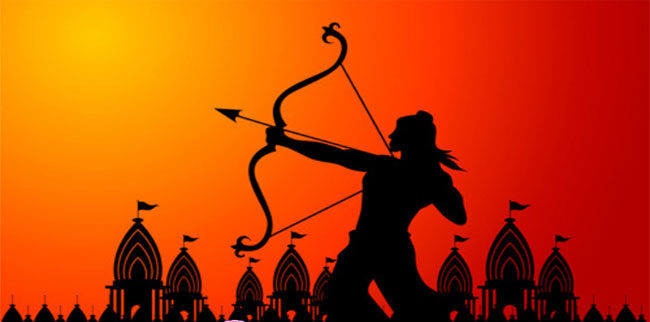
Silhouette of Lord Rama aiming bow before temple skyline image
⁠Festivals in Sanathan Dharam and Hinduism, Swami Sivananda

Ramnavmi

Ramnavmi By SRI SWAMI SIVANANDA Om Sri Ram Jai Ram Jai Jai Ram SALUTATIONS to Lord Rama, an Incarnation of Lord Vishnu, who is measureless, who is of the nature of pure Consciousness and bliss, who is the consort of Sita, Master of Sri Hanuman, and the Lord of the three worlds, who took His birth at His own will in order to establish righteousness, destroy the wicked and protect His devotees. Ramnavami or the birthday of Lord Rama falls on the 9th day of the bright fortnight of the month of Chaitra (March-April). Rama was the Lord Hari Himself, incarnate on earth for the destruction of Ravana. He was well accomplished, beautiful and endowed with royal marks. His glory and prowess were unlimited. He was peerless on earth. He was free from malice. He was gentle. He was the protector of all His people. He always addressed them in gentle words. He never used any harsh words even when somebody provoked Him. He held sway over the whole world. Let Sri Rama be your ideal. Ideals are remembered and adored for the purpose of adopting them in your own life. The Ramnavmi celebration or the Vasanta Navaratri every year is an opportune period for us to saturate ourselves with the spirit of Lord Rama. We love and adore our ideals because we express thereby our yearning to unite with them. In our worship of God it is implied that we should be virtuous, good and perfect even as God is. Hence the wise instruction: “One should become divine in order to be able to worship God”. One cannot be a real worshipper of Lord Rama unless one makes an honest attempt to grow in the virtues that the Lord represents. On the other hand, worship of Lord Rama is itself the surest means to develop such virtues. One who approaches Sri Rama with love and worshipfulness becomes large-hearted, pure in spirit, good-natured and dispassionate in thought, word and deed. A true devotee of Lord Rama is His representative, with His power and His knowledge. Lord Rama was the prince of the Ikshvaku race. He was virtuous and of manly strength. He was the Lord of the mind and the senses. Brave and valiant, He was yet gentle and modest. He was a sage in counsel, kind and sweet in speech, and most courteous and handsome in appearance. He was the master of all the divine weapons, and a great warrior. Ever devoted to the good and prosperity of His kingdom and His subjects, He was a defender of the weak and the protector of the righteous. Endowed with numerous wondrous powers of the mind, He was well versed in all sciences–in military science as well as the science of the Self. Deep and unfathomed like the ocean, firm and steadfast like the Himalayan mountains, valiant like Lord Vishnu, He was the joy of Kaushalya. Though fierce like fire on the battlefield, He was calm like the cool breeze of the Mandara Hills, patient like Mother Earth, bounteous like the god of wealth and righteous like the lord of justice himself. In the pains and the griefs of His people, His heart swiftly sympathised with the sufferers. In the festive scenes which held them in joy, He like a father, shared their joys. By His honour and heroism, as well as by His gentleness and love for His subjects, He greatly endeared Himself to the hearts of His people. Such a great person was the Lord Rama! Lord Rama was the best of men with a sterling character. He was the very image of love. He was an ideal son, an ideal brother, an ideal husband, an ideal friend and an ideal king. He can be taken to embody all the highest ideals of man. He led the ideal life of a householder to teach the tenets of righteousness to humanity. He ruled His people so well that it came to be known as Ram-Rajya, which meant the rule of righteousness, the rule which bestows happiness and prosperity on all. The noblest lesson embodied in the Ramayana is the supreme importance of righteousness in the life of every human being. Righteousness is the spiritual spark of life. Cultivation of righteousness is the process of unfoldment of the latent divinity in man. The glorious incarnation of the Supreme Being in the form of Lord Rama has exemplified the path of righteousness. Let mankind follow His footsteps and practise the ideals cherished by Him, for it is only thus that there can be everlasting peace, prosperity and welfare in this world. None but the righteous can be truly happy. None but he who has the correct sense of duty and the will for its implementation can be said to live worthily. One must be imbued with a definite conviction about the supremacy of moral principles, ethical values and spiritual ideals. These ought to guide one’s day-to-day actions and serve as powerful means for the culture of the human personality. That is the purpose of life. That is the way to Self-realisation. That is the message and the mission of Lord Rama’s fife on earth. To a devotee, Sri Rama is not simply a good and a great person, but God Himself. Rama was the son of King Dasaratha of Ayodhya, but He is also the divine omnipresent, omnipotent and omniscient God. The destruction of the ten-headed Ravana signifies the annihilation of the mind or the ten senses. Worship of Lord Rama is worship of the all-pervading Godhead Himself. Read the prayers offered by Mandothari and Brahma in the Yuddha Kanda of the Ramayana. They refer to Rama as the one Creator of the universe, the God of all, the Ruler of the universe. Devotion to God is not a simple emotion. It is the result of intense dispassion and purity of heart and attitude. You should strive your utmost to possess the good qualities that are extolled in the Ramayana and exemplified in the life of

Ramnavmi Read Post »

20240808074846 Daily Horoscope 6 e1771833375761
⁠Festivals in Sanathan Dharam and Hinduism, Swami Sivananda

Raksha Bandhan

Raksha Bandhan By Sri Swami Sivananda RAKSHA BANDHAN is called Avani Avittam in South India. This falls on the full moon day of the month of Sravan (August-September). It is an important Hindu festival. Hindus wear a new holy thread and offer libations of water to the ancient Rishis on this day. Recitation of the Vedas on this great day is highly beneficial. This festival is also known as Upakarmam, and is specially sacred to the Brahmins, who have been invested with the sacred thread. When a Brahmin boy is invested with this thread, symbolically his third eye, or the eye of wisdom, is opened. The holy festival of Upakarmam reminds one who wears the sacred thread of its glorious spiritual significance. Brahmins also offer libations of water to their ancestors, to whom they owe their birth; to the great Rishis, to whom they are highly indebted for their spiritual knowledge; and to the Vedas themselves. The true Hindu never forgets his benefactors! The followers of the four different Vedas have their Upakarmam on different days. On this day, Sachi, the consort of Indra, tied a holy thread or amulet around the wrist of Indra, when he was defeated by the demons. Then Indra, the king of gods, gained victory over the demons by the power of this protection (Raksha means “protection”). He then recovered the lost city of Amaravati. In North India, on this day, an amulet known as a Raksha or Rakhi, is tied round the wrist of brothers by the sisters as a protection from evil during the coming year. Brahmins and Purohits similarly tie amulets round the wrists of their patrons and receive gifts. A Mantra is recited when the Rakhi or the silken thread is tied. The silken thread is charged with the power of the Mantra, which is as follows: Yena baddho balee raajaa daanavendro mahaabalah;Tena twaam anubadhnaami rakshey maa chala maa chala. “I am tying on your hand this Raksha, with which the most powerful and generous King Bali himself was bound; O Raksha, don’t go away; don’t go away.” The power of this Mantra protects the wearer from evil influences.

Raksha Bandhan Read Post »

Decorated Hindu goddess idol adorned with flowers and jewelry image
⁠Festivals in Sanathan Dharam and Hinduism, Swami Sivananda

Sri Radha–The Divine Mystery

Sri Radha–The Divine Mystery By SRI SWAMI KRISHNANANDA Sri Radhashtami is a joyous occasion observed throughout the country, especially in the North, bringing to one’s hallowed memory the advent of Radha, a name familiar to every religious historian and devotee. But, there is nothing in religious history which is so little understood as the particular spiritual significance which is the theme of the observance of this sacred day, the eighth day in this bright half of the month of Bhadrapada (August-September), the birthday of Radha. The word ‘Radhakrishna’ is a reputed compound name, and devotees generally run into mystical contemplation and even fly into ecstasies in their moods in an attempt to understand the relationship between Sri Krishna and Radha. But, as is the case with almost everything in the world, this relationship which is deeply spiritual and mystical, is hard for the human mind to understand, because God, and everything that is connected with God, cannot become an object of human understanding. The human mind is not expected to understand God, and to ‘understand’ Him would be a blasphemy on the part of the human reason. As a straw would try to carry fire on its body, the intellect of man tries to apprehend the divine mysteries in creation. Devotees of Sri Krishna relate a lot about Radha, the Divine Mystery. I can call her only a Divine Mystery and there is no other designation suitable. Even today, it is a mystery, and it has remained ever a mystery, because God’s relation to the world, His relation to devotees, His relation to human beings, His relation to anything, is a Divine Mystery in itself. But the specific significance that is attached to the relationship between Sri Krishna and Radha is the supernal love that operates in this mysterious relation between God and the world. The world is ruled by love, which is the quintessence of God. The basic stuff of God’s Being may be said to be Love, Joy, Delight, Bliss, Ananda. But man, being what he is, can interpret this joy or delight, this satisfaction or love, this affection or pull, only in terms of his experiences. There are only men and women in this human world, and we do not see a third thing. Therefore, when men and women contemplate the mystery of God, they cannot think in any other way, except in terms of men and women. This is a travesty of religious mystery and a demonstration of the human incapacity to equal the requirement on the part of man by the Law of God. Read any Purana or any Epic, still you will never be able to understand the relation between Krishna and Radha. On the one hand, it has been a theme for a divine upsurge and ecstasy of devotion in the case of pure minds and devotees, while, on the other hand, it has become a theme for sarcastic interpretations of the mysterious relation between the Supreme Male we call God, and the Supreme Female we name Shakti. Two extremes meet in the concept of God’s Glory, and in the mediocre approaches of devotees on the path of divine love, these extremes are not felt. Most of us, may we say all of us, are mediocre followers of the path of God. The extreme steps are not intended for fragile minds, weak bodies, impure emotions and tarnished intellects or prejudiced reasons. The vehicle that can contain the divine mystery has to have the capacity to bear the fire which is God’s Glory. Many times it is said that the embrace of God is an embrace of fire, and no man has lived as man after having seen and embraced God. These are some of the statements we hear from the adepts on the path. The Radhakrishna mystery is a secret, even as God Himself is a secret. What can be a greater secret than God’s Existence! You cannot know where God is, or what God is doing, or why God has created the world. You cannot say what His relation is to us, or, our relation is to Him. You cannot say anything about Him, and the less said the better. Thus it is that when we read the Srimad Bhagavata Purana, the Brahma-vaivarta Purana and certain other texts where such extreme forms of divine relation are expounded, we retrace our steps and turn back dumbfounded: “Yato vacho nivartante aprapya manasa saha“–Speech and mind turn back from that which they are not supposed to express or understand or think. The reason behind this difficulty is that we are, as human beings, not prepared to shed the human way of thinking. We have a reservation always, secretly maintained in our own minds, a secret which we wish to hide even from God’s eyes. There is a fear in the human individual, a fear, on the one hand, of losing the meaning that one attaches to the laws operating in human society and, on the other hand, the fear of losing oneself in what devotees call Love of God. The term ‘Love of God’ may mean either love that a devotee evinces in regard to God, or the love that God has for a devotee. Either way, we can take this term, ‘Love of God’. There is no half-hearted and mediocre attitude in respect of God. Either it is a whole-souled dedication or it is a nothing. There is no partiteness or reserved attitude towards God. It is a completion and a fulfilment which requires on our side also a fulfilled and a complete approach. But we are, as I told you, always men and we can think only as men. We are women, and we can think only as women. These prejudices do not leave us and they cannot leave us. Apart from the idea of male and female, there are other shackles by which we are bound to this earth, all of which are, as it were, steel chains with which we are

Sri Radha–The Divine Mystery Read Post »

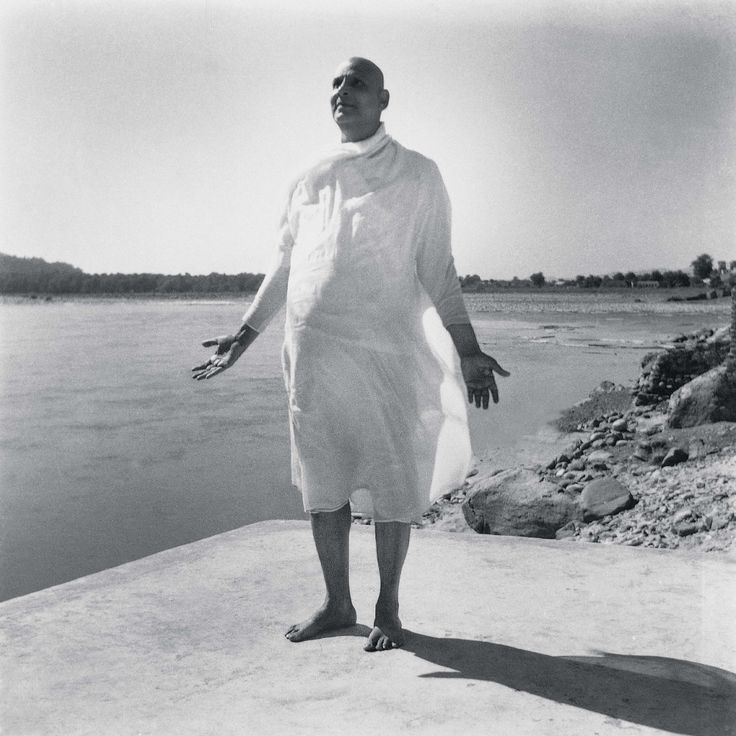
Swami Sivananda standing by river with open arms. image
Swami Sivananda, THE Glory of Saints - The Self Realized Masters of Bharat - The Jivanmuktas

Gurudev Lived To Serve All

Gurudev Lived To Serve All Sri Swami Chidananda “Serve all. Love all. Service of humanity is worship of God. There is no greater yoga than service of mankind.” These are the sterling utterances of Gurudev. He was an embodiment of karma yoga. He served his father and mother when he was young. He served his teachers during his student days. He served his patients as Dr. Kuppuswami in Malaya. Thus it was service all along. Even when he was a monk in absolute seclusion, not speaking to anyone, engaged in intense spiritual sadhana–penance, meditation, introspection, study, silence–he used to go and work one hour a day or more at a little medical dispensary in Laxmanjula. Being an embodiment of selfless service as well as a qualified doctor, he was an ideal servant of the suffering and the sick, the yatris and the sadhus living nearby. And events are narrated how far he went to make his service one hundred per cent perfect and complete. One of the earliest books that Gurudev wrote was The Practice of Karma Yoga. And from those earliest days till the very end of his life, he urged everyone to purify their heart through selfless service. He said: “The almost insurmountable barrier standing between the individual soul and God is the personal ego-principle.” In his short poem that begins: “Within you is hidden God. Within you is Immortal Soul. Within you is ocean of bliss. Within you is fountain of joy,” he adds the most significant words, “Kill this little ‘I’. Die to live. Lead the divine life.” This means that the essence of divine life is the killing of this little “I”. The essence of divine life is a total renunciation of the self and dedicating oneself to selflessness–a total renunciation of self and selfishness and self-centred living and dedicating oneself to total unselfish service of one and all, seeing God in all. “Kill this little ‘I’. Die to live. Lead the divine life.” This is divine life–killing of the little “I”, dying to live. Most significant is the simple prayer of Saint Francis who himself lived what he said in the concluding line of the prayer: “For it is in dying to the little self that we are born to eternal life.” Again: “Then shall I be free, when ‘I’ shall cease to be.” It is only when the “I” disappears that one can rise into the experience of real spiritual freedom. All Gurudev’s life after Self-realisation, after becoming an enlightened sage and shining as a great light of the Himalayas, was a saga of selfless service–service of the poor, service of the suffering, service of the sick, service of the distressed, service of spiritual aspirants and seekers, service of all humanity, service of the whole world. In diverse, numerous ways, his entire life was one great, continuous stream of selfless service. He had even forgotten how to think of himself; he could only think of others. He lived thinking of others: “In what way can I be of benefit, in what way can I serve?” That was Gurudev Swami Sivanandaji Maharaj till the very last days. Gurudev declared in one of his eighteen handwritten autobiographical epistles: “I live to serve, to feed the hungry, to clothe the naked, to raise the fallen, to console the distressed. This is my mission in life.” And anyone who has known him, anyone who has lived with him, anyone who has seen him instantly recognised: “Here is a totally selfless, dedicated human being.” He fulfilled to the very letter the scriptural description of this type of realised soul, who having attained illumination, having done everything that has to be done, having no desires because all their desires have been fulfilled through God-realisation, are seen to be, in the words of the Gita, “intent on the welfare of all creatures.” Rare it is to find a parallel to the type of life–of lofty, sublime selflessness and total, wonderful, dedicated selfless service of all God’s creatures–that Gurudev was and placed before us as an ideal. It is to this embodiment of selflessness and selfless service, this great expounder of nishkama-karma-yoga, who boldly declared, “Service of humanity is worship of God,” that we pay our homage. May his blessings be upon us all!

Gurudev Lived To Serve All Read Post »

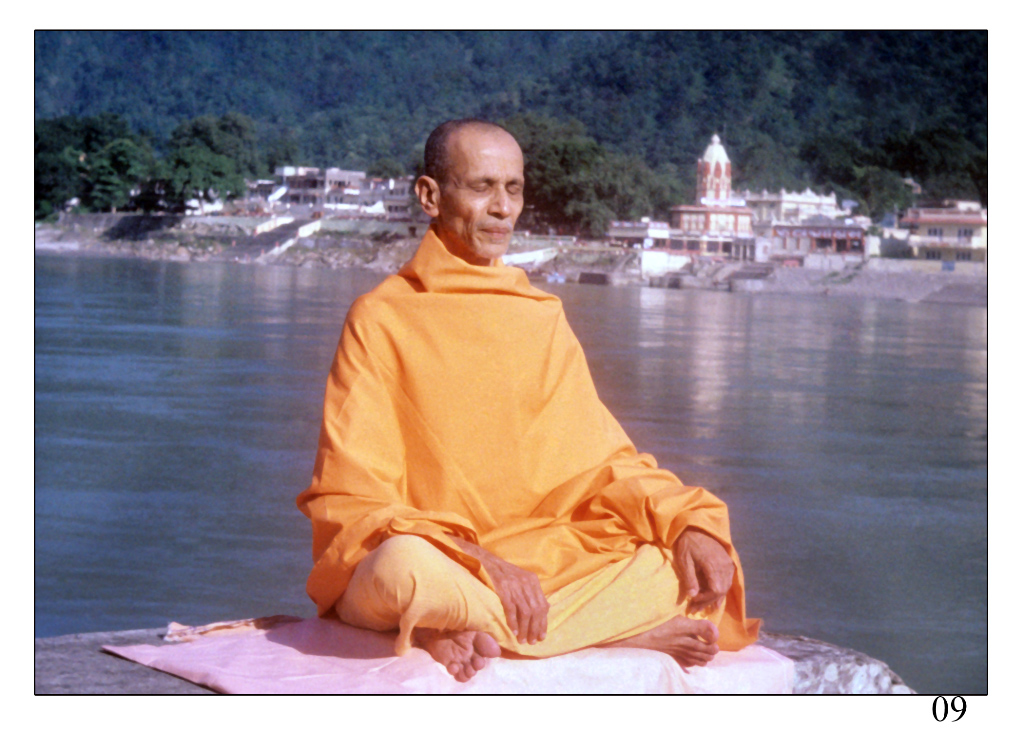
Meditation 006
Swami Sivananda, THE Glory of Saints - The Self Realized Masters of Bharat - The Jivanmuktas

Guru Seva

Guru Seva Sri Swami Chidananda The glorious promise given by the Lord in the Gita Sloka: यदा यदा हि धर्मस्य ग्लानिर्भवति भारत।अभ्युत्थानमधर्मस्य तदात्मानं सृजाम्यहम्॥ yadā yadā hi dharmasya glānirbhavati bhārata |abhyutthānamadharmasya tadātmānaṁ sṛjāmyaham || 4-7. Whenever there is a decline of righteousness, O Arjuna, and rise of unrighteousness, then I manifest Myself! is once again being fulfilled right before our eyes. This promise was given by the Lord at the end of Dwapara Yuga when Kali was about to come. As Divine Knowledge was being lost, God has come to give it to man again. He has come to us in His aspect of Vidya Shakti. This is the Vibhuti of Gurudev who has made Jnana Yajna the lofty spiritual mission of his life. But for Gurudev, it is difficult to imagine where Viveka, Vedanta and spirituality would be in this fearful age of Adharma. Through the instrumentality of Gurudev, God is not only protecting our spirituality, but positively building up our spirituality. I may say that all those with Gurudev’s grace are not in Kali Yuga. The power of the various modes of Sadhana which he has opened up for us enables us to overcome the power of Samsara to drown us. Gurudev is thus creating and keeping alive a current of Satya Yuga in Kali Yuga. In this atomic age, he is radiating Divine Light far and wide. How can we repay him? Will it ever be possible for us to repay him for the great service he has rendered to us and is continuing to render? What is the Guru-Seva which we can do to please Him? In this case, the greatest Guru-Seva would be in the form of Jnana Yajna. The glorious culture of Bharatavarsha has taught us to deify everything. The Srutis repeatedly proclaim this eternal truth: ‘Isavasyam idam sarvam!’ — ‘Sarvam khalvidam Brahma!’ This is the glorious discovery of our ancients, this unique conception of seeing God in everything, in the speck of dust, in the insect, in the sky, in everything. We particularly adore anything wherein Divinity is especially manifest, wherein there is an exceptionally dense manifestation of any aspect of Divinity. The Vibhuti Yoga of Lord Krishna enumerates these manifestations in detail. The Lord is also manifest in an exceptionally dense form in the Guru, in the Spiritual Preceptor who enlightens the disciple. That is why we are asked to worship the Guru as visible God. In Swami Sivananda, we have a universal Guru, a person who deserves to be worshipped by the entire universe. Practice of Jnana Yajna as Guru-Seva to such a universal preceptor implies two things: (i) the dissemination of the universal teachings of Gurudev as far and wide as possible and (ii) the practice of those teachings in our daily lives. For both these purposes, we must know what the main tenets of Gurudev’s Gospel are. The fundamental points that Gurudev is trying to propagate may be summed up as: – There is a higher and nobler purpose in life than mere eating and drinking. – That higher purpose is Self-realisation. – Self-realisation can come about only through renunciation. – Renunciation does not mean going away from home or taking Sannyasa. Real renunciation consists in renunciation of Ahamkara (Ego) and Trishna (craving for objects of sense enjoyment). – Real renunciation as explained above is possible for everyone and must be practised by everyone. The second aspect of Jnana Yajna, viz. the practice in one’s life of Gurudev’s teachings is really the more important. Knowing the teachings of Gurudev thoroughly and putting them to practice is the practical way of doing Jnana Yajna. Towards this end, I would suggest that everyone should get by heart Gurudev’s Universal Prayer, Twenty Spiritual Instructions and Sadhana Tattwa. Everyone should know at least the bare outlines of the four principal Yogas. I would particularly recommend the book ‘Essence of Yoga‘ by Gurudev. It contains all his teachings in a nut-shell. Every disciple of Gurudev should also know the important Asanas and some essential Kirtans and Bhajans.

Guru Seva Read Post »

swami sivananda Vintage portrait of monk in white robe outdoors image
Swami Sivananda, THE Glory of Saints - The Self Realized Masters of Bharat - The Jivanmuktas

Guru and Disciple

Guru and Disciple Sri Swami Venkatesananda In his books Swamiji has given the essence of traditional teaching, imparting to those teachings the secret message of how to keep in touch with this truth, how to make it an integral part of one’s life. The teaching was embodied in him. For instance, though his whole life was one of karma yoga in the truest sense of the word, his actual writings on karma yoga were very meagre. Though he didn’t lecture very much, the few words of instruction that his disciples heard from him were unforgettable. He was the living truth for the most part. His actions spoke far louder than a loud speaker. The enlightened guru cannot verbalise his fundamental experience. What has been written down, committed to memory or verbalised, is only a fraction of the sage’s experience. There is something which he has experienced that is inexpressible. Even the little fraction that he is able to verbalise is lost in transmission, because the disciple is not attentive; so Swamiji didn’t often encourage people to take down notes when he spoke, but to write down the conversation or dialogue afterwards. Communication is almost always non-verbal. Often it was found that when a highly inspiring dialogue was jotted down it wasn’t so inspiring, because Swamiji’s ‘hum’, his smile and the expression on his face and in his eyes had a tremendous impact and tremendous meaning. That was where communication took place. Communication can take place only when the disciple and the master have become like one, where they are at the same level and on the same wavelength. Then the teaching is picked up without the need for words. It is said in the Katha Upanishad: Uttishtata jagrata prapya varan nibodhata.Arise, awake, be vigilant; then approach a great master and attain enlightenment. The arising and the awakening are the disciple’s problem, not the guru’s; but Swamiji went out of his way to admit to the ashram people who did not have all these qualifications. He did not hide spiritual truth–it was there, published–and he did not parade his knowledge. That was an extraordinary trait in him. Many swamis and yogis when asked even a simple question like: “Can one bathe in the Ganges in the winter?” would give a whole talk on vedanta: “You are not the body, you are not the mind. You are the immortal Self.” It is not the immortal Self that feels the cold, it is the body and the mind that feel cold! Swamiji never spoke like this. If at all, he erred on the other side. He was more interested in the aspirant’s physical and intellectual welfare, rather than impose a sort of religious instruction everytime one sneezed or coughed. He waited for the aspirant to ask a spiritual question, and when the seeker was keen he communicated that knowledge in a mysterious way. It was the tradition in those days for holy men to hide themselves in a cave, and wait to be approached by qualified disciples who had experienced an inner awakening, who were vigilant and keen and who at great expense of energy and time went to them and asked for instruction. Swami Sivananda adopted this tradition to a great extent by ‘veiling his wisdom in a big overcoat’, so that the people who went to him often remembered him for his affection and love, for his great concern for their physical and material welfare. These were his main preliminary concerns–wisdom or Atma jnana came in its own time. But, when in total affection and love the disciple became one with him, then it was easy for non-verbal communication to take place. That was his secret. But, he did recognise that unless a person had wisdom, dispassion, noble virtuous qualities and a steady yearning for liberation, no amount of verbal instruction would be of any use whatsoever, and non-verbal communication became impossible. Discipleship In the early days when people went to Rishikesh they found Swamiji radiating bliss, peace and joy, in spite of the fact that all the things that are considered vital to peace, happiness and prosperity were absent. There was absolutely nothing. Living in such conditions he was able to radiate joy. What is that, possessing which he led such a life? The expression in his eyes revealed that he had found the Truth. When you looked into his eyes you realised that he had found the Truth and that you had not. That was enough to humble you and make you collapse at his feet. Early in 1947 Swamiji was sitting in the office. A young man from South Africa, who had stayed in the ashram for about two or three months, was leaving that day. He walked in, prostrated to Swamiji and started crying. With supreme love and affection Swamiji looked at him. He said, “Swamiji, I have to go today, and in Africa where do we get a guru like you?” Suddenly Swamiji’s expression changed, and with a very beautiful, meaningful and mischievous smile he said: “Huh, you don’t find a guru in Africa?” By this time the man’s grief had gone, his tears had dried up. He found Swamiji laughing and smiling. Swamiji then fixed his gaze on him and said, “It is very easy to find a guru, it is very difficult to find a disciple. Be a disciple! From head to foot be a disciple! Then you will find a guru.” Swamiji never said, “I am your guru.” Occasionally he used to say, “You are my disciple,” or “He is my disciple,” and to his early disciples he wrote: “I have accepted you as my beloved disciple, I shall serve you and guide you.” When he said: “I have accepted you as my beloved disciple,” the disciple felt that he had a claim over Swamiji and could write to him more freely. That is what Swamiji wanted. The next sentence was: “I will serve you.” The disciple is supposed to serve the guru!

Guru and Disciple Read Post »

pradosha vrata 2
⁠Festivals in Sanathan Dharam and Hinduism, Swami Sivananda

Pradosha Vrata

Pradosha Vrata By Sri Swami Sivananda ALL THINGS in this vast creation function upon definite cosmic laws or laws of God. There is always a beautiful system and sound rationale governing every phenomenon and process, mundane or mystical. Just as the gross elements and physical forces operate differently under different states and conditions, so also the subtler and higher forces respond and react in the inner mystic planes, and in the purely spiritual processes like meditation, prayer, worship, etc. Therefore, you will find definite injunctions for performing certain types of worship in the morning, certain other injunctions for the midday prayers, and still others for the evening worship. Again, some observances are meant to be performed during certain phases of the moon, some when a particular star is in the ascendant, or at the time of a particular conjunction of planets. The Pradosha worship is to be done in the evening twilight on the thirteenth day of each lunar fortnight. It is the worship of Lord Siva for victory and success in all undertakings, and the fulfilment of all your heart’s cherished desires. When you desire to obtain a favour from a superior person, don’t you naturally approach him at a moment when he is likely to be in a very pleasant frame of mind? You will perhaps see him after he has had a good dinner and is happily chatting with a friend in a hearty, expansive mood. Even so, the Hindu, especially the Hindu who is engaged in the motivated type of worship, usually selects the most pleasant aspect of God for his worship. He performs it at a time which the ancient Rishis experienced as being the most helpful and efficacious in propitiating the Deity. The Pradosha worship is based on such mystic psychology. Pradosha is the worship of Lord Siva and Parvati when they both are in an extremely propitious mood. Repeatedly worsted in war by the demons, the gods approached Lord Siva to bless them with a leader for their celestial hosts. They came to the Lord at twilight on the thirteenth day of the lunar fortnight and found Him in the blissful company of His consort, Parvati. Hymned and glorified by them, Siva immediately granted their prayerful request. Hence, the extreme auspiciousness of the period. The Skanda Purana relates how Sandilya Muni prescribed this Vrata to a certain Brahmin lady. She came to the sage with two boys, her son, Suchivrata, and an orphan prince, Dharmagupta, whose father was slain in battle and the kingdom overrun by enemies. Acting upon the advice of the sage, the woman and the boys performed the Vrata with great devotion. After four months, that is, in the eighth Pradosha, Suchivrata obtained a pot of nectar and drank the divine ambrosia. Prince Dharmagupta won the hand of a celestial princess and, as ordered by Lord Siva, with the help of the celestial king himself, his enemies were slain and his kingdom restored to him. Then Dharmagupta attained the Lord’s supreme abode. So easily, and yet so greatly is the Lord of Kailas pleased by this Vrata. One who takes this Vrata fasts on that day, and keeps vigil at night after the fast is over. Bathing an hour before sunset, the worshipper first performs a preliminary worship of Lord Siva, together with all the others of His divine family, namely, Parvati, Ganesha, Skanda and Nandi. After the worship of Ganesha, Lord Siva is invoked in the special kalasha placed on a square mandala with a lotus drawn in it and spread over with darbha grass. After the formal worship has been completed, a Pradosha story is read and heard by the devotees. This is followed by the recitation of the Maha Mrityunjaya Mantra 108 times. In the end the sacred kalasha water is partaken of, the sacred ash is applied to the forehead, and the water which was used to bathe the Lord, is drunk. A gift of a pot, a cloth and an image of the Lord is given to a Brahmin to conclude the worship. A very important point to be remembered in this connection is that during this auspicious period all the hosts of celestial beings and gods come down from the heavens and attend the worship in their subtle forms. This adds immensely to the sanctity of the worship. This Vrata is highly lauded by the scriptures and is of very great sanctity and importance to worshippers of Lord Siva. The mere sight of the Deity in a temple during this period will destroy all sins and bestow bountiful blessings and Grace upon the fortunate beholder. Even a single bael leaf offered to the Lord at this unique, auspicious moment equals a hundred Mahapujas. It is usual to have special additional lights in the shrine during the Pradosha. To light even a single wick at this juncture is highly meritorious and productive of untold benefits, spiritual as well as material. Most fortunate and blessed is the person who performs the Pradosha Vrata, for upon him Lord Siva showers His choicest Grace and blessings in a very short time. Here is the Yogic interpretation of the Pradosha: According to the Siva-Raja Yoga, concentration is directed towards the central point in the middle of the eyebrows, where the spiritual light can be perceived by the Yogi who turns the vision inwards. The Yogi passes through various stages, all of which are subdivisions of the four states of waking, dreaming, deep sleep, and the Superconscious State or Samadhi. Each one of these states is further sub-divided into four states, for example, the waking-dreaming, waking-sleep, waking-fourth, and waking-waking. It will be seen that when the states are sub-divided in this way, the first three states comprise a total of twelve sub-states. The thirteenth is the fourth-waking. There is correspondence between this and the thirteenth day of the lunar fortnight, either bright or dark. Those who worship Mother Shakti have certain beliefs of their own, one of which is that the Goddess that is worshipped acquires one ray on each of

Pradosha Vrata Read Post »

⁠Festivals in Sanathan Dharam and Hinduism, Swami Sivananda

The Esoteric Significance of the Devi-Mahatmya

The Esoteric Significance of the Devi-Mahatmya By SRI SWAMI KRISHNANANDA Our longings are fundamentally very deep and cannot be easily satisfied by temporary make shift or day-to-day adjustment of outer circumstances. Our desires are profound, our yearnings are very unintelligible to outer atmosphere of our daily life. We seem to have a root which is deeper than what can be comprehended by our normal understanding of the world. We grow from all sides, and when we long for or desire or yearn or aspire, we do so in a very comprehensive manner. This aspiration of the human being is really the soul’s longing for freedom. All our desires are desires of the soul, ultimately. Though they look like sensory desires, mental desires, intellectual desires, social desires, etc., they are, at the bottom, the longing of the soul of the human being, which ramifies itself into various distracted rays through the operations of the mind and the activities of the senses. Our longings are, therefore, capable of being collected into a single essential power, an inward urge, which we may call the longing for freedom. It is freedom that we ask for and it is freedom that anyone asks for. Varieties of longings and multitudes of enterprises in the world can be collected into a single focus of the soul’s aspiration for liberation. And this aspiration for liberation is not merely the longing of the human being, but of all that is created anywhere on earth or in heaven. Whether it is the plant or the animal, whether it is a man or a celestial, the aspiration is this much. All longings can be boiled down into the quintessence of the longing for liberation, freedom from all sides and an ultimate supremacy over one’s own self in the realisation of this freedom. The Devi-Mahatmya which, in a majestic poetry in Sanskrit, describes to us the Epic of the march of the human soul to its destination, the realisation of this freedom, is the dramatic aspect of the great worship of the Divine Mother during these nine days of Navaratri or Dassehra as you call it. The march of the soul is dramatic. It is not a lagging or a crawling but a beautiful, sonorous, musical advent, you may call it. This is the beauty of the Devi-Mahatmya. All Epics have this particular character of grandeur, uplifting the emotions, and chastening the intellect of the devotee who goes through them. The Devi-Mahatmya is a part of the Markandeya Purana, containing thirteen chapters which are grouped into three sections, known as the Prathama Charitra, Madhyama Charitra and the Uttama Charitra. As in the Bhagavadgita, sometimes we are told that the eighteen chapters can be grouped into three sections of teaching, consisting of six chapters in each, in the Devi-Mahatmya also, which is an Epic-counterpart of the methods of the Bhagavadgita in its practical implementations, it is capable of a division into three sections. The march of the soul is graduated into three major steps, though there are many minor steps involved in these three major ones. While we have to rise through various rungs of the ladder of evolution, we come to three points or halting places, we may call them, where there is a complete transformation of outlook, attitude and constitution of our being. These threefold transformations of the spiritual being of the aspiring soul are dominated or presided over by three deities known as Maha-Kali, Maha-Lakshmi and Maha-Sarasvati. These three presiding forces are representative of the powers of the spirit within manifesting themselves in an upward ascent towards freedom ultimate, so that in this march of the soul to its freedom, it carries with it everything that is connected with it. The difference between the spiritual march and your march along the road or a highway is this, that while in your march on a roadway, you alone walk and nobody need accompany you, nothing need be connected with you, and you can have a free walk independently; in the spiritual march, it is not such an isolated march, but you carry with you everything that is connected with you. Now, what are the things connected with you that you carry? There are four stages of this relationship. Consciously we are related in a particular manner and subconsciously we are related in another manner altogether. Consciously, we people seated in this hall for example, have a particular sort of relationship among ourselves, but subconsciously our relationships are of a different kind altogether and they need not tally with our conscious relationship. And deeper still, we have a layer where our relationship is more akin to a unity of life than to a diversity of personality. There is a fourth stage which is incapable of any description at all. We do not know whether we are to call it a unity or a diversity, or oneness or otherness. This is the goal towards which the soul is marching. So, in the description of the Devi-Mahatmya, we are carried forward psychologically and spiritually to our destination of the ultimate realisation. There are three stages of transformation described in the three sections of the Devi-Mahatmya. The first one is where Adi-Sakti awakes Maha-Vishnu who was asleep, so that He may destroy or overcome the original demoniacal forces, Madhu and Kaitabha. The second stage is where the same Sakti manifests Herself as Maha-Lakshmi and overcomes Mahishasura and Raktabija. The third one is where Sumbha and Nisumbha are destroyed by Maha-Sarasvati. And the nine days of worship comprehend these three stages adored in three days of worship, each. The final victory is called Vijaya-Dasami, the tenth day, as you know. That is the day of Victory, where you master the forces of Nature completely and your goal is reached. When you step over nine, you enter into Infinity. Numbers are only nine, you do not have ten numbers. All the arithmatic is within nine numbers only. The whole cosmos is within nine. But when you transcend the nine, you have gone to Infinity,

The Esoteric Significance of the Devi-Mahatmya Read Post »

Goddess Durga idol with multiple arms holding weapons picture
⁠Festivals in Sanathan Dharam and Hinduism, Swami Sivananda

The Quintessence of The Spiritual Quest

The Quintessence of The Spiritual Quest By Sri Swami Chidananda Today is the sixth day of the annual nine-day worship of the Divine Mother. This morning we will mention the actual inner nature of a common universal factor that constitutes the very quintessence of the quest, which if present, the quest becomes powerful and successful, which if absent, no matter how much you struggle and seek and pursue the quest, you seem to be getting nowhere, it seems to be unproductive. And that inner factor can be explained in terms of a physiological activity that is absolutely indispensable for sustaining life and thus is an apt analogy. Life is sustained by food. But a desire for food only arises if there is keen hunger. If there is no hunger, no appetite, a person turns away from food. Therefore, the quintessential inner factor is that there should be a great hunger in the soul for the attainment, just as when physiologically a person feels great hunger for food and will not rest until their hunger is appeased. Scientific researchers are driven by such a hunger. Day and night they can be in their laboratories trying to somehow or other attain a breakthrough. They have this powerful inner hunger for new knowledge, for discovery. In the same way, in the spiritual world it is this great inner longing, this great hunger, that is the one quintessential factor. If it is there, all other things are somehow or other managed; they are dealt with and you go on proceeding further and further upward. If it is not there, if it is lacking or if it is not of the highest quality and measure, then no matter how much yoga and pranayama, how much japa and study of scriptures or any other spiritual practice you may do, all that is seen is a snail’s pace progress. It is not without reason that Jesus said, “Blessed are those who hunger and thirst after righteousness.” Mark! These are key words–hunger and thirst–a great longing. The guru of Swami Vivekananda, Sri Ramakrishna, used to go and stand before the shrine of the Divine Mother and say: “Mother, here is knowledge, here is ignorance. I offer both at Your feet; I do not want either. Give me only unalloyed devotion to Thy lotus feet.” He would offer Her everything–discrimination and non-discrimination, meditation and dissipation, this and that, everything–saying that he wanted nothing; he just asked for unalloyed devotion to Her lotus feet. This leads us into a great truth in spiritual life. That which pleases the Supreme Being the most, that which unfailingly draws down the grace of the Divine, is this hunger and thirst in the human heart, a great longing in the human heart for God and God alone to the exclusion of all other things: “Take away everything. I only want unalloyed devotion that longs for You and You alone.” This is the quintessential factor in the spiritual path and the spiritual life. May you hunger and thirst after righteousness. May the grace of the Divine Mother and the benedictions of Holy Master grant you all that is essential to make your life a glorious success!”

The Quintessence of The Spiritual Quest Read Post »