













Hari Om

Menu

February 23, 2026

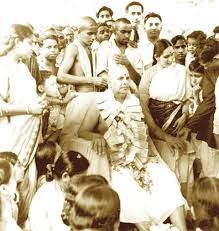
swami sivananda Vintage photo of spiritual guru surrounded by devotees image
Swami Sivananda, The Ultimate Goal of Mankind - Self Realization

The Call of the Real

The Call of the Real By SRI SWAMI SIVANANDA The seed of the perpetration of evil is sown by the lack of ability to apprehend the nature of wisdom, truth and justice. It is not the human aspiration but the subhuman propensity that ravages the very values of life through contempt for alien temperaments and hatred towards other inhabitants of the earth. It is a great mistake that the boys and the girls of today are spending their career in “education for job, bread and comfort”, neglecting the central realities of true civilisation and culture. It is imperative that all schools and colleges should, if they intend to work for the happiness and freedom of mankind, include, as the most important item in the curriculum, the art of perfect living, an appreciation of the essential values of life–virtue, love, truth, purity, universality, wisdom and justice,–which constitute the very heart of religion–religion which soars high up to the possibility of cosmic salvation. There is no life in the educative process, if it is destitute of the religious consciousness, for religion is the very meaning of life’s purpose, the one aim of the struggle for existence. If religion is rejected, there is nothing left in the mortal except a heap of bones and a mass of flesh. Why modern civilisation has despised religion is only because it understands by religion an outburst of the irrational spirit. The truth is far from this! Religion is the light that enlivens the most rational life, the manifestation of the eternal glow of intelligence that peeps through even the mightiest genius of the world. There can be no civilisation without religion, and there is no worth in religion if it is destitute of spirituality. That religion which aims at nothing more than a happy life in the world is only materialistic utilitarianism and not a solacing religion. Materialism is the crude product of a want of proper illumination and insight into the true essence and, hence, it is not worthy of consideration. An impure heart and conceited brain cannot understand religion. True religion begins when and where the intellect ends. Religion is neither emotion nor scholarship, but knowledge that is direct and immediate, a faith born not of practical necessity but of impersonal experience. The revelations of the Vedas and the Upanishads, the gospel of Buddha, the teachings of Christ, all have sprung from an impersonal source, though this impersonality is made known to us only as expressed through personalities. No intelligent man of the world can say that he has reached the zenith of intelligence; knowledge grows and widens when experience deepens itself. Many rank materialists have turned into great spiritual heroes, which shows that the shallow world cannot satisfy the deep spirit in man. This One Spirit is common to all and, therefore, religion must be One, not two or many. Though shirts and coats may be many, the person who puts them on is the same. The divine play of manifestation, through its scenes of appearing and disappearing in the variegated colours of life and death, drives home to mankind the lesson that this life is only an act in the stage of becoming, where many parts are played and no part in itself is complete enough to give the character of wholeness to the play. Every actor on the stage behaves in such a way that he does not portray himself as an unrelated independent personality, but endeavours to be an integral part of the entire play. This behaviour of the actor fitted to the wholeness of the play is his dramatic peculiarity or the Dharma which unites all actors to the whole, which is the ultimate purpose. The Dharma of man is his religion which binds him to the Whole, which shows that he is a part of the Whole, trying to abide by the Law of the Whole and aiming at fulfilling the purpose of the Whole. For, the Whole is the truth and the good of all is included in it as its constituents which can never exist independently of the Whole. Man can never live without God, for God is the Whole and man is only a part. Man’s religion is his Dharma and this Dharma can be in its real sense only one, for its goal is one. There is one God, the indubitable Self of all beings; there is one Law, the relentless law of cause and effect; there is one religion, the indispensable religion of Self-realisation. Everyone is only the One Self; how, then, can there be many laws and many religions? As life has been made for the time being comfortable and comparatively effortless by modern inventions, the ease-loving man is prone to disregard the place of religion in his life and exalt the values of materialistic view of things. Events are slowly disclosing the unreliability of the purely objective views and methods of physical science, since it is the experience of man that he is not really happier, and the world is not in fact better, even after his daring attempts at extracting out of external nature the secrets of its resources in order to utilise the same for his own purposes. Where is satisfaction, where is happiness, and where is peace, then? Is anyone who has deeply and correctly thought over his conditions and the world’s vicissitudes capable of asserting that the struggle for advancement through the physical methods has ended in the solace of man? The purely physical outlook is not compatible with the inner truth of the real man, for, religious discipline, and not bodily pleasure, is the role to be followed in the course of right living. Let it not be thought that religion is a dogmatic, other-worldly, pet tradition of blind believers or irrational emotionalists. Religion is the most rational science of man as he essentially is, not merely as he presumes himself to be. Religion is the way to the realisation of the highest perfection. If

The Call of the Real Read Post »

Swami Sivananda spiritual saint and yoga master
⁠Direct Disciples of Sri Swami Sivananda Maharaj, Swami Sivananda

His Holiness Sri Swami Dayananda Saraswati Maharaj

His Holiness Sri Swami Dayananda Saraswati Maharaj Born in Bhimavaram, Andhra Pradesh, in the year 1923 to prosperous parents, he was known as Ramalinga Raju. Even when he was studying in college, he was interested in the literary side, particularly philosophy and religion, and he was an admirer of Dr. Radhakrishnan, especially. Suddenly he felt an urge to renounce the world and found himself at the feet of Swami Sivananda, in the year 1946. Reading, doing Japa and meditation were his specialities. Swami Sivananda recognised the great spirit of renunciation in the young man and initiated him into the holy order of Sannyasa within two years of his joining the Ashram, on 14th January, 1948 and gave him the monastic name of Swami Dayananda. He accompanied Sri Gurudev during the All-India tour in 1950 and did untiring service to him, day and night, with great love and care. Swami Dayananda is known as the active participant in the work of The Divine Life Society from the time Sri Gurudev felt it necessary to have a wing of the Ashram helping in printing work. The very seed of the Printing Press, it may be said, was sown by Swami Dayananda. Over night he worked a miracle, as it were, and brought a printing machine (a tradle machine) from Rishikesh town and saw to it that the very next day (20th September, 1951) the inauguration of the Printing Press so dear to Sri Gurudev was performed. He also worked and struggled tooth and nail to bring electricity to the Ashram, which he succeeded in bringing, a few years after the founding of the Printing Press. Actually the manner in which he brought electricity to the Ashram is an epic, a saga by itself. No person would have succeeded easily in doing that work, since it required permission from the Government which was not eager to spend money, for the sake of bringing connection to the Ashram. Anyhow by moving the District Magistrate of Dehra Dun, Swami Dayananda succeeded in doing this work. Thereafter he concentrated himself entirely on the Printing Department, even till today. Due to his persistent and tenacious concentration on this work the Press has increased its dimension. It has become one of the top-most Printing plants in the Garhwal region, which is all due to his indefatigable work and totally unselfish labour. Sri Gurudev loved him so much that once he said, “Ah! I am proud of you, Swami Dayananda,” and added, “You are an embodiment of Nishkama Seva.” Today, he is the main-spring behind the management of the Printing Press. Swami Chidananda paid his tribute thus: “Swami Dayanandaji Maharaj has been a pillar of this Institution over these decades. Today he is a ‘Veetaragi’, a ‘Nirlipta’, ‘Tyagi’ Saint. He is a rare Sadhu who in the midst of intense Guruseva is yet ever engaged in trying to abide constantly in the state of ‘Atma-samsthiti’. He is also ‘Iccha Rahita’ Yogi in the sense that he has no personal self-desire of any sort in his life. He has one overwhelming desire and that is Sri Gurudev’s Jnana Yajna. Other than his desire to meditate, meditate, meditate, his only second ambition in life is to see each and everyone of Holy Master Sivananda’s books in print and to make them available to thirsting spiritual aspirants all over the world.” In the year 1970, Swami Dayananda was appointed as one of the Secretaries of the Divine Life Society, in which post he continued till September, 1975 when he was elected by the Board of Trustees as a member of the Trust Board and Treasurer of the Divine Life Society, which position he is holding till today.

His Holiness Sri Swami Dayananda Saraswati Maharaj Read Post »

Hindu saint seated with Lord Vishnu appearing behind image
Swami Sivananda, The Ultimate Goal of Mankind - Self Realization

The Call of the Absolute

The Call of the Absolute Teachings from Swami Krishnananda Introduction by Swami Bill Eilers of the Sivananda Ashram in Rishikesh, India “The next time you come to Rishikesh you must stay here at Sivananda Ashram.” So exclaimed Swami Krishnananda, the long-time General Secretary of the Divine Life Society, to Andrew Cohen when Andrew visited him earlier this year. Deciding to accept the invitation sooner rather than later, Andrew changed his travel plans for the interval between his teachings in Bodhgaya and Kathmandu, and on January 24, accompanied by about a dozen of his students, returned to Rishikesh to spend five memorable days at the ashram. Sivananda Ashram, the world headquarters of the Divine Life Society, is huddled on a bank of the Ganges River two miles north of the “City of Saints,” Rishikesh. This area, in the foothills of the Himalayas, with its many ashrams and temples, is considered to be one of the holiest parts of India. For thousands of years, seekers after God realization have come here to do penance, austerities and deep meditation, and the very atmosphere is charged with the power of the realizations of bygone seers. The ashram was founded in 1932 by the great saint and sage Swami Sivananda, who passed away in 1963. Since then his ashram and the Divine Life Society have continued to grow. The society has about 10,000 members and over 200 branches in India and abroad. The ashram, with its large library, teaching academy and thirty-bed hospital, has around 300 residents including about 100 monks, and feeds over 500 people a day. It is a spiritual oasis for many sincere seekers from all over the world who feel at home in an atmosphere where English is spoken and where people of all faiths are welcomed. Swami Krishnananda was born in South India in 1922. At the age of twenty-two he joined the budding Sivananda Ashram and two years later donned the ocher-colored monastic robes. Many years of study followed as his photographic memory absorbed not only the Indian scriptures but the entire range of Western philosophy. His semireclusive life ended in 1957, and he was named General Secretary of the Divine Life Society in 1959. Since then he has performed the difficult task of balancing numerous administrative duties with lectures, spiritual discussions and writing. Although some of his writings are in difficult philosophical language, Swami Krishnananda has a genius for giving simple and highly original answers to questions from seekers. For example, he once defined Self-realization as “where thought expires into experience.” He recently revealed an aspect of his personal philosophy when he explained to a distinguished visitor, “Swami Chidananda [President of the Divine Life Society] and I are more interested in how we live our lives than we are in teaching.” As often as not, comments such as these are interspersed with signing official papers, answering administrative queries, making casual jovial remarks, and suddenly, brilliantly, expounding a profound Vedantic truth.Vedanta is the crown jewel of Indian spiritual thought. The word Vedanta itself means “the end of the Vedas” or “the end of all knowledge.” The Vedas, among the most ancient scriptures known to humankind, are the roots of the entire Hindu tradition. Vedanta, based upon later but still ancient Hindu scriptures (the Upanishads, the Bhagavad Gita and the Brahma Sutras of Vyasa), boldly asserts that atman and Brahman, or the individual soul and the Absolute, are one–You are That! And at the end of the eighth century A.D., the great Shankara in his exposition of Advaita Vedanta, or absolute nonduality, declared, “I will tell you within half a verse the essence of all the scriptures: Brahman alone is real. The world is unreal. The individual self is not other than Brahman.” This does not mean that the world does not exist, but that it is unreal if it is understood to be different from the sole reality, Brahman, which is both immanent and transcendent, and finally beyond any categorization whatsoever. While Andrew was in Bodhgaya, Swami Krishnananda was asked whether there was any reason in particular that he had given Andrew the special invitation to the ashram. In the humblest way he answered simply, “I just want to give him honor.” And when Andrew approached him the first morning of his return, Swami Krishnananda welcomed him and said, “We want to do everything for you. We want nothing from you.” Having been asked if he could make himself available if people would like to meet him, Andrew inquired if it would be all right to hold some public meetings. “Of course, you don’t even need to ask,” was Swami Krishnananda’s quick response, “You will help bring sanity into the lives of your listeners.” Someone then asked if it would be possible for Swamiji to spare a little time each day for the visiting group. “Please come at 6 p.m. just after my group meditation and I’ll be glad to see you,” Swamiji replied. Thus was initiated a double series of fascinating meetings that were an inspiration to those who were privileged to attend. For the following three afternoons, Andrew held deeply meaningful dialogues usually preceded and followed by meditation, and in the evenings the visiting group met with Swami Krishnananda for a series of passionate and illuminating encounters.

The Call of the Absolute Read Post »

Swami Sivananda Indian yoga guru and saint picture
⁠Direct Disciples of Sri Swami Sivananda Maharaj, Swami Sivananda

His Holiness Sri Swami Venkatesananda Saraswati Maharaj

His Holiness Sri Swami Venkatesananda Saraswati Maharaj Swami Venkatesananda with beloved Gurudev on his right. Parthasarathy (as Swami Venkatesananda was called before he entered the holy order of Sannyasa) was born to the pious and noble parents, Sri Srinivasan and Srimati Lakshmi Devi, in a village called Koil Venni in Tanjore District, South India, on 29th December 1921. Many incidents happened in his childhood and boyhood which reveal his inborn divine qualities. The boy’s mind began to turn to devotion and love towards Lord Venkatesa of the famous shrine of Holy Tirupati. When Parthasarathy was a boy of twelve years, he came across books written by Swami Sivananda who was destined to become his spiritual Master and Living God. In course of time Parthasarathy held a responsible position at Delhi as a personal assistant to highly influential Secretary to the Government of India. But the call of the spirit was irresistible. His contact with Swami Sivananda through books had developed into contact through frequent letters. Then it flowed into regular visits to the holy Ananda Kutir, whenever Parthasarathy managed to get leave from his office duties. The personal contact with the Master soon overwhelmed Parthasarathy and he cut off all bonds that bound him to the secular life, renounced a promising career and offered himself as a dedicated Sevak (servant) at the lotus-feet of his Divine Master Swami Sivananda. Coming thus into the spiritual fold of Swami Sivananda at a very young age, Parthasarathy took to the renunciate in the year 1945 when he resigned the excellent position he was holding. He came with the specific intention of placing himself entirely at the service of Gurudev’s Universal Spiritual Mission, with intense devotion, utter dedication and unparalleled spirit of service. He soon made himself indispensable to worshipful Gurudev, especially, in his global spiritual dissemination work. From early 1945 up to the time when he breathed his last, his entire life was whole-souled absorption in the sublime good work of Gurudev Sivananda. Parthasarathy was ordained as a monk on 8th of September, 1947, the sacred Diamond Jubilee of Sri Gurudev. He became Swami Venkatesananda. The Swami was a versatile personality. He placed his great talent in the service of the holy Master. He was one of the pillars of the Divine Life spiritual movement. At a certain period he was the very right hand of worshipful Gurudev. Such was the great confidence reposed on him by worshipful Gurudev, that every morning, when Gurudev stepped out of his little cottage on the banks of the holy Ganga, he would first go directly to Swami Venkatesananda’s room situated right in front and sitting there, he would many a time consult him and seek his opinion on matters concerning Jnana Yagna (dissemination of spiritual knowledge) and publishing activities of the Society and at times on other important matters as well. He was a tower of strength to Sri Gurudev during the latter’s unique “ALL INDIA SPIRITUAL AWAKENING TOUR OF 1950” which had electrified the entire nation and powerfully stirred up the spiritual consciousness of millions of people creating a wave of religious awakening and inspiration throughout the country. Gurudev declared about Swami Venkatesananda: “He is the Crest-Jewel of my Mission. He is the resplendence of my work. Will I see anyone else shine brighter than him! Surely none have I seen so far. He is a tower of strength to me and my Mission.” During the tour he took down notes of every word spoken by Sri Gurudev at each centre and has brought a voluminous work “Sivananda’s Lectures: All India Tour.” He came especially to work vigorously in the correspondence section of the Ashram. One can say that volumes of typewritten material connected with correspondence is to be turned out, even during night hours by this Swami. The entire career of his in the Ashram was devoted to writing, recording of Gurudev’s speeches and editing the day-to-day messages and conversations of Gurudev which he did to the point of perfection and perhaps most of the Sivananda: Day-to-Day that we have these days recorded are the works of Swami Venkatesananda, principally. After tireless service and winklessly working in the Ashram for Sri Gurudev’s glory, his main mission was to bring glory around the aura of Gurudev’s Centre, The Divine Life Society, which task he fulfilled very commendably. He has produce a superb work entitled “Gurudev Sivananda” which is not merely a detailed biography of Swami Sivananda but also an authentic record of the history of the Divine Life Society, – a reference book involving great labour. The Indian devotees in South Africe, headed by Swami Sahajanandaji Maharaj, required a powerful spirit of the Divine Life Society to enthuse them and Swami Venkatesananda was the man chosen by Sri Gurudev for the fulfilment of this Mission there. Thus in 1961 Swami Venkatesananda was deputed to South Africa, where he did a marvellous work. Reports came from there Swami Venkatesananda shook the whole of South Africa and he hoisted the banner of Sri Gurudev’s Mission. After working there for some years, he moved to other countries – Mauritius, Madagascar, and some countries in Europe, – and later on to the East, particularly to Australia. Most of his later days were spent in South Africa only, where again he did vigorous literary work, writing and compiling excellent text books on philosophy, Yoga and scriptures. He produced more than 50 books covering a wide range of subjects pertaining to philosophy, religion, metaphysics, ethics, self-development, spiritual Sadhana (spiritual practice), the different Yoga paths, Gurudev’special teachings, comparative religion, psychology and the different scriptures like the Ramayana, Srimad Bhagavata Purana, Yoga Vasishtha, the Gita, the Devi Mahatmya, etc., the very latest volume being a compilation of the teachings of Lord Buddha, entitled “Buddha Daily Readings.” No other single disciple of worshipful Gurudev has made such an admirable, substantial contribution on such a scale to the great Master’s world-wide spiritual ministry of the present-day mankind. The crowning glory of his contribution was the spade-work he prepared of the “Complete Work

His Holiness Sri Swami Venkatesananda Saraswati Maharaj Read Post »

swami sivananda Yoga demonstration by river with group watching
Swami Sivananda, The Ultimate Goal of Mankind - Self Realization

Ayurveda–Theory and Practice

Ayurveda–Theory and Practice By Sri Swami Sivananda The Importance and Value of the Ancient Indian System of Medicine The ancient intuitive India that brought to being thebrightest and the most inspired of eternal spiritual songs on the struggles andproblems of active life in this terrestrial world in relation to the highest Endof Existence which Self-realisation is, and embodied them in the four Vedas,could not resist its native many-sided tendency not merely to subject the entirenature of man to a process of dynamic spiritualisation, but literally to seekthe health, strength, vim, vitality, longevity of the third of the triune aspectof man,–the physical body, which is recognized as the indispensable andperfectible vehicle for both the enjoyment of temporal happiness and supremespiritual felicity. This tendency of an essentially intuitive mind, towards anintegral development of life, towards a complete blossoming of the whole maneven while living in a physical form in this material world, this impassionedaffirmation of positive living, this acceptance of the body as the bestinstrument for the realization here on earth, of the best blessings of theprofound spiritual realms, resulted in the obtainment of the yet unmatched,deepest insights, the subtle determining vital powers and secrets in the humansystem that govern its radiant health and longevity and in the creation of a yetanother Veda, the Ayurveda. Ayurveda is a perfect science of life andconsists of a body of most remarkable knowledge on the internal mechanism ofhuman health and longevity, on medicinal herbs and therapeutic roots, on theefficacious treatment of human ills by eradicating from the human system thevery sources of their causation. This great medical science and humanity’smost ancient and finest preventive school of practical medicine, which has beenpractised in India, century after century for over four thousand years, byexpert Vaidyas well-versed and highly trained in its lore, should now receive,as a matter of immediate practical necessity, the increasing and the bestinterest of modern free India. To those who claim to have a knowledge of thisancient medicinal science enriched by the happy results of the researches andadvancement made by eminent Vaidyas in succeeding ages, its superior merits overthe Western systems of medicine, and its immense value, do not need anydelineation. Such names of the great pioneers who added to the development ofthe science of Ayurveda, as Vagbhata, Madhava, Jivaka and Bhava Mishra ofBanaras are well-known, and the almost miraculous results that the medicinalherbs prescribed by Ayurveda have brought into the systems of those who haveused them, are more than sufficient proof of its unique value. The amazinglywide scope and the genuine scientific nature of Ayurveda received muchenthusiastic appreciation by such Westerners as Sri William Hunter, too, and therecent researches show that the early Greeks owed much of their knowledge on thephysiology of man and medicine, to Ayurveda. The interest of Government ofIndia, in Ayurveda is indeed most encouraging, but the private bodies and thepublic too should come to an increasing recognition of its importance and value,and as a first step begin trying its drugs. Origin of Ayurveda The Lord Himself is the first divine physician. He is thebest among physicians. When the body is afflicted with senility and diseases, theholy water of Mother Ganga is the medicine and Lord Narayana, from whose holyfeet Ganga emanates, is the great physician. –Lord Dhanwantari. Once upon a time some distinguished sages happened to meet onthe Himalayan mountains, among them being Agastya, Ashvalyana, Asita,Badarayana, Balikhya, Bharadwaja, Chyavana, Devala, Dhaumya, Galaya, Garga,Gautama, Gobhila, Harita, Hiranyaksha, Jamadagni, Kamya, Kankayana, Kapinjala,Kashyapa, Katyayana, Kaundinya, Kushika, Langakshi, Maitreya, Markandeya,Narada, Parashara, Parikshaka, Pulasthya, Sankhya, Sankritya, Shakuneya,Shandilya, Sharaloma, Shaunaka, Vaijapeya, Vaikhanasa, Vamadeva, Vasishtha,Vishwamitra and many others. All of them were well-versed in philosophy andpractised religious austerities. The subject of their conversation was the ‘illsthat the flesh is heir to’. They began to complain: “Our body, which isthe means of attaining the four aims of life, viz., virtue, worldly pursuits,pleasure and liberation, is subject to diseases which emaciate and weaken it,deprive the senses of their functions, and cause extreme pains. These diseasesare great impediments to our worldly affairs and bring on premature death. Inthe face of such enemies, how can men be happy? It is necessary, therefore, tofind remedies for such diseases.” They turned to sage Bharadwaja, and thusaddressed him: “O Sage! Thou art the fittest person among us. Go thouto the thousand-eyed Indra, who has systematically studied the Ayurveda, and byacquiring from him the knowledge of that science, free us, O sage, from thescourge of diseases.” “So be it,” said the sage, who at once went toIndra and thus accosted him: “O Lord, I have been deputed by the parliamentof sages, to learn from you the remedies for the direful diseases that afflictmankind; I pray you, therefore, to teach me the Ayurveda.” Indra was pleased with the object of his mission, and taughthim the Ayurveda in all its parts. Bharadwaja recounted the precepts he hadacquired to the other sages who had deputed him, and with the knowledge of thisscience they were able to live in health and happiness. Indra taught the science to his pupil Atreya, who wroteseveral works. Atreya Samhita is a celebrated book. Atreya is one of the oldestauthorities on Hindu medicine. Brahma propounded the healing art first. He composed theAyurveda consisting of one hundred chapters of one hundred stanzas each. It isthe oldest medical book of the Hindus. It is divided into eight parts: (1) Shalya: Surgery. (2) Shalaka: Treatment ofdisease of the eye, nose, mouth, ears, etc. (3) Kaya Chikitsa: Treatmentof general diseases affecting the whole body, such as, fever, diabetes, etc. (4)Bhoota-vidya: Treatment of diseases caused by evil spirits. (5) KumaraBhritya: Treatment of infants and of puerperal state. (6) Agada: Antidotesto poisons: (7) Rasayana: Treats of medicines which promote health andlongevity, which preserve vigour, restore youth, improve memory, cure andprevent diseases in general. (8) Vajikarana or aphrodisiac: Describes themeans of increasing the virile power, of giving tone to the weakened organs ofgeneration. Nidane Madhava Shreshthah, Sutra Sthane Tu Vagbhatah;Sharire Sushrutah Proktah, Charakastu Chikitsake. It means Madhava is unrivalled in Diagnosis. Vagbhata inprinciples and practice of Medicine. Sushruta in Surgery and Charaka inTherapeutic. In his old age Madhava became an ascetic and assumed the name ofVidyaranya

Ayurveda–Theory and Practice Read Post »

swami sivananda Monk writing at desk with books image
⁠Direct Disciples of Sri Swami Sivananda Maharaj, Swami Sivananda

Swami Krishnananda–The Ideal Saint

Swami Krishnananda–The Ideal Saint Swami Chidananda I Great is my happiness to express my homage and high regards to our most revered Swami Krishnananda Saraswati, my beloved spiritual brother and fellow disciple at the feet of our most worshipful Gurudev Sri Swami Sivanandaji Maharaj, upon this joyful and auspicious anniversary of his 60th Birthday, which, we at the Ashram, are celebrating at his Diamond Jubilee Jayanti Utsav. Sri Swami Krishnanandaji is the foremost spiritual personality of our Gurudev’s holy Ashram, who has inspired, guided and enlightened countless spiritual seekers ever since his advent at the Headquarters of The Divine Life Society in 1944. He has drawn to himself innumerable fortunate spiritual aspirants by the sublime spiritual quality of his life and his deep knowledge and rare wisdom. Today, Swami Krishnanandaji is enshrined in the hearts of countless Sadhakas and students of Yoga and Vedanta all over the world by his loving disposition, his kindness to them and his genuine keen interest in their spiritual progress and welfare. Thus, it is not only we, at the holy Sivananda Ashram, but also many thousands of spiritual people in many countries all over the world who will be rejoicing upon this very happy occasion of his Diamond Jubilee Birthday. Beloved Swami Krishnanandaji shines as the leading light of our monastic brotherhood at the Sivananda Ashram and as the foremost amongst the spiritual teachers of The Divine Life Society, whom worshipful Gurudev left behind to carry forward his spiritual work in this latter half of the 20th century. That he was born for this spiritual work and that he was a man with a mission in this modern age becomes clearly evident by the way in which he grew up in his young age and showed unmistakable signs of what was to come right from the very beginning of his life. It makes a most interesting as well as a rewarding study to look into the early life of this eminent spiritual son of India, shining with highest knowledge, supreme dispassion, unequalled renunciation, simplicity, austerity, desirelessness and dedication. Swami Krishnanandaji is Vedanta and Virakti personified, and as such an embodiment of Dharma, of Gurubhakti and of Samadrishti (equal vision) that the very presence of this truly great-souled Mahatma adds lustre to the order of Sanyasins today. In his Purvashrama, Swami physically hails from South Kanara district on the Western Coast of South India. He was the eldest son of a family of 5 children, three of them being his younger brothers, and a sister named Ratnavathi who was the youngest child in the family. His brothers Keshava, Ananda and Rajgopala are indeed most fortunate and blessed to have as their elder brother a sage and saint of such exceptional spiritual illumination as Sri Swami Krishnanandaji, who shines as the Vedantic Light of our times, known not only in India but in numerous other countries across the seas. Known by the name Subbaraya, he was born of orthodox Shivaralli Brahmin parents, his father being Sri Kombrenje Shankara Narayana_Puthuraya and his mother named Kaveri Amma. The family belongs to the Angirasa Gotra. Subbaraya, their eldest son, was named after his grandfather Subbaraya Puthuraya. This ancestor was an ideal Grihastha, strictly following the noble Dharma of Grihasth-ashrama. He was a very pious man and most compassionate and generous-hearted. He spent most of his income in charity, and was so kind and generous that he even sold away some of his property in order to do charity and help those who were less fortunate than himself. It is related how, being without male issue and being greatly concerned that his family line might come to an end without male lineage, this pious Subbaraya Puthuraya took a vow to feed holy Brahmins for one month during the Makara Masa, every year throughout his life at the local Shanmukha temple at his village Kemminji near Puttur. During this holy month, he was doing Pradaksinas (circumambulations) to the temple shrines, prostrating again and again before the Deity, so much so that his knees and elbows became bruised and began to bleed. This charity and austerity bore the desired fruit, and he was blessed with a son as well as a daughter. This son, named Shankara Narayana, is the Poorvashrama father of Swami Krishnanandaji. Interestingly enough, Swamiji, as the young child Subbaraya, spent the first years of his childhood often in the neighbourhood of the Shanmukha temple where his pious grandfather had done penance in the past and wherein during little Subbaraya’s childhood his mother’s father, Sri Narasimha Kudraytaya, was conducting daily worship of the Lord as the Archaka (Priest). The forefathers of Swamiji belong to one of the respected Brahmin families settled in Tuluva (South Kanara district) by Maharaja Verma, ruler of Banavasi. This family was well-versed in the performance of Karma-kanda and in the knowledge of Tantrashastra, and was one amongst those authorised by the above ruler to practise Paurohitya and Tantra as their services to religious life of the community. As such, devotion and worship of God was very much a tradition in the family and it was no wonder, therefore, that this highly evolved soul took its birth in such a pious, devout and religious family. Swamiji’s great-grandfather, Keshava Puthuraya, was at Mercara, the capital of Coorg in the 18th century, as Archaka or priest-in-charge of the Omkareshwara temple in that place. So very sincere and earnest were the members of this family about carrying out the regular worship of the family Deity, that when one Gangadhara Puthuraya, another member of the same family living at time in Kemminje village, died a premature death, Sri Keshava Puthuraya was requested by the bereaved mother of Gangadhar to leave Mercara and go over and settle down in Kemminje in order to continue the performance of the regular Nitya Pooja (daily worship) and the Viniyogas of the family deities. At the family house there is Nitya-panchapooja, besides the due observance of all the religious festivals that are prominent in the

Swami Krishnananda–The Ideal Saint Read Post »

Hindu saint seated with Lord Vishnu appearing behind image
⁠Direct Disciples of Sri Swami Sivananda Maharaj, Swami Sivananda

His Holiness Sri Swami Krishnananda Saraswati Maharaj

His Holiness Sri Swami Krishnananda Saraswati Maharaj Born as the eldest son of a family of six children, on the 25th of April, 1922, he was named as Subbaraya. He was born in a highly religious and orthodox Brahmin family, well-versed in the Sanskrit language, the influence of which was very profound on the young boy. He had his High School education at Puttur (South Kanara Dist., Karnataka State) and stood first in the class in all the subjects. Not being satisfied with what was taught in the classroom, he took to earnest self-study of Sanskrit with the aid of Amara-Kosa and other scriptural texts. He studied and got by heart the entire Bhagavad Gita when he was still a boy, and he had a simple way of doing it, that of not taking his morning breakfast or even lunch unless he memorized a prescribed number of verses, every day. Thus within months he memorized the whole of the Gita and recited it, in full, everyday. Such was his eagerness to study scripture. Reading from the Srimad Bhagavata that Lord Narayana lives in the sacred Badrinath Dham, the young boy literally believed it and entertained a secret pious wish to go to the Himalayas where Badrinath is and see the Lord there. By the study of Sanskrit works like the Gita, the Upanishads, etc, he was rooted more and more in the Advaita philosophy of Sanakaracharya, though he belonged to the traditional Madhva-sect which follows the dualistic philosophy. His inner longing for Advaitic experience and renunciation was growing strong everyday. In 1943, Subbaraya took up Government sevice at Hospet in Bellary District, which however did not last long. Before the end of the same year, he left for Varnasi and there he studied the Vedas and other scriptures. But the longing for seclusion and the unknown call from the Master pulled him to Rishikesh, where he arrived in the summer of 1944. When he met Swami Sivananda and fell prostrate before him, the saint said: “Stay here till death; I will make kings and ministers fall at your feet.” The young man who wondered within himself how could this ever happen at all, now realizes the prophecy of the saint’s statement. Swami Sivananda initiated this young Subbaraya into the holy order of Sannyasa on the sacred day of Makara-Sankranti, the 14th of January, 1946, and he was named as Swami Krishnananda. Sri Gurudev found that he was suitable in his eyes to do works of correspondence, letter writing, writing messages and even doing some assistance work in compiling books, editing them, etc. Later on he was given the work of putting into type-written form the hand-written manuscripts of Sri Gurudev which he used to bring to him everyday. For instance, the entire two volumes of the Brahma Sutras of Sri Gurudev, which he wrote in his hand-writing was type-written by Swami Krishnananda. He confined himself mostly to the literary side and never used to have any kind of relation with visitors so that people who came from outside never knew he existed in the Ashram. It was in the year 1948 that Gurudev asked him to do more work, along the lines of writing books in Philosophy and religion which he took up with earnestness. It could be safely said that from that year onwards, he was more absorbed in writing and conducting classes, holding lectures, etc., as per instruction of Sri Gurudev. The first book he wrote, ‘The Realisation of the Absolute’ in a matter of mere 14 days, is still the best of his, at once terse, direct and stimulating. When it became necessary for the Ashram to co-opt assistance from other members in the work of management, Swami Krishnananda was asked to collaborate with the Working Committee which was formed in the year 1957 and at that time it was that he received a position of Secretary, especially concerned with the management of finance which work he continued till about the year 1961, when , due to the absence for a protracted period of Swami Chidananda, Gurudev nominated him as General Secretary of the Divine Life Society which position he is associated with till today. It can very safely be recorded that in the history of the Divine Life Society none ever held, nor is likely to hold, that responsible and taxing position of General Secretary for more than a quarter of a Century. It may be recorded to his credit, without the fear of the least exaggeration, that it is Swami Krishnananda, the genius and master of scriptures, who alone has expounded practically all the major scriptures of Vedanta in the Yoga-Vedanta Forest Academy of the Society, in the early morning sessions, afternoon classes and the regular three-month courses, most of which have been brought out in book-form – authentic commentaries covering the philosophy, psychology and practice of the various disciplines of Yoga. He is thus the author of nearly twenty works, each one a master-piece in itself. This, a genius of his caliber only could do, in the midst of his enormous day-to-day volume of work as the General Secretary of a vast Institution. He is a rare blend of Karma and Jnana Yogas, a living example of the Gita-teaching. Such was his literary skill and understanding of the entire gamut of the works of Sivananda numbering about three hundred that he was made the President of the Sivananda Literature Research Institute, by Sri Gurudev himself, when the Institute was formed on 8th September, 1958. Again it was Swami Krishnananda who was appointed as the President of the Sivananda Literature Dissemination Committee, which was formed to bring out translations of Sri Gurudev’s works in the major Indian languages, simultaneously. When Swami Shivapremananda was deputed to the States, Swami Krishnananda was made the Editor of the Society’s official monthly organ, ‘The Divine Life’ from September 1961, which he did efficiently for nearly two decades.

His Holiness Sri Swami Krishnananda Saraswati Maharaj Read Post »

swami sivananda Two monks sitting calmly together image
⁠Direct Disciples of Sri Swami Sivananda Maharaj, Swami Sivananda

They are the Embodiment of what we learn from Scriptures

They are the Embodiment of what we learn from Scriptures Sri Swami Muktananda Swami Chidananda’s association with Anandashram dates back to the 1930’s during Papa’s time when he was still Sridhar Rao. During Mother Krishnabai’s and Swami Satchidananda’s time we had the privilege of having his darshan every year as he would come and spend some time in Anandashram. Looking at the gigantic photos of Swamiji Maharaj here in the Sivananda Satsang Bhavan brings back so many memories! My first darshan was in 1969 when he came to Madras and I was working there. Especially one image I can never forget. There was a big important programme going on and every time a car was heard coming up, the eager question was, “Is it  Swamiji?” Finally he arrived. And on reaching the dais, what did he do? I can never forget this. He performed sashtanga pranam to the entire audience which was followed by the resounding words that overwhelm everyone “Radiant Immortal Atman!…” I was a regular visitor to Sivananda Ashram and so I had the great good fortune of meeting Swamiji and talking to him. In 1989, he came to Anandashram, and when he saw me there, he asked, “Have you made this place your home?” “Yes, Swamiji!” I said. That is how saints are. Nobody is important and nobody is unimportant. They are the embodiment of what we learn from the scriptures. In our magazine we publish many articles of Swamiji. All are great, but two stand out in my mind. One is ‘The Guru never dies’. He is living through his disciples in the form of ideas, ideologies and visions. Swamiji says: “Looking at you, the world should know who your Guru is.” To have a Guru is an honour, it is a privilege, but it is a responsibility also. Every time you think a thought or do an action, you must ask yourself, ‘Will my Guru approve of this?” In the second article Swamiji says something which we all know, but we have to ponder over it, contemplate it. “Everyone has a special role to perform according to God’s plan. Nobody is irrelevant, nobody is unimportant. Each one is sacred and important.” So there are as many paths as there are people. When we listen to Mahatmas, we hear that each one is saying,  “You are special!” And when our spiritual vigour starts to decrease, it is good to remind ourselves, “Hey, you are unique! You cannot compare or contrast with others. You have to play on your own!” Pujya Papa Ramdas says, “Be original! In your own original way tread your path to God!” We are all very grateful for all Swami Chidanandaji has shared with us. Now we pray to him to bless us that we may progress on the spiritual path fast enough and reach the stage that is expected of us. Thank you for giving me this unique opportunity for sharing these thoughts with you. Hari Aum

They are the Embodiment of what we learn from Scriptures Read Post »

swami sivananda Guru seated with two women devotees image
Swami Sivananda, The Ultimate Goal of Mankind - Self Realization

Ayurveda–Although Ancient It Can Be Ever New

Ayurveda–Although Ancient It Can Be Ever New By Sri Swami Sivananda Source of Knowledge In addition to the methods of experiment and observation, which are the sources of knowledge in the Modern Sciences, Ayurveda accepts concentrated meditation and intuition (Yoga) as a method of acquiring knowledge. He who relies solely on observation, thinks more of differences than of similarities. The methods of investigation in Ayurveda are more synthetic leading to oneness, Adwaita, whereas the tendency in Modern Medicine is more analytical leading to dissipation of ideas. The mechanistic view of man prevailed progressively during the last two or three centuries, and any disease was considered to be a breakdown in the machine, which should be set right by adjusting or repairing the damaged parts. The attention to the part or organ assumes greater importance than the consideration of the whole man. Ayurveda considers man as a complex and inseparable combination of the material body, the senses, the mind and the soul. Happiness in life depends upon the control of the senses and contentment. (Charaka Sutra-I) The Factor of Personality Unlike the machine, man has mind, Manas. Manava is one who has a mind. He has the power of thinking and deciding his future conduct. The decision depends upon the personality of every individual, which is unborn in all living creatures and persists as long as the organism lives. It is often transmitted to the offspring. Triguna Theory Constitutional traits or inborn tendencies or qualities are classified in Ayurveda into three categories called Trigunas. The constitutional factors leading to emotions are due to Rajoguna. The constitutional factors leading to inertia are due to Tamoguna. The constitutional factors leading to equilibrium or harmony are due to Sattwaguna. The mental and physical characteristics of every individual in health and disease are determined by the predominance of one or the other of these three qualities, Trigunas. Tridosha Theory Vata, Pitta and Kapha are the nutritive fluids that feed the living organisms through the nervous, digestive and lymphatic systems respectively. Vata is constituted predominantly of Rajas, Pitta of Sattwa and Kapha of Tamas. Their equilibrium is health and imbalance is disease. Clinically, these theories are very helpful to the diagnosis and successful treatment of the multifarious diseases of the mind and the body. These theories represent the synthetic psychosomatic conception of man, which deals with his mental and physical states including the effects of the vitamins, hormones, toxins, antibodies and all factors relating to the self and the environments of time and place. The physiology of Ayurveda begins where the physiology of Modern Science ends. This means that the Ayurveda deals with both the known and the unknown as well, through its philosophy. The theories of Ayurveda have not been so far verified by modern research, because the instruments of Science have their own limitations, when they have to deal with living matter. Further research is sure to establish the truth of these assumptions, which are like axioms as Ayurveda is concerned. Even the illiterate people and particularly women in India understand theories which they apply in their daily life. The practitioner of Modern Medicine refuses to understand them, because he has lost his moorings in the Indian Culture on account of the bias that he has been taught to acquire by his new education. Domestic Medicine It is not always that the aid of the physician is sought in our country immediately after the appearance of the first symptoms of disease. The people are able to classify the symptoms of the predominance of Vata, Pitta and Kapha respectively and apply some domestic remedies such as ginger, pepper, garlic, Neem, asafoetida and musk, whose properties are well-known to them, to check the respective fault in the earliest stage (Kriyaakaala) of the disease. This brings about the equilibrium which makes the invading agent powerless to grow in the unsuitable soil. Immunity is thus acquired in many instances. Modern Research should help to enlighten us on the rationale of these domestic remedies, some of which are not yet recorded in the text books on Ayurveda. According to Ayurveda, there is nothing in this world which may not be used as a medicine–Na Jagati Anoushadham (Charaka). It all depends upon the capacity of the physician to discover and utilise the available material as a medicine or as an article of diet or otherwise. Modern Medicine appears to be concerned with advertisement of more and more medicines of doubtful value to cure diseases, whereas the long term purpose of the medical science should be to empty the hospitals. For this reason, Ayurveda was traditionally taught to every man and woman in India. Valuable aids to health such as massage, sweating, oil baths, regulated exercises and walks, Asanas, manual labour, games, recreation and prayer are in Ayurveda, included in the daily routine (Dinacharya) of every citizen. Physiotherapy which promotes positive health is badly neglected in modern hospitals. Colossal Ignorance and Pride Even after the advance of Science, our ignorance of the secrets of nature is colossal. Many medical practitioners do not seem to realise the vastness of their ignorance. Instead of feeling humiliated by his utter powerlessness in many situations in his daily life, the proud young doctor is full of egoism (Ahamkara), due to his materialistic mentality. Emotions Cause Disease Emotions like anger, greed and hurry are potent sources of disease. Desire produces anger. Anger results in infatuation; both have their origin in Rajas (Gita). The senses, mind and intellect are the seats for these emotions. Therefore one should develop control over these emotions which are the worst enemies of man. Otherwise, all material and spiritual knowledge will be useless–Jnana Vijnana Nashanam. In Ayurveda prevention of disease is effected through strict discipline of man to develop self-control. Ayurveda teaches not only how to live a happy life, but also how to die a happy death with detachment, contentment and peace. Ayurveda advocates Varnashrama Dharma, a system of organisation of the whole human life into definite self-adjusting socio-economic units, so that, all people may be happy without any strife for

Ayurveda–Although Ancient It Can Be Ever New Read Post »

Swami Sivananda seated in yellow robes with glowing halo image
⁠Direct Disciples of Sri Swami Sivananda Maharaj, Swami Sivananda

The Voice of Reality

The Voice of Reality In June of 1970, with permission given by Swami Chidanandaji, I joined him in Los Angeles, California. It was a week filled with heavenly satsangs, lectures and a weekend retreat. I was, also, to meet with him to discuss his upcoming visit to our Branch in Harriman, New York. As time ran out, we never had our meeting, so Swamiji suggested that I join him on the flight to San Francisco. It was very exciting for me to have the opportunity to spend time alone with Swamiji, and to possibly be able to serve him. As the time of our departure neared, my mind became very restless and started jumping from thought to thought, losing all focus. I stood there numb, just watching the scene as the devotees took leave of him. It was the usual chaos of loving affection and emotional goodbyes. While this was going on, I could not function, not even to hold on to the things he had given me to carry for him. My mind was preoccupied with thoughts like, “What will happen if he misses the plane? Will I have to go on by myself, missing my precious time with him?” Previously, Swamiji had told me that he would select a date for my Mantra Initiation. All of this could now change or possibly never manifest if Swamiji were to miss his plane. As I was wrapped in these thoughts of negativity, Swamiji suddenly turned towards me and spoke with a stern voice: “Stop feeling anxious, thinking that I may miss the plane. Be peaceful and calm!” His strong command shook me up and awakened me from my stupor. I realised the enemy of my mental equilibrium was a collection of tendencies developed during years of struggle, insecurities and preoccupation with worldly thoughts that had produced a mind agitated with self-centred concerns. Swamiji immediately pointed out to me, through his interjection, that desire and dissatisfaction are born of mental assumptions that are essentially false. With this realisation, I experienced a sense of harmony around me filled with a love for the others and a deep serenity for the situation at hand. This liberation from selfish concerns brought back my equipoise and stability, freeing me from habitual worries. It was a worthwhile lesson, one that would protect me in my future undertakings.

The Voice of Reality Read Post »