




Hari Om

Menu

February 21, 2026

insight2006 4
⁠Festivals in Sanathan Dharam and Hinduism, Swami Sivananda

Yajna–Quintessence of the Culture of India

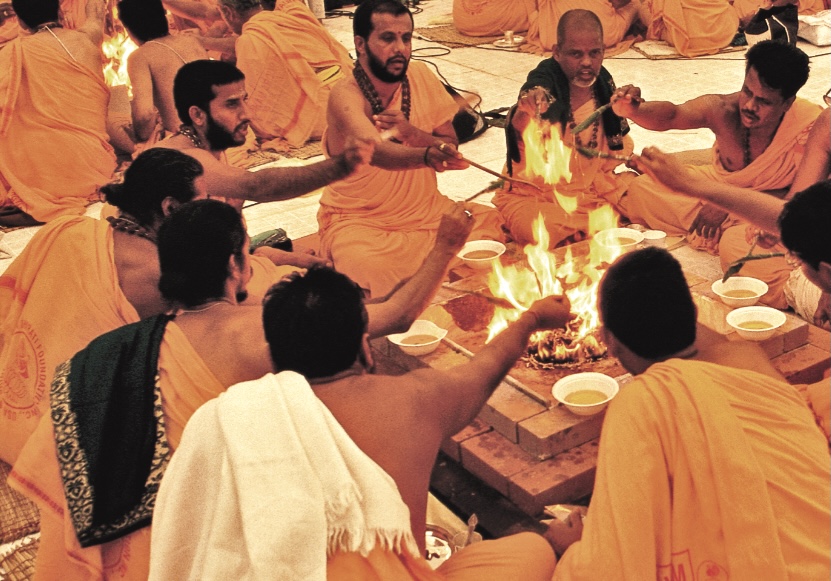
Yajna–Quintessence of the Culture of India By SRI SWAMI KRISHNANANDA Yajnarthat-karmano-nyatra lokoyam karmabandhanah;Tadartham karma kaunteya muktasangah samachara. “The world is bound by actions other than those performed for the sake of sacrifice; do thou, therefore, O son of Kunti (Arjuna), perform action for that sake (for sacrifice alone), free from attachment.” (Gita III-9) When we are born into a particular set up of circumstances which we call a family, all the conditioning factors of the family are also born together with us. The tradition of the family grows when we grow. The pattern of our character and conduct is entirely determined by the idealogical background that is at the very basis of the structure of that particular family. We are born not merely in a family but also in wider circumstances called the community, nation, world, universe, etc., to all which we owe obligations. Our obligation to a condition into which we are born is sacrifice or Yajna and that is what Bhagavan Sri Krishna speaks of in the above verse. When we are born, we are born with certain obligations. What are these obligations? They are the allegiance that we perforce owe to those factors that are responsible for our birth and maintenance. That is the sacrifice which we are called upon to do. In the Vedas, which are antecedent even to the Mahabharata and the Bhagavadgita, we are given the first primeval concept of sacrifice. Supreme sacrifice is extolled in the Veda, according to which the Absolute itself is the first performer of the Yajna and not a Pandit. The Absolute did the first Yajna and then the others followed. They are only imitating what the Absolute did, originally. What was the sacrifice that the Absolute did and who was the performer of that sacrifice? Where was the Vedi or the Yajna-kunda for that sacrifice and what was the material that was offered in that sacrifice? ‘Yajnena Yajnamayajanta Devah’, says the Purusha-Sukta. Yajna was the sacrifice, Yajna was offered in Yajna by Yajna for the sake of Yajna. Sacrifice was offered in the sacrifice, through the sacrifice, for the sake of sacrifice. What do you understand from this? You understand nothing, except a jumble of words. Similar to this enigmatic statement of the Veda, we have another statement in the Bhagavadgita also: ‘Brahmarpanam Brahmahavir-Brahmagnou Brahmana Hutam, Brahmaiva Tena Gantavyam Brahmakarma Samadhina’. Brahman is offering Brahman through Brahman for the sake of Brahman. What does it mean? It seems as confusing as that Vedic Mantra. But let us remember that this is what sacrifice precisely means. It is a universal involvement of factors wherein and whereby we become the property of the whole creation. Can you imagine this situation where we become the property of everyone in the world! Anyone can demand anything from us, and we must give it! We have an obligation to everything in this world. That obligation is the sacrifice that we are called upon to do. That is the Yajna. Our obligation is not merely to our parents, brothers and sisters, not merely to the government of our country that protects us, not merely to the planet earth on which we live, not merely to the solar system which gives us light, heat and energy. Oh God! We have got larger demands upon us and if we can think for a moment the obligations that we really owe to this wonderful creation of God, we will not be able to breathe for a moment! Because we are not able to fulfil all these obligations in a short span of life, we are reborn. Otherwise we need not be reborn. If we have fulfilled or discharged all our duties in this very life itself, why should we take next birth! But, life is short, and also we have not got the least concept of what obligations we bear or owe to the universe outside. Even when we are ninety years old, this knowledge will not come to us. So, naturally we die with ignorance. And because of this ignorance we are not able to discharge our duties properly. Because of the non-discharge of the duties and obligations properly, we are hurled into transmigration. And so long as we do not understand the meaning of the sacrifice that we are expected to perform and fulfil the obligations that we owe to the conditions of our existence, we cannot avoid undergoing this process of births and deaths. What are the conditions of our existence? Parents are a conditioning factor. They have given birth to us, they feed us, take care of us and educate us. Society is another conditioning factor. You know how much we owe to the society. Though it may not be visible outwardly, invisibly the society protects us, takes care of us and helps us in many ways. The nation and the international system help us. The stellar systems also help us. In short, the whole cosmos helps us. Therefore, we owe a universal obligation to all things in the universe. When we go for a walk in the jungles, sometimes a part of our cloth gets caught in a thorny bush and when we try to remove a thorn and move forward, we will find that another thorn is pricking us from behind. When we try to remove that, here it pricks again, so that we find ourselves unable to get out of it. When we are freed from one side, we are caught from another side. Similarly, when we discharge one obligation, we will find that another obligation has not been discharged. We cannot have an integral vision of things. We are partial, short-sighted people. We have a very narrow vision of things and it is this narrow vision that is responsible for our birth and death. This mysterious law, the law of Yajna, operates in the world. ‘Yajno vai Vishnuh’–Supreme Narayana Himself is called Yajna. The term ‘Yajna‘ signifies the whole of the culture of Bharatavarsha. If you want one word which can give us the quintessence of the whole of the culture of India, ‘Yajna‘ is that word. How meaningful it is, we can imagine. Every cultural pattern and every presupposition

Yajna–Quintessence of the Culture of India Read Post »

images 2026 02 21T134552.702
⁠Festivals in Sanathan Dharam and Hinduism, Swami Sivananda

Can We Rejoice Always?

Can We Rejoice Always? By Sri Swami Chidananda Dipavali is the day when there is light everywhere. There are reunions and celebrations. People rejoice. A question arises: “Should it not be possible to make this mood a permanent state of your inner being? Should you not try to see if it is possible to perpetuate this mood and make it a permanent state of mind within yourself, so that all the days will be of light, of cheerfulness, of rejoicing?” We do not require any special day to celebrate God, because God is everywhere, every day, always. So we can always rejoice in Him, because He is a perpetual being. He is eternal. And being all-pervading He is everywhere present. We are never far from Him; He is ever near to us at all times. This very fact, this great truth, which our ancestors realised, provides us with an answer to the question. Certainly it is possible to make it a permanent state due to the very fact that this great eternal Light of lights beyond all darkness dwells within you as your eternal, permanent Indweller. That Light is within you. So it is certainly possible, because what it takes to live thus, and be thus is already there within you as the essence of all beings. The wonder is that this possibility is forgotten and the absurdity of such a thing as the absence of God or Light is imagined. It is very strange. This most improbable and impossible situation is referred to in Indian philosophy as Maya. To be true to our own self, we must be what we are. Therefore, shine! Let your life be an effulgence. Make it impossible for darkness to prevail. All negativity is darkness. The simple little prayer of St. Francis of Assisi is a great reminder of this fact, of this truth. St. Francis teaches us how to dispel darkness: “Where there is hatred, let me sow love; where there is injury, pardon; where there is doubt, faith; where there is despair, hope; and where there is sadness, joy.” This simple prayer is not merely great and beautiful in its idea; it is also great in the philosophy, which it conceals within these simple words. And it concludes by saying that this is the way to find joy within yourself, peace within yourself, to liberate yourself from the little self and to attain your birthright–the eternal Light and everlasting life. Let your life be a bright and shining factor as something divine and positive that all negativity of our human life is replaced by that which is desirable and bright.

Can We Rejoice Always? Read Post »

unsplash image xisPXJqwQkA
⁠Festivals in Sanathan Dharam and Hinduism, Swami Sivananda

Deepavali — The Festival of Lamps

Deepavali — The Festival of Lamps By Sri Swami Chidananda Festivals, periodical religious functions, ceremonies and rites have a two-fold aspect and purpose. These are the external observances sanctified by long custom and there is the inner truth which these functions are meant to remind us of and to rekindle in us. To keep fresh in mind and to readily recall the seven component colours of the rainbow, students are given the code word “VIBGYOR”.In like manner each festival and ceremony is in the nature of a socio-religious keyword to remind you of spiritual truths. Unlike ordinary symbols that are silent these ceremonies are ‘symbols in actual enactment’. The truth which the different sacred observances symbolise are better understood and glimpsed when their scriptural back-ground is impartially studied. The Deepavali is a national festival in India. It is a very joyous three-day affair. There is gaiety everywhere, cheerful faces, new clothes, bright colourful decorations and lamps, lamps and more lamps. Illumination is the main, prominent feature of the celebrations. There is something unique about Deepavali. Most festivals in Hinduism are held in honour of some particular aspect of the Deity. But Deepavali is a distinctive combination of three different celebrations falling under the same name. The first is Naraka Chaturdasi, (on the fourteenth day of a dark half) then is Lakshmee-Puja on the New Moon day and the third day is Bali Padya (on the first day of the following bright fortnight). The first day is the celebration of Lord Krishna’s Victorious battle with the demon Narakasura. Srimad Bhagavata describes this incident in the 59th chapter of its 10th Skandha. Narakasura is a most formidable demon of terrible prowess. He is the son of Bhu Devi (presiding deity of the Earth) and the Great Boar or Varaha Avatar. Seated upon Garuda, Sri Krishna slays the Asura. The next day comes Lakshmee-Puja, the adoration of the mine and store-house of all auspiciousness. The third day commemorates the great sacrifice of King Bali who never refused a suppliant. Danaveer Bali is confined to the nether-world. On Bali Padya day he is glorified. The Ever-perfect Self, becoming involved in Maya and the Gunas (symbolised by the boar form) contacts with Samsar (Bhu Devi) and out of this association is born the lower Asuric ego of the impure self in the individual with its hosts of passions and evil tendencies (Narakasura and his Asuric forces). The Sattwic side in man (Devas) is overcome by Narakasura and man’s faith (Aditi’s ear-rings) taken away by the latter. Sri Krishna (the Guru) riding upon Garuda (Yoga and self-control) overcomes the lower ego of the seeker and restores his lost faith to him. The aspirant now adores Virtue and Righteousness (Lakshmi) and obtains all the auspicious qualities. But the rapid progress in virtue and success on the spiritual path endows him with a subtle higher egoism (Bali) which retards his further progress. This necessitates Divine intervention again and the Lord’s Grace disguised in the form of some experience (the Vamana form) removes the higher ego and thus blesses the Jiva. When the lovingly Lord’s blessings come in disguise to the seeker the latter’s personal ego (Sukracharya) tries to prevent the seeker from receiving the divine guest. But the seeker should turn away from such promptings and surrender himself full to the inflow of Grace. Then he is accepted by the Lord as His own. This is, in brief, the implication of the three-day celebration of the Narak-chaturdasi, Lakshmee-puja and Bali-padya together observed as the DEEPAVALI. Glory be to the ancient seers who sought to perpetuate the great truths through festivals and observances! All Glory to the Omnipresent Lord Who inspired them to adopt this effective method!

Deepavali — The Festival of Lamps Read Post »

Picture 1
⁠Festivals in Sanathan Dharam and Hinduism, Swami Sivananda

The Indestructible Divine Seed

The Indestructible Divine Seed Deepavali Message, 1949. Light, light, dazzling light everywhere! May our obeisance be to the Light of Lights, Brahman of God! Deepavali is one of the numerous celebration to which we are heir and which take us at once back to the thought of our own Godhead. This particular festivity has a deep significance in several directions. I have myself always been a staunch advocate of early rising. Waking up in Brahmamuhurta (about 4 A.M.) is a great blessing from the standpoints of health, ethical discipline, efficiency in work, and spiritual advancement. It is on Deepavali day that every one wakes up early in the morning. The Sage who instituted this custom must have cherished the hope that their descendents would realise its benefits and make it a regular daily habit. Every one wears new clothes. (Often, for the poor, this is the only new cloth for the year.) Masters present new clothes to their servants; those who can afford distribute clothes freely to the poor and the needy. Charity, especially in the matter of distribution of clothes, is freely resorted to; the heart expands. Here, again, the Rishis have hidden a divine seed which, given the favourable circumstances, would sprout forth into an all-pervading tree of Universal Love and Charity. In a happy mood of great rejoicing the village folk move about freely, mix with one another without reserve; all enmity is buried deep under the earth; people embrace each other in fond love Deepavali is a great unifying factor. Those with keen ‘inner ears’ will clearly hear the Ancients’ Voice: “Children of God! Unite; Love all.” The vibrations produced by the greetings of love which fill the atmosphere are powerful enough to bring about a change of heart in every man and woman in the world. Alas! This heart has considerably hardened; and only a continuous celebration of Deepavali in this holy land can re-awaken humanity to the urgent need of turning away from the path to ruin. India has to do it. That is her duty and privilege in this New Age. Her liberation from foreign political yoke is but the first step in that direction. Rama Rajya can first be established in India alone. It will be India’s duty, then, to spread the Message of Rama Rajya throughout the world. Deepavali is just a day’s reminder of Rama Rajya. Mythology has it that it is on this sacred day that Sri Rama returned to Ayodhya after destroying the Rakshasas and established Rama Rajya. In our Rama Rajya (which is brought to our mind’s eye by Deepavali) there will be a complete absence of hatred, ill-will or self-aggrandisement. People’s hearts will be filled with thoughts of Love, charity, and selfless service. When these come to stay in the Indian heart, I call that a perpetual celebration of Deepavali! India alone can do it at the present time. For it is in her soil alone that this seed has been left unscorched. Merchants turn over a few leaf on this day. They close their accounts and open fresh books. How I wish every Indian ‘turned over a few leaf’: close the previous year’s account of recriminations, reprisals, retaliatory schemes, of hatred, ill-will and rancour, and open a fresh Book of Love! A New Year, and with that will dawn a New Era of Peace. Sri Lakshmi, the Goddess of all Auspicious Qualities, is worshipped. All the Daivi Sampatti (Divine, Virtuous qualities) have their origin in Her alone. She is the Source of Peace, Love and Joy. She is the Mother of all, who preserves and protects every one. On Deepavali day Goddess Lakshmi is invoked and the devotee prays to Her to bestow onall Her choicest blessings, in the shape of Peace and Goodwill. He surrenders himself at Her Lotus Feet and seeks protection there. He gives up the little ego and drinks the sweet nectar of wisdom and love that drips from the lotuses She holds in her hands. Lakshmi alone can root out the evil qualities that lurk in theman’s lower self. Oh Man! Invite Her to occupy the lotus of your heart on this great day, so that She can awaken in you the latentpowers of love and joy! Every household is illuminated on this day. Everywhere you look there is Light. This is intendedto remind man that his essential nature is Light: that the Atman, his own real Self, is the Light of all lights, the Light that lends luminosity to countless suns, moons and stars in the infiniteuniverses. It is Avidya that produces a semblance of darkness! This Avidya consists of Nama-Rupa, name and form, characteristics of the organs of sight and hearing. In Reality there is nothing but one Infinite Consciousness–Akhanda Ekarasa Satchidananda Swarupa Para Brahman. Even as the same sulphur is made into a variety of fireworks–with differences only in name and form, in the sound that they make and the spectacle they produce–even so, Brahman, the Reality, is the same: Avidya has manufactured names and forms, sounds and spectacles, out of It for the amusement of children! No man, however erudite a scholar he may be, whatever be his age, learning, or wealth can call himself other than an ignorant child, till he actually perceives this Unity in diversity. Oh Man! Awake! Arise! It is Brahmamuhurtha now. Sing the Names of the Lord now. Worship Goddess Lakshmi, the Abode of all virtues. Love all. Be charitable. Turn a new leaf in the book of your life. Light the lamp of wisdom in your heart and dispel the darkness of ignorance or the perception of name and form! Behold now the Light of lights–the Atman, within yourself! That is the Message which the Seers of India intended to convey through the Deepavali celebration. That is the true message of Peace and Love. That is the Message which India will have to broadcast to the world. The Western Scientists’ Brains Trust, working at a furious rate for the

The Indestructible Divine Seed Read Post »

images 2026 02 21T131905.730
⁠Festivals in Sanathan Dharam and Hinduism, Swami Sivananda

Deepavali

Deepavali By Sri Swami Sivananda DEEPAVALI or Diwali means “a row of lights”. It falls on the last two days of the dark half of Kartik (October-November). For some it is a three-day festival. It commences with the Dhan-Teras, on the 13th day of the dark half of Kartik, followed the next day by the Narak Chaudas, the 14th day, and by Deepavali proper on the 15th day. There are various alleged origins attributed to this festival. Some hold that they celebrate the marriage of Lakshmi with Lord Vishnu. In Bengal the festival is dedicated to the worship of Kali. It also commemorates that blessed day on which the triumphant Lord Rama returned to Ayodhya after defeating Ravana. On this day also Sri Krishna killed the demon Narakasura. In South India people take an oil bath in the morning and wear new clothes. They partake of sweetmeats. They light fireworks which are regarded as the effigies of Narakasura who was killed on this day. They greet one another, asking, “Have you had your Ganges bath?” which actually refers to the oil bath that morning as it is regarded as purifying as a bath in the holy Ganges. Everyone forgets and forgives the wrongs done by others. There is an air of freedom, festivity and friendliness everywhere. This festival brings about unity. It instils charity in the hearts of people. Everyone buys new clothes for the family. Employers, too, purchase new clothes for their employees. Waking up during the Brahmamuhurta (at 4a.m.) is a great blessing from the standpoint of health, ethical discipline, efficiency in work and spiritual advancement. It is on Deepavali that everyone wakes up early in the morning. The sages who instituted this custom must have cherished the hope that their descendents would realise its benefits and make it a regular habit in their lives. In a happy mood of great rejoicing village folk move about freely, mixing with one another without any reserve, all enmity being forgotten. People embrace one another with love. Deepavali is a great unifying force. Those with keen inner spiritual ears will clearly hear the voice of the sages, “O Children of God! unite, and love all”. The vibrations produced by the greetings of love which fill the atmosphere are powerful enough to bring about a change of heart in every man and woman in the world. Alas! That heart has considerably hardened, and only a continuous celebration of Deepavali in our homes can rekindle in us the urgent need of turning away from the ruinous path of hatred. On this day Hindu merchants in North India open their new account books and pray for success and prosperity during the coming year. The homes are cleaned and decorated by day and illuminated by night with earthern oil-lamps. The best and finest illuminations are to be seen in Bombay and Amritsar. The famous Golden Temple at Amritsar is lit in the evening with thousands of lamps placed all over the steps of the big tank. Vaishnavites celebrate the Govardhan Puja and feed the poor on a large scale. O Ram! The light of lights, the self-luminous inner light of the Self is ever shining steadily in the chamber of your heart. Sit quietly. Close your eyes. Withdraw the senses. Fix the mind on this supreme light and enjoy the real Deepavali, by attaining illumination of the soul. He who Himself sees all but whom no one beholds, who illumines the intellect, the sun, the moon and the stars and the whole universe but whom they cannot illumine, He indeed is Brahman, He is the inner Self. Celebrate the real Deepavali by living in Brahman, and enjoy the eternal bliss of the soul. The sun does not shine there, nor do the moon and the stars, nor do lightnings shine and much less fire. All the lights of the world cannot be compared even to a ray of the inner light of the Self. Merge yourself in this light of lights and enjoy the supreme Deepavali. Many Deepavali festivals have come and gone. Yet the hearts of the vast majority are as dark as the night of the new moon. The house is lit with lamps, but the heart is full of the darkness of ignorance. O man! wake up from the slumber of ignorance. Realise the constant and eternal light of the Soul which neither rises nor sets, through meditation and deep enquiry. May you all attain full inner illumination! May the supreme light of lights enlighten your understanding! May you all attain the inexhaustible spiritual wealth of the Self! May you all prosper gloriously on the material as well as spiritual planes!

Deepavali Read Post »

Brahma Vishnu Shiva sitting together on lotus image
⁠Festivals in Sanathan Dharam and Hinduism, Swami Sivananda

The Divine Trinity

The Divine Trinity Sri Swami Chidananda Worshipful homage unto Dattatreya, the trimurti avatara, the divine son of the austere and illumined Sri Atri Maharshi and sati sadhvi, mahapativrata, rishi patni Sri Anasuya. May the benedictions of this divine couple be upon all married couples, in all countries, throughout the world. The divine trinity, Brahma, Vishnu and Mahesvara were born as the unique divine child Dattatreya. Actually Dattatreya was born as triplets, three children, and yet they were not born, they were immaculate conceptions. Later on they gave a boon that they would be born as children of Sage Atri and Anasuya in a natural and normal way, and then they disappeared. Anasuya became the mother of these three children, but later on two of them withdrew into their abodes. Somatreya, the manifestation of Brahma, the creator, and Durasatreya, the manifestation of Rudra, the dissolver, both merged into Dattatreya, the manifestation of Lord Vishnu, and then they returned to their abodes leaving behind their unique symbols. Brahma left the kamandalu and mala, Lord Siva left the trisula and damaru and the sankha and chakra were retained by Lord Vishnu. So Dattatreya is the manifestation of all the trinity, brahma vishnu sivatmaka svarupa. And this unique manifestation was the direct result of the irresistible devotion of a chaste dharmapatni, Sati Anasuya, the wife of the great sage Atri Maharshi. Her chastity was well known throughout the three worlds, the celestial worlds, the heavenly worlds and this earth plane. She was known to be the symbol of the highest purity as a housewife. And it was the power of her chastity that rendered the three murtis into little infants. Later on it was the same power of chastity and her chaste love for these infants that made them grant the boon that she desired. May the blessings of sati sadhvi Anasuya be upon all women throughout this world today. May they be filled with the lofty, supreme power of life-sanctifying chastity and may the power of the tapasya of Atri Maharshi bless all sad-grihasthas and make them shine with sadachara, shine with the power of purity, self-control and fidelity to their life-partner. This is the one thing needful in the world of today. For it is the character, the nature of the parents, their purity of conduct and character, that decides the nature, svabhava, and the moral fibre of the child that is born to them. For the child is not biologically or physically different and apart from the father and mother. They are one. It is the parents themselves manifesting in the form of a new generation. Therefore, what the parents are, what their inner state or condition is, their psyche is, becomes the nature of the child. It is that which decides its behaviour. Therefore, if the world of tomorrow is to be peopled by citizens of sterling moral character, of self-control, moderation, purity, high idealism, chastity, good conduct and lofty character, then it is indispensably necessary that the source from which they spring should be of the same lofty nature. If one generation is fired with lofty idealism and is of sterling moral worth, then the succeeding generation will also tend to be likewise, to be of great moral worth. Therefore, there is a close connection between a married couple and their offspring. From the offspring you can judge what the parents might have been. From the parents you can judge what the offspring is going to be, quite apart from the fact that each jivatma, individual soul, comes with its own previous karma-janita (born of karma) samskaras and vasanas. The austere, self-controlled sage of sterling character and conduct, Atri Maharshi and the shining exemplar of absolute chastity and fidelity, Sati Anasuya, thus became worthy of being parents to no less than God Himself, the divine trinity of Brahma, Vishnu and Mahesvara themselves. By the power of her chastity and his penance, they proved eminently deserving and worthy of being parents of Divinity. May the divine grace of Dattatreya be upon you all. He was a supreme yogi. Like Dakshinamurti, He was the adi guru, the primal world teacher. Contemplate His life. Meditate upon Him. Feel His divine presence. Evoke in your mind the sacred memory of Sati Anasuya and Atri Maharshi, the power of chastity, and divine grace in the form of Divinity taking birth at the earnest supplication and prayer of a heart filled with devotion. The earnest prayer of a heart filled with devotion never goes unanswered or unfulfilled. This is what the advent, the avatara of Dattatreya represents or proves. Try ever to be steeped in the lofty teachings of Guru Dattatreya. His one admonition and His one teaching was God-consciousness. Until you realise God, attain God- consciousness and become established in God-consciousness, ever strive to keep yourself by continued, unbroken effort in a state of awareness of your divinity, at least upon the intellectual level. May there not even be one moment when there is any doubt about your divinity in your mind or intellect. May your intellect be firmly based, with absolute conviction, upon this truth: “I am divine. I am immortal soul, birthless and deathless, beyond time and space, without name and form. I am Atman, formless. I have no limitations. The body does not limit me. The mind does not confine me. I am the limitless, all-pervading Divine-consciousness. This is my true identity. This is my real nature.” By constant affirmation of your divinity, develop within yourself, within your interior, a state of feeling and thinking, a state of intellectual conviction of your supreme divine nature. This is the one teaching of Jagat Guru, Adi Guru Dattatreya. Never fall into the error, the slumber of Self-forgetfulness or ignorance. Ever strive to keep yourself in a state of ever-wakeful awareness of your divinity. And as His benediction and prasad, this is the one thing we should strive to receive from Him today. Because, He is an immortal who is ever present. He is a nitya avatara, a pratyaksha devata, a living, immortal manifestation of Divinity upon the earth plane. And His direct admonition is: “Be aware, be aware. Be rooted in the consciousness of your essential nature, of your divinity.” And beloved and worshipful Guru Maharaj Swami Sivanandaji ever

The Divine Trinity Read Post »

Lord Dattatreya with three heads and animals in forest image
⁠Festivals in Sanathan Dharam and Hinduism, Swami Sivananda

Dattatreya Jayanthi

Dattatreya Jayanthi Sri Swami Sivananda Om Namo Bhagavate Dattatreyaya DATTATREYA Jayanthi falls during December-January on the full moon day of the month of Margaseersha. His story is told as follows. Anusuya is quoted as the model of chastity. She was the wife of Atri Maharishi, a great sage and one of the seven foremost seers and sages. She was well established in the Pativrata Dharma, the main elements of which are devotion to husband and regard of him as God Himself. She did severe austerities for a very long time in order to beget sons equal to Brahma, Vishnu and Shiva, the Hindu Trinity. Once, Saraswathi, Lakshmi and Parvati requested their husbands (the Trimurtis) to test the Pativrata Dharma of Anusuya, by asking her to give them alms with an unclothed body. Brahma, Vishnu and Shiva came to know of the austerity and desire of Anusuya. So, they agreed to their wives’ request, as they knew that by agreeing to it, they would also be fulfilling Anusuya’s wish. They put on the garb of Sannyasins and appeared before Anusuya, asking her to give them alms as specified by their wives. Anusuya was in a great dilemma. She could not say “No” to the Sannyasins. And she had to maintain her Pativrata Dharma also, which she would be violating if she appeared naked before men other than her own husband. She meditated on the form of her husband, took refuge at his feet and sprinkled over the three Sannyasins a few drops of water used for washing the feet of her husband. Immediately the Trimurtis were transformed into three babies on account of the glory of her chastity. At the same time, there was accumulation of milk in her breast. She thought that these children were her own and fed them with the milk, in a nude state and cradled them. She was eagerly expecting the arrival of her husband who had gone to have a bath. As soon as Atri Rishi returned home, Anusuya related all that had happened during his absence, placed the three children at his feet and worshipped him. But, Atri knew all this already through his divine vision. He embraced all the three children. They became one child, with two feet, one trunk, three heads and six hands. Atri Rishi blessed his wife and informed her that the Trimurtis themselves had assumed the forms of the three children to gratify her wish. In the meantime, Narada went to Saraswathi, Lakshmi and Parvati and informed them that their husbands had been turned into children through the power of the Pativrata Dharma of Anusuya and that they would not return unless they asked for their husbands as alms from Rishi Atri. Thus Saraswathi, Lakshmi and Parvati assumed the form of ordinary women, appeared before Atri and asked for their own husbands as alms. Atri duly honoured the three ladies and, with folded palms, prayed to them that his wish and the wish of Anusuya should be fulfilled. Then, the Trimurtis appeared in their true form before Atri and said, “This child will be a great sage according to your word and will be equal to us, according to the wish of Anusuya. The child will bear the name of Dattatreya.” Saying this they disappeared. The child Dattatreya soon attained manhood. As he had the rays of the Trimurtis and as he was a great man of the highest wisdom, all the Rishis and ascetics worshipped him. He was gentle, peaceful and amiable. He was an Avadhuta–an ascetic who always remains naked. He preached the Truth of Vedanta. Dattatreya taught his Avadhuta Gita to Lord Subramanya. This is a wonderful book which contains the truths and secrets of Vedanta and the experiences of Self-realisation. Once, while he was roaming happily in a forest, he met King Yadu, who, on seeing Dattatreya so happy, asked him the secret of his happiness and the name of his Guru. Dattatreya said, “The Self alone is my Guru. Yet, I have learnt wisdom from twenty-four other individuals and objects. So they, too, are also my Gurus.” Dattatreya then mentioned the names of his twenty-four Gurus and spoke of the wisdom that he had learnt from each as follows: “The names of my twenty-four Gurus are earth, water, fire, sky, moon, sun, pigeon, python, ocean, moth, honey-gatherers (black bee), bees, elephant, deer, fish, the dancing-girl Pingala, raven, child, maiden, serpent, arrow-maker, spider and beetle. 1. I learnt patience and doing good to others from the earth. 2. From water, I learnt the quality of purity. 3. I learnt from air to be without attachment though I move with many people in this world. 4. From fire I learnt to glow with the splendour of Self-knowledge and austerity. 5. I learnt from the sky that the Self is all-pervading and yet it has no contact with any object. 6. I learnt from the moon that the Self is always perfect and changeless and it is only the limiting adjuncts that cast shadows over it. 7. Just as a sun reflected in various pots of water appears as so many different reflections, so also Brahman appears different because of the bodies caused by the reflection through the mind. This is the lesson I have learnt from the sun. 8. I once saw a pair of pigeons with their young birds. A fowler spread a net and caught the young birds. The mother pigeon was very much attached to her children. She fell into the net and was caught. From this I have learnt that attachment is the root cause of earthly bondage. 9. The python does not move about for its food. It remains contented with whatever it gets, lying in one place. From this I learnt to be unmindful of food and to be contented with whatever I get to eat. 10. Just as the ocean remains unmoved, even though hundreds of rivers flow into it, so also the wise man should remain unmoved among all the various sorts of temptations, difficulties and troubles. 11. To control the sense of sight and to fix

Dattatreya Jayanthi Read Post »

Swami Sivananda Indian spiritual guru yoga teacher founder Divine Life Society photo
Divine Teachings & Message of Swami Sivananda, Swami Sivananda

INTRODUCTION

INTRODUCTION The Guru is God Himself manifesting in a personal form to guide the aspirant. Grace of God takes the form of the Guru. To see the Guru is to see God. The Guru is united with God. He inspires devotion in others. His presence purifies all. The Guru is verily a link between the individual and the immortal. He is a being who has raised himself from this into That, and thus has free and unhampered access into both the realms. He stands, as it were, upon the threshold of immortality; and, bending down he raises the struggling individuals with his one hand, and with the other lifts them up into the empyrean of everlasting joy and infinite Truth-Consciousness. THE SADGURU To be a Guru, one must have a command from God. Mere study of books cannot make one a Guru. One who has studied the Vedas, and who has direct knowledge of the Atman (Self) through Anubhava (experience), can alone be enrolled as a Guru. A Jivanmukta or liberated sage is the real Guru or spiritual preceptor. He is the Sadguru. He is identical with Brahman or the Supreme Self. He is a Knower of Brahman. A Sadguru is endowed with countless Siddhis (psychic powers). He possesses all divine Aisvarya (powers), all the wealth of the Lord. Possession of Siddhis, however, is not the test to declare the greatness of a sage or to prove that he has attained Self-realisation. Sadgurus generally do not exhibit any miracle or Siddhi. Sometimes, however, they may do so in order to convince the aspirants of the existence of superphysical things, give them encouragement, and instill faith in their hearts. The Sadguru is Brahman Himself. He is an ocean of bliss, knowledge, and mercy. He is the captain of your soul. He is the fountain of joy. He removes all your troubles, sorrows, and obstacles. He shows you the right divine path. He tears your veil of ignorance. He makes you immortal and divine. He transmutes your lower, diabolical nature. He gives you the rope of knowledge, and takes you up when you are drowning in this ocean of Samsara (cycle of birth and death). Do not consider him to be only a man. If you take him as a man, you are a beast. Worship your Guru and bow to him with reverence. Guru is God. A word from him is a word from God. He need not-teach anything. Even his presence or company is elevating, inspiring, and stirring, His very company is self-illumination. Living in his company is spiritual education. Read the Granth-saheb (the holy scripture of the Sikh religion). You will come to know the greatness of the Guru. Man can learn only from man, and hence God teaches through a human body. In your Guru, you have your human ideal of perfection. He is the pattern into which you wish to mould yourself. Your mind will readily be convinced that such a great soul, is fit to be worshipped and revered. Guru is the Moksha-dvara (door to liberation). He is the gateway to the transcendental Truth-Consciousness. But, it is the aspirant who has to enter through it. The, Guru is a help, but the actual task of practical Sadhana (spiritual practice) falls on the aspirant himself. THE NEED FOR A GURU For a beginner in the spiritual path, a Guru is necessary. To light a candle, you need a burning candle. Even an illumined soul alone can enlighten another soul. Some do meditation for some years independently. Later on, they actually feel the necessity of a Guru. They come across some obstacles in the way. They are unable to know how to obviate these impediments or stumbling blocks. Then they begin to search for a Master. Only the man who has already been to Badrinath will be able to tell you the road. In the case of the spiritual path, it is still more difficult to find your way. The mind will mislead you very often. The Guru will be able to remove pitfalls and obstacles, and lead you along the right path. He will tell you: “This road leads you to Moksha (liberation); this one leads to bondage”. Without this guidance, you might want to go to Badrinath, but find yourself in Delhi! The scriptures are like a forest. There are ambiguous passages. There are passages which are apparently contradictory. There are passages which have esoteric meanings, diverse significance, and hidden explanations. There are cross-references. You are in need of a Guru or Preceptor who will explain to you the right meaning, who will remove doubts and ambiguities, who will place before you the essence of the teachings. A Guru is absolutely necessary for every aspirant in the spiritual path. It is only the Guru who will find out your defects. The nature of egoism is such that you will not be able to find out your own defects. Just as a man cannot see his back, so also he cannot see his own errors. He must live under a Guru for the eradication of his evil qualities and defects. The aspirant who is under the guidance of a Master or Guru is safe from being led astray. Satsanga or association with the Guru is an armour and fortress to guard you against all temptations and unfavourable forces of the material world. Cases of those who had attained perfection without study under any Guru should not be cited as authority against the necessity of a Guru; for, such great men are the anomalies of spiritual life, and not the common normality. They come into existence as spiritual masters as a result of the intense service, study, and meditation practised in previous births. They had already studied under the Guru. The present birth is only its continuative spiritual effect. Hence, the importance of the Guru is not lessened thereby. Some teachers mislead their aspirants. They say unto all: “Think for yourself. Do not surrender yourself to any Guru”. When one says, “Do not follow

INTRODUCTION Read Post »

Om
Swami Sivananda, The Divnity in Religions

Hinduism

Hinduism Sri Swami Sivananda Hinduism is the religion of the Hindus. It is the oldest of all living religions. Hinduism is not a man-made religion. It was not founded by any single person. It is not based on a set of dogmas preached by a particular set of teachers. It was not started as a system, like Islam or Christianity. It is the product of the seers of the Vedas. It was developed from age to age by the teachings of Avataras, Rishis, Vedas, the Upanishads, the Gita and the Itihasas. It will exist as long as the world lasts. There is a peculiar, mysterious spiritual force that is ingrained in the heart of every Hindu. Hinduism is also known by the names Sanatana Dharma and Vaidika Dharma. Sanatana Dharma means eternal religion, the Ancient Law. Vaidika Dharma means the religion of the Vedas. The Vedas are the foundational scriptures of Hinduism. A Religion of Freedom Hinduism allows absolute freedom to the rational mind of man. Hinduism never demands any undue restraint upon the freedom of human reason, the freedom of thought, feeling and will of man. Hinduism is a religion of freedom. It allows the widest freedom in matters of faith and worship. It allows absolute freedom to the human reason and heart with regard to questions such as the nature of God, soul, creation, form of worship, and goal of life. It does not force anybody to accept particular dogmas or forms of worship. It allows everybody to reflect, investigate, enquire and cogitate. Hence, all sorts of religious faiths, various forms of worship or Sadhana, diverse kinds of rituals and customs, have found their honourable place side by side within Hinduism, and are cultured and developed in harmonious relationship with one another. Hinduism, unlike other religions, does not dogmatically assert that the final emancipation is possible only through its means and not through any other. It is only a means to an end, and all means which will ultimately lead to the end are equally approved. The religious hospitality of Hinduism is proverbial. Hinduism is extremely catholic and liberal. This is the fundamental feature of Hinduism. Hinduism pays respects to all religions. It does not revile any other religions. It accepts and honours truth, wherever it may come from and whatever garb it may put on. Hindu Mythology In every religion, there are three parts, viz., philosophy, mythology and ritual. Philosophy is the essence of religion. It sets forth its basic principles or fundamental doctrines or tenets, the goal, and the means of attaining it. Mythology explains and illustrates philosophy by means of legendary lives of great men or of supernatural beings. Ritual gives a still more concrete form of philosophy so that everyone may understand it. Ritual consists of forms and ceremonies. Mythology is a part of every religion. Mythology is concretized philosophy. Mythology is the science which investigates myths or fables or legends founded on remote events, especially those made in the early period of a people’s existence. Mythology inspires the readers through precepts and laudable examples, and goads them to attain perfection or the highest ideal. The abstract teachings and subtle ideas are made highly interesting through the garb of stories, parables, legends, allegories and narratives. The sublime and abstract philosophical ideas and ideals of Hinduism are taken straight to the heart of the masses through impressive stories. Mythology is slightly mixed up with a little history. It is difficult to make a fine distinction between history and mythology. There are great truths behind the ancient mythology of Hinduism. You cannot ignore a thing simply because it has a garb of mythology. Do not argue. Keep your intellect at a reasonable distance when you study mythology. Intellect is a hindrance. It will delude you. Give up arrogance, vanity. Cultivate love for imagery. Sit like a child and open your heart freely. You will comprehend the great truths revealed by mythology. You will penetrate into the hearts of the Rishis and sages who wrote the mythology. You will really enjoy mythology now. You study geography through maps. There is no real country or town in a map, but it helps you to know a great deal about the different countries. Similar is the case with myths. You can grasp the subtle, philosophical truths through myths only. The object of myth and legend is merely to lure the mind to the truths of religion. Emphasis on Practice Hinduism is not a religion of mere theories. It is eminently practical. In no religion will you find such a variety of Yoga practiced, and such sublime unique philosophy expounded. Hinduism provides spiritual food and Yoga Sadhana for all sorts of people to suit their temperaments, capacities, tastes, stages of spiritual development, and conditions of life. It prescribes Yoga Sadhana even for a scavenger or a cobbler to attain God-realization, while doing his ordinary avocation in the world. Hindu Yoga and Vedanta teachers lay great stress on self-restraint, Tapas, renunciation and practical Sadhana, which are best calculated to control the mind and the senses and unfold the Divinity within or attain Self-realization. Religion is the practical aspect of philosophy. Philosophy is the rational aspect of religion. The philosophy of Hinduism is not armchair philosophy. It is not meant for intellectual curiosity and vain discussion. Hindu philosophy is a way of life. The philosopher of Hinduism seriously reflects after hearing the Srutis (Vedas), does Atma-vichara (enquiry into the nature of the Self), constantly meditates, and then attains Self-realization or Atma-sakshatkara. Moksha (liberation from birth and death) is his goal. He attempts to attain Jivanmukti (liberated being) now and here. Law of Karma The Law of Karma is one of the fundamental doctrines of not only Hinduism, but also of Buddhism and Jainism. As a man sows, so shall he reap. This is the law of Karma. Desire produces Karma. You work and exert to acquire the objects of your desire. Karma produces its fruits as pain and pleasure. You will have

Hinduism Read Post »

images 2026 02 21T122429.747
Swami Sivananda, The Divnity in Religions

Yoga and Christianity

Yoga and Christianity By SRI SWAMI CHIDANANDA I shall speak to you at some length upon the subject of ‘Yoga and the Christian Religion’ because most of you are from a Christian background, very pious and very religious. Some are only Christian because they are born Christian, but some are halfway going to the Church once in two months, but all are from a Christian background, may be some Roman Catholic, may be not, may be Protestant, may be Methodist, may be some other. Some of you are Jews. Whatever religion you belong to, when I speak about Yoga and the Christian religion, it could equally apply to Yoga and any other religion. So, what is the connection between Yoga and one’s religion? One takes it for granted that Yoga is of the Hindu religion, and asks: ‘What is the connection between, this Hindu thing and my religion?’ Anyone belonging to another religion must wonder. So, it is worth-knowing how to relate Yoga to religion. Is it like other religions or are there sharp divergences between Yoga and other religions? If these things are not clear, may be some would feel a sense of guilt. ‘O, I am a Christian, am I doing the right by coming and taking to Yoga? Perhaps, I am being a little irreligious in the particular area of my interest in Yoga.’ Thus, a vague sort of uneasiness may be felt. First and foremost, it has to be known that Yoga has arisen from a background or basis of the Hindu religion. It has its origin in India and it is part of the Hindu religion. But it is not Hindu. It is a universal science that has arisen out of the Hindu religious ground-a science that has risen above religion. It is a universal technique. Because in Yoga, as it is given in the Yoga-Darsana of Patanjali, one of the six systems of philosophy, no particular dogma is laid down and no particular God is pointed out for your worship. Yoga doesn’t say that you must worship Rama or Siva or meditate upon Krishna, or you must worship Kaali or Durga, or Hanuman; Yoga has nothing to say upon all these things. Yoga doesn’t say that you must repeat any particular Name of God. Yoga only says that repetition of one of the Divine Names is one of the ways of concentrating the mind. It says repetition of the Divine Name. You may repeat the Divine Name, you may say the prayer of Jesus, you may say Allah, you may say Rama, you may say the name of Siva, or you may say some other Name if you are in some other religion, but it does not specify that Name and also whom to worship. The All-perfect Divine Being, who is ever-free, ever-perfect, free from all the imperfections, ever-free beyond Maya, the Supreme Purusha, means the Supreme Being, Almighty Father in Heaven, Allah, Jehovah, you can call it by any name, it does not matter, the ever-free Being is not bound by Maya, and who is free from affliction, who is of the nature of Bliss-Absolute, Consciousness-Absolute; that is the object of meditation to be attained, that is the goal of Yoga. So, it does not give for you a goal other than the goal of Yoga; it does not give for you a goal other than the goal of your religion. It does not point out a God different from the one pointed by your own religion–Christianity, Islam, etc.–and it does not give a special name of that God so that you will have to change Gods. It does not give any special name to the one God. Emerging from the ground of Hinduism, it goes beyond religion. Yoga is a Religious Science, which means that it goes beyond religion, and assumes a universal characteristic. Secondly, Yoga is a science for Man. It is not a science either for an Easterner or a Westerner, an Oriental or an Occidental. Yoga is for man on earth. It was given to mortal man on this earth of birth, pain and death. It was given to man on earth, no matter what he is or who he is; and it is given to man for all times. It was not given to an ancient man or medieval man or a modern man, or anyone who might come, wanting to go beyond all sorrow, pain and suffering, go beyond bondage and delusion. If he takes to this path, it brings him to the place of supreme experience. So it is the answer to the need of mortal man, on this earth plane. So it is something that is the property, the heritage of humanity–Yoga is the heritage of humanity. It does not interfere with religion. What does Yoga do? Yoga supplies to the life of man and makes up for certain lack brought about by religion failing man or man failing religion. There is a condition created by the failure of religion administering to man’s highest needs, or the failure of man to take advantage of religion or properly utilise his religion which it is, we cannot say. Some say religions have failed. I say, no. Man has failed to follow religion. It is not due to religion that man suffers. It is due to the neglect of religion, the ignoring of religion and its teachings and its wisdom. Mostly, this is the situation. But in some places where religion has become totally institutionalised, it has become a great impersonal structure, and lost living contact with the individuals. Under it, then, it becomes barren of real spirit. It becomes only a pattern for dogma and ritual, and ceremony and belief. You are a Christian; if you say ‘I believe in salvation through the blood of Christ’. Yes, I believe, then you are a Christian. You are a very good Christian; so go your way. Do what you like, drink, smoke, break all the ten commandments, but

Yoga and Christianity Read Post »