














Bhagavad Gita Yoga
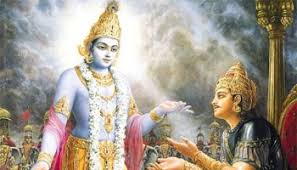
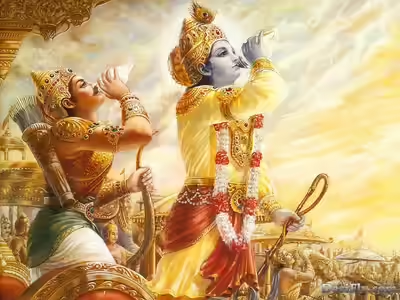
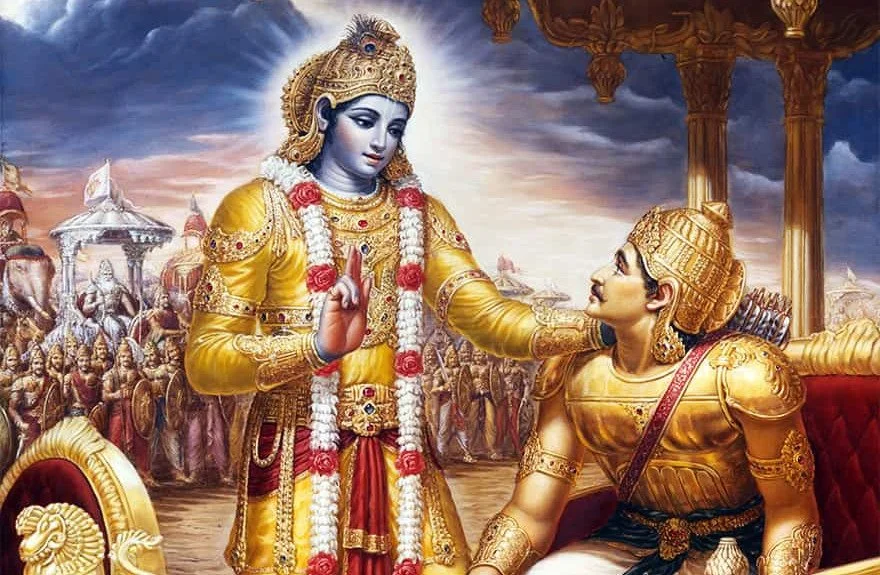
Bhagavad Gita Yoga By Sri Swami Sivananda The Bhagavad Gita is a gospel of the life spiritual. It concerns not merely some remote other-worldly life unconnected with practical activity here, but the whole gamut of experience, and lays down rules of disciplining life here on earth. No aspect or phase of life is excluded from the scope of the Bhagavad Gita way of self-transfiguration. Life is a process of series of experiences which are mysteriously and inextricably connected with the entire universe in all its planes of existence. Hence, when the Gita offers a solution to the problems of life and prescribes methods of regulating and harmonising its modes, it has to take into account everything in the universe to which life is related. The greatness of the Gita lies in the integrality of its scope, the universality of its teachings, the all-comprehensiveness of its doctrine. The Perfect Man gives the Perfect Science of the Perfect Life. This Perfect Science which is the Bhagavad Gita aims at unveiling the deepest secrets in a language which is at once simple and grand, charming and dignified, revealing the glory of the Spirit, the majesty of the Divine. This secret is the relation between man and God, between man and his environment. When once this secret of existence, this art of living, is known, man is lifted from penury to a blissful fulfilment, from limitation to self-completion in the Infinite. The Bhagavad Gita discloses the fact that the primary cause of the troubles in which man finds himself is the erroneous notion which he has about his relations with the body and the world, and virtually with God. The perishable nature of the body and the world, and the immortal nature of the conscious soul within is forgotten, and man clings to the reverse of this truth, thinking that the body and the objects amidst which it is placed have a permanent value, and that the self is a dependent entity entwined in inter-relations with things that seen to sustain it. Sri Krishna openly declares the immortality of the soul and the transience of all its extraneous appendages. “The non-existent never becomes existent, and the existent never becomes non-existent.” (II-16). The soul is the existent, and all objective phenomena are the non-existent. The non-existent is to be understood as that which is not ever enduring, which does not persist in the changing processes of time. Affection for the non-existent and the wrong notion that objects bring pleasure to the self, strike at the root of the peace of the soul, for these loves and false ideas spring from ignorance. “The pleasures that are contact-born are wombs of sorrow: the wise does not rejoice in them” (V-22). The pains of life have this ignorance and wrong notion as their basis. Buddhi or the higher reason should be made use of in distinguishing between the truth and the falsehood of life. Discrimination between the real and the unreal is possible only when the light of understanding is thrown upon the facts and events which become contents of consciousness. But, mostly, it is found that reason in the human being works in co-operation with the senses and becomes a mere tool of the latter, carrying out the function of transmitting to the individual, the characteristics of the objects of sense-perception. It interprets life in terms of space, time and objects, and degrades experience to body-consciousness. The joys and sorrows of life, even good and bad, are judged from the standpoint of sense-experience, and reason seems to play second fiddle to the clamourings of the senses. But the fact is that true happiness cannot be had by resort to body and its physical companions. The knowledge of this fact can come to the reason of man only when it is purified and gets freed from the shackles of the senses. Reason which reflects the characteristics of sense-experience is different from the a priori reason which draws sustenance from the Inner Self and commands the sense-powers, independent of spatial and temporal relations. But the senses will continue to work even when an independent purified reason is developed. Man cannot cease from action. Action is the law of individual life. To act, and not to allow the reason to get attached to the acts, is the essence of Karma Yoga. “He who has no sense of doership, whose intellect is not attached even while destroying all these worlds (or people), neither destroys these nor is bound” (XVIII-17). Cessation from physical action is not non-action. For one can be physically inactive and yet be performing actions in a different sense. Vital, emotional, mental and intellectual action is real action. Cessation from actions like these would be real inaction. But man has no freedom to do this. He is forced to act by the very nature of his being. All actions generally disturb the phenomenal vestures of the personality of man. On account of this disturbance, he feels a non-normal state in his being. And to maintain a state of equanimity even in the midst of disturbing activities he should act in a spirit of self-sacrifice, self-surrender, self-restraint or self-knowledge. The universe is a living organism, every element of which perforce tends to and does fulfil the unitary law of the organism. And the duty of everyone, therefore, is to be conscious of this Great Organism and work in loyalty to it. Karma-Yoga which Sri Krishna teaches is action based on the consciousness of the absoluteness of God, the surrender of oneself to God, or one’s steadfast concentration on God. Love and service should become the mottos of one’s life. Absolute negation of action, is not possible for man; but he can neutralise the effects of actions, by turning them into Yogic activity. No person can really afford to happily lead a completely selfish life. The universe works on a co-operative basis. One thing is dependent and hangs on another thing. Experiences of individuals are relative to particularities, and the absolute worth
Bhagavad Gita Yoga Read Post »