













Hari Om

Menu

February 20, 2026

swami sivananda Framed portrait of Swami Sivananda with garland and spiritual words image
Principal Asanas

Baddha Padmasana (Locked-up Lotus Pose)

Baddha Padmasana (Locked-up Lotus Pose) This is a variety of Padmasana (Lotus Pose). TECHNIQUE Sit in Padmasana with legs crossed. The heels should touch the lower part of the belly or abdomen. Then take your right hand behind the back. Catch hold of the right leg with the forefinger and middle finger of the right hand. Then take your left hand behind the back and catch hold of the toe of the left leg with the forefinger and middle finger of the left hand. Now press the chin against the chest. Look at the tip of the nose, Nasikagra Drishti. Breath slowly.Some people find it difficult to catch hold of the two toes at a time. They can practise Ardha Baddha Padmasana (half-pose) to start with for a month. Afterwards they can take to the Purna Baddha Padmasana (full-pose). Practise this Ardha Baddha Padmasana on the right side. Then do alternately on the left side also. In doing the full pose, use little skill. Catch one toe first and when you attempt to catch the other one, slightly bend the body forwards. This will make matters easy in catching the other toe. During the half-pose, catch hold of one toe with one finger. Change the side afterwards. The half-pose is a preparatory stage for the full-pose. This is not an Asana for meditation. This is chiefly intended for improving the health, vigour and vitality of the body to a considerable degree. The benefits of the Padmasana are derived in this Asana to an enormous extent. This must be practised regularly at least for six months. Then only maximum advantages can be realised. You cannot expect the full benefits of this Asana by merely sitting for a couple of minutes. You must practise this at least for half an hour. If you can do it for an hour or an hour and a half, you will doubtless derive immense benefit. There are persons who do this Asana for full three hours. How tenacious and patient these people are! They keep wonderful health and vigour and a high standard of vitality. Many diseases are cured by this Asana. Chronic diseases of the stomach, liver, spleen and intestines that are pronounced incurable by Allopaths and Ayurvedic Kavirajas are cured by a steady practice of this Asana. There is no doubt of this. Diseases of the stomach such as chronic gastritis, dyspepsia, flatulence, colic, dysentery, ascites, constipation, acidity, belching, chronic lumbago, are removed. As it keeps the Meru Danda erect, hunch-back is removed. The nerves of the waist, hip, feet and legs are purified. Enlargement of the spleen and liver is cured. Torpidity of the liver disappears. This Asana exercises a potent influence over the Surya Chakra (solar plexus of nerves) behind the Nabhi (navel) and stimulates it. You draw a great deal of energy. Draw the belly backwards and upwards. Repeat Om or Rama mentally. Imagine that the seminal energy flows towards the brain for being stored up as Ojas-Sakti. Do this special practice for 10 minutes daily. You will have no wet-dreams. This process is a great help for keeping up Brahmacharya.

Baddha Padmasana (Locked-up Lotus Pose) Read Post »
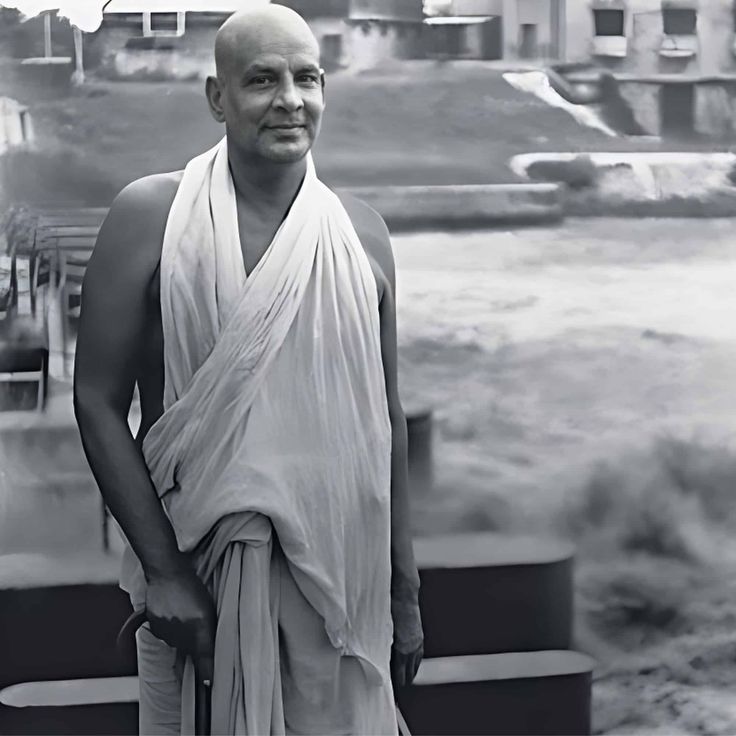
Swami Sivananda Spiritual monk standing outdoors holding walking stick in robe image
Principal Asanas, Swami Sivananda

Trikonasana (Three Angle Pose)

Trikonasana (Three Angle Pose) TECHNIQUE Stand erect. Keep your legs two feet apart. Now stretch your arms wide on the sides in a line with the shoulders. The arms must now be quite parallel to the ground. You might have done this portion of the exercise in your drill class in the school. Now bend slowly to the right. Keep the left knee stiff and erect. This is important. Touch the right toe with the fingers of the right hand. Bend the neck slightly to the right. It may touch the right shoulder. Now stretch the left arm above. Retain the posture for 2 or 3 minutes. Breathe slowly. Again you can practise on the left side. Let the fingers of the left hand touch the left toe. Stretch the right arm in the air as before. Do 3 or 6 times on each side. BENEFITS This Asana gives very good lateral movements to the spine. It is an auxiliary Asana to Ardha Matsyendrasana. It amplifies and fulfils the Matsyendrasana. Mr. Muller also gives a description of this Asana in his system of physical culture exercises. If you have a healthy spine, you can sit in your meditation in one Asana for many hours without fatigue. For a Yogi the spine or Meru Danda is a great thing as it is connected with the spinal cord and the sympathetic system. It is the spine that contains the important Sushumna Nadi which plays a vital part in the Kundalini movement. This Asana tones the spinal nerves and the abdominal organs, increases peristalsis of the bowels and invigorates appetite. Constipation is relieved. The body becomes light. Those who suffer from shortening of the leg due to fracture of hip or thigh bone (Femur) or bones of the leg (Tibia or Fibula) will be benefited by this Asana. This Asana lengthens the legs. Krishna Kumar Bhargava, Advocate, Sitapur, practised this Asana for three months. His legs became lengthened and he was able to walk one or two miles later.

Trikonasana (Three Angle Pose) Read Post »

Swami Sivananda seated blessing pose image
Obstacles in Meditation, Swami Sivananda

Introduction

Introduction Just as volunteers come in front and obstruct the path of those who want to enter a conference Pandal without tickets, so also the old Samskaras of enmity, hatred, lust, jealousy, fear, honour, respect, etc., assume definite forms and obstruct the path of aspirants. An intelligent and comprehensive understanding of the various obstacles that act as stumbling blocks in the path of God-realisation is indispensable. Then alone the aspirant will find it easy to conquer them one by one. Just as the sailor sails in and out of a harbour along a dangerous coast with the help of a pilot, so also the aspirant with the help of a detailed knowledge of these obstacles, and the methods to conquer them will be able to steer clear the ocean of spirituality. Hence I have given a very lucid exposition of the various obstacles and effective methods to conquer them. The aspirant comes across various kinds of obstacles when he practises meditation. If he has an intelligent and comprehensive understanding of the various obstacles that stand in his way to God-realisation, and the suitable methods to conquer them, he can tread the spiritual path easily and overcome the obstacles without much difficulty. The real and serious obstacles to meditation are from within only. They do not come from outside. Train the mind properly. Be courageous friends! You will come across various obstacles when you endeavour to control the mind and enter into deep meditation and Samadhi. Aspirants are requested to go through these very carefully often and often when they encounter difficulties in the path. Every aspirant will have to face various sorts of difficulties in the spiritual path. Buddha, Uddalaka and Sikhidhvaja experienced great difficulties. You need not be discouraged on this score. Nil Desperandum. Never despair. Failures are stepping stones to success. Muster all your strength and courage and march afresh in the path with redoubled vigour and energy. Take some rest now. No impediment can stand before a man of fiery determination and iron will. Perfection cannot be attained in a single birth alone. The perfected sages are the products of the sum total of virtuous actions done in several births. Lord Krishna says in the Gita, “The Yogi, labouring with assiduity, purified from sin and perfected through manifold births, reacheth the supreme Goal!” (Chap. VI-45).

Introduction Read Post »

swami sivananda Vintage portrait of monk wearing shawl and prayer beads image
Kinds of Meditation, Swami Sivananda

Meditation on Mahavakyas

Meditation on Mahavakyas Mahavakyas are the sacred sentences of the Srutis. They are four in number: 1. ‘Prajnanam Brahma.’ 2. ‘Aham Brahma Asmi.’ 3. ‘Tat Tvam Asi.’ 4. ‘Ayam Atma Brahma.’ The first is in Aitareya Upanishad of Rig-Veda. The second is in Brihadaranyaka Upanishad of Yajur-Veda. The third is in Chhandogya Upanishad of Sama Veda. And the fourth is in Mandukya Upanishad of Atharvana Veda. The first is a Lakshana Vakya which gives a definition of Brahman and imparts Tatbodha-Jnana. The second is an Anubhava Vakya that gives Sakshi-Jnana. Third is Upadesha Vakya and bestows Siva Jnana. Guru instructs the disciple. Fourth is Sakshatkara Vakya which confers Brahma-Jnana. You can take any Mahavakya and meditate on it as you do on OM. Meditation on Aham Brahma Asmi: Constantly feel that you are the Suddha Sat-Chit-Ananda Vyapaka Atman (Pure, Existence Absolute, Knowledge Absolute, Bliss Absolute, All-Pervading Brahman), when you repeat mentally: “Aham Brahma Asmi.” Lip repetition will not produce much benefit. You must intensely feel from the subjective heart. Gradually, you will be taken to superconscious state through deep feeling. Sit in your Asana on a fourfold blanket. Face North or East and constantly feel: 1. Infinity I am. 2. Eternity I am. 3. Immortality I am. Meditation on Mahavakyas is tantamount to meditation on OM. You can take either ‘Aham Brahma Asmi’ or ‘Tat Tvam Asi’ Mahavakya, and meditate on its significance. Negate or throw out the Koshas yourself and identify with the one essence that lies behind them. Meditate. Purify your mind. Practise concentration in a solitary room. Then squeeze out the Upanishads and the Gita from your heart. Do not depend upon imperfect commentaries. If you are sincere, you will understand the real Sankalpa of the Rishis of the Upanishads and Lord Krishna, you will know what they really meant when they uttered those wise Slokas.Unfold the Divinity that is lurking in your heart by concentration and meditation. Do not waste your time. Do not waste your life. Negative Meditation “I am not the body. I am not the mind. I am Sat-Chit-Ananda Svarupa.” Meditate on the above ideas constantly. Feel you are the Sat-Chit-Ananda Svarupa always, all through twenty-four hours. Negate the body-idea. Incessant Sadhana is necessary to remove Deha-Adhyasa which is due to Anadi Samskaras (beginningless impressions). If you can go above the body-consciousness, if you can leave the body at will, three fourths of your Sadhana is over. There is a little balance only. Then, there remains only the drawing of the curtain, removal of the veil of Avidya. That can be done quite easily. Even when you move about, even when you are at work, always feel that you are all-pervading, infinite Brahman. This is important. Thinking, concentration and efforts to separate yourself from the body should go together. In negative meditation, the Jnani dwells in Suddha, Nirguna Brahman. He has no consciousness of the world. Positive Meditation 1. I am the All (Sarvatva) 2. I am in All (Sarvatmaka) Meditate on the above ideas. In this meditation, the body and the world are taken as Brahman. As expressions of Brahman they are included. It is highly preposterous to think that Brahman is by itself full of Ananda and that which is expressed out of Brahman is full of misery, pain and sorrow. Pessimism should be shunned. It is the Jiva Srishti that is at the bottom of all pain and misery. There is nothing wrong in Isvara Srishti. Isvara Srishti does not give the least pain. On the contrary, it is Kama, Krodha, idea of mine, thine, “I am the doer” etc., that cause all trouble. This is due to Ajnana which causes identification with the limited mind. Repeat the above idea mentally at all times. Feel you are the All. Feel that your Shakti is working in all bodies. Constantly dwell on these ideas: “The whole world is my body. All bodies are mine. All lives are mine. All pains are mine. All joys are mine.” Jealousy, anger, hatred, egoism all will vanish. In the Samadhi of positive meditation, the Jnani sees within himself the world as a movement of ideas. He is both Saguna and Nirguna.

Meditation on Mahavakyas Read Post »

swami sivananda Yoga demonstration by river with group watching
Principal Asanas, Swami Sivananda

Padangushthasana

Padangushthasana Fatty people will find it a little difficult to practise this Asana. They are tossed about either from side to side or forwards and backwards. A little steady practice will make matters all right. In former days the Naishthika Brahmacharins of Gurukulas used to practise this Asana daily. Rishis of yore prescribed this Asana along with Sirshasana and Sarvangasana for Brahmacharins for the preservation of Virya, or the vital energy. TECHNIQUE Put the left heel right in the centre of the anus or perennium, the space between anus and external organ of generation. Put the whole weight of the body on the toes, particularly the left big toe. Place the right foot over the thigh near the knee. Sit carefully now, keeping up balance. If you find it difficult to practise this Asana independently, you can take the help of a bench by placing your hands on the bench or sitting by the side of a wall. Place the hands on the sides of the hips. Retain the breath as long as you can do it comfortably. Breathe slowly. Gaze steadily on any black or white spot in front of you. Repeat your Guru Mantra or Rama Rama while practising the Asana. BENEFITS The perennial space is four inches in breadth. Underneath this space lies the Virya Nadi or the spermatic duct that carries the semen or vital energy from the testes. By pressing the Nadi with the heel, the flow of semen outside is checked. A steady practice of this Asana removes wet-dreams or spermatorrhoea and makes one an Urdhvareto-Yogi or a Yogi in whom the semen flows upwards to the brain and gets stored up there as Ojas-Sakti or spiritual power. A combination of Asanas such as Sirshasana, Sarvangasana, Siddhasana, Bhujangasana and Padangushthasana is very conducive to keep up Brahmacharya. Each has its own specific action. Siddhasana and Bhujangasana act on the testes and its cells and prevent the formation of semen. Sirshasana and Sarvangasana help the flow of semen towards the brain. Padangushthasana acts on the spermatic duct effectively.

Padangushthasana Read Post »

swami sivananda Monk in orange robes with artistic double-exposure portrait photo
Kinds of Meditation, Swami Sivananda

Meditation and Action

Meditation and Action Man consists of Atman, mind and body. The Atman has two aspects, changeless and changing. The latter is called the world and the former God. World also is nothing but God in manifestation. God in movement is the world. Not that the world does not exist, it has a relative existence. Atman is all-pervading, all-blissful, all-powerful, all-knowing, eternally perfect and pure. It assumes these names and forms called the world (Nama Rupa Jagat) of its own free will. There is no desire, because there is no outside object. This will is called Shakti. It is Atman in action. In Nirguna Atman, the Shakti is static. In Saguna, it is dynamic. Atman has no desire, because it is perfect, and because there is nothing which is objective to the Atman. Desire implies attraction, which presupposes imperfection. It is the very negation of will which is decision for action from within. The Atman wills and the universe comes into being. The will of the Atman upholds and governs the universe. Human beings are driven hither and thither by egoism, desires and fears due to identification with the limiting adjunct of mind and body. This idea of limitation is called egoism. The realisation of oneness in all existences, manifested and unmanifested, is the goal of human life. This unity already exists. We have forgotten it through ignorance. The removal of this veil of ignorance, the idea that we are confined within the mind and the body, is our chief effort in Sadhana. It logically follows that to realise unity, we must give up diversity. We must constantly keep up the idea that we are all-pervading, all-powerful, etc. There is no room here for desire because in unity there is no emotional attraction, but steady, persistent, calm, eternal bliss. Desire for liberation is terminological inexactitude. Liberation means attainment of the state of infinity. It already exists. It is our real nature. There can be no desire for a thing which is your very nature. All desires for progeny, wealth, happiness in this world or in the next and lastly even the desire for liberation should be completely annihilated and all actions guided by pure and disinterested will towards the goal. This Sadhana-the constant attempt to feel that you are the all-can be practised or rather ought to be practised in the midst of intense activity. That is the central teaching of the Gita. It stands to reason also. Because God is both Saguna and Nirguna, with form and without form. Let the mind and the body work. Feel that you are above them, their controlling witness. Do not identify yourself with the Adhara (support for mind and body), even when it is employed in activity. Of course meditation in the beginning has to be resorted to. Only an exceptionally strong-willed man can dispense with it. For ordinary human beings, it is an indispensable necessity. In meditation, the Adhara is steady. So the Sadhana, the effort to feel Unity is comparatively easy. In the midst of activities, this effort is difficult. Karma Yoga is more difficult than pure Jnana Yoga. We must, however, keep up the practice at all times. That is absolutely essential, otherwise the progress is slow; because, a few hours’ meditation on the idea that you are the all and identification with mind and body for a greater portion of the day, do not bring about rapid or substantial advance.It is much better to associate the word-symbol, OM, with the idea. From time immemorial, this symbol has been used for expressing the idea of unity. So the best method is to repeat this word OM and meditate on its meaning at all times. But we must set apart some hours for meditation, pure and simple, in the morning and in the evening.

Meditation and Action Read Post »

Swami Sivananda Indian yoga guru and saint picture
Kinds of Meditation, Swami Sivananda

Saguna and Nirguna Meditation Compared

Saguna and Nirguna Meditation Compared Isa, Prasna, Katha, Tapaniya and other Upanishads elaborately treat the method of contemplation of Brahman, as devoid of qualities. Badarayana, in a chapter of Brahma-Sutras which deals with the nature of qualities of Brahman, mentions positive attributes like ‘joyful,’ ‘intelligent,’ etc., as well as negative attributes like ‘measureless,’ ‘colourless,’ etc. Both kinds of attributes are referred to the absolute and yet the contemplation of such a Brahman can be called Nirguna-Upasana or meditation on conditionless Brahman. The chief distinction between the contemplation of the conditioned (Saguna) and unconditioned (Nirguna) Brahman is that in the former the devotee looks upon it as really connected with those attributes, while in the latter, positive and negative qualities are not viewed as essentially connected with it, but as suggesting its absolute nature. Hence, joyful etc., do not enter into the essence of the contemplated Brahman but act as a gateway for grasping its true nature. In the contemplation of the conditioned Brahman, those and similar other properties form a part of the contemplation. The term Nirguna does not mean that Brahman is a negative concept, the Brahman is a non-entity or zero. It means that the qualities found here in limitation, are found illimitable in Brahman. It means that the attributes are Brahman’s essential nature or His Svarupa. It means that Brahman does not possess perishable qualities of matter like the blue colour of a cloth but possesses all auspicious qualities (Sarva-Kalyana-Gunas). Brahman is Nirguna-Guni. So also, by Nirakara, it does not mean that Brahman is formless. It means ‘He has not got a limited form as that of objects, but has a form unimaginable.’ What form can you attribute to infinity? Many have a crude idea of Brahman. They say “Brahman is a block of stone because He has no qualities. He is a regular void, a zero.” No. No. They are entirely mistaken. They have not made Sadvichara. They have various doubts. They have a gross intellect which is unfit for philosophical investigation (Vichara), discrimination, reflection, ratiocination, etc. They have not studied the infallible Upanishads, the right means of knowledge, the right source of wisdom which gives an accurate knowledge of Brahman. Upanishads are infallible, because they appeal to the reason of every thinker, every philosopher. They tally with the experiences of realisation. Hence they are infallible. Their authority is more valid than that of perception or inference. Brahman is extremely subtle. He is finer than a thousandth part of a point of a hair divided into a thousand parts. A subtle, calm, pure, sharp-pointed, clear and one-pointed Suddha Buddhi is needed for understanding and meditating on Brahman. They suffer from Samasya-Bhavana, doubts regarding the validity of the Upanishads, and the true nature of Brahman. They should purify the mind by selfless service, should study the Upanishads, should develop the four means of qualifications, should have constant Satsanga. Then, they will have intellectual conviction and intellectual grasp of Brahman. By Sravana, by Manana and by Nididhyasana they reach Brahman. This is the royal road. So, Brahman is full of auspicious Gunas. He is a lump of luminosity. He is Prajnana-Ghana. He is a solid mass of knowledge. He is really more solid than the Himalayas. Knowledge is more heavy and more concrete than a huge block of stone. In Saguna meditation, the devotee considers himself as entirely different from the object of worship. The worshipper makes a total, unreserved, ungrudging, self-surrender to the Lord. He respects, honours, adores the Lord and depends on Him for everything, for food, protection and his very existence. He looks always for help of any sort from the Ishta Devata. There is nothing independent for him. He is an instrument in the hands of the Lord. His hands, legs, senses, mind, Buddhi, physical body belong to the Lord. A devotee does not at all like the idea of Jnana or merging. He likes to have his separate entity as a servant and to serve, worship and love the Lord always. He does not like to become sugar as a Jnani, but like to taste sugar and eat sugar. This method of worship is one of contraction. Suppose there is a circle. You have a position in the centre. You contract yourself to a point and merge in the circumference. This is Saguna meditation. This is suitable for people of emotional temperament. Vast majority of persons are fit for this line of worship only. In Nirguna meditation, the aspirant takes himself as Brahman. He denies and sublates the false adjuncts or fictitious environments as egoism, mind and body. He depends upon himself and upon himself alone. The aspirant asserts boldly. He reflects, reasons out, investigates, discriminates and meditates on the Self. He does not want to taste sugar but wants to become a solid mass of sugar itself. He wants merging. He likes to be identical with Brahman. This method is one of expansion of lower self. Suppose there is a circle. You have a position in the centre. You so expand by Sadhana to a very great extent that you occupy the whole circle, and envelop the circumference. This method of meditation is suitable for persons of fine intellect, bold understanding, strong and accurate reasoning and powerful will. Only a microscopic minority of persons is fit for this line of meditation. It is comparatively easy to meditate on ‘Aham Brahma Asmi’ when you are seated in a steady posture in a solitary closed room. But it is very, very difficult to keep up this idea amidst crowded surroundings, while the body moves. If you meditate for one hour and feel that you are Brahman, and if you feel for the remaining twenty-three hours that you are the body, the Sadhana cannot produce the desired result. So, at all times, you must try to keep up the idea that you are Brahman. This is very, very important.A worldly mind needs thorough overhauling and a complete psychological transformation. Concentration and meditation bring about

Saguna and Nirguna Meditation Compared Read Post »

swami sivananda Guru seated with two women devotees image
Kinds of Meditation, Swami Sivananda

Meditation on “Soham”

Meditation on “Soham” “Soham” means “He I am” or “I am He”, “I am Brahman.” “Sah” means “He.” “Aham” means “I.” This is the greatest of all Mantras. This is the Mantra of Paramahamsa Sannyasins. This is an Abheda-Bodha-Vakya which signifies the identity of Jiva or the individual soul and Brahman, the Supreme Self. This Mantra comes in the Isavasya Upanishad: “Sohamasmi.” Soham is only OM. Delete the consonants S and H. You get OM. Soham is modified Pranava or OM. Some like ‘Soham’ better than ‘OM.’ Because they find it convenient and easy to associate it or mix it with the breath. Further there is no effort in doing Japa of this Mantra. If you simply concentrate on the breath, if you simply watch the breath, that is quite sufficient. Meditation on ‘Soham’ is same as meditation on OM. Some repeat a compound Mantra “Hamsah Soham-Soham Hamsah.” Before you practise Soham Dhyana or meditation on “Soham” you must practise the Neti-Neti (not this, not this) doctrine. You must negate or deny the body and the other Koshas by repeating “Naham Idam Sariram”-“Aham Etat Na.” “I am not this body, mind or Prana. I am He, I am He-Soham, Soham!” Repeat this Mantra mentally. You should feel with all your heart and soul that you are the All-pervading, Omnipotent, All-blissful Soul or Brahman. This is important. Then only the full benefits of meditation or Japa of this Mantra will be realised by you. Mere mechanical repetition will not help you much. It has its own benefits. But maximum benefits can only be realised in feeling. Feeling is Self-realisation. If intellect tries to feel, “I am Brahman, I am Omnipotent” and the Chitta tries to feel, “I am a clerk in the chief court; I am weak; I am helpless. What shall I do for money for my daughter’s marriage? I am afraid the judge will fine me,” realisation is not possible. You must destroy all wrong Samskaras or impressions, all false imaginations, all weaknesses, all superstitions and all vain fears. Even if you are in the jaws of a tiger, you must powerfully roar-“Soham, Soham, Soham, I am not this body!” Then only you are a real Vedantin. Even if you have nothing to eat, even if you are in the roll of unemployment, you must say with great force and power, “Soham, Soham.” You have been spoiled by the mind and by Avidya (ignorance). It is Avidya, it is mind that has brought one to this limitation through identification with this body. Pierce the veil of ignorance. Tear the five sheaths. Remove the curtain of Avidya or nescience, which is a great nuisance. Rest in your own essential Satchidananda Svarupa through the force of Meditation on `Soham’ Mantra! The Jiva or the individual soul is repeating this Mantra 21,600 times within 24 hours. Even during sleep the Soham-repetition goes on by itself. Watch the breath very carefully and you will know this. When you inhale the breath, the sound ‘So’ is produced. When you exhale, ‘Ham’ is produced. This is termed Ajapa-Mantra because this is done without moving the lips along with the breath. Repeat ‘So’ mentally when you inhale, ‘Ham’ mentally when you exhale. Practise this for two hours in the morning and evening. If you can repeat for 10 hours, it is all the more good. You must practise meditation for full 24 hours when you advance on the path. Study Hamsa Upanishad. You will find real rest during meditation. There is no necessity for sleep. The repetition of the compound Mantra “Hamsah Soham -Soham Hamsah,” creates a deeper impression. The late famous Sri Sheshadri Swami of Tiruvannamalai used to repeat this compound Mantra. When he moved alone in the streets and bazaar he repeated this Mantra. He meditated on this compound Mantra. We say ‘God is Love-Love is God.’ Similarly repetition of ‘Hamsah Sham-Soham Hamsah,’ gives more force. This intensifies the force of the Mantra. The aspirant gets more internal strength from the Atman or the Soul-force. His conviction grows stronger. This sort of repetition corresponds to the repetition of the Mahavakya, “Aham Brahma Asmi. Brahmaivahamasmi-I am Brahman. Brahman am I.” “Anal Haq” of the Sufi-Fakirs corresponds to Soham of the Paramahamsa-Sannyasins. Guru Nanak highly extols this Mantra. Your duration of life is counted really by so many ‘Soham’ breaths in the light of Yoga. It is not really made up of so many years. By the practice of Pranayama, you save the Soham-breaths and thus can prolong your life. In the beginning of your practice, simply watch the breath every now and then. Meditate for one hour in a closed room on Soham with Bhava and meaning. You can watch the breath with silent Soham-repetition while sitting, standing, eating, talking, bathing, etc. This is an easy method of concentration. Soham is the breath of life. OM is the Soul of breath. Eliminate ‘Ha’ and substitute ‘I.’ Soham will become ‘So I am.’ If you concentrate on the breath you will notice that the breath is gradually becoming very, very slow when concentration becomes deep. Gradually the repetition of Soham will drop when there is deep concentration. The mind will become very calm. You will enjoy. Ultimately you will become one with the Supreme Self.

Meditation on “Soham” Read Post »

swami sivananda Black-and-white portrait of monk seated with flower garlands image
Kinds of Meditation, Swami Sivananda

Meditation on Om

Meditation on Om OM (Pranava) is a ferry-boat for men who have fallen into the never-ending ocean of mundane life. Many have crossed this ocean of Samsara with the help of this ferry-boat. You can also do so if you will meditate constantly on OM with Bhava and meaning and realise the Self. OM is the only symbol for the Immortal, All-pervading Self or Atman. Think of OM to the exclusion of everything else. Shut out all mundane thoughts. They may again and again recur. Again and again generate thoughts of the pure Self. Associate ideas of purity, perfection, freedom, knowledge, immortality, eternity, infinity, etc., with OM. Repeat OM mentally. Om is everything. Om is the name or symbol of God, Isvara or Brahman. OM is your real name. OM covers all the threefold experiences of man. OM stands for all the phenomenal worlds. From OM this sense-universe has been projected. The world exists in OM and dissolves in OM (AUM). “A” represents the physical plane, “U” represents the mental plane and astral planes, the world of spirits, all heavens, “M” represents the deep sleep state, and all that is unknown even in your wakeful state, all that is beyond the reach of the intellect. Om represents all. OM is the basis of your life, thought and intelligence. All words which denote the objects are centred in OM. Hence the world has come from OM, rests in OM and dissolves in OM. OM is the symbol of Brahman or the Supreme Being. Meditate on OM. When you think or meditate on OM, you will have to think of Brahman, the thing signified by the symbol. Association with OM is to become one with the thing signified. “Tad-japas-tadartha-bhavanam.” Try to identify yourself with the All-blissful Self when you think or meditate or chant OM and negate the five Kosas as illusory adjuncts created by Maya. You have to take the symbol OM as Sat-Chit-Ananda Brahman or Atman. This is the meaning. During meditation, you should feel that you are all purity, all light, all-pervading existence, etc. Meditate on the Self daily. Think you are different from mind and body. Feel “I am Sat-Chit-Ananda Atman-I am all-pervading consciousness.” This is the Vedantic meditation. Meditate on OM till you attain Samadhi. If your mind gets distracted by Rajas and Tamas, practise Dharana (concentration) and Dhyana (meditation) again and again. “Having made one’s body or the lower self, the lower fire-stick, and Pranava (OM) the upper, by the friction of continued practice (Abhyasa) of meditation one should see God (Atman) hidden within.” -Svetasvatara Upanishad. O Rama, you are now living in the Himalayas. Be in tune with the Nature’s Lord. The lofty peaks will whisper to you the secret of life eternal. The gurgling streams around you will sing the song of Omkara to you. Fix your mind in Pranava-Dhvani and enter into sublime communion easily. Nature will reveal to you her closely guarded secrets. Take lessons from her. Feel your unity or oneness with the snow-clad peaks, the glaciers, the refreshing Himalayan breeze, the rays of the sun, the blue sky, the glittering stars, etc. May you all rest in the non-dual Brahman and taste the nectar of immortality. May you all reach the fourth state of bliss (Turiya) by analysing the experiences of the waking, dream and deep sleep states. May you all have a comprehensive understanding of Omkara or Pranava and the Amatra. May you all enter the soundless OM by transcending the sounds A, U and M. May you all meditate on OM and attain the goal of life, the ultimate Reality, Sat-Chit-Ananda Brahman. May this OM guide you. May this OM be your centre, ideal and goal. May the secret and truth of Mandukya Upanishand be upon you all, OM OM OM!!

Meditation on Om Read Post »

image 21
Principal Asanas, Swami Sivananda

Urdhva Padmasana

Urdhva Padmasana TECHNIQUE Perform Sirshasana as mentioned before. Slowly bend the right leg and keep it on the left thigh and then the left leg on the right thigh. You must do this very carefully and slowly. If you can stand in Sirshasana for more than 10 or 15 minutes, then alone you can attempt this. Otherwise, you will have a fall. A gymnast who can balance himself on the parallel bars or on the ground can do this Asana quite easily. The practice of this Asana needs some strength. Breathe slowly through the nose and never by the mouth. Remain in the posture from 5 to 10 minutes in the beginning and gradually increase the time. To start with practice this Asana by the side of a wall over a fourfold blanket. There are some other varieties in this Asana. They are not of much use. Some persons will find it easy to do Padmasana first and then they will raise the legs slowly. Experienced persons can bring down the Padmasana to the ground and again they can raise the legs above as before. Those who practise this Asana should take some light tiffin, a cup of milk or fruit juice after finishing this Asana. Practitioners of Sirshasana and Urdhva Padmasana should keep up Brahmacharya. Then only will they realise the maximum benefits. BENEFITS When any sort of prayer or Japa is done during the course of Asanas, it becomes a Tapas also. You will get Siddhis. In days of yore, Tapasvins used to stand on the head for a period of twelve years and repeat the Mantras of the Ishta Devata or Guru. You will find this in Maha Bharata in many instances. Japa or meditation in Urdhva Padmasana or Sirshasana touches the heart of the Lord deeply. He showers His blessings quickly. Many difficulties will be obviated. All the advantages of Sirshasana are derived from this Asana. He who practises this will have perfect control over the body.Pandit Sri Suryanarayan, Advocate, Lakhimpur, practised this Asana. His memory had considerably increased. It cured spermatorrhoea or wet-dreams in Ganga Prasad, a student of M.Sc. class, and Narendra, a student of the Calcutta Medical College. Judge Kedarnath could turn out double the work in Courts and read books for many hours. You can also sincerely practise this Asana regularly and get the full benefits and live long in perfect health.

Urdhva Padmasana Read Post »