








Hari Om

Menu

February 18, 2026

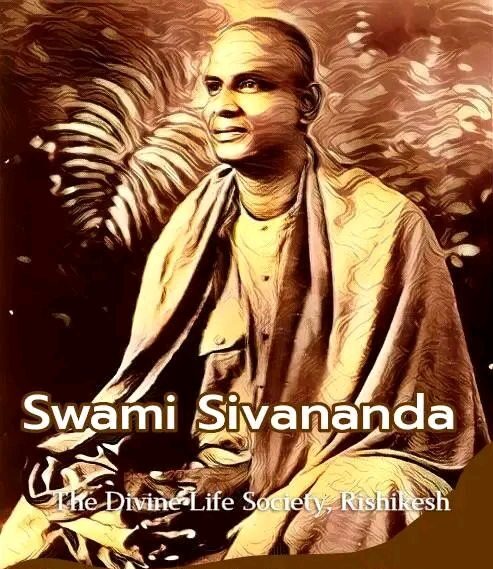
Swami Sivananda Artistic portrait image
Getting Started, Swami Sivananda

Benifits of Meditation

Benifits of Meditation by Swami Sivananda 1. This world is full of miseries and sufferings. If you want to get rid of the pains and afflictions of this Samsara, you must practice meditation. Meditation is the pathway to Divinity. It is the royal road to the Kingdom of Brahman. It is a mysterious ladder which reaches from earth to heaven (Vaikuntha or Kailasa or Brahman) from error to truth, from darkness to light, from pain to Bliss, from restlessness to abiding Peace, from ignorance to Knowledge, from mortality to Immortality. Meditation leads to knowledge of the Self which brings about the eternal peace, supreme Bliss. Meditation prepares you for the integral experience or direct intuitive knowledge. 2. Truth is Brahman. Truth is Atman. Truth is quite pure and simple You cannot realise the Truth without reflection and meditation. Be silent, Know thyself. Know That. Melt the mind in That. 3. Without the help of meditation you cannot attain knowledge of the Self. Without its aid you cannot grow into the Divine state. Without it you cannot liberate yourself from the trammels of the mind and attain Immortality. If you do not practice meditation, the supreme splendour and faceless glories of Atman will remain hidden from you. Tear the veils that cover the soul by practicing regular meditation. Rend asunder the five sheaths that screen the Atman by constant meditation and then attain the final beatitude of life. 4. The fire of meditation annihilates all foulness due to vice. Then suddenly comes knowledge or Divine Wisdom which directly leads to Mukti or final emancipation. 5. There are many valuable trainings of the mind which are essential to mental culture, for instance, the training of the memory, the cultivation of reflection, discrimination, Vichara or enquiry of ‘Who am I?’ The practice of meditation itself is a potent clarifier of memory. The practice of memory-culture powerfully helps the attainment of meditation. 6. Meditation is a powerful tonic. It is a mental and nervine tonic as well. The holy vibrations penetrate all the cells of the body and cure the diseases of the body. Those who meditate save doctor’s bills. The powerful, soothing waves that arise during meditation exercise a benign influence on the mind, nerves, organs and cells of the body. The Divine energy freely flows like Taila-dhara (flow of oil from one vessel to another) from the feet of the Lord to the different systems of the Sadhaka (aspirant). 7. If you can meditate for half an hour, you will be able to engage yourself with peace and spiritual strength in the battle of life for one week through the force of this meditation. Such is the beneficial result of meditation. As you have to move with different minds of peculiar natures in your daily life, get the strength and peace from the meditation and you will have no trouble and worry then. 8. A Yogi who meditates regularly has a magnetic and charming personality. Those who come in contact with him are much influenced by his sweet voice, powerful speech, lustrous eyes, brilliant complexion, strong healthy body, good behaviour, virtuous qualities and Divine nature. Just as a grain of salt dropped in a basin of water dissolves and becomes distributed throughout the whole water, just as sweet fragrance of jessamine pervades the air, so also his spiritual aura becomes infiltrated to the minds of others. People draw joy, peace and strength from him. They are inspired by his speech and get elevation of mind by mere contact with him.

Benifits of Meditation Read Post »

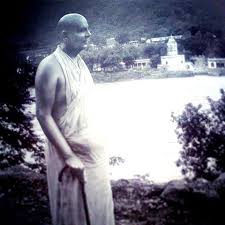
Swami Sivananda standing by riverside landscape image
Getting Started, Swami Sivananda

Kinds of Meditation

Kinds of Meditation by Swami Sivananda 1. There are different kinds of meditation. A particular kind is best suited for a particular mind. The kind of meditation varies according to taste, temperament, capacity and type of mind of the individual. A devotee meditates on his tutelary deity or Ishta Devata. A Raja Yogi meditates on the special Purusha or Isvara who is not touched by the afflictions, desires and Karmas. A Hatha Yogi meditates on the Chakras and their presiding deities. A Jnani meditates on his own Self or Atman. You will have to find out yourself the kind of meditation that is suitable for you. If you are not able to do this, you will have to consult a teacher or preceptor who has attained Self-realisation. He will be able to know the nature of your mind and the correct method of meditation for you. 2. The mind assumes the form of the object it cognises. Then only perception is possible. A Bhakta constantly meditates on the form of his tutelary deity. The mind always takes the form of the deity. When he is established in his meditation, when he attains the stage of Para-Bhakti or supreme devotion he sees his Ishta Devata only everywhere. The names and forms vanish. A devotee of Lord Krishna sees Lord Krishna only everywhere and experiences the state described in the Gita: “Vasudevah sarvam iti-Everything is Vasudeva (Krishna) only.” A Jnani or a Vedantin sees his own Self or Atman everywhere. The world of names and forms vanishes from his view. He experiences the utterances of the seers of the Upanishads: “Sarvam khalvidam Brahma-All indeed is Brahman.” 3. Meditation is of two main kinds, viz., Saguna (concrete) meditation and Nirguna (abstract) meditation. In concrete meditation the Yogic student concentrates on the form of the Lord Krishna, Rama, Siva, Hari, Gayatri or Sri Devi. In abstract meditation he concentrates the whole energy of the mind on one idea of God or Atman and avoids comparisons of memories and all other ideas. The one idea fills the whole mind. 4. When you see the concrete figure of Lord Krishna with open eyes and meditate, it is the concrete form of meditation. When you reflect over the image of Lord Krishna by closing your eyes, it is also concrete form of meditation but it is more abstract. When you meditate on the infinite abstract light it is still more abstract meditation. The former two types belong to Saguna form of meditation, the latter to Nirguna form. Even in Nirguna meditation there is a concrete form in the beginning for fixing the mind. Later on this form vanishes and meditator and meditated become one. Meditation proceeds from the mind. 5. Saguna meditation is meditation on a Murty or form of the Lord. This is a concrete form of meditation for people of devotional temperament. This is meditation with Gunas or attributes of God. Repeat the Name of the Lord or pure Om. Think of His attributes Omniscience, Omnipotence, Omnipresence, etc. Your mind will be filled with purity. Enthrone the Lord in the lotus of your heart amidst a blazing light. Mentally think of His feet, legs, chest, head, hands and the ornaments and dress and again come to His feet. Again and again repeat this process. 6. This is one kind of meditation for beginners. Sit on Padmasana in a solitary room. Close your eyes. Meditate on the effulgence in the sun, splendour in the moon, glory in the stars, beauty in the sky. 7. Meditate on the magnanimity of the ocean, its infinite nature. Compare the ocean with the Infinite Brahman, the waves, foams and blocks of ice to the various names and forms. Identify yourself with the ocean. Become silent. Expand. Expand. 8. This is another kind of meditation. Meditate on the Himalayas. Imagine that the River Ganga takes its origin from the icy region of Gangotri, near Uttarkasi, flows through Rishikesh, Benares and enters the Ganga Sagar in the Bay of Bengal. Himalayas, GangaGanga and finally to the sea. Then again take it to the icy Gangotri. Rotate the mind in this manner for 15 minutes. and the sea, these three thoughts only should occupy the mind. First take your mind to icy Gangotri, then along the Ganga and finally to the sea. Then again take it to the icy Gangotri. Rotate the mind in this manner for 15 minutes. 9. Imagine that there is a fine garden with lovely flowers. In one corner there are Jessamine flowers. In another corner there are beautiful cabbage roses. In the third corner there is the ‘lady of the night.’ In the fourth corner there are Champak flowers. First meditate on Jessamine. Then take the mind to the rose, then to the ‘lady of the night’ and finally to the Champak. Again rotate the mind as above. Do this again and again for 15 minutes. Gross meditation like this will prepare the mind to finer abstract meditation on subtle ideas. 10. Have the figure Om in front of you. Concentrate on this. Do Trataka also with eyes (steady gazing without winking till tears flow profusely). This is both Saguna and Nirguna meditation (with and without attributes). Keep a picture of Om in your meditation room. You can do Puja for this symbol of Brahman. Burn incense, etc., and offer flowers. This suits the modern educated persons. 11. This is abstract meditation on Nirguna Brahman. Repeat Om mentally with Bhava (feeling). Associate the ideas of Sat-chit-ananda, Purity, Perfection, ‘All-joy I am,’ ‘All-bliss I am.’ 12. ‘There is no world. There is neither body nor mind. There is only one Chaitanya (pure consciousness). I am that pure consciousness.’ This is Nirguna meditation (without attributes). 13. Meditation on Mahavakyas is tantamount to meditation on Om. You can take up either ‘Aham Brahma Asmi-I am Brahman’ or ‘Tat Tvam Asi-That thou art.’ These are the Mahavakyas or the great sentences of the Upanishads. Meditate on their significance. Deny or negate

Kinds of Meditation Read Post »
Swami Sivananda portrait photograph picture
Getting Started, Swami Sivananda

Auxiliaries of Meditation

Auxiliaries of Meditation by Swami Sivananda (a)WHAT IS MEDITATION 1. Meditation is the flow of continuous thought on one thing or God or Atman. Meditation is the keeping up of one idea of God alone always like the continuous flow of oil (Taila-dharavat). Yogins call this ‘Dhyana.’ Jnanins term this ‘Nididhyasana.’ Bhaktas style this ‘Bhajan.’ Concentration is fixing the mind on a point or object, either internal (in the body) or external (on any outside object or image). Meditation follows concentration. In Dhyana all worldly thoughts are shut out from the mind. The mind is filled or saturated with Divine thoughts, with the Divine Glory, the Divine Presence. (b)PLACE 2. Have a separate meditation-room under lock and key. Do not allow anybody to enter the room. Keep it holy. Burn incense in the morning and evening. Keep a photo of Lord Krishna, Siva, Rama, Devi or your Ishta Devata or Guru. Place your Asana (seat) in front of the picture. Keep some books also such as the Gita, the Ramayana and other scriptures. When you repeat the Mantra or the Name of the Lord, the powerful vibrations will be lodged in the ether of the room. In six months’ time you will feel peace and purity in the atmosphere of the room. Whenever your mind is disturbed by worldly influence, sit in the room and repeat the Name of the Lord for half an hour; then you will find an entire change in the mind immediately. Practise and feel the soothing spiritual influence yourself. Nothing is like spiritual Sadhana. You will find a local Mussoorie, Himalayas, in your own house. 3. Solitude and intense meditation are two important requisites for Self-realisation. The banks of the Ganga or the Narmada, Himalayan scenery, lovely flower-garden, sacred temple-these are the places which elevate the mind in concentration and meditation. Have recourse to them. 4. A solitary place, spiritual vibratory conditions as at Uttarkasi, Rishikesh, Badri Narayan, a cool place and temperate climate-these conditions are indispensably requisite for concentration of mind. Just as the salt melts in water, the Sattvic mind melts in silence during meditation in Brahman, its Adhishthana (substratum).(c)TIME5. Get up at 4 in the morning in Brahmamuhurta. It is very favourable for spiritual contemplation and to start worship of God. In the early morning the mind is calm pure and quite refreshed after slumber. The mind is like a blank sheet of paper and comparatively free from worldly Samskaras (mental impressions). It can be moulded very easily at this time. The atmosphere also is charged with more Sattva at this particular time. Wash your hands, feet and face with cold water if you find it difficult to take a bath. This will suffice. 6. Always choose that part of the day or night when your mind is clear and when you are least likely to be disturbed. You can have a sitting just before retiring to bed. The mind will be calm at this time. 7. You can have good meditation on Sundays because this is a holiday, and the mind is free. Do vigorous meditation on Sundays. You can have good meditation when you live on milk and fruits alone or when you fast. Use your commonsense always and try to bring out good result in meditation. (d)WHERE TO CONCENTRATE 8. Concentrate gently either on the lotus of the heart (Anahata Chakra) or at the space between the two eyebrows (Trikuti). Close your eyes. 9. The seat of mind is Ajna Chakra at Trikuti. The mind can be easily controlled if you concentrate on Trikuti. Bhaktas should concentrate on the heart. Yogins and Vedantins should concentrate at Ajna Chakra. 10. Crown of the head (Sahasrara) is another seat for concentration. Some Vedantins concentrate here. Some Yogins concentrate at the tip of the nose (Nasikagra Drishti). Stick to one centre in concentration. Cling to it tenaciously. If you concentrate on heart, stick to it. Never change it. Guru will select the centre for concentration, if you are a student of faith. If you are a man of self-reliance, you can select it for yourself. (e)YOGIC DIET11. Take Mitahara, Sattvic diet. Overloading the stomach with rice, vegetables, Dhal and bread brings sleep and interferes with Sadhana. A glutton or a sensualist, a dullard or a lazy man cannot practice meditation. A diet on milk renders the body very, very light. You can sit on one Asana for hours together with ease and comfort. If you feel weak, you can take for a day or two a little rice and milk or barley and milk or any light diet. Those who are in the field of service and who do platform lectures and other intense spiritual propagandic activities need solid, substantial food. (f)ASANA12. Asana steadies the body; Bandhas and Mudras make the mind firm; Pranayama makes the body light; Nadi-suddhi produces steadiness of the mind. Having acquired these qualifications you will have to fix the mind on Brahman. Then only meditation will go on steadily with ease and happiness. For meditation, concentration and Japa, Padmasana or Siddhasana is prescribed. For general health and keeping up of Brahmacharya, Sirshasana, Sarvangasana, Matsyasana, Paschimottanasana are good.

Auxiliaries of Meditation Read Post »

swami sivananda Thought Power book cover with monk image
Saints and Masters, Swami Sivananda

Baba Neem Karoli

Baba Neem Karoli by Swami Chidananda INVOCATION Om Sri Hanumate Namah. Homage unto the Divine! Worshipful salutations unto the Supreme Almighty Being, the Wonder of wonders, the Beauty of beauties, the Light of lights, the Power of powers, the Eternal Truth of all truths. May His Divine Grace shower upon all and lead all beings unto joy, peace and illumination. May His love, compassion and blessings manifest upon us through His spiritual representatives, namely, the Saints and Holy Men. Salutations to the holy memory of worshipful and beloved Sri Baba Neem Karolithe wonder mystic of Northern India. He is one of the most unique phenomena among the religious fraternity of Saints, Sages and holy Fakirs of Northern India. It would not be a wonder to me, if, as I am sitting and dictating this article on a mildly warm summery afternoon at Jaipur, in Rajasthan, at this moment Babaji is perfectly aware of this fact and knows exactly where I am staying, what words I am dictating, to whom I am dictating them and precisely at what time I am doing this; and this in spite of the fact that revered Baba Neem Karoli is physically no more amongst us and has left his body very recently, just about a couple of years back. Though this statement may seem rather extraordinary and would surprise many of the readers, yet, it is nevertheless true that many of Babajis close disciples and devotees had personal experience of the fact that revered Babaji seemed to be aware of whatever they had been saying and doing in distant places, far away from him, and Babaji was actually in some other place at that moment. This has convinced most of his closest followers that Sri Baba Neem Karoli was a Siddha Purusha (perfected being) and knower of the past, present as also of the futureTrikala Jnani. The last time I had the good fortune of meeting revered Baba Neem Karoliji was in the month of October 1973. This was when I visited him at his secluded Ashram at Kainchi near Nainital, U.P., in the Kumaon Hills. I was driving from Almora to Nainital during a tour. It was late evening and, when we arrived at Kainchi, it was dark. The season was autumn and it was beginning to get chill as it was near night-fall. One of our party went ahead to ascertain and find out whether Babaji was in the Ashram. Babaji was present and sent word that he would receive us. Myself with my companions went down from the road with the help of flash lights and, crossing the little bridge that spans the mountain stream, we entered the Ashram. The entire place was totally deserted and absolute silence prevailed. The Temple Pujari (priest) received us in the courtyard and conducted us into a little room. The revered Baba Neem Karoli was seated on a cot and was wrapped in a simple blanket. He received me and my party with a very kind and benign look and motioned us to take our seats on the carpet spread near the cot. I knelt down beside the cot and offered my homage, laying my head upon his lap where he had tucked up his foot, being seated cross-legged. Babaji softly said “All right, all right, very good” and signed to me to be seated. One of our tour party, Sri Yogesh Bahuguna, a very idealistic young man and a sincere spiritual seeker, had brought with him 7 or 8 oranges in a little towel. There was an empty basket by the side of Babaji and Sri Yogesh Bahuguna placed these oranges in the basket as an offering. We then sang some Sankirtan and sat in silence for a couple of minutes. Before taking leave after enquiring about Babajis health and answering a few queries by him, Babaji started to distribute the fruit as Prasad to us. By this time some other workers and devotees of the Ashram had gathered near the door. Sri Yogeshji was taken aback and was overcome by surprise when he observed that Babaji continued taking oranges from the basket even after he had already given away 8 oranges and went on distributing this Prasad to all the members of our party plus the assembled Ashram Staff and ultimately he had given 18 fruits in all. From where the additional 10 oranges came into the basket is something we could not explain. Perhaps only Babaji knows this. I first came to hear about revered Baba Neem Karoli in some detail in the early fifties about 23 years ago. It took place this way. Worshipful Gurudev Swami Sivanandajis Ashram is situated in Tehri-Garhwal district. At that time the District Magistrate was Sri R.K. Trivedi, an able and outstanding officer. He later on became one of the very first Directors of the National Academy of Administration in Mussoorie. Sri R.K. Trivedis old father used to stay with him at Narendranagar, which is the district headquarters of Tehri-Garhwal. The father was an old man, a very pious and spiritual Sadhaka who had developed a good inner life. He expressed a desire to visit Sivananda Ashram to meet Gurudev. Sri R.K. Trivedi, D.M., had great respect for Sri Gurudev and he gladly brought his old father down from Narendranagar and they met H.H. Sri Swami Sivanandaji Maharaj in his little cottage on the bank of the Ganga. Being General Secretary at that time, I had to conduct the two visitors into revered Gurudevs presence. He asked me to stay on while they were with him and it was then that Mr. Trivedis father told us that his Guru was Sri Baba Neem Karoliji of Nainital. When requested to tell us something about his Guru, the senior Trivedi narrated many things about Babaji and his experience about him as his disciple. He said, “Swamiji, right at this moment Babaji knows where I am, what I am doing and what exactly I am saying to you. When

Baba Neem Karoli Read Post »

Swami Sivananda standing near riverside image
Getting Started, Swami Sivananda

Meditate

Meditate by Swami Sivananda Meditation is the keeping up of the one idea-be it of Nirguna Brahman, Saguna Brahman, image or an abstract idea. It follows concentration where all the rays of the mind are focussed on to a single thought. Ultimately even this single thought gives place to Awareness-just awareness and illumination-where all problems dissolve themselves. When you enter into deep meditation, you will have no consciousness of your body or surroundings. You will have equanimity of mind. You will not hear any sounds. The consciousness of egoism also will gradually vanish. You will experience inexplicable joy and indescribable happiness. Gradually reasoning and reflection give place to awareness. If you can meditate for half an hour, you will be able to engage yourself with peace and spiritual strength in the battle of life for one week through the force of this meditation. Such is the beneficial result of this meditation. As you have to move with people of different natures in your daily life, get the strength and peace from meditation and you will have no trouble and worry then. Sit down with a composed mind. Assert your mastery over the body and mind. Plunge deep into the chamber of your heart and enter into the stupendous ocean of Silence. Listen to the voice which is soundless.

Meditate Read Post »

Swami Sivananda sitting near river with mountains image
Getting Started, Swami Sivananda

Wisdom

Wisdom by Swami Sivananda GIVE UP ATTACHMENT Attachment is the first child of Maya. This whole Lila of the Lord is kept up by the force of attachment. There is in the mind gummy substance which is like a mixture of castor oil, glue, gum-arabic, mucilage of tragacanth, gluten paste, honey, glycerine, jack fruit’s juice and all other pasty substances of the world. The mind is glued, as it were, to the objects with this mixture. Therefore the attachment is very strong. Selfishness causes attachment. Attachment is the root-cause for all the miseries and troubles of this world. Work incessantly without an identification. Then alone you can have real happiness. You will yourself feel that you are a different being. This is the master-key to open the realms of Brahmic Bliss. SHUN SENSUAL ENJOYMENTS Look out for an unchangeable, infinite and Supreme happiness which must come from a Being in whom there is no change. Search and find out such Being, and if you could only succeed in your quest, then you can get that unalterable happiness from Him. Sensual enjoyment is attended with various defects. It is attended with various sorts of sins, pains, weaknesses, attachments, slave mentality, weak will, severe exertion and struggle, bad habits, cravings, aggravation of desires and mental restlessness. Therefore shun all sorts of sensual enjoyments. HAVE A BALANCED MINDThough the cow grazes on the pastures having been separated from the calf, her mind is always fixed on the calf only. Similarly you should fix the mind on God when you do Japa, and give your hand to work. Renounce all attachment. Be balanced in success or failure, gain or loss, victory or defeat, pleasure or pain. Discipline your mind cautiously. This is your master-key to open the doors of the realm of Bliss. This is the secret of success in Yoga. Feel and think that you breathe, live and work for God alone, in every second of your life, and that without Him life is absolutely useless. Feel the pangs of separation while at work if you forget Him even for a fraction of a second. COAX THE MIND Let not your heart give way to trials. Be ever intent on your spiritual Sadhana. Learn to discriminate. Develop true lasting Vairagya by association with wise people. Make the mind understand about the unreal nature of objects and the defects of a sensual life. Talk to your mind. Coax the mind. It will hear your words. Gradually the mind-wandering will cease. Then the mind will abide firmly in the centre of the source. Become a Yogi. Yoga will put an end to all sorts of pain. Yoga will destroy all Kleshas (afflictions). Wake up. Open your eyes. Practise Yoga. My Child! DISCIPLINE THE MIND Destroy the Sankalpas or imagination of the mind. Discipline the mind in a perfect manner through discrimination, enquiry, dispassion and regular meditation on Atman. Have a wide outlook on life. See God in everything, in every face. Give up all that is false and untrue. Pray fervently. Lead a life of virtue and happiness. Renounce all your sorrows, fears and anxieties, and walk in the path laid down by the scriptures. You will attain supreme peace and eternal bliss. KEEP THE MIND FULLY OCCUPIED Understand fully the aim and purpose of life. Yield not to temptations. Develop virtuous qualities like humility, forgiveness, tolerance, etc. Wish eagerly and fervently to attain God-consciousness. Have faith, interest and attention. You are bound to succeed. Conserve all energy and utilise it for higher spiritual achievements in life. Purify. Be just. Be true. Be sincere in your attempts. Respect all prophets and saints. You will shine as a dynamic Yogi. Keep the mind fully occupied. Sing the name of the Lord. Twirl the beads. Study the scriptures. Think of God and meditate upon Him with true devotion and feeling and merge in Him. This is the goal of life. GIVE NO LENIENCY TO MIND Mere hearing of eloquent valuable spiritual lectures will not do in the spiritual path. You will have to act according to them. You will have to give your whole heart, mind and soul to practice. Then only you will have progress in the path. Follow the instructions of your master and the teachings of the scriptures to the very letter. Give no leniency to the mind. Exact, implicit, strict obedience to the instructions is expected of you. Do not fight for rights. Think more about your duties and less about your rights. These rights are worthless. It is wasting of time and energy. Assert your birthright of God-consciousness. Realise this and become wise. LEARN TO DISCRIMINATE Know things in their proper light. Do not be deluded. Emotion is mistaken for devotion; violent jumping in the air during Sankirtan for Divine ecstasy; Rajasic restlessness and motion for divine activities and Karma Yoga; a Tamasic man for a Sattvic man; Tandri and deep sleep for Samadhi; Manorajya or building castles in the air for meditation; physical nudity for the Jivanmukti state. Understand the laws of the universe. Move tactfully in this world. Learn the secrets of Nature. Learn to discriminate and become wise. Fight out the inner battle again and come out victorious! SACRIFICE PLEASURE TO SECURE BLISS Spiritual pursuits, and practice of Yoga are really sweet, but appear to be bitter; sensual pursuits, which are really bitter, appear to be sweet. This is due to the perversion of intellect caused by Avidya. Select some good songs or Dhwanis and repeat them during night along with your friends and relatives. Even during day while working, you can sing the select Dhwanis of your Ishta Mantra. By this you will have continuity of Divine thoughts. May you always shine with the divine splendour and inexhaustible wealth of Atma Jnana, which is the common property of all mankind! THINK RIGHTLY Worry does great harm to the astral body and the mind. Energy is wasted by worry. It causes inflammation and drains the vitality of man.

Wisdom Read Post »

Swami Sivananda Monk praying beside large portrait image
Saints and Masters, Swami Sivananda

Sri Sri Ananda Mayee Ma

Sri Sri Ananda Mayee Ma by Swami Chidananda Beloved Immortal Atman, Beloved seekers and aspirants! Yesterday we were referring to saints and sages as being of two types. Some who were born like other human individuals, but who, by their prayer and persistence in spiritual life, went beyond to God-realization. The second category were never born, ever free souls with some mission on earth; eternally free, perfect beings. In the case of the latter category, many are born with their advent announced before their birth and with their birth attended by many supernatural, supranormal signs. Sometimes they gave indications of their special divine origin, through certain events or actions, even in their young age. There was no question on any spiritual struggle in them. Sometimes, if they seemed to do sadhana, it was more as an example to guide others, rather than for any necessity of theirs. Among this unique class of never bound, ever free beings, we have our worshipful Sri Sri Ananda Mayee Ma. Sri Sri Ma was born in a Bengali family in a rural part of East Bengal, which is now a separate state under the name of Bangladesh. It was part of India and Bengal at that time. Her father and mother were both pious God-fearing people. The special uniqueness of this child when she was born was something we could learn only much later from the lips of Ma herself. Otherwise, there was no means of knowing what the state of consciousness of this child was when it was in infancy. But it is now definite and certain that even from the time of being born, the consciousness of the child was one of awareness of its spiritual identity. The little infant in the cradle gazed around and saw its surroundings and people moving about, but it was aware that it did not belong to that outer environment and was fully aware of itself as an ever free, ever-perfect soul. At all times the child was fully aware that it was pure, untrammeled spirit, without limitation of body, mind or identity. It knew itself to be Satchidananda Atman. From that state it watched like a witness the parents and relatives at home as if in a play or dramatic performance. So the child grew up in a state of awareness of her true self. That awareness afterwards never left Ma until the very last day of her life. This then is the secret behind Ma�s personality. As was the case in those days, the child was brought up with great love and affection by her parents, relatives and neighbors. She received the rudiments of ordinary, normal education, but was more interested in serving her parents at home than anything else. As in the case of Lord Krishna, this little girl had a powerful attraction to all people. She was of an extremely sweet and kind nature, filled with the spirit of service. She liked to help her mother in the household duties. One extraordinary trait in her, was that when she heard the chanting of God�s Name, she gravitated to that place. She could not resist it. Otherwise, she was normal and ordinary in every respect. This young girl, Nirmala, which means “pure”, grew up into a very virtuous and sweet tempered, good-natured young maid. As was the Indian custom, when she became of marriageable age, the family arranged a marriage with a good boy from a reputable family and they were married. The young man, Bholnath, was also of a pure and simple nature. Now the couple entered into the second stage of life, according to the Hindu life pattern. However, in a short time, through a couple of incidents, Bholnath became aware that his bride was no ordinary human individual. He felt that he had some celestial or divine being as his partner. From that day onwards all thought of basing their relationship upon the gross physical level vanished from the mind of the earthly husband of this being. As days passed by, many extraordinary experiences were gone through by the young bride and housewife, but through it all she was meticulous in performing all her household duties and responsibilities and, if necessary attending to guests in the house. She was a very good cook and a very large-hearted housewife. At this stage, extraordinary phenomena began to occur in and through her body. The husband would sit after supper in bed, put up the mosquito curtain and smoke. After finishing in the kitchen, his wife would come into the room and sit on the floor. As I told you, she had no special spiritual sadhana routine. She was engaged in household work, but suddenly from nowhere various ingredients of worship began to manifest in front of her. Her body started to assume various yogic postures and kriyas began to manifest in and through her body. Bholnath had a clear vision of all that was happening. He watched in wonder and silence. The young housewife was at that time in a peculiar state of trance and was not aware of her body. Soon, various kriyas manifested in her body. A fire appeared and she made use of all the ingredients for doing worship. When the whole thing was completed, she would go into a deep trance and all the ingredients of worship would vanish and the place would be exactly as it was before, but remnants of the worship in the form of flowers would be left behind. This went on for many weeks and months. Until this time, the nature of this young person and their mutual relationship was known only to themselves and God. No other person was aware of their special relationship. But soon it came to the knowledge of an office colleague of the husband, who was a genuine seeker and devotee of the Divine Mother. He expressed the ardent desire to have the darshan of Ma. So one evening he accompanied Bholnath home from the office. Arriving

Sri Sri Ananda Mayee Ma Read Post »

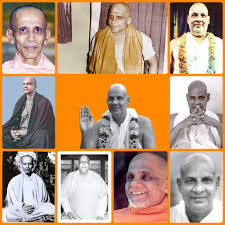
swami sivananda Collage of multiple spiritual guru portraits image
Saints and Masters, Swami Sivananda

Swami Omkar

Swami Omkar Swami Omkar was born in the East Godavery District. His parents were without children and prayed fervently to God in the hope of getting a child. One very auspicious day, a tall Mahatma came to their home and blessed the couple, giving them some holy water to drink. The mother drank this water with all reverence and devotion. The Mahatma disappeared as suddenly as he had come. After some months, to the great joy of the couple, a little baby boy was born to them. They named him Venkateswara. Little Venkateswara was later to grow up to be the great saint, Swami Omkar. At the age of three Venkateswara would sit still like a statue beside his father during the daily prayer. He would listen to the reading of the Gita very attentively. In this way, the boy was given a strong spiritual foundation from early childhood. Swami Omkar often said later, “As are the parents, so are the children”. Venkateswara’s mother died when he was very young. His father now became like a mother to the little boy. He was utterly devoted to his son and gave him everything he desired, both materially and spiritually. The boy went to the best school and wore the most expensive clothes. Venkateswara had a little sister who looked after all his needs until she was twelve years old, when she developed a blood condition. But she was not to live long and very soon passed away, taking her brother’s name. Since then, whenever Swami Omkar served women, he would feel that he was serving the form of his little sister. Even while he was still young, Venkateswara went away to Rishikesh, in the Himalayas. Here he assumed the name Omkar, and spent many years in deep meditation. Now he had a call from within to go to America. He described his visit as follows: “I went as a seeker of Truth, not to teach but to learn all that is best in America. There is so much to learn in order to rise from darkness to light.” Even at this early age, Venkateswara had unusual mental and psychic powers. He could heal the sick, whether their ailments were mental or physical. He would write the sacred symbol Om on water, and give this sacred water to the patient. The patient would feel immediate relief. Gifted with a universal vision from his early boyhood, Swami Omkar soon realised the eternal Truth. He founded the Sri Shanti Ashram, the abode of peace, at Totapalli Hills in the Andhra province. Swami Omkar was a great Karma Yogi. From dawn to dusk he would be engaged in endless activity-helping devotees in their spiritual progress, watering the plants, or feeding the animals. He had a very compassionate heart from his very boyhood, and would not hurt any living creature. He loved plants and would often talk to them. Many saints visited his Ashram and stayed with him for some time. During the early years of his life as a monk, the Divine Master, Swami Sivananda, also stayed at Shanti Ashram for some months and served the sick. Many years later, Swami Omkar, too, visited the Master at his Ashram at Rishikesh. Both the saints had great love for each other. Shanti Ashram is a beautiful place surrounded by hills and enchanting scenery. There is a small hospital and a school for children run by the Ashram. There is a mobile clinic also to serve the needs of the hill people. There are several other branches of the Ashram, at Waltair and in other places. At the Waltair Ashram there is a small school for deaf and dumb children. Swami Omkar had a very broad and liberal heart. He had great love and reverence for the saints of all religions. All approaches to God were valid for him. Swami Omkar was so compassionate that he once gave a piece of bone from his own thigh to be grafted in a little girl to save her life. He spent several months in hospital as a result of this great sacrifice on his part. Such a noble personality, who worked heart and soul for spreading peace in the world, passed away in his ninety-third year, on 10 June, 1982. Shanti Ashram, which is located at the foot of the beautiful Totapalli hills in Andhra Pradesh, is currently rendering active service to the poor and needy, under the able and loving guidance of Mother Jnaneshwari, who was appointed by Swami Omkar as his successor.

Swami Omkar Read Post »

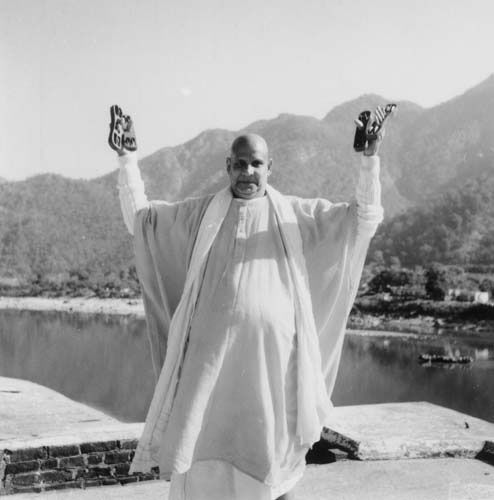
Swami Sivananda raising hands near river image
Getting Started, Swami Sivananda

Surrender to the Lord

Surrender to the Lord by Swami Sivananda Sadhana or spiritual practice should make you ever cheerful, more concentrated, joyful, balanced, peaceful, contented, blissful, dispassionate, fearless, courageous, compassionate, angerless, ‘I’-less, desireless, mineless. Sadhana should give you rich inner life, introspective inner vision and unruffled state of mind under all conditions of life. These are the signs of your spiritual growth. Seeing of visions, lights, hearing of Anahata sounds, Divya Gandha, etc., have not much spiritual value, although they indicate you have attained first degree of concentration. Man can never separate himself from God, for God is the Cosmos and man its component. There is only one God, the Self of all beings. There is only one law, the law of cause and effect. There is only one religion, the religion of Self-realisation. Religion is the most rational science of life, the science of man as he essentially is, the science which shows him how he is a part of Cosmos, how he ought to abide by the law of the Cosmos, and aim at the fulfilment of the evolutional process of the Cosmos. Religion is practical philosophy. Philosophy is the understanding of the ultimate Principle that governs life. Religion is the art of practicing it, i.e. living the spirit of philosophy.

Surrender to the Lord Read Post »

swami sivananda Guru seated with two women devotees image
Getting Started, Swami Sivananda

Signs of Spiritual Growth

Signs of Spiritual Growth by Swami Sivananda Sadhana or spiritual practice should make you ever cheerful, more concentrated, joyful, balanced, peaceful, contented, blissful, dispassionate, fearless, courageous, compassionate, angerless, ‘I’-less, desireless, mineless. Sadhana should give you rich inner life, introspective inner vision and unruffled state of mind under all conditions of life. These are the signs of your spiritual growth. Seeing of visions, lights, hearing of Anahata sounds, Divya Gandha, etc., have not much spiritual value, although they indicate you have attained first degree of concentration. Man can never separate himself from God, for God is the Cosmos and man its component. There is only one God, the Self of all beings. There is only one law, the law of cause and effect. There is only one religion, the religion of Self-realisation. Religion is the most rational science of life, the science of man as he essentially is, the science which shows him how he is a part of Cosmos, how he ought to abide by the law of the Cosmos, and aim at the fulfilment of the evolutional process of the Cosmos. Religion is practical philosophy. Philosophy is the understanding of the ultimate Principle that governs life. Religion is the art of practicing it, i.e. living the spirit of philosophy.

Signs of Spiritual Growth Read Post »