






Hari Om

Menu

February 15, 2026

swami sivananda Vintage photo of guru teaching disciples by riverside image
Bhakti Yoga, Swami Sivananda

Sakhya Bhakti

Sakhya Bhakti by Swami Sivananda Sakhya-Bhava is the cultivation of the friend-sentiment with God. The inmates of the family of Nandagopa cultivated this Bhakti. Arjuna cultivated this kind of Bhakti. The Bhagavata says: Oh, how wonderful is the fortune of the people of Vraja of cowherd Nanda whose dear friend is the perfect, eternal Brahman of Absolute Bliss! To be always with the Lord, to treat Him as one’s own dear relative or a friend belonging to one’s own family, to be in His company at all times, to love Him as one’s own Self, is Sakhya-Bhava of Bhakti-Marga. The devotee of Sakhya-Bhava takes up with eagerness any work of the Lord leaving aside even the most important and urgent and pressing work, assuming an attitude of neglect towards personal work, and totally concerning himself with the love of the Lord. How do friends, real friends love in this world? What an amount of love they possess between one another? Such a love is developed towards God instead of towards man. Physical love is turned into spiritual love. There is a transformation of the mundane into the Eternal. The devotee considers all his actions as merely nothing, though he has done really a superhuman act. He always does what may please God in all respects. He considers all as God. He treats every being of the world as his own relative or friend. He treats everyone as belonging to himself. There is no selfishness, no hatred, no separateness in him. He becomes one with all in feeling. He loves all, for all are his friends. All is God. And God is the Supreme Friend of his. He is always satisfied with what is ordained by God. He is supremely joyful if anything of his own comes to the service of God. He feels that God has similar powers over his belongings as he has got himself. He moves with God and treats God as not a dignified, terrifying, hard task master, but a friend, sweet and loving. He longs to see God. He does not want to leave the Lord even for a moment. He says, My Lord! My Beloved! How can I live without Thee? My Dear! Where are You? And loses himself in the Love of his Beloved. He considers that his existence and the existence of what belongs to him is fruitful only if it is useful in the service of God, for he cannot live without God. To live without God is an impossibility. God is the innermost and the dearest of friends. All friends may desert a person, but God will never desert His devotees. He loves you even if you do not love Him. The devotee feels himself merged in the ocean of joy on seeing, touching or thinking of the Beloved. Mere hearing of His Name kindles the devotee’s love for God. He jumps and sings in ecstasy. He is overwhelmed with joy when anybody brings a message of the Beloved. He feels anguish at his separation from the Beloved. He is ever expecting to meet his Beloved. These are some of the characteristics of a Bhakta who follows the Sakhya-Bhava. Vibhishana, Sugriva, Uddhava, Arjuna, Sudama, Sridama and the playmates of the Lord in Vraja are the examples of devotees who cultivated the friend-sentiment of Bhakti.

Sakhya Bhakti Read Post »

Swami Sivananda poster with spiritual teachings image
Bhakti Yoga, Swami Sivananda

Dasya Bhakti

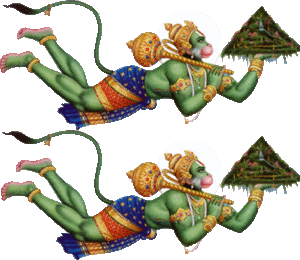
Dasya Bhakti by Swami Sivananda Dasya Bhakti is the love of God through servant-sentiment. To serve God and carry out His wishes, realising His virtues, nature, mystery and glory, considering oneself as a slave of God, the Supreme Master, is Dasya Bhakti. Serving and worshipping the Murtis in temples, sweeping the temples, meditating on God and mentally serving Him like a slave, serving the saints and the sages, serving the devotees of God, serving poor and sick people who are forms of God, is also included in Dasya Bhakti. To follow the words of scriptures, to act according to the injunctions of the Vedas, considering them to be direct words of God, is Dasya Bhakti. Association with and service of love-intoxicated devotees and service of those who have knowledge of God is Dasya Bhakti. The purpose behind Dasya Bhakti is to be ever with God in order to offer services to Him and win His Divine Grace and attain thereby immortality. Arjuna prays with a sentiment of a slave, a servant and a disciple, in order to get the grace of Lord Krishna. O Lord! I am Your disciple. I have taken refuge in You. Teach me. This should be the Bhava of a Bhakta. He should completely give himself up to God and should not retain any personal reservations with him. Ananya-Bhakti is total relinquishment of the self to God. Lakshmana, Hanuman, Angada, etc., cultivated this Dasya-Bhava of Bhagavad-Bhakti. Lakshmana could not even speak to Rama at times in his extreme love for Rama and the humiliation of his self before Rama. Hanuman is a towering example of Divine Seva to the Lord. He spent his whole life in serving Lord Rama. Angada did not want to leave Rama even at the latter’s request and prayed to Lord Rama that he would serve Him at all times, that he would do even the most menial of services for the sake of Lord Rama. These devotees were of an exceptional type and it is very difficult to develop such a Bhakti as was possessed by Hanuman, Lakshmana or Angada. The heart has to be purified, the mind has to be thinned out, desires have to be annihilated. It is then that the devotee feels his real Love for God. Before such a purification, the love of God becomes coloured with earthliness and does not bear the expected fruit. Total surrender is the ideal of Dasya Bhakti. The Dasa or the servant loses nothing but gains everything through the service of God either in His Transcendental or His Immanent aspect.

Dasya Bhakti Read Post »

images 41
Bhakti Yoga, Swami Sivananda

Vandana

Vandana by Swami Sivananda Vandana is prayer and prostration. Humble prostration touching the earth with the eight limbs of the body (Sashtanga-Namaskara), with faith and reverence, before a form of God, or prostrations to all beings knowing them to be the forms of the One God, and getting absorbed in the Divine Love of the Lord is termed prostration to God. The Bhagavata says: The sky, air, fire, water, earth, stars, planets, the cardinal points (directions), trees, rivers, seas and all living beings constitute the body of Sri Hari. The devotee should bow before everything in absolute devotion, thinking that he is bowing before God Himself. Lord Krishna says to Uddhava: Giving no attention to those who laugh in ridicule, forgetting the body and insensible to shame, one should prostrate and bow down to all beings, even to the dog, the ass, the Chandala and the cow. All is Myself, and nothing is but Myself. Arjuna does prostration to Krishna in a most beautiful manner: Salutation to You from the front, salutation to You from behind, salutation to You from every side! O All! Immeasurable in strength, You pervade all. You are all! The object or purpose of Devotion is to realise God through exclusive love. The Mahabharata says: There is nothing which is more auspicious than Bhagavan Vasudeva, there is nothing more purifying than Vasudeva, and there is no Deva, worthy of being worshipped higher than Vasudeva. He who offers his salutations to Vasudeva suffers no afflictions. Bhishma says: Even one bend of the head to Lord Sri Krishna is equal in merit to the completion of ten horse-sacrifices. The latter does not bring about Liberation, but the former makes one God Himself. Akrura practised this kind of Bhakti, i.e., Vandana Bhakti. His story is given in the Srimad-Bhagavata. The Bhagavata says: Overwhelmed with devout love, Akrura quickly jumped down from the chariot and fell prostrate like a pole at the feet of Balarama and Sri Krishna. In the Mahabharata it is told that the old warrior Bhishma offered his salutation to the Lord in a voice choked with deep emotion and Sri Krishna immediately favoured him with the light of Divine Knowledge, Having thus offered his prayer to the Lord, Bhishma whose mind was wholly absorbed in God, said, ‘Salutation to Krishna’ and bowed his head to Him. Learning the depth of Bhishma’s devotion, through His power of Yoga, Sri Hari, Madhava, bestowed upon Bhishma the light of Divine Knowledge which illuminates the three worlds. The ego or Ahamkara is effaced out completely through devout prayer and prostration to God. The Divine grace descends upon the devotee and man becomes God.

Vandana Read Post »