Hari Om

Menu

February 13, 2026

Swami Sivananda seated on chair in white robes image
Raja Yoga, Swami Sivananda

Mind, Its Manifestations and Resistences

Mind, Its Manifestations and Resistences by Swami Sivananda I. THOUGHT AND FACIAL EXPRESSION Face is the index of Mind. Face is the mould of the mind. Every thought cuts a groove in the face. A divine thought brightens the face. An evil thought darkens the face. Continued divine thoughts increase the aura or halo. Continued evil thoughts increase the depth of dark impressions just as the continued striking of a vessel against the edge of a well while drawing water makes deeper and deeper hollow on the vessel. The facial expression truly advertises the inner state of the mind or the true contents of the mind. II. THE INNER WAR So long as there are desires or Vasanas, you cannot have knowledge of the Self. So long as you have no knowledge of the Self, you cannot destroy desires completely. This is a Chakrika or paradox. The more you thin out desires or Vasanas the more you are near to Atman or the Goal. Subha Vasanas will not bind you. Japa, meditation, Vichara are subtle Vasanas. A desire for liberation is a subtle Vasana. Increase the subtle Vasanas. The evil Vasanas will perish by themselves. III. FIGHT WITH EVIL Fight with evil is fight with the mind. Fight with senses is fight with evil. Fight with desires is fight with the mind. Fight with matter is fight with evil. Fight with matter is breaking all attachments, that bind you to this world. Fight with desires and cravings is fight with ignorance. Conquest over mind, senses, desires and matter is the greatest victory. It bestows Immortality and eternal bliss, and makes you real King of kings. IV. REMOVE THE DIRT IN THE MIND-RADIO A new Radio is fixed. All its parts are quite all right. But the message is not received. This is due to a particle of dirt in it. If the dirt is removed, all the messages and songs will be heard distinctly. Even so in the big radio of the mind if there is dirt of bad character of evil quality, it cannot express true joy, bliss, love, the spirit of self-sacrifice, the aroma of truth. Remove the dirt of evil trait. Fill the mind with divine virtues. You will shine with Brahmic aura. You will shed the light of Self-illumination. V. THE CREEPER-MIND A creeper grows. You allow it to ascend on a stick. Every day you tend it, and move it in the direction you want. If you do not tend it for a week, it will move in its own way. It will not serve your purpose. It will look ugly. Even so, you must tend the creeper-mind daily. Then alone can you bend it easily. You can mould it properly, you can control it easily. by Swami Sivananda

Mind, Its Manifestations and Resistences Read Post »

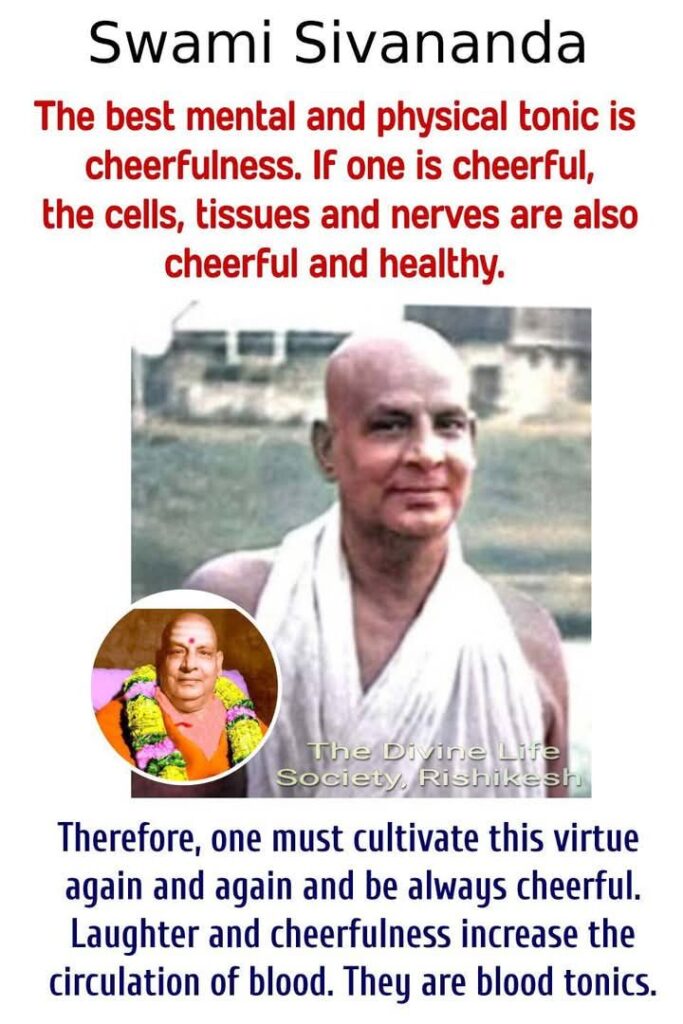
Swami Sivananda cheerfulness quote with portrait image
Karma Yoga, Swami Sivananda

The Western Theory of Evolution is Unsound

The Western Theory of Evolution is Unsound Thus evolution and involution can be, strictly speaking, postulated only of the thinker. While so, some of the Western philosophers propound a theory that there is gradual progress from the mineral condition to the vegetable, from the vegetable to the animal, and from the animal to the human, and call it the theory of evolution. In the first place no religion of the world supports such a theory, and, as Benjamin Kidd in his Social Evolution says: “The tendency of the doctrine of evolution has been generally considered to be on the whole anti-religious.” They say that evolution is going on in the universe; but what it is that is evolving they have nothing to say about. They observe different natures, bodies and objects in the universe occupying different positions in some respects and seeing that one is more ‘advanced’ than another, they make regular scales noting the different degrees of advancement. But they do not say that what is now found in the more advanced state of being must, in its essence, have been in existence formerly and must have been then in a less advanced condition. In other words, they do not say that the underlying entity which bears a more advanced form or exhibits a higher state or condition today is the same that formerly appeared in a coarser garb or functioned in a lower kind of existence. In fact, they have in general ignored the necessity, nay, even the possibility, of the continuing presence of the subsisting reality and have only directed attention to some stations on the road of evolution without caring to know whether there is anyone journeying along the road, and if so, who he is and how he is going on. In fact no evolution is possible from the stage of the mineral to that of the vegetable, for there is nothing in the mineral that can evolve. Dr. Bose’s discoveries of the modern day can have reference only to the Isvaric life, not the life of any Jiva in the mineral. The whole mineral kingdom has emerged out of the Tamasic aspect of Maya and it forms the material which goes to make the bodies of the Jivas and their means and places of support; mineral matter not composing the body of any Jiva is called ‘inanimate’ or ‘inorganic’, not because there is no life at all in it-for it has its very existence in the life of Isvara-but because there is no separate co-ordinating life-principle connecting together the several atoms in harmonious co-operation for serving some common end. It is the presence or the absence of such a separate connecting life that makes, in fact, all the difference between the organic and the inorganic sides of Nature. The view that is now and then expressed from the modern Theosophical platform: ‘every grain of sand has its Jivatma’ is clearly wrong and opposed to the clear statement in the holy books that the Jivas are to be found only in four classes of bodies, viz., Jarayuja (mammals), Andaja (egg-born), Svedaja (sweat-born) and Udbhijja (earth-born). Again, as regards the alleged evolution from the vegetable to animal and from the animal to the human, the Western evolutionists do not actually trace the passage of any entity from a lower to a higher state of being. They are only able to see that one being is more ‘advanced’ than another and that this universe is inhabited by beings of manifold gradation of advancement, physical and mental. They mentally arrange the beings under different groups and these groups as well as the beings placed in each of these groups are then arranged according to a regular and graduated scale of advancement. They then perceive that the ladder of advancement created by them in their imagination presents a really beautiful appearance and they infer that Nature, beautiful as She is, must have brought about the advancement of beings only in the order in which the rungs of the ladder appear. A big library may contain a large number of books of different gradations of thought or size. They may be arranged in some regular order. Will it be proper to infer that a book written by an advanced author has ‘evolved’ out of a book written by an ordinary man, or that a big volume has come out of a small booklet? The present-day theory of evolution has no strong foundation.

The Western Theory of Evolution is Unsound Read Post »

Swami Sivananda wearing garland near riverbank picture
Raja Yoga, Swami Sivananda

Modifications of Mind

Modifications of Mind by Swami Sivananda 1. Modifications of Mind The mental modifications are five kinds, (some) painful and (others) not painful. NOTES If you want to suppress the modifications, it is necessary for you to have a comprehensive understanding of these modifications. The painful Vrittis have to be controlled by the not-painful Vrittis, and these in turn have to be mastered by Para Vairagya or absolute non-attachment or dispassion or indifference to sensual enjoyments. The painful Vrittis are those which bring the afflictions and become the field for the growth of the vehicle of actions (Karmasaya). Vrittis that emanate from Rajas and Tamas are all painful ones. All Vrittis that proceed from Sattva Guna are not-painful ones. Through Vairagya and Abhyasa the painful Rajasic-tamasic Vrittis are to be controlled. Good Samskaras are generated by Vairagya and Abhyasa. 2. Five Modifications They (the modifications) are right knowledge, wrong knowledge, imagination, sleep and memory. NOTES All the above five kinds of modifications are dealt with in the subsequent five Sutras. 3. Pramana Right knowledge is direct perception or inference or testimony. NOTES Right knowledge is that which is unquestionably reliable and true. Right knowledge is right cognition. Wrong knowledge is misconception. These Pramanas are helps or steps to attain knowledge of the Self. They are of no use for one who is resting in his own native divine glory. A full-blown Yogi depends on his own realisation for his knowledge. He is not in need of these proofs. An ordinary man depends on Pratyaksha only for his knowledge. A little advanced man depends on Pratyaksha and Anumana. A little more advanced man depends on these three proofs. Pratyaksha is that knowledge which is caused by the direct contact of any of the five senses of knowledge, viz., ear, eye, tongue, skin and nose with the objects of knowledge. Proofs are the right sources of knowledge. If there is no contradiction in your two perceptions, you can call it a proof or right condition. If there is contradiction, you begin to doubt at once. You see a river or mountain. You feel heat and cold. You taste an orange or a mango. These are all Pratyaksha Pramanas or direct cognitions. There cannot be any contradictions in these experiences. If there is flood in a river, you infer that there ought to have been a heavy rain on the previous day. If you see smoke, you infer that there must be fire. These are all inferences. Inference is knowledge produced by a previous knowledge of the relation between a characteristic mark and the possessor of the mark. You see a clear sign and from that you come to the thing signified. You see a table and infer that the table ought to have been made by a carpenter. You see the external universe and thereby infer that there must be a Creator. This is inference. Testimony, Apta Vakya, Agama Pramana and Sabdha Pramana are all synonymous terms. A competent person is an Apta. He has omniscience. He is a Seer or a Sage who has direct knowledge or Aparokshanubhuti. He will not reason anything. The whole book of inner knowledge or knowledge of the Self is revealed to him like Amalaka fruit in the hand. His words serve as direct authority. There can never be any mistake in his statement. His words are infallible. The highest testimony is the Veda (Agama), which has come out of the mouth of Isvara. An Apta is a Seer who has Self-realisation. All his words are gospel truths. He has derived super-intuitional knowledge beyond the senses through Asamprajnata Samadhi. His words will not contradict reasoning and past human experiences. Sankhyas also have three Pramanas like Raja Yogins. The Naiyayikas add Upamana (Analogy) to the above three. Vedantins have six proofs. In addition to the above three, they have Upamana, Anupalabdhi (non-presence) and Artha-patti (implication). These three come under the category of Anumana. 4. Viparyaya Wrong knowledge is false perception whose real form is not of its own. NOTES The real Svarupa of one thing does not appear. A false form appears in its stead. I will give you a clear illustration. Mother-of-pearl is mistaken for silver. A post is taken for a man. A rope is mistaken for a snake. Viparyaya is wrong cognition brought about by some defect either in the object itself or in the means leading to it. Doubt is also included in this. 5. Vikalpa Imagination follows from mere words which have nothing in reality. NOTES As instances of Vikalpa we have: ‘horns of a hare’, ‘son of a barren woman’, ‘lotus in the sky’, ‘intelligence of Purusha’, ‘head of Rahu’, etc. The difference between Vikalpa and Viparyaya lies in the fact that Vikalpa can hardly be removed by a careful observation of the object, as Viparyaya is. As soon as you closely observe, the notion of silver in the mother-of-pearl, or snake in the rope, disappears. Mind havocs through the power of imagination. Imaginary fears of various sorts, exaggeration, concoction, mental dramatisation, building castles in the air, are all due to the power of imagination. Even a perfect man full of health has some imaginary disease or other due to the power of imagination of the mind. A man may have a little weakness or Dosha (fault). When he becomes your enemy, you at once exaggerate and magnify his weaknesses and Doshas. This is due to the power of imagination. Much energy is wasted on account of imaginary fears. Whenever the minds of two friends are strained by ill-feelings, these minds begin to exaggerate and concoct things. Fault-finding nature increases. It is very difficult to get at the truth of the statements of these two broken friends with broken friendship. Their utterances are always coloured by their inner feelings. The power of imagination havocs now. Maya havocs through mind and its power of imagination. May peace be unto them. May there be sympathy and better understanding amongst them. I shall explain

Modifications of Mind Read Post »

Swami Sivananda sitting by riverside chair image
Raja Yoga, Swami Sivananda

The Three Avasthas

The Three Avasthas by Swami Sivananda Mind has got three Avasthas, viz., Jagrat (waking state), Svapna (dreaming state) and Sushupti (deep sleep state). Jagrat Avastha (waking State) The individual soul (Jiva) is called awake as long as it is connected with the various external objects by means of the modifications of the mind-which thus constitute limiting adjuncts of the soul-apprehends those external objects and identifies itself with the gross body which is one of those external objects. During waking state, the mind occupies the brain. Svapna Avastha (dreaming State) When the mind enters the Hita Nadi, which proceeds from the heart and surrounds the great membrane round the heart, which is as thin as a hair divided into thousand parts and is filled with the minute essence of various colours of white, black, yellow and red, the individual soul or Jiva (ego) experiences the state of dream (Svapna Avastha). In dream, the senses are thrown off just as you throw off your suit when going to bed. In dream state, the senses are quiet and absorbed in the mind. Mind alone plays during dream. The mind alone operates in a free and unfettered manner. There is no land, no sea, no horse, no elephant in dream; but mind creates everything out of its own body, out of the materials supplied from waking consciousness. The mind itself assumes the various forms of bee, flower, mountain, elephant, horse, river, etc. It is the subject. It is the object as well. The seer and the seen are one. The objects perceived in dreams are revivals of impressions received in waking state and have an external reality only to the dreamer. When modified by the impressions which the external objects have left, the Jiva sees dreams. Perception takes place through the internal organ called Manas; so it is called “inner perception.” Every man has his own subjective mental world and his own dream-creatures. The dream-creatures of a young lady are her husband and new-born babe. Her mind has two strong mental images, viz., those of her husband and baby. The mental images are strengthened by constant thinking. The dream-creatures of a doctor are his patients, while those of a barrister are his clients. There is temperamental difference. Some rarely get dreams. A Jnani who has Knowledge of the Self will not have any dream.The Difference Between Jagrat And Svapna. The difference between the waking and the dreaming states consists in this, that in the waking condition the mind depends on the outward impressions, while in the dreaming state, it creates its own impressions and enjoys them. It uses, of course, the materials of the waking hours. In Jagrat state, the objects exist independent of the mind. So, every day you see the same objects as soon as you wake up from sleep. But in dreams, the objects of dream exist only so long as there is mind, so long as the dream lasts, because the dream-creatures are manufactured out of mind only. In dream, mind itself creates the dream-creatures out of the materials supplied by waking experiences with some modifications. When mind drops down to waking state, all dream-objects vanish. Waking State, A Long Dream You dream that you are a king. You enjoy various kinds of royal pleasures. As soon as you wake up, everything vanishes. But, you do not feel for the loss because you know that the dream-creatures are all false. Similarly, even in the waking consciousness if you are well established in the idea that the world is a false illusion, you will not get any pain. When you know the real Tattva (Brahman), the waking consciousness also will become quite false like a dream. Jagrat state is only a long dream (Dirgha Svapna). The state of waking consciousness does not exist either in dream or sleep. Therefore, it is illusory. Reality always exists in all conditions or states. Wake up and realise, my child! Svapna-Jagrat Manorajya (building castles in the air), recollection of the events and things of dream, recollection of things long past in the waking state are all Svapna-Jagrat (dreaming in the waking state). Sushupti Avastha (deep Sleep State) When the mind enters the Puritat Nadi, the state of deep sleep sets in. In Dridha Sushupti (dreamless sleep), you have a cessation of empirical consciousness. There is no play of the mind in this Avastha (state). There is neither Raga nor Dvesha (attraction or repulsion, like or dislike). The mind gets Laya into its cause. Manolaya (involution of the mind) takes place. There is no play of the Indriyas (organs, senses) too. This state of profound sleep is not a complete non-being or negative, for such a hypothesis conflicts with the later recollections of a happy repose of sleep. The self continues to exist, though it is bereft of all experiences. The consciousness is continuous. You feel you have existed even during sleep as soon as you are awake. You feel that you exist always. Vedantins build their philosophy around this Sushupti Avastha. This stage gives them the clue to the non-dual state (Advaitic state). A careful study of the three states-Jagrat, Svapna and Sushupti (waking, dreaming and deep sleep)-is of immense practical use for the clear understanding of the Vedanta. Says Ajata Satru to Gargya in Brihadaranyaka Upanishad (II-i-16): “Where was the spirit whose nature is like knowledge at the time when one profoundly sleeps? When the spirit whose nature is like knowledge thus profoundly slept, then the ether in the midst of the heart, drawing in, together with the knowledge of the senses, slept therein in the ether. When the spirit draws in that (knowledge of the senses), then he sleeps indeed. Thus, life is drawn in, speech is drawn in, the eye is drawn in, the ear is drawn in and the mind is drawn in.” When, on the cessation of the two limiting adjuncts (i.e., the subtle and the gross bodies) and the consequent absence of the modifications due to the adjuncts,

The Three Avasthas Read Post »

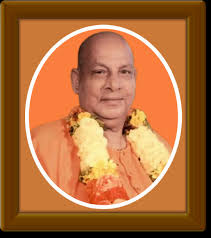
Swami Sivananda Framed portrait of Swami Sivananda imge
Karma Yoga, Swami Sivananda

Karma

Karma Sri R. Krishnaswami Aiyer, M.A., B.L., writes about Karma in the Hindu Mind dated October, 1935: a. Karmas Classified Karmas are good, bad or mixed. The results of good Karmas are: 1. Purification of the mind, that is to say, the removal from the mind of its drossness which is the effect of thoughts of narrow selfishness and gross sensuality. 2. Happiness in the higher regions, during the period between the death and rebirth in this physical world. If the Karma is of an exceptional nature, the thinker may even be made an office-bearer with an authority in such higher regions. 3. Coming back, as man again, to earth-life with facilities for further purification of mind. If the Karma, however, is done without attachment to its fruits and the thinker has been going along the path of Jnana (knowledge) or along the higher regions of the path of Bhakti (devotion to the supreme universal Soul) having his mind completely purified and possessing faith in the revealed truth that he and the Divine Object of his devotion are in fact one in the self, he is not bound to return again to earth-life. The results of bad Karmas are: 1. The mind becomes more and more impure. 2. Suffering in the nether region or hell during the period between the death and rebirth here. 3. If the Karma is very bad, after suffering in the nether region, the thinker is made to take his birth in this world in the lower animal or vegetable kingdom as part of his punishment. In some cases these lower births immediately follow the previous earth-life. 4. After undergoing his sufferings in hell or as a sub-human Jiva, the thinker comes again to assume a human body. He is then placed amidst very unfavourable environments to his progress onwards. These bad environments or impediments to advancement are in consequence of his own previous errors and misdoings. Mixed Karmas are partly bad and its results are: 1. The mind becomes pure in certain respects and more impure in certain others. 2. The thinker suffers for some time in hell, and enjoys for some time in the happy regions above. Afterwards he ordinarily takes birth here again as man.

Karma Read Post »

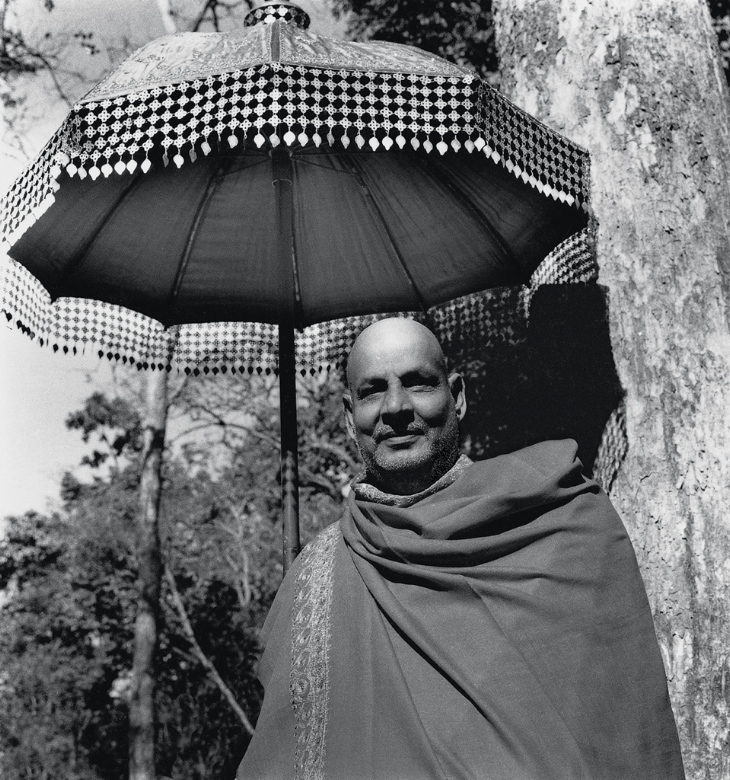
Swami Sivananda standing under decorative umbrella photo
Raja Yoga, Swami Sivananda

Mind And Food

Mind And Food by Swami Sivananda “Aharasuddhau SattvasuddhihSattvasuddhau Dhruva SmritihSmritilabhe Sarvagrantheenam Vipramokshah.” “When the food is pure, the whole nature becomes pure; when the nature becomes pure, the memory becomes firm; and when a man is in possession of a firm memory, all the ties are severed.” (Chhandogya Upanishad, VII-xxvi-2) Mind is Made of Food Mind is manufactured out of the food that we take. Subtlest part of food reaches upward to the heart and thence entering the arteries called the ‘Hita’, and thereby bringing into existence the aggregate of the organs of speech and being changed into the form of the mind, it increases the mind. And thus, the mind, being increased by food, is material and not eternal as held by the Vaiseshikas. The Upanishadic philosophers believed that the mind depends upon the food for its formation. “The food that we take is transformed in three different ways: the gross or the heaviest part of it becomes the excrement; that of medium density is transformed into flesh and the finest part goes to form the mind.” (Chhandogya Upanishad, VI-v-1) “Just as in the churning of curd, its fine particles rise up and are transformed into butter, so when food is consumed, the subtlest part rises up and is transformed into mind.” (Chhandogya Upanishad, VI-vi-1 & 2). Later, even in the days of the Bhagavad-Gita, we find that the three different mental temperaments-the Sattvic, the Rajasic and the Tamasic-were supposed to be due to the three different kinds of food what we eat. (Bhagavad-Gita, XVII-8 & 10). Quality of Mind depends upon Quality of Food Food has a direct and intimate connection with the mind and plays a vital part in the make-up of the mind. Sattvic diet calms the mind. Rajasic diet excites the mind. Mark the difference in nature between a tiger which lives on flesh and a cow which lives on grass. Food exercises important influence on the mind. You see it clearly every day. It is very difficult to control the mind after a heavy, sumptuous, indigestible, rice meal. The mind runs, wanders and jumps like a monkey all the time. Alcohol causes tremendous excitement in the mind. Food plays an important role in meditation. For purposes of meditation, the food must be light, Sattvic and nutritious. The body is Annamaya (made up of food). Bhairavi Chakra is in Annamaya Kosha. Bhairavi Chakra is Maya. Light Sattvic food, such as fruits, milk, etc., takes you to Vishnu Chakra and thence to Nirvikalpa state quite easily. When the quality of the mind depends upon the quality of the food taken, it is natural to insist in the interest of the highest morality upon a kind of Sattvic regimen of diet for those aspirants who lead a contemplative life and householders who are attempting to lead a spiritual life in the world. It was because Narada had his impurity destroyed that the venerable Sanatkumara pointed out to him the way beyond darkness. The way which leads up beyond darkness, therefore, must be sought for in the purity of food, which involves in its train, the purity of mind. Harmful Foods Different foods produce different effects in different compartments of the brain. Spiced dishes, sour things, black gram, onions, garlic, tea, wine, fish, meat, mustard oil, etc., excite passions and emotions and should, therefore, be avoided. They should be particularly avoided by a Sadhaka. A Jijnasu (spiritual aspirant) should strictly give up meat, fish and alcoholic drinks as these make the mind coarse and produce excitement in the mind. Heavy food brings Tandri (drowsiness) and Alasya (laziness). Tea should be given up. It destroys Virya. Sugar must be taken in moderation. It is better if it is given up. Food items helpful in Meditation Milk, fruits, almonds, sugar-candy, butter, green oats, Bengal oats (Chenai) soaked in water overnight, bread, etc., are all helpful in meditation. Thed, a kind of Kandamula found in abundance in Brahmapuri, Vasishtha Guha and other parts of the Himalayas, is very Sattvic. It helps meditation. My friend and spiritual brother Swami Purushottamanandaji used to live on that for some days when he was at Vasishtha Guha, fourteen miles from the reputed Rishikesh. Sunthi-Sevana (taking powder of dried ginger) is very good for aspirants. It can be taken along with milk. It refreshes the mind and helps digestion. Yogins take it very often. Triphala water also is taken by Yogins. It removes constipation, cools the system and stops wet-dreams. Myrobalan or Haritaki (Harad of the yellow kind) can be chewed by Yogic practitioners very often. It preserves semen and checks nocturnal discharges. Potatoes boiled without salt or roasted in fire are very good. A Note of Caution Evolution is better than revolution. Do not make sudden changes in anything, particularly in food. Let the change be gradual. The system should accommodate it without any hitch. Natura non facil saltum (nature never moves by leaps). A Raja Yogin who wants to control the mind must be able to avoid the two extremes, viz., luxury and severe Tamasic Tapas. Too much fasting brings about extreme weakness. You cannot do any Sadhana. You cannot think. You cannot ratiocinate. Take any food that suits you. Do not make much fuss about it. Any food that is readily available and that agrees with your system is harmless. When Food can be Dispensed With Food is only a mass of energy. Water supplies energy to the body. Air also furnishes energy. You can live without food for very many days, but you cannot live without air even for some minutes. Oxygen is even more important. What is wanted to support the body is energy. If you can supply the energy from any other source, you can dispense with food entirely. Yogins keep up the body without food by drinking nectar. This nectar flows through a hole in the palate. It dribbles and nourishes the body. A Jnani can draw energy directly from his pure, irresistible will and support the body

Mind And Food Read Post »

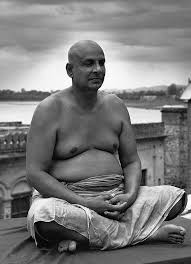
Swami Sivananda sitting cross-legged outdoors picture
Raja Yoga, Swami Sivananda

Mind, Prana And Kundalini

Mind, Prana And Kundalini by Swami Sivananda Prana-the Outer Coat Of Mind There are two principal Tattvas in the universe, viz., mind and Prana. Wherever there is Prana, there is mind also. Even in the external movement of breath beyond the nose, the mind is mixed with the external breath. Prana (energy) is the outer overcoat for the mind. Prana digests the food, turns it into chyle and blood and sends it to the brain and mind. The mind is then able to think and do Brahma-Vichara (enquiry into Brahman). The life of the mind is kept up through the vibration of the subtle psychic Prana which gives rise to the formation of thought. Prana is gross. Mind is subtle. Mind is formed out of the conglomerate Sattvic essence of the five Tanmatras; whereas, Prana is formed out of the sum total of Rajasic essence of the five Tanmatras. That is the reason why mind is more Sukshma than the Prana. The Pranamaya Kosha (vital sheath) is more subtle than the physical body. It overlaps the Annamaya Kosha (physical sheath) and is more extensive than it. Manomaya Kosha is more subtle than the Pranamaya Kosha and more extensive than the vital sheath. You have to touch the body of another man to have a physical influence over him. Whereas you can stand at a distance and by mere ‘passes’you can impart your Prana to him; because, Prana (vital) is more subtle than the body. You can influence a man mentally through thought even though he lives a thousand miles away from you, because mental force is more subtle than Prana. Inter-Dependence Of Mind And Prana Prana and mind stand to one another in the relationship of the supporter and the supported. Both these are only like the flower and its odour or a sesamum seed and the oil in it. If either of them is slain, then the other also will cease to exist. If the mind and Prana cease to exist, then thoughts will not arise at all. The destruction of both will confer Moksha on all. Ekagrata (one-pointedness) and Nirodha (controlled state) are two Avasthas of the mind. Spanda (subtle or Sukshma) and Nirodha are two Avasthas of the Prana. When the mind becomes one-pointed, Spanda Avastha of the Prana comes by itself. If the mind is purified with true Sattva Guna, the Prana will be distributed freely throughout the body. The food will be digested thoroughly. Mind, Prana And Virya Mind, Prana and Virya (semen) are under one Sambandha (connection). If you can control any one of these three, the other two are controlled by themselves, quite easily. Hatha Yogins try to control the Prana. Raja Yogins try to control the mind. Jnana Yogins start their Sadhana with Buddhi and will. Benefits Of Pranayama By Pranayama (control of Prana or restraint of breath), you can also increase the mental energy and develop thought-control and thought-culture. This will help concentration and meditation. This will make the mind steady. This will remove Rajas (passion) and Tamas (inertia). This will burn the dross in the mind. By Pranayama, the mind gradually moves from the gross to the subtle. It, therefore, exercises a wholesome check upon sexual irritation. When some evil thought disturbs your mind, at once take to Padmasana or Siddhasana and do Pranayama. The thought will leave you immediately. The Superiority of Prana Over Mind The sight is more internal than speech as the sight generally informs without contradiction. Similarly, the hearing than the sight, as the eye may convey false impressions, e.g., the mother of pearl as silver, but the ear never hears a non-existing sound. Similarly, the ear only exercises its functions with the aid of the mind’s attention and, similarly, the mind depends on the Prana or life. Prana is, therefore, Brahman, the Innermost of all. “Forsooth, mind departed from the body. It returned after a year’s absence and enquired of the organs: ‘How did you survive my separation?’ ‘In the same way’, replied the organs, ‘in which an infant not possessing the power of reflection breathes through the agency of his respiratory organs, speaks through the organ of speech, sees by his eyes, hears by his ears.’ Mind resumed its place. Then did mind say unto Prana, ‘The quality of containing all, which belonged to me, is due to thee. ‘The function of mind belongs to Prana; from Prana or life proceed all.” (Chhandogya Upanishad, V-xiv-15). This parable illustrates the superiority of life (Prana) over mind and other organs. In reality, there was no dispute of any kind. Mind And Kundalini Kundalini, the serpent-like coiled power that lies dormant with 3 coils with the face downwards in the Muladhara Chakra, the basal lotus at the end of the spinal column, is connected with Prana and Prana is connected with the mind. Even a Vedantin (student of the path of Jnana) can get Jnana-Nishtha (superconscious state) only through the awakening of Kundalini Sakti. No superconscious state or Samadhi is possible without the awakening of this primordial energy, whether it is in Raja Yoga, Bhakti Yoga or Jnana Yoga. Kundalini Sakti can only be aroused when the mind is actually free from passions and desires. Sakti-Chalana or Asvani Mudra, Tadana, Pracharana-all help in awakening the Kundalini. Mahabheda helps in taking the Kundalini higher up. When the Kundalini Sakti is awakened, the mind enters, along with Prana and Jiva, the Sushumna and all perceptions are in the mental space (Chidakasa). After Kundalini is awakened, Prana passes upwards through Sushumna or Brahma Nadi within the spinal cord, along with mind and Agni. The Yogin is freed from physical consciousness. You are shut out from the external objective world. As soon as Kundalini is awakened for the first time, a Yogin gets these six kinds of experiences which last for a short time, viz., Ananda (spiritual bliss), Kampana (tremor of various parts of the body), Udbhava (rising above the ground from his Asana), Ghurni (intoxication divine-the body moves in

Mind, Prana And Kundalini Read Post »

Swami Sivananda holding prayer beads seated image
Raja Yoga, Swami Sivananda

The Root of All Evils

The Root of All Evils by Swami Sivananda The erroneous imagination that you are the body is the root of all evils. Through wrong thinking, you identify yourself with the body. Dehadhyasa arises. You are attached to the body. This is Abhimana. Then, Mamata (mineness) arises. You identify yourself with your wife, children, house, etc. It is identification or attachment that brings about bondage, misery and pain. You never wept when millions of Germans died in the war. Why? Because, there was no identification and attachment. But, you weep profusely when your son dies, on account of attachment. The word ‘My’ produces wonderful influence in the mind. Note the difference in effects produced in the mind when you hear the two sentences: ‘Horse is dead’ and ‘My horse is dead.’ Pain Is In Mind Only Pain is evident so long as you connect yourself with the mind. There is no pain in sleep. If there is an inflammatory swelling on your back with throbbing pain, you do not experience any pain at night when you are asleep. Only when the mind is connected with the diseased part through nerves and thinking, you begin to experience pain. There is no pain when the mind is disconnected from the body by the administration of chloroform. During moments of great joy, the severe pain entirely ceases, as the mind is taken away from the body, from the seat of the pain. If you can consciously withdraw the mind from the diseased part by concentrating it on God or any other attractive object, you will not experience any pain even when you are wide awake. If you have a powerful will and strong Titiksha (power of endurance), then also you will not experience any pain. By constant thinking of any trouble or disease, you only augment your pain and suffering. Pain is in mind. Atman or spirit is Anandasvarupa (full of bliss). Conquer The Mind To Control The Body With the majority of mankind, the mind is greatly under the control of the body. Their minds being very little developed, they live on Annamaya Kosha mostly. Develop the Vijnanamaya Kosha and, through Vijnanamaya Kosha (Buddhi), control the Manomaya Kosha (mind). The Vijnanamaya kosha is developed by abstract thinking and reasoning, by systematic meditation, Brahma-Chintana, study of the Upanishads, Yogavasishtha and Brahma Sutras. When you have controlled the mind, you have perfect control over the body. The body is only a shadow of the mind. It is the mould prepared by the mind for its expression. The body becomes your slave when you have conquered the mind.

The Root of All Evils Read Post »

Swami Sivananda teaching disciple with motivational quote image
Karma Yoga, Swami Sivananda

As you Sow so shall you Reap

As you Sow so shall you Reap This world runs on well-established laws. There is no chaos. There is no such thing as accident or chance in life. Events occur in succession or order. There is perfect harmony. The child grows, attains boyhood and adolescence, begets children, decays and dies. The child becomes a father and the father brings forth a child. How is it that a human being is born of a human being, a horse of a horse, a cat of a cat, a dog of a dog, and a monkey of a monkey. A seed sprouts and comes out with leaves, stems, twigs and flowers. It brings forth fruits and seeds in due seasons. A seed from this fruit brings forth a tree like the parent tree. The seed of a mango tree cannot give rise to the growth of a Jambu tree. How is it that only a mango tree comes out of a mango seed, a Jambu tree from the Jambu seed, an apple tree from an apple seed? This is a great mystery indeed. There is some mysterious power that is working behind all these phenomena. That mysterious, all-pervading power or intelligence is God. He who sows paddy reaps paddy. He who sows green gram reaps green gram. He who sows oranges reaps oranges. Man sows the seed to attain what he desires to reap. Even so, man does evil deeds and reaps the fruits of pain. He who does virtuous actions reaps good fruits. One reaps the fruits according to his Karmas or actions. How is it that one man is a king, another is a beggar, one is a genius while another is a fool, one man is very wealthy while another is in want, one is always in good health while another is constantly ailing, one is handsome while another is ugly, one man is wicked while another is a saint, one dies at the age of ten while another dies at the age of ninety? Is this due to heredity? Certainly not. The operating cause is Karma. He who has done Tapas, meditation, had Satsanga with Mahatmas, served saints and devotees and lead a life of purity is born as a Yogi or a saint in this birth. He who had done vicious actions in his previous birth is born as a wicked man. He who had done a lot of charity in his previous birth is born as a king. It is only the theory of Karma that can explain things beautifully and satisfactorily. Lord Krishna says: “Whosoever at the end leaves the body, thinking of any being, to that being only does he go, O son of Kunti, because of his constant thought of that being.” Ch. VIII-6. Avidya (ignorance), Kama (desire), and Karma (selfish action) are the three Granthis or knots which bind a man to the wheel of Samsara. Man first entertains a desire to have a blanket. He says: ‘Winter is very severe now. I desire to get a blanket.’ Then he begins to think where he can get it. He now decides to get it from the local departmental store. He takes the money, proceeds to the store and purchases the blanket. He had desire at first. Then the thought made its appearance. Then there was Karma or action of moving and purchasing. The three things, viz., the desire, the thought and the action always go together. Desire and thought are internal acts. Action is external. If a man entertains good desires, he gets good thoughts and does good actions. If a man cherishes evil desires, he develops evil thoughts and does evil actions. It is the thought that develops the character of a man. If one cultivates thoughts of mercy, love, tolerance, generosity and understanding he exhibits these virtues in his character and behaviour towards others in society. The same rule applied to the sowing of seeds in the soil also applies here. If one sows the virtue of mercy, he reaps a good harvest of mercy. He becomes a merciful man. If one sows cruelty, he reaps a good harvest of cruelty. He does cruel deeds. One can change his habits, thoughts and character by developing good habits and thoughts. It is the thought that moves the body to action. There is thought behind every action. There is desire behind thought. Do not allow the desires to control your thoughts. Do not be carried away easily by all sorts of desires through emotion. When a desire manifests, cogitate, think well. Reason out whether this particular desire towards the particular object will bring maximum happiness and minimum pain. If it is otherwise, reject it ruthlessly. Do not try to fulfil it. You must control desire through thoughts. You must not allow a desire to overrule the thought. You must slowly gain the strength to control a desire. A desire, when controlled, becomes transmuted into will. You will gain will-force. Many people fall a prey to their desires and are tossed about hither and thither helplessly like a straw in the wind. This is a great pity. That man who has gained control over desires and thoughts is really a powerful and happy man. Learn to become wise. Learn to discriminate. Learn to control thoughts and desires. Watch your thoughts carefully. Do not allow any evil thought to enter the gates of the mental factory. Nip it in the bud. Always entertain holy, sublime thoughts and desires. Renounce unholy thoughts and unholy desires. Develop passion for Self-realisation. This one strong and holy desire will annihilate all other worldly desires. Understand well the theory of Karma. Cut the three knots of Avidya and realise Satchidananda. Then you are beyond the operation of the law of Karma. Then you are a Jivanmukta or a liberated sage even while living. This is the highest goal of life. This is your highest duty. All other duties are secondary and self-imposed through Abhimana, ignorance and delusion.

As you Sow so shall you Reap Read Post »

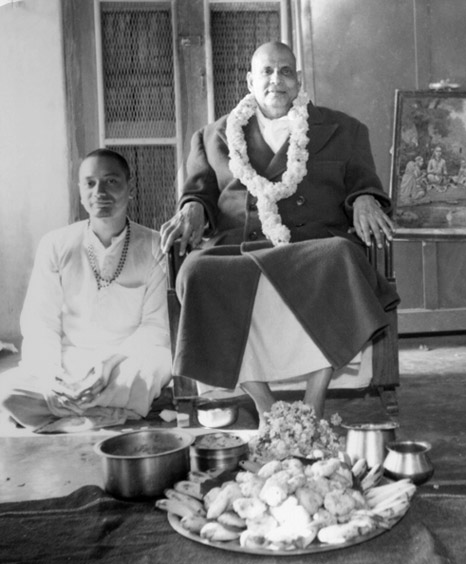
Swami Sivananda seated with disciple and offerings image
Raja Yoga, Swami Sivananda, Uncategorized

Body The Mould for Mind’s Enjoyment

Body The Mould for Mind’s Enjoyment by Swami Sivananda The body with its organs is no other than the mind. The physical body is the outward manifestation of the mind. Mind is the subtle form of this physical body. The mind contemplating upon the body becomes the body itself and then, enmeshed in it, is afflicted by it. All the bodies have their seat in the mind only. Should the mind be paralysed, then the body will not evince our intelligence. Without water, can a garden exist? It is the mind which transacts all business and is the highest of the bodies. Mental actions are the real actions. The mind performs all actions very speedily in the Linga Sarira and fluctuates thereby. But, the gross body knows not anything and is inert. Even should this gross body be dissolved, the mind will assume fresh bodies to its liking very quickly. This physical body is the mould, as it were, made by the mind for its own enjoyment, for its outpouring of its energy and thereby gaining different experiences of this world through the five avenues or channels of knowledge, the five Jnana-Indriyas (organs of knowledge or perception). Thoughts Make The Body The actions of the mind alone are indeed actions; not so much those of the body. The body is really our thoughts, moods, convictions and emotions objectivised, made visible to the naked eyes. It is a point worthy to note with care that every cell in the body suffers or grows, receives a life-impulse or a death-impulse, from every thought that enters the mind, for you tend to grow into the image of that which you think about most. When the mind is turned to a particular thought and dwells on it, a definite vibration of matter is set up and often more of this vibration is caused, the more does it tend to repeat itself to become a habit, to become automatic. The body follows the mind and imitates its changes. If you concentrate your thought, the eyes become fixed. Every change in thought makes a vibration in your mental body and this, when transmitted to the physical body, causes activity in the nervous matter of your brain. This activity in the nervous cells causes many electrical and chemical changes in them. It is thought-activity which causes these changes. Face: An Index Of Mind Mind is the subtle form of this physical body. The physical body is the outward manifestation of the mind. So when the mind is rough, the body is rough too. As a man of rough appearance generally cannot invoke love and mercy of others, so a rough-minded man cannot invoke love and mercy of anybody. Mind very conspicuously reflects on the face its various states which a man of intelligence can very easily read. Face is an index of the mind, just as the tongue is an index of the stomach. The body follows the mind. If the mind thinks of falling from a height, the body prepares itself immediately and shows external signs. Fear, anxiety, grief, cheerfulness, hilarity, anger-all produce their various impressions on the face. The eyes which represent the windows of the soul bespeak of the condition and state of the mind. There is a telegraphic instrument in the eyes to transmit the messages or thoughts of treachery, cunningness, fraud, pure love, compassion, devotion, depression, gloom, hatred, cheerfulness, peace, harmony, health, power, strength and beauty.If you have the faculty to read the eyes of others, you can read the mind at once. You can read the uppermost thought or dominant thought of a man if you are careful to mark the signs in his face, conversation and behaviour. It needs a little pluck, acumen, training, intelligence and experience. Your thoughts, sentiments, modes and emotions produce their strong impressions on the face. The face is like an advertisement board wherein is advertised what is going on inside the mind. In face, you can hardly hide your thoughts. You may foolishly think that you have kept up your thoughts in secret. Thoughts of lust, greed, jealousy, anger, revenge, hatred, etc., at once produce their deep impressions on your face. The face is a faithful recorder and a sensitive registering apparatus to register and record all the thoughts that are running in your mind. The face is a polished mirror to indicate the nature of the mind and its contents at a particular time. He who thinks that he can hide his thoughts is a dunce of the first water. His position is like that of the ostrich which, when chased by the hunters, hides its head underneath the sand and imagines that it cannot be seen by anyone. Your face is like a gramophone record or plate. Whatever you think is at once written on your face. Every vicious thought serves as a chisel or needle to write down the thoughts on your countenance. Your faces are covered with the scars and wounds which are made by the vicious thoughts of hatred, anger, lust, jealousy, revenge, etc. From the nature of the scar in your face, I can at once read your state of mind. I can at once diagnose your disease of the mind. Mutual Influence Between Mind And Body The mind is intimately connected with the body. The mind acts upon the body and the body reacts upon the mind. Mind has influence over the body. A pure, healthy mind means a healthy body. Grief in the mind weakens the body. Body influences the mind also in its turn. If the body is strong and healthy, the mind also becomes healthy and strong. If the body is sick, the mind also becomes sick. A pain in the stomach causes depression in the mind. Bad Thoughts, The Primary Cause Of Disease The primary cause of diseases which afflict the body is bad thoughts. Whatever you hold in your mind will be produced in the physical body. Any ill-feeling or bitterness towards


Body The Mould for Mind’s Enjoyment Read Post »