













Hari Om

Menu

February 13, 2026

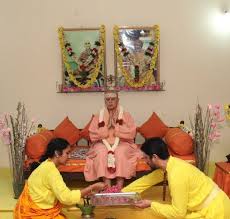
Swami Sivananda seated wearing garland candid photo
Karma Yoga, Swami Sivananda

Three Kinds of Karma

Three Kinds of Karma by Swami Sivananda 1. Sanchita Karmas are accumulated works 2. Prarabdha Karmas are ripe or fructuous actions 3. Kriyamana or Agami Karmas are current works Sanchita are destroyed by Brahma Jnana. One should enjoy the Prarabdha anyhow (Vyavaharika Drishti). Kriyamana are no actions, as the Jnani has Akarta and Sakshi Bhava. Tarash, the case in which arrows are accumulated, represents our Sanchita Karmas; the arrow that is ready for discharging represents our Agami Karmas; and the arrow which has already left the bow, which cannot return, which must hit the target, represents the Prarabdha Karmas. The articles in the store-room represent the Sanchita; the articles that are put in the shop for sale are Prarabdha; the daily sale proceeds are the Agami. There are three kinds of Prarabdha, viz., Iccha Prarabdha, Aniccha Prarabdha, and Paraiccha Prarabdha. There is difference between the Iccha Prarabdha of Vivekins and non-Vivekins. Non-Vivekins think that they are the agents of all actions. They are egoistic. They do mischief to other people. They always do evil actions. They are always full of misery. Vivekins eradicate attachment, desires and egoism. They have no desire for money. They lead a peaceful life and serve others. Aniccha Prarabdha is common to Vivekins and non-Vivekins. Both suffer from the heat of the sun, wind, rain, disease, accidental injury to the head by striking against the door, lightning-stroke, etc. Paraiccha Prarabdha is common to both. One man prostrates before a Vivekin or a non-Vivekin and implores him to render some help or service. He has to undergo the pleasure and pain that accrue from this work. The seed-like subtle impressions of the entire accumulated actions lie dormant in Chittakasa (the mental space). When a great Jnani gets illumination through direct intuitive knowledge, that he is not the five sheaths but transcendental to them and also their witnessing intelligence (Sakshi), the Atman, then the subtle impressions of Sanchita Karma lying in Chittakasa of the Manomaya Kosha remain in the sheath only; they can no longer enchain the liberated Jnani. Just as a potter, having set in motion the wheel by a rod, removes his hand and rod from it, allowing the wheel to revolve till the momentum previously imparted to it is exhausted, in the same way, the Jnani, even after his attainment of Jivanmukti through Self-knowledge, continues enjoying the fruit of his Prarabdha Karma up to the end of the present body. Prarabdha is exhausted by no other means than by enjoying its fruit. Just as the potter’s wheel, after being set in motion continues revolving, even after the connection with the potter is cut off, so also a Jnani continues to enjoy the fruit of his Prarabdha Karma; but they cannot produce the seed of Sanchita Karma on account of his non-attachment or absence of craving for them. The enjoyment of the fruit of Prarabdha Karma falls to his lot by the force of Prarabdha. He has not the least desire for them as he has realised, through Self-knowledge, their impermanent and unreal nature. So their enjoyment does not in any way affect him. The experience of happiness and misery, owing to his non-attachment, is impotent to produce the seeds of Sanchita Karma, as the parched grains are impotent to germinate and produce any crop. Brahma Jnana annihilates Agami Karmas (current works) of a Jnani as he has no contact with them, that is, he is untouched or unaffected by his Karmas, like the lotus leaf which is unaffected by the drops of water on it. The accumulated and current actions of a Jnani take shelter in Brahmanda Prakriti. Those who serve and adore a Jnani acquire his merit of current actions, while those who hate and censure him get the demerit of his current actions. Thus the Jnani gets disentangled from the fetters of all Karmas (Tattva Bodha).

Three Kinds of Karma Read Post »
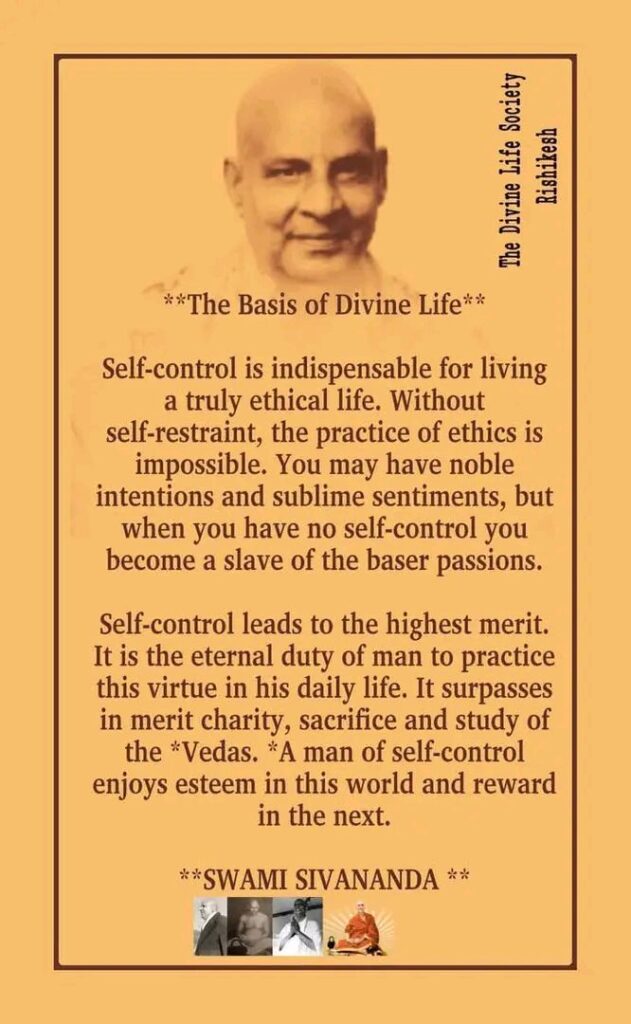
Swami Sivananda self-control quote poster
Karma Yoga, Swami Sivananda

Lawful and Forbidden Actions (Vidhi-Nishedha)

Lawful and Forbidden Actions (Vidhi-Nishedha) Actions are of two kinds: 1. Lawful (Vidhi). 2. Forbidden or prohibitory (Nishedha). Lawful actions are the injunctions of the Sastras. They are beneficial to the performer. “Satyam vada, Dharmam chara-speak the truth, do virtuous actions.” These are lawful actions. They are best calculated to purify the heart of the performer and to prepare his mind for the reception of Brahma Jnana. Forbidden are those actions which are interdicted by the scriptures, such as: “Do not drink liquor. Thou shalt not kill. Thou shalt not steal, etc.” They are harmful. They hurl the doer down to lower births. The lawful actions are of four kinds: 1. Nitya Karmas-daily rites. 2. Naimittika Karmas-occasional rites. 3. Kamya Karmas-optional rites. 4. Prayaschitta Karmas-penances. Morning bath and Sandhya in the three periods of time constitute Nitya Karmas. If you do not perform them daily you incur sin. You are subject to Pratyavaya Dosha (the sin of omission). The rites done during eclipse and Shraddha (ceremony) every year are Naimittika Karmas. Non-performance of these rites brings sin. That man who is struggling to obtain Moksha will not be affected by the harmful effects of leaving the Nitya and Naimittika Karmas. Kamya Karmas are performed with a motive of obtaining definite results. Sacrifices that are done for getting rain, and the offerings to fire for obtaining Svarga, are examples of Kamya Karmas. Prayaschitta is done for the destruction of sin. In the Code of Manu you will find various kinds of Prayaschitta for the destruction of various kinds of sins, such as the murder of a Brahmin, killing of a cow, drinking alcohol or taking forbidden foods, adultery, etc. Prayaschitta is of two kinds, viz., 1. Extraordinary (Asaadharana) and 2. Ordinary (Saadharana). Extraordinary penances are those which are prescribed in the Code of Manu for the destruction of particular sins. Chandrayana Vrata, Krichhra Vrata and various other kinds such as carrying a skull in the hand and living on alms after renouncing all property, living underneath a tree, long pilgrimage till the end of one’s life, and openly admitting before the public one’s crime, are prescribed. If anyone repents and openly admits his minor offences, the sin is washed away. In doing Prayaschitta the offender actually suffers, he punishes himself by long fasting and other ordeals as described above. Action and reaction are equal and opposite. Complete fasting on Ekadasi and Pradosha days destroys many sins. Every one of you should practise this. Bathing in the Ganga, Japa and ordinary pilgrimage constitute ordinary Prayaschitta for the destruction of small sins. A full-blown Jnani is above Vidhi and Nishedha. He can do anything he likes. He can kill thousands of Brahmins and millions of people. The Gita says: “He who is free from the egoistic notion, whose reason is not affected, though he slays these people, he slayeth not, nor is he bound.” Ch. XVIII-17. This only glorifies the exalted state of the Jnani. He cannot do a single wrong action. He has disciplined himself in the beginning. He has practised Sama and Dama for a long time. Whatever he does will be in strict accordance with the injunctions of the scriptures. A Jnani has no idea of being an actor. He has no Kartru Bhava. He identifies himself with Brahman. He has established himself in his own Svarupa. Karma may have been acquired in many previous births. Actions cause good and bad results. Some actions might have begun to bear fruits and others not. Therefore it is impracticable to consume by enjoyment in one single birth, that portion of the Karma which has not begun to bear fruit. Hence the certainty of subsequent embodied existence on account of the unenjoyed portion of the Karma. The observance of obligatory Karma has not got the power of rendering inoperative good and bad deeds, which have not begun to bear fruit. There is a penalty if you do not perform obligatory Karma. There will be Pratyavaya Dosha (unpleasant consequences). It therefore follows that the observance of obligatory Karma only has the effect of warding off misery, the certain consequence arising from its non-performance, and has not the effect of consuming previous Karma which is yet to bear fruit. Obligatory Karma diminishes the sins stored in previous births. CONDUCT “According as he acts and according as he conducts himself, so will he be.”-Bri. Upanishad. Conduct is the cause of the quality of new birth. The Upanishads declare: “Those whose conduct has been good will quickly attain some good birth, the birth of a Brahmin or a Kshatriya or a Vaishya, when the fruits of their good works have been all exhausted in the Chandraloka or the sphere of the moon. But those whose conduct has been evil will quickly attain an evil birth, the birth of a dog or hog. In some places conduct is spoken of not as Purushartha but as Karmanga. In this case it produces no separate result; what, if considered as Purushartha, it has a special result of its own.

Lawful and Forbidden Actions (Vidhi-Nishedha) Read Post »

ChatGPT Image Feb 13 2026 05 10 27 PM
Raja Yoga, Swami Sivananda

Avidya And Ahankara

Avidya And Ahankara by Swami Sivananda Avidya The mind itself is a creation of Avidya (ignorance). It is a Karya (effect) of Avidya. It is filled with delusion. That is the reason why it deceives and tempts you. It makes you go astray. If you can destroy the cause of the mind, Ajnana, by getting Jnana (knowledge of the Supreme Self), mind is nowhere. It dwindles into an airy nothing. Manonasa (annihilation of mind) takes place when Jnana dawns. Avidya works through Upadhis (attributes, limiting adjuncts). All the special apparatus required by Avidya constitute the Upadhis of the soul. Mind is an Upadhi; Buddhi is an Upadhi and Ahankara also is an Upadhi. The sea of Avidya (ignorance) is in the mind of man. The explanation of the empirical concept must be sought in the nature of our cognitive faculty. Sri Sankara explains Avidya in this way. It is Naisargika; it is innate in our mental faculty. It is Mithyajnananimitta, based on wrong knowledge; and, knowledge is a function of the mind. It is Nityapratyayarupa; it consists in the form of a wrong conception. “All Jivas-human entities-which are really non-existent, are (with all concomitant appearance of birth, death, etc.) mere results of the objectivising tendency of the mind and nothing else.” The whole experience of duality, made up of perceiver and perceived, is pure imagination. There is no Avidya apart from the mind. On destruction of the mind, all is destroyed. The activity of the mind is the cause of all appearance. On account of Avidya or Bhranti (illusion) in the mind, you see the objects, trees, etc., outside and feel as if they are separate from you and real. So long as there is mind, there are all these distinctions of big and small, high and low, superior and inferior, good and bad, etc. The highest Truth is that in which there is no relativity. If you can transcend the mind by constant and profound meditation on Atman, you will be able to attain the Nirdvandva state (a state beyond the pairs of opposites) wherein lies the supreme peace and highest knowledge. There is no Avidya outside the mind. The mind itself is Avidya. Imaginations and Sankalpas are products of Avidya. Ignorance is imbedded in the mind. The mind needs thorough cleansing with Japa, Pranayama, Satsanga, Vichara and Nididhyasana, just as a rusty copper plate needs cleansing with earth, ash, tamarind, powder, etc. Ahankara-how It Develops Atman in conjunction with the Buddhi is Ahankara. The basis of Ahankara is Buddhi. As the Buddhi (Bheda Buddhi) is the cause for this differentiation (this little “I”), Buddhi is the cause or seed for Ahankara. Ahamta and Mamata (‘I’-ness and ‘mine’-ness) are Jivasrishti. It is Jivasrishti that binds a man to the world. Isvarasrishti (God’s creation) helps man in his God-realisation. The seed of mind is Ahankara. Ahankara is development through the thoughts of the mind. As the first thought is the ‘I’ thought and as this ‘I’ thought is at the base of all other thoughts, Ahankara is the seed for the mind. This idea of ‘I’ will bring in its train, the idea of time, space and other potencies. With these environments, the name Jiva accrues to it. Contemporaneously with it, there arise Buddhi, memory, Manas which is the seed of the tree of Sankalpa. When you are a boy, the Ahankara is not very potent. It is like a shadow in a glass. It gets developed and firm-rooted during your adolescence after you marry and entangle yourself in the achievement of various worldly desires. You are fearless in your boyhood. The moment this little ‘I’ becomes stronger in your, side by side, various sorts of fears, various sorts of desires, a host of delusions take firm hold of you. The world appears to you more real, too. The Curse Of Egoism Ahankara is, after all, nothing. But, tremendous is its influence! Maya means Ahankara. Mind is another name for Ahankara. World means Ahankara. The sprout of Ahankara ramifies here and there with its long branches of ‘mine’ and ‘thine’. It is inveterate. Ahankara wants to live in flesh (Abhinivesa or clinging to life), to eat flesh and to embrace flesh. This is pure Ajnana (ignorance) only. Look at Maya’s deception and wholesale swindling! Beware! Awake! Get Jnana. Just as the cloud screens the sun, so also this cloud of Ahankara screens the ‘Jnana Surya’, the Infinite Sun of Knowledge, Brahman. You cannot realise God, if you have the least tinge of egoism, if you have the slightest attachment to name and form, if you have the least tinge of Vasana or if you have the least trace of worldly desire in the mind. How To Eradicate Ahankara The deep roots of Ahankara should be burnt by the fire of knowledge (Jnanagni). Then you will quite easily get the wealth of Moksha. All tribulations, sorrows, miseries and afflictions will terminate now. Control of the Indriyas and Pranayama help to develop the Buddhi (Vikasa of Buddhi). You cannot, all at once, eradicate Ahankara altogether. You can easily give up wife, children, money, anger. But it is extremely difficult to give up Ahankara. Try to minimise it little by little. Remove one anna of Ahankara within three months. Within four years, you will be able to root it out completely. You will have to remove it either by self-sacrifice through Karma Yoga-or self-surrender through Bhakti-or self-denial through Vedantic Atma-Vichara. Through the Sankalpas of Manas, Ahankara is generated. If the modification of the mind which leans to sensual pleasures is destroyed, the Atman, divested of its Ahankara, becomes the unnameable Brahmic Reality. Ahankara is like a thread. It connects or links all the Indriyas on itself. When the thread is broken, all the pearls fall down. Even so, when the thread of Ahankara is broken by ‘Aham Brahma Asmi’ Bhavana or Sakshi Bhava or self-surrender method by taking the Nimitta Bhava (instrument-in-the-hands-of-the-Lord attitude), all the Indriyas will be broken down or destroyed.

Avidya And Ahankara Read Post »

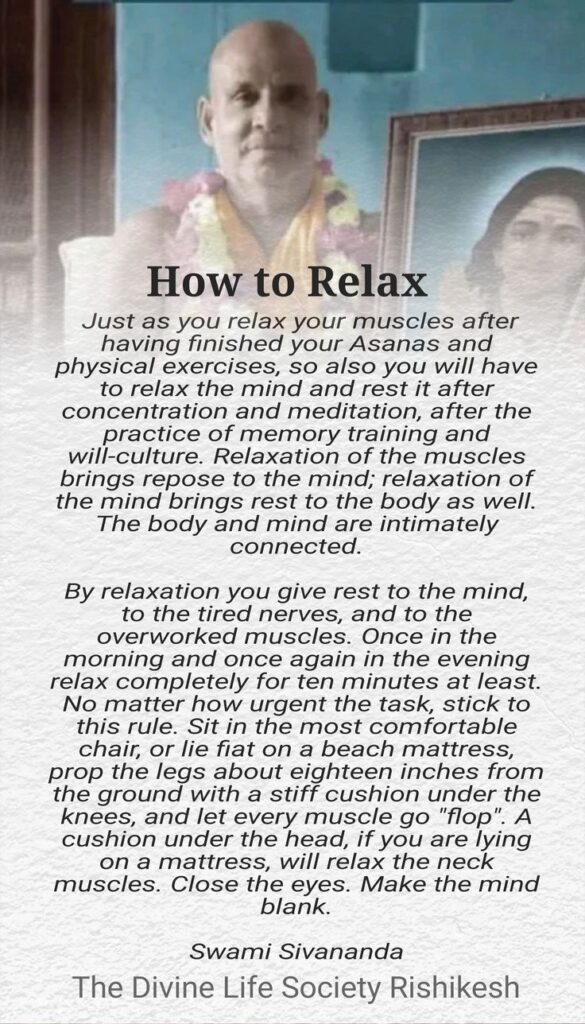
Swami Sivananda relaxation guidance poster image
Karma Yoga, Swami Sivananda

Sin is a Mistake Only

Sin is a Mistake Only The ignorant man only says: “I am a great sinner.” This is a serious mistake. Never for a moment think that you are a sinner. You are the most holy one, you are the ever-pure Atman. Sin cannot touch you. You are above vice and virtue, Dharma and Adharma. Punya and Papa are mental creations only. Sins are mistakes only. An ignorant Jiva commits these mistakes during the course of his journey in this world on account of Avidya or ignorance. Through mistakes he gains experiences and marches forward in his path of spirituality. Every mistake is your best teacher. One has to evolve through sins and mistakes. These mistakes are inevitable. Some people become a prey to thoughts of sin. They ever brood: “We are great sinners. We have committed many crimes.” This is a great blunder. Whenever thoughts of this nature worry you, you should think: ‘I am doing Japa of Om. This will burn all old sinful actions. This will purify my mind. I am doing Tapas, fasting and charity. These are all great purifiers. I am becoming purer and purer. Nothing can affect me now. I am like the effulgent fire. I have become a holy person.’ Assert, whenever such negative thoughts of sin trouble you: ‘I am the Nitya Suddha, ever-pure Atman.’ Hear the words of assurance of Lord Krishna in the Gita: “Even if thou art the most sinful of all sinners, yet shall thou cross over all sin by the raft of wisdom. As the burning fire reduces fuel to ashes, O Arjuna, so doth the fire of wisdom reduce all action to ashes. Verily, there is no purifier in this world like wisdom; he that is perfected in Yoga finds it in the Self in due season.” Ch. IV-36, 37, 38. “Even if the most sinful worships Me with undivided heart, he too must be accounted righteous, for he hath rightly resolved. Speedily he becometh dutiful and goeth to eternal peace. O Kaunteya, know thou for certain that My devotee perisheth never. They who take refuge in Me, O Partha, though of the womb of sin, women, Vaishyas, even Sudras, they also tread the highest path. How much more easily, then, the holy Brahmins and devoted royal saints (attain the goal); having obtained this impermanent and unhappy world, do thou worship Me. Fix thy mind on Me, be devoted to Me, sacrifice unto Me, bow down to Me, having thus united thy whole self in Me, taking Me as the supreme goal, thou shalt come to Me.” Ch. IX-30

Sin is a Mistake Only Read Post »

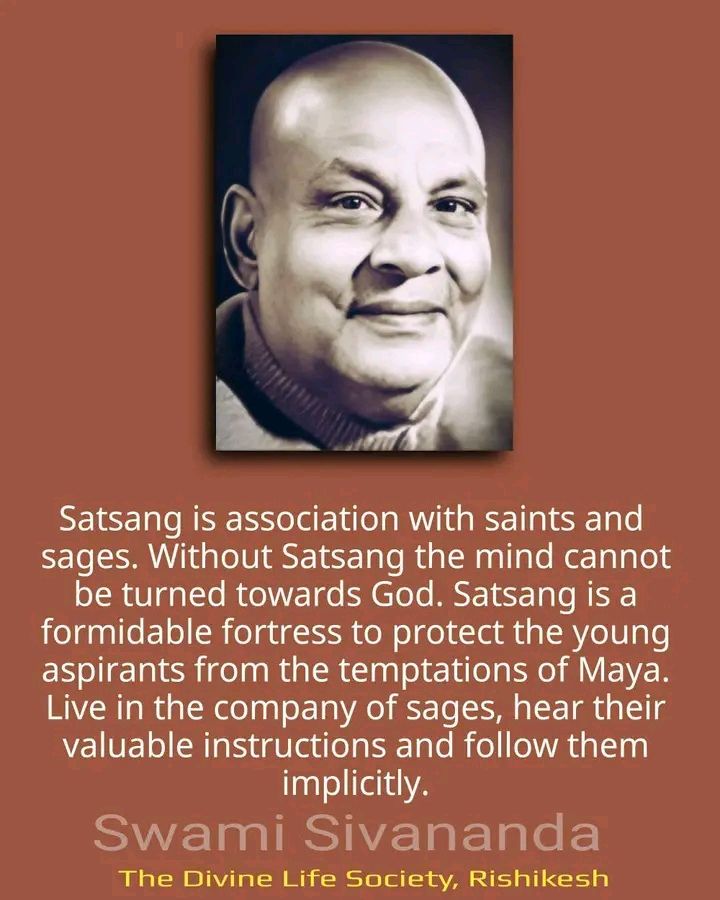
Swami Sivananda satsang quote poster
Swami Sivananda

Reincarnation is quite True

Reincarnation is quite True Man can hardly attain perfection in one life. He has to develop his heart, intellect and hand. He has to mould his character in a perfect manner. He has to develop various virtuous qualities such as mercy, tolerance, love, forgiveness, equal vision, courage, etc. He has to learn many lessons and experiences in this great world-school. Therefore he has to take many lives. Reincarnation is very true. One small life is a part of the long series that stretches behind you and in front of you. It is quite insignificant. One gains a little experience only. He evolves very little. During the course of one life man does many evil actions. He does very few good actions. Very few die as good men. Christians believe that one life determines and settles everything. How could this be? How can the everlasting future of man be made to depend on that one small, little, insignificant life? If in that life he believes in Christ, he will get eternal peace in heaven; if he is an unbeliever in that life, he will get eternal damnation, he will be thrown forever into the lake of fire or into a horrible hell. Is this not the most irrational doctrine? Should he not get his chances for correction and improvement? The doctrine of reincarnation is quite rational. It gives ample chances for man’s rectification, upheaval and gradual evolution.

Reincarnation is quite True Read Post »

ChatGPT Image Feb 13 2026 05 01 40 PM
Raja Yoga, Swami Sivananda

Afflictions of the Mind

Afflictions of the Mind by Swami Sivananda 1. What Are the Afflictions The afflictions are ignorance, egoism, attachment, hatred and clinging to life NOTES All these disorders ruffle the mind like physical malady. Therefore they are great impediments to meditation. They hang upon man and make the qualities firm. They raise Vrittis and bring about fructification of Karmas by coming to depend upon one another for mutual support. If you eradicate Abhinivesa, Raga and Dvesha currents will die. If you remove egoism, these two currents, like and dislike will vanish. The root for egoism, Raga, Dvesha and Abhinivesa is ignorance. If ignorance is destroyed by getting knowledge of Purusha through Samadhi, the other four Klesas will die by themselves. The Karmas are supported by afflictions and the afflictions are supported by Karmas. This is mutual support. This is a Chakrika or cycle like the analogy of the seed and the tree (Bija-Vriksha Nyaya). These Klesas develop the Mahat Tattva, egoism and Tanmatras. These are the five ties that bind a man to the wheel of birth and death. The most important knot is ignorance (Hridaya Granthi). This is the fundamental cause. The other four Klesas are the effects of ignorance. Pain and sin are ignorance only. These manifest in those who have forgotten the true all-blissful and eternally pure nature of Purusha. All the above five kinds of afflictions are dealt with separately in the subsequent Sutras. 2. What Is Avidya Avidya (ignorance) is the field of those that follow, whether they be in a dormant, thinned out, overpowered or expanded condition. NOTES Ignorance is the field or source for the four Klesas, viz., Asmita, Raga, Dvesha and Abhinivesa. These four afflictions are only modifications or varieties of Avidya only. These afflictions have four stages. In Prasupta state, they are hidden or dormant like the tree in the seed. Videhas and Prakritilayas have got this state. In Tanu Avastha, they are in an attenuated condition like a thin thread. Yogins who do practice have got this state. They thin out one evil Vasana by developing the counter-current or contrary good Vasanas. Anger is thinned out by developing mercy, love and forgiveness. In Vicchinna, they are in an overpowered state for the time being. When the husband fights with his wife, the love Vritti in him is for the time being in an overpowered state. The hatred Vritti is operating during the quarrel. As soon as the fight subsides, the love Vritti will manifest again in him when the wife smiles and speaks kind, loving words. In Udhara state, the Klesas are very powerful. They operate with full force. Vicchinna Avastha and Udhara Avastha are present in worldly persons. They bind one to Samsara. He who has Tanu Avastha can control the afflictions. There is another state termed Dagdha Avastha wherein the Klesas are fried out like burnt seeds. This exists in a full-blown Yogi who is established in Asamprajnata Samadhi. 3. Avidya Explained Ignorance is taking the non-eternal impure, painful, and not-self as the eternal, pure, happy and the Self or Atman. NOTES Ignorance causes Vipareetha Bhavana (perverted understanding), and the man is rendered blind by passion and various sorts of Raga. He is under intoxication. Ignorance clouds understanding. An ignorant man is a dead man while living. He is a living buried soul, despite his wealth, possession and university knowledge. To take a thing for what is not, is ignorance. It is not a privation of knowledge. It is a Bhava Vastu. It does not mean absence of knowledge. You mistake this perishable body of five elements and various impurities as the pure Self. You think that you are the body only and you have forgotten the real nature of Purusha. This is delusion. This is ignorance. 4. How to Remove Avidya The method for the removal of ignorance is the continuous practice of discrimination. NOTES Discrimination must be undisturbed. It must become habitual. There must not be any break even for a twinkling of an eye. When discrimination operates, you will have complete inner life in Purusha. All the outgoing tendencies of the mind will stop. The Indriyas will be calm. This practice of discrimination is the cause for destroying ignorance, the cause of the junction of Prakriti and Purusha, leading to various experiences. Discrimination remains shaky as long as false knowledge has not been completely removed. 5. What Is Egoism Egoism is the appearance of the identification of the power of consciousness with the power of the instrument of seeing. NOTES Egoism is the identification of the Seer with the power of seeing. Drik, the Seer, is the Purusha. Darsana is the instrument of seeing. The instrument of seeing is Antahkarana. Purusha joins with the Antahkarana and appears as if he is one or blended with the Antahkarana. Purusha has the Abhimana of ‘I’ in the Anatma – Antahkarana. The Antahkarana is mistaken for the sentient Purusha or Atman. This is Asmita. When you get anger, pain, misery, contentment, etc., you associate yourself with the Vrittis and say: I am angry. I am miserable. I am happy. When the Atman is associated with the Antahkarana, the experiences of objects take place. Separate yourself from the Vrittis and the Antahkarana and stand aloof as the witness in your original all-blissful nature. This is Kaivalya. The means for destroying this egoism is given in Sutra II-10. 6. What Is Raga Attachment is the attraction to pleasure. NOTES Through the memory of pleasure enjoyed previously, the attachment or desire that arises towards pleasure or the means of pleasure (Sukha Sadhana, i.e., objects) is Raga. The desire for ‘thinking on pleasure’ (Sukha Chintana), is included under Raga. Egoism is the root cause for Raga. This is the reason why Raga is described after egoism. When pleasure is remembered, attachment is proceeded by the remembrance of the pleasure in consequence of the enjoyment thereof. Wherever there is pleasure, there is Raga side by side. Why are you very much attached to

Afflictions of the Mind Read Post »

Swami Sivananda feet Devotee bowing image
Karma Yoga, Swami Sivananda

Doctrine of Reincarnation

Doctrine of Reincarnation The doctrine of reincarnation is accepted by the majority of mankind of the present day. It has been held as true by the mightiest Eastern nations. The ancient civilisation of Egypt was built upon this doctrine, and it was handed over to Pythagoras, Empedocles, Plato, Virgil and Ovid who scattered it through Greece and Italy. It is the keynote of Plato’s philosophy when he says that all knowledge is reminiscence. It was wholly adopted by the Neo-Platonists like Plotinus and Proclas. The hundreds of millions of Hindus, Buddhists and Jains have made this doctrine the foundation of their philosophy, religion, government and social institutions. It was a cardinal point in the religion of the Persian Unagi. The doctrine of metempsychosis was an essential principle of the Druid faith and was impressed upon the Celts, the Gauls and the Britons. Among the Arab philosophers it was a favourite idea. The rights and ceremonies of the Romans, Druids and Hebrews expressed this faith forcibly. The Jews adopted it after the Babylonian captivity. John the Baptist was to them a second Elijah. Jesus was thought to be a reappearance of John the Baptist or one of the old prophets. The Roman Catholic purgatory seems to be a makeshift, contrived to take its place. Philosophers like Kant, Schelling and Schopenhauer have upheld this doctrine. Theologians like Julius Muller, Dorner and Edward Beecher have maintained it. And today it reigns over the Burmese, Siamese, Chinese, Japanese, Tartar, Tibetan, East Indian and Ceylonese including at least 750 millions of mankind or nearly two thirds of the human race. Is it not wonderful than that this great and grand philosophical education which the Hindus, Buddhists and Jains gave to the world centuries and centuries before the Christian era should or could be blotted out of existence from the Western and European world by the soul-blighting and absurd dogmas of the dark ages that supervened? By the persecution of the wise men and destruction of innumerable works in the library of Constantinople, the Church hierarchy managed to plunge the whole of Europe into mental darkness which has given the world the black record of the inquisition and the loss of millions of human lives through religious wars and persecutions. Here is a challenge to the non-believers of the Hindu theory of transmigration. Recently a little girl Santi Devi gave a vivid description of her past lives in Delhi. There was a great sensation in Delhi and Muttra, nay, throughout the United Provinces. There was a great assembly of persons to hear her statements. She recognised her husband and child of her previous birth who are living in Muttra. She pointed out the place where money was kept, and an old well in the house which is covered now. All her statements were duly verified and corroborated by respectable eye-witnesses. Several cases like this have occurred in Rangoon, Sitapur and various other places. They are quite common now. In such cases the Jiva takes immediate rebirth with the old astral body or Linga Sarira. That is the reason why memory of previous birth comes in. He did not stay in the mental world for a long time to rebuild a new mind and astral body according to his previous experiences of the world. Transmigration made its appearance in the early Christian church. Elijah was reborn as John the Baptist. “Did the blind man sin, or his parents, that he was born blind?” ask the believers in transmitted retribution. There is a period of anxiety immediately after death, when angels contend with demons for the possession of the departing soul on its way to purgatory. Pythagoras and others obtained their belief in metempsychosis from India only. Pythagoras who flourished in the sixth century also taught a doctrine of transmigration; and, curiously enough, prescribed abstinence from the eating of flesh. The suckling of a child and the act of swimming of a duckling-these instinctive acts are proofs of memory which must be the result of their corresponding and inseparable impressions left by the same acts in a previous incarnation, never mind when and where. Every act leaves Samskaras in the Chitta, which causes memory. Memory in its own turn leads to fresh actions and fresh impressions. This cycle or Chakrika goes on from eternity like the analogy of the seed and tree. There is no beginning for them, the desire to live being eternal, ‘for them’, i.e., for the desires. Desires have no beginning or end, every being has clinging to this physical life (Abhinivesa). This “will to live” is eternal. Experiences are also without beginning. You cannot think of a time when this feeling of ‘Aham’ or ‘I’ has not existed. This ‘I’ exists continuously without interruption. From this we can very easily infer that there have been previous births for us. Now, could there be fear of death to avoid pain in any being who has only been born, if he has had no experience of liability to death, it being understood that desire to avoid anything is only caused by remembrance suffered in consequence thereof? Nothing which is inherent in anything stands in need of a cause. How could it be that a child, who has not experienced this liability to death in the present life, should, as he is falling down from the mother’s lap, begin to tremble and hold with his hands tightly the necklace hanging on her breast? How is it that such a child should experience the fear of death, which can only be caused by the memory of the pain consequent upon aversion to death, whose existence is conferred by the trembling of the child? We have boy-geniuses. A boy of five becomes an expert on the piano or violin. Sri Jnanadev wrote his commentary “Jnaneshwari” on the Gita when he was fourteen years old. There have been boy-mathematicians. There was the boy-Bhagavatar in Madras who conducted Kathas when he was eight years old. How could you explain these

Doctrine of Reincarnation Read Post »

swami sivananda Illustration of spiritual saint seated with Om symbol
Karma Yoga, Swami Sivananda

True Evolution

True Evolution What then is true evolution? It is, as once before stated, the progress of the thinker in man from his present condition of limitedness to the state of the unlimited Self. Progress of the thinker means improvement and growth of mind through which he thinks. In the physical plane, all vegetable and animal bodies develop out of the life-germ, the unit cell. The embryonic cell sometimes divides itself into two or more cells and sometimes, as in the case of the lower forms of life, becomes associated with new cells drawn from outside. In any case, development of the embryo implies multiplication of the cells. Mere multiplication of the cells again cannot make a living body. Along with it, there is also the widening or expansion of the life within so as to control all the cells together. Similarly, a man’s mind is said to grow or expand when his thoughts extend beyond his physical body and beyond his limited personality. As the original unit cell is the earliest and lowest state of the physical body, thoughts of one’s own interests alone belong to the lowest stage of the mind. The mind grows when the interests of others are also considered, as the physical body grows up packing together more cells. As there is connecting life for all the cells together, selfless thoughts or thoughts of others’ interests should be bound up together by a connecting and unifying knowledge that all are only the Self. The end of the evolution of the thinker is reached when the evolving mental life becomes, by expansion, identical with the all-including life, the universal Self. If, however, his thoughts and actions are directed exclusively towards personal and selfish ends, his mind contracts more and more and recedes still further from the path of evolution. He should therefore think only such thoughts and do only such actions as may widen his mind and raise him up in evolution. The mind has to expand and expand until the limiting mind-covering, becoming very thin, is torn asunder when, the limitations of the thinker ceasing to exist any longer, his inner Self shines in his infinitude of existence, consciousness and bliss, for it was only he, the only one and the real Self that was appearing till then as enclosed in a covering made of mindstuff.

True Evolution Read Post »

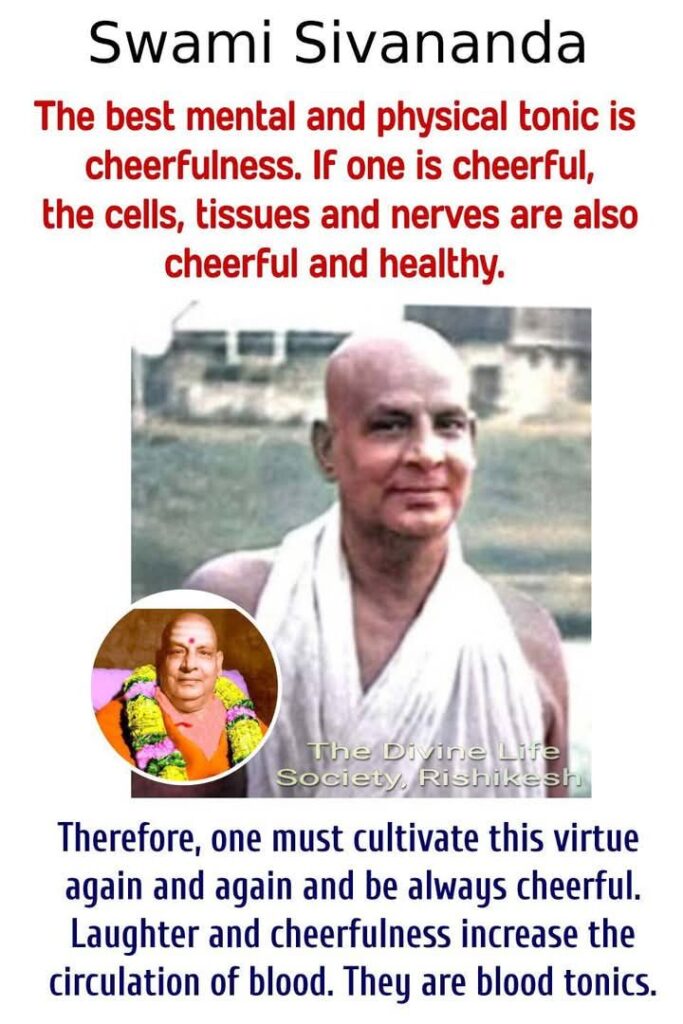
Swami Sivananda cheerfulness quote with portrait image
Raja Yoga, Swami Sivananda

Mind, World Inner Discipline and Spiritual Progress

Mind, World Inner Discipline and Spiritual Progress by Swami Sivananda I. MIND AND THE WORLD The body is the root of the tree of Samsara or the earthly existence. There was not pot in the beginning and there will not be any at the end. But if you see the pot in the middle, then your attitude towards it should be detached i.e., you should not believe in its permanence. So also, there was no body in the beginning, and there will be none at the end. But that which exists in the middle and not in the beginning or at the end, should not cause bondage to you, i.e., you should not get attached to it. Identification with the body is the cause for pleasure and pain. Where there is pleasure, pain is present in the background. The characteristics of the body, senses, vital force, mind and intellect are superimposed on the pure Atman, which, in reality you are. You labour under the false notion, – I am the doer, I am the enjoyer, I am the sufferer in relation to your body, mind and senses, and thereby come to grief. The senses are the avenues for sense-knowledge. They are the gateways of perception for the mind. The mind works always in conjunction with the five senses. It is drawn out by the five senses to the external objects, and thus the world is perceived. Mind generates endless thoughts in relation to its perception through the senses, and the world comes into being. Thoughts and names and forms are inseparable. If thought ceases, the world also ceases. Perception gives stimulation to thought. The nature of the mind being extrovert. It tries to derive pleasure through stimulation of thoughts which are effected by the contact of the senses with the objects. Not being satisfied with one object, the mind jumps from one to another, because no object can give continued satisfaction, and therefore they have to be changed constantly. Thus the mind is restless. In a restless mind, no true knowledge, which is extra sensory supra-mundane, can dawn. Therefore, the necessity of the control of thought, and then its annihilation. Then intuition dawns, which is beyond the means of thought. Acquire mastery over the mind. Make it your servant. Allow it not to become your master. Practise Yoga. Discipline the senses and control the mind. Open the portals of intuition and let divine knowledge flood over the mind. Be bold. Be courageous. Be manly. Yield not to temptation. Be not dejected. Stand up. Gird up your loins, achieve victory over the mind. The external world cannot affect you if you have mastery over the mind. The impressions of your past actions, tendencies and aptitudes are left in your subconscious in the form of Samskaras. All your past experiences, though lost to your memory, are deeply rooted in the subconscious. These Samskaras, some of which or the most of which may have been acquired in the past birth or births, are revived in the present life. Though external environmental factors mould your propensities, the past Samskaras are not lost. They may acquire a different mode of expression but never lose themselves. The sum total of Samskaras constitutes the mind, together with its various agencies. This mind is a strong wall that stands between the individual soul and the Supreme Soul. The nature of mind is to create distinctions and differences. It separates, divides, limits. It is a storehouse of errors, cravings, doubts, delusions and the primordial ignorance. The lower mind is your real enemy, because it binds you to the Samsara. The higher mind, which is endowed with the faculty of right perception, is your aid in the spiritual path. The lower mind is filled with Rajas and Tamas, or passion and inertia or ignorance. The higher mind is filled with Sattva or purity. The Atman never feels any pleasure or pain. The mind feels the different conditions of life. If it is controlled and well-cultivated and guided in the right groove, then one attains happiness, being not entirely dependent on the external conditions. Equipoise of mind is the ideal sought by all, consciously or unconsciously. II. ANALYSIS OF MIND If the senses of perception are restrained, the mind can be greatly neutralised. For the moment the mind may be restless, not finding the service of the senses, but later on it will quiet down and be amenable to your directives. Intellect should guide and mould the emotions. The higher mind has a large measure of pure intellect which enables right understanding or evolution. Perverted intellect may cause unhealthy emotions, and is often a great obstacle to Self-realisation. Unbridled emotions can bring about a good deal of harm even to spiritual aspirations. Emotionalism is certainly not devotion. Intellect is not Self-luminous. It borrows its light from the Atman. Higher emotions that are well-cultivated and directed in the right grooves, can lead one to God-realisation. Ahamkara or – I-ness is the core of the mental world. Ahamkara denotes identification. Identification causes the generation of Vrittisor modifications. Identification with the Atman helps one to rise above the mundane world. This is the process of Vedanta. The lower impulses are subdued and scorched out by the higher emotions through the process of Yoga. III. INNER DISCIPLINE The senses are the gates. Close the gates of the senses by the practice of Dama and Pratyahara (abstraction). You will have deep concentration. Even if the external senses are controlled, the mind will be dwelling on the sensual objects. Therefore the mind also should be fixed in the lotus of the heart or the point between the two eyebrows (Ajna Chakra). Then the thoughts can be controlled. Develop one-pointedness of mind. Fix your mind on the Lord. If the mind wanders bring it back again and again to the object of meditation. Collect all the dissipated rays of the mind. Gather all thoughts through discrimination, dispassion and concentration. You will be free from wavering or oscillation

Mind, World Inner Discipline and Spiritual Progress Read Post »

images 94
Karma Yoga, Swami Sivananda

Who Evolves

Who Evolves Further, what is the cause of growth or evolution? Why should an entity which was sometime ago in the vegetable stale now appear in an animal body? Is its advancement or promotion to a higher state of being only accidental? If not, in what way did it merit the promotion? Is the vegetable capable of doing any responsible act or Karma for which it is rewarded? If it is itself not capable of doing any, is its ascent in evolution compulsory and due to the act of another agent? If so, does it mean that the fruits of action may go to one who did nothing to merit them? Among the lower animals themselves one is found happier throughout its life-span, from the moment of its birth, than another? Why should it be so? The differences in the animal’s experience of pain and pleasure must have their own causes. What are they? The causes must relate to the previous existence of every such Jiva in question. This previous life could not have been that of a lower animal, for lower animals can do no responsible Karma. The law of Karma and justice, if it is true at all, shows unmistakably that there is no real foundation for the notion that there is evolution going on below the stage of man. Every brute, every little insect and every one of the plants and trees, all were, and are going to be again human beings themselves. They are all temporarily only suspended from the class of humanity for some offences. It may be asked, if all non-human states of being are only the results of the previous human Karma, in the beginning stage of the universe, there must have been only men and nothing else; is there any authority to show that there was a time when there were men alone and that the non-human states of being appeared only later on? The question assumes that there was a beginning for the universe. It may be that every Kalpa or Cycle of the universe has a beginning; but at the beginning of a Kalpa the universe takes the appearance in the condition in which it was just before the Pralaya or dissolution that preceded the Kalpa in question. The universe, with this alternate existence of Kalpa and Pralaya has had no beginning at all. None can say that there was a beginning for the existence of the power of Maya in the Self. As there was no beginning for the universe, there could not have been any period of time when there were men alone. At all times there have been human as well as non-human states of being in the manifested universe.

Who Evolves Read Post »