Hari Om

Menu

January 23, 2026

Shri Sathya Sai Baba blessing devotees gathering picture
Divine Tales - Filling the Heart with Bliss, The Divine Master Guides Mankind - Bhagavan Sri Sathya Sai Baba Guides

The Woodcutter’s Delusion

The Woodcutter’s Delusion This is a story that Bhagavan Baba has narrated to illustrate how we have ignored spiritual teachings while leading a mundane life.  A king was out hunting in the forest. Pursuing deer, he went too far and left his retinue behind. He lost his way and was overcome by hunger and thirst. At last he saw a tiny hut in which lived a poor woodcutter and his wife. The wood-cutter eked out a livelihood by selling fuel in distant villages. Their larder was almost empty, but the wife managed to find a piece of bread, which the king ate avidly. He had never tasted any-thing so good, as he had never been as hungry as he was then. He went to sleep at noon and slept soundly, for he had never been as tired as he was then. By that time the courtiers and soldiers had tracked the king to the hut, and the woodcutter was astounded to learn that his guest was the monarch of the realm. He apologized profusely for the poor fare he had offered, although the king had never uttered a word of complaint. The next day when men came from the capitol to take him to court, the poor fellow was certain that he was going to be punished for insulting the ruler. His wife accompanied him, for she felt that she should share the misery of her husband. Upon their arrival at the court, the king provided a seat for the woodcutter and insisted that he sit. The poor man was sure that this was an honor reserved for animals to be sacrificed. He and his wife were fed well, also an honor usually given to sacrificial animals. Then the king asked him what boon he would like from him. The terrified man could only ask, ‘Please let me go home with my wife, and do not cut off my head.’ The king answered, ‘I am not such an ungrateful wretch that I would treat you so cruelly. If I give you an estate, you will only ruin it. You do not understand agriculture. If I give you riches, thieves will only steal them, as you live alone in the jungle. So I shall give you a 30-acre sandalwood plantation in that forest. Make good use of it and prosper.’ The woodcutter was very relieved, and he and his wife returned to the forest. About six months later, the king went hunting in the forest again, and he went in search of the woodcutter. He found him quite happy, for, as he told the king, he was now selling charcoal for fuel. The sandalwood trees were being reduced to charcoal by the woodcutter because he did not know the value of the gift he had received. He frittered them away for temporary and trivial benefits. That is the tragedy of man everywhere. Bhagavan says that, “The ancient wisdom, reflected in the moral laws of all religions, has laid down rules and regulations for the best possible utilization of human life. But for lack of teaching, exposition and example, they have been neglected. This neglect of the rules is like inflicting injuries on oneself… Reform the body, reconstruct the mind, and regulate the way of living. Dedicate all tasks as offerings to the Lord.”

The Woodcutter’s Delusion Read Post »

Shri Sathya Sai Baba righteousness
Divine Tales - Filling the Heart with Bliss, The Divine Master Guides Mankind - Bhagavan Sri Sathya Sai Baba Guides

How to Use the Avatar

How to Use the Avatar The way in which the Avatar has to be used for one’s liberation and uplift is: watch His every step, observe His actions and activities, follow the guiding principles of which His life is an elaboration. Mark His love, His compassion, His wisdom, and try to bring them into your own life. Man has become artificial, crooked, twisted out of his normal shape. He has left behind the simple natural ways and made his mind a lumber room for ideas, worries, anxieties, and terrors. He can live on very much less, with much greater joy for himself and others. If only he remembers that he is a treasure-chest with the Divine spark in it, he will be more loving and more useful. God incarnates for the revival of dharma (righteousness), which includes morality, truth, virtue, love, and a host of other qualities that uphold the communities of man as well as the individual. The other purposes usually given, such as serving the devoted, destroying the wicked, re-establishing the sacred tradition—these are all secondary. For, he who is righteous will be guarded from harm by righteousness itself; he who is unrighteous will fall into disaster through the evil that he perpetrates. The one task includes all else. ~Baba

How to Use the Avatar Read Post »

Shri Sathya Sai Baba Meditation Peaceful Image
Srimad Bhagavad Gita - The Song Divine

Gita: The Song of Life – Introduction

Gita: The Song of Life – Introduction Sai Sarathi, from this issue onward, is pleased to present the serialized poem, The Song of Life, composed by Sri N. Kasturi in the last years of his life. He also wrote Sathyam Sivam Sundaram, the biography of Bhagavan Sri Sathya Sai Baba. Permission to publish the poem in its entirety has been granted by Rasmeesh and Ananda Kasturi the grandson and daughter-in-law of Sri N. Kasturi. The Song of Life is published by Heart to Heart Publishing, Bangalore, India. One day, when Kasturiji was about 82 years old, his closest friend and spiritual guide of 3½ decades, Sri Sathya Sai Baba, asked, “Kasturi, what are you writing these days?” Kasturi smiled and answered, “I am writing the Gita.” “Wonderful,” answered Baba. “I am delighted. But I have one suggestion. You have written numerous books, but all are for adults. This time let the book be for children. As it is, very few writers have tried to comment on the Gita for the benefit of young people. Write it as a poem and keep it as simple as possible.” “Okay, Baba, I will do as you say. I can see that it will not be easy, but I will do my best,” agreed Kasturi. The very first line of the poem starts with the battlefield of Kurukshetra. Armies of both the Kauravas and the Pandavas are facing each other, warriors blowing their conches, eager to fight. Arjuna wants to see the whole scene. Krishna, as his charioteer, drives the vehicle to a spot in the middle of the field. Arjuna sees his gurus, uncles, and nephews on both sides. Despondency grips him. His bow slips from his hands. He refuses to fight asking why? Krishna smiles, tells him that the sense of ‘I, Me, and Mine’ clouds his vision. “Don’t turn back, act your part—leave the rest to me.” “Easier said than done,” says Arjuna. “Remember Arjuna, I am the doer, you are the instrument,” says Krishna. Arjuna asks, “Shall I then be a doll or a dummy? Why ask me to lift my bow? Why not do it yourself.” “No,” says Krishna, “you are my arm. No one escapes work because you and I are one and the universe moves if we do our parts.” Krishna advises, “Say to yourself, He is the doer, I am just an instrument. I am a puppet dancing on the stage. He pulls the strings.” Arjuna pleads, “But the mind wanders like the storm. Can wind be rolled and packed? Can water be sliced and hacked? Do not ask the impossible, Krishna.” “You are a tool Arjuna, but a living tool. You are free to do good or bad, act or not to act. Are you or are you not going to use the power of discrimination given to you?” Krishna explains in simple words. Kasturiji goes on and on in simple, clear, telling words. He tries hard to inform, educate, and entertain the young readers. In fact, The Song of Life is written so beautifully that young and old alike can enjoy it.

Gita: The Song of Life – Introduction Read Post »

Bhagwan Shri Sathya Sai Baba teachings photo.
The Divine Master Guides Mankind - Bhagavan Sri Sathya Sai Baba Guides

An Emperor’s Taste  

An Emperor’s Taste   Bhagavan Baba, in the following short story, shows us the importance of controlling the vagaries of the mind. The Emperor of Delhi, the famous Akbar, was melancholy and depressed. His Empire was prosperous and safe from enemies, both internal and external. The cause of his sadness lay elsewhere. It was the food he ate every day. Of course he had himself shown the preference; the cooks and Birbal, the Superintendent of the imperial kitchen, were not to blame. Nevertheless, he had developed a disgust for meat, for, it was meat, meat, meat—morning, noon, evening, and night. So he called Birbal into his presence, and commanded that the menu be changed soon. The command was obeyed. Birbal racked his brains for a long while and decided on brinjals [eggplant] for a change. He procured baskets of brinjals, fresh and fine. He had chutney salad, soup, cutlets, and sweet, savory, and bitter dishes all prepared from brinjal. Akbar relished every item and praised Birbal to the skies. It was brinjal breakfast, brinjal lunch, brinjal dinner. Thus it went on merrily for a few days—but, for a few days only! Akbar grew disgusted with brinjals, too. He poured all his wrath on Birbal and Birbal had to switch over to something else. For likes and dislikes are but fancies of the moment; the mind wavers, flits from one thing to another. One has to realize this and be steady, adhering to the good and avoiding the injurious. Establish mastery over the mind or the mind will ride you into ruin. The mind is a bundle of desires. Give up desire; the mind disappears. ~Baba

An Emperor’s Taste   Read Post »

Shri Sathya Sai Baba spiritual path image
The Divine Master Guides Mankind - Bhagavan Sri Sathya Sai Baba Guides

Inner Peace

Inner Peace Man’s life affords a holy opportunity, a supremely sublime chance.It is also a great good fortune to be able to receive an education that can help one to realize one’s destiny. Education that does not confer wisdom, wisdom without humility, scholarship without tolerance, music without virtue—are all husks without grain! Discriminative intelligence has to be gained from education; it must be accompanied by humility and tolerance. Tolerance must spread sweetness all around. Sweetness emanates from virtue. Love is the core of every virtue, of every good, of every phenomenon in nature. Love must be sought in and shared with every being and thing. Love is the essence of worship. Love toward God becomes compassion to living beings. All religions prescribe duties that promote purity of the consciousness at all levels. The goal to which every sadhana leads is the mansion of shanti (equanimity undisturbed). Embodiments of love! Let me tell you that inner peace is very hard to acquire and develop. Be unaffected, whatever anyone says, however much anyone harms you, however many obstacles anyone places on your path. Of course, the experience is bound to be bitter at first. But it will turn into nectarine joy in the end. Your forbearance might be construed as cowardice or dullness or weakness. Do not pay heed to these conclusions. For if you react with anger or hatred, vice or vengeance, you are certain to ruin your lives. Shanti is the one indispensable treasure to be gained by spiritual effort. Thyagaraja [poet philosopher] sang, ‘Without shanti, there can be no happiness, either for the skilled or for the scholar.’ Scholars are today stuffing their brains with pride, envy, competition, and other such poisonous attitudes. They do not treasure love and peace. They are acclaimed scholars when they pass certain memory tests, otherwise called question papers handed out at examinations. They do not pass any test dealing with mental qualities that make living happy and peaceful. The inner peace that emanates from a pure consciousness is won by meaningful moral activity; that is the activity to which one has to dedicate all one’s powers and skills. Every activity must be directed toward this end, not in the vain pursuit of sensual pleasures and hollow desires. When the mind revels in such demeaning thoughts and distractions, man degrades himself to the level of demons inspite of having the external appearance of a human being. A stinking pool will not cause as much damage to the neighborhood as a stinking mind can cause to the community. Education is the process by which the mind is purified and made socially beneficent. Nara is the Sanskrit word for a human being. [The syllable]‘ra’ means ‘destruction’ and ‘na’ that qualifies the word ra means, ‘no’. That is to say, nara is the being that ‘does not destroy’ and ‘is not destroyed.’ Nara is the indestructible atma [soul] and so his innate nature revolts against any idea of destruction. When such a nara desires and designs for destruction, how can he be anything other than a demon? The sovereign consciousness enshrined in the destructible sheath (the body) has to be recognized as the spring of one’s life; that is the reason why I have been telling you to ‘Follow the Master, face the devil, fight to the end, and finish the game.’ The degrees that you gather in universities cannot ennoble your life; the education you have received has to be manifested in your activities and in your dealings with others. Then only can you be at peace with yourselves and with society.

Inner Peace Read Post »

Bhagwan Sathya Sai Baba spiritual path
His Glory is Beyond Description - Miracles of Bhagavan Sri Sathya Sai

Man’s Far Journey

Man’s Far Journey At the beginning, and for a long time on the [spiritual] journey, we think that it is happiness that we are seeking. But happiness cannot be courted; it comes unbidden, unexpectedly, while you are occupied with other matters; then when you try to possess and enjoy it, it slips away like a shy nymph. Eventually, we learn that the sure way to be unhappy is to strive directly for happiness. Perhaps that is why men camouflage their objective and pretend that it is money, power, fame, or knowledge for which they are striving. But a little self-analysis would reveal to them that just beneath the surface lies the illusory conviction that some permanent brand of happiness will appear when such things have been acquired. The search for the El Dorado [utopia] of perfect happiness is basic to mankind. Some aspect of– this quest, with the illusions, conflicts and tragedies encountered therein, forms the theme of all the human stories ever written, of all the philosophies that have striven to carve an intellectual path to the goal, and of all the religions that have tried to mark the way with sign posts. Though all mankind is consciously or unconsciously on the journey, they are pilgrims at different levels, with different degrees of understanding and awareness. There are some and their number is growing, who dedicate their lives to the greater quest. These searchers are fully aware that money, power, fame—the ‘lights that glitter’ in the world’s pleasure houses—are not the true goals. They know what they seek, though they may call it by different names—the key to the mysteries, wisdom, self-realization, and God. Where will they search: along the tortuous tracks of the philosophers? Amongst the fallen finger posts and half obliterated signs: of the old religions and into the jungles of their own minds? Along the ancient pathways of yogaand mysticism, or will the great god, modern science that has brought them comfort, yet threatens to devour them, point the way? Should a man, as some of the books say, keep his feet to one path, or may he follow the ‘wandering fires’ wherever they lead, learning what he can until such time as he beats out his own by-road to the goal he seeks to God? It seems that we each must ultimately make our own individual way through the strange country. Yet, we are not alone in the great adventure. As we wander through the deserts and jungles and pleasant pastures, we meet and go a part of the way with fellow pilgrims. And we can communicate a little on matters of importance. Each, though he may not have progressed far, has found something that can be a clue, a pointer providing perhaps some help to other seekers. They are found—these serious pilgrims—scattered throughout the world. Some travel alone, some in groups bearing different names. I myself have found pleasant company among them, learning with them a little of that long pilgrimage on which all life has, for some unknown reason, set its feet. Yet, for the most part, it is the blind leading the blind toward a far off lightthat is sensed rather than seen. How inexplicably fortunate then are we—the few—who have found here in physicalform, one who can say, as Christ said long ago, “I am the way.” And for those who can receive it, this statement soon becomes a self-evident truth. We see in Him—Sai Baba—those qualities that we have always associated with the idea of divinity. We see power wedded to benevolence and lit with glory. We feel a love and compassion that hitherto hadbeen no more than a dream of the heart. When we are in His company we are elevated to a golden world where the atmosphere vibrates with inner joy, and all mundane things are forgotten; or at least they take their true place well down the scale of values. Such is His patience, understanding, and power of assimilation that when He talks to you individually, you feel that you are the one person in the world to Him, that in His mind no one else exists but yourself. What a divine gift of heart penetration that is! And so the way becomes clear before us. It is the bhakti marga [path of devotion], the guru marga [path of the spiritual teacher]; all we have to do is to surrender to Him, our sadguru [true guide], and He will do the rest. ‘All’, did I say, as if it were easy, this self-surrender? Alas, it is far from easy to crucify the obstinate, cunning, deceitful lower self—the proud ego built of desires and attachments. It calls for long days and nights of work and watching. Yet I believe it is undoubtedly the surest and swiftest way to the goal, for in it we have the help of the Lord’s grace, and His silent soul—to soul teaching. We must work, worship, watch, and always remember that it is mainly through His grace that our hearts will be purified as they must be; for as Sri Aurobindo [a yogi] wrote: ‘Only the pure in heart shall walk in light’—that glorious light of the true home at the end of the far journey.  ~Howard MurphetSource: Sanathana Sarathi, March 1969

Man’s Far Journey Read Post »

Shri Sathya Sai Baba spiritual path image
His Glory is Beyond Description - Miracles of Bhagavan Sri Sathya Sai

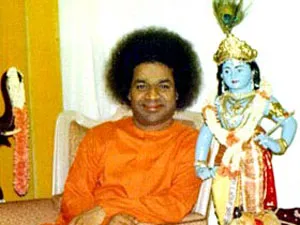
Sai Krishna

Sai Krishna This is a story about Krishna. In a way, however, the story was not completed until November 1975. A number of years ago I was in Bhagavan’s car. He was in the rear seat with two persons, one on each side of Him. I was in the front seat, with the driver. We were on our way to Puttaparthi. Driving in the car with Swami is a fascinating experience. Not only is there the thrill of being close to the Divine Lord Himself but, sometimes He will give you the opportunity to ask questions. Sometimes, He engages in animated conversation in Telugu [Indian language] with the companions. Sometimes, He indulges in jokes with one or other of them. Sometimes, He remains silent making the characteristic gesture with His hand that seems to indicate that He is giving attention to something quite unknown to us. And, very often, He sings bhajans [devotional songs], with everyone in the car joining in the chorus (except me, who has a musical voice akin to the crow). The net result of all this enthralling activity is that my neck is constantly being twisted in order to see what is going on in the back seat. Swami understands my plight, but, does not advise me to desist; He allows me the liberty to turn round. Of course, I do not stare all the time. I look only so long as I dare and then I resume my posture, turning to the front again. So, my looking at Swami is intermittently back and forth. At some point in the journey, maybe about half‑way, Swami was talking and I turned to look. My breathing stopped and I was transfixed! I could not believe my eyes. His devotees see Swami’s face as beautiful indeed, although the chief impression I receive from His feature is that of power and majesty. What transfixed my movement and stopped my breathing was Swami’s face. The Swami I know was not there! Instead, there was a face of the most extraordinary beauty, quite different of shape and cast from the features of our beloved Sai. The charm was so great, so poignant that my heart seemed to twist, almost as though it were in pain. Never in life, nor in photos, nor in painting by great artists have I seen a face of such exquisite beauty. It was beyond imagination and concept, totally out of experience. And His color was blue. Not just blue, not the blue with which artists paint Krishna but, a deep blue, like the velvet blue that sometimes can be seen in a dark sky, like a blue that I haveattimes seen from the deck of a ship thousands of miles from shore on the Pacific Ocean. I do not know how else to describe it. I could not remove my eyes from Swami. At length, I caught myself and turned away. But, at once, I looked again, and the same beauty surely not of the world, was still there. This continued for at least fifteen minutes. The two men sitting with Swami were beginning to look at me with somewhat puzzled expressions for, my staring was different from what they had become used to. After a few miles, Vittala Rao (on Swami’s left) asked me, “Hislop! What were you staring at Swami like that?” Instead of answering, I directed a question to Swami, “Swami! What was that blue color?” Swami replied, “Oh! That? Whenever there is something of unfathomable depth, it appears to be deep blue.” That was the end of the conversation. Naturally the thought had come to mind that maybe this was Lord Krishna, but neither then, nor at any time in connection with this experience did I ever say the name of Krishna to Swami. There the matter rested until November 1975. It was before people started to arrive in multitudes for Swami’s birthday. Swami’s schedule was still somewhat free and He was taking me with Him in the jeep and so on… and probably that was why I got invited into an interview. An army man and his wife had come from Assam [northern part of India]. They were devotees, but this was their first time to actually see Swami. Often people wait for months for an interview but this family was called in as soon as they arrived. I was seated on the verandah of the mandir [temple] and saw them go into Swami’s room. Swami motioned to me to go in also. The family was made up of the mother, father, son, and daughter. Swami spoke to them most lovingly. He knew everything about their lives and it was very evident that He was an intimate member of that household. After a while, Swami asked me, “Hislop! Tell them some experiences.” I complied and after mentioning some incidents, I told the same story just now related in these pages, but, not even then, did I mention the Krishna name. The man was deeply impressed and words broke from his lips, “Oh! That had to be Lord Krishna” Swami smiled and said, “Yes, that was Krishna; not the Krishna pictured by artists and imagined by writers. I showed Hislop the real Krishna.” The man said, “Oh! How I want to see Krishna.” Swami smiled again and said, “Wait; wait.” There is a sequel to this story. About a month later, in December, at Brindavan [in Bangalore], I was talking with Swami and I brought forward the names of some famous saints and gurus of the past and Swami said some things about them. Then the idea struck me that, wonderful though it must have been to know those great personages and learn from them, the present day was the first time since Krishna lived that one could have God Himself as guru. So I started to say, “Swami! In the thousands of years of time, since Krishna….” Swami interrupted me before I could say another word and exclaimed “Time since Krishna…? I am Krishna. Where is time?”I folded my hands and bent low to Him and

Sai Krishna Read Post »

Destiny and Karma
His Glory is Beyond Description - Miracles of Bhagavan Sri Sathya Sai

Sri Sathya Sai—The Shiva

Sri Sathya Sai—The Shiva This is the 10th Birthday of the Sanathana Sarathi. It is the form of the eternal words, the nitya [everlasting] the vibhu [the supreme Lord], of the Sanathana Sarathi [eternal charioteer] who is eternal. He has no beginning, and no end; He has taken a human form as a result of the love he bears us. Bhagavan Sri Krishna says in the Bhagavad-Gita [the eternal song], “Avyakta hi gatirdukham dehavadbhi­ravapyate—for those who are manifest in the form of a body, it is difficult to understand and rea­lize that which is not manifest.” Taking upon Himself all suffering that the body is prone to, He, the formless, has taken form to come to this earth, to His beloved India, the land acclaimed as the guru of the world in the spiritual field. Bhagavan Sri Sathya Sai Baba emphasizes in each of His discourses that we must awaken to our great heritage and be aware of our privileges. He advises us not to run after material success but discriminate between what is ephemeral and what is everlasting. He warns us against identifying the false “I” and the body with the true “I” and the soul. Bhagavan is sathyam-shivam-sundaram—truth-bliss-beauty incarnate. He is bliss, Shivam. Baba is Shiva, the ever auspicious, for He is all love. Who among His devotees—big or small, high or low—has not experienced the very special love, the very special consideration He shows to each? His essence is love, and power is His attribute. Therefore His love is greater than His power [shakti]. On Mahashivaratri day, out of His great love for all His devotees, He manifests His power and demonstrates the most glorious of all miracles, the creation of the linga. “Eating, sleeping, fear, and mating are common to both men and animals,” says the Su­bhashita [Hindu religious text]. How then, are men different from animals? Is it their reasoning faculty or does the instinct overtake his reasoning? For example, when a dog is threatened with a stick, he runs away; was it instinct or was it his mind reasoning that the stick would hit. The real distinguishing mark of a human being is his sense of wonder. Man alone is capable of being in awe and wonder. The Vedic singer was struck by the spectacle of the tropical dawn, and the intense force of lightning and thunder of the torrential rains of the equatorial belt; consequently, he went into raptures and sang aloud in praise of Ushas, Indra, and Varuna [Lords of the elements]. He could not contain himself. But today, our senses are benumbed with the glamour of materialism that infects the objective world. We are complacent and do not appreciate the beauties of nature. Nothing seems to shake us from our stupor. Bhagavan has come to shake us out of this stupor and awaken us to the awe and wonder. While thousands look on, He creates on Mahashivaratri day, the linga, the symbol of creation. The “form” of the “formless,” emanating from the “formless” with “form,” awakens us to this awe and wonder. What a grand spectacle it is! How much grander is its spiritual significance! As Baba says, He manifests His mahimas [glory/greatness] to express the love He bears toward mankind, and to demonstrate His grace and to make them realize who He is. The lesson of the Mahashivaratri miracle is some­thing divine and profound that evades description. Mahashivaratri, the night of Shiva, is supposed to be the darkest night of the year. The moon and the mind have a great affinity, as Baba shows quoting the Shruti, “Chandramaa manaso jaatah,” “Out of the moon, the mind was born.” Therefore, Baba explains that the night of Shiva must be the night when the mind affects us the least, and Shiva affects us most. Those who have no faith in the Shruti might argue that the mind and the moon have nothing to do with each other; but even they have learnt to use the word, “lunatic,” for those whose madness waxes and wanes with the moon. The cosmic forces are too subtle for our gross intelligence to comprehend. All that we have to do is to believe in them and forge ahead. If we have no faith, we have to start the experiments all over again. Yet, we, Bharatiyas [Indians] do neither because we are too engrossed in petty squabbles. When children fight amongst themselves over an insignificant toy, the mother distracts their attention; she does not take the trouble of ending the fight, by trying to judge to whom the toy belongs. That is what Sathya Sai Mata [the divine mother] is doing today for our fortunate country. Differences, disputes, and quarrels permeate this age of political, linguistic, and other ideologies. Those who do not get the opportunity of being selfish in the field of politics indulge in narrow selfishness in the fields of their personal existence. But, Sai Mata is ever vigilant, patient, and persistent for She wants to hold our hands and lead us on to the light. With His loving persistence, everyday and on every occasion, Bhagavan reminds us that we are human beings, much higher than animals. He asks us to awaken from slumber, and realize that the gross world outside is to be given a place lower than the inner world. In His Divine way, He wraps the pill of spiritual training in tasty words so that it is palatable to the minds immersed in the mundane. Mahashivaratri reminds us that by sadhana [spiritual practice] the mind has to be reduced to its minimum. After all, what is this mind? It is our own creation, woven out of the warp and woof of desires. The cherished ideal is “to be” and not “to become.” Desirelessness is the ideal to strive for, and not mere fulfillment of materialistic desires. If we find the effort strenuous, all we have to do is simply to keep faith, and cry for our Sairam, and pray to Him, “Asato ma sat gamaya; Tamso ma jyotir gamaya; Mrtyor Ma amritam gamaya.” (Lead me, Oh Lord, from the unreal to truth, from darkness to light, and from death to immortality). A moment will surely come, when His grace will descend on us and will grant

Sri Sathya Sai—The Shiva Read Post »

Sathya Sai Baba divine message
The Divine Master Guides Mankind - Bhagavan Sri Sathya Sai Baba Guides

Vamsi Kunj

Vamsi Kunj There was an occasion when Krishna laid His flute aside and declared that He would not play on it again. It is a long story, not found in books. I alone must tell you about it, for only the Person who has experienced it can describe it. A bride named Neeraja came to Gokulam as the daughter-in-law of a Gopa family. Her husband and parents-in-law warned her against Krishna and His pranks and threatened her, on pain of dire punishment, to keep away from Him and to avoid Him by every possible means. It was Govardhana puja [prayer to Govardhana Mountain] day, celebrated every year, and all the gopas [cowherd] and gopis [cowherd maids] had to go beyond the village limits to circumambulate and worship the Govardhan Hill. Neeraja, too, went with the others, and in spite of the severest warning she peeped into a crowd of enthusiastic gopis watching the dance of Radha with Krishna in a flower bower near the hill. She was so captivated by the Divine presence that she was no longer the same person. Another day, while on the Yamuna [river] bank, she saw Krishna fashioning a flute from a reed taken out of Vamsi Kunj [garden] and she heard Him play! Oh, it was over-whelmingly ecstatic! It was a call to transcend the material bonds, to free oneself from the shackles of earthly endeavors. Neeraja did not care for anyone now. She became God-mad. In fact, she was the first to hold the reins of Akrura’s chariot when he was taking Krishna away from Gokulam to Mathura and to try to push the vehicle back! Well, she was driven out of her house by the mother-in-law for that. She was an outcast. The whole village rose up against her; she spent her days in the Vamsi Kunj, her whole mind fixed on the Lord whom she had installed there. Years passed; Nanda, Yasoda, and Radha all left the world. Neeraja was now 52 years old. One day she prayed desperately to Krishna, “I can no longer bear this forlorn life. My eyes have gone dry; they have no more tears to keep this love green. My heart, too, is fast turning into a wasteland. Come, O Lord, come and save me, take me unto Yourself.” Krishna heard the prayer. He responded to her yearning and called her by name so sweetly that the very voice filled her with new life. The Vamsi Kunj was fragrant with Divine glory. Krishna came near and took Neeraja’s palm in His Hand. “What do you desire?” asked He. She asked “What is the purpose of life?” Krishna replied, “To merge in God.” “Well, let me merge in You… but before that, before my prema [divine lovr] merges in Yours, let me hear You play on that flute for a short while.” Krishna smiled and gave the excuse that He had not brought His flute. But seeing Neeraja’s yearning, He plucked a reed from the Vamsi Kunj, broke it right and in a trice converted it into a flute. With Neeraja on His lap, Krishna played so melodiously on the flute that the entire Gokula, and indeed even the whole world, was bathed in ecstatic joy. When He stopped, Neeraja had attained final beatitude and was no longer a limited individual gopi separate from Him. Krishna laid aside His flute and said He would not play on it again. This is the story of one gopi; the story of every gopi would be interesting, each in its own way, for they were all so transmuted by the bhakti they bore toward the Lord. The gopis were declared by [sage] Narada in the bhakti sutras [aphorisms on devotion] to be the greatest among the bhaktas [devotees].

Vamsi Kunj Read Post »

What is Antahkarana
His Glory is Beyond Description - Miracles of Bhagavan Sri Sathya Sai

Namasmarana

Namasmarana Adi Sankaracharya, who undoubtedly occupies the foremost place of eminence and honor amongst the great vedantins [philosophers] and jnanis [sages] that Bharat [India] has produced, finally rea­lized in his later years that in this age of Kali (Kaliyuga [Iron Age]), the only sure and safe path along which humanity could successfully reach the supreme goal is that of bhakti [devotion] developed through namasmarana [recitation of the Lord’s name]. Hence he proclaimed: ‘The divine name of Lord Hari [God] and that alone is my support and refuge. In Kaliyuga there is no other effective path for salvation.’ He proceeded to compose and give unto the world many devotional hymns like the famous “Bhaja Govindam” for fostering bhakti in the hearts of men. In today’s world, our environment and conditions of life are such that it is extremely difficult, if not impossible, to pursue properly the practice of rigorous `tapas’ [penance] or to follow the intricate paths of rajayoga or jnanayoga [union with God through will power or wisdom]. The all knowing Lord, in His infinite compassion, has therefore declared in the “Gita” and in “Shrimad Bhagavatam” that during the Kaliyuga period, He can be easily attained through nama-sankirtanam [group singing of His name] The nine progressive steps in bhakti sadhana [spiritual effort] have been explained by Prahlada [a devotee of Lord Vishnu] as shravanam. keertanam, smaranam, padasevanam, archanam, vandanam, dasyam, sakhyam, and finally atmanivedanam [faith, praise, remembrance, worship of the feet, prayer, reverence, servitude , friendship, and surrender]. Namasmaranam combines in itself the first three steps of shravanam, keertanam, and smaranam, and it will rapidly lead one past the next five steps to the final stage of complete surrender and merger with the supreme. Namasmaran literally means remembrance of the divine name of God. In practice, this sadhana may take any of the following three forms: japam [chanting the name], dhyanam [meditation], or sankirtanam [group singing]. Each of these methods has its own distinct advantages, but all the three paths, whether pursued separately or conjointly, will certainly enable man to get rid of the evil qualities of lust, greed, anger, jealousy, and egoism and to develop the purest form of prema [love] and thereby achieve shanti [peace], leading to supreme and eternal bliss. Japam consists of the simple process of chanting the divine name of God or reciting some sacred mantras [formulae], the mind being kept absolutely pure. The great advantage of this method is that it can be practiced at any time and at any place or even in the midst of the routine activities of one’s mundane life. The chanting or the recitation of the divine name, if performed with faith and devotion, automatically makes one’s mind dwell on the form and glory of God. When such a state of God consciousness pervades one’s mind, there is no longer any room left for bad thoughts and evil instincts. The manas [mind] is purified and from then on, life becomes a dedicated journey on the God-ward path. The importance of this method has been stressed by Lord Krishna in the Bhagavad Gita where He has declared,’ ‘Of yajnas [sacrificial worship], I am japa yajna.’ Dhyana, which is another mode of namasmarana, consists of the process of concentrated meditation on the Lord’s divine form and glory. By practicing this sadhana of single-minded meditation on the Paramatma [supreme absolute], the mind that is by nature wayward, gets har­nessed and ceases to run after sense objects. Once the sensory cravings are banished from the mind, the worries, miseries, and sorrows arising from worldly attachments will all disappear and one is enabled to gradually attain satchitananda [bliss]. However, in the manner of living that  exists today, it is seldom possible for one to spend long hours in dhyana and hence it would be preferable to combine the methods of japam and dhyana, so that part of one’s day can be utilized for such sadhana. Namasankirtan means the loud singing and recitation of the Lord’s name and glory. Even though an individual can perform this sadhana it is more effective when it is done conjointly in the company of other sadhakas [devotees]. Then, it is commonly referred to as bhajan. If performed with discipline and devotion, bhajan offers the easiest medium through which one is enabled to spend some time in communion with God rising above all the cares and anxieties of worldly life. The ecstasy with which bhajan can fill our hearts can only be experienced and is not susceptible to any description. Another great advantage of participation in bhajan is that it helps one to get rid of one’s ego that is the main obstacle in the path of all spiritual progress. Furthermore, while performing one’s own spiritual sadhana through bhajan, one is simultaneously re ndering service to the entire people of the locality also, because the vibrations caused by the chanting of the Lord’s name, with sincerity and devotion, spread out far and wide and sanctify the atmosphere of the entire locality. These beneficial results are even more pronounced in the case of nagarsankirtan . There, groups of sadhakas go round the streets in the early hours immediately preceding day break, melodiously singing the glories of God. The message of namasmarana is thus carried to many homes in the Brahma muhurta [4 to 6 a.m. auspicious time for prayers] period. Nagarsankirtan, if performed regularly and properly, helps one to completely eliminate `ahamkara’ (egoism), and elevate oneself spiritually; and, it also simultaneously awakens and tethers God consciousness, the spread of which is so essential for the welfare of humanity. Has not Lord Krishna declared, “One who constantly chants aloud My names without any sense of shame, not merely attains oneness with Me but also brings along with himself crores [millions] of others to My feet?” One often hears Kaliyuga being described as a bad and inauspicious period. What a thorough misconception it is! Whatever other defects Kaliyuga may have, it offers to mankind, more than ever before, the most precious opportunity of God‑realization through the facile and safe path of namasmarana. Are we not the most fortunate amongst the entire human race, that has existed since the beginning of time, to have been born during this period of the Kali Age when the Divine has again incarnated in human from, more resplendent than ever before and to have been blessed with the unique and precious chance of having His darshan [sight of a divine being], sparshan [divine touch], and sambhashan [conversation]? Unlike during the time of the earlier Avatars we are also being mercifully given the great privilege of participation in His divine mission of dharma samsthapana [the reestablishment of righteousness]. Let us fully utilize this rare

Namasmarana Read Post »