Hari Om

Menu

December 4, 2025

Shri Sathya Sai Baba divine spiritual teaching picture
The Divine Play

Gitapress

Gitapress Gita Press is a unit of Gobind Bhawan Karyalaya registered under the Societies Registration Act, 1860 (presently governed by the West Bengal Societies Act, 1960). The institution’s main objective is to promote and spread the principles of Sanatana Dharma, the Hindu religion among the general public by publishing Gita, Ramayana, Upanishads, Puranas, Discourses of eminent Saints and other character-building books & magazines and marketing them at highly subsidised prices. The institution strives for the betterment of life and the well-being of all. It aims to promote the art of living as propounded in the Gita for peace & happiness and the ultimate upliftment of mankind. The founder, Brahmalina Shri Jayadayalji Goyandka, was a staunch devotee and an exalted soul. He was much given to the Gita as the panacea for mankind’s plight and began publishing it and other Hindu scriptures to spread good intent and good thought amongst all.  The Governing Council (Trust Board) manages the institution. The institution neither solicits donations nor accepts advertisements in its publications. The deficit is met by the surplus from other departments of the society which render services at reasonable cost, in accordance with the objects of the society. In the Gita Press, the day starts with a morning prayer. A person roams around throughout the day to remind the name of God to each worker several times.Gita Press archives contain over 3,500 manuscripts including over 100 interpretations of the Bhagwad Gita.Choose from over 3000+ online collections with new additions of Kalyan published every month. Flexible reading with set of languages available for each book.

Gitapress Read Post »

Shri Sathya Sai Baba divine temple service image
The Divine Play

Surrender

Surrender Secret of Surrender by Swami Sivananda Sakrudeva prapannaya tavasmeeti cha yachate;Abhayam sarvabhutebhyo dadamyetad vratam mama. “I remove all fears of all beings even if they come to Me only once and seek My refuge; calling themselves as Mine-This is My vow. ” -Sri Ramachandra’s vow. Throughout the Gita there is a ringing note that surrender and devotion are absolutely necessary for the attainment of God-consciousness. In reality, the nine modes of devotion (Navavidha Bhakti) are reducible to one, viz. , Atmanivedan. The following Gita Slokas will impress on your mind the importance of devotion and self-surrender: Tameva saranam gachha sarvabhavena bharata;Tatprasadat param santim sthanam prapsyasi sasvatam. “Flee unto Him for shelter with all thy being, O Bharata; by His Grace thou shalt obtain supreme peace, the everlasting dwelling-place. ” (XVIII-62. ) Manmana bhava madbhakto madyajee mam namaskuru;Mamevaisyasi satyam te pratijane priyosi me. “Merge thy mind in Me, be My devotee, sacrifice to Me, prostrate thyself before Me, thou shalt come even to Me. ” (XVIII-65. ) Sarvadharman parityajya mamekam saranam vraja;Aham tva sarvapapebhyo mokshayishyami ma suchah. “Abandoning all duties come unto Me alone for shelter; sorrow not, I liberate thee from all sins. ” (XVIII-66. ) Slokas 65 and 66 of Chapter XVIII are the most important Slokas of the Gita. The gist of the teaching of Lord Krishna is here. If anyone can live in the true spirit of these Slokas, he will realise the goal of life soon. There is no doubt of this. The self-surrender must be total, ungrudging and unreserved. You must not keep certain desires for gratification. Mira says: “I have given my whole heart, mind, intellect, soul, my all to my Griridhar Gopal. ” This is perfect self-surrender. A real devotee will not ask the Lord even for Mukti. So long as the subtle desire for liberation lingers in one’s heart he cannot claim himself to be a true devotee of the Lord. Though the desire for emancipation is of Sattvic nature, yet the devotee has become a slave of Mukti. He is still selfish and so is unfit to call himself a sincere lover of God. He has not yet made total, unreserved self-surrender. To ask for Mukti is a variety of hypocrisy. Can a true devotee dare ask anything from God, when he fully knows that He is an ocean of love and compassion? A real devotee never complains anything against God. A raw Bhakta speaks ill of God when he is in distress. He says, “I have done 25 lakhs of Japa. I am studying Bhagavata daily. Yet God is not pleased with me. He has not removed my sufferings. God is blind. He has not heard my prayers. What sort of God is Lord Krishna? I have no faith in Him.” A real Bhakta rejoices in suffering, pain and destitution. He welcomes grief and sorrow always, so that he may not forget God even for a second. He has the firm belief that God does everything for his good only. Kunti Devi prayed to Krishna: “O Lord! Give me pain always. Then only I will remember Thee always. “ In Puri a saint who completely dedicated himself to Lord Hari was seriously ailing from chronic dysentery. He became quite helpless. Lord Jagannath was serving him for months in the form of a servant. The law of Prarabdha is inexorable. Nobody can escape from the operation of this infallible law. The Lord did not want the Bhakta to take another birth for the exhaustion of his Prarabdha. So His devotee had to suffer from protracted ailment. This was his Karmic purgation. But He Himself served him, as the devotee surrendered himself completely. Look at the unbounded mercy of the Lord! He becomes a slave of His devotees when they entirely depend upon Him. Self-surrender does not mean retirement into the forests. It does not mean giving up of all activities. Tamas or inertia is mistaken for self-surrender. This is a sad mistake. What is wanted is internal surrender. The ego and desire must be annihilated. This will constitute real surrender. The Rajasic mind stands obstinate to effect complete self-surrender. Obstinacy is a great obstacle in surrender. The lower nature again and again raises up to assert itself. There is resurrection of desires. Desires get suppressed for some time. Again they manifest with redoubled force. Man is dragged hither and thither by these desires. Believe in the divine possibilities. Completely dedicate yourself to the Lord. Have full trust in Him. Rest in peace. All cares, worries, anxieties, tribulations and egoistic efforts will terminate now. Look at Prahlada’s surrender and faith in God! He completely resigned himself to Lord Hari. No other thought save thoughts of God occupied his mind. He had His full Grace and benediction even though he was ill-treated by his father in a variety of ways. He was hurled down from the top of a cliff. He was trampled by the elephant. He was poisoned. He was thrown into the sea with the legs tied by iron chains. Cobras were thrown over him. His nose was filled with poisonous gases. He was thrown over fire. Boiled oil was poured over his head. Yet his faith in Narayana was not shaken a bit. The Name of Narayana was always on his lips. Such must be the faith of every devotee. The lower nature must be thoroughly overhauled. All old, wrong habits must be completely destroyed. Then the surrender becomes complete. Do not make plans and speculations. “Sufficient for the day is the evil thereof. ” Keep the mind and the intellect passive. Allow the Divine Will and Grace to work through your mind and Indriyas. Become silent. Feel His Grace and Love and enjoy the Divine Ecstasy. Be at ease. Pray to God fervently, “O Lord! Make my will strong to resist all temptations, to control my Indriyas and lower nature, to change my old evil habits and to make my surrender complete and real. Enthrone Thyself in

Surrender Read Post »

Shri Sathya Sai Baba sacred compassionate darshan image
The Divine Play

4 States of Consciousness

4 States of Consciousness Brahman is the One that defies positive identification and description;the One that can be indicated only by negations and denials;the One that is Eternal and Infinite: Being Awareness Bliss Absolute. The one all-pervasive Brahman permeates the entire universe of animate and inanimate objects. This all-inclusive Brahman has assumed the audible form of the primordial word AUM. There are four inseparable elements in this Supreme Parabrahman. They are Viswa, Taijasa, Prajna, and Turiya. Jagrathavastha, the wakeful state is the state of normal consciousness and is concerned with the gross world of matter. It brings empirical knowledge of the phenomenal world acquired through sensations and perceptions. It has several means of knowing. These consist of the karmendriyas (the five organs of action), the jnanendriyas (the five organs of perception), the five pranas (vital energies), manas (mind), buddhi (intellect), chitta (consciousness), and ahankara (ego). In the jagrathavastha these nineteen aspects of sensational or empirical knowledge are integrated. It is essentially this knowledge which hankers after the pleasures of the material world. Swapnavastha, the dream state of consciousness has the subconscious faculty of recognising and getting an inkling of the holy experience of divinity and sanctity. It is concerned with the subtler aspects of human knowledge and experience. It carries with it subtler impressions of the experiences of the jagrathavastha. Prajna and turiyavastha assume different characteristics. Prajnavastha is a transcendental state of consciousness in which the dichotomy between grossness and subtlety disappears in superconsciousness. It is pure prajna or consciousness of Divinity. In prajnavastha, the differentiating and diversifying faculties of the mind become inoperative. That is why it is said that prajnana is Brahman. To help man reach this summit of Divinity, Krishna has expounded in the Bhagavad Gita the sadhana of dhyana, the path of meditation. In prajnavastha, all mundane desires and dream-wishes are sublimated into the bliss of spiritual experience. The lambent light of prajnana shines steadily in this state of higher consciousness. The turiyavastha is the highest state of consciousness in which the essential nature of the Atma is experienced. Santam (tranquillity), sivam (goodness) and adwaitham (nonduality) are experienced by the sadhaka. The turiyavastha is a pure, tranquil and steady state of superconsciousness in which all discriminating and differentiating gunas (attributes) are transcended and dissolved in the eternal and absolute reality of Brahman. Omkar is the fusion of the three primal sounds, A, U, and M. These three letters represent respectively the jagrata, the swapna, and the sushupti states of consciousness. They also symbolise Brahma, Vishnu, and Maheshwara. This trinity represents the three personified realities corresponding to the aforementioned three states of consciousness. In a garland of beads, a string passes through them and holds them together. In a similar manner, Brahman passes through all jivas and makes them interdependent and interrelated. Sakshatkara is the immediate, intimate, and unitive apprehension of the absolute, supreme, and integral reality of Brahman. It is a mystical experience beyond mind, space and time. Dhyana is an aid to sakshatkara. The eye cannot see itself. Similarly, the Atma also cannot see itself. If a doll made of salt is sunk into the sea for finding its depth, the doll gets dissolved in the water and becomes irrecoverable. In a similar manner, the jivatma in search of the Paramatma loses its individuality and identity. Brahman is an unfathomable ocean. A jiva that goes in search of Brahman becomes one with Brahman. Atma and Paramatma are ontologically identical and non-dual. They are only aspects of the highest state of consciousness. In dhyana, manas (mind), buddhi (intellect), and the various indriyas (senses) are transcended by means of self-control. All dualities, dichotomies, differences, and relativities disappear in the superconscious state of dhyana. Dhyana is synonymous with the unitive knowledge of the Godhead. It is a divyadarshana, a vision of and a path to the Divine. It leads to Sath-chith-ananda or the integral reality of Existence-consciousness-bliss. It grants nityananda, or everlasting bliss and confers Atmananda or the bliss of the Atma. It helps man attain paramananda or supreme bliss, and adwaitananda, or the bliss of non-duality. Krishna said, “Ahamatma Gudakesa”. Krishna who is Hrishikesa addressed Arjuna as Gudakesa. Hrishikesa is the Lord, the Master of all senses. Arjuna is Gudakesa, the one who has acquired sense-control. Gudakesa is the disciple of Hrishikesa. The Lord of the senses is the Supreme Guru and the one who has acquired control of the senses is His sishya. Krishna is the Supreme Guru and Arjuna is His sincere sishya. Arjuna is Narottama, the ideal human being; and Krishna is Purushottama, the Supreme Purusha or God. Today, there may be good gurus, but there are no sincere sishyas. This is the influence of Kali on human beings. People remember and repeat the name of Krishna, but they do not put His teachings into practice. Once upon a time there was a noble guru. He had a disciple. One afternoon, the guru who had gone somewhere, returned home in the hot sun. The disciple was then performing the guru’s worship. The guru had arrived in the blazing heat of the sun. His bare feet were being scorched by the hot earth. He asked the disciple to open the door and let him in. The disciple, who was reciting the ashtothara of his guru said that he should not be disturbed during the puja. He did not open the door until he had finished the puja. The poor guru had to stand in the hot sun until the disciple had completed his worship. We find many such foolish disciples today. What is the use of worshipping the guru but causing him pain? There are many devotees who worship Krishna without caring for His teachings. Every individual must recognise the truth that there is only one Parameswara for all. God may be conceived in many ways. Brahman may be either saguna or nirguna. Saguna Brahman is Brahman with attributes and Nirguna Brahman is Brahman without attributes. There is no essential difference between the two, just as there is no substantial difference between a piece of cloth and cotton. Nirguna Brahman is like the cotton, the basic substance, while Saguna Brahman is like the fabric, the derivative. Saguna Brahman and Nirguna Brahman are only two levels of Reality. A beam of light falling on

4 States of Consciousness Read Post »

Shri Sathya Sai Baba serene divine portrait image
The Divine Play

Watch

Watch The watch you have may break some day or the other. But this “watch” is unbreakable. So, possess this “watch.” Watch whether you are speaking good or bad. Watch whether you abuse others or appreciate them. You should not use your tongue to abuse others. Abusing others is a sin. Do not let your tongue indulge in such sins. You cannot escape the consequences of your sinful acts. Everything has reaction, reflection, and resound, and it comes back to you in some form or the other. Hence, exercise control over the tongue. Silence Is Golden Buddha observed silence and became quiet. Every sacred act has manifold rewards. By being quiet, Buddha began to experience Soham (“I am That”) within Him. You may chant the names of Rama, Krishna, Govinda, Buddha, and Sai to steady your mind. Once the mind becomes steady, you do not need to chant. Observe total silence. That is why it is said, silence is golden. Once words become less, the activities and vagaries of the mind also become less. As words increase, the vagaries of the mind also increase. Annihilate the mind by quietude. However, it is easier said than done. Man may die, but the mind will not die. The mind vanishes when words vanish from it. Observing silence is one of the ways of silencing the mind. That is why our ancients practised silence. We should not allow the mind to go wherever it likes and do whatever it likes. We should not allow the mind to ridicule, hurt, and hate others. If you hurt anybody, you will be hurt ten times  more. You may be proud that you have abused somebody. But there will be somebody who will abuse you also someday. The sin you commit today will bring retribution to you later amplified manifold. Do Not Encourage the Mind to Follow Its Whims You are easily led astray by the vagaries of the mind. That is why, I say, WATCH! W is for watch your Words; A is for watch your Actions; T is for watch your Thoughts; C is for watch your Character; H is for watch your Heart. If the watch reminds you every second of the need to watch these five, you can be quite happy. The mind swings like a pendulum between one pleasant object and another. To stop the pendulum, the easiest means is to stop winding. That will put an end to the swing. So too, stop encouraging the mind by following its whims and fancies. When we beat another or cause harm to him, we justify it as only right and proper; when he beats us or harms us, we revolt and call it wrong and punishable. The Mind Is a Double-Edged Sword Everything is judged by us on the touchstone of the ego. The mind is a double-edged sword – it can save, but it can also bind. Yoga is the restraint of the waves natural to the mind. By learning and practising the disciplines of yama, niyama, asana, pranayama, prathyahara, dharana, dhyana, and Samadhi (abstention from evil-doing, various observances, postures, control of breath, restraining the sense organs, concentration, meditation, absorption in the Atma), the seeker can overcome and eliminate the mind. When the mind is eliminated, the reality will become patent! It is like the discovery of the lost “tenth man.” Ten friends waded across a river in floods, and when they reached the bank opposite, each one took a count and found only nine, for he did not count himself! So, they inferred that “the tenth man” was drowned and began lamenting his loss. Then, a passerby came along and counted them; he found that all were there; the tenth man too was there; only ignorance had kept him unrecognised. This is the consequence of illusion. Since you do not know the real nature of the Self or Atma, you do not recognise the Self at all; when this knowledge is communicated by the guru or scripture, the ignorance of the Self disappears. Keep a Watch on Your Words Dear students! You are pursuing your education in a sacred atmosphere. You must continue to develop this atmosphere later in your life. Modern science is, of course, great. But, your senses are at a low level. Along with science, the senses must also be raised to a higher level. Today, we are leading a high-level life, keeping our senses at a low level. This should not be what is meant by “educare.” Educare is bringing out the latent Divinity in a human being. Whatever words you speak, you must watch whether they are the result of your education or educare. Today, nobody is keeping this watch. I often refer to the spelling of the word, WATCH. The spelling consists of five letters, namely, W A T C H. These letters stand for: W – Watch your Words A – Watch your Actions T – Watch your Thoughts C – Watch your Character H – Watch your Heart The real watch is when you keep a watch on your words, actions, thoughts, character, and heart, not the one you wear on your wrist. The wristwatch may go for repair, but the word “watch” will never be damaged. It will always bring purity of thought, word, and deed. How great these words are! Education in the olden days contributed to making man a noble and ideal human being. Watch Your Thoughts and See That They Do Not Go Astray Do not waste your thoughts, for it makes your mind unsteady and wavering. (Showing His handkerchief ) What is this? This is a cloth. No, this is not a cloth but a bundle of threads. Not even threads, it is just cotton. Without cotton, there can be no threads, and without threads there can be no cloth. Likewise, the mind is nothing but a bundle of thoughts. Therefore put a check on your thoughts. Even the wealth you acquire and the food you eat must be within a certain limit. Food is God; do not waste

Watch Read Post »

shri sathya sai baba with large curly hair smiling photo
The Divine Play

Good Company | Bad Company

Good Company | Bad Company Man always becomes good or bad by the company he keeps. If, therefore, we get into sacred company, we will also acquire sacred qualities. There is a small example for this. If we look at a snake at any place, we regard it as harmful and we try to kill it. But if the same snake is in the company of Easwara, we begin to worship it and respect it because of the company it keeps. The Upanishads have taught us that both good and bad qualities really come out of the company that we keep. If we find a rat in some corner, we immediately try to trap it and kill it. But if the same rat is seen as the Vahana of Vinayaka (Ganesha), we make obeisance to it. We do so because of the company it keeps. Bad qualities are also like this. If we take a big pot full of milk and add even a few drops of liquor to it, the milk itself will become bad. In similar manner, fire, which is regarded as a sacred entity, gets hammered when it is in contact with a lump of iron. Thus, by bad company we get several troubles and sorrows, and by good company we get good results. If we take a piece of iron and throw it in the dust, it will get rusted and will lose all its value. However, if the same iron is put in fire, it loses its impurities and acquires a bright shining colour. In this way, man changes because of the company that he keeps. If dust comes in contact with wind, it will go high up although it has no wings to fly. The same dust goes down to the lowest depths when it comes into contact with water. It has no legs to go down or wings to go up. Thus the company we keep determines whether we go up or down. As we know, good company results in a calm and peaceful life. That is why elders tell us that we should keep good company. Although Balarama and Krishna have both aspects of divinity in them, one follows the path of Jnana while the other follows the path of Bhakthi or devotion. Between Balarama and Krishna both paths are demonstrated to the world. That is why there is sometimes so much contradiction in their actions. The Jnana Marga relates to one’s wisdom while the Bhakthi Marga is related to one’s heart. On one occasion, Krishna wanted to give Subhadra in marriage to Arjuna but Balarama did not agree to this. The actions of Krishna are such that he shows the harmony between one’s thought, word and deed. It has been said that the proper study of mankind is man, and Krishna always establishes such a harmony. He has always been addressing Arjuna as his brother-in-law, and he felt that he should not go on calling Arjuna his brother-in-law without actually making him his brother-in-law by a marriage alliance. In that context, if you simply come on a platform and address everyone as brothers and sisters, it will be a very shallow statement and will not reflect the truth. Only when you really regard one and all as brothers and sisters should you address them as such. The feeling of anxiety that you will have when your own brothers and sisters are in trouble must be reflected when anyone gets into trouble. If an unrelated person looks at your sister with some bad intentions, it will cause you a great deal of pain and unhappiness. You should feel hurt in the same manner, when these other brothers and sisters are humiliated or insulted. Therefore, the words we utter with our mouth must also be put into practice and we should experience the same in our thoughts. The students today should strive to promote such harmony between their thought, word and deed. The leelas of Krishna were such that he was putting his thoughts into practice. Krishna never had any impure ideas in him. He never had any worldly thoughts in him. He had no blemish in him at all. He always had pure thoughts. Krishna is an ideal example and we should end up by becoming one with him. Buddha observed silence and became quiet. Every sacred act has manifold rewards. By being quiet, Buddha began to experience Soham (“I am That”) within Him. You may chant the names of Rama, Krishna, Govinda, Buddha, and Sai to steady your mind. Once the mind becomes steady, you do not need to chant. Observe total silence. That is why it is said, silence is golden. Once words become less, the activities and vagaries of the mind also become less. As words increase, the vagaries of the mind also increase. Annihilate the mind by quietude. However, it is easier said than done. Man may die, but the mind will not die. The mind vanishes when words vanish from it. Observing silence is one of the ways of silencing the mind. That is why our ancients practised silence. We should not allow the mind to go wherever it likes and do whatever it likes. We should not allow the mind to ridicule, hurt, and hate others. If you hurt anybody, you will be hurt ten times  more. You may be proud that you have abused somebody. But there will be somebody who will abuse you also someday. The sin you commit today will bring retribution to you later amplified manifold. You are easily led astray by the vagaries of the mind. That is why, I say, WATCH! W is for watch your Words; A is for watch your Actions; T is for watch your Thoughts; C is for watch your Character; H is for watch your Heart. If the watch reminds you every second of the need to watch these five, you can be quite happy. The mind swings like a pendulum between one pleasant object and

Good Company | Bad Company Read Post »

Sashtanga 2
PEARLS OF DEVOTION

Sashtang Dandvat Pranams

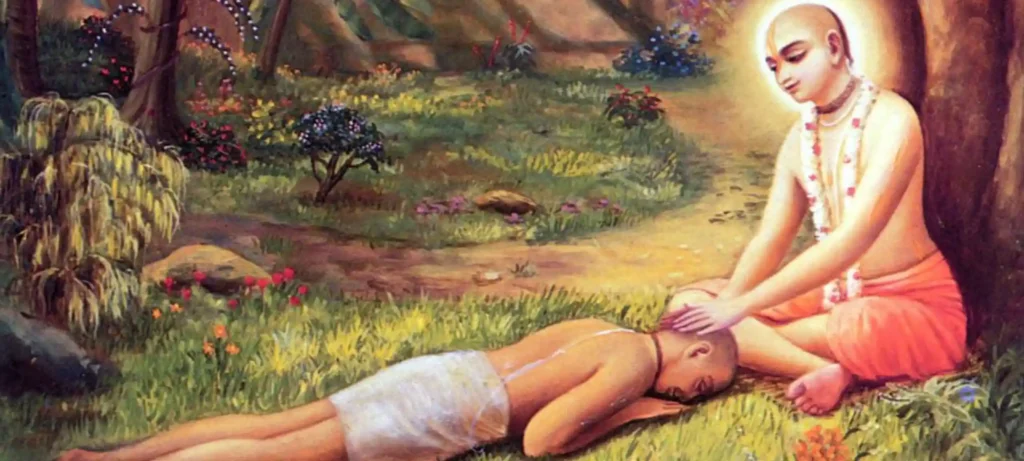
Sashtang Dandvat Pranams 7 Spiritual Insights into Dandvat Pranam What is Sashtang Dandvat Pranam? Prostration is an integral aspect of Sanatana Dharma. Hindus, prostrate before elders or people in the renounced order, to seek their blessings. Why should we Prostrate? When the body is aligned vertically with the palms joined, facing each other, in a stretched condition, above the head, lying on the chest, with the knees, wrists, chest, thighs, genitals, and toes resting against the ground, it represents a powerful energy meridian. This pose is Dandvat Pranam. When the inner mood of the heart, is that of prayer and surrender, this pose shall immediately attract, the vital energy force of the universe. It aligns the bodily currents, just as electricity aligns the electrons, in an electric conductor. This alignment calms the mind and energizes the chakras. It supports the Awakening of Kundalini without fail. Paying obeisance through prostration is an effective means towards one’s higher journey. It is in the Hindu faith, that one’s life goal is towards attaining the Supreme. Other than this there is no purpose to life; only such a person is a true Hindu. In the golden old days of yore, prostrations, offering the body full length with the body stretched, fully on the ground, in front of saints and elders, was a common practice. Significance of Dhoti in Sanatana Dharma You would have seen traditional people wearing Dhoti while visiting their Guruji’s ashram. Dandvat Pranam (Sahtang Dandvat) is a mark of respect for both, God and Guru. In many parts of rural India, dhoti has survived to remain the regular outfit for men. However, with metropolitanization, this tradition has disappeared. Dhoti is the simplest cloth possible to cover one’s body. It is not fancy whatsoever. Meant only to cover the body, dhoti marks simplicity and dignity. Silk Dhoti’s are most preferred for auspicious, religious, and spiritual festivals. Men in South India prefer to wear Mundu which is a single piece of cloth wrapped around the thighs, less commonly seen in Northern India. It is simple and extremely comfortable to wear. Traditional outfits do not have any knots. So, next time you wear a dhoti, ensure you don’t tie too many knots to it! Spirituality aims at simplicity. If desires are less, only needs remain. Fulfilling the needs of a spiritual aspirant is the Lord’s responsibility, which He should graciously fulfill. So, let’s continue… With changing times, Dandvat Pranam practice lost its presence. Foreign invasions and British influence on the common man, has killed this practice, which then considered to be an expression of the higher journey. A Spiritual Practice Called Sashtang Dandavat This practice of prostration, takes the form of sadhana when associated with the Supreme. In holy sites connected with Sanatana Dharma, there is a sadhana or spiritual practice of paying obeisances through prostrations around holy structures like mountains and rivers. People offer 108 prostrations in front of rivers like the Ganges and Sarayu Devi in Ayodhyaji. People make many prostrations to Goverdhanji hill and the river Yamunaji in the Mathura district, in Uttar Pradesh, India. These rivers and mountains are fully spiritual by Nature. They are a storehouse of other-worldly energy. Undertaking a spiritual routine of prostrations is known as “Vandanam”. Vandanam” is one of the 9 main processes of Bhakti Yoga. This practice breaks the unnecessary and unhealthy body vibrations and harmonizes the bodily vibrations in such a way that the chakras or energy centers become capable of raising the overall consciousness of the individual offering prostrations. This process is also known as “Dandavat” or the act of “falling like a stick”. Benefits of Surya Namaskar The more one subscribes to the habit of offering prostrations, the more, humility grows within one’s heart and one becomes capable of becoming a vessel to spiritual grace. It is a practice that females offer “Dandavat” without touching their chest to the ground. This means, only their knees and head must touch the ground with knees folded and body crouched. The process of “Dandavat” can be life-changing if taken up as a process of spiritual practice. People undertaking spiritual practices offer something known as “Surya namaskar” at dawn which also means offering prostrations to Sun-God. Offering obeisance’s to the Sun, increases vitality and personal power. One becomes the owner of a healthy body and one also gains immense fame and wealth, if one were to do Surya namaskar for a year, at dawn, without fail. Offering obeisance through prostrations, is an act of sadhana or spiritual practice, that can bless one with the highest benefits incomparable to any material gains. Dandvat Pranam symbolizes Humility and has great significance in spiritual circles. Humility in Santana Dharma The goal of Sanatana Dharma is to help living entities attain freedom from their compulsive thought and action patterns and attain liberation. Sanatana Dharma recommends greatly, the attainment of humility in the heart as the number one step. Even Attaining Humility at heart can qualify one sufficiently to get to liberation. Expression of humility happens in two ways. One is through action and the other through a thought or a feeling in the heart. Sashtang Dandvat Pranam makes our heart soft Spiritual rigor, recommended by Shastra, is a step towards this goal, to make the heart soft. The outward representation of humility is to bow down, to prostrate. Prostration is the recognition of our smallness when compared to the vast expanse of the rest of Creation. Sanatana Dharma uses the technical term Dandvat Pranamto represent such Prostration. Wise men of Bharath say that physical action even when done mindlessly, in the long run, can result in a change of heart, in alignment with the action. Offering Sashtang Dandvat Pranam to All ? For example, if someone is hard-hearted, elders following the Dharma recommend to the person performance of Dandvat Pranam to each and every individual the person meets. This is the way to express humility. Initially, we may do an activity with detest. But if the activity is pure and genuine and we continue the

Sashtang Dandvat Pranams Read Post »

Lord Shiva meditating on rock under starry night sky.
PEARLS OF DEVOTION, Uncategorized

Bhramakumaris and Lord Shiva 

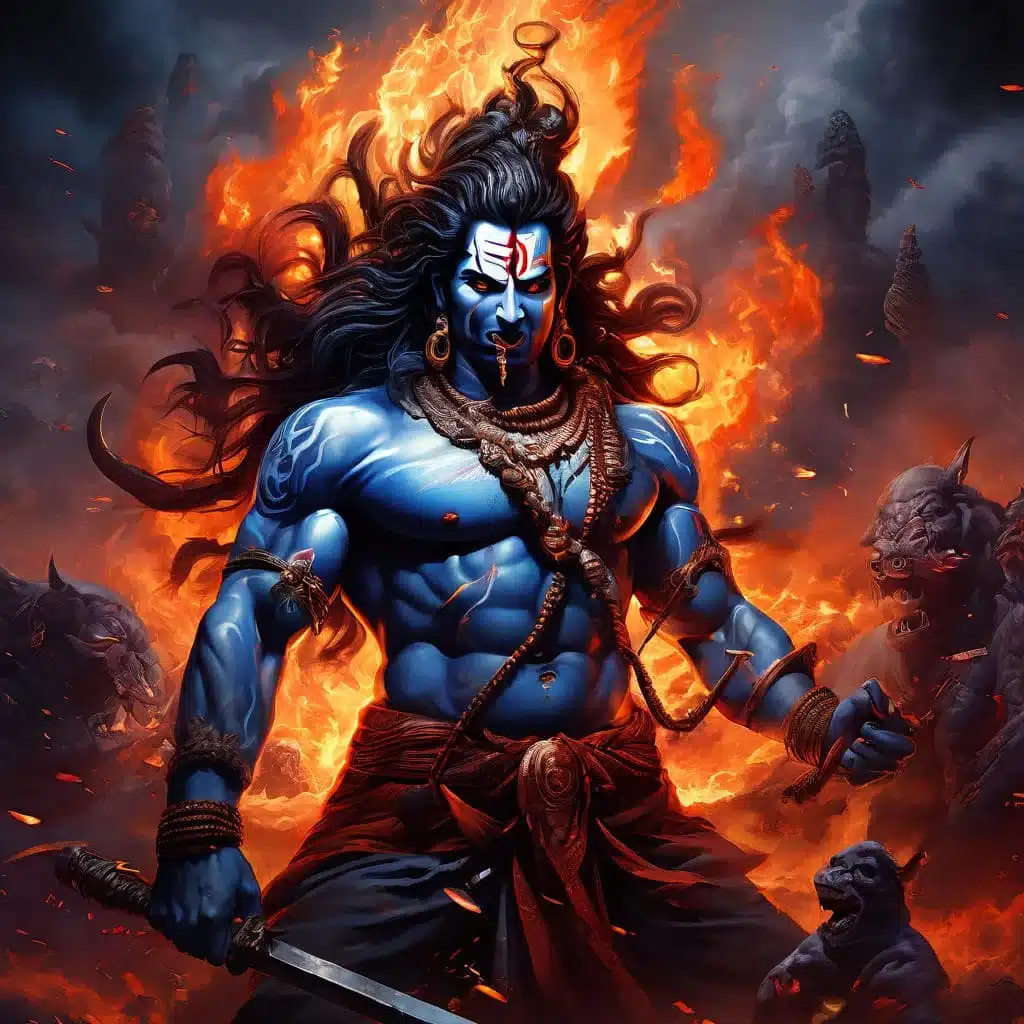
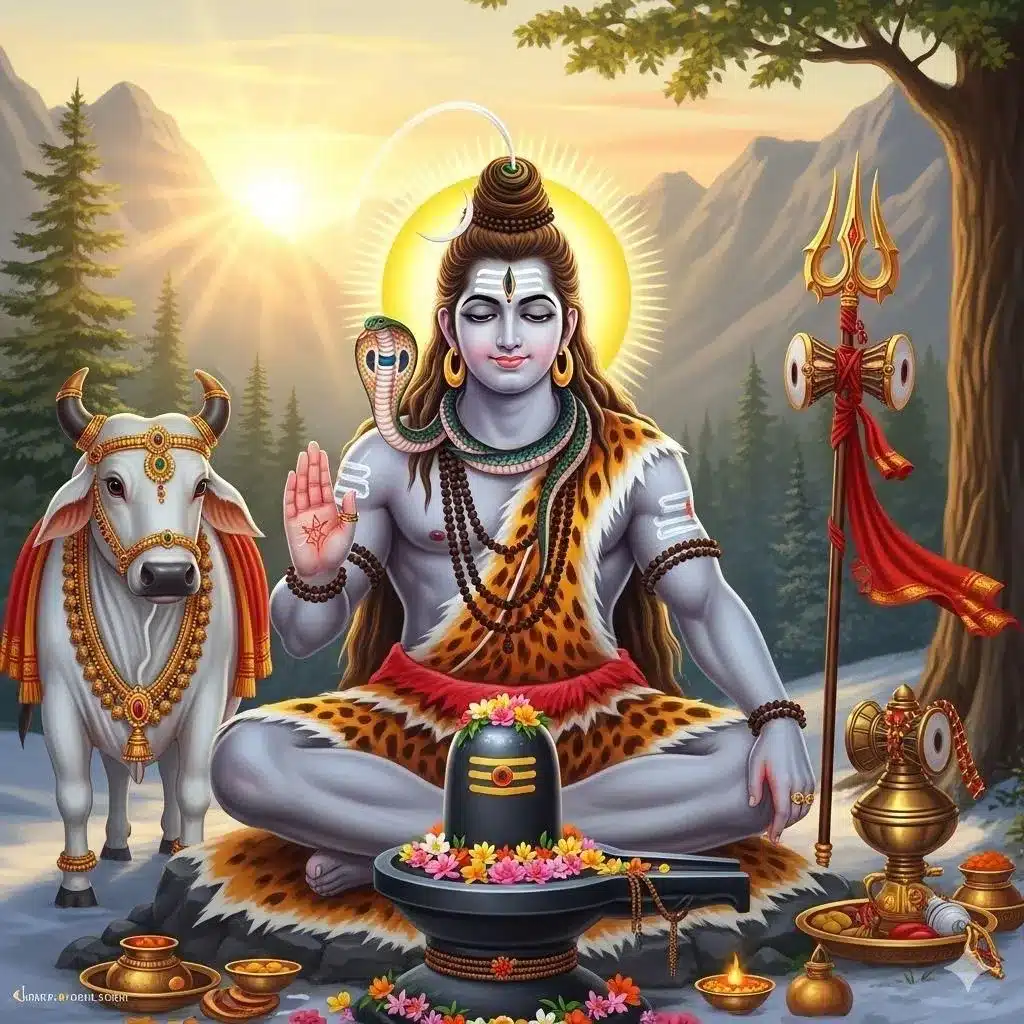
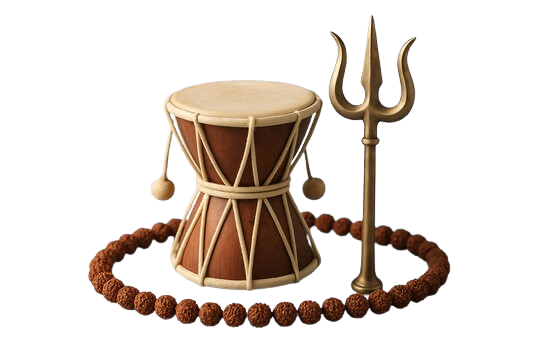
Bhramakumaris and Lord Shiva  MahaShivratri or Shiva Jayanti is a festival imbued with deep spiritual meaning. Today, it is celebrated by devout Hindus as one of the many festivals and very few are aware of the deep significance of observing MahaShivratri. Shiva symbolizes the universally worshipped form of God, the Eternal Light. Shiva literally means one who is Kalyankari, the Benefactor of all souls. MahaShivratri, therefore, is the memorial of the divine incarnation and divine acts of the incorporeal God. Shiva is the Supreme Father; He performs the triple role of creation, sustenance, and destruction. This divine Trinity is symbolized as Brahma, Vishnu, and Shankar in Hindu theology. When devoted offer prayers to the Trinity form, they say “Brahma Devtaya Namaha, Vishnu Devtaya Namaha, Shankar Devtaya Namaha” and “Shiv Paramatmaya Namaha” Shiva denotes the Supreme God who is the creator of these three subtle deities through whom he performs divine acts. Only God, the Father has the power to create, sustain and also destroy creation in order to renew it. Shiva is the Paramatma, the Supreme Soul, the Incorporeal, and the Formless. But all deities and incarnations have corporeal form. Shiva and Shankar are worshipped distinctly as God and Deity respectively. The Shivalingam denotes the incorporeal form of God Shiva. The three lines and a dot in the center signify the subtle form of God as a point of light and his three divine acts. The 12 renowned temples in India, the Jyotirlingam Maths, are dedicated to the divine attributes of Shiva. The prayer Om Namo Shivay signifies that Om Namo Shivay signifies that Om is the soul who is worshipping Shiva. Those who believe themselves to be manifestations of God say Shivoham (I am Shiva). We seldom hear of anyone referring to themselves as God, taking the name of deities. The deities are addressed as Lord; they are earthly rulers who appear in the cycle of karma, according to the fruit of their actions. God remains always beyond joy and sorrow. Deities are the highest creations of God; hence they are also worshipped alongside God. But they take birth in the corporeal world while God never appears in the cycle of birth and death, for, He is beyond it. Deities are worshipped as pure beings but only God is Patitapavan, the Purifier of all impure beings. All Shiva temples are named after His divine attributes and acts. Legends tell us that even the most revered deities, Krishna and Rama, invoked the blessings of Shiva, and this is represented by the temples at Rameshwaram and Gopeshwar. God is known as the Liberator who grants salvation to all souls because He is the only one who remains liberated, eternally. Shivaratri signifies the night of ignorance and unrighteousness when Shiva incarnates in order to open our third eye of wisdom. Today, due to ignorance, we say that God is omnipresent; yet, we continue to suffer and seek Him for salvation. In blind faith, we believe every spark of light to be the Sun. When we cannot comprehend God, we look up to His divine creation as God. But it the Supreme Soul who is the eternal source of light and Might. All that seems divine, are in fact, His creation. Due to spiritual ignorance, we have lost our divinity.We can regain our divine nature only when we link ourselves to the Supreme Soul Shiva, who is the Ocean of all divine virtues and powers.As the Gita points out when the Ocean is bestowing everything why stop at a river or pond? God, the Supreme Soul (Shiv Baba) God is called the Supreme Soul or more accurately, the Supreme Soul is known to us as the God, the creator Almighty. He is supreme among all souls. Yet, like souls, God is a subtle point of light. But unlike human Souls, that Soul is beyond the cycle of birth and death and the effects of Karma (actions) in the form of experience of pleasure or pain. God is the Supreme Father, Mother, Teacher, and Guide of all human souls. We all remember Him only in our difficult times, it is built within us. So let us explore the truth about God, as revealed by himself through murlis. Representations of incorporeal God  Being incorporeal, God is represented by an oval-shaped stone or light in many religions. In Hinduism, God is worshipped as an oval-shaped stone called Shivlingam or Jyotirlingam, meaning “a symbol of Shiva” or “a symbol of light”. Muslims revere an oval-shaped black stone called Sang-e-Aswad (holy stone), which is placed in the Kaaba in the Grand Mosque in Mecca. Jesus Christ (Christianity) has said and described God as ‘light ‘. Mahatma Buddha started deep meditation and found a spiritual existence of God, beyond the cycle of birth and death. Hence he describes the Self as such free beings detached and as a part of God. All religions point to the supreme soul in one or the other way. The common is clear that ‘God is a being of Light‘ and so is worshipped as a metaphysical power or energy that is present everywhere and within us. Name of God Everything that exists in nature has a name and a form. We get a name when we are born. In each birth, our name is different. But what about the name of one who never takes birth, and is unborn? His name must be eternal. So God has revealed Himself with His eternal name ‘Shiv‘ or ‘Shiva‘ (when pronounced in English). The Sanskrit meaning of Shiv is ‘One who is Ever Benevolent‘. He is the one who brings benefit to everyone. Till now, you have understood the reality of God the incorporeal supreme soul). Now let us turn to what we all souls call – ‘Our sweet home’. This is also the home of our spiritual father (god). There is complete and eternal sweet silence. Why sweet? Because here we are merged in the ocean of love. There is no body-consciousness (as there is no physical body). We and God live there as divine points

Bhramakumaris and Lord Shiva  Read Post »

shri sathya sai baba Spiritual guru sitting comfortably on chair image
⁠Sathya Sai Baba Divine messages

Divine Messages By Bhagavan Sri Sathya Sai Baba on Silence

Divine Messages By Bhagavan Sri Sathya Sai Baba on Silence Silence Develops Love Silence is the only language of the realised. Practise moderation in speech. That will help you in many ways. It will develop love, for most misunderstandings and factions arise out of carelessly spoken words. When the foot slips, the wound can be healed; but when the tongue slips, the wound it causes in the heart of another will fester for life. The tongue is liable for four big errors: uttering falsehood, scandalising, finding fault with others, and excessive articulation. These have to be avoided if there is to be peace for the individual as well as for society. The bond of brotherhood will be tightened if people speak less and speak sweetly. That is why silence was prescribed as a vow for spiritual aspirants by the scriptures. You are all spiritual aspirants at various stages of the road, and so this discipline is valuable for you also. Talk Sweetly without Anger The first step in spiritual discipline is the cleansing of speech. Talk sweetly without anger. Do not boast of your scholarship or attainments. Be humble, eager to serve; conserve your speech. Practise silence. That will save you from squabbles, idle thoughts, and factions. Make the Place Where You Are a Citadel of Silence You need not escape into a forest to gain silence and the chance of uninterrupted spiritual practice. You can make the place where you are a citadel of silence; shut off the senses, let them not run after objects. Your home becomes a hermitage; your spiritual practices will then move on, without any obstacle. Stay Away from Bad Company I know that you are finding time, in spite of the hard work throughout the day, to attend cinemas, to engage in wayside chats, to promote and partake in factions, and quarrels, and for many other distractions that add to the sum of your worries. It is best you stay away from companions who drag you to such distractions that weaken and worry you; spend a few minutes every morning and evening in the silence of your own shrine or home; spend them with the highest of all powers that you know of. Be in His elevating and inspiring company; worship Him mentally; offer unto Him all the work you do; you will come out of the silence nobler and more heroic than when you went in. Communion with the Master Just consider – do you come out of the cinema theatre more peaceful, more heroic, purer, nobler than when you went in? No; your passions are aroused, your animal impulses are catered to, your lower nature is fed. Nothing else can give one the rich reward that silence and prayer and communion with the Master can give. Not even a decent bank account, or a string of degrees, or the muscles of a prize-fighter. Kindness Has to Be Fostered in Silence One great temptation for weak minds nowadays is the opportunity for publicity. Even a gift of five rupees to some charitable organisation is announced in thick banner headlines! Conceit is thus encouraged, and man slides into paltry pomp. Kindness has to be fostered in the silence of the mind. The Silent Man Has No Enemies The tongue is the armour of the heart; it guards one’s life. Loud talk, long talk, wild talk, talk full of anger and hate – all these affect the health of man. They breed anger and hate in others; they wound, they excite, they enrage, they estrange. Why is silence said to be golden? The silent man has no enemies, though he may not have friends. He has the leisure and the chance to dive within himself and examine his own faults and failings. He has no more inclination to seek them in others. If your foot slips, you suffer a fracture; if your tongue slips, you fracture someone’s faith or joy. That fracture can never be set right; that wound will fester forever. Therefore use the tongue with great care. The softer you talk, the less you talk, the more sweetly you talk, the better for you and the world. Silence Is the Best Practice to Guard Faith Silence is the best spiritual practice to guard faith; that is why I insist on silence here also, as a first step in your spiritual practice. Repeat God’s Name in the Silence of the Heart The magnet cannot draw to itself a bit of iron that is covered with rust and dust. You cannot yearn for God when your mind is laden with the rust of material desires and when the dust of sensual craving sits heavy on it. Clear the rust, know the glory of God, and repeat His name in the silence of the heart. Any one of the names that denote Him can be selected. Do not listen to people who canvass for one particular name and cavil at others. Keep Silent if Speaking Truth Causes Grief or Pain If you want to know the way in which you have to observe truth in speech, read the Bhagavad Gita. It tells you that the best speech is speech that does not create pain or anger or grief to others. The scriptures also say, “Speak the truth and speak pleasantly. Do not speak the truth which is not pleasant. If speaking truth will cause grief or pain, keep silent.” The Voice of God Can Be Heard Only in the Depth of Silence It is only in the depth of silence that the voice of God can be heard. Speak as low as possible, as little as possible, as sweetly as possible. All Joy Is Within All the joy you crave for is in you. But, like a man who has vast riches in the iron chest but who has no idea where the key is, you suffer. Hear properly the instructions, dwell upon them in the silence of meditation, practise what has been made clear therein; then,

Divine Messages By Bhagavan Sri Sathya Sai Baba on Silence Read Post »

dc911b1a93e76b07f0a8ff7bf5bd4671
The Divine Play

Who is a Pilgrim

Who is a Pilgrim Life is a pilgrimage, where man drags his feet along the rough and thorny road. With the name of God on his lips, he will have no thirst; with the form of God in his heart, he will feel no exhaustion. The company of the holy will inspire him to travel in hope and faith. The assurance that God is within call, that he is ever near, nor is he long in coming, will lend strength to his limbs and courage to his eye. Remember that with every step, you are nearing God; and God too, takes ten steps toward you when you take one step towards him. There is no stopping place in this pilgrimage; it is one continuous journey, through day and night, through valley and desert; through tears and smiles; through death and birth; through tomb and womb. When the road ends and the goal is gained, the pilgrim finds that he has traveled only from himself to himself, that the way was long and lonesome, but the God that led him unto it was all the while in him, around him, with him, and beside him! He Himself was always Divine. His yearning to merge in God was but the sea calling to the Ocean! Man loves, because he is Love! He craves for melody and harmony, because He is melody and harmony. He seeks joy, for he is joy. He thirsts for God, for he is composed of God, and he cannot exist without him.” Sri Sathya Sai Baba

Who is a Pilgrim Read Post »

Upanayana Hindu Ritual
PEARLS OF DEVOTION

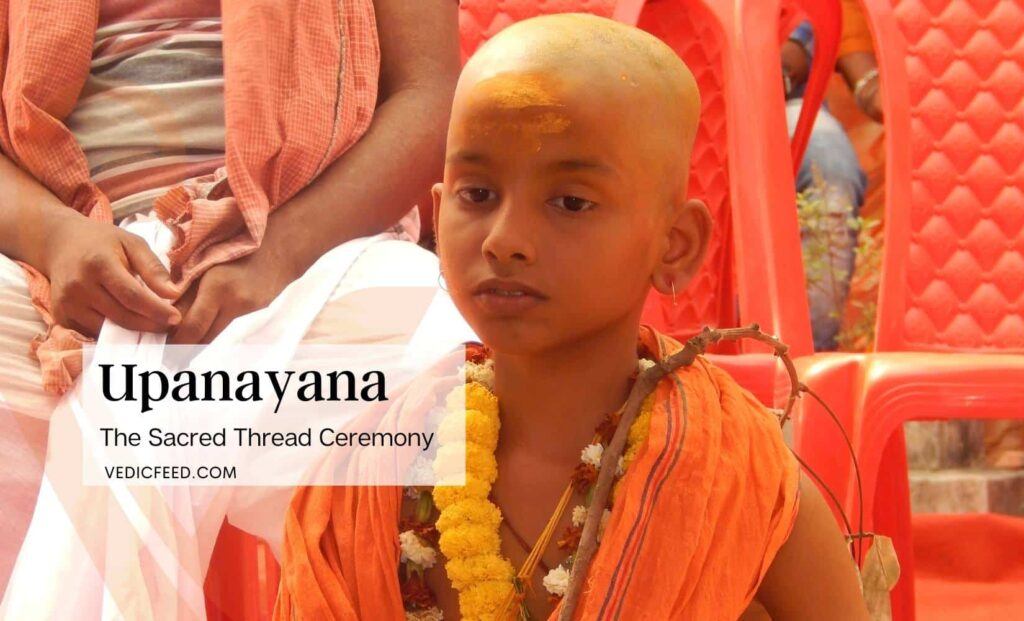
The Upayana Ceremony  

The Upayana Ceremony   The ceremony of Brahmopadesam is Upanayanam, which means, “taking near,” taking the young aspirant near Brahman, that is to say, introducing him to Brahmajijnasa (desire to know Brahman), the path of Brahman. It is one of the Samskaras (purificatory acts), rites which reconstruct the personality, reform the mind, purify it and re-build it. It makes the person receiving it a Dwija (a twice born)! The boy is born first into the world; now, he is born into the Sadhaka world. He becomes a Brahma-chari – a person who walks towards Brahman. So, it is a very significant day in the lives of these people, a day they must long remember with joy and thankfulness. It is the day when their hearts were turned towards God; and they should try not to run away from God hereafter; that is a great responsibility. 1 Gayathri manthra is Universal prayer The initiation was done by the Upadesham (instruction) of the Gayathri manthram. The manthram (sacred formula) is a universal prayer that can be used by men of all climes and creeds, for, it calls upon the Glorious Power that pervades the Sun and the three worlds to arouse, awaken and strengthen the Intelligence, so that it may lead to intense Sadhana (spiritual practice) and Sadhana may lead to success. Every little moment or incident results in sound; only, you may not be able to hear, because the range of your ear is limited. The falling of an eyelid over the eye makes a sound, the dropping of dew on a petal makes a sound. Any little agitation disturbing the calm is bound to produce sound. The sound caused by the primal movement that resulted in the enveloping of Brahman by self-evolved illusion is the Pranavasabdha or OM. The Gayathri is the elaboration of that Pranava and so, it is now held so venerable that initiation into spiritual life is achieved by its contemplation. The sound of a Manthra is as valuable as its meaning. Even a poisonous cobra is quietened by music; Nadham (sound), has that allaying property. The child in the cradle stops wailing as soon as the lullaby is sung; it may not carry any meaning; it may be a nonsensical rhyme or just a jingle, but, it quietens, soothes the nerves and induces sleep. In the case of the Gayathri, the meaning too is easy and profound. It does not ask for mercy or pardon; it asks for a dear intellect, so that the Truth may be reflected therein correctly, without any disfigurement. 2 Requisites of spiritual discipline The Brahmachari has vowed himself into a life of spiritual discipline. Now what are the requisites for the discipline? First : Faith, that can stand the ridicule of the ignorant, the cavilling by the worldly, the laughter of the low-minded. When someone ridicules, you should argue like this within yourself: Is he ridiculing my body? Well, he is doing what I myself would wish to do; for, I too want to escape out of this attachment of this body. Is he ridiculing the Atma? Well, he is doing the impossible, for, the Atma is beyond the reach of words or thought; it is unaffected by praise or blame. Say to yourself, “My Atma thathwa (Principle of the Self) is Nischala (immovable), it is Nirmala (pure),” and carry on. Second: Do not worry about ups and downs, loss or gain, joy or grief. You are yourself the maker of the ups and downs. If you but care, it can all be one smooth level. You label something as loss and something else as gain. You crave for a thing and when you get it, you call it joy; when you don’t, you call it grief. Cut the craving off, and there will be no more swinging from joy to grief. Third: Reason out and get convinced of the truth, Sarvam Brahmamayam(All is Brahman). You know there are five elements or bhuuthas, which constitute, by their permutations and combinations, the world called Prapancham, the “Five-constituted.” Prithivi or the Earth element has five qualities, the maximum, and so, it is the grossest. It has its own special characteristic of gandha (smell), as well as the characteristic of the other four, namely, sparsha, rasa, ruupa and sabdha (touch, taste, form and sound). The next one Jala, the water-element has only four, its own special one – taste and touch, form. So it is subtler than the Earth-element. Agni is subtler still, because apart from its special characteristics of form, it has only two others, sound and touch. Vayu, the Air-element has touch as its special and one more quality, sound. Finally, the lightest and subtlest of all the five, Akasha, the Sky-element, has only one characteristic, its own, namely, sabdha. Now, God is subtler than even Akasha and so He is all-pervading, even more than ether or anything more pervasive than that. His nature is beyond all human vocabulary, beyond all human mathematics. Have this conviction well stabilised in your intellect. 3 Establishment of Dharma by Adhi Shankara Fourth: Be steady in spiritual practice, and never hesitate once you have decided on it. When the bus is moving on, the dust will be floating behind as a cloud: it is only when it stops with a jerk that the dust will envelop the faces of the passengers. So, keep steadily engaged in the practice. Then, the cloudy dust of the objective world will not cover your face. Shankaracharya came to this world for the work of Dharmasthapana (establishment of righteousness), but he did not wage a war against the narrow sectarians or the wild theologians who opposed him or the critics who condemned him as a pseudo-Buddhist. He won them over by argument, persuasion and preaching. He spoke softly, but, with conviction. He gave his opponents fair chances to present their cases to the best of their ability and sometimes he even helped them to clarify their own points of view. Through Bodha (knowledge) alone can Dharma be saved in the modern Kali-age. That is why I am engaged in bodha (imparting knowledge), in this task of re-constructing through upadesha (instruction). When you scatter seeds on the surface of the soil, they do
The Upayana Ceremony   Read Post »