






Hari Om

Menu

saint

ChatGPT Image Mar 7 2026 01 34 52 PM e1772870745426
Mahatmas

Sant Jalaram Bapa

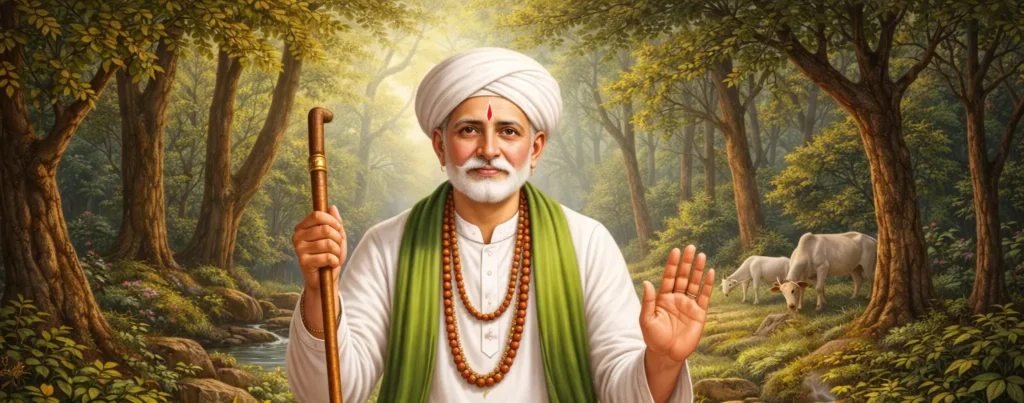
Sant Jalaram Bapa Jalaram’s love towards sadhus’ and sants’ grew day by day and he would go to any extent to entertain sadhus and sants This was not acceptable to his father. Jalaram’s deep involvement with sadhus’ and sants’ led to his seperation from his father’s business. He had decided to go his way. He worked for his uncle for some time. Uncle Valjibhai was very fond of Jalaram, but even that love and fondness would not deter Jalaram’s desire to serve sadhus’ and sants’. If at all anything it made more determined to devote himself fully to the service of sadhus’ and sants’ and the needy. He was fully aware that such devotion would mean complete withdrawal from marital life, a life free from family ties and circles. His inclination was to go on that path faster and with approval of his parents and uncle Valjibhai, he set out on a holy pilgrimage of holy places. He was fortunate that Virbaima was keen to follow her husband Jalaram. To her, Jalaram’s work was her work, Jalaram’s wishes were her wishes and all that Jalaram decided to do she was but prepared to do that. She was following Jalaram in every respect. At the age of 18 he accepted Bhojalram as his Guru and with Gurus’ blessings, he started “Sadavrat” a feeding centre, a place where all sadhus’ and sants’ and the needy can go and expect to be fed 24 hours a day. Both Jalaram Bapa and Virbaima started working for this holy place. Jalaram’s strong belief was that “This was the Lord’s order – This was Lord’s work – I am not doing anything for anybody – Lord has asked me to do this work – since it is Lord’s work HE looks after it and ensures that it functions”. Actually that did happen – indeed the place functioned well. Nobody ever returned from that place without being fed. One can question whether this can possibly be done by a single person – Yes. We argue and debate and yet probably would not come to a sensible answer – but then to do what Jalaram did one has to be a person of Jalaram’s determination, his patience, his love towards others. He was 20 years when his saintliness acquired a great fame. There are stories of how he was put to tests for his qualities of patience, endurence, love towards others, his steadfastness of thinking – he did not change under any pressure – he came out of all those tests successfully. His fame spread and he was regarded and accepted as a saint. People started worshipping him. They came to him for guidance in difficulties, for blessings in real distress and discomfort. It is said that once he was called out to see an ailing child struct with serious disease. Parents of this child believed that the cure was solely due to Jalaram Bapa’s blessings – Jala was since called Allah. In another instance a person who was threatened to be imprisoned went to Jalaram for his blessings. This man was not only saved from such imprisonment but he decided to lead a normal honest life then onwards. Jalaram was then onwards addressed as Bapa – Father of all. There are numerous such instances that can be quoted from his books but fact is that his feeding place was open and is still open today in Virpur where people go and are fed. People go to Jalaram Bapa’s places for prayers to him and seek his blessings for their personal griefs, shortcomings and failures and many acquire relief and satisfaction. Human beings during their span of life always aspire to be rich and acquire wealth – they pray for complete family life – it is such saint as Jalaram Bapa who remain away from such desire and wants. In their lives they always give – even when they are gone they still give to those who ask from them with purity of heart and sincerity of purpose. In 1934 during terrible famine Jalaram Bapa worked very hard to feed those who were suffering. In 1935 Virbaima died and 1937 Jalaram Bapa died while in prayers. Sankara was the exponent of the Kevala Advaita philosophy, Ramanuja of the Visishtadvaita philosophy, Shri Jalaram Bapa was born on Monday, November 14, 1799 the seventh day of the bright half of the kartik, Vikram era 1856 in Virpur. He had a first meeting with the God at the age of five and since then he was all the time muttering Rama Rama. His father was a grocer and had a small shop in the town. From childhood only Jalaram was inclined towards the Sadhus and Sannyasis. Whenever he saw a sadhu he would take him to his house for meals. In the age of 14 he started working with his father in his shop. At the age of 16, Jalaram was married to Virbai the daughter of Pragji Thakkar of Atkot. As Jalaram continuously indulged in offering the meals to the sadhus his father had separated him from the house and shop. Now he started working in his uncle’s shop. Sourse- jalarammandir
Sant Jalaram Bapa Read Post »

images 2026 03 07T133745.683
Mahatmas

Sant Nimbarka

Sant Nimbarka What is Markandey Puran & Who is Writer of It? Niyamanandacharya said to the Sannyasin, “I shall bring quickly roots and fruits from the forest. I guarantee that the sun will not set till you finish your meals”. Niyamanandacharya placed his Sudarshana Chakra on a Nim tree in the Ashram where it shone like the sun. Brahma, who was in the guise of the Sannyasin, was struck with amazement. In a few minutes Nimbarka returned with roots and fruits and gave them to his mother, who served them to the Sannyasin with intense devotion. As soon as the Sannyasin finished his meals, Nimbarka removed the Sudarshana Chakra from the Nim tree. It was at once pitch dark. One quarter of the night had passed. The Sannyasin, who was Brahma, conferred on the boy the name ‘Nimbarka’ (Nim–Neem tree; Arka–Surya or the sun). Since then he has been called Sri Nimbarkacharya. Sri Nimbarkacharya is considered to be an incarnation of Lord Hari’s weapon Sudarshana Chakra or discus. There are four kinds of Avataras: (i) Purna (full) e.g., Lord Krishna, Lord Rama. (ii) Kala (not all-full) e.g., Matsya, Varaha, Hamsa, etc. (iii) Amsa (part) e.g., Jada Bharata, Nara Narayana, etc. (iv) Amsamsa (part of the part) e.g., Sri Sankara, Sri Ramanuja, Sri Nimbarka, etc. In Vishnu Yana, the spiritual lineage of Sri Nimbarkacharya is given as follows: “The sacred Gopala Mantra of eighteen letters sprang from the lotus mouth of Sri Narayana. It was given to Hamsa Bhagavan. Hamsa Bhagavan in turn initiated the Kumaras who revealed this Mantra to Rishi Narada. Narada taught this to his disciple Sri Nimbarka. Nimbarka gave this Mantra to his disciple Srinivasacharya”. Sri Nimbarkacharya was the embodiment of mercy, piety, love, kindness, liberality and other divine qualities did rigorous austerities at Neemgram and had Darshan of Lord Krishna in that place. In that village only Nimbarka had exhibited his miracle when Brahma came for Bhiksha as a Sannyasin. Another holy place of the Nimbarka sect is Salembabad in Rajasthan. A big Mahant lives here. There is a temple of Nimbarka here. The Nimbarka sect is found mostly in Brij Bhumi, viz., Brindavan, Nandigram, Barsana, Govardhan, etc. Jaipur, Jodhpur, Bharatpur, Gwalior, Burdwan and Okara are its centres. The Nimbarka followers are also to be found in Central India, Bihar, Orissa and West Bengal. ri Nimbarkacharya wrote the following books: Vedanta Parijat Saurabh, a commentary on the Brahma Sutras; a commentary on the Bhagavad Gita; Sadachar Prakash, a treatise on Karma Kanda; Rahasya Shodasi, an explanation of the Sri Gopala Mantra in verses; Prapanna Kalpa Valli, an explanation of the Sri Mukunda Mantra in verses; Prapatti Chintamani, a treatise pertaining to supreme refuge; Prata Smarana Stotram, a devotional hymn; Dasa Sloki or Kama Dhenu, the ten nectarine verses; and Savisesh Nirvisesh Sri Krishna Stavam. Sankara was the exponent of the Kevala Advaita philosophy, Ramanuja of the Visishtadvaita philosophy, Madhvacharya of the Dvaita philosophy, Vallabhacharya of the Suddhadvaita philosophy and Nimbarkacharya of the Dvaitadvaita philosophy. All were great souls. We cannot say that Sankara was greater than Ramanuja or Vallabha was greater than Nimbarka. All were Avatara Purushas. Each one incarnated on this earth to complete a definite mission, to preach and propagate a certain doctrine, which was necessary to help the growth of a certain type of people who flourished at a certain period, who were in a certain stage of devotion. All schools of philosophy are necessary. Each philosophy is best suited to a certain type of people. Sourse- dlshq org

Sant Nimbarka Read Post »

Parashara Rishi ji
Mahatmas

Parashara Rishi

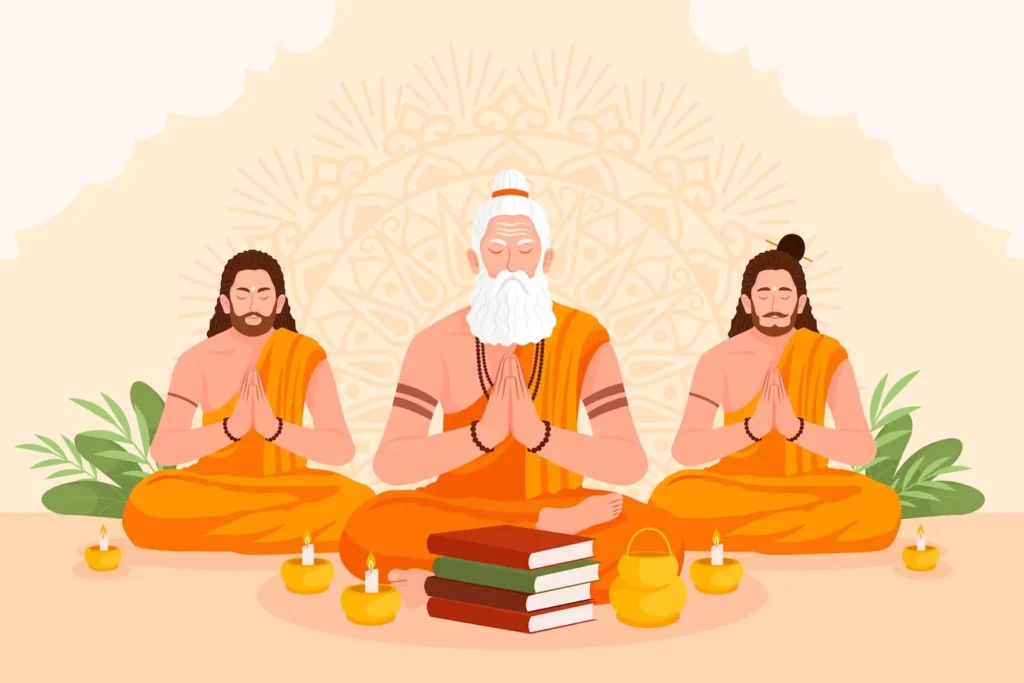
Parashara Rishi BLOGS & LIBRARY. His contributions to Hindu dharma are immense. He is traditionally credited as the author of the Vishnu Purana, a text that beautifully outlines cosmology, theology, and devotional practice centered around Lord Vishnu. Moreover, his work Bṛhat Parāśara Horā Śāstra is considered the cornerstone of Vedic Astrology, where he systematically laid out the principles of karma, time cycles, planetary effects, and predictive techniques that continue to shape the astrological sciences to this day. Parashara Rishi’s life, framed by sorrow, wisdom, and divine purpose, is a shining example of how even through adversity, the soul can rise to become a guiding light for countless generations. Through his son Veda Vyasa, the compiler of the Vedas and author of the Mahabharata, his spiritual legacy only expanded further, influencing not just Jyotish and philosophy, but the very fabric of Sanatana Dharma. There is an interesting story behind the birth of Sage Parashara, involving the tragic death of his father, Shakti Muni. Once, while Shakti Muni was crossing a narrow bridge, he encountered King Kalmashapada of Ayodhya, who belonged to the Ikshvaku Dynasty. The king was riding in his chariot, leaving no room for Shakti Muni to pass. Shakti Muni politely requested the king to make way, but the king refused to pull back his chariot. The two remained at an impasse, locked in a standoff.  He abandoned all thoughts of giving up his life. That child was none other than Parashara—destined to become one of the greatest sages of the Vedic tradition.  There is also a mention of Rishi Parashara in the Mahabharata, where he becomes enchanted by a girl who smelled like fish, named Matsyagandha. This girl was Satyavati, whose work was to ferry people across the Yamuna River. One day, Rishi Parashara met her when he wished to cross the river.  He was drawn to her and expressed his desire to have a relationship. However, Satyavati refused, unwilling to engage in an act she believed to be immoral. Yet, Rishi Parashara continued to persuade and plead with her. Eventually, Satyavati agreed—but only on the condition that he fulfill three specific demands: She wished for the fishy odor that clung to her body to be replaced with a fragrant aroma. No one should be able to see them during the encounter. In response, Parashara used his yogic powers to envelop the area in a dense, concealing fog.  Her virginity must remain intact even after the union. Parashara assured her that she would regain her virginity immediately after giving birth.  Parashara Rishi fulfilled all her conditions, and only then did they unite. From this union, a son was born, named Krishna Dvaipayana, who later became renowned as Veda Vyasa—the sage who compiled the four Vedas and authored the Mahabharata. Later in his life, when he came to know that his father had been killed by a Rakshasa, he resolved to take revenge by wiping out the Rakshasa clan from the face of the Earth. To accomplish this, he began a Rakshasa Satra Yajna, during which all the Rakshasas started to fall into the sacred fire one by one.  …into the sacrificial fire, turning into ashes one by one. At that moment, Maharshi Pulastya arrived and requested him to stop, explaining that it was unjust to kill all Rakshasas indiscriminately, especially those who had done no harm. He taught Parashara the principle of non-violence (ahimsa). Moved by the teachings and prayers of both Pulastya and Vyasa, Parashara finally stopped the yajna.  Maharishi Pulastya blessed Parashara and predicted that he would one day compose the Purāṇa Saṁhitā, which he indeed fulfilled, along with many other works. Rishi Parashara acquired knowledge in numerous disciplines and generously shared it with the world. Several verses in the Rig Veda are attributed to him. Among his notable compositions are the Vishnu Purana, Parashara Samhita, Parashara Gita, and the Brihat Parashara Hora Shastra. In the Shanti Parva of the Mahabharata, during the discourse between Bhishma and Yudhishthira, Bhishma narrates a profound dialogue between Raja Janaka and Rishi Parashara, which is known as the Parashara Gita. Source: jyotishyavignanam

Parashara Rishi Read Post »

c1 20231210 16473467 1280x720 1
Mahatmas

Sant Markandeya Rishi

Sant Markandeya Rishi What is Markandey Puran & Who is Writer of It? Markandeya Purana is a Sanskrit text of Hinduism named after Sage Markandeya. This is one of the oldest Purana which contains 137 chapters on Dharma-Karma, Samsara, and Śrāddha. Markandeya Purana has 9000 verses presenting a diverse range of topics including mythology, religion, society, etc. It is believed that the earliest version of Markandeya Purana was composed by sage Markandeya near river Narmada which describes a lot about Vindhya Range and western India. Markandeya Purana is particularly popular in the eastern part of India such as Orissa and West Bengal. A legendary belief is that the author of Markandeya Purana is Brahma itself since it has come from Lord Brahma’s mouth. Markandeya Rishi hails from Hindu tradition who was born in the clan of Rishi Bhrigu. Sage Markandeya gained accomplishments by performing forceful religious practice (hath yoga) and worshipped till Brahm-Kaal. While meditating his concentration used to reach to Brahmlok (also called Mahaswarg). Markandeya Rishi used to consider his worship to be superior but the fact remained he did not get relief from Kaal’s web.  Moving on, let us try to understand basis true stories what is Kaal’s trap and how innocent souls remain in the devil’s trap.  Once upon a time Rishi Markandeya considering God to be formless was performing tenacity of Brahm-Kaal for a very long time in the Bay of Bengal. The soul enthroned as Lord Indra in heaven always has a fear that during his tenure of 72 chaturyuga if any human being (seeker) on the earth performs austerity and gains religious achievements without having any disturbance in his religious activity then that seeker becomes eligible to receive the position of Lord Indra. Since the post of the King of Heaven is attained with fierce austerity. That successful seeker gets enthroned as Lord Indra and the current Lord Indra’s position is stripped. Therefore, as far as possible, Lord Indra during his tenure does not let the tenacity or religious sacrifice of any seeker gets complete. He dissolves his austerity, no matter whatever he may have to do.  When Lord Indra’s messengers told him that Rishi Markandeya is performing tenacity in the Bay of Bengal then he sent the celestial maiden (Apsara) Urvashi, his perennially youthful and infinitely charming wife to dissolve the tenacity of Sage Markandeya. Urvashi was considered to be the most beautiful Apsara amongst all the Apsaras and nymphs in heaven. Attired with various ornaments Markandeya Rishi said ‘My concentration was in Brahamlok Sage Markandeya asked ‘Since nothing is inevitable when Lord Indra will die then what will you do?’. Urvashi replied ‘I will mete fourteen Indra. My age is in the form of the Queen consort’. Note: The age of the Empress of one Lord Indra =72 chaturyuga *14=1008 chaturyuga ie. till one day (kalp) of Lord Brahma. One day of Brahma Ji is 1008 chaturyuga. One chaturyug=Satyug+Tretayug+Dwaparyug+Kalyug ie. total 43.20 lac years The duration of one Lord Indra is 72 chaturyuga. After completing rule for these years 14 such Indra dies and another eligible soul takes charge of the King of heaven. Such 14 Indra will become husband of one Empress Urvashi.  This signifies, the soul of the Queen consort of Lord Indra ie. Urvashi would have done so many auspicious deeds in some human birth that she relishes luxuries in heaven for so long duration and enjoys pleasure as consort with 14 Kings of heaven. Then sage Markandeya said ‘those 14 Indra will also die, then what will you do?’ Apsara Urvashi replied ‘I will become a mare after death and will spend life on the earth, the same will happen to all those 14 Indra. They will acquire the life form of a donkey on earth’. Markandeya Rishi said ‘then why are you taking me to such a region (lok) whose King becomes a donkey after death and the Queen acquires the life form of a mare?’. Urvashi replied ‘to protect my honor, else they will taunt me a deceiver’. Sage Markandeya said ‘what honor could be of a mare? You are a donkey in current birth since you mete with 14 husbands and after death, you accept that you will acquire life form of a mare, then what kind of honor is this of a mare?’. Embarrassed Urvashi then returned. At that time, Lord Indra came from Heaven; according to the legislation; to provide his throne of the King of heaven to Markandeya Rishi. Lord Indra said ‘Sage I am defeated and you have won. Kindly accept the title of Indra’. Markandeya Rishi said ‘Well Indra! The title of Indra is of no use to me. To me, it is similar to a crow’s beat’.  The reality is, in the same way, Brahma, Vishnu, and Shiva after completing their tenure will also die and will go in 84 lac life forms A worshipper named Ruchi, by practicing celibacy, was doing sadhana according to the Vedas. He was not married. When he turned forty, he saw his four ancestors who had become Pitra by doing sadhana opposite to the scriptures and were suffering. Pitro said, “Son Ruchi, get married and carry out our Śrāddha; we are suffering.” Ruchi Rishi said, “Pitramaho, in the Vedas, the path of Karm-Kand (Śrāddha, to offer Pind etc) is said to be sadhna of the fools. Then why are you directing me to that wrong (devoid of injunctions of scriptures) sadhna.  Pitro said, “Son, it is true that in Vedas, Pitra-worship, ghost-worship, worship of gods-goddesses (Karm-Kand) is called as Avidhya (ignorance / an error); there is no doubt about this.”  Sourse- jagatgururampalji

Sant Markandeya Rishi Read Post »