






























Hari Om

Menu

vedas

shri krishna Bhagavad Gita
Bhagavad Gita, vedas

Chapter One

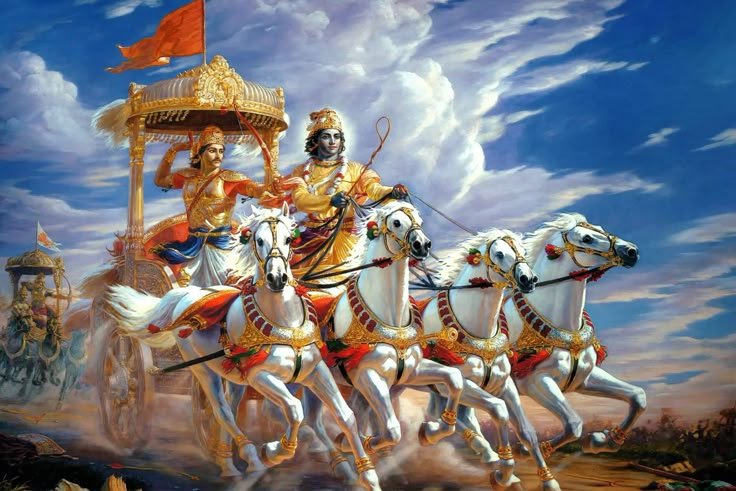
Chapter 1 Arjuna Visada Yoga The first chapter of the Bhagavad Gita – “Arjuna Vishada Yoga” introduces the setup, the setting, the characters and the circumstances that led to the epic battle of the Mahabharata, fought between the Pandavas and the Kauravas. It outlines the reasons that led to the revelation of the Bhagavad Gita. As both armies stand ready for the battle, the mighty warrior Arjuna, on observing the warriors on both sides, becomes increasingly sad and depressed due to the fear of losing his relatives and friends and the consequent sins attributed to killing his own relatives. So, he surrenders to Lord Krishna, seeking a solution. Thus, follows the wisdom of the Bhagavad Gita. Bhagavad Gita 1.1 धृतराष्ट्र उवाच धर्मक्षेत्रे कुरुक्षेत्रे समवेता युयुत्सवः। मामकाः पाण्डवाश्चैव किमकुर्वत सञ्जय।।1.1।। dhṛitarāśhtra uvācha dharma-kṣhetre kuru-kṣhetre samavetā yuyutsavaḥ māmakāḥ pāṇḍavāśhchaiva kimakurvata sañjaya dhṛitarāśhtraḥ uvācha—Dhritarashtra said; dharma-kṣhetre—the land of dharma; kuru-kṣhetre—at Kurukshetra; samavetāḥ—having gathered; yuyutsavaḥ—desiring to fight; māmakāḥ—my sons; pāṇḍavāḥ—the sons of Pandu; cha—and; eva—certainly; kim—what; akurvata—did they do; sañjaya—Sanjay Translation Dhritarashtra said, “What did my people and the sons of Pandu do when they had assembled together, eager for battle, on the holy plain of Kurukshetra, O Sanjaya?” Commentary 1.1 धर्मक्षेत्रे on the holy plain? कुरुक्षेत्रे in Kurukshetra? समवेताः assembled together? युयुत्सवः desirous to fight? मामकाः my people? पाण्डवाः the sons of Pandu? च and? एव also? किम् what? अकुर्वत did do? सञ्जय O Sanjaya.Commentary Dharmakshetra — that place which protects Dharma is Dharmakshetra. Because it was in the land of the Kurus? it was called Kurukshetra. Sanjaya is one wh o has cornered likes and dislikes and who is impartial. Bhagavad Gita 1.2 सञ्जय उवाच दृष्ट्वा तु पाण्डवानीकं व्यूढं दुर्योधनस्तदा। आचार्यमुपसङ्गम्य राजा वचनमब्रवीत्।।1.2।। sañjaya uvācha dṛiṣhṭvā tu pāṇḍavānīkaṁ vyūḍhaṁ duryodhanastadā āchāryamupasaṅgamya rājā vachanamabravīt sanjayaḥ uvācha—Sanjay said; dṛiṣhṭvā—on observing; tu—but; pāṇḍava-anīkam—the Pandava army; vyūḍham—standing in a military formation; duryodhanaḥ—King Duryodhan; tadā—then; āchāryam—teacher; upasaṅgamya—approached; rājā—the king; vachanam—words; abravīt—spoke Translation Sanjaya said: Having seen the army of the Pandavas drawn up in battle array, King Duryodhana approached his teacher, Drona, and spoke these words. Commentary 1.2 दृष्ट्वा having seen? तु indeed? पाण्डवानीकम् the army of the Pandavas? व्यूढम् drawn up in battlearray? दुर्योधनः Duryodhana? तदा then? आचार्यम् the teacher? उपसङ्गम्य having approached? राजा the king? वचनम् speech? अब्रवीत् said.No Commentary. Bhagavad Gita 1.3 पश्यैतां पाण्डुपुत्राणामाचार्य महतीं चमूम्। व्यूढां द्रुपदपुत्रेण तव शिष्येण धीमता।।1.3।। paśhyaitāṁ pāṇḍu-putrāṇām āchārya mahatīṁ chamūm vyūḍhāṁ drupada-putreṇa tava śhiṣhyeṇa dhīmatā paśhya—behold; etām—this; pāṇḍu-putrāṇām—of the sons of Pandu; āchārya—respected teacher; mahatīm—mighty; chamūm—army; vyūḍhām—arrayed in a military formation; drupada-putreṇa—son of Drupad, Dhrishtadyumna; tava—by your; śhiṣhyeṇa—disciple; dhī-matā—intelligent Translation Behold, O Teacher! This mighty army of the sons of Pandu, arrayed by the son of Drupada, thy wise disciple. Commentary 1.3 पश्य behold? एताम् this? पाण्डुपुत्राणाम् of the sons of Pandu? आचार्य O Teacher? महतीम् great? चमूम् army? व्यूढाम् arrayed? द्रुपदपुत्रेण son of Drupada? तव शिष्येण by your disciple? धीमता wise.No Commentary. Bhagavad Gita 1.4 अत्र शूरा महेष्वासा भीमार्जुनसमा युधि। युयुधानो विराटश्च द्रुपदश्च महारथः।।1.4।। atra śhūrā maheṣhvāsā bhīmārjuna-samā yudhi yuyudhāno virāṭaśhcha drupadaśhcha mahā-rathaḥ atra—here; śhūrāḥ—powerful warriors; mahā-iṣhu-āsāḥ—great bowmen; bhīma-arjuna-samāḥ—equal to Bheem and Arjun; yudhi—in military prowess; yuyudhānaḥ—Yuyudhan; virāṭaḥ—Virat; cha—and; drupadaḥ—Drupad; cha—also; mahā-rathaḥ—warriors who could single handedly match the strength of ten thousand ordinary warriors; Translation Here are heroes, mighty archers, equal in battle to Bhima and Arjuna, Yuyudhana (Satyaki), Virata, and Drupada—all mighty warriors. Commentary 1.4 अत्र here? शूराः heroes? महेष्वासाः mighty archers? भीमार्जुनसमाः eal to Bhima and Arjuna? युधि in battle? युयुधानः Yuyudhana? विराटः Virata? च and? द्रुपदः Drupada? च and? महारथः of the great car.Commentary Technically? maharatha means a warrior who is proficient in the science of war and who is able to fight alone with ten thousand archers. Bhagavad Gita 1.5 धृष्टकेतुश्चेकितानः काशिराजश्च वीर्यवान्। पुरुजित्कुन्तिभोजश्च शैब्यश्च नरपुङ्गवः।।1.5।। dhṛiṣhṭaketuśhchekitānaḥ kāśhirājaśhcha vīryavān purujit kuntibhojaśhcha śhaibyaśhcha nara-puṅgavaḥ yudhāmanyuśhcha vikrānta uttamaujāśhcha vīryavān dhṛiṣhṭaketuḥ—Dhrishtaketu; chekitānaḥ—Chekitan; kāśhirājaḥ—Kashiraj; cha—and; vīrya-vān—heroic; purujit—Purujit; kuntibhojaḥ—Kuntibhoj; cha—and; śhaibyaḥ—Shaibya; cha—and; nara-puṅgavaḥ—best of men; yudhāmanyuḥ—Yudhamanyu; cha—and; vikrāntaḥ—courageous; uttamaujāḥ—Uttamauja; cha—and; vīrya-vān—gallant; Translation Dhrishtaketu, Chekitana, the valiant king of Kasi, Purujit, Kuntibhoja, and Saibya—the best of men. Commentary 1.5 धृष्टकेतुः Dhrishtaketu? चेकितानः Chekitana? काशिराजः king of Kasi? च and? वीर्यवान् valiant? पुरुजित् Purujit? कुन्तिभोजः Kuntibhoja? च and? शैब्यः son of Sibi? च and? नरपुङ्गवः the best of men.No Commentary. Bhagavad Gita 1.6 युधामन्युश्च विक्रान्त उत्तमौजाश्च वीर्यवान्। सौभद्रो द्रौपदेयाश्च सर्व एव महारथाः।।1.6।। saubhadro draupadeyāśhcha sarva eva mahā-rathāḥ saubhadraḥ—the son of Subhadra; draupadeyāḥ—the sons of Draupadi; cha—and; sarve—all; eva—indeed; mahā-rathāḥ—warriors who could single handedly match the strength of ten thousand ordinary warriors Translation The strong Yudhamanyu and the brave Uttamaujas, the son of Subhadra (Abhimanyu, the son of Subhadra and Arjuna), and the sons of Draupadi, all of them great charioteers (great heroes).” Commentary 1.6 युधामन्युः Yudhamanyu? च and? विक्रान्तः the strong? उत्तमौजाः Uttamaujas? च and? वीर्यवान् the brave? सौभद्रः the son of Subhadra? द्रौपदेयाः the sons of Draupadi? च and? सर्वे all? एव even? महारथाः great carwarriors.No Commentary. Bhagavad Gita 1.7 अस्माकं तु विशिष्टा ये तान्निबोध द्विजोत्तम। नायका मम सैन्यस्य संज्ञार्थं तान्ब्रवीमि ते।।1.7।। asmākaṁ tu viśhiṣhṭā ye tānnibodha dwijottama nāyakā mama sainyasya sanjñārthaṁ tānbravīmi te asmākam—ours; tu—but; viśhiṣhṭāḥ—special; ye—who; tān—them; nibodha—be informed; dwija-uttama—best of Brahmnis; nāyakāḥ—principal generals; mama—our; sainyasya—of army; sanjñā-artham—for information; tān—them; bravīmi—I recount; te—unto you Translation Know also, O best among the twice-born! the names of those who are the most distinguished amongst ourselves, the leaders of my army; these I name to you for your information. Commentary 1.7 अस्माकम् ours? तु also? विशिष्टाः the best? ये who (those)? तान् those? निबोध know (thou)? द्विजोत्तम (O) best among the twicorn ones? नायकाः the leaders? मम my? सैन्यस्य of the army? संज्ञार्थम् for information? तान् them? ब्रवीमि speak? ते to thee.No Commentary. Bhagavad Gita 1.8 भवान्भीष्मश्च कर्णश्च कृपश्च समितिञ्जयः। अश्वत्थामा विकर्णश्च सौमदत्तिस्तथैव च।।1.8।। bhavānbhīṣhmaśhcha karṇaśhcha kṛipaśhcha samitiñjayaḥ aśhvatthāmā vikarṇaśhcha saumadattis tathaiva cha bhavān—yourself; bhīṣhmaḥ—Bheeshma; cha—and; karṇaḥ—Karna; cha—and; kṛipaḥ—Kripa; cha—and; samitim-jayaḥ—victorious in battle; aśhvatthāmā—Ashvatthama; vikarṇaḥ—Vikarna; cha—and; saumadattiḥ—Bhurishrava; tathā—thus; eva—even; cha—also Translation “Thou thyself, Bhishma, Karna, Kripa, the victorious in war, Asvatthama, Vikarna, and Bhurisrava, the son of Somadatta—all these are ready for battle.” Commentary 1.8 भवान् yourself? भीष्मः Bhishma? च and? कर्णः Karna? च and? कृपः Kripa? च and? समितिञ्जयः
Chapter One Read Post »

dadar roman devnagri thumb
vedas

Download Vedas

Table of Contents Download Puran: Agni Puran in Hindi Bavishya Puran in Hindi Bhagwat Puran in Hindi.pdf Brahamand Puran in Hindi Part 2 Brahamand Puran Part 1 in Hindi Bramha Puran in Hindi Garuda Puran in Hindi kurma Puran in Hindi Ling Puran in Hindi Markende Puran in Hindi Matsya Puran in Hindi Part 1 Matsya Puran Part 2 in Hindi Narad Puran in Hindi Padam Puran in Hindi Shiv Puran in Hindi Skand Puran in Hindi Vaivatra Puran in Hindi Vaman Puran in Hindi Varaha Puran in Hindi Misc Collection: Sri Ramchritmanas In Roman Sri Guruth Sahib In Hindi Ramayana All Kand Pages.pdf Mahabhart Full With Geeta Hindi Kalki Puran Hindi Kalki Puran Hindi Gita Gita Roman by Gita Press Garland of Prayers by Swami Sivananda Full Punjabi Gita Conquest Fear by Swami Sivananda Brhadaranyaka Upanishad Bhrigu Sutras Ashtavakra Gita Arthasastra An Acharaya’s life All the vedas Sacred Texts: Who am I What What Happens After Death by Swami Sivananda Vidya Vahini By Bhagwan Sri Sathya Sai Baba Upanishads Upanishad Vahini By Bhagwan Sri Sathya Sai Baba Thus Awakens Swami Sivananda Thought Power by Swami Sivananda The Science of Pranayam by Swami Sivananda SwamiSamarth Swami Bhakta Vishita Sutra Vahini By Bhagwan Sri Sathya Sai Baba Sri Vishnu Sthotram Sri Swami Sivananda – Parables of Sivananda Sri Swami Sivananda – Ideal of Married Life Sri Sathya Sai Vahini Sri Aurobindo–The secret of the vedas Sri aurobindo ,all upanishads Shlokas Shared Shirdi Sai Miracles Self realization , workshop Science of yagna Science of breath control Science of brain breathing by Swami Sivananda Sanskrit dictionary Sandeha Nivarini Vahini By Bhagwan Sri Sathya Sai Baba Sai bhakti Sahaja yoga & Turya course Rig Veda Samhita Purusha suktam 2 Prayers Prasnottara Vahini By Bhagwan Sri Sathya Sai Baba Prashanti Vahini By Bhagwan Sri Sathya Sai Baba Om yoga Om namaste Ganapataye Narayan is Supreme Mind and its Mysteries By Swami Sivananda May I Answer That By Swami Sivananda Lord Shiva by Swami Sivananda Lord Rama Leela Vahini By Bhagwan Sri Sathya Sai Baba Kundali Yoga Kriya yoga – Personal Experience of a Disciple karma – The Truth Kalki Avatar Jaimini Sutras Intro to Pranayam Hymns to the mystic fire How To Get Vairagya By Swami Sivananda Hindu Rituals and Routine Hatha yoga Hatha Yoga of patanjali Hamsa Yoga Gyana Vahini By Bhagwan Sri Sathya Sai Baba Great Kriya and Other Techniques God Exists by Swami Sivanada Gita Vahini By Bhagwan Sri Sathya Sai Baba Dreams by Swami Sivananda Dhyana Vahini By Bhagwan Sri Sathya Sai Baba Dharma Vahini By Bhagwan Sri Sathya Sai Baba Brahmacharya by Swami Sivananda Brahma Sutras by swami Shivananda Bhogi Yogi- krishna the supreme Bhagavatha Vahini By Bhagwan Sri Sathya Sai Baba Ayurveda history Vedas Collection: Atharva Veda Part -1 Atharva Veda Part -2 Rig Veda Sam Veda Yajur Veda Other Collection: Satya Sai Baba Downloads 50-Gems from Sai baba Discources 100-answers on gita by baba Awake – awake by baba Baba – The Life Breath of Every Soul Chinna katha Part 1 Chinna katha part 2 clarifify doubts by bhagwan dasara – as explained by baba Dattatreya – shri guru charita Declarations by bhagwan baba Devi-Slokas Gita Guidelines for devotees & samithis Meditation – by bhagwan baba Pearls of swamis msg -1 Pearls of swamis msg -2 Pearls of swamis msg -3 Pearls of swamis msg – 4 Quotable quotes by baba Sahasra namavali of satya sai baba Sai the divine avatar – a study & thesis SaiQA SaiSatcharitra – Shirdi Baba SATHYA SAI BABA-THE DIVINE MASTER SATHYA SAI BABA-THE DIVINE MASTER Slokas-Shiva Sree Guru Charitra – Complete History on Lord Dattatreya Swami Shivananda Downloads All about Hinduism Autobiography of Swami Sivananda Brahma Sutra by Swami Shivananda , word by word Brahmacharya by Swami Sivananda Conquest Fear Conquest of Anger Dream Easy Steps to Yoga by Sri Swami Shivananda Essence if Yoga By Sri Swami_Sivananda God Exists Jesus Teaches – By Swami Sivananda kingly science , kingly secrets Kundalini Yoga Light Power & Wisdom Lord Krishna Lord Shiva Master said to Disciple Venkatasheananda May I Answer That Mind and its Mysteries Practical Lessons in Yoga by Swami Sivananda ji Rudram with Meanings Sri Swami Sivananda – 63 Nayanar Saints Sri Swami Sivananda – All About Hinduism Sri Swami Sivananda – Amrita Gita Sri Swami Sivananda – Guru Tattva Sri Swami Sivananda – Guru-Bhakti Yoga Sri Swami Sivananda – Hindu Fasts and Festivals Sri Swami Sivananda – Ideal of Married Life Sri Swami Sivananda – Ideal of Married Life Sri Swami Sivananda – Lord Krishna, His Lilas And Teachings Sri Swami Sivananda – Lord Shanmukha and His Worship Sri Swami Sivananda – Parables of Sivananda Sri Swami Sivananda – Practice Of Karma Yoga Sri Swami Sivananda – Radhas Prem (A Drama) Sri Swami Sivananda – Satsanga and Svadyaya Sri Swami Sivananda – Self Knowledge Sri Swami Sivananda – Siva Yoga Sadhana Sri Swami Sivananda – Temples in India Sri Swami Sivananda – The Philosophy and Significance of Idol Worship (20p) The Science of Pranayama by Sri Sivananda Thought Power Thus Awakens Swami Sivananda Vairagya Vedanta for Beginners Vedanta for Beginners What Happens After Death Works of Sri Sankaracharya – Brahmasutra Yoga and Kriya Swami Satyananda Saraswati – A DISCIPLE OF SWAMI SIVANANDAJI Yoga in Daily Life Yogies Downloads Autobiographical Notes Bande Mataram Collected Poems Early Cultural Writings Essays On The Gita Isha Upanishad Karmayogin Record Of Yoga Savitri The Future Poetry The Human Cycle The Life Divine The Secret Of The Veda The Synthesis Of Yoga Translations Essays Divine And Human Collected Plays And Stories Letters On Poetry And Art Kena And Other Upanishads Essays In Philosophy And Yoga The Mother With Letters On The Mother Letters On Himself And The Ashram Sri Chaitnya Mahaprabhu Downloadables Lord Gauranga – Autobiography by Swami Sivanandji Maharaj Sri_Chaitanya_Mahaprabhu Gurudev Sri Paramhansa Yogananda Downloadables Autobiography_of_a_Yogi-by_Paramahansa_Yogananda_1946_edition gita_intro_7 my_india Paramahansa-Yogananda-Whispers-From-Eternity The-Second-Coming-of-Christ-1st-Volume Sri Ramakrishna Paramhansa Downloadables Lord Gauranga -A Short Life of Sri Ramakrishna Paramhansaji Tales And Parables Of Sri Ramakrishna ji The Gospel of Sri

Download Vedas Read Post »

calligraphy day 1 thumbnail
vedas

Grandeur & Glory

Table of Contents The great poet-saint Jayadeva sings at the beginning of his immortal poem Gita Govinda – the Song Celestial – “Vedan uddharathe Jagannivahathe Bhoogolamudhvibhrathe” (Sanskrit) – ‘The Avatar revives the Vedas and redeems the world.’ Veda is the name for a mass of divine knowledge. Veda teaches the Truth that cannot be revised or reversed by the passage of time through the three stages – past, present and future. The Veda ensures welfare and happiness for the three worlds. It confers peace and security on human society. The Veda is the collation of Words that are Truth, which were visualised by sages who had attained the capacity to receive them into their enlightened awareness. In reality, the Word is the very Breath of God, the Supreme Person. The unique importance of the Veda rests on this fact. “Anantho vai Vedaah.” The Vedas are infinite.The Sanskrit word veda is derived from the root vid, which means to know. From vid comes vidyaa, which means a work that imparts knowledge. Therefore, veda means knowledge. Vedas are a storehouse of knowledge – both worldly and spiritual knowledge. The Veda is the Mother of all the Sastras. The Veda emanated from God Himself as inhalation and exhalation. The great sages, who were the embodiments of the treasure gained by long ascetic practices, received Veda as a series of sounds and spread it over the world by word of mouth from preceptor to pupil. Vedas are the words of God. The word “Veda” means knowledge. They were revealed by God to the sages (“Rishis”) of past. The sages taught their disciples who in turn taught them to their  disciples who in turn taught them to their disciples. Thus through an unbroken chain of succession of teachers and disciples, this body of knowledge is available to mankind today in the very same form that it was received ages ago. Since this body of knowledge was “heard” from God and passed on from generation to generation through an oral tradition, Vedas are also called “Shruti” or that which is heard. Vedas do not have a human author. God is its only source. Vyasa, who was a partial manifestation of Narayana (God, Vishnu) Himself. He was the son of Sage Paraasara. He had mastered the scriptures and spiritual treatises. He was a great sage himself. He was a skilful coordinator. In order to promote the welfare of mankind, he compiled the Veda in four parts and facilitated righteous living by all. He divided the Vedas into four and prepared five samhithas.The Vedas are the gift of God for the welfare of the entire humanity. The Vedas make no distinction whatsoever on the basis of religion, caste, nationality, etc. The Vedic mantras can be chanted by one and all. The rks or hymns of praise in the Veda were therefore separated from the rest and grouped under the title. Rk-Samhitha; the Yajussamhitha; The Saama verses (capable of musical rendering) were grouped under the title Saama-samhitha and the Artharva manthras (formulae and spells) were collected under the title Atharva-samhitha. The Veda is known as Chhandas also. This name means pleasant, joyous; it is also associated with the kindred meanings – strong, vital, shielded. Since all the attributes and characteristics can be predicated of the Vedas, the name referred to above is very appropriate. The sacred ceremonies and rituals which the Vedas expound confer joy not only on the participants but on the entire world and even on worlds beyond. The Supreme Lord who is the source of Bliss, is known in the scriptural text as Yajnaanga (having the Vedic ritual as His Limbs), Yajna-vahana (using the Vedic ritual as His Vehicle). When Godhead assumes Form the first manifestation is Hiranyagarbha (the Golden Womb). This too is embodied Bliss, having as vehicle the Bird with wings of Beauty, or Garuda. The Supreme Lord is also known as Vrsha-ratha , He whose  chariot is the Bull, the symbol of Dharma (Righteousness). This is the reason why in temples we find the bird Garuda carved or kept as an idol before the shrine of Vishnu and the figure of the Bull or its idol placed before shrines of Siva. Besides, the spiritual wisdom of India is today a triumphant Beacon, shining in One resplendent flame in the thickening darkness, illumining all lands, encompassing all races and enchanting all mankind. There is no fortune more splendid than being born on this sacred land, Bharath, repository of this magnificent and beneficent culture, which can save the world. Becoming aware of this blessing is, indeed, a spring of immeasurable Ananda.

Grandeur & Glory Read Post »

aboutmepic
vedas

About Vedas

Table of Contents Vedas The Veda is the Mother of all the Sastras. The Veda emanated from God Himself as inhalation and exhalation. The great sages, who were the embodiments of the treasure gained by long ascetic practices, received Veda as a series of sounds and spread it over the world by word of mouth from preceptor to pupil. Since it was ‘heard’ and preserved by generations, the Veda is known as Sruthi, ‘that which was heard or listened to.’ The Veda is endless. Who composed the Vedas? Until today, it has not been possible to unveil their names. Those who recited it had perhaps no desire to earn renown, for the names are nowhere seen mentioned in the Veda. May be they had attached no importance to their names, or clans or sects, or it is likely they had no kith or kin or clan. Whoever he or they may be, the sages were sure they were masters of all knowledge, for the sense of equality and equanimity found in the Veda is the innate quality of only such wise persons. So it is very appropriate to infer that the Veda was given to the world only by persons endowed with all powers. The word ‘Veda’ originated from the root ‘Vid’, meaning ‘to know’, “Vidana thu anena ithi Vedah”, “That which reveals and makes clear all knowledge is Veda”. The Veda can be mastered neither by limited intellect nor by limited experience. The sacred Veda instructs all that one requires for his spiritual advancement. It instructs one the means and methods to overcome all sorrows and grief. It instructs one in all the spiritual disciplines which can give unshaken peace. No one has understood correctly the beginning of the Veda or its end. So, it is hailed as Anaadi (Beginningless) and Sanathana (Eternal). Since the first and the last of the Veda are not known, it is Nitya, Everlasting. The intelligence of humans is tainted but since the Veda has no trace of taint, it is concluded that it cannot be a human product. So the Veda is also characterised as A-pourusheya (Non-personal). The Veda is its own authority. Each Vedic sound is sacred because it is part of the Veda. Those who have faith in the Veda and its authority can personally experience this. The great sages were enriched by such experiences and they have extolled it as the source of wisdom. These experiences are not bound by time or space. Their validity and value can be recognised not only in India but by people of all lands. They lay down basic truths, it can be asserted. The Vedas have nine names by which they are denoted: There are Four Vedas: 1. Rig Veda2. Sama Veda3. Athara Veda4. Yajur Veda Divided into 5 Samhithas:1. Rk-Samhitha2. Yajus-samhitha3. Saama-samhitha4. Atharva-samhitha The Vedas have nine names by which they are denoted: Sruthi Anusrava Thrayee Aamnaaya Naamaamnaaya Chhandas Swaadhyaaya Aagama Nigamaagama Vedas : Mother Veda has been kind to her children – the human race. To sanctify its cravings and to uplift the race, she has posited the concept of Time – and its components, the years, months, days, hours, minutes and seconds. Even gods were declared to be bound by Time. The individual or Jiva is caught in the wheel of Time and Space and rotates with it, unaware of any means of escape. But, really he is beyond the reach of Time and Space. The Veda is bent upon the task of making him know this Truth, and liberating him from this narrowness. Mother Veda is compassionate; she longs to liberate her children from doubt and discontent. She has no desire to inflame or confuse; wise men know this well. Gravitation has existed on earth since we do not know when. It had its origin along with the Creation of the Earth. The Earth and the Force of Gravitation are both inseparable, indistinguishable. Just because it is not recognised by a few or because it is not visible as such, it will be foolish to deny its existence in the Earth. But the fact is, no one knew the existence of this universal force, though it was there along with the Earth! The force was operating even when man was unaware of it. At last, after analysing various principles and observing various experiments, the Western physicist Newton announced that the Earth had the force of gravitation. The world accepted his statement and placed faith in its truth. But, the force was operating all the time, even before the announcement by Newton. It did not start operating all of a sudden, when the experiments demonstrated it. The Vedas are Eternal Truths; they existed even before the people of this land discovered, practised and experienced them. Just as Western physicists announced the existence of gravitation after their experiments, the ancients of this land demonstrated the innate authenticity of the Vedas through their own experience. Here too, the Veda existed long before it was discovered and put into practice. Newton’s Laws of Gravitation benefited the whole world; they express universal truths applicable to all places and times. They are not confined to Western countries only. So too, the Veda is Truth, not merely for Bharath but for all people on earth. It is not correct to claim that Bharath or India is the birthplace of the Vedas. The utmost that can be said is that they were discovered by the people of Bharath. To ask why a happening in one place did not take place in another place also is the sign of a confused mind. The Divine Author decides what should happen when and where. As He decides, so it takes place. The atmosphere in India was congenial for the revelation and the growth of the Vedas. The Vedas were drawn towards the hearts of the sages of this land, this Karma-bhoomi, this Yoga-bhoomi and this Tyaga-bhoomi. Other lands pursued Bhoga and so their atmosphere was overcharged with worldly aspirations and

About Vedas Read Post »



