Hari Om

Menu

The Jagadguru Amidst Us – The Ultimate Fortune

What is Antahkarana
The Jagadguru Amidst Us - The Ultimate Fortune

Develop Divine Love

Develop Divine Love Asupreme moral and spiritual crisis grips the world today. People everywhere feel frustrated and helpless, anxiously wondering what is in store for humanity. The hopes raised by the advances of science have overcome the barriers of time, distance, and nationality. They have, however, done little to promote better understanding between peoples and amongst nations. Never has there been so much distrust, hatred and violence as is witnessed today in almost every country. Men have forgotten their essentially divine nature and have even failed to develop basic human qualities which raise them above the level of animals. In the ceaseless pursuit of material acquisitions and sensuous pleasures, people have forgotten that the real source of happiness and bliss is the discovery of the Atma (soul) that is in each of us. There are, however, heartening signs that earnest people in many countries are turning to the way of the spirit as the answer to the crisis that faces humanity. There is a spiritual hunger that is growing in every country. Without the conquest of one’s passions and desires and without realizing the divinity that is inherent in every living thing, man cannot achieve bliss within and harmony with the world. The message of the “Fatherhood of God and Brotherhood of Man” which Jesus Christ professed over 2,000 years ago should become a living motto for the achievement of real peace and the unity of mankind. The oneness of all creation affirmed by the ancient seers and sages must be expressed in a transcendental love, which embraces all people regardless of creed, community or language. This is Sai’s Message to you all. May you all develop this Divine Love and stand out as messengers of a new age that is free from selfishness, greed, hatred and violence. Let each of you be a light for himself or herself and thereby be a light for others. Source: Sanathana Sarathi, November 1991

Develop Divine Love Read Post »

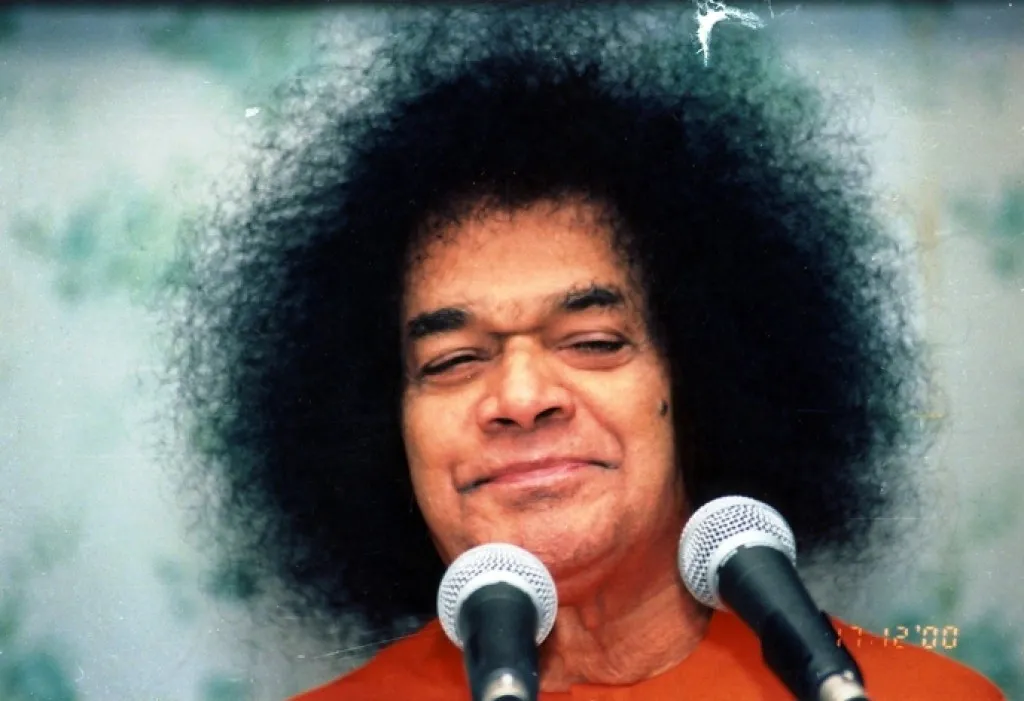
Shri Sathya Sai Baba sacred compassionate darshan photo
The Jagadguru Amidst Us - The Ultimate Fortune

Four-Fifths and One-Fifth

Four-Fifths and One-Fifth What does Sai Baba mean by saying that the search for truth is four-fifths self-inquiry and one-fifth meditation? What does God’s light mean? And what is meant by “not doing anything” about your faults and weaknesses when you discover them? The response to these questions will be what Baba Himself explains in various dis-courses. You yourself can turn up these same answers, if you watch for them. Self-inquiry is vital to your attempt to get what you want—the truth about yourself. A good point for starting self-inquiry is to ask how much you are awake and how much asleep. You may awaken in the morning half-drowsy. But you must fully wake up to the world around you and to your status in that world to behave effectively. Have you noticed that in doing some task, day-dreaming or thought-fantasy gets mixed with your concentration, so you miss something essential, and as a consequence errors creep in? Almost everyone has this experience and thus understands the need to wake up before making a move or an effort. It is the same in spiritual life. An inquiry or a doubt must arise as to whether or not you are cognizing and experiencing yourself and the world in a way that fully accounts for the actual situation. From this self–inquiry, there follows the perception of the need to question yourself and the world more closely. The Buddha, all by himself, relying totally on himself, made this inquiry and finally, while seated quietly under a tree, saw the truth of himself and the world as it actually is. Baba says that this cool, direct path of knowledge is exceedingly difficult. The meaning of self-inquiry, then, is to make an intentional and volitional effort to settle the doubt that you may still be, more or less, dreaming and therefore not seeing things as they really are. When the questioning and observing yourself and the world get under way, you soon realize that the world, the perceived, is not wholly independent of the perceiver. Therefore, an absolutely essential aspect of self-inquiry is to expose and reject faulty and incomplete views about yourself, no matter how strongly entrenched they are in your experience and how much they meet with approval. Whatever cannot stand up under intense scrutiny is rejected, and the inquiry continues. For example, the lifelong belief that the body and you are one and the same is, at best, an incomplete idea and inquiry must continue past that idea. In a very concentrated mode, this self-inquiryis represented by the “Who am I?” question of Ramana Maharshi (he lived into this century, as you know). Baba says that by itself this intense self-inquiry is not enough. The successful way includes some meditation. Then there is the devotional way of searching for the truth about yourself and the world. Either by means of intelligence applied to the problem or because someone you believe tells you, you adopt the viewpoint that duality is relative and that the ultimate reality of both yourself and the world is the omnipresent divine principle. When you take this path, self-inquiry means looking through every phenomenon appearing as yourself or as the world and conceiving God as the essential reality thereof. All of the above is what Swami is talking about when He says that inquiry is four-fifths of searching for the actuality of yourself and the world. In this search, you may decide to rely wholly upon your own intelligence and your own experience and to learn through trial and error—a process that is certainly valid. There are many self-made persons in the spiritual world. But it is common knowledge that in many fields of endeavor, if you can find a master in one of those fields and become his student, you will reach the goal more quickly. From this fact arises the need for a guru—one who is master in his field and who is willing to guide you so you may reach the goal without undue delay and avoid mistakes. The problem with gurus, according to Baba, is that nowadays, competent gurus cannot be found. Today, the only competent guru is God Himself. Baba says that if the true seeker prays to God for guidance, God Himself will appear as guru. Those of us who believe that Sathya Sai Baba is no other than the omnipresent Divine Lord hold on to His teachings with great tenacity. An important part of our daily self-inquiry is to ask ourselves if we are, in fact, putting Swami’s instruction into daily practice with faith and enthusiasm. As you study yourself, faults and bad habits come into view. Swami says that dwelling on your “bad side” is a positive hindrance to discarding the unreal and to revealing the basic unchanging reality. It is not that you should live complacently with your faulty nature, your imperfect personality, but it is that once the truth comes into view, untruth must yield. Swami asks, “Where does darkness go?” It does not go any place. Where there is light, there is no darkness. Swami, the Lord, is Himself light and love. Within the field of that divine light, your bad qualities—creatures of darkness—cannot persist and thrive. By taking the omnipresent God as the focus of your mind, emotions, and behavior, you have Him in you, beside you, with you, every moment of your life. Hold on to His light. Dwell in His light. Let the darkness of the past and the shadows of the present fall away. That is the answer you will find Swami giving to the second part of the question. If you watch for this answer as you read Swami’s discourses, you will find that He does give it again and again. ~John HislopSource: Sanathana Sarathi, Oct./Nov. 1980

Four-Fifths and One-Fifth Read Post »

Bhagwan Sathya Sai Baba meditation moment
The Jagadguru Amidst Us - The Ultimate Fortune

The Swing of the Pendulum

The Swing of the Pendulum Baba often uses the analogy of the swing of the pendulum to describe the state of our mind. In the interview room, He says with deep sympathy, “Your mind is like the pendulum; it swings from faith to doubt, and doubt to faith. At one time you have faith in Swami, and again this faith is followed by doubt! You vacillate! Learn to be steady in your heart,” smiles Baba. “Come, examine, experience, and then believe. But don’t lose faith merely because somebody says something. Don’t discount your own experience!” In the Gita Vahini, Swami says, “The weak will be agitated as peacock feathers; they are restless, with no fixity for a moment. They sway like the pendulum, this side and that, once toward joy, the next moment toward grief.” The pendulum is a very picturesque analogy of the human situation! It symbolizes the eternal problem of swinging from birth to death, the consequence of our attachment to desires. From birth we swing toward death gathering momentum from the cumulative effect of unfulfilled desires, only to swing back to another birth, back to where we started. Through our lives, we swing bet-ween grief and happiness, love and hate, heat and cold, anticipation and disappointment, peace and confusion, between the dualities of opposites. The Lord has said in the Gita about this swinging of the pendulum: “Sukha duhkhe same krutwa laabhaa laabhou jayaajayau…—Treat alike pleasure and pain, gain and loss, victory and defeat.” Baba reminds us that happiness is only an interval between two moments of misery; misery is only an interval between two moments of happiness. Once the pendulum swings forward, it must come back to its original position. “Grief and joy are the obverse and reverse of the same coin. It is like a printed page; you cannot have only one page without the reverse!” says Baba. The pendulum also signifies time. It is the movement of the pendulum that gives us a measure of time. God is described as kala-swarupa [embodiment of time]; He is also described as kalateeta, beyond time. What does this mean? Taking the analogy of the pendulum, it means that God is beyond dualities; beyond the swing of opposites; i.e. He is dwandwateeta! If we do not swing between the opposites, then we will not be subject to the bullying effects of time! So the only way to transcend the pull of dualities is to welcome neither happiness nor grief. In fact, Baba says, “Generally man seeks only happiness and joy; under no stress will he desire misery and grief! He treats happiness and joy as his closest well-wishers and misery and grief as his direst enemies. This is a great mistake. When one is happy, the risk of grief is great; fear of losing the happiness will haunt the man. Misery prompts inquiry, discrimination, self-examination and fear of worse things that might happen. It awakens you from sloth and conceit. Happiness makes one forget one’s obligation to oneself as a human being. It drags man into egoism and the sins that egoism leads one to commit. Grief renders man alert and watchful. So misery is a real friend… So, troubles and travails are to be treated as friends; at least not as enemies. Only it is best to regard both happiness and misery as gifts of God. That is the easiest path for one’s liberation.” The pendulum swings as long as the main spring is able to make it swing. Once we tighten the spring, it unwinds itself. The swing of the pendulum is a consequence of this unwinding process of the main spring. Thiscan be compared to human life. When we are born, the main spring is wound with the prarabdha karma,the karma that has to work itself out during the present life, which runs out as the spring unwinds itself! Most of the time, man does not realize that he is swinging because of the unwinding of the main spring of prarabdha karma. He even enjoys and grieves with the swinging of the pendulum. But man is not a mere clock, an unintelligent machine! The moment he realizes that the swing of the pendulum is the result of his prarabdha karma, then he can transcend the swing! He can swing but not take part in the joy and grief of the swinging. His problem is that he is not only swinging, but also identifying himself with the swing, thinking all the time that it is he who is responsible for the swinging. Themoment wisdom dawns on him, he can cultivate detachment. We may not be able to alter thecourse of events, butwe can certainly alter our attitudes to them. Paul Brunton, in his book, Message from Arunachala, says, “Even were we immutably preordained to undergo predicted disasters, our reaction to them is not preordained. Events may be fixed by unseen powers, but our attitudes toward them are not. This is the fire of wisdom that burns up karma!” We can take the analogy one step further if we think of an electric clock that we do not have to wind every week. We swing like the electric clock’s pendulum, thinking all the time that it is we who swing. We forget that we swing because there is a power that makes us swing. It is the divine power, which, like electricity, is unseen but active in and through us. Like puppets, we swing and dance so long as the sutradhara, the puppeteer, pulls the strings. “Surrender!” advised Krishna to Arjuna. “Surrender!” advises Sai Krishna to all of us swinging like the pendulum! “Man surrenders his dignity and status to other men for purposes in life like wealth, fame, possession, pomp, power, etc. But rarely does he get the chance to surrender to the Lord for the sake of the Lord! How can he get the urge as long as he craves for the aadheya [object] and not the aadhara [support/base]? How long can a base-less object satisfy? Manwants the gift, not the giver; the created not the creator; things from the hand, but not the hand! He is running after a non-existent thing. Can there be an object without

The Swing of the Pendulum Read Post »

Shri Sathya Sai Baba spiritual teachings photo.
The Jagadguru Amidst Us - The Ultimate Fortune

F. F. F. F.

F. F. F. F. Bhagavan Baba says follow the four Fs, which are Follow the Master, Face the devil, Fight to the end, and Finish the game. The following article illustrates that this is true in Christianity and in other religions. The first commandment of Swami is: “Follow the Master.” It is much more than a command. It is an assurance, a guarantee, a guideline, and reinforcement. Following the Master is not simplistic either. There are enemies built into our lives—physical and mental illnesses, lack of proper understanding, want of constant vigilance and awareness. We must not and cannot follow the Master mechanically or unintelligently. It has to be deliberate, spontaneous, and joyous, with every step placed on His footprints, advancing along the direction marked out by Him. The second command is a corollary of the first, the very purpose of that prescription—Face the devil. One cannot follow the Master without facing the devil, who tries to block every step of ours. The devil dispatches his most insidious lieutenant, no doubt to prevent our progress. Possessed by doubt, we begin to doubt our own experience, our own conclusions and convictions of the Master. We see footsteps other then those of the Master and waver in hesitation. The devil is anxious to nip in the bud our attempts to follow the Master, since the Master Himself reinforces us once we turn our faces toward Him. Though the devil and his minions try to lead us away, the Master whom we follow is sure to lead us on. Facing the devil and foiling its strategies become easier with the Master’s grace. Sri Krishna, as the charioteer of Arjuna, emboldened him to take up arms on the battlefield. He counseled him on critical occasions to face the enemy and overcome them. The Lord had in his hands only one weapon—the whip. He used it seldom on the horses and never on Arjuna. But His ridicule, repartee, and reassurance served to awaken Arjuna’s heroism and self-confidence. Swami has declared that He has taken on the role of charioteer for every one of us so that He may awaken in us the awareness of our innate impregnability. Swami does not wield even the whip. He has come with a disconcerting smile, an all-conquering love, and a penetrating and probing eye. While following such a Master, we can confidently face the devil and his ubiquitous throng. But if the Master’s call is sought to be interpreted and bypassed through the devil’s dictionary and logic, we are heading for a fall with our eyes open. When we are tempted to ask, “Why did the Master advise me so?” We have immediately to condemn the thought and pray to the Master to help us to keep the tempter away. The story of the temptation as recorded in the second chapter of Genesis is a warning to every one of us. Adam and Eve could not “follow the Master”, the Lord God, and obey His injunction: “You may eat from every tree in the garden but not from the tree of knowledge of good and evil, for, on the day that you eat it, you will certainly die.” The reason was the devil’s temptation. They had no strength to face the devil that came as a serpent and, as Eve confessed to God, tricked her. The devil has many tricks up his sleeve; and his words are soaked in sweet poison. But, the Master whom we follow will surely help us to escape his allurements. The Bhagavad-Gita describes  the nature of men who yield to the devil’s allurements and give up following the Master (XVI—8, 12, 14, 15, 16). The devil has succeeded in polluting their brains. According to the Gita: “They say that the world is without a presiding God, a basic overlord who adheres to truth. They ask, what else is there except lust? They are immersed in lust and anger and entangled in hopes and expectations. They are led away by pride to boast, ‘I am the Lord, I am powerful and happy. I am rich and well-born.’ The asura [demonic] qualities are judged as really beneficial and desirable by the victims. The Gita pictures their fate thus, “Maddened by many thought currents, caught within the snare of confusing values, addicted to lustful gratifications, such people fall into dirty hell.” No wonder Swami, in His infinite compassion, has given us the third Commandment: Fight to the end. Perpetual vigilance is the price for progress. The higher the climb, the greater the risk. The Master we follow appreciates single-pointed attention to the message He has condescended to give us. As the Bible advises, “Be alert! Be on the watch! Your enemy, the devil, roams around like a roaring lion, looking for someone to devour. Be firm in your faith and resist him, because you know that your fellow believers in all the world are going through the same kind of sufferings.” [1st Peter 5:8-9] Again, “God is our shelter and strength, always ready to help in times of trouble. So we will not be afraid, even if the earth is shaken and mountains fall into the ocean depths, even if the seas roam and rage and the hills are shaken by the violence.” (Psalms 46) “Fight to the end.” What exactly is the end that we have in mind through all the years of Following, Facing, and Fighting? Swami has denoted it by another F, the fourth: “Finish the game.” “Life is a game, play it,” says Swami. The world is the arena, the gymnasium, and the field for playing games. Every game has its own rules; respect them. Do not take to the game with fanatic frenzy. The victor in the game is rewarded by Him who sent you to play it and watched over your conduct until the final whistle. The reward is Himself. The ocean is the reward awaiting the river that does not stray into the Dead Sea but follows the call of the waves, faces rocky barriers, and leaps over precipices

F. F. F. F. Read Post »

Sai and His Students
The Jagadguru Amidst Us - The Ultimate Fortune

The Prayer that Baba Gave

The Prayer that Baba Gave At one of the sessions at the recent convention in Taupo, New Zealand, we were asked to discover the inner meaning of the words of a beautiful prayer that Baba gave us many years ago. To the great surprise of some of us, it was discovered that hardly anybody knew it. Nearly all Westerners know the ‘Our Father’ prayer, given by Jesus some 2,000 years ago. Even non-Westerners seem to have at least a nodding acquaintance with it. But even among Baba’s staunch devotees, few seem to know the prayers our present Avatar has given us. Of all the prayers He has given, this one is probably the most beautiful. As several people wanted me to put it in the newsletter, I give it here: Oh Lord! Take my love and let it flow in fullness of devotion to Thee.Oh Lord! Take my hands and let them work incessantly for Thee.Oh Lord! Take my heart and let it be filled with overflowing love for Thee.Oh Lord! Take my soul and let it be merged in one with Thee.Oh Lord! Take my mind and thoughts and let them be in tune with Thee.Oh Lord! Take my everything and let me be an instrument to work for Thee. There is a feeling among some people that prayer is inferior to meditation as a means of contacting God, because most prayers are an ‘asking’, whereas meditation is seeking to experience God in oneness. There is certainly some truth in this if all one’s prayers are requests for worldly benefits; but prayers like the above one are in a very different category. This prayer is the expression of our desire to reach total surrender. It is also a statement of the ideal to which we aspire, and a promise of the way in which we want to live our lives. There is also another important aspect to such prayers. If said every day, with full devotion and awareness of their meaning, they imprint themselves on our inner consciousness—our soul—and they slowly transform us. They can become an inner light that guides our life. They draw us, gently, into becoming an example of the true devotion expressed in the prayer. But, for that to happen, we have to be diligent in using the prayers as a tool for self-transformation. We must dwell mentally on the ideals expressed therein, and search for the inner implications of the words. Every word uttered by Baba has profound meaning, indeed, many levels of meaning; and we need to discover those meanings for ourselves, and allow them to work like a leaven in our inner consciousness. Here are just a few of the meanings brought out during the break-out session at the convention. Oh Lord! Take my love and let it flow in fullness of devotion to Thee. We must ask ourselves what we mean by “fullness of devotion”. Do we mean joining our hands together in our prayer room and contemplating on Baba’s photo? Swami says, “Only by contemplating on God can one become God”,but He doesn’t mean just the outer form of God. This is obvious from His insistence on the importance of the Gayatri mantra. In that prayer, He wants us to contemplate on the fullness of God in His concretized form as creation (bhur),God as the vibration that sustains that creation (bhuva),andGod as the infinite radiance (suvaha), the Paramatma [super soul], of which our own atma is an indissoluble part. Our contemplation should, therefore, result in our radiating the love that He is to all around us. Oh Lord! Take my hands and let them work incessantly for Thee. The word ‘incessantly’ is very revealing. He evidently doesn’t want us to take time off! If God is in everything and in everybody, working for Him obviously means being ever ready to serve—to serve Him in our family members, in the community at large and, indeed, in all living beings and creation itself. Service is love expressed in action. Oh Lord! Take my heart and let it be filled with overflowing love for Thee. ‘Overflowing’—that, too, is a key to the inner meaning. God, who is love, keeps telling us that we are also embodiments of love, and He wants our love to overflow toward one and all. Bhagavan constantly reminds us that “Expansion is life; contraction is death”. Resentment, dislike, anger, hatred—these negative reactions to situations and people have a contracting effort on our souls. They strangle the life out of the divine spark of love in us. As the song says, we must ‘expand our hearts to encompass all.’ Oh Lord! Take my soul and let it be merged in one with Thee. We often think that we can only merge with God once we are no longer in the body, but this is not so. We need to leave our attachment to the body, but that does not prevent us from walking around in it. If we can train ourselves to live in the moment, not constantly in the past or in the future, we will feel the constant presence of God. Baba says, “the present is omnipresent,”it is the Divine presence. If we walk always in that presence of God, our soul will be merged in that Divine presence. He wants us to aim at experiencing unity with Him, not just in the hereafter, but in the here and now. Indeed, unless we can achieve that oneness while still in the body, we are not yet ready to merge when we leave the body. As He says, “only like can merge with like.”It is a very high ideal that this prayer holds before our souls! Oh Lord! Take my mind and thoughts and let them be in tune with Thee. Yes—that wayward mind! We need to constantly ask ourselves, “Are my thoughts in tune with Baba’s teachings? Are they based on truth? Are they loving? Do they promote peace?” If we are mentally criticizing the actions of another, our thoughts are promoting discord, not peace. Even if we do not actually

The Prayer that Baba Gave Read Post »

120956577Bhubaneswar Mukteswara temple Main
The Jagadguru Amidst Us - The Ultimate Fortune

His Touch that Purifies

His Touch that Purifies The late Charles Penn was an ardent devotee of Bhagavan Sri Sathya Sai Baba. He often received messages from Baba during his meditations, which he shared with fellow devotees. The following piece is one such lesson from Baba. This morning, long before His bright light [Sun] appeared over the horizon, this devotee with the heart filled with ananda [bliss] received a beautiful lesson from Bhagavan Sri Sathya Sai Baba. Sharing it with you is a joy. In the midst of my dhyana [meditation], Babaji let me “see” Him on one of His frequent visits to hospitals. The scene was the waiting room. Actually it was a widened hallway with new patients sitting on each side. Although suffering, they patiently awaited their turn to see the doctors. Babaji, who did not appear to be visible to the patients, walked in front of each and touched their hands. I asked Him why He did that. “These patients come for treatment. They know of only one kind of treatment, the kind that can be seen. A wound healing! Limb mending! A disease being routed! My touch also heals. Most times, it is not felt by the patient engrossed in body pain. I pour purity into their bodies. It is a `charge’ that cannot be seen. It can only be felt by one who has risen above mortal fears, one who has commenced to release himself or herself from bodily demands influenced by a diseased mind,” Baba kindly explained. “Swamiji, you said that you pour purity into their bodies. Please, tell me more about this ingredient to better health,” I asked yearningly. “Charles, you know well that pouring clean water that is free of impurities into the vessel containing muddy water will in time make the water in the vessel all clean. And so also with the body [vessel] the purity I pour in to skim off the debris will, given the chance, rise to the ‘surface’,” Baba softly answered. “Swamiji, are there other ways to take in your purifying power?” I asked further. “Your eyes can gather this treasure at every turn. Your recognition of purity in others brings into yourself a like amount of the purity you see,” He answered. “How else can one gather up this treasure, Swamiji,” again I asked. “There are many ways to load your chariot with Me, more than I could hope for you to learn in one lifetime, Charles. Seeing purity in all actions of others is wonderful to experience. But even more is knowing that all actions, regardless of their kind, contain elements of purity. Even actions that are foul and bitter and full of suffering contain purity,” He patiently replied. “You mean, Swamiji, that one writhing in pain, even self-inflicted, is purifying himself?” I enquired. “Yes, Charles, but such a one, while striving for the goal of final purification in the world, knows no other way to reach the clouded goal. He endures mortal pain. No matter how many times such a seeker takes this path to Me, he will fail if he destroys his body, his vessel. He merely rids himself of the one means of traveling toward Me.” “Now the one who strives hard to rid himself of impurities by pouring clean water into his vessel will begin to feel different—uplifted. He feels released from the draw of earthly things and desires. By continually practicing walking along the pure path, he will enjoy shanti [peace] and in time, his round of births and deaths will cease. He will find that even the remaining time he has for using the human vessel will be filled with ananda [joy]. He will not even want time ever to pass swiftly for he also has great joy here on earth. In fact, such a one has attained immortality upon earth,” Swamiji continued. “You have often told about the crossing of the Ocean… Can you tell as to how long such a voyage takes?” I asked Him. “When the vessel is on course and you have acknowledged Me as the Master, the crossing can come in a flash, for time is a man-made expression that is not relative to My creation. That which I created in a flash—all the universes—can complete it instantly [the crossing]. For where do you `travel’ to? You are already there, are you not?” He patiently explained. “All too often, though, a soul seasoned by many journeys in the `body vessel’ almost reaches the other side, but runs aground in the midst of the great calm. The vessel runs aground on unseen reefs. Just a little more guidance and vigilance would have brought the vessel safely to the shore-line.” “Once your sails are filled with the breeze, don’t waver on the course even when a peaceful island is located on the horizon. I will be your wind, your sails, and your rudder as long as you need Me. One touch of My hand, Charles, purifies the `sailor’ and strengthens him!” Babaji sweetly concluded. ~Charles Penn, Los Angeles, California, USASource: Sanathana Sarathi, Feb. 1968

His Touch that Purifies Read Post »

Har Ki Pauri Ganga Temple Haridwar
The Jagadguru Amidst Us - The Ultimate Fortune

Life’s Pilgrimage

Life’s Pilgrimage The author entreats the readers to abide by Sri Sathya Sai’s spiritual guidelines as closely as one follows traffic signs for a safe and successful trip.  Life, according to Bhagavan Baba, is a pilgrimage from the ‘I’ to the ‘We.’ In other  words, it is a spiritual journey from separateness to togetherness, from the vyashti (particular) to the samashti (universal), from bheda (differentiation) to abheda (non-differentiation), from dvaita (duality or diversity) to advaita (non-duality or unity), from selfishness or lovelessness to selflessness or universal love, from the transient finite self to the real infinite self, from mrutyu (mortality) to amruta (immortality), from viyoga (separation from God) to yoga (union with God), from the status of jivatma (individual soul) to that of Paramatma (Supreme Soul). If this is so, how well are we equipped for this journey? We find the answer to this question in the Katho Upanishad [a Hindu scripture], which employs the example of a chariot to explain this pilgrimage. According to the treatise, the jivatma [individual soul] undertakes the pilgrimage toward the Paramatma in the chariot of the body, with the buddhi (intellect) as the charioteer, the mind as the reins, and the senses as horses. Baba uses a more modern example—the automobile—to drive home the message of the Upanishad. The human body is the vehicle; the intellect is the driver; the mind is the brake; and the senses are the wheels. Shreyas and preyas The purpose of this example is to show that if the senses are under the control of mind, the mind under the control of the intellect, and the intellect under the control of the jiva [individual], the latter will be able to complete his pilgrimage quickly and safely. In the scriptures this is called nivritti marga (the path of internal sadhana). It is also known as the path of shreyas (what is beneficent). In contrast to this, if the chain of commands and controls operates in re-verse, with the senses dominating the mind, the jiva would be involved in accidents and departures from the right path, resulting in hold-ups and delays in the completion of the pilgrimage. This is designated as the pravritti marga (the pursuit of the external). The scriptures have termed this as the path of preyas (the apparently pleasant). Bhagavan often cautions devotees: “Start early, drive slowly and reach safely.” Many of us have the wrong notion that we can or should start the spiritual journey only in our old age. But Bhagavan has insisted that if people are to be placed well and truly on the spiritual path, you must “catch ‘em young.” The truth of this is exemplified in the global Bal Vikas [Sathya Sai education program] movement initiated by Bhagavan and the way Swami teaches students in His education-al institutions. Children are introduced to a life of the spirit from a very early age. They are inspired by the message of the Vedic [Hindu scriptures] hymns and the slokas [verses] in the Bhagavad Gita [the divine teachings of Lord Krishna]. It is indeed thrilling to watch the young children enrolled in the Primary School at Prasanthi Nilayam reciting stanzas from the Upanishads and the Gita. Swami’s advise to drive “slowly and safely” is as relevant to spiritual travel asit is to journey by road or rail. Practice of intense austerities for quick results can at times cause mental derangements. “Stop and proceed” is another common traffic sign that can be applied to the spiritual path. Swami advises us to ask ourselves, “Where am I now?” “Whither am I bound?” “Which way should I take?” etc. “Don’t follow hastily the wayward suggestions of the monkey-mind,” cautions Baba. He adds: “Subject those suggestions to thorough scrutiny by the intellect and the heart before you proceed further, thereby avoiding pitfalls in the spiritual path ahead.” “Less luggage, more comfort, makes travel a pleasure,” says the ubiquitous slogan posted on the Indian trains. Baba tells us that if we want to have a comfortable spiritual journey, we must learn to travel light by jettisoning the unwanted luggage of excessive desires. “Properties are not proper-ties,” quips Swami. Hence, His emphasis is on tyaga (renunciation) as the essential element in spiritual sadhana. He recommends moderation in everything—moderation in food, in speech, and in personal possessions. He disapproves wastage of any kind—of food, money, time, and energy. “Come to Me, now and then, for re-charging your battery,” Swami urges us because nothing can boost the energy and enthusiasm of a spiritual aspirant as much as contact with Bhagavan, and the company of His devotees. Owners of cars routinely send their vehicles to the work-shop for overhaul and repairs. Similarly, Swami says that, whenever He feels it necessary, He sends His devotees to the workshop of trials and tribulations in order to toughen them, and make them road-worthy to continue their spiritual journey. “Road under repair; use the diversion,” is a familiar traffic signal. Swami cites this as an analogy whenever He avoids or ignores a devotee for some time because of some lapse on the devotee’s part that needs some introspection or atonement. Finally, Baba gives us a yardstick by which to judge whether we have successfully completed the pilgrimage of life. If we who cried koham (who am I?) at the time of our birth can emphatically answer that question with Soham (I am He) at the time of our passing, then according to Baba, we have reached the goal. Needless to say, we can attain this consummation if we follow the aforesaid traffic guidelines Bhagavan Baba has put forth. However, it can hardly be denied that most of us falter and stumble in our life’s pilgrimage because of our inability to adhere strictly to His guidelines. So, Swami advises us, “Hand over the reins of your chariot, or the steering of your car, to Me, giving no room for any doubt, fear, or anxiety; and I, the Sanathana Sarathi [the eternal charioteer], will certainly lead you to victory, as did Krishna in the case of Arjuna [Krishna’s devotee and one of the Pandava brothers].” ~Dr. A. Adivi ReddySource: Sanathana Sarathi, March 1988

Life’s Pilgrimage Read Post »

Bhagwan Shri Sathya Sai Baba spiritual guidance
The Jagadguru Amidst Us - The Ultimate Fortune

Our Beloved

Our Beloved The full, cosmic, universal being descends into the human form, the Avatar, the scriptures declare. But we need to understand the word in the right perspective. What induces the Most High, the Universal Mind, the Transcendent Will, to come down and engage Itself in limited conditions for the betterment of mankind? What makes Him endure neglect, calumny, doubt, and denial that blindness dare heap on Him? It is His compassion. The Avatar comes prompted by compassion and lives as the embodiment of compassion. It flows in every word and act of the Avatar. Baba has declared, “When I am alone, I am God.” Keep in mind this declaration while listening to the following incident: Once during [the festival of] Dasara, while the Bal Vikas [Sai spiritual education] children were enacting a play on stage, Baba, seated among the devotees watched the kids sing and dance. Noticing that it was pretty warm in the midst of the crowd that had packed the auditorium, one devotee began fanning Baba rather vigorously with a borrowed fan. Apparently unconcerned, Baba sat through this for a few minutes. Then He suddenly turned round, and with a charming smile He took the fan from the devotee’s hand saying, “I have come to do your seva [service]; why should you do My seva?” Now, how do you react to such a God? Bhagavan is a compassionate parent, not a distant formidable God almighty. Can we afford to install Him in a temple, anoint Him as the omnipresent, omniscient, omnipotent Lord, and keep Him away from our hearts and homes? Do you think He would love to stay in a lordly mansion with candelabras and carpets (for He is God almighty)? Wouldn’t you rather have Him in your own home, though it may be an unimpressive cottage? He has come to give the drooping eye a little light, the broken heart a little joy, the failing limbs a little more endurance, and the lost spirit a little love. He says, “My son! You complain that I have a hard heart. You say I do not care for your tears. But when you weep, I weep; when you are happy, I am happy. I am fed when you are fed.” Here is a God who is our kith and kin, aware of the joys and grief of imperfect men, understanding our loves and frustrations, dreams and aspirations. He asserts that man can realize his truth by involving him-self in loving service of fellowmen. He admonishes us, “What sort of God are you seeking in temples while on your streets thousands of living gods invite you to worship them with your seva?” He does not tell an erring man, “You are doomed; you are a sinner.” If a man insists that he is a sinner, He says, “No, My boy. There is nothing like sin. You have only erred. The moment you repent, I pardon you. I shall take your word that you will not repeat the error again.” To the members and office bearers of the Seva organization bearing His name, He says, “Nothing pleases Me, no dhyana [meditation], no tapas [penance], no scriptural studies, nothing…. as service of man. In your impatience if you speak an angry word to someone you cannot tolerate, you say it to Me.” How often He has said, “I do not want you to cringe before Me, I want that you should demand grace from Me as a child does from its parent.” It is not the elaborateness of the worship that pleases Him; it is the love and sincere friendliness of a pure heart, a Partha’s (another name for Arjuna) love. He does not build caves or monasteries or academies to teach men the way to blessedness; for Him blessedness lies in our feeding a forlorn brother or sister, in our taking the hand of a blind fellow-traveler, in our shedding love into a castaway heart. He does not lead us to dusty debates on scriptural texts; instead He shakes the dust off the scriptures and asks us to recollect that the “proper study of man is mankind.” All these centuries we worshipped a strange God high up in the heavens or far in the interior of temples, and we banished brother man from our minds and thoughts. Consequently, instead of building up a prosperous, just and happy world, we have thrown the world helter-skelter. We do not see the tender sunlight playing on our doorstep; we imagine the sun far over the distant hills. So the sun has come to persuade us to look down and admire the beautiful strips of warm light that are lying in wait. Today Baba is the supreme lover of man, the beloved of every one of us. He is the greatest evangel of humanism, for He asserts that the human is not a whit less than the Divine. His pronouncements are not like the distant thunder, which makes us cower in fear. They are like the frag-rant breeze that blows around us, gently inviting us to come out of our petty selves and grow as large as the sky, as warm in generosity as the morning sun, and as lovely as the dewdrop. Our beloved Lord does not want to blind us by miracles; He wants each of us to shine as a miracle. He does not want to make us small by His Himalayan height; He stands with us on the same ground to lift us to Himalayan heights. He opens our vision to the spectacle of our innumerable brothers and sisters jostling around us for a whiff of divine grace, and He shows us that He is the innermost core of every one of them. According to Him, the world is not a place to run away from. It is an arena for service and sacrifice, for work and worship. He is the Divine Being born as man for the love of man. He has never slept all these years, never eaten what we would designate as a meal. He is incessantly engaged in correcting, consoling, and counseling


Our Beloved Read Post »

jagat ambika mata temple udaipur rajasthan 1
The Jagadguru Amidst Us - The Ultimate Fortune

Baba on Hanuman’s Greatness

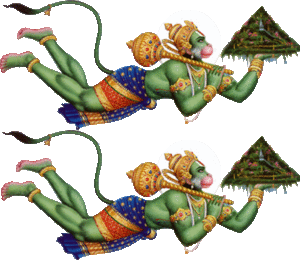
Baba on Hanuman’s Greatness Sri Anil Kumar, the official translator of Bhagavan Baba, asked Swami the following question:  Swami! In the [epic scripture] Ramayana, the role of Hanuman is very prominent. He is the best example of dasyabhakti—devotion of a loyal servant—one of the nine paths of devotion. We are so fortunate to hear from You about the devotion of Hanuman. Would You kindly tell us how modern youngsters can emulate his example? Bhagavanenlightens us with the reply: “Hanuman is known for physical strength, intelligence, perfect character, and scholarship. Yet, do you know what he said when he entered the court of Ravana? While introducing himself, he said, ‘dasoham Kosalendrasya, [which means] ‘Iam a servant of Rama.’ The position of a servant of Rama was a matter of pride and prestige for Hanuman. Rama asked the vanaras [monkeys] who among them could cross the ocean and go in search of Sita. One of them said that he would be able to cross 10 kilometers, another said 40 kms, but none could say that he could jump 100 kms across the ocean. Then Rama asked Hanuman, “Can you do it and successfully return after finding out where Sita is?” Hanuman replied, “Yes, I will.” Rama then said, “Hanuman, you have had no experience with jumping across a vast sea. You have never even seen Sita to identify her now. Then how do you say so confidently that you can cross the mighty ocean in search of Sita in Lanka, find her, and return?” Hanuman replied, “Swami! Would You not give me the needed strength, capacities, and abilities to fulfill the mission You have assigned to me and then command me to fulfill it? With Your blessings and invincible will, wouldn’t I accomplish what I am supposed to?” Such was the intensity of his devotion. Youngsters should follow God’s command unhesitatingly. They should never doubt, question, disobey, or criticize it. Strict obedience to the divine command is called surrender. When you develop this kind of surrender to God, you are bound to succeed. While crossing the ocean Hanuman displayed courage and valor par excellence due to his deep devotion to Rama. Mount Mainaka prayed to Hanuman to rest on his peak on the way to Lanka. Mainaka wanted to take this opportunity to express his gratitude to Vayu, the wind God and father of Hanuman, who had saved him earlier. But Hanuman politely rejected the offer, saying that he wouldn’t rest until he had completed the work that Rama had assigned to him and that he would oblige Mainaka on his return. He, thus, gave top priority to Rama’s mission. It was his confidence born out of devotion to Lord Rama that made him cross a vast ocean. Following Rama’s command, he won His grace. Usually a monkey is noted for its unsteady and wavering mind, but by surrendering to Rama Hanuman’s mind became absolutely steadfast. Hanuman was firmly fixed in his devotion to duty, and that is exactly why he is worshipped today. At the time of his coronation toward the end of the epic, Rama was distributing gifts to all His subjects. But he did not give any present to Hanuman. So Sita asked softly, “Lord! Have you forgotten Hanuman? How is it that you have not given him any gift?” Rama smilingly said, “Sita! It is true. I want you to present him with any gift of your choice.” Then Sita gave Hanuman her own pearl necklace. But Hanuman started biting every pearl in the necklace, breaking it off, bringing it close to his ear, and then dropping it on the ground. Watching this, Sita said “What! Hanuman! You have not given up the habits of a monkey. What are you doing with the pearl necklace I presented to you?” Hanuman replied, “Mother! No doubt you have given me a most precious pearl necklace, but I want every individual pearl of the necklace to resonate with the sound of my Lord Rama’s name. Therefore I am testing every one of the pearls by breaking it first and then keeping it close to my ear to check for the sound of the Lord’s name. I am throwing the pearls out one after another as I don’t hear His name in any of them.” Nothing in this universe is more precious than the sacred name of God, Rama. The whole assembly was adjourned for the day. Rama retired to His bedroom and Sita was following him when lo and behold! Hanuman, too, started making his way there. Rama asked, “Hey Hanuman! What are you doing here?” Hanuman replied, “Lord! Sita is following You. So I am also coming to You.” Rama said, “Anjaneya [another name for Hanuman]! Look! Sita has vermilion on her forehead, which qualifies her to get into my bedroom.” At this Anjaneya left the place and returned after some time. He had gone around all the shops, collected kumkum (vermillion), applied it all over his body and now stood before Rama. He said, “Oh Lord! Just for the simple reason that Mother Sita has a dot of kumkum on her forehead, You qualified her to enter Your bedroom. Now look! I have this sindura [vermillion powder] all over the body. What do You have to say now?” That was the standard of his devotion and his determination always to be with God. On another occasion, the three brothers of Rama met, discussed, and distributed among themselves all the duties they personally had to do while attending on Lord Rama. Hanuman noticed all this and finding that he was left without any duties to his lord softly asked them, “Sir! When the lord yawns, there is a need for someone to click their fingers and make a snapping sound befitting His royal status. We do not know when He might yawn, so I should be with Him at all times.” So Hanuman had to be in the company of Rama while His brothers could attend to Him according to duties they had taken upon themselves at different times. Thus Hanuman

Baba on Hanuman’s Greatness Read Post »

Sathya Sai Baba message of truth
The Jagadguru Amidst Us - The Ultimate Fortune

Hard Nuts to Crack

Hard Nuts to Crack As compared with the previous three yugas (ages), the people of the current Kaliyuga (literally, the age of wickedness) are more difficult to impress. They have strayed too far from the divine path; even children are not easy to convince. In an age of much skepticism, to see countless people, including many intellectuals, devoted to Bhagavan Sri Sathya Sai Baba is miraculous. They come from all areas of the world. It is impressive that despite their diverse religious origins and positions in life, they have responded to the call of the Avatar. An old Hindi couplet expresses this well: Kahe ke eent kahe ka rorabhanumati ne kumbha joda It means “Bhanumati, used a brick from somewhere and a pebble from somewhere else to erect a pillar.” Sathya Sai Baba has united all humanity into a spiritual family. This, in large measure, is the result of recognition of His divinity. No other Avatarhad been widely acknowledged as such during His lifetime. Lord Rama’s [the Avatar of Dwapara Yuga] divinity was known only to the saptarishis [the seven immortal sages recognized in the Hindu scriptures]. Rama’s mission to rid the world of a tyrant [Ravana] required Him to keep His divinity under wraps. Likewise, Lord Krishna’s [the Avatar of Treta Yuga] divinity was known only to a few members of His immediate family and a handful of devotees. He had to wage many wars throughout His lifetime, and it was centuries before His divinity became widely acknowledged. Unlike the other Avatars, Sathya Sai Baba has come armed only with the lamp of love and the sword of truth. With these He has touched millions of people and drawn them to Himself. Countless books detailing experiences of devotees worldwide have been published. These anecdotes show how Baba has responded not only to prayers of people in agony, but even the so-called atheists.  His timely help comes unasked. In these self-centered, materialistic times, people are wont to be skeptical about lending a hand to the needy. Yet so many devotees come to Prasanthi Nilayam [Baba’s residence in southern India] just for the privilege of serving as volunteers at Baba’s ashram. They all have a story to tell, and I am no exception. Swami had plans for me long before I heard of Him, but I wasn’t an easy job. As the only child of highly educated parents, I was a hard nut to crack. After completing my medical training in India, I was selected by the Nigerian embassy for the post of a gynecologist. I was to work with the assistant professor in a medical college in Nigeria. It was there that a dramatic incident opened my eyes to Swami’s divinity. I had recently been pronounced a rarity as the Nigerians generally preferred their own doctors over foreigners. About 11 a.m. one morning, a lady came into the hospital with a ruptured uterus. The baby had died inside the womb, and so I had to immediately operate on her. Her blood pressure was low even when she arrived, but after the surgery it dropped further to 80/60. All our efforts to bring it up were in vain. Although the staff worked until midnight, she had not come out of anesthesia, nor was there any change in her low blood pressure. Little did I know Swami would use this event to bring me into His fold. I had recently started to attend a get-together every Thursday evening with a group of other Indians living in Nigeria. Every family brought a dish, and so I joined the gathering to enjoy the company and the delicious food. During one such gathering, one of the men who had just returned from Prasanthi Nilayam had brought with him some vibhuti [sacred ash], which he distributed among the guests while mentioning that it came from Sathya Sai Baba. As the condition of my patient seemed hopeless, it struck me that I should give her Baba’s vibhuti as a last resort. It was after midnight when I took the vibuthi and made my way to the hospital. My mother came along to stand guard at the door so I could administer Baba’s “medicine” in privacy as the hospital staff would not appreciate this remedy. Mentally, I told Baba that I was referring the case to Him. I felt that if the patient was meant to die, she would have done so already. Thus entrusting her in Baba’s hands, I went home and slept soundly. Well, the miracle did happen. Despite 13 hours of post-operative shock, the patient recovered completely. This miraculous cure worked as a visiting card from Baba, the Divine healer. I went to see Him on my return to India. This doctor, who came to investigate, was conquered and remained to serve at the Divine lotus feet. During my 30 years of service to Him, I have personally witnessed countless miracles. Appropriately an old Indian saying goes, “Naam na pucho sant ka, dekho us ke kaam,” meaning: “Do not ask the name of the saint, see his works.”  A saint feels the agony of the whole world. Tulsidas [a great poet and saint] has said, “Sant hridaya navneet smaana” and “Sare jahan ka dero mere jigar me hai,” meaning: “A saint’s heart is soft like butter,” and “The whole world resides in my heart.” How much softer then is the heart of Swami who is God Himself? The numerous service projects that he has undertaken show His ceaseless efforts to relieve human suffering. What the government with all its finances, material resources, and manpower could not accomplish, Swami has. The Super Specialty Hospital [in Puttaparthi] was completed in just five and half months; mammoth water projects are now quenching the thirst of millions; and the Sri Sathya Sai universities are shaping the characters of the future leaders of the country and the world. An invocation from the Bhagavad Gita [scriptures] says, “He makes the dumb speak; and the lame climb mountains by the grace of Lord Krishna; to Him I bow.”  Today we see all this work done by Sai Krishna

Hard Nuts to Crack Read Post »