




Hari Om

Menu

The Avatar as Guru & Guide

Sathya Sai Baba divine presence image
The Avatar as Guru & Guide

Divine Trainer’s Drama Directions – By Prof. Siva Sankara Sai

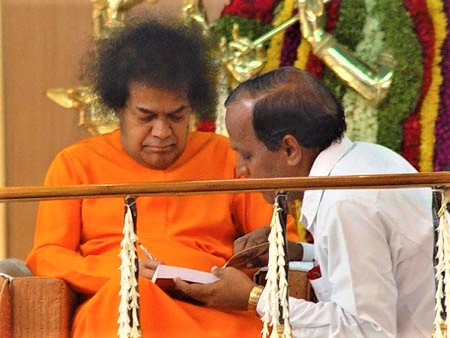
Divine Trainer’s Drama Directions – By Prof. Siva Sankara Sai Bhagavan is everything for His students. He is a friend, philosopher and guide. In the education that is imparted in His University, He is the inspiration, goal and guide of every single activity. Even though we may consciously know this or not, I have found this to be true. Sometimes, when we detach ourselves and see the way “His Will” flows, then we become awestruck and feel supremely blessed to be part of that grand plan. Celebrating cultural events are an integral part of Swami’s education system. Swami defines culture as a way of life. He has come down to revive our sacred Bharatiya Culture. Swami used to encourage students to develop the talents of ‘acting’, ‘music’, ‘dance’ and ‘art’ along with secular education. After all, these are the ways our lovely culture was propagated for thousands of years. Each generation adds its own flavour and beauty to this great Indian culture and thus embellishes it further. In Swami’s Hostel, dramas, dance, art & music are positively encouraged, nurtured and fostered. Swami provides a number of opportunities to the students for developing these qualities by putting up various dramas in His Divine Presence. I would like to relive one such occasion where I saw Bhagavan personally involving Himself completely with the students’ drama, in spite of His busy schedule and gave us the joy of His Divine intimacy and Directions. It was the year 1987; Swami had decided that the students should put up a drama on the life of Markendeya to emphasise the devotion of young Markendeya to Lord Shiva. One day in the month of October that year, Swami called me and Sri Ram Mohan Rao sir along with a few students and explained to us the story of Bhakta Markendeya. He highlighted the qualities of young Markendeya, especially, his humility and obedience to the words of his parents. Swami also highlighted the steady and unwavering devotion of young Markendeya to Lord Shiva. He told us that if we put up a drama with this theme, it would be an inspiration for all the young students. Then He instructed us to write the dialogues of the drama based on what He mentioned and show to Him. We were overjoyed at this unique and rare chance. Ram Mohan Rao sir, being a good speaker both in Telugu and English, and also a lecturer in English literature, wrote the draft of the drama script. We both fine-tuned it to our level best as per the story and directions given by Swami and got the script ready to be shown to Swami. To our luck, after three days, Swami called us for an interview along with a few other students. He asked, “Enna Samacharam?” (What’s the news?) When we mentioned that the draft of the drama script was ready, He immediately listened to the entire script and gave a few suggestions and asked us to incorporate them. He polished certain sentences and corrected a few factual details. He stressed and drilled one very important point into our heads – when we are on the stage to enact a drama or skit, the entire attention of the eyes, ears, and mind of the audience is on us. Hence, what we speak and act is observed by a thousand minds, two thousand ears and two thousand eyes. Hence it is extremely important that what we say and do should be of high standard, inspiring and exemplary to the people.  Swami was very particular that negative emotions, negative feelings, negative words and actions should be avoided or minimal (if we cannot avoid them completely due to the theme chosen). In the script of the Markendeya drama, we had introduced the conversation between the two soldiers of Yama very elaborately, to lighten the very sombre theme. The next day, Swami called us for an interview and reviewed our progress in writing the script. He liked the first part and approved the script of the first part. But, in the second part, Swami objected the conversation between Yama’s Kinkaras (Yama’s minions) that we painstakingly introduced.  He told us that the Yama’s Kinkaras’ scene should not be made light or loose, like in films. He corrected us and mentioned that even humour can be there to lighten the mood, the drama should be of high standard and not cheap, as is commonly done. Especially in a spiritual theme, wherein the devotion is highlighted, we need to be extra careful to give proper emphasis to various emotions. Swami said that, our mind is so fickle that, inspite of many good things depicted in the drama; our mind gets attracted towards the negativity and tends to retain the negative dialogues and actions in the drama more than the moral of the drama itself.  Thus the script of ‘Markendeya’ drama had to undergo many changes to conform to the Divine standard. It was a great revelation for us to know the absolute and benchmark standards of our Divine Director. It need not be mentioned that the drama was a success because the Lord Himself became the script-writer and trainer. All of us were lucky because the Eswara whom Markendeya was praying for his life, was the one who directed all aspects of the drama. – Prof. Siva Sankara Sai Student and Research Scholar (1982-1989), Department of Physics Warden (1994-2011), Sri Sathya Sai Hostel Currently, Dean of Sciences Sri Sathya Sai Institute of Higher Learning Prasanthi Nilayam

Divine Trainer’s Drama Directions – By Prof. Siva Sankara Sai Read Post »
Bhagwan Shri Sathya Sai Baba blessings image
The Avatar as Guru & Guide

Golden Jubilee Birthday Celebrations and Message of Sri Sathya Sai

Golden Jubilee Birthday Celebrations and Message of Sri Sathya Sai The 50th Birthday celebrations were held at Prashanti Nilayam between 14th and 24th November, 1975. The All India Sathya Sai Seva Dal Conference (3rd) and the All India Bal Vikas Gurus Conference (3rd) were held at Prashanti Nilayam on 15th, 16th and 17th of November. The Rathotsavam started from Prashanti Mandir at 8.30 am on the 18th morning. Chandi Yaga was performed in the Divine Presence from the 19th to the 23rd of November. Swami performed the Poornahuti of the Yaga on 23rd morning. The 2nd World Conference of Sri Sathya Sai Organisations was held in the Divine Presence at Prashanti Nilayam between the 19th and the 21st of November, 1975. A rally by the Bal Vikas students was held on the 22nd. At the conclusion of the World Conference on 22nd November, Swami nominated the following members as the Members of the Governing Body of the World Council of Sri Sathya Sai Organisations: Sri Indulal H. Shah, Dr. J. Hislop, Dr. K. Pani, Sri S. Sitaram, The Rajmata of Navanagar, Dr. Bhagavantam, Sri Sohanlal, Sri Balesingham and Mrs. Natalie Santos. Swami blessed the devotees with His Darshan from a helicopter on 23rd morning. When the helicopter landed, the Chief Minister of Andhra Pradesh, Sri Vengala Rao received Swami. Swami accompanied by the Chief Minister then moved in a procession to the Sarva Dharma Aikya Stupa. The Stupa was then inaugurated by the Chief Minister. On 23rd evening, Members of Sathya Sai Central Trust; the State Presidents of Sri Sathya Sai Organisation from India and all over the world; Sri T. A. Pai, Minister for Heavy Industries and Civil Supply; Sri Subbarayudu and Sri Sagi Suryanarayana Raju, Ministers of Govt. of Andhra Pradesh; offered their homage at the Lotus Feet of Swami at Poornachandra Auditorium. Swami then delivered His Birthday Message. He said:  “A person who has mastered-Vedas (ancient spiritual revelations) and Vedanta (metaphysics of the Supreme Reality) might be honoured as a Pandit (learned scholar). Another might be praised for his brilliant writings in both prose and verse. But if such scholars have neither purity of consciousness nor elevating Ideals, their capacities will result in more harm than good. They will promote neither happiness of the people nor peace in society. They will pass through life without the awareness of its sanctity or sublimity. The Lord blessed the boy Dhruva, appreciating his Innocence and his steadfast faith in Him. The Lord saved Prahlaada from direct disasters planned by his own father, for the boy had surrendered to Him and placed unshakeable trust in His Mercy. The Lord showered Grace on Kuchela who suffered from agonising poverty because he never once faltered in his devotion to Him. The Lord is the refuge of all who seek refuge, the saviour of all who have to be saved. He is the Embodiment of Sat-Chit-Ananda (Being- Awareness-Bliss Absolute). He is now at Puttaparthi as the Effulgent Emperor over the region of Truth, Goodness and Beauty. Today man’s behaviour is really artificial Life sustained by food is short; life sustained by the Aatman (Divine Spirit) is eternal. Do not lay claim to long life, but to Divine life. Do not pine for more years on earth, but for more virtues in the heart. The Buddha knew and made known to the world the truths: Everything is grief. Everything is empty. Everything is brief. Everything is polluted. So the wise man has to do the duties cast upon him with discrimination, diligence and detachment. Play the role, but keep your identity unaffected. Have your head in the forest ashram (retreat), unaffected by the aimlessly rushing world. But it is your duty, a duty you cannot escape, to fully engage yourself in your work, unconcerned with loss or gain, failure or success, slander or praise. The Geeta instils this very lesson In you: “Whoever does Upasana with no thought other than Me, him I shall have with Me; I shall bear his burden now and forever.” The Geeta says, “Keeping Me ever in memory, engage yourself in the battle of Life.”  This ‘Me’ to which Krishna refers is not something outside you or extraneous to you. It is your own Divine Reality which you can cognise in the silence of your own Dhyana (meditation), when you shut out of your awareness the distraction of the senses, the mind and the ego. You can take refuge in the calm coolness of your heart where He has installed Himself as the Charioteer. You must only engage yourself in work that is purifying, with an attitude that sanctifies. Most people do not know how to set about on this most rewarding adventure. They waste their lives in sorrow, wading through disappointment and despair, for they cling to something as theirs and treat something else as belonging to others. They grab and grieve, and labour to acquire and lose. Desire multiplies desire, and man sinks deeper Into discontent and distress. The behaviour is really artificial; it does not conform to man’s real nature, the prompting of his Atman, which is Divine. In the universal, eternal sea of change, the Atman alone is above change. All differences are apparent, not real In creation, in the objective world, no one article is like any other. No two human beings are similar in every respect; there is some twist or turn which distinguishes one from the rest. Each has his own peculiar experiences. Immense diversity prevails. Nor is an individual the same for any length of time. The infant changes into a child, then into a boy, an adolescent, an adult, and soon becomes middle-aged, old, decrepit and, finally, senile. In one single day the Individual Is changed into a wakeful person, a dreamer and a sleeping log! So man must seek refuge in the changeless, the Paramatman (Supreme Reality), from which all variety emerges, and into which it merges. Then only can be secure peace and contentment. The past is past;

Golden Jubilee Birthday Celebrations and Message of Sri Sathya Sai Read Post »

Explain By Bhagwan Sri Sathya
The Avatar as Guru & Guide

“Pakoda means little fat, but Bonda means very fat…”

“Pakoda means little fat, but Bonda means very fat…” November 25, 2002 (Monday) Swami came towards a student and materialised a ring for him. Swami    :    Correct size. Is it ok? Student    :    Yes Swami. Swami    :  Goldsmith, Size Teesukoni wrong size Chesistaadu (A goldsmith even after taking the size makes a wrong-sized one)! (To Brindavan Warden) Have all the boys come? Warden    :    Yes Swami. Swami    :    (To a student) How are you Pakoda? (Swami often uses this name to tease students who are chubby or over-weight. ‘Pakoda’ is a kind of fried item made of flour.) (To another student) What is the difference between a Pakoda and a Bonda? (There was no reply. Then He said smilingly) Pakoda Ante Koncham Fat, Bonda Ante Chaala Fat (Pakoda means little fat, but Bonda means very fat).  (Takes a letter from a few students. Seeing one of the letters.) This is waste of paper. (Seeing another) Good boy, you should write only two lines. (Takes another letter from a student) He has written, “My Dear Lord.” If you write, “Our Dear Lord,” many will be included. But if you write only, “My Dear Lord,” only you are included. (Taking a letter from a student) This boy spoke better than you the other day. He spoke very confidently and firmly. Swami then went back into the interview room.

“Pakoda means little fat, but Bonda means very fat…” Read Post »

Shri Sathya Sai Baba divine aura
The Avatar as Guru & Guide

Sri Sathya Sai on: Who is an Avatar?

Sri Sathya Sai on: Who is an Avatar? What is the meaning of Avatar (incarnation of God)? It connotes the combination of Divine consciousness with human consciousness. Man is the combination of body, mind, intellect and consciousness. God, who is the embodiment of love, assumes human form to establish identity with man so as to bring about transformation in him through Love. God descends on earth and involves Himself in the affairs of the world to teach and guide man and to put him on the right path.  – “Do not Burden Yourself with Limitless Desires”,  Sathya Sai Speaks, Volume 39, May 02, 2006, Bangalore The Avatar (Divine Incarnation) is the Atma Shakti (power of the Supreme Soul) that has put on the raiment of Kriya Shakti and Yoga Shakti (power of action and power of Divine communion). Generally, Avatarana (the process of incarnation), is described as a ‘coming down’ from a higher status to a lower one. But, no! When the baby in the cradle weeps, wails and clamours for help, the mother stoops and takes it up in her arms. Her stoop is not to be described as a ‘coming down’.  – “Happy Birthday”, Sathya Sai Speaks, Volume 14,  November 23, 1978, Prasanthi Nilayam The word Avatar means descent. It is not coming down from the peak of a mountain or the top storey of a building. It is a descent from the state of the Atma to the state of the body.  – “The Inner Dialogue”, Summer Showers in Brindavan 1979, Brindavan Divinity has five names. The first is Paranaamam; second, Vyuhanaamam; third, Vibhavanaamam; fourth, Antaratmanaamam and fifth, Archananaamam. The Divine functions in the cosmos under these five names. Paranaamam refers to the abode of the Supreme – Vaikuntha. Vaikuntha means that which is unchanging. There the Supreme Lord dwells under the name Paranaamam. No one can enter that abode of the Lord. The Lord dwells there as an effulgence. He oversees everything. But He is not visible to anyone and no one can see His form.  The second is Vyuhanaamam. This name refers to the Lord who reclines on a serpent on the ocean of milk. The Lord in this form can be seen only by Devas. Only those with special powers can see the Lord there. Ordinary beings cannot do so. But the Lord in His Vyuha form fulfills the desires of the Devas. You are aware of the story of Hiranyakashyap. He was harassing the Devas in various ways. So, they went to the Lord’s couch on the ocean of milk and prayed to Him. In answer to their prayers the Lord agreed to incarnate on earth.  Third is Vibhavanaamam. This refers to the various human forms in which the Lord incarnates on earth as Avatars of Rama and Krishna to protect the good and punish the wicked and turn them towards the righteous path. The incarnations that are adored as the ten Avatars belong to this category of Vibhavanaamam. In this form, the Lord manifests the relationship between God and the devotees.  The fourth is Antaratmanaamam. In this form, the Lord pervades every part of a human being as an indwelling spirit. This indwelling spirit is Divine. The fifth is Archananaamam. This refers to the form in which the Divine can be worshipped, praised and adored for securing His grace. In those days, there used to be frequent wars between kings of different territories. These wars generated hatred between people of different regions. The feeling of national unity was lost and all kinds of bad practices like untruth, injustice, dishonesty and disreputable conduct became the order of the day. Even the learned Pandits, scholars and intellectuals of the time started interpreting the Vedas in perverse ways. As a result, people’s faith in the Vedas and scriptures was diluted. At such times, God or a Divinely inspired saint or Messiah makes His advent on earth to reform the wicked and restore the reign of Dharma. Such incarnations are known as Archananaama forms of the Divine. In this Archananaama form, the manifestations are regarded as Amshaavatars – manifestations of partial aspects of the Divine.  The Vibhavaavatars (like Rama and Krishna) are Purnaavatars (total manifestations of the Divine). The Archanaavatars are Amshaavatars (partial manifestations). Such Avatars incarnate from time to time, not only in India but in all countries. Jesus declared at first that He was ‘A Messenger of God’. Who are these messengers? They are of two kinds Yamadoota and Avadhoota. Yamadootas are messengers who inflict harm on people. Avadhootas are messengers who protect. Jesus belonged to the second category. In due course, He recognised His own inner Divinity. Then He declared, “I am the Son of God”. Thereby He proclaimed His right to a share in all the qualities of God. When He acquired all the qualities of the Divine, He announced, “I and My Father are one”. The same threefold progress can be seen in the pronouncements of Hazrat Mohammed. First, He declared “I am in the Light”. Then He said, “The Light is in Me”. Finally He declared, “I am the Light”. These declarations can be compared to the three systems of Indian philosophy Dualism (Dvaita), Qualified Non-Dualism (Vishishta Advaita) and Non-Dualism (Advaita). – “Sri Adi Shankaracharya: His Life”, My Dear Students, Volume 03 In the world, God has descended as human incarnation in five different forms. These forms are based on the different aspects of the Divine. One is Nityaavatar. Second is Viseshaavatar. Third, Aveshaavatar. Fourth, Leelaavatar, and fifth, Purnaavatar. Leelaavatar is also known as Amshaavatar. Nityaavatara, Visheshaavatar and Aveshaavatar have only five to nine Kalas (aspects) of the Lord. Only in the Purnaavatar are all the sixteen aspects of the Divine present. The ancients regarded only the Purnaavatars as the full manifestation of God. In this context, every human being must be deemed as Avatar as he has some aspect of the Divine in him. It is because he has descended from the Divine, he is entitled to be called

Sri Sathya Sai on: Who is an Avatar? Read Post »

shri sathya sai baba Offering gift presentation ceremony picture
The Avatar as Guru & Guide

When Sri Sathya Sai corrected Smt. Anjali Devi and Smt. P. Suseela

When Sri Sathya Sai corrected Smt. Anjali Devi and Smt. P. Suseela Sunday, November 30, 1980 Bhagavan visited the Sri Sathya Sai Seva Shibiram located on the Bangalore highway close to Bagepalli on this day. He told the organisers, “My blessings are always available in plenty to whosoever is dedicated to doing good.” Inspired by Bhagavan’s blessings, the Seva Shibiram dedicated itself to the establishment of a Seva Sadan in the form of an orphanage and an old age home. During that visit, Bhagavan named this Shibiram ‘Prema Kuteeram’. It so happened that Smt. Anjali Devi and Smt. P. Suseela, the well-known figures in the film world were traveling to Puttaparthi that day. Enroute, they were passing Bagepalli. The organisers at the Prema Kuteeram offered them Prasadam. But the famed travelers mistook them to be the usual run of cinema fans. Disdaining the kind offer they went their way.  Later when they were with Swami He gently admonished them, “I am present not only in Prashanti Nilayam but also in the Seva Shibiram in Bagepalli.” The lesson went home. On their return journey they visited the Shibiram and apologised to the organisers. They humbly accepted the Prasadam from them before resuming their journey. 

When Sri Sathya Sai corrected Smt. Anjali Devi and Smt. P. Suseela Read Post »

Shri Sathya Sai Baba divine presence
The Avatar as Guru & Guide

“If you do not listen to what I say, you will be destroyed altogether…”

“If you do not listen to what I say, you will be destroyed altogether…” November 29, 1999 After the interview, Swami came out to the second block. Swami : Have the sports and games started? Student : Yes, Swami. Swami : Which sport are you participating in? (No answer) Aye, you must participate. All boys should participate. Did the Vice Chancellor tell anything?  Student : No, Swami.   Swami : Anyway, I am not coming.  There is no connection between sports and Me. (Jokingly) Not My business, not My business… Vice Chancellor!! (To the Vice Chancellor Sri S.V. Giri) Have the sports and games started? VC : Yes, Swami Swami : Who is captain, vice-captain? (No answer) Captain, Vice-captain, President, Vice-president, Chairman. (Smiled. Then more seriously) What are you doing? VC : Swami should tell. Swami : There is no connection between sports and Me. Some of the boys are not participating. All boys should participate – MBA, MFM, and M.Tech, and all degree boys. All should participate .Make sure that all boys participate.  VC : Swami, watch Chestamu. (We’ll keep a watch, Swami) Swami : To watch, you need to put a watchman. (To a student) Aye Bheema, do the job of the watchman. Student : Yes, Swami. Swami : What will you do if you don’t participate? (The student pointed to Swami’s feet) There is no connection between sports and Me. VC : It is all for your satisfaction, Swami. Swami : No, no, not for Swami’s satisfaction. There is not a single person who is working for Swami’s satisfaction. Not a single person. Ask them only this question, whether they came here for their satisfaction or for Swami’s satisfaction. Ask in English” VC : (To students seated there) Swami is asking whether you have come here for your satisfaction or for Swami’s blessings. Students : (In a loud chorus) Swami’s blessings. Swami  : (To VC) You didn’t ask what I asked you to. You put the answer in the question itself. There is a big difference between satisfaction and blessings. I bless even an atheist. Whatever I do is for your own good, nothing selfish in me from top to toe. If you know this, it is enough. For those who don’t like Swami and sports, there is no place for them here, in our Institute. They can go outside, elsewhere. They should be sent out. Remember what Tulasidas said? ‘Those who haven’t understood the value of the Divine name are like those who don’t know the value of the gem that is with them. They treat it just like a marble and play with it. But once you know its value, you keep it safe, locked in a Godrej almirah. You don’t know the value yet. Payoji Maine Naam Ratan Dhan Payo. (I have received the gem of the name of the Lord) Nobody is looking inside to find out the meaning.  Last year what happened? You didn’t listen to My words and you saw what happened. (During the Sports Meet Festival in the previous year, Bhagavan had an injury. He took over the calamity that was to befall the students onto His body. Prior to the Sports Festival, Bhagavan had told all the students and staff to be very cautious while performing various stunts.) I told in Brindavan also, didn’t I?  Cheppina Maata Vinaka Pote, Patanamaipotaru. (If you do not listen to what I say, you will be destroyed altogether) Lower than the earth, lower and lower to Patala. There is no source, only force. What boy, source or force? Student  : Source Swami  : (Smiling) Source for sports!

“If you do not listen to what I say, you will be destroyed altogether…” Read Post »

Bhagwan Shri Sathya Sai Baba spiritual guidance
The Avatar as Guru & Guide

Life’s A Little Thing – By Dr. Anshuman Das

Life’s A Little Thing – By Dr. Anshuman Das Life is a little thing, but a little thing can mean a life. He created the cosmos and felt dissatisfied. The rivers sprang, the flowers bloomed, and the firmament above held pearls in the dusk. The mountains rose, the birds began their song, the beasts appeared and life manifested itself in many forms. Only then did the Master decide to create one who could go back from where he came from… He then created you and me.  There were times when I was very happy. This happiness bound me so greatly that I tended to forget God. But, He did not forsake me. The compassionate One took care of me at all times. The all knowing One had also taken care of my parents and everybody else.  This is an interesting instance from my father’s life. My father is a senior medical officer in the Border Security Force (BSF). It so happened that he had been posted to Anantnag (a strife-torn place in Jammu and Kashmir). One fine morning he set out with two jeeps to open a bank account. He entered the bank and finished the work. As he was coming out, a few militants barged in and opened fire. He hurried into the bulletproof jeep and bent down. The ring went on for about 35 minutes and all the while he kept doing Likhitajapam in his diary. (Since he was unarmed.) With a lot of difficulty, they returned to their base with many soldiers sustaining injuries, including the driver of my father’s jeep. At about the same time my mother was seated in the Darshan line. At that time she was working as a lecturer in the Sri Sathya Sai Institute of Higher Learning, Anantapur Campus in the B.Ed Faculty. She happened to be seated in the front. Bhagavan came right up to her, created Vibhuti and said, “Don’t worry. Husband is safe.” At that time my mother did not understand fully the meaning of Bhagavan’s words. When my father rang up and informed her and narrated what had happened, she realised the meaning of Bhagavan’s words.  What can we say about such a Lord? This ultimate Saviour asks for nothing but Love. He sheds blood for His devotees and students. He cares only about our welfare, not His. There have been many occasions where we may have hurt Him, but He never complains. This is an instance to show how much Bhagavan cares for His students. This happened years back, round the late 80s. One fine day, Bhagavan asked the boys, “How many of you can cook food?” All of them were surprised and a few managed to raise their hands. “You can only make tea. But, I am going to hold a cooking competition tomorrow,” Bhagavan said. All were excited. The next day Bhagavan asked them to prepare ‘Upma’ and ‘Kesari’. Both of these dishes are made of the same material but have opposite tastes. The boys had finished making and the samples were sent to Bhagavan. Bhagavan tasted them and said that the dishes were delicious and sent sweets for the boys as reward. The boys after receiving sweets wanted to taste their own samples. When they tasted it, to their utter horror, they found it extremely repulsive! Then they realised Bhagavan’s love for them, which overlooked all the bad in them.  Let’s pray to this Great Lord to guide us so that we may do good and reach Him.  You to me, are the flowers of the spring, And I really love You, You’re my all, You’re my everything, Yes, I really love You, You, to me, are the morning sun, And I really love You, In my life You’re my only one, Yes, I really love You. As the seasons tumble by, With our lives, we blindly stumble, Like a star shining in the night, You guide me safely home, Like a river that flows to the sea, You carry me along, You guide me, You speak to me, You be with me. – Dr. Anshuman Das Student (2001-2006), Department of Physics Sri Sathya Sai Institute of Higher Learning

Life’s A Little Thing – By Dr. Anshuman Das Read Post »

Shri Sathya Sai Baba seated on spiritual throne photo
The Avatar as Guru & Guide

Sri Sathya Sai on: Why does an Avatar descend?

Sri Sathya Sai on: Why does an Avatar descend? When the Divine comes down as Avatar – whether it be as Rama or as Krishna, Matsya (fish), Varaha (boar) or Vamana (dwarf) – it is only for one purpose. You recognise only the momentary results of the advent. But you should note that the Divine comes as Avatar only to teach mankind the truth about Love.  – “Role of the Avatar”, Sathya Sai Speaks, Volume 21,  August 03, 1988, Prasanthi Nilayam We must try to understand the nature of Divinity. God always assumes human forms. Why? Only for the upliftment of mankind. Only then can men feel intimate kinship with Him. Therefore, an Avatar has both Divine and Human traits. When in human form, the Divine sometimes behaves like an ordinary man and acts as if He knows nothing. Devotees get misled by His acting and think, “He seems quite plain. How can He be God?” People concentrate on His human qualities and forget His Divinity. “He eats with us, walks with us, talks with us. What is special about Him?” they say. That is why they are surprised by miracles. This happens in the case of every Avatar.  – “Birth of Sri Krishna”, Summer Showers in Brindavan 1995, Brindavan The descent of the Avatar means the Divine coming down to the level of the human. No blemish attaches to the Divine as a result of this descent. There is no diminution in His puissance. Here is the example of a child playing on the ground. If the mother feels it is beneath her dignity to bend and calls upon the child to leap into her arms, the child cannot do so. But out of her love for the child, the mother herself stoops and picks up the baby. By bending down to take the child, does the mother bow to the child? Likewise, the Avatar descends to the level of the human to bless and rescue those who cannot rise to the level of the Divine. The ignorant assumes that because the Divine has descended with a human form God has lowered Himself to the human level. This is a case of bending and not kneeling down. It is an act of benediction and not of submission.  – “Ideals of the Rama Avatar”, Sathya Sai Speaks, Volume 24, March 24, 1991, Prasanthi Nilayam God takes human form when the Godliness that is inherent in man is submerged, when the moral code and the spiritual discipline that have been prescribed by the experience of Godly seekers are neglected, when man slides into beast from which he rose and becomes a terror to brother man.  – “How Far is God?”, Sathya Sai Speaks, Volume 05,  August 19, 1965, Prasanthi Nilayam In response to the prayers of sages and seers, God comes down in human form. He strives for the welfare of humanity and bestows joy on one and all. The Avatar is a manifestation of Brahmaswarupa and Manavatwa (humanness). The same principle of Brahman is latent in all. One has to develop inward vision in order to experience Him. Eashwara Sarva Bhootanam (God is the indweller of all beings). In this cosmic drama, God alone is the director and also the actor. He is donning all the roles such as mother, father, husband, wife, daughter, son, etc.  – “Develop the Spirit of Oneness”, Sathya Sai Speaks, Volume 38, November 19, 2005, Prasanthi Nilayam The common people can derive no benefit if the Formless Absolute remains in Kailasha or Vaikuntha. It is not possible to worship the Formless Absolute. An Avatar assumes the form that is beneficial to and within the reach of human beings. Men cannot comprehend the Formless and the Attributeless Absolute. Unfortunately, even when the Formless Absolute assumes a form, there are persons, who impelled by their own attitudes, attribute their own human foibles to the Avatar. “When He has the same form as ours, the same physical features, and eats, talks and moves about like any of us, what is the difference between the Avatar and ourselves?” they ask. Because of this narrow-minded approach, these persons are distancing themselves from the Divine. An effort must be made to understand the nature of Divinity. “Daivam Maanusharoopena,” declares the scripture (God in human form). It is only when God comes in human form can human beings have the full opportunity to experience and enjoy the Divine.  – “Ideals of the Rama Avatar”, Sathya Sai Speaks, Volume 24, March 24, 1991, Prasanthi Nilayam Avatars make their advent with certain resolves. They also set certain limits to their roles. Krishna incarnated with three resolves:  (1) Dharma Samsthaapanaarthaaya Sambhavaami Yuge Yuge (“I Incarnate from age to age to establish Dharma”);  (2) Yogakshemam Vahaamyaham (“I shall promote the progress well-being of My devotees”);  (3) Mokshayishyaami Maa Suchah (“I shall liberate those who take refuge in Me”).  Rama also had three resolves: One word, one arrow, one wife. Rama declared that whoever sought asylum from Him, would be totally protected. Similarly all Divine personalities make their advent for some definite purposes. They will not deviate from them in any circumstance. Swami’s Prema Tatwa (essential nature of Love) is of the same character. Swami’s Prema (Divine Love) has no trace of self-interest in it. It is absolutely pure. Swami knows only how to give, not how to receive. Swami’s hand is held above for conferring something, not stretched for seeking anything.  – “The Triple Promise”, Sathya Sai Speaks, Volume 17,  July 13, 1984, Prasanthi Nilayam God comes in human form because man has strayed away from the path of righteousness. To reform man and bring him back to Dharma, God has to take the human form. Birds, beasts and insects lead lives according to their specific nature. They do not need Avatars. Today, only man has given up all righteousness, forgotten his Divine essence and degraded his humanness. To reform man in this state, God has to come in human form. The Avatar has to protect the good

Sri Sathya Sai on: Why does an Avatar descend? Read Post »

Sathya Sai Baba blessing devotees with raised hand photo
The Avatar as Guru & Guide

Sri Sathya Sai Conversations with Lion Dance Students

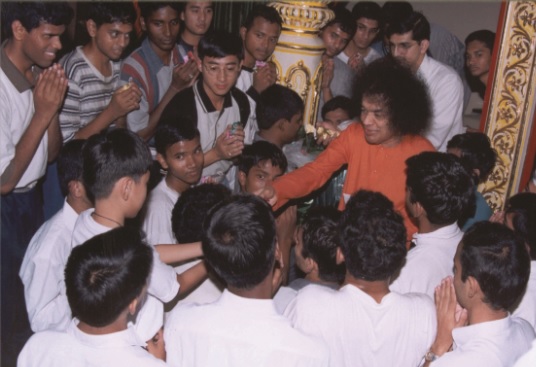
Sri Sathya Sai Conversations with Lion Dance Students December 9, 2001 (Sunday) Morning Swami : (To Warden) I have some costumes needed for the boys involved in the Lion Dance. The coach can come to Poornachandra Auditorium after Bhajans for the practice. (For this year’s Sports Meet, the Lion Dance was a special performance for which Swami was taking a lot of interest.) That morning there were very few students who were waiting for Swami inside the Poornachandra Auditorium. Swami spoke to the students and asked them their names and their native places. Then, Swami instructed the students to go to the round buildings, pick up the Lion heads (costumes) and get them to the Poornachandra Auditorium. Swami instructed that the costumes should be covered properly while bringing them. He wanted the event to be a surprise for everybody. Swami had kept all the other costumes given by the Japanese people ready the previous day itself in the Poornachandra Auditorium for the Lion Dance practice.  Inside Poornachandra Auditorium, after Bhajans, Swami blessed the coach, Mr. Goh from Singapore. To the coach… Swami : Teach the boys right away. The students learnt the basics of Lion Dance. After 90 minutes of practice, Swami came back to see the progress made by the students and was satisfied. He then called all the students near and asked nearly all of them their names, native places and the courses they were studying. Swami then distributed sweets to them. Swami gave permission for the Lions (costumes) to be kept in Poornachandra Auditorium itself and the practice to be resumed at 3.00 pm in the afternoon. Evening: Inside Poornachandra Auditorium Swami came to Poornachandra Auditorium and directed the students in wearing their costumes. He watched the practice session for sometime. Swami : The distance between the boy at the head and the boy at the tail of each lion is not maintained properly, and has to be corrected. If the distance is not maintained properly, it looks like a lion with a broken back as there is a dip formed at the centre. Swami then noticed that the costume, which was to be worn on the legs of the Lion, was not there and He instructed to get shining cloth material of different colours from inside. He personally distributed the cloth pieces to each of the students, according to the colour of their lions. He watched the practice session for some more time and before giving permission for the students to leave, He instructed them to come at 3.00 pm in the afternoon the next day, after classes. Sri Sathya Sai with Students in the Poornachandra Auditorium December 10, 2001 (Monday) Inside Poornachandra Auditorium As per Swami’s instructions, students had come to the Poornachandra Auditorium for the Lion Dance practice. Swami came after sometime along with some elders to see the practice. The students showed a costume stitched with the cloth given by Swami the previous day. Swami corrected the mistakes committed by the students during the practice session. He again stressed on the mistake committed by the students the previous day – the distance between the student at the head of the Lion and the one at the tail was not being maintained. It looked like a Lion with a broken back as a dip was formed at the centre. Swami called some of the ‘Lions’ separately and made them do the steps individually. He was describing their movements to the elders present there. A wonderful interaction followed thereafter… At around 4.45 pm when the practice was over, the Warden signalled to the boys to come and sit around Swami’s feet. Swami : Who called you all here? I did not call. Did your Warden call you? Swami was asking some of the students their names and the places they come from. Swami : (To Arvind, a student of the first year M.Sc. (Physics) class) Which place?  Student : Rajahmundry. Swami : What is father’s name? (The student mentioned his father’s name. Then Swami mentioned his surname and asked) Is it not? Student : Yes, Swami. Warden : Swami, the student studied in Gurukulam. (Sri Sathya Sai Gurukulam is Swami’s school in Rajahmundry, Andhra Pradesh.) Swami : Yes, I know, I know. (To Shashi Kiran, a student of first year M.Sc. (Mathematics) class) Where do you come from? Student : Mysore. (The following conversation between Swami and the student was in Kannada.) Swami : How many years since you came? Student : Swami, three years. Swami : Where in Mysore (do you stay)? Student : Swami, Vidyaranyapuram. Swami : Do you want Vibhuti? Student : Yes, Swami. (Swami created Vibhuti and gave him.) Swami : (Pointing to another student) Telangana? Student : No Swami. Anantapur. Meanwhile a student showed Bhagavan two bowls of fried groundnuts. Student : Will You eat, Swami? Swami : No, I won’t eat. I do not eat at any odd time I want to. You all eat. Another student also requested Bhagavan. Student : Swami, if You take, we will be very happy. (Then Swami took one groundnut, broke it into two and gave one piece each to two of the students.) Student : Swami, at least take water. Swami : Water is fine. When this student showed the tumbler, Bhagavan dipped His finger a little into the water and placed a drop on His tongue. He then looked at a card that was held by a student. Swami : What is this? Student : Swami, Orchestra competition. (As part of the Annual Sports and Cultural Meet, various competitions are conducted within all the Campuses of the Institute.) Warden : Swami, today evening there is a music competition. We have divided all the students into four houses. Swami : How many are there? Warden : Swami, approximately 20 students per group. Swami : (Pointing to the students present there) No. How many among these? (Two boys raised their hands.) Only two!! Warden : Swami, one plays Sitar.  Student : Swami, I know

Sri Sathya Sai Conversations with Lion Dance Students Read Post »

Sathya Sai Baba smiling spiritual portrait picture
The Avatar as Guru & Guide

Sri Sathya Sai On: Lessons from the Mahabharata – Part 1

Sri Sathya Sai On: Lessons from the Mahabharata – Part 1 he ideals which are demonstrated in the Mahabharata talk about the sanctity of the senses. But having been associated with sensual pleasures for a long time, man has started craving for the sensual pleasures and has stooped to the level of an animal. What man enjoys secretly, animals enjoy openly. With such a conduct, is there a difference between man and animal?  We have to understand the concept of Divinity in humanity to some extent. The human body is given to us so that we may raise ourselves to the level of Divinity. The human body is given to do good acts. It is for the sake of Dharma. Through Dharma you can know the secret of life. By knowing the secret, you can fulfill the purpose of the human life. The Mahabharata is no ordinary story. They say in Andhra: “If you want to listen to something, then listen to the Mahabharata. If you want to eat something then eat Vadas!” The eldest among the Pandavas, was the very embodiment of Dharma. The eldest brother Dharmaja (Yudhisthira) demonstrated great ideals and values. Even when his wife was being humiliated, he displayed patience and marched forward. Even when the Kauravas were troubling and humiliating Draupadi, he didn’t say a word. The reason was that he felt one must not speak at such a sensitive juncture. This demonstrates the Divinity in humanness. He played the game of dice. After losing he said, “It was my mistake to play the game of dice. They won the game of dice. Thus after winning the game they will behave as they like. But I have lost the game. Therefore I don’t have the freedom to behave as I like.” He had the discrimination to know the difference between the permanent and the temporary. There is an inner significance in every action of his.  Gandhari and Kunti Devi were the mothers of the Kauravas and the Pandavas respectively. Kunti Devi was a woman of character. Even Gandhari was a very sacred person. Because the husband didn’t have eyes, she decided to blindfold herself and live like that for the rest of her life. She didn’t use her eyes though she had them. She tied a black strap of cloth around her eyes. She never saw the sons that she bore. Just because we are given the eyes, we should not look at the world like crows! But how did she love her children? She only felt her children. While touching them, she only thought and prayed that no harm should come to them. But she never looked at them. She never had the Darshan of even Lord Krishna. But as it is told, ‘Sparshanam Karma Vimochanam’ (the touch of the Divine destroys all Karmas). She had only touched Krishna, and thus was redeemed of all her sins from all the lives.  The Death of Ashwatthama  During the war Dharmaja said, “Ashwatthama Hataha Kunjaraha.” He shouted the first two words loudly but told the last word Kunjaraha (elephant) very softly. This was also the will of Krishna. The words meant that an elephant by the name Ashwatthama had died. Dharmaja didn’t speak a lie and showed his honesty. He just spoke the word Kunjaraha very softly. Dronacharya who was filled with attachment for his son (Aswatthama) didn’t realise what had happened. He thought that his son was killed and he gave up his weapons. That was his mistake. Even on that day in that tense situation, Dharmaja never wanted to utter Kunjaraha in a low tone. He thought, “How can I cheat him?” He thought that he would tell Dronacharya that Ashwatthama the elephant had died and not Ashwatthama himself. But that was the command of Krishna. Divine command is always truthful. The world will never understand the meaning of Divine command. For God everything is truth. Every word is truth. Every vision is truth. Every action He does is truthful. God is the very embodiment of Truth.  After the war, there was not even a single child left, who could perform the ceremonial rites for the dead Kauravas. The Pandavas were victorious in the battle. All the Kauravas had died. At that time, Gandhari was grief stricken. Even one of her sons was not alive. There was nobody to perform her last rites. She was troubled by these thoughts. She blamed Krishna for cheating her like that. She went on rebuking Krishna the way she wanted. Krishna said, “It is natural for you and it is natural for Me. The person who doesn’t know the truth speaks infinitely many lies. It is basic human nature. I know the truth, thus I don’t need to speak. I am Truth. Truth is an evidence for itself.”  The Last Journey of the Pandavas  The Pandavas were going on their last journey (Mahaprasthana – a Godward journey after renunciation of the world). Dharmaja ordered Arjuna to coronate Parikshit (the grandson of Arjuna and the only surviving member of the Pandava clan). After hearing of the Lord Krishna’s departure to His heavenly abode, Kunti Devi gave up her life. Her head was on the lap of Dharmaja. He couldn’t even get up. He sent Nakula and Sahadeva for arranging the last rites of their mother. Bhima was ordered to make arrangements for the last journey. He was only a witness to everything that happened. After the last rites, they started for their last journey.   On the way, Draupadi who was the last in the line, died first. She could not walk. Kunti has already died. The Upa Pandavas (the sons of the Pandavas namely Prativindhya, Shrutasoma, Shrutakarman, Shatanika and Shrutasena) also had died. Abhimanyu had also died in the battlefield. Parikshit, a small boy, was left alone to take care of the kingdom. Draupadi gave up food and water due to the grief of all the deaths. She was unable to walk and cried to Dharmaja that she

Sri Sathya Sai On: Lessons from the Mahabharata – Part 1 Read Post »