





Hari Om

Menu

shri sathya sai

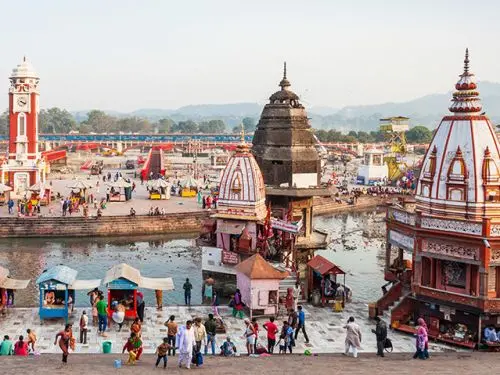
Har Ki Pauri Ganga Temple Haridwar
The Jagadguru Amidst Us - The Ultimate Fortune

Life’s Pilgrimage

Life’s Pilgrimage The author entreats the readers to abide by Sri Sathya Sai’s spiritual guidelines as closely as one follows traffic signs for a safe and successful trip.  Life, according to Bhagavan Baba, is a pilgrimage from the ‘I’ to the ‘We.’ In other  words, it is a spiritual journey from separateness to togetherness, from the vyashti (particular) to the samashti (universal), from bheda (differentiation) to abheda (non-differentiation), from dvaita (duality or diversity) to advaita (non-duality or unity), from selfishness or lovelessness to selflessness or universal love, from the transient finite self to the real infinite self, from mrutyu (mortality) to amruta (immortality), from viyoga (separation from God) to yoga (union with God), from the status of jivatma (individual soul) to that of Paramatma (Supreme Soul). If this is so, how well are we equipped for this journey? We find the answer to this question in the Katho Upanishad [a Hindu scripture], which employs the example of a chariot to explain this pilgrimage. According to the treatise, the jivatma [individual soul] undertakes the pilgrimage toward the Paramatma in the chariot of the body, with the buddhi (intellect) as the charioteer, the mind as the reins, and the senses as horses. Baba uses a more modern example—the automobile—to drive home the message of the Upanishad. The human body is the vehicle; the intellect is the driver; the mind is the brake; and the senses are the wheels. Shreyas and preyas The purpose of this example is to show that if the senses are under the control of mind, the mind under the control of the intellect, and the intellect under the control of the jiva [individual], the latter will be able to complete his pilgrimage quickly and safely. In the scriptures this is called nivritti marga (the path of internal sadhana). It is also known as the path of shreyas (what is beneficent). In contrast to this, if the chain of commands and controls operates in re-verse, with the senses dominating the mind, the jiva would be involved in accidents and departures from the right path, resulting in hold-ups and delays in the completion of the pilgrimage. This is designated as the pravritti marga (the pursuit of the external). The scriptures have termed this as the path of preyas (the apparently pleasant). Bhagavan often cautions devotees: “Start early, drive slowly and reach safely.” Many of us have the wrong notion that we can or should start the spiritual journey only in our old age. But Bhagavan has insisted that if people are to be placed well and truly on the spiritual path, you must “catch ‘em young.” The truth of this is exemplified in the global Bal Vikas [Sathya Sai education program] movement initiated by Bhagavan and the way Swami teaches students in His education-al institutions. Children are introduced to a life of the spirit from a very early age. They are inspired by the message of the Vedic [Hindu scriptures] hymns and the slokas [verses] in the Bhagavad Gita [the divine teachings of Lord Krishna]. It is indeed thrilling to watch the young children enrolled in the Primary School at Prasanthi Nilayam reciting stanzas from the Upanishads and the Gita. Swami’s advise to drive “slowly and safely” is as relevant to spiritual travel asit is to journey by road or rail. Practice of intense austerities for quick results can at times cause mental derangements. “Stop and proceed” is another common traffic sign that can be applied to the spiritual path. Swami advises us to ask ourselves, “Where am I now?” “Whither am I bound?” “Which way should I take?” etc. “Don’t follow hastily the wayward suggestions of the monkey-mind,” cautions Baba. He adds: “Subject those suggestions to thorough scrutiny by the intellect and the heart before you proceed further, thereby avoiding pitfalls in the spiritual path ahead.” “Less luggage, more comfort, makes travel a pleasure,” says the ubiquitous slogan posted on the Indian trains. Baba tells us that if we want to have a comfortable spiritual journey, we must learn to travel light by jettisoning the unwanted luggage of excessive desires. “Properties are not proper-ties,” quips Swami. Hence, His emphasis is on tyaga (renunciation) as the essential element in spiritual sadhana. He recommends moderation in everything—moderation in food, in speech, and in personal possessions. He disapproves wastage of any kind—of food, money, time, and energy. “Come to Me, now and then, for re-charging your battery,” Swami urges us because nothing can boost the energy and enthusiasm of a spiritual aspirant as much as contact with Bhagavan, and the company of His devotees. Owners of cars routinely send their vehicles to the work-shop for overhaul and repairs. Similarly, Swami says that, whenever He feels it necessary, He sends His devotees to the workshop of trials and tribulations in order to toughen them, and make them road-worthy to continue their spiritual journey. “Road under repair; use the diversion,” is a familiar traffic signal. Swami cites this as an analogy whenever He avoids or ignores a devotee for some time because of some lapse on the devotee’s part that needs some introspection or atonement. Finally, Baba gives us a yardstick by which to judge whether we have successfully completed the pilgrimage of life. If we who cried koham (who am I?) at the time of our birth can emphatically answer that question with Soham (I am He) at the time of our passing, then according to Baba, we have reached the goal. Needless to say, we can attain this consummation if we follow the aforesaid traffic guidelines Bhagavan Baba has put forth. However, it can hardly be denied that most of us falter and stumble in our life’s pilgrimage because of our inability to adhere strictly to His guidelines. So, Swami advises us, “Hand over the reins of your chariot, or the steering of your car, to Me, giving no room for any doubt, fear, or anxiety; and I, the Sanathana Sarathi [the eternal charioteer], will certainly lead you to victory, as did Krishna in the case of Arjuna [Krishna’s devotee and one of the Pandava brothers].” ~Dr. A. Adivi ReddySource: Sanathana Sarathi, March 1988

Life’s Pilgrimage Read Post »

Bhagwan Shri Sathya Sai Baba spiritual guidance
The Jagadguru Amidst Us - The Ultimate Fortune

Our Beloved

Our Beloved The full, cosmic, universal being descends into the human form, the Avatar, the scriptures declare. But we need to understand the word in the right perspective. What induces the Most High, the Universal Mind, the Transcendent Will, to come down and engage Itself in limited conditions for the betterment of mankind? What makes Him endure neglect, calumny, doubt, and denial that blindness dare heap on Him? It is His compassion. The Avatar comes prompted by compassion and lives as the embodiment of compassion. It flows in every word and act of the Avatar. Baba has declared, “When I am alone, I am God.” Keep in mind this declaration while listening to the following incident: Once during [the festival of] Dasara, while the Bal Vikas [Sai spiritual education] children were enacting a play on stage, Baba, seated among the devotees watched the kids sing and dance. Noticing that it was pretty warm in the midst of the crowd that had packed the auditorium, one devotee began fanning Baba rather vigorously with a borrowed fan. Apparently unconcerned, Baba sat through this for a few minutes. Then He suddenly turned round, and with a charming smile He took the fan from the devotee’s hand saying, “I have come to do your seva [service]; why should you do My seva?” Now, how do you react to such a God? Bhagavan is a compassionate parent, not a distant formidable God almighty. Can we afford to install Him in a temple, anoint Him as the omnipresent, omniscient, omnipotent Lord, and keep Him away from our hearts and homes? Do you think He would love to stay in a lordly mansion with candelabras and carpets (for He is God almighty)? Wouldn’t you rather have Him in your own home, though it may be an unimpressive cottage? He has come to give the drooping eye a little light, the broken heart a little joy, the failing limbs a little more endurance, and the lost spirit a little love. He says, “My son! You complain that I have a hard heart. You say I do not care for your tears. But when you weep, I weep; when you are happy, I am happy. I am fed when you are fed.” Here is a God who is our kith and kin, aware of the joys and grief of imperfect men, understanding our loves and frustrations, dreams and aspirations. He asserts that man can realize his truth by involving him-self in loving service of fellowmen. He admonishes us, “What sort of God are you seeking in temples while on your streets thousands of living gods invite you to worship them with your seva?” He does not tell an erring man, “You are doomed; you are a sinner.” If a man insists that he is a sinner, He says, “No, My boy. There is nothing like sin. You have only erred. The moment you repent, I pardon you. I shall take your word that you will not repeat the error again.” To the members and office bearers of the Seva organization bearing His name, He says, “Nothing pleases Me, no dhyana [meditation], no tapas [penance], no scriptural studies, nothing…. as service of man. In your impatience if you speak an angry word to someone you cannot tolerate, you say it to Me.” How often He has said, “I do not want you to cringe before Me, I want that you should demand grace from Me as a child does from its parent.” It is not the elaborateness of the worship that pleases Him; it is the love and sincere friendliness of a pure heart, a Partha’s (another name for Arjuna) love. He does not build caves or monasteries or academies to teach men the way to blessedness; for Him blessedness lies in our feeding a forlorn brother or sister, in our taking the hand of a blind fellow-traveler, in our shedding love into a castaway heart. He does not lead us to dusty debates on scriptural texts; instead He shakes the dust off the scriptures and asks us to recollect that the “proper study of man is mankind.” All these centuries we worshipped a strange God high up in the heavens or far in the interior of temples, and we banished brother man from our minds and thoughts. Consequently, instead of building up a prosperous, just and happy world, we have thrown the world helter-skelter. We do not see the tender sunlight playing on our doorstep; we imagine the sun far over the distant hills. So the sun has come to persuade us to look down and admire the beautiful strips of warm light that are lying in wait. Today Baba is the supreme lover of man, the beloved of every one of us. He is the greatest evangel of humanism, for He asserts that the human is not a whit less than the Divine. His pronouncements are not like the distant thunder, which makes us cower in fear. They are like the frag-rant breeze that blows around us, gently inviting us to come out of our petty selves and grow as large as the sky, as warm in generosity as the morning sun, and as lovely as the dewdrop. Our beloved Lord does not want to blind us by miracles; He wants each of us to shine as a miracle. He does not want to make us small by His Himalayan height; He stands with us on the same ground to lift us to Himalayan heights. He opens our vision to the spectacle of our innumerable brothers and sisters jostling around us for a whiff of divine grace, and He shows us that He is the innermost core of every one of them. According to Him, the world is not a place to run away from. It is an arena for service and sacrifice, for work and worship. He is the Divine Being born as man for the love of man. He has never slept all these years, never eaten what we would designate as a meal. He is incessantly engaged in correcting, consoling, and counseling

Our Beloved Read Post »

jagat ambika mata temple udaipur rajasthan 1
The Jagadguru Amidst Us - The Ultimate Fortune

Baba on Hanuman’s Greatness

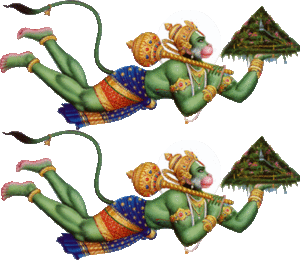
Baba on Hanuman’s Greatness Sri Anil Kumar, the official translator of Bhagavan Baba, asked Swami the following question:  Swami! In the [epic scripture] Ramayana, the role of Hanuman is very prominent. He is the best example of dasyabhakti—devotion of a loyal servant—one of the nine paths of devotion. We are so fortunate to hear from You about the devotion of Hanuman. Would You kindly tell us how modern youngsters can emulate his example? Bhagavanenlightens us with the reply: “Hanuman is known for physical strength, intelligence, perfect character, and scholarship. Yet, do you know what he said when he entered the court of Ravana? While introducing himself, he said, ‘dasoham Kosalendrasya, [which means] ‘Iam a servant of Rama.’ The position of a servant of Rama was a matter of pride and prestige for Hanuman. Rama asked the vanaras [monkeys] who among them could cross the ocean and go in search of Sita. One of them said that he would be able to cross 10 kilometers, another said 40 kms, but none could say that he could jump 100 kms across the ocean. Then Rama asked Hanuman, “Can you do it and successfully return after finding out where Sita is?” Hanuman replied, “Yes, I will.” Rama then said, “Hanuman, you have had no experience with jumping across a vast sea. You have never even seen Sita to identify her now. Then how do you say so confidently that you can cross the mighty ocean in search of Sita in Lanka, find her, and return?” Hanuman replied, “Swami! Would You not give me the needed strength, capacities, and abilities to fulfill the mission You have assigned to me and then command me to fulfill it? With Your blessings and invincible will, wouldn’t I accomplish what I am supposed to?” Such was the intensity of his devotion. Youngsters should follow God’s command unhesitatingly. They should never doubt, question, disobey, or criticize it. Strict obedience to the divine command is called surrender. When you develop this kind of surrender to God, you are bound to succeed. While crossing the ocean Hanuman displayed courage and valor par excellence due to his deep devotion to Rama. Mount Mainaka prayed to Hanuman to rest on his peak on the way to Lanka. Mainaka wanted to take this opportunity to express his gratitude to Vayu, the wind God and father of Hanuman, who had saved him earlier. But Hanuman politely rejected the offer, saying that he wouldn’t rest until he had completed the work that Rama had assigned to him and that he would oblige Mainaka on his return. He, thus, gave top priority to Rama’s mission. It was his confidence born out of devotion to Lord Rama that made him cross a vast ocean. Following Rama’s command, he won His grace. Usually a monkey is noted for its unsteady and wavering mind, but by surrendering to Rama Hanuman’s mind became absolutely steadfast. Hanuman was firmly fixed in his devotion to duty, and that is exactly why he is worshipped today. At the time of his coronation toward the end of the epic, Rama was distributing gifts to all His subjects. But he did not give any present to Hanuman. So Sita asked softly, “Lord! Have you forgotten Hanuman? How is it that you have not given him any gift?” Rama smilingly said, “Sita! It is true. I want you to present him with any gift of your choice.” Then Sita gave Hanuman her own pearl necklace. But Hanuman started biting every pearl in the necklace, breaking it off, bringing it close to his ear, and then dropping it on the ground. Watching this, Sita said “What! Hanuman! You have not given up the habits of a monkey. What are you doing with the pearl necklace I presented to you?” Hanuman replied, “Mother! No doubt you have given me a most precious pearl necklace, but I want every individual pearl of the necklace to resonate with the sound of my Lord Rama’s name. Therefore I am testing every one of the pearls by breaking it first and then keeping it close to my ear to check for the sound of the Lord’s name. I am throwing the pearls out one after another as I don’t hear His name in any of them.” Nothing in this universe is more precious than the sacred name of God, Rama. The whole assembly was adjourned for the day. Rama retired to His bedroom and Sita was following him when lo and behold! Hanuman, too, started making his way there. Rama asked, “Hey Hanuman! What are you doing here?” Hanuman replied, “Lord! Sita is following You. So I am also coming to You.” Rama said, “Anjaneya [another name for Hanuman]! Look! Sita has vermilion on her forehead, which qualifies her to get into my bedroom.” At this Anjaneya left the place and returned after some time. He had gone around all the shops, collected kumkum (vermillion), applied it all over his body and now stood before Rama. He said, “Oh Lord! Just for the simple reason that Mother Sita has a dot of kumkum on her forehead, You qualified her to enter Your bedroom. Now look! I have this sindura [vermillion powder] all over the body. What do You have to say now?” That was the standard of his devotion and his determination always to be with God. On another occasion, the three brothers of Rama met, discussed, and distributed among themselves all the duties they personally had to do while attending on Lord Rama. Hanuman noticed all this and finding that he was left without any duties to his lord softly asked them, “Sir! When the lord yawns, there is a need for someone to click their fingers and make a snapping sound befitting His royal status. We do not know when He might yawn, so I should be with Him at all times.” So Hanuman had to be in the company of Rama while His brothers could attend to Him according to duties they had taken upon themselves at different times. Thus Hanuman

Baba on Hanuman’s Greatness Read Post »

Sathya Sai Baba message of truth
The Jagadguru Amidst Us - The Ultimate Fortune

Hard Nuts to Crack

Hard Nuts to Crack As compared with the previous three yugas (ages), the people of the current Kaliyuga (literally, the age of wickedness) are more difficult to impress. They have strayed too far from the divine path; even children are not easy to convince. In an age of much skepticism, to see countless people, including many intellectuals, devoted to Bhagavan Sri Sathya Sai Baba is miraculous. They come from all areas of the world. It is impressive that despite their diverse religious origins and positions in life, they have responded to the call of the Avatar. An old Hindi couplet expresses this well: Kahe ke eent kahe ka rorabhanumati ne kumbha joda It means “Bhanumati, used a brick from somewhere and a pebble from somewhere else to erect a pillar.” Sathya Sai Baba has united all humanity into a spiritual family. This, in large measure, is the result of recognition of His divinity. No other Avatarhad been widely acknowledged as such during His lifetime. Lord Rama’s [the Avatar of Dwapara Yuga] divinity was known only to the saptarishis [the seven immortal sages recognized in the Hindu scriptures]. Rama’s mission to rid the world of a tyrant [Ravana] required Him to keep His divinity under wraps. Likewise, Lord Krishna’s [the Avatar of Treta Yuga] divinity was known only to a few members of His immediate family and a handful of devotees. He had to wage many wars throughout His lifetime, and it was centuries before His divinity became widely acknowledged. Unlike the other Avatars, Sathya Sai Baba has come armed only with the lamp of love and the sword of truth. With these He has touched millions of people and drawn them to Himself. Countless books detailing experiences of devotees worldwide have been published. These anecdotes show how Baba has responded not only to prayers of people in agony, but even the so-called atheists.  His timely help comes unasked. In these self-centered, materialistic times, people are wont to be skeptical about lending a hand to the needy. Yet so many devotees come to Prasanthi Nilayam [Baba’s residence in southern India] just for the privilege of serving as volunteers at Baba’s ashram. They all have a story to tell, and I am no exception. Swami had plans for me long before I heard of Him, but I wasn’t an easy job. As the only child of highly educated parents, I was a hard nut to crack. After completing my medical training in India, I was selected by the Nigerian embassy for the post of a gynecologist. I was to work with the assistant professor in a medical college in Nigeria. It was there that a dramatic incident opened my eyes to Swami’s divinity. I had recently been pronounced a rarity as the Nigerians generally preferred their own doctors over foreigners. About 11 a.m. one morning, a lady came into the hospital with a ruptured uterus. The baby had died inside the womb, and so I had to immediately operate on her. Her blood pressure was low even when she arrived, but after the surgery it dropped further to 80/60. All our efforts to bring it up were in vain. Although the staff worked until midnight, she had not come out of anesthesia, nor was there any change in her low blood pressure. Little did I know Swami would use this event to bring me into His fold. I had recently started to attend a get-together every Thursday evening with a group of other Indians living in Nigeria. Every family brought a dish, and so I joined the gathering to enjoy the company and the delicious food. During one such gathering, one of the men who had just returned from Prasanthi Nilayam had brought with him some vibhuti [sacred ash], which he distributed among the guests while mentioning that it came from Sathya Sai Baba. As the condition of my patient seemed hopeless, it struck me that I should give her Baba’s vibhuti as a last resort. It was after midnight when I took the vibuthi and made my way to the hospital. My mother came along to stand guard at the door so I could administer Baba’s “medicine” in privacy as the hospital staff would not appreciate this remedy. Mentally, I told Baba that I was referring the case to Him. I felt that if the patient was meant to die, she would have done so already. Thus entrusting her in Baba’s hands, I went home and slept soundly. Well, the miracle did happen. Despite 13 hours of post-operative shock, the patient recovered completely. This miraculous cure worked as a visiting card from Baba, the Divine healer. I went to see Him on my return to India. This doctor, who came to investigate, was conquered and remained to serve at the Divine lotus feet. During my 30 years of service to Him, I have personally witnessed countless miracles. Appropriately an old Indian saying goes, “Naam na pucho sant ka, dekho us ke kaam,” meaning: “Do not ask the name of the saint, see his works.”  A saint feels the agony of the whole world. Tulsidas [a great poet and saint] has said, “Sant hridaya navneet smaana” and “Sare jahan ka dero mere jigar me hai,” meaning: “A saint’s heart is soft like butter,” and “The whole world resides in my heart.” How much softer then is the heart of Swami who is God Himself? The numerous service projects that he has undertaken show His ceaseless efforts to relieve human suffering. What the government with all its finances, material resources, and manpower could not accomplish, Swami has. The Super Specialty Hospital [in Puttaparthi] was completed in just five and half months; mammoth water projects are now quenching the thirst of millions; and the Sri Sathya Sai universities are shaping the characters of the future leaders of the country and the world. An invocation from the Bhagavad Gita [scriptures] says, “He makes the dumb speak; and the lame climb mountains by the grace of Lord Krishna; to Him I bow.”  Today we see all this work done by Sai Krishna

Hard Nuts to Crack Read Post »

Purusha and Prakriti
The Jagadguru Amidst Us - The Ultimate Fortune

From Darkness to Light

From Darkness to Light The journey from birth to death is a game that has to be played with skill. From time to time, prophets and messengers from God have appeared among different peoples to teach them the rules of this game and to show them how it should be played. However, in the past and even today, owing to ignorance or incomplete understanding of these rules and a failure to live by them, the game has continued from one birth to another, and it seems it could go on indefinitely. During my student days, I was skeptical about God and anything that was supernatural. I believed I should examine everything in my life and work from a rationalist and humanist point of view. At that time, some of my friends and I recognized the need to use more of the untapped human potential for self-improvement and for the benefit of mankind, but the changes that divine grace could produce in man were something we could not understand. The possible good example of those who practiced their faiths sincerely was destroyed by the pretensions of others in the same faith. And, of course, we had no first-hand experience of divinity. Meanwhile, my search for the true meaning of life and death continued, and this was successful only after my contact with Bhagavan Sri Sathya Sai Baba. I first heard about Bhagavan Baba in 1970, and my family and I had our first darshan in Prasanthi Nilayam [Baba’s residence in South India] in August 1975. In a physical sense Bhagavan seemed to be both far away and very close. It took some time before I realized that He had the power to work from within me or from within anyone else. In my case, there was no instant conversion, but after this first visit we started to put into practice His teachings, and gradually changed our food habits and life style. By mid 1980, I had sufficient experience of Bhagavan’s Divinity to accept Him, the Avatar of our age, as my most trustworthy guide. What puzzled me for some time was His apparent indifference in situations that seemed to call for immediate attention. I soon learned that Bhagavan Baba is not only testing us, but also teaching us the virtues of patience, endurance, compassion, and equanimity. These are, as He Himself says, indispensable qualities for the serious spiritual aspirant or any person really wanting to play the game of birth-rebirth to a finish. Rules of the game Everything in creation is subject to the laws of nature, e.g., gravitation, heredity, etc. Human existence is governed also by the law of karma (of actions and their consequences, or causes and effects), operating in and beyond our known space-time framework. It is the law of predestination, determined by each person’s actions and based on the principles of moral or retributive justice. The full implications of this law, which most of us do not appreciate, are straightforward and consistent with individual freedom within the limits imposed by each one’s past actions and desires. To have total freedom is the real object of the game: it means to become liberated, to be free from the human bondage that keeps us filled with desires and attached to the fruits of our actions. When Bhagavan Baba says, “Do good!” and “Become desire-less!” He is endorsing a prescription that has been given to mankind many times before. But being reckless, we forget or do not care and so the game goes on and on. Everything that Bhagavan Baba says and does is for the good of humanity. When He responds to a cry of anguish or grants our desires, He hopes that we shall one day yearn for what He has come to give us, namely liberation itself. Many of us would like to change our ways and practice Bhagavan Baba’s teachings more and more, but owing to obstacles (including laziness and insufficient motivation), we often postpone it to another time. Even so, like a hidden catalyst, Bhagavan Baba has quietly been changing our lives and, provided we play our part, He will certainly help us to finish the game. Karma and the Quran The law of karma, as stated above, is not one of the usual beliefs among Jews, Christians, and Muslims, even if some passages in their sacred books tend to support it. During the past few years, thanks to Bhagavan Baba’s inspiration and command, I have found many verses in the Holy Quran [religious book of the Islamic faith] that are in full accord with this law and with this universal teaching. For example, in Chapter 39, verses 5 to 9, it says: “God created the heavens and the earth in Truth… and He creates you in the wombs of your mothers, creation after creation, in threefold darkness. God is your Lord… there is no God but He… No soul laden bears the load of another. You shall return to your Lord and He will tell you what you have been doing…” In this passage from the Quran, which Muslims believe is the inspired word of God, we find all the elements to support the karmic law, such as personal responsibility for our actions and their consequences (“no soul… another”), the idea of successive births (“creation after creation” in “mothers” in the plural), and our ignorance (“darkness”) of our past (previous births), present and future (“threefold”). The standard interpretation of this passage is that the embryo lying in the darkness of the womb, covered by three layers (amniotic membrane, uterine muscle, and abdominal wall), passes through various “stages” during development, each representing a “creation” in evolutionary terms. It can only be due to fate that for over a thousand years Muslims have failed to see the true significance of these precious words. How blessed we are to have Bhagavan Sri Sathya Sai Baba to correct our misconceptions and errors, which He often does by working inside us, changing us from within and inspiring us to improve our destiny. All this He does unassumingly, as if not

From Darkness to Light Read Post »

shirdi sai baba
The Jagadguru Amidst Us - The Ultimate Fortune

A Fateful Hour of My Life

A Fateful Hour of My Life Many Sai devotees can empathize with the anecdote below —the process of spiritual cleansing much like that of purifying gold. One night while bhajan [devotional singing was going on as usual in the prayer hall at Prasanthi Nilayam, I happened to sit near the throne of the Lord [Sai]. But, He was not present at the moment in the form we know. I felt suffused with a sublime happiness and peace, much like the bliss described in scriptures. It was something new, sudden, and unexpected. It lasted barely an hour. Undoubtedly it was the experience of the highest spiritual order. But it was so overwhelming that I was afraid of losing all sense of the world in which I live, and to which I was deeply attached. It was this fear of losing what I do not, in fact, possess but still imagine that I do, this fear of losing what I do not enjoy in this illusive and deceptive world of sense perception, that caused me to take a false and unhappy step at that critical juncture of my life. What a shame! I do confess now that instead of availing myself of the great opportunity to grasp what is real, I prayed to the Lord at that fateful hour to relieve me of His grace. The reason for this fall is the existence in me of unfulfilled earthly desires and aspirations. This clearly shows how, in the absence of self-renunciation, I was not fit for the spiritual elevation I enjoyed. After a while, Swami came to one of the apartments in the Prasanthi Nilayam colony where I stayed; and He told me about the conversation that transpired between Ravana [the Sri Lankan king who abducted Lord Rama’s wife, Sita] and his wife, Mandodari, regarding Sita when she was held in captivity at the Ashoka vatika [garden]. Ravana’s wife, knowing that her husband could metamorphose himself at will into the form of any person, asked him why he had hesitated to assume the form of Rama and fool Sita. Ravana replied that to assume the form of Rama would automatically rid Ravana of gunas or traits that were the cause for his present demonic behavior. In the absence of his gunas, Ravana’s desire for Sita would cease to exist. Since then, I was in distress. Fate is sterner than what I thought at first. One day I complained of my distress; Baba said that if the sugarcane is not to go dry and its sugar contents are to last for some time, its juice must be extracted in time after proper crushing and then boiled until it was converted into jaggery or sugar. He [Baba], like a goldsmith, tests our metal [mettle] and throws it back into the red hot coals ofspiritual fire to sift the pure from the dross. ~Challa Appa RaoSource: Sanathana Sarathi, Feb. 1959

A Fateful Hour of My Life Read Post »

maa ambika ka devi
The Jagadguru Amidst Us - The Ultimate Fortune

Unity and Purity: Message of Ramzan

Unity and Purity: Message of Ramzan Bhagavan says that the truth proclaimed by all religions is one and the same. The ultimate goal of all religions is the same—to cure man of his follies and make him a real human being. All religions aim at promoting righteous conduct by transforming the mental attitude of man. [Sathya Sai Speaks, Vol. 22] Whenever one speaks, the expression often begins with ‘I’ and revolves around ‘I.’ “I am walking,” “I am sitting,” “I am eating,” “I am going,” “I am listening,” “I am seeing”—‘I’ is almost always in the forefront. Man tends to believe, “I am the doer,” whatsoever the deed may be. Who exactly is this ‘I,’ the agent, the doer? There are three aspects connoted by the ‘I.’ ‘I am this body,’ is the first; ‘I am the life-force in it,’ is the second; ‘I am the atma,’ is the third. “I am dark,” “I am fair,” “I am short,” “I am tall,”— these are statements generally made. “I am young,” “I am old,” “I am a brahmin,” “I am a non-brahmin,”—these statements too are common. These qualities concern only the body. When a person is unconscious, in deep sleep, or dead, he is unaware of any of these characterizations regarding his body. They are extraneous to the real ‘I,’ for the attributes adhere or fall off when time elapses or when circumstances change. Next is the jiva principle or life force. The incessantly active consciousness is constantly wayward and restless. We say, “My intelligence is not clear,” or “My mind is perplexed.” These apply to the second facet of the ‘I.’ This facet, too, is linked with the body through the objects—senses-mind-reason complex. Lastly, the third aspect is the atma [real self, soul]: “I am sadananda, nityananda, satchitananda [always happy and blissful]! I am nirmal [pure], I am nischal [calm]. I am all. I am Brahma. Aham Brahmasmi [I am God].” The body is mortal; the jiva principle undergoes transformation; but the atma is immortal. The atma exists in unaffected glory in the waking, dreaming, sleeping, and the fourth level beyond. The gross body is active in the waking stage; the subtle I-consciousness is alert in dreams, the causal atma is dormant as ‘I’ in sleep. The real ‘I’ or atma has no exclusive affiliation to one body, one country, one nation, or one sex. It is in every being everywhere, in bird and beast, plant and tree. Each of these reveals its existence. The atma is all-pervading and immanent in India, Russia, America, England, all over the world. All founders of religions have heard this impersonal voice of God revealing the atma that activates the entire creation. Just as the Vedas were ‘heard’ and propagated as ‘heard’ (shruti), the Quran, too, was ‘heard’ by Hazrath Muham-mad. The Quran has salat and zakat as the two eyes. Salat means prayer; zakat means charity. Those who consider charity as a high duty and elevate their consciousness through prayers and continuous meditation on God are Muslims. Islam is a word that denotes not a particular religion but a state of mind—the state of total surrender to the Will of God. Islam means dedication, surrender, peace, and tranquility. Islam denotes the social community whose members have achieved supreme peace through surrender to the all-merciful, all-powerful God, and who have vowed to live in peace with their fellowmen. Later, it came to be applied to communities that considered themselves separate and different and hostile to the rest. Islam taught something higher. It directed attention to the One in the many, the unity in diversity, and led people to the reality named God. Every human being has three basic needs: food, clothing, and shelter. Seeking to fulfill these needs, man has developed a variety of foods to fill his little stomach, but along the way he has ignored the purpose of eating. Clothing has to be worn to protect the body from cold. However, we are attaching enormously exaggerated value to clothing. Of course, one must have a house to live in and lay the body down to rest. The Muslim, Gibran, asks why build these gigantic dwellings then? They are erected not for oneself but to hoard one’s treasure and riches. Gibran says these mansions are tombs erected by the dead for the living. Hazrath Muhammad announced to the townsmen of Mecca the message of God that he had heard. At that time, people did not give heed to the divine declarations. They forced him to leave the place. But Hazrath Muhammad knew that truth will win and God will prevail. He knew that insult and injury were only for the body; the atma can never be hurt. The Ramzan [Muslim festival] month is set apart for the holy task of bringing into memory and practice the teachings that Hazrath Muhammad conveyed, and attaining that stage of unity and purity that is truly divine. Islam gives importance to the moon which regulates the months. Hindus consider the moon as the deity presiding over the mind. With the darshan [sighting] of the new moon, the Ramzan fast begins and when the new moon is seen again, the fast ends. ‘Fast’ does not consist in merely desisting from food and drink. The fast starts at sunrise, is broken only after sunset, and is observed most rigorously. Waking as early as 3 a.m. or 4 a.m., in the Brahma muhurta [auspicious early morning hours], prayer is started: and throughout the day the constant presence of God is sought to be experienced. This is the meaning of upavasa or fast. Also, during the Ramzan month, rivalry is avoided, hatred is suspended, husband and wife live apart though in the same home, mother and children both follow the same spiritual regimen, and an atmosphere of brotherhood is maintained. The body, the senses, and the mind are subject to rigorous discipline. Periods of fasting comprising a month are prescribed in all religions. The Hindus observe it in Magha and Shravana [11th and 5th month of the Hindu calendar months]. Zoroastrians and Christians have allotted for themselves months for the same purpose. The Quran teaches that all men should cultivate the sense of unity, of interdependence, of selfless love, and of the immanence of divinity. Generally, all men nourish their bodies with food or drink five times a day—an early cup of

Unity and Purity: Message of Ramzan Read Post »

Sathya Sai Baba divine aura picture
The Jagadguru Amidst Us - The Ultimate Fortune

Christmas and the Avatar

Christmas and the Avatar In 1985 on Christmas Day in Brindavan, Bhagavan Baba asked Mr. Al Drucker of the United States to speak to the people assembled there. Drucker narrated how he had asked Swami if He was the Messiah whom every one had prayed for. Bhagavan replied, “No, not one Messiah but you are all Messiah.” Our sweet Lord has been most generous to us this Christmas with His love and His blessings. We have all had a chance to taste the sweet nectar of His grace. It is our one-pointed yearning and devotion that has evoked such a loving response from our dearest Swami. When all we want is Him, and when we follow His precepts for living in love and with dharma [right action], then He gives us everything we hope for and fills our hearts with joy. I want to relate a little incident that happened a few months ago on the veranda of the mandir [temple] in Prasanthi Nilayam. Swami was walking by a line of devotees sitting there, when He turned quite unexpectedly toward one of them and asked, “What do you want?” A little surprised at the sudden question, the person being addressed by Swami answered, “O Bhagavan, I’m very happy. I’m satisfied. I really don’t want anything.” Now it was Baba’s turn to act surprised, and He said, “You mean you want nothing?”The recipient of all this attention from the Lord held his hands to his heart, and in an emotion‑filled voice replied, “Dearest Swamiji, the only thing I want is You! Only You!” At this Baba leanedforward and said quite emphatically, “That’s not nothing!”Spreading His arms wide apart, He said, “That’s everything!”Then pointing a finger toward the world outside, He added, “Nothing is there! Everything is here! Everything is here!” He concluded, waving His hand toward the heart that had just expressed its divine longing so sweetly. Swami’s message is that all the sweetness we can ever garner, every joy, every delight, all beauty, all bliss, and all goodness is experienced here inside us when we install the Lord in our hearts. This is also what Jesus proclaimed when he said, “Seek ye the kingdom of heaven within you.” This Christmas, Swami blessed all with a taste of the joy and the divine love of that kingdom within. We realize that Christmas is such a happy day because we celebrate the birth of the divine child. This divine child is not born in some far‑off place or in some far‑off time; it is born today, inside us. It is born as pure delight, as pure love, as a bubbling sweetness that leaves an unforgettable taste of joy in our hearts. How can we ever forget fine honey, once we have tasted its sweetness? How can we ever forget the experience of the living Divinity once we have tasted His sweetness? Once we have experienced the Divinity as we did today, it is natural for us to go on with the work for which we have incarnated. We go on to realize our own divinity, realize our own ineffable joy, realize our own springs of pure, selfless love, realize our own inner beauty, our own innate goodness, our own sweet essence. This very path is the one that Jesus walked long ago. Oneness with Divinity Unfortunately, we know very little about Jesus’ life. There are just some glimpses given in the Gospels which were set down many years after his death. There is hardly anything to speak of the wonderful good humor that Jesus must have had. We know nothing much of his joy, his ananda [bliss], his laughter, his happiness in the company of his devotees who must have been unable to take their eyes off him for even a moment, lest they miss his look or his smile or some endearing gesture. We know hardly anything of his physical beauty. But we do know that Jesus realized the ultimate goal of human life, he realized his oneness with Divinity, and so he must have completely transcended body consciousness and been filled with divine bliss. Even as he sacrificed his life for humanity and his body was undergoing the extreme trial of the crucifixion, he himself must have remained immersed in ananda and totally unaffected by the physical suffering of his body. Swami says that the first step on the spiritual path is to be happy, to be always contented and satisfied. The spiritual path, He says, is not pressure but pleasure; it is not information but transformation. It is not taking on new burdens but getting rid of old ones, becoming light, giving up all burdens to Him. He says, “Get on My train and I will carry you and your baggage.” But first we have to get on His train. That means thinking always of Him, loving only Him, surrendering everything to Him—everything we think weare, and everything we think we do. A year ago, He gave us this promise, “I will always protect those who are Mine, those who surrender and say, ‘Lord, I am Thine.’” Moses and Jesus In the Bible, there is a story of another great soul whose life represents a supreme level of surrender. Moses was the great devotee to whom God identified Himself in the burning bush, as ‘I am that I am’. Moses brought the children of Israel, a million strong, out of the land of bondage where they had been pressed into slavery for 400 years. The divine command to go came early one morning and they left suddenly, without having time even to take some bread along for the long journey across the desert. After three days of forced marches they came to the Red Sea; there they rested, at last feeling free. Before them to the east was the deep sea that would have to be crossed. But then, when they looked behind them, they suddenly saw the far‑off horizon to the west teeming with armies, chariots, cavalry, infantry, and elephantry. The whole imperial army of their recent

Christmas and the Avatar Read Post »

Sathya Sai Baba universal love
The Jagadguru Amidst Us - The Ultimate Fortune

Unity is Divinity

Unity is Divinity At a Divine discourse on India’s Independence day this year, Baba drove home to us the importance of unity through a very simple and striking example. He asked how it was possible for England, a country so much smaller than India in population and land size, to conquer and rule India for so many years. The answer was simple⎯lack of unity on the part of the Indian people. Baba has been trying to make us understand the deeper significance of unity on the spiritual path for many years now, going so far as to say that unity is divinity. He also encourages this feeling of unity through emphasizing unity among groups who come to Prasanthi Nilayam, and speaking often of the Sai family and the one caste⎯the caste of humanity. He speaks of love as the highway to God⎯love in the form of service to humanity. The word yoga itself means to unite the individual soul with the universal spirit (Paramatman). The word religion comes from the Latin roots “re” (again) and “ligere” (to link) signifying the “relinking” of the soul with God. What is God but all of life, including humanity? Thus it seems that there must be two types of unity: vertical unity with the higher aspects of one’s Self and God, and horizontal unity with the people, nature, and the world around us. It seems that the spiritual unity that is already a reality at the level of the one pure universal consciousness (chit) must gradually be manifested in the lower vehicles of mental, emotional, and physical bodies of humans and between all the various bodies that are simply manifestations of that one consciousness. This has been the goal of every religion and spiritual philosophy since the beginning of time. This will create the real heaven for man on earth, unity with his higher Self and with others. There seem to be two basic forces operating in the universe: one is involution of spirit into matter and thus into greater and greater separateness and involvement into matter. This involution into matter reaches its culmination in the development of the human ego as the most evolved form of matter. This can be understood by comparing a two‑meter bin full of separate cells to a man two meters tall. Let us say that a man has 35 billion cells (I have no idea how many he has) and that thebin also has 35 billion separate cells. They are the same number of cells, but do they have the same abilities in the physical world? Can the bin of cells walk, dance, sing, build houses, create in various ways, think, philosophize, pray, love or discriminate? What is the difference? In man there is a unity between the cells. They are functioning together for a common goal: the health and happiness of the whole being. The cells are guided by the sub‑conscious of the man in each of their functions. They do not live for themselves as the 35 billion cells in the bin do. They live for the good of the whole and thus the whole, man’s sub‑conscious, looks after them. Each cell is provided with its needs through the work of the other cells, but all cells are guided in their function by the man. There is unity and thus there is health, strength, and happiness for the man and for the cells. If some of the cells should cease to cooperate with the organism for a while then they would constitute a sickness in the organism such as cancer or leukemia. When a man’s mental, emotional, and physical forces are not united, then a small group of foreign cells can easily invade and conquer his body as the English did to the Indians. Involution has taken place, and man’s body and ego are exquisite tools for the expression of this power of the spirit in the physical world. Now the process of evolution must be tended to so that spirit can evolve out of matter again. In order for this to happen, the ego must undergo the same process the cells did during their development into human body. The ego must be united into the service of the body of humanity in the same way that the cells of the body, at some point in their evolution, had to give up functioning for themselves and start to function together with other cells for the sake of the large organism. We find ourselves now in a time and place where the Incarnation of this universal consciousness that is wanting to manifest itself as the one body of humanity, is telling us, “Dear cells of My own body, please come together and cooperate in your functioning. Work together for the good of the whole body. And in that way I can provide for all of your needs as cells of My own body.” A recent scientific experiment may help us understand this. Kirlian photographs (which show the aura or the energy field) were taken of fertilized eggs on every day of their development. After some days, the energy field of the embryo of the chicken-to‑be appeared clearly on the photos. But when the egg was cracked open to see what was inside, the physical embryo had not formed. From this we could infer that the mental and energy bodies of the chicken form first and are present before the eventual development of and taking position of the various cells in the physical embryo. We might imagine a similar situation in terms of the body of humanity. The causal and subtle bodies are there. They represent a united functioning between all beings on earth. The sankalpa [divine will] for the creation of that body has taken the form of Sai Baba, who represents that universal consciousness on the physical level so as to encourage us and quicken and facilitate the formation of the body of God as united humanity. But the cells have not yet taken their positions and started functioning in harmony with the

Unity is Divinity Read Post »

Sathya Sai Baba compassion and love
The Jagadguru Amidst Us - The Ultimate Fortune

The Laws of Action

The Laws of Action Karma [action] is the action principle of the universe; every cause has its effect, every action has its reaction. The law of karma is a comprehensive law embracing all action in all the planes of existence. Karmic law maintains law and order in the universe and the whole of creation is bound by its inexorable impact. The law of karma is based on the principle of causation and there is science behind all phenomena. Because of this inherent order, understanding is possible and there is meaning in our search for truth. There is no chance in the cosmic order but man has yet to grasp higher laws and suprasensory phenomena. The law of karma operates in the energy mediums of ichcha-shakti [power of desire], jnana-shakti [power of wisdom], and kriya-shakti [power of action]. The different energies are meant for different functions of volition, cognition, and action—the motive, thought, and action. Our motive is an emotional act, our thought is a mental act, and our action is a physical act and all involve a definite quantum of respective energy. All our motives, thoughts, and actions are concrete phenomena and can be measured quantitatively in terms of their energy expense. The physical laws are simple, and their causation follows a sequence in a straight line and their effect is immediate and obvious. The physical laws can be discerned through experimental verification and accepted for general understanding. The nature of operation in the psychic and spiritual planes is highly abstract, subtle, and complex to grasp. The psychic and spiritual laws transcend time, space, and limitations of the physical plane. Their causal relation does not follow a sequence. In higher planes, hundreds of causes in association produce a cumulative effect, sometime, somewhere. The subtler the plane, the more intense and concentrated is the energy form and greater is its power, wisdom, and joy. We can have more enduring and elevating peace and joy in the higher realms of thought, beauty, and spirit. The different forms of energy are inter-convertible from one form to another, and from one plane to another. Man established in the higher plane can exercise his will power and manipulate the energy and phenomena of the lower planes. Understanding higher laws and techniques to evoke higher centers, man can acquire extra-ordinary powers or siddhis. Man can tap the potential of psychic and spiritual energies and faculties within him to his immense advantage. The law of karma embraces past, present, and future linked in one continuous causal chain. The law of karma balances the opposing forces either through smooth integration or through, strife if necessary. All action in tune with dharma [right action] contributes to universal balance and harmony and for the good of the whole. All action in adharma [unrighteousness] causes chaos, conflict, and suffering thus disturbing universal balance and affecting total life. We reap what we sow. All our motives, thoughts, and actions sows psychological seeds in the subconscious form of impressions. These psychic records are the eternal witness to all our motivations, for nothing escapes this automatic imprint of the psyche. When the acts are often repeated these impressions get stronger and become our habits and tendencies, traits of character and conduct. Through good and bad karma we build our credits and debits in the book of life and the totals renew from life to life. We are partly free and partly determined, for we are the products of our past vasanas [bad tendencies] and samskaras [fundamental impressions], embedded in our swabhava  [individuality].  We are free to build a new future, and by righteous action we can give a benevolent turn to life and exhaust the past impact. We are not helpless tools in the hands of any external agency and our lives are not fatalistic, for we can tune in to the law of life. Man is endowed with a rational and discriminating faculty and has free choice to make or mar himself. Man is endowed with the voice of conscience for right action, but the noise of ego eclipses the silent voice of the heart. Man shall have blow after blow on the anvil of life, till he realizes his folly and tunes to dharma. Man is free to violate the moral law and free to suffer and he alone is responsible for the consequences of his action. The suffering is a blessing in disguise, it is a moral exercise, and has the rich reward of understanding through experience. Man can free himself from the bondage of karma through right understanding and right action in tune with dharma. Every motive, thought, and action has direct bearing on our life as the law of karma operates in all the three planes. If motive is pure, the karma does not affect the soul, for, motive is important in determining the effect of karma. We get measured reaction for the wrong action in the physical and social plane but it does not affect the inner being. If the motive is evil and although not executed in action, the karma binds the soul, for the intention is bad. All our good and bad karma accumulate in our psychic center, chitta [consciousness], our personality center, and we build our load of karma. Through sincere, intense prayer, and repentance for the wrongs done, we can cleanse the dark impressions of the sub-conscious. By intense and sincere prayer we generate spiritual vibrations that can clear the impressions by giving vent to them. Thus we can lessen the burden and lighten the load of karma and purify our psychic center. All action in tune with dharma in the spirit of yajna [sacrifice] dedicated to the cosmic cause does not bind. All action without egoistic motivations, without desiring the fruits thereof, does not bind. All action in total surrender in sublimation of the ego, as an instrument of the supreme, does not bind. We are all effective partners in the collective karma and are collectively responsible for social evils ; it affects every one. Man is a part of the collective life and stands in the same relation as a cell in our body and has to be in tune with cosmic life. It is the duty of every one, not only to be positively dharmic in personal life, but equally resist adharma wherever found. The karmic impact on life are of three

The Laws of Action Read Post »