Hari Om

Menu

human values

man is god
human values, the nine gems

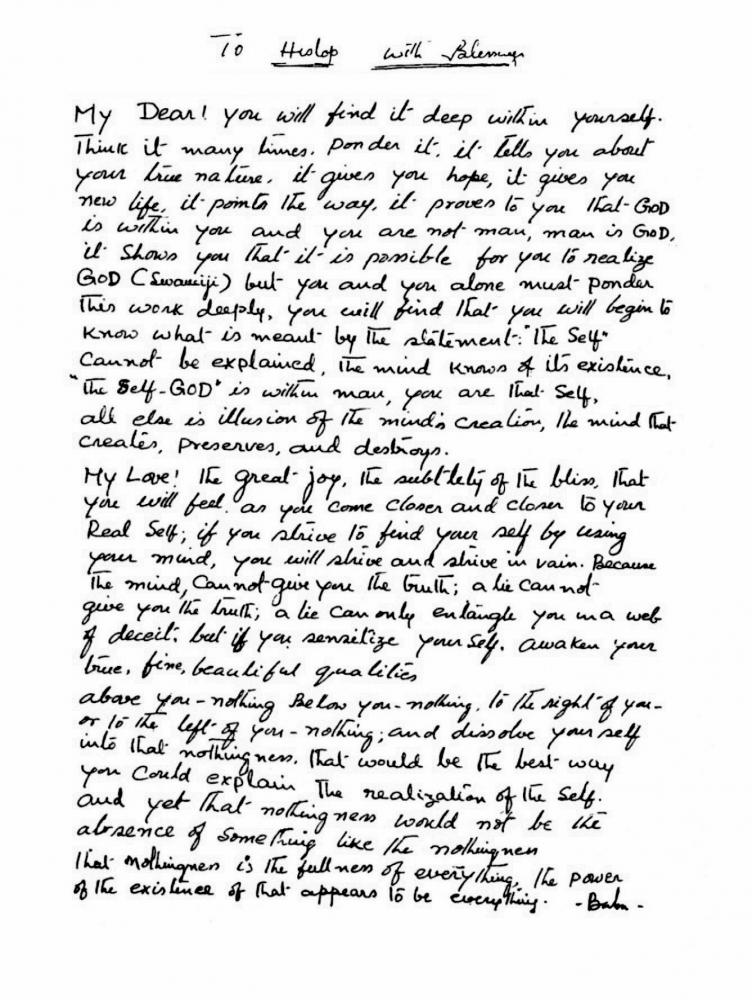
Man is God

Man is God To Hislop With Blessings My Dear! You will find it deep within yourself. Think it many times, ponder it, it tells you about your true nature, it gives you hope, it gives you new life, it points the way, it proves to you that God is within you and you are not man, man is GOD. It shows you that it is possible for you to realize God (Swamiji) but you and you alone must ponder this work deeply, you will find that you will begin to know what is meant by the statement: “the Self” cannot be explained, the mind knows of its existence, “the Self-God” is within man, you are that Self, all else is illusion of the mind’s creation, the mind that creates, preserves, and destroys. My Love! The great joy, the subtlety of the bliss, that you will feel, as you come closer and closer to your Real Self; if you strive to find your self by using your mind, you will strive and strive in vain. Because the mind, cannot give you the truth; a lie cannot give you the truth; a lie can only entangle you in a web of deceit, but if you sensitize yourself, awaken your true, fine, beautiful qualities. Above you – nothing. Below you – nothing, to the right of you or to the left of you – nothing; and dissolve yourself into that nothingness, that would be the best way you could explain the realization of the Self and yet that nothingness would not be the absence of something like the nothingness. That nothingness is the fullness of everything, the power of the existence of that appears to be everything. Baba

Man is God Read Post »

spiritual hunger
human values, the nine gems

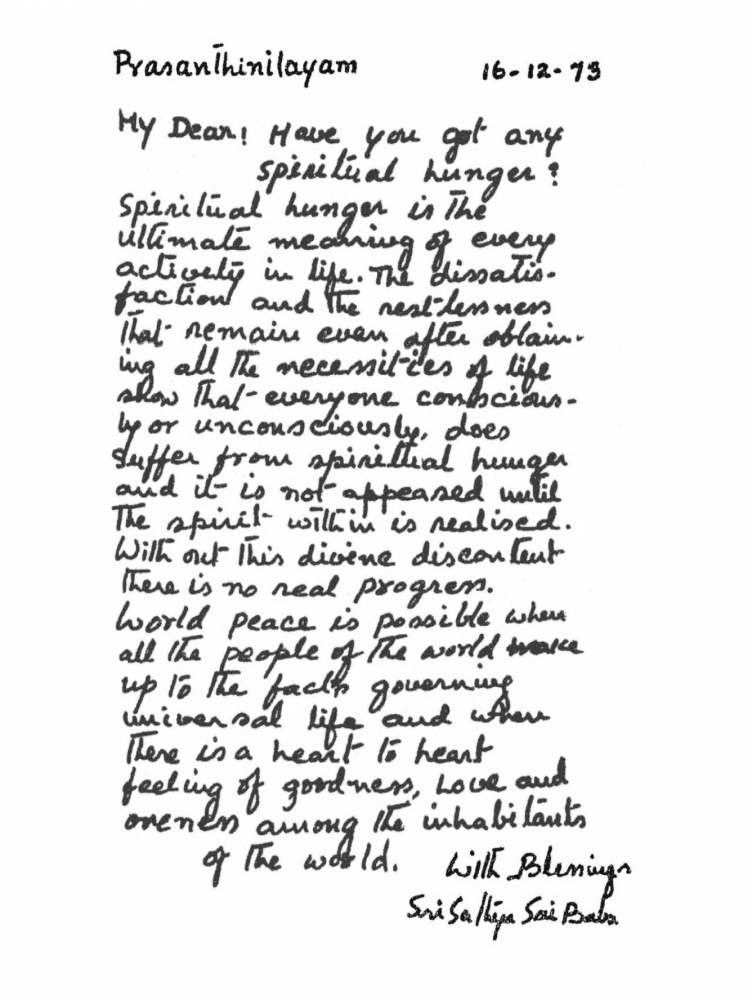
Spiritual Hunger

Spiritual Hunger 16-12-73 My Dear! Have you got any spiritual hunger? Spiritual hunger is the ultimate meaning of every activity in life. The dissatisfaction and the restlessness that remain even after obtaining all the necessities of life show that everyone consciously or unconsciously, does suffer from spiritual hunger and it is not appeased until the spirit within is realised. Without this divine discontent there is no real progress. World peace is possible when all the people of the world wake up to the facts governing universal life and when there is a heart to heart feeling of goodness, Love and oneness among the inhabitants of the world. With BlessingsSri Sathya Sai Baba

Spiritual Hunger Read Post »

within you is the real happiness
human values, the nine gems

Within You is the Real Happiness

Within You is the Real Happiness Message You as body, mind or soul are a dream, but what you really are is Existence, Knowledge, Bliss. You are the God of this universe. You are creating the whole universe and drawing it in. To gain the infinite universal individuality, the miserable little prison individuality must go. Bhakti is no crying or any negative condition, it is seeing of all in all we see. It is the heart that reaches the goal, follow the heart. A pure heart seeks beyond the intellect, it gets inspired. Whatever we do reacts upon us. If we do good, we shall have happiness and if evil, unhappiness. Within you is the real happiness, within you is the mighty ocean of nectar divine. Seek it within you, feel it, feel it, it is here, the self. It is not the body, the mind, the intellect, the brain. It is not the desire of the desiring. It is not the object of desire. Above all these, you are. All these are simply manifestations. You appear as the smiling flower, as the twinkling stars. What is there in the world which can make you desire anything? With BlessingsBaba (A letter given to a group of devotees from USA. First published in Sanathana Sarathi of 1973)

Within You is the Real Happiness Read Post »

Shri Sathya Sai Baba Compassionate Blessing Close-Up Image
human values, nine gems, the nine gems

Nine Gems Forward part 1

Nine Gems Forward Nine Gems – Part 1 We are blessed and fortunate to have received the divine love, grace and blessings of our Guru and God, Bhagawan Sri Sathya Sai Baba who is the universal teacher, divine teacher, and teacher of teachers, who has shown us the goal of life and the way to attain it through the path of love and service. His every word is a mantra, and His writings are the essence of all scriptures. In His infinite love and grace, He has given us a treasure-house of knowledge through His divine discourses and writings in the form of Vahinis – practicing which, our life will be redeemed. His discourses, writings, and conversations, as well as His exemplary life, are unparalleled in human history, both with respect to their content and their efficacy in transforming countless lives for the better. This Study Guide, in preparation for the Guru Poornima celebrations, presents selected letters of Swami which He has written to the devotees, His students, teachers and spiritual seekers, guiding them in various aspects of life. We are very happy to share nine letters which are precious gems, giving us guidance on various spiritual practices – like Namasmarana, the path of knowledge, meditation, and surrender to lead us to the goal that we are divine and everything is Brahman. Let us dive deep into these words of our beloved Lord Sai and enjoy peace and bliss therefrom.

Nine Gems Forward part 1 Read Post »

Shri Sathya Sai Baba divine darshan radiant picture
human values

Unity Is Divinity

Unity Is Divinity Bhagawan Sri Sathya Sai Baba, the universal teacher, the embodiment of love and truth, teaches us the way to reach the ultimate and supreme goal of human life – namely, to realise our innate divinity and the divinity inherent in all creation. In His love for us, He has given us two key aphorisms: Unity is Divinity and Purity is Enlightenment. To attain unity and purity, He has also given four practical divine commandments – Love All; Serve All; and Help Ever; Hurt Never. Baba lent His sacred name to the Sri Sathya Sai Organisation wherein, as brothers and sisters, we can come together to realize the goal of life easily by following these aphorisms and commandments. He said that we can reach the summum bonum of existence by following His teachings immediately, implicitly and completely, with sincerity and absolute faith. Accordingly, the 11th World Conference of the Sri Sathya Sai International Organisation (SSIO) will focus on two seminal teachings of Bhagawan, with the theme: Unity is Divinity & Purity is Enlightenment. To assist Sri Sathya Sai devotees everywhere in their spiritual journey, two study guides, which are compilations of the essential teachings of Baba on Unity and Purity, have been developed. Unity Is Divinity The first Study Guide deals with the aphorism–Unity is Divinity. Swami says that just as we see different reflections of ourselves when we are surrounded by mirrors, the apparent multiplicity around us is just the many reflections of the one Self, which is our reality. Realisation of this fundamental unity leads to purity of mind. Through this purity, we are enlightened and realise our innate divinity and that everything and everyone is divine. Baba says we are reflections of the one divinity, facets of the one immortal Self, and our essence is love–which is our own true nature, the Atma or divine Self. Although fundamentally One, unity manifests in many ways. At the fundamental level, all is God – Isavasya Idam Sarvam. The next level is unity in Nature – God is Nature; Nature is God. The one divinity is manifested in all of nature’s multiplicity, and humanity is an integral part of nature. Unity can also be manifested at the levels of the individual, the family, the Sri Sathya Sai Organisation and society. Bhagawan reminds us that Man (Vyakthi) is part of Society (Samashti), which is part of Creation (Sristhi), which is part of God (Parameshti). The Study Guide explores the linkages, principles and practices of seeing unity in all these manifestations. Purity Is Enlightenment The second Study Guide deals with the aphorism–Purity is Enlightenment. Swami says that purity is essential for experiencing divinity and everlasting bliss. It is not possible to experience divinity unless we are pure – in fact, Swami says that all spiritual exercises, such as selfless service, devotional activities and education, are undertaken to purify the mind. How to develop purity? This is the crux of the matter, and Swami beautifully dilates on the importance of developing purity at a young age, and the various aspects of external and internal purity. External purity refers to purity at the body level, which includes purity of food, speech and action and purity of the place and environment. However, it is not enough if the body is clean — purity of the heart and mind is essential and Swami’s teachings on developing inner purity (Antahkarana Suddhi) are listed in this section. In His infinite compassion, Bhagawan recommends specific steps to develop ten types of purity in day-to-day life, and gives directives on spiritual practices such as namasmarana, selfless service, meditation, etc. and how they should be performed. The Study Guide also deals with Swami’s admonitions on the pitfalls in the process of developing purity. He warns us about the obstacles, as we undertake sadhanas such as devotional singing, service activities, study circles etc., and provides practical solutions to overcome them. He guides us to practice purity in thought, word and deed in our daily lives. The Study Guide expounds on love as the basis for developing purity. The more we develop love, the more pure we become. Finally, there is a short discussion on what we can learn from the examples of various spiritual masters, sages and saints who achieved purity. Conclusion The simplicity and beauty of the practical advice given by the Lord is of lasting value to all devotees engaged in spiritual advancement, at all times, wherever they may be. It also has practical value for sustained peace and prosperity of society and the world, at large. Let us study His nectarine words, understand them through discussions, study circles and workshops, and practice them sincerely. Let us resolve to move forward with unity, achieve purity and experience divinity in this very life. Jai Sai Ram. In the Loving Service of Sai, Narendranath Reddy, M.D. Chairman, Prasanthi Council Sri Sathya Sai International Organisation

Unity Is Divinity Read Post »

Shri Sathya Sai Baba divine spiritual teaching picture
human values

Forget the Harm by Others

Forget the Harm by Others Do Not Forget God; Forget the Harm Done to You, and Forget the Good You Have Done Do Good to Those Who Have Harmed You Will Have to Take Birth Again if You Expect Something in Return for the Good You Have Done Do Not Forget God, Do Not Put Faith in the World, and Do Not Be Afraid Ingratitude Is a Great Sin – Be Grateful to Those Who Have Helped You Whatever things we do with this body, we are leading to a rebirth of this body. Any actions, good or bad, can be compared to seeds. In order not to sow such seeds, we should do all actions without desire. All actions should be done in and only for the pleasure of God. If you sweep a place, think that you are doing that for cleaning the heart, the shrine of God. When you help or harm others, think that you are doing it to yourselves. Then you will never let yourself harm anyone else. The Two Eternal Truths You must forget two things. Firstly, you must forget whatever help you have given to others. Secondly, you must forget whatever harm others have done to you. Because, when you remember the harm done by others to you, you always plan to take revenge. When you do not remember this, you will not do any harm. If you remember the help rendered by you to someone, you will be looking forward to the reward. On the contrary, there are two things that you must always remember. One is that God is One, and the other, that death is inevitable. In whatever manner you may look at them, these two are the eternal truths. If you do not want to go to a marriage, you can cancel the engagement. Similarly, if you do not want to go to a cinema, you can postpone it until the next day. But the last journey, the journey to your death, can be neither cancelled nor postponed. We make preparations when we want to go for a marriage or a cinema. What preparations are we making for the final journey? Make All Your Actions Conform to Righteousness There are three things that must be done in life. You should try to do good to those that have done harm to you. You must forget the harm done by others and also the good you have done to others. So you should forget what needs to be forgotten and remember those things that require being remembered. What are the things you have to remember? The good that others have done to you. You must remember the good that has been done to you as something sacred. You must express your gratitude to them. Make all your actions conform to righteousness. Whatever actions you do remembering God will be sanctified thereby. See no evil; see what is good. Hear no evil; hear what is good. Speak no evil; speak what is good. Think no evil; think what is good. Do no evil; do what is good. This is the way to God. Practise Two, Give Up Two You must have heard elders say some warning words. Practise two, give up two. The two things to be given up are all remembrance of (1) the evil that others do to you and (2) of the good that you do to others. The two things to be practised are (1) belief that death is certain and inevitable and (2) that God exists and yields to prayer and purity. But, usually, men do not forget the evil that others do or the good that is done by them; they forget the fact of death and the fact of the existence of God. If you seek profit in every act, of what use is it? Bank deposits, buildings, degrees, titles, and riches all have to be left behind. As soon as the last breath is drawn, the body becomes a thing of bad omen; it is moved out of the house one has built and loved. Think of Three Essential Things From morning till night, you must think of the three essential things, namely: do not forget God, do not believe in the world, and do not be afraid of death. These three things are essential in your life. You must forget any harm done to you by others. So also, you must forget any good you may do to others. If you keep on thinking in your mind the harm done to you by others, you will in return attempt to harm them. To harm them in return is a sin. You should not undertake to commit such a sin. By forgetting the good that you may have done to others, you will not be expecting them to do good to you in return. If you are expecting to get something in return and do not get it, you will have to take birth again. You should strive not to participate in transactions connected with the cycle of birth and death. Unfortunately, today, several people take the spiritual path as if it is a path of business. I am hoping that you will not do such a thing. You will recognise the truth and make your lives fruitful and purposeful. Implant Three Ideals in the Heart Do not try to find fault with others; search, rather, for your own. I direct you to implant three ideals in your hearts: (1) do not forget God; (2) do not put faith in the world you see around you; it is changing every second and does not last; and (3) do not be afraid. You are the imperishable Atma that knows no fear. I want you also to banish two ideas from your hearts: (1) forget the harm that anyone has done to you, and (2) forget the good that you have done to others. Above all, develop love. Love all religions and all nations. Recognise and

Forget the Harm by Others Read Post »

Bhagwan Shri Sathya Sai Baba divine temple gathering photo
human values

Who is Dear to the Lord

Who is Dear to the Lord Devoid of Desires Absolutely Pure Firm in Determination Completely Detached Free from Grief Renounced Pomp and Ostentation Six Qualities One Should Possess to Become Dear to the Lord Anapeksha (Devoid of Desires) There Must Be Control over Desires Anapeksha means that the devotee is beyond apeksha, i.e., desires or expectations. Is it ever possible for man, bound as he is by the body and the senses, to be without desires? Hardly. Some desire or the other will always be there. However, there must be control over the desires that one has. What sorts of desires are permitted? Recall what Krishna has to say about this matter. He says that all righteous actions are Divine. Thus, among the permissible desires, the best is the desire for sacrifice. The yearning for righteousness also is important. The desire for God is mandatory. Although what must truly be desired is very clear, people have widely different types of expectations and desires. Although some consider being righteous as very important, others think that achieving [worldly] greatness is the best goal. Some even try to combine these two objectives. Truly speaking, no one has the freedom or the authority to do as one likes. One must do exactly as the Lord says. Perform Actions Exclusively for the Pleasure of the Lord The Lord has stated very clearly that He wants you to attain the state of desirelessness. How does one do that? One does this by strictly confining oneself to righteous activities alone, performing such actions exclusively for the pleasure of the Lord, and by offering all such actions in their entirety to the Lord. Actions performed in this spirit rise well above worldly desires and expectations. Thus the word anapeksha ought not to be interpreted in a very rigid sense. What it really means is having the irresistible urge to work only for the Lord and for His sole pleasure. However, that does not mean one can do anything and everything. Our actions must be such that they please Him and would secure His approval. If a devotee conducts himself in this fashion, he becomes dear to the Lord. Man Has Taken Birth to Perform His Duties When man performs actions, regarding himself, as the doer, the actions become fetters that bind him. All actions that are performed with the feeling that they are intended as offerings to please the Divine do not lead to bondage. They become desireless actions. One has to recognise that it is the Divine Principle in all beings that is getting all actions done through human beings as instruments. As long as man regards himself as the doer and enjoyer he cannot escape from the consequences of his actions. When a man regards a certain piece of land as his, the crops grown on it will belong to him. The Bhagavad Gita teaches that when actions are done as offerings to God, they become “desireless” actions. Man has taken birth to perform his duties and not to enjoy power or assert his rights. When one’s duty is performed, the right comes of its own accord. Men today fight for their “rights” and forget their duties. Hence discharge of duty comes first. It is through duty that man realises God. The Lord Is Present in All Righteous Actions In the Bhagavad Gita, the Lord has declared that He is present in all righteous actions. Therefore, those who perform righteous actions can develop desirelessness. This means that when a man performs all actions as offerings to the Lord, they become desireless actions. The Lord is the one who, from within, makes a person act, speak, listen, see, and perform many other actions. He is the doer and the enjoyer. If a person performs all actions with the conviction that the Indwelling Lord is the real Doer, then his actions become desireless. Hence every spiritual aspirant should regard his actions as offerings to the Divine. Lead Your Life without the Feeling of “Mine and Thine” Today man is filled with various desires. Then what is the way to lead a desire-free life? Lord Krishna has shown the way for this. He said, “Son, there is nothing wrong in having desires, but all of them must be pleasing to God.” “Let all your actions be pleasing to God.” You should put into practice the eternal principles based on truth and dedicate all your activities to God. Lead your life without the feeling of “mine and thine,” and offer everything to God. Only then can you attain the state of desirelessness. Today man has both worldly desires and desires that lead to the inward path, but the number of desires that lead to the inward path pale in comparison to the number of worldly desires in him. Desirelessness Prevails When All Actions Are Offered to God It is only when all actions are done as an offering to God that desirelessness prevails. When such a feeling fills the heart of the devotee, the Divine confers beatitude on him. Such a devotee is dear to the Lord. If you want to earn the love of the Lord, you have to render service to anyone, anywhere, as an offering to the Lord. Suchi (Purity) Both Inner and Outer Purity Is Essential The second quality is suchi (purity). There should be both inner and outer purity. Bodily purity relates to the physical. It covers such cleansing acts as bathing, wearing clean clothes, eating pure food, and the like. Even in studies, the books should be wholesome and elevating. But mere external cleanliness without internal purity is of no value. Everyone, from the scholar to the common man, is concerned only about external cleanliness and not about the purity of the heart within. However pure the ingredients may be, if the vessel in which they are cooked is not clean, the food will be spoiled. For a man, his heart is the vessel, and he must see that it is kept pure and untainted. Undertake Selfless Service to Purify the Heart

Who is Dear to the Lord Read Post »

Bhagwan Shri Sathya Sai Baba divine ashram portrait picture
human values

The Five D’s by Bhagavan Sri Sathya Sai Baba

The Five D’s by Bhagavan Sri Sathya Sai Baba Master the Five Ds and Receive God’s Love Dedication Means Offering Your Heart to the Lord Devotion is the Highest Form of Love Strictly Follow Discipline in Daily Life Discrimination Is Essential for Everyone Everything Can Be Achieved with Firm Determination and Persistence The universe itself is a university in which every human being is a student. Every student pursues one subject and acquires a degree. Each one chooses a subject he likes. But whatever different subjects they may study, there is one thing common to all of them, one common pursuit and goal: to obtain the degree of divine love. Master the Five Ds In the cosmic university, though there are scientific, political, economic, and other studies, what is fundamental to all of them is spiritual knowledge. Even in the spiritual field there are special subjects. There is one group that may be described as the five Ds: Dedication, Devotion, Discipline, Discrimination, and Determination. Those who have mastered the five Ds are qualified to receive God’s love. Be Free from Desire, Envy, and Greed Dedication means offering. As soon as Swami arrived, teachers and students made offerings of flowers and offered their salutations. The flower symbolizes the heart. When you offer the flower of your heart to the Lord, it should be free from the pest of desire, hatred, envy, greed, and the like. Only flowers are offered to the Lord or those whom you revere. The flower of the heart is subject to infestation by two evil creatures: one is self-conceit; the other is envy. Self-conceit is based on several different factors: wealth, physical prowess, birth, scholarship, beauty, power, and penance. Of these, the arrogance born of wealth is to be despised most. As long as this self-conceit is predominant, it is impossible to recognise the Divine or one’s spiritual reality. Self-conceit is a great barrier between the individual and God. It has to be utterly demolished. Pride of wealth is another human failing that causes the downfall of man. All forms of pride, based on birth, wealth, power, or scholarship have to be given up totally. Only when egoistic pride is offered as a sacrifice at the altar of the Divine can man discover his true nature. This is the dedication that is called for as the first step in the spiritual journey. Devotion Is the Highest Form of Love Next comes devotion. This is the highest form of love. Devotion means constant contemplation of God. The term bhakti is derived from the root bhaj (to worship). Devotion means loving contemplation of God, repetition of His name, worshipping Him, and doing penance for Him. Service to the Lord is the highest expression of devotion. There is nothing that is not attainable through loving service to the Divine. Devotion does not mean merely singing devotional songs or performing puja (ritualistic worship). These forms of devotion at present are based on some kind of self-interest and self-seeking. True devotion should be free from selfishness of any kind. Devotion is not something to be proclaimed or demonstrated. Exhibitionistic devotion may result in disaster. True devotion should be an expression of love both internally and externally. Discipline Should Be Strictly Followed in Daily Life Next comes discipline. This is most essential for students. From the moment you wake up, you have to carry out your morning ablutions, meditate on God, and then do your prescribed duties in an orderly manner without deviating from the regular routine. Variations in the routine from day to day are undesirable. You should not wake up at one hour on one day and at a different time on another day. The day’s activities should be regulated by the same schedule. Immediately after finishing the morning chores, one should devote, in the calm and serene atmosphere of the morning, at least a few minutes to loving meditation on God. The human estate is based upon regulation and self-control. These have to be strictly adhered to in daily life. Follow the Directions of the Intelligence Then comes discrimination. The world is a mixture of good and bad, of joy and sorrow, right and wrong, victory and defeat. In a world replete with such opposites, man has to make constantly the choice between what is right and proper and what is wrong and undesirable. Man should not let himself be guided by the mind. He should follow the directions of the intelligence. As long as you follow the mind, you cannot obtain Divinity. Discrimination Is Essential for Everyone Young people in their tender years tend to follow the inclinations of the mind. They do not rise to the level of their intelligence. Consequently, they are subject to various agitations and frustrations. They have, therefore, to learn to use their powers of discrimination. “I am a human being. In this condition how should I conduct myself so that I may win the respect and regard of others?” These are the questions that each student must ask himself. He should inquire on every occasion as to what is the right course and what is to be avoided. He should decide on what he should do and where he should go after due inquiry. Having acquired knowledge, he should not behave like an illiterate, uneducated person. His conduct should be in keeping with his learning. Humility is the index of true education. Without humility, scholarship will lack lustre. Discrimination is essential for every student and educated man. Have Only Fundamental Discrimination Discrimination is of two types: individual discrimination and fundamental discrimination. Individual discrimination arises out of selfishness, whereas fundamental discrimination is concerned with the welfare of one and all. One should discard individual discrimination and have only fundamental discrimination. This was the teaching of Buddha to Ananda, son of Gautami, before he attained Nirvana. Exercise Your Discrimination Properly Before undertaking any activity man should discriminate whether it is good or bad, right or wrong. But man is using his power of discrimination only to suit his selfish ends, which

The Five D’s by Bhagavan Sri Sathya Sai Baba Read Post »

Shri Sathya Sai Baba divine smiling temple image
human values

Speak Obligingly With All – By Bhagavan Sri Sathya Sai Baba

Speak Obligingly With All – By Bhagavan Sri Sathya Sai Baba Speak with Love Speak Good Words Always Speak with a Smile Speech Promotes Friendship as Well as Differences In this world, speech carries more value than the currency note. In ancient times, people used to give immense value to speech. With the help of speech they were able to become rich and prosperous; they could even win kingdoms. Man becomes virtuous only when his speech is good; he becomes evil when his speech is bad. Speech promotes friendship. It also brings about differences between friends. Speech promotes affinity among relatives. It also creates discord. Effects of speech are not confined to ephemeral and worldly matters only; speech affects our spiritual progress also. Speech may even cause death. Speech can save one’s life, too. Sweet speech brings you name and fame. Since man today has lost his pleasant speech and sweet temper, he is subjected to innumerable ordeals and sufferings. That is why I tell the students now and then, you cannot always oblige, but you can always speak obligingly. When the speech is good, man becomes a hero. But man will become a zero if the speech is not good. Sathya Sai Speaks, Volume 32, Part 1,Chapter 11: The Ephemeral and the Transcendental. Wound Inflicted by the Tongue Can Never Be Healed Never use harsh words. You cannot always oblige, but you can always speak obligingly. Bodily wounds can be cured by the use of medicines. But the wounds inflicted by the tongue can never be healed. That is why I repeatedly tell you to cultivate love and talk with love. I never use harsh words even when I appear to be angry. I always speak lovingly. You too will become Divine when you cultivate such Divine love. Cultivate good thoughts. Good thoughts lead to good actions. Good actions lead to good company. Cultivate love. Everything is based on love and love alone. Man is born in love, is sustained in love, and ultimately merges in love. Love is the basis of human life. But you are forgetting such true love and are getting carried away by worldly and physical love, which is not love in the true sense. Sathya Sai Speaks, Volume 33,Chapter 19: God Incarnates to Serve Mankind. See No Evil; See What Is Good The image of every seen object gets imprinted in the mind. Therefore first of all one must have right vision. Right vision is that which is untainted by the baneful influence of evil feelings, evil thoughts, and evil deeds. See no evil; see what is good. That which develops your insight to understand what is good, eternal, and true is right vision. Next comes right listening. You should lend your ear only to good speech. Under no circumstances should you listen to evil talk. For this, you should listen to sacred texts, devotional songs, and talks about sacred acts. Everything in this world is impermanent. The  Vedas say, “All that is seen is bound to perish.” All that you see will disappear one day or the other. For the nine-fold path of devotion, good listening is the beginning. Listening, singing the glories of the Lord, constant remembrance of the name of Vishnu, serving the Lord’s feet, worship, salutation, servitude, friendship, and self-surrender are the nine paths of devotion. The first step to the final act of self-surrender is listening. Ancient scriptures are derived from listening only. Sathya Sai Speaks, Volume 32, Part 1,Chapter 13: Nature of Self. Right Vision and Right Listening Lead to Right Speech The next virtue is right speech. Right vision and right listening lead to right speech. Your speech should be good. Never utter harsh words. Speak softly and sweetly. That is why I tell you often, “You cannot always oblige, but you can always speak obligingly.” Say what you have to say without harshness. Speak softly so that only the person for whom your words are intended may hear you. Such soft and sweet speech should be developed. Good vision, good listening, and good speech lead to good thoughts. “As are your thoughts, so is the result.” Right thoughts lead to right action. Without good thoughts, it is not possible to perform good actions. Buddha performed penance for many years to put his five senses on the sacred path. Mere bookish knowledge is of no consequence. It is in fact artificial. Mere textual knowledge will not lead you to right vision. Similarly, your sense of hearing does not become holy by listening to the expositions of a teacher. Good thoughts cannot be acquired by reading scriptures or by listening to the teachings of the preceptor. By self-effort you should put your senses of sound, touch, form, taste, and smell to right use. That alone leads you to proper spiritual practice. Sathya Sai Speaks, Volume 32, Part 1,Chapter 13: Nature of Self. Sanctify Your Senses When you put your senses in the right direction, your life will also enter the right path. For the wrong attitude of man today, senses are the cause. As the senses become impure, the entire life too becomes impure and unsacred. If you want to make your life sacred, you have to first sanctify your senses. So, Buddha, who did penance for several years, understood that all ritualistic practices were useless. He declared right vision, right listening, right speech, right thoughts, and right acts as the five primordial principles for the guidance of man. Sathya Sai Speaks, Volume 32, Part 1,Chapter 13: Nature of Self. Speak with Love The food you eat is impure. The air you breathe is impure. Everything is impure. Then how can you escape disease? If you do not want disease, eat pure food, breathe pure air, drink pure water, and be pure. But wherever one looks, there is only impurity. When you are surrounded by impurity, how can you get purity? When purity manifests from within, you can experience its reflection, reaction, and resound in the external world. First and foremost, you have to

Speak Obligingly With All – By Bhagavan Sri Sathya Sai Baba Read Post »

Shri Sathya Sai Baba divine smiling sacred portrait
human values

The Message of WATCH – By Bhagavan Sri Sathya Sai Baba

The Message of WATCH – By Bhagavan Sri Sathya Sai Baba The Real Watch Is When You Watch Your Words, Actions, Thoughts, Character, and Heart, Not the One You Wear on Your Wrist You Cannot Escape the Consequences of Your Sinful Acts. Watch How You Speak to Others – Abusing Others Is a Sin Observe Total Silence – Silence Is Golden Watch Your Thoughts – Each Time a Thought Arises, Analyse It. Welcome Only Good Thoughts The word WATCH has an important message to convey. WATCH means: W – Watch your Words A – Watch your Actions T – Watch your Thoughts C – Watch your Character H – Watch your Heart The watch you have may break some day or the other. But this “watch” is unbreakable. So, possess this “watch.” Watch whether you are speaking good or bad. Watch whether you abuse others or appreciate them. You should not use your tongue to abuse others. Abusing others is a sin. Do not let your tongue indulge in such sins. You cannot escape the consequences of your sinful acts. Everything has reaction, reflection, and resound, and it comes back to you in some form or the other. Hence, exercise control over the tongue. Silence Is Golden Buddha observed silence and became quiet. Every sacred act has manifold rewards. By being quiet, Buddha began to experience Soham (“I am That”) within Him. You may chant the names of Rama, Krishna, Govinda, Buddha, and Sai to steady your mind. Once the mind becomes steady, you do not need to chant. Observe total silence. That is why it is said, silence is golden. Once words become less, the activities and vagaries of the mind also become less. As words increase, the vagaries of the mind also increase. Annihilate the mind by quietude. However, it is easier said than done. Man may die, but the mind will not die. The mind vanishes when words vanish from it. Observing silence is one of the ways of silencing the mind. That is why our ancients practised silence. We should not allow the mind to go wherever it likes and do whatever it likes. We should not allow the mind to ridicule, hurt, and hate others. If you hurt anybody, you will be hurt ten times  more. You may be proud that you have abused somebody. But there will be somebody who will abuse you also someday. The sin you commit today will bring retribution to you later amplified manifold. Do Not Encourage the Mind to Follow Its Whims You are easily led astray by the vagaries of the mind. That is why, I say, WATCH! W is for watch your Words; A is for watch your Actions; T is for watch your Thoughts; C is for watch your Character; H is for watch your Heart. If the watch reminds you every second of the need to watch these five, you can be quite happy. The mind swings like a pendulum between one pleasant object and another. To stop the pendulum, the easiest means is to stop winding. That will put an end to the swing. So too, stop encouraging the mind by following its whims and fancies. When we beat another or cause harm to him, we justify it as only right and proper; when he beats us or harms us, we revolt and call it wrong and punishable. The Mind Is a Double-Edged Sword Everything is judged by us on the touchstone of the ego. The mind is a double-edged sword – it can save, but it can also bind. Yoga is the restraint of the waves natural to the mind. By learning and practising the disciplines of yama, niyama, asana, pranayama, prathyahara, dharana, dhyana, and Samadhi (abstention from evil-doing, various observances, postures, control of breath, restraining the sense organs, concentration, meditation, absorption in the Atma), the seeker can overcome and eliminate the mind. When the mind is eliminated, the reality will become patent! It is like the discovery of the lost “tenth man.” Ten friends waded across a river in floods, and when they reached the bank opposite, each one took a count and found only nine, for he did not count himself! So, they inferred that “the tenth man” was drowned and began lamenting his loss. Then, a passerby came along and counted them; he found that all were there; the tenth man too was there; only ignorance had kept him unrecognised. This is the consequence of illusion. Since you do not know the real nature of the Self or Atma, you do not recognise the Self at all; when this knowledge is communicated by the guru or scripture, the ignorance of the Self disappears. Keep a Watch on Your Words Dear students! You are pursuing your education in a sacred atmosphere. You must continue to develop this atmosphere later in your life. Modern science is, of course, great. But, your senses are at a low level. Along with science, the senses must also be raised to a higher level. Today, we are leading a high-level life, keeping our senses at a low level. This should not be what is meant by “educare.” Educare is bringing out the latent Divinity in a human being. Whatever words you speak, you must watch whether they are the result of your education or educare. Today, nobody is keeping this watch. I often refer to the spelling of the word, WATCH. The spelling consists of five letters, namely, W A T C H. These letters stand for: W – Watch your Words A – Watch your Actions T – Watch your Thoughts C – Watch your Character H – Watch your Heart The real watch is when you keep a watch on your words, actions, thoughts, character, and heart, not the one you wear on your wrist. The wristwatch may go for repair, but the word “watch” will never be damaged. It will always bring purity of thought, word, and deed. How great these words are! Education in the olden days contributed to making man a noble


The Message of WATCH – By Bhagavan Sri Sathya Sai Baba Read Post »