







Hari Om

Menu

His Glory is Beyond Description – Miracles of Bhagavan Sri Sathya Sai

images 77
His Glory is Beyond Description - Miracles of Bhagavan Sri Sathya Sai, Swami Sivananda

Swami Sivananda

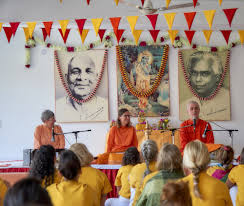
Swami Sivananda Delivered on September 8, 1998 in the Samadhi Shrine of The Sivananda Ashram on the occasion of Swami Sivananda’s Birth Anniversary  We bring to our memories today the advent of a great soul which incarnated upon this earth many, many years back. We remember the birth into this earth-plane the great Master Swami Sivanandaji Maharaj. Usually such indefinable individuals are called supermen, or if you would like to be a little more philosophical, super-individuals. An extended form of an individual person, – that is the meaning of super-individuality. In what way does he extend beyond the dimension of his visible personality? The extension of the dimension of a person is not actually the extension of the physical body, because the body is not the person. The mind or the consciousness that animates the body is what determines the meaning of a super-individual. We have to keep in our mind carefully the point that a person is not the body. The force that is exerted by a person, the knowledge and the capacity to execute action of any kind is not seen in the five element-based physical body. It is in the mind of that person. What the person thinks is itself the person, otherwise everybody looks alike. Even Sri Rama and Krishna looked like any other human being, but they were intensely super-individual, they extended beyond themselves. What is it that is extending beyond itself? It is that which is the person. Swami Sivananda never travelled abroad, but there is no country in the world that does not know his name. How did he spread himself around the globe of the earth without seeing anybody outside India? Living in a little cave-like room on the bank of the Ganga, with no ventilation even, dark inside; what is the principle working through him that made him so famous even today? As time passes, his name captures more and more people. The books that he has written are a magazine of magnetism. The writing of Sri Swami Sivanandaji is the manifestation of a soul force. He was entirely present in every word that he wrote. The author should be immersed in the words that he speaks or writes, otherwise the book will not cut ice. Whenever you think, you must be there wholly in your thought. It is not that you think something and at the same time think twenty other things – then that thought will not have any power. When you think a thing, you think only that, and not another thing. This is the principle not only of spiritual growth, but also even the maintenance of good health in the body. The dissipated action of the mind distracted in various directions does not permit its concentration on anything. Even when you eat your food, you cannot think you are eating food, the mind is in the railway station, you have to catch the train after half an hour. A person who is wanting to catch the train after half an hour need not eat the food. Better go. Else, the stomach cannot digest what you eat. The modern malady is in the haste with which things are being done. Everything is rapid, now it must be done, and now another thing must be done. Go on doing. But you are not in anything that you are doing, you are outside it. This kind of action, where you are not present, is called binding action. Action in which you are wholly present is liberating action. But any one of us can close one’s eyes for a few minutes and think deeply whether we are wholly present in anything in this world. We will find, to the dismay of our own selves, that we are not present wholly in anything, therefore there is failure in whatever one touches. Karma does not bind, says the Ishavasya Upanishad “na karma lipyate nare”, provided that you condition your action with the proviso in the first line of the Upanishad “ishavaysamidam sarvam”. If God does a work, it cannot bind, and if you do a work by uniting yourself with God, your action cannot bind you, because you are not the doer. Swami Sivananda is generally called a Godman. A French writer called Romain Rolland wrote a book giving a biography of Sri Ramakrishna Paramahamsa. He strangely titled his book as “Sri Ramakrishna, the ManGods”. Not Godman, but ManGods. To a casual reader it looks very strange. What is ManGods? It is a man in whom every god can be found. Godman is a person who has planted God in his heart, and ManGods is a person in whom every god is residing. We may say this in connection with Sri Swami Sivananda also. Whatever word he uttered was a scripture. Whenever residents in this Ashram went and requested him to give a message, he would say “What message do you want? See how I’m living, see how I work, that is my message. If you can follow my footsteps and think as I am thinking, and do as I do, what other message do you want?” The life of a person is the message of that person. Sri Rama is not great because Valmiki wrote a book or Tulsidas wrote a book, but because his greatness was in his personality. Charming, resplendent, kind, compassionate and indomitably powerful, and so was Krishna. All the gods were present there, – Brahma, Vishnu, Siva, were operating through these incarnations. To every spiritual seeker Swami Sivananda was an ideal, an exemplary Guru, wanting nothing but giving everything. If anybody offers a basket of fruits he would immediately distribute it to everybody. He will not say ‘let me eat it, keep it there’. No, he won’t do like that, he doesn’t want anything. ‘Tena tyaktenabhunjiyhah’ is another passage from the Ishavasya Upanishad. ‘Enjoy the world, but under the condition that it is pervaded by God.’ It is like saying ‘enjoy God Himself’. Every leaf of the tree, every breeze that

Swami Sivananda Read Post »

Bhagwan Sathya Sai Baba spiritual path
His Glory is Beyond Description - Miracles of Bhagavan Sri Sathya Sai

Man’s Far Journey

Man’s Far Journey At the beginning, and for a long time on the [spiritual] journey, we think that it is happiness that we are seeking. But happiness cannot be courted; it comes unbidden, unexpectedly, while you are occupied with other matters; then when you try to possess and enjoy it, it slips away like a shy nymph. Eventually, we learn that the sure way to be unhappy is to strive directly for happiness. Perhaps that is why men camouflage their objective and pretend that it is money, power, fame, or knowledge for which they are striving. But a little self-analysis would reveal to them that just beneath the surface lies the illusory conviction that some permanent brand of happiness will appear when such things have been acquired. The search for the El Dorado [utopia] of perfect happiness is basic to mankind. Some aspect of– this quest, with the illusions, conflicts and tragedies encountered therein, forms the theme of all the human stories ever written, of all the philosophies that have striven to carve an intellectual path to the goal, and of all the religions that have tried to mark the way with sign posts. Though all mankind is consciously or unconsciously on the journey, they are pilgrims at different levels, with different degrees of understanding and awareness. There are some and their number is growing, who dedicate their lives to the greater quest. These searchers are fully aware that money, power, fame—the ‘lights that glitter’ in the world’s pleasure houses—are not the true goals. They know what they seek, though they may call it by different names—the key to the mysteries, wisdom, self-realization, and God. Where will they search: along the tortuous tracks of the philosophers? Amongst the fallen finger posts and half obliterated signs: of the old religions and into the jungles of their own minds? Along the ancient pathways of yogaand mysticism, or will the great god, modern science that has brought them comfort, yet threatens to devour them, point the way? Should a man, as some of the books say, keep his feet to one path, or may he follow the ‘wandering fires’ wherever they lead, learning what he can until such time as he beats out his own by-road to the goal he seeks to God? It seems that we each must ultimately make our own individual way through the strange country. Yet, we are not alone in the great adventure. As we wander through the deserts and jungles and pleasant pastures, we meet and go a part of the way with fellow pilgrims. And we can communicate a little on matters of importance. Each, though he may not have progressed far, has found something that can be a clue, a pointer providing perhaps some help to other seekers. They are found—these serious pilgrims—scattered throughout the world. Some travel alone, some in groups bearing different names. I myself have found pleasant company among them, learning with them a little of that long pilgrimage on which all life has, for some unknown reason, set its feet. Yet, for the most part, it is the blind leading the blind toward a far off lightthat is sensed rather than seen. How inexplicably fortunate then are we—the few—who have found here in physicalform, one who can say, as Christ said long ago, “I am the way.” And for those who can receive it, this statement soon becomes a self-evident truth. We see in Him—Sai Baba—those qualities that we have always associated with the idea of divinity. We see power wedded to benevolence and lit with glory. We feel a love and compassion that hitherto hadbeen no more than a dream of the heart. When we are in His company we are elevated to a golden world where the atmosphere vibrates with inner joy, and all mundane things are forgotten; or at least they take their true place well down the scale of values. Such is His patience, understanding, and power of assimilation that when He talks to you individually, you feel that you are the one person in the world to Him, that in His mind no one else exists but yourself. What a divine gift of heart penetration that is! And so the way becomes clear before us. It is the bhakti marga [path of devotion], the guru marga [path of the spiritual teacher]; all we have to do is to surrender to Him, our sadguru [true guide], and He will do the rest. ‘All’, did I say, as if it were easy, this self-surrender? Alas, it is far from easy to crucify the obstinate, cunning, deceitful lower self—the proud ego built of desires and attachments. It calls for long days and nights of work and watching. Yet I believe it is undoubtedly the surest and swiftest way to the goal, for in it we have the help of the Lord’s grace, and His silent soul—to soul teaching. We must work, worship, watch, and always remember that it is mainly through His grace that our hearts will be purified as they must be; for as Sri Aurobindo [a yogi] wrote: ‘Only the pure in heart shall walk in light’—that glorious light of the true home at the end of the far journey.  ~Howard MurphetSource: Sanathana Sarathi, March 1969

Man’s Far Journey Read Post »

Shri Sathya Sai Baba spiritual path image
His Glory is Beyond Description - Miracles of Bhagavan Sri Sathya Sai

Sai Krishna

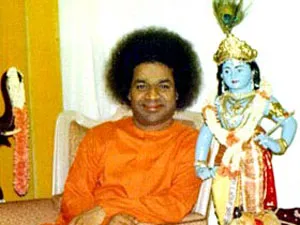
Sai Krishna This is a story about Krishna. In a way, however, the story was not completed until November 1975. A number of years ago I was in Bhagavan’s car. He was in the rear seat with two persons, one on each side of Him. I was in the front seat, with the driver. We were on our way to Puttaparthi. Driving in the car with Swami is a fascinating experience. Not only is there the thrill of being close to the Divine Lord Himself but, sometimes He will give you the opportunity to ask questions. Sometimes, He engages in animated conversation in Telugu [Indian language] with the companions. Sometimes, He indulges in jokes with one or other of them. Sometimes, He remains silent making the characteristic gesture with His hand that seems to indicate that He is giving attention to something quite unknown to us. And, very often, He sings bhajans [devotional songs], with everyone in the car joining in the chorus (except me, who has a musical voice akin to the crow). The net result of all this enthralling activity is that my neck is constantly being twisted in order to see what is going on in the back seat. Swami understands my plight, but, does not advise me to desist; He allows me the liberty to turn round. Of course, I do not stare all the time. I look only so long as I dare and then I resume my posture, turning to the front again. So, my looking at Swami is intermittently back and forth. At some point in the journey, maybe about half‑way, Swami was talking and I turned to look. My breathing stopped and I was transfixed! I could not believe my eyes. His devotees see Swami’s face as beautiful indeed, although the chief impression I receive from His feature is that of power and majesty. What transfixed my movement and stopped my breathing was Swami’s face. The Swami I know was not there! Instead, there was a face of the most extraordinary beauty, quite different of shape and cast from the features of our beloved Sai. The charm was so great, so poignant that my heart seemed to twist, almost as though it were in pain. Never in life, nor in photos, nor in painting by great artists have I seen a face of such exquisite beauty. It was beyond imagination and concept, totally out of experience. And His color was blue. Not just blue, not the blue with which artists paint Krishna but, a deep blue, like the velvet blue that sometimes can be seen in a dark sky, like a blue that I haveattimes seen from the deck of a ship thousands of miles from shore on the Pacific Ocean. I do not know how else to describe it. I could not remove my eyes from Swami. At length, I caught myself and turned away. But, at once, I looked again, and the same beauty surely not of the world, was still there. This continued for at least fifteen minutes. The two men sitting with Swami were beginning to look at me with somewhat puzzled expressions for, my staring was different from what they had become used to. After a few miles, Vittala Rao (on Swami’s left) asked me, “Hislop! What were you staring at Swami like that?” Instead of answering, I directed a question to Swami, “Swami! What was that blue color?” Swami replied, “Oh! That? Whenever there is something of unfathomable depth, it appears to be deep blue.” That was the end of the conversation. Naturally the thought had come to mind that maybe this was Lord Krishna, but neither then, nor at any time in connection with this experience did I ever say the name of Krishna to Swami. There the matter rested until November 1975. It was before people started to arrive in multitudes for Swami’s birthday. Swami’s schedule was still somewhat free and He was taking me with Him in the jeep and so on… and probably that was why I got invited into an interview. An army man and his wife had come from Assam [northern part of India]. They were devotees, but this was their first time to actually see Swami. Often people wait for months for an interview but this family was called in as soon as they arrived. I was seated on the verandah of the mandir [temple] and saw them go into Swami’s room. Swami motioned to me to go in also. The family was made up of the mother, father, son, and daughter. Swami spoke to them most lovingly. He knew everything about their lives and it was very evident that He was an intimate member of that household. After a while, Swami asked me, “Hislop! Tell them some experiences.” I complied and after mentioning some incidents, I told the same story just now related in these pages, but, not even then, did I mention the Krishna name. The man was deeply impressed and words broke from his lips, “Oh! That had to be Lord Krishna” Swami smiled and said, “Yes, that was Krishna; not the Krishna pictured by artists and imagined by writers. I showed Hislop the real Krishna.” The man said, “Oh! How I want to see Krishna.” Swami smiled again and said, “Wait; wait.” There is a sequel to this story. About a month later, in December, at Brindavan [in Bangalore], I was talking with Swami and I brought forward the names of some famous saints and gurus of the past and Swami said some things about them. Then the idea struck me that, wonderful though it must have been to know those great personages and learn from them, the present day was the first time since Krishna lived that one could have God Himself as guru. So I started to say, “Swami! In the thousands of years of time, since Krishna….” Swami interrupted me before I could say another word and exclaimed “Time since Krishna…? I am Krishna. Where is time?”I folded my hands and bent low to Him and

Sai Krishna Read Post »

Shri Sathya Sai Baba divine teachings photo
His Glory is Beyond Description - Miracles of Bhagavan Sri Sathya Sai

Sri Sathya Sai—The Shiva

Sri Sathya Sai—The Shiva This is the 10th Birthday of the Sanathana Sarathi. It is the form of the eternal words, the nitya [everlasting] the vibhu [the supreme Lord], of the Sanathana Sarathi [eternal charioteer] who is eternal. He has no beginning, and no end; He has taken a human form as a result of the love he bears us. Bhagavan Sri Krishna says in the Bhagavad-Gita [the eternal song], “Avyakta hi gatirdukham dehavadbhi­ravapyate—for those who are manifest in the form of a body, it is difficult to understand and rea­lize that which is not manifest.” Taking upon Himself all suffering that the body is prone to, He, the formless, has taken form to come to this earth, to His beloved India, the land acclaimed as the guru of the world in the spiritual field. Bhagavan Sri Sathya Sai Baba emphasizes in each of His discourses that we must awaken to our great heritage and be aware of our privileges. He advises us not to run after material success but discriminate between what is ephemeral and what is everlasting. He warns us against identifying the false “I” and the body with the true “I” and the soul. Bhagavan is sathyam-shivam-sundaram—truth-bliss-beauty incarnate. He is bliss, Shivam. Baba is Shiva, the ever auspicious, for He is all love. Who among His devotees—big or small, high or low—has not experienced the very special love, the very special consideration He shows to each? His essence is love, and power is His attribute. Therefore His love is greater than His power [shakti]. On Mahashivaratri day, out of His great love for all His devotees, He manifests His power and demonstrates the most glorious of all miracles, the creation of the linga. “Eating, sleeping, fear, and mating are common to both men and animals,” says the Su­bhashita [Hindu religious text]. How then, are men different from animals? Is it their reasoning faculty or does the instinct overtake his reasoning? For example, when a dog is threatened with a stick, he runs away; was it instinct or was it his mind reasoning that the stick would hit. The real distinguishing mark of a human being is his sense of wonder. Man alone is capable of being in awe and wonder. The Vedic singer was struck by the spectacle of the tropical dawn, and the intense force of lightning and thunder of the torrential rains of the equatorial belt; consequently, he went into raptures and sang aloud in praise of Ushas, Indra, and Varuna [Lords of the elements]. He could not contain himself. But today, our senses are benumbed with the glamour of materialism that infects the objective world. We are complacent and do not appreciate the beauties of nature. Nothing seems to shake us from our stupor. Bhagavan has come to shake us out of this stupor and awaken us to the awe and wonder. While thousands look on, He creates on Mahashivaratri day, the linga, the symbol of creation. The “form” of the “formless,” emanating from the “formless” with “form,” awakens us to this awe and wonder. What a grand spectacle it is! How much grander is its spiritual significance! As Baba says, He manifests His mahimas [glory/greatness] to express the love He bears toward mankind, and to demonstrate His grace and to make them realize who He is. The lesson of the Mahashivaratri miracle is some­thing divine and profound that evades description. Mahashivaratri, the night of Shiva, is supposed to be the darkest night of the year. The moon and the mind have a great affinity, as Baba shows quoting the Shruti, “Chandramaa manaso jaatah,” “Out of the moon, the mind was born.” Therefore, Baba explains that the night of Shiva must be the night when the mind affects us the least, and Shiva affects us most. Those who have no faith in the Shruti might argue that the mind and the moon have nothing to do with each other; but even they have learnt to use the word, “lunatic,” for those whose madness waxes and wanes with the moon. The cosmic forces are too subtle for our gross intelligence to comprehend. All that we have to do is to believe in them and forge ahead. If we have no faith, we have to start the experiments all over again. Yet, we, Bharatiyas [Indians] do neither because we are too engrossed in petty squabbles. When children fight amongst themselves over an insignificant toy, the mother distracts their attention; she does not take the trouble of ending the fight, by trying to judge to whom the toy belongs. That is what Sathya Sai Mata [the divine mother] is doing today for our fortunate country. Differences, disputes, and quarrels permeate this age of political, linguistic, and other ideologies. Those who do not get the opportunity of being selfish in the field of politics indulge in narrow selfishness in the fields of their personal existence. But, Sai Mata is ever vigilant, patient, and persistent for She wants to hold our hands and lead us on to the light. With His loving persistence, everyday and on every occasion, Bhagavan reminds us that we are human beings, much higher than animals. He asks us to awaken from slumber, and realize that the gross world outside is to be given a place lower than the inner world. In His Divine way, He wraps the pill of spiritual training in tasty words so that it is palatable to the minds immersed in the mundane. Mahashivaratri reminds us that by sadhana [spiritual practice] the mind has to be reduced to its minimum. After all, what is this mind? It is our own creation, woven out of the warp and woof of desires. The cherished ideal is “to be” and not “to become.” Desirelessness is the ideal to strive for, and not mere fulfillment of materialistic desires. If we find the effort strenuous, all we have to do is simply to keep faith, and cry for our Sairam, and pray to Him, “Asato ma sat gamaya; Tamso ma jyotir gamaya; Mrtyor Ma amritam gamaya.” (Lead me, Oh Lord, from the unreal to truth, from darkness to light, and from death to immortality). A moment will surely come, when His grace will descend on us and will grant

Sri Sathya Sai—The Shiva Read Post »

Sathya Sai Baba divine grace photo.
His Glory is Beyond Description - Miracles of Bhagavan Sri Sathya Sai

Namasmarana

Namasmarana Adi Sankaracharya, who undoubtedly occupies the foremost place of eminence and honor amongst the great vedantins [philosophers] and jnanis [sages] that Bharat [India] has produced, finally rea­lized in his later years that in this age of Kali (Kaliyuga [Iron Age]), the only sure and safe path along which humanity could successfully reach the supreme goal is that of bhakti [devotion] developed through namasmarana [recitation of the Lord’s name]. Hence he proclaimed: ‘The divine name of Lord Hari [God] and that alone is my support and refuge. In Kaliyuga there is no other effective path for salvation.’ He proceeded to compose and give unto the world many devotional hymns like the famous “Bhaja Govindam” for fostering bhakti in the hearts of men. In today’s world, our environment and conditions of life are such that it is extremely difficult, if not impossible, to pursue properly the practice of rigorous `tapas’ [penance] or to follow the intricate paths of rajayoga or jnanayoga [union with God through will power or wisdom]. The all knowing Lord, in His infinite compassion, has therefore declared in the “Gita” and in “Shrimad Bhagavatam” that during the Kaliyuga period, He can be easily attained through nama-sankirtanam [group singing of His name] The nine progressive steps in bhakti sadhana [spiritual effort] have been explained by Prahlada [a devotee of Lord Vishnu] as shravanam. keertanam, smaranam, padasevanam, archanam, vandanam, dasyam, sakhyam, and finally atmanivedanam [faith, praise, remembrance, worship of the feet, prayer, reverence, servitude , friendship, and surrender]. Namasmaranam combines in itself the first three steps of shravanam, keertanam, and smaranam, and it will rapidly lead one past the next five steps to the final stage of complete surrender and merger with the supreme. Namasmaran literally means remembrance of the divine name of God. In practice, this sadhana may take any of the following three forms: japam [chanting the name], dhyanam [meditation], or sankirtanam [group singing]. Each of these methods has its own distinct advantages, but all the three paths, whether pursued separately or conjointly, will certainly enable man to get rid of the evil qualities of lust, greed, anger, jealousy, and egoism and to develop the purest form of prema [love] and thereby achieve shanti [peace], leading to supreme and eternal bliss. Japam consists of the simple process of chanting the divine name of God or reciting some sacred mantras [formulae], the mind being kept absolutely pure. The great advantage of this method is that it can be practiced at any time and at any place or even in the midst of the routine activities of one’s mundane life. The chanting or the recitation of the divine name, if performed with faith and devotion, automatically makes one’s mind dwell on the form and glory of God. When such a state of God consciousness pervades one’s mind, there is no longer any room left for bad thoughts and evil instincts. The manas [mind] is purified and from then on, life becomes a dedicated journey on the God-ward path. The importance of this method has been stressed by Lord Krishna in the Bhagavad Gita where He has declared,’ ‘Of yajnas [sacrificial worship], I am japa yajna.’ Dhyana, which is another mode of namasmarana, consists of the process of concentrated meditation on the Lord’s divine form and glory. By practicing this sadhana of single-minded meditation on the Paramatma [supreme absolute], the mind that is by nature wayward, gets har­nessed and ceases to run after sense objects. Once the sensory cravings are banished from the mind, the worries, miseries, and sorrows arising from worldly attachments will all disappear and one is enabled to gradually attain satchitananda [bliss]. However, in the manner of living that  exists today, it is seldom possible for one to spend long hours in dhyana and hence it would be preferable to combine the methods of japam and dhyana, so that part of one’s day can be utilized for such sadhana. Namasankirtan means the loud singing and recitation of the Lord’s name and glory. Even though an individual can perform this sadhana it is more effective when it is done conjointly in the company of other sadhakas [devotees]. Then, it is commonly referred to as bhajan. If performed with discipline and devotion, bhajan offers the easiest medium through which one is enabled to spend some time in communion with God rising above all the cares and anxieties of worldly life. The ecstasy with which bhajan can fill our hearts can only be experienced and is not susceptible to any description. Another great advantage of participation in bhajan is that it helps one to get rid of one’s ego that is the main obstacle in the path of all spiritual progress. Furthermore, while performing one’s own spiritual sadhana through bhajan, one is simultaneously re ndering service to the entire people of the locality also, because the vibrations caused by the chanting of the Lord’s name, with sincerity and devotion, spread out far and wide and sanctify the atmosphere of the entire locality. These beneficial results are even more pronounced in the case of nagarsankirtan . There, groups of sadhakas go round the streets in the early hours immediately preceding day break, melodiously singing the glories of God. The message of namasmarana is thus carried to many homes in the Brahma muhurta [4 to 6 a.m. auspicious time for prayers] period. Nagarsankirtan, if performed regularly and properly, helps one to completely eliminate `ahamkara’ (egoism), and elevate oneself spiritually; and, it also simultaneously awakens and tethers God consciousness, the spread of which is so essential for the welfare of humanity. Has not Lord Krishna declared, “One who constantly chants aloud My names without any sense of shame, not merely attains oneness with Me but also brings along with himself crores [millions] of others to My feet?” One often hears Kaliyuga being described as a bad and inauspicious period. What a thorough misconception it is! Whatever other defects Kaliyuga may have, it offers to mankind, more than ever before, the most precious opportunity of God‑realization through the facile and safe path of namasmarana. Are we not the most fortunate amongst the entire human race, that has existed since the beginning of time, to have been born during this period of the Kali Age when the Divine has again incarnated in human from, more resplendent than ever before and to have been blessed with the unique and precious chance of having His darshan [sight of a divine being], sparshan [divine touch], and sambhashan [conversation]? Unlike during the time of the earlier Avatars we are also being mercifully given the great privilege of participation in His divine mission of dharma samsthapana [the reestablishment of righteousness]. Let us fully utilize this rare

Namasmarana Read Post »

Bhagwan Shri Sathya Sai Baba grace
His Glory is Beyond Description - Miracles of Bhagavan Sri Sathya Sai

Our Nearest Kith And Kin

Our Nearest Kith And Kin Following is a talk given by Dr. Bhagavantham in the Divine presence of Bhagavan Sri Sathya Sai Baba during the Prasanthi Vidwanmahasabha, the archetype assembly of the learned in Prasanthi Nilayam. It is a rare privilege for anyone to be invited in whatever capacity it may be, to sit on the same platform as Bhagavan Sri Sathya Sai Baba. It is a rarer privilege to be asked to preside over such a function as this. During the many years of my association with Bhagavan, He did put me often in situations more difficult than this. There is no rose without a thorn; there is no privilege without attendant difficulties. I feel that the Prasanthi Vidwanmahasabha  is putting me to trial on this occasion, but I welcome it. I have never spoken before Bhagavan of the few things that I would have liked to speak about. This is an occasion and to decide on what to speak about is a particular difficulty for a person of my background. You have been told during the past two days that the tribe of scientists is a peculiar one, that they have their vision extended outward only, that they forget the essence of life that is embedded in the spiritual make up of man, that they generally add to the misery of mankind rather than help to alleviate it, and so on. Moreover, it has been made out that in general, the scientists are either atheists or near-atheists and that they do not find a place in such gatherings. Let me tell you that not all scientists are like that. At least, I am not one of them and I can assure you that in me, you will find a scientist who is not quite an atheist. That I stand before you today in the presence of Bhaga­van is a proof thereof. One need not learn science to turn away from God. Others, too, both learned and unlearned, have turned away from God. Many who have learnt subjects other than science have become atheists. Of course, the scientist asks inconvenient questions and so is charged with conceit. I shall try to remove this impression. The discipline of science does not take any one away from God. Years ago, in one of my early confrontations with Bhagavan, He spoke of the scientists as belonging to a lost tribe, and made fun of their behavior. “You, in particular, do you have any respect for our ancient texts?” He asked and hurt my pride. I have some family traditions of Sanskrit learning and orthodox Sanathana Dharma [eternal right conduct] behind me; so, I tried to establish my bona fides, as well as that of my tribe. I related an incident in regard to Oppenheimer, who had succeeded in exploding the first atom bomb, some 25 years ago. There was great doubt at that time whether it would real­ly explode and many press representatives surround­ed him on that historic occasion. It did explode. Though that first bomb was a small thing compared to those made possible since then, it was a terrible and awe-inspiring event. The reporters asked Oppenheimer about his reactions and he replied that he was reminded of the shloka [verse] in the Bhagavad-Gita by which Arjuna described the Vishwaswarupa [the universal form] of the Lord as: Divi Surya Sahasrasya Bhaved yugapad uththithaa Yadi bhaah sadrsee saa syaad Bhaasasthasya mahaathmanaa. That is the only way I can describe the magnificent brightness I have seen now, he said. I told Bhagavan that the truly learned are aware of the wisdom of our ancient texts and of the teachings of the Upanishads. We were then sitting on the sands of the Chitravati River and it was a full moon day. Bhagavan asked me, “Do you like to have a copy of the Bhagavad-Gita?” and took some sand into His hand. The sand instantly turned into a text [book] of the Gita and He put it into my hands! I was curious to know in which press it was printed and later, I turned over the leaves to discover it; but, needless to say, the name of the press was not to be found. I was a fairly lost person at that time, for, all this was in utter denunciation of the laws of physics for which I stood and I still stand. Subsequently too, He has, to my dismay, been breaking one law of physics after another, laws that I learnt as being inviolable. Having learnt the laws of physics in my youth and having taught others for many years thereafter about the in­violability of such laws—at least so far as any known human situation is concerned—and having put them into practice with such a belief in them, I naturally found myself in a dilemma that needs to be resolved. On one other such occasion, He performed a surgical operation with instruments created by Him. I was an eyewitness and my young son was standing by my side. “Have you got a good bandage?” He enquired after the operation, though He had created a knife and a needle a few minutes earlier. But, before we could reply, He created the bandage too. I still have it with me. What has science to do with this or to say about this? Prof. Gokak said yesterday that Bhagavan defies the laws of physics and chemistry. I would prefer to say that He transcends the laws of physics and chemistry. He is a phenomenon; He is transcendental; He is divine; He is an incarnation. I accepted that as His role, for this is the right way and the only way to get out of the dilemma I referred to a little while ago and in which I was placed. Still, I continued asking questions. In a remote village, I was once invited to speak about Him. I quoted the shloka in the Bhagavatam where Yashoda [Krishna’a mother, confronted by facts and events that were unbelievable, wondered whether what she saw was a dream or a fantasy or an illusion.

Our Nearest Kith And Kin Read Post »

Sathya Sai Baba spiritual inspiration
His Glory is Beyond Description - Miracles of Bhagavan Sri Sathya Sai

The Path of Divine Love

The Path of Divine Love Ihad the unique privilege and pleasure of witnessing and enjoying the musical play Radha bhakti [Radha’s devotion] that Baba wrote. It was performed by the children studying at the Vedashastru Pathashala [one of Swami’s schools], during Dassara [festival of the triumph of good over evil]. He had composed the songs and He had Himself trained the children to sing and act their roles. In the play, Baba has depicted the path of divine love that is referred to in Hindu texts as madhura bhakti. This path developed to a great extent in Bengal [an Indian state] and spread from there to all provinces of India. It was extolled and elaborated and exemplified by Chaitanya, Chandidas, Vidyapati, Jayadeva, and many other poets, singers, and saints. They shared the nectar with mankind and gained immortality for themselves. Baba has declared, in the tradition established by other proponents, that Radha [Krishna’s devotee] is the symbol of prakriti [nature] and Krishna is the Purusha [universal consciousness]. The Lord and master is the charmer-with-the-flute, of whom it is said, “His music is sweet; His flute is sweet; and His every thought, word, and act is sweet beyond compare.” Radha is ever looking for Him, seeking Him in her mind’s eye, for as Purusha He is the very breath, substance, and sustenance of Radha, who is prakriti, the manifested world. The love that binds prakriti to Purusha is thus eternal, enlightening, elevating, and elemental. It is the purest and the most powerful form of devotion or bhakti. Poets and saints plunge into the translucent waters of song when they taste that love. The very contemplation of the virtue, beauty, and glory of Krishna sends them into such ecstasy that every word that they use in painting His splendor is resonant with supreme ananda [bliss]. “Anandaambhudhi varadhanam prathi padam,” [He expands the blissful ocean of transcendental life] says Chaitanya. They see Krishna as the only Purusha; the rest are all stri, feminine as prakriti is. To the aspirants adept in madhura bhakti, the world is transmuted into Brindavan, the home of inexhaustible peace and in expressible sweetness of a magnificent temple of the Lord. As Baba writes in the drama, Radha bhakti, “He is all forms, He is in all places; no name is alien to Him; and no place is foreign to Him.” “In the love of Krishna, all beings are enveloped in one supreme kinship. They see their Lord in the setting sun, in the rising moon, in the refreshing breeze playing with the tendrils of a flower-laden creeper, in the streaks of lightening adorning the dark shimmering clouds, and in everything grand, awe-inspiring, good, simple, and sweet; infact, Krishna is in every atom of the universe.” Each flower that blooms is, for example, a lovely letter that the Lord has sent out of His infinite love to Ravindranath Tagore! When every molecule is inundated with His infinite glory, the bhakta [devotee] finds no evil, cruelty, hatred, and poison in this world. It is this that made Meera quaff quietly and with a smile the cup of poison that the Rana [her husband] sent to bring about her death. When the whole world is filled with love, insults cannot cause a groan, falls do not make one falter, and burdens are gladly borne. Whether you win or lose, you are the loved one and He the Lord; there is no reason to feel thankful or sad; He knows, He gives, and He takes. Chains that bind become garlands that gladden; burdens that overwhelm become bouquets that emanate joy. Meera is the outstanding example of madhura bhakti. Many of the rest are males and so, they could not rise to the height of love that she reached. Meera sang of the pangs of separation from the master, as much as the thrill of communion with Him. She sang, “I shall be born as Krishna and you as Radha; then you will know the agony of the soul striving to reach you.” She sang, “You cannot escape me, Lord, for, I shall be with you, whatever may happen. If you are a lake, I am the fish in its depths; if you are the green hill, I am the peacock among the trees; if you are a tree, I am the bird taking shelter on its bough; if you are a pearl, I am the string that goes through it; and if you are the moon, I am the chakora bird reveling in the cool comforting rays. If you are gold, I am the glitter; if you are the Lord, I am the attendant; I shall be where you are, inseparable, ever.” Thus she widens and deepens love into a universal garment. No other thought or idea can intrude into the mind. Meera sings of the gopis [milk maidens] who went along the streets of Mathura, with the curd pots on their head; they were so fully immersed in Krishna, that they could not cry out, “curds” to sell their ware and bring out the customers from their houses; they knew only one name, and they cried out that name: “Giridhari [another name of Krishna]! Giridhari!” Bhaktas of this path will not relish the advaitic [non-dual] awareness of Godhead. They are only filled with ananda [bliss] when they feel themselves instruments dear to the Lord. They long to sing the name of the Lord; they extol the heart that is saturated with the sweetness of that name as ananda-dhamam, the abode of bliss. They know that the cool showers of His praise alone can quench the agony of worldly toil and travail. ~ Chathurvedi NarasimhaSastry(A translation from Telugu)Source: Sanathana Sarathi, January 1967

The Path of Divine Love Read Post »

Shri Sathya Sai Baba truth image
His Glory is Beyond Description - Miracles of Bhagavan Sri Sathya Sai

The Lord of the Heart

The Lord of the Heart When Baba sent word that I was to make some remarks at this great New Year’s gathering of Sathya Sai devotees, I thought that if I were to speak with all the truth that I could muster, there was only one topic on which I could speak and that was personal in its reference. It is: what does Bhagavan Sri Sathya Sai Baba mean to me, to this mind and body, educated and cultured in a foreign country and also, what does He mean to that subtler aspect of me, that is without nationality? My wife and I first heard of Swamiji in 1968, through a description of Him as given to a friend of mine by a lady who had visited Prasanthi Nilayam [the abode of peace]. This lady had brought back some sacred vibhuti [sacred ash], and a beautiful ring as a gift to her from the miraculous nature of Baba. She had many fascinating stories to tell; however, one special remark struck fire to my mind and imagination. The lady said that she had felt a change in her character while at Prasanthi Nilayam, and that change persisted even after returning home. This statement really struck my mind with the impact of a great storm. Could there be a man, was there a man living today whose art was so subtle, powerful, mysterious, and divine, that He could change the human heart? If it were indeed true that such a man lived in today’s world, then nothing else in my life could equal the urgency of seeking Him out, prostrating myself at His feet, and praying that through His grace He would be so kind as to cultivate my dry heart with His divine power so that my heart might open into fresh life as the dry fields become alive and vibrant with the spring rain. My wife and I heard the story of Bhagavan Sri Sathya Sai Baba on a Monday and that same week, we were aboard a plane to India. I should not imply that my faith was able to keep up with the eager rush of my heart to the Lord. After all, my mind was educated in the cold scientific methodology of a western university and then, cultured in the profit climate of the business world. Moreover, I had disappointing experiences with various spiritual preceptors. However, my intellectual doubts that had gained considerable strength during the journey were unable to survive even the first meeting with Swamiji. In His divine presence, how can doubt maintain itself? In His presence, doubt is like very shallow water in the burning sun; in no time at all, it disappeared. As my wife and I sat before Swamiji at Prasanthi Nilayam, in the room reserved for meetings with inquirers, we soon realized that the elegant and charming Indian gentleman speaking with us was unmistakably something far more than that. We listened to His sweet voice, felt the warmth of His loving smile, noted the impression of irresistible power conveyed by the cast of His features, looked as deeply as we dared into His eyes—now soft, now flashing. But, beneath these surface impressions, our awareness was deepening, and we became conscious that a state of love and affection now existed in the room. In my heart, there arose a movement, a new feeling, a joy so intense that tears came from my eyes. So to me, first of all, Bhagavan Sri Sathya Sai Baba is the Lord of the heart, He who is able to remove all the hardness accumulated in the years and make the heart fresh, new, and joyful again. Then, the next aspect of Baba that strikes me with real force is the overwhelming and incomprehensible mystery of His Divinity. He appears to be a man, but, even a dullard can see that Baba is not a man. One looks at Him and sees the blue, perfect calm of the deep sky. One tries to define His form but can see only space. The only thing certain about Him is that He loves us; otherwise, to predict Him or define Him is like trying to capture the wind, or the silver of the moonlight. Even the stories we read of the Avatar are just other futile attempts to define Swamiji. It is said that the supreme and only being wills to take form as an object within that world of maya [illusion] created by Him and that, there He plays a human role without in any way compromising His total subjectivity. Out of such words, reason may satisfy itself, constructing some framework of meaning. But, that meaning can only be relative, whereas Baba is not relative. So, if we are honest about it, we end up where we started, ­facing a divine mystery that is incomprehensible, The third aspect of Bhagavan Sri Sathya Sai Baba that has tremendous importance for me is that Baba as the supreme teacher of men guides us to liberation, and re­union with Him. Each word that He speaks carries a lesson intended for our benefit. Certain basic principles are repeated by Baba again and again. Perhaps these basic principles could be sum­marized into seven cardinal points: I. Be happy. Bliss is God’s nature expressed in the individual and happiness is also our social duty. Simple happiness rooted in good becomes value to everyone around us. 2. Feel always that you are Divine. There is only One, and we are not different from that One. 3. Let thought, word, and action flow from that divinity that is one’s essential nature. How happy we feel when we engage in noble action, and how miserable when our action is petty or hateful! 4. Behave to others with the same kindness that we use toward ourselves, because at some subtle level of our being, I am you and you are me—we are not two, opposing forces. 5. Awaken with love, fill the day with love, and end the day with love. It is not that we should

The Lord of the Heart Read Post »

Shri Sathya Sai Baba universal brotherhood image.
His Glory is Beyond Description - Miracles of Bhagavan Sri Sathya Sai

What Does God Seek From Us?

What Does God Seek From Us? This is probably one of my favorite stories. It is so full of intrigue and suspense in the beginning, yet so simple and profound in its ending. I have heard it only once, but I have narrated it a hundred times at least. And each time it fills me with new vigor, enthusiasm, and direction. It is the story about a messiah—a messiah who wanted to retire! The first time I narrated this story was in Swami’s presence on the 29thof July 2005. I have kept narrating this story many times, in order to keep reminding myself more than anybody else of what Swami wants from me. Messiah who wanted to retire There was this messiah who lived in a village. He was a tremendous source of help and inspiration for the villagers who sought his wise counsel for almost every problem. He sought nothing himself and selflessly gave of himself to the people whenever they needed him. Everything seemed to be going well when, out of the blue the messiah made a startling revelation. “I am ready to announce my retirement now,” he said much to the shock of all the assembled villagers. “I have been preparing for this moment and ultimately, it has arrived.” No! You cannot do this. Please do not leave us…” “What will we do without you? Whom shall we turn to for succor and solace?” “How can a messiah retire? What do you mean?” “Why do you want to retire? Have we failed you or disappointed you in any way?” came the questions. The messiah smiled within himself. As usual, men were making their own audacious assumptions and theories. The assumptions may have varied in nature and scope, but they all were tinged with selfishness to varying degrees. Everyone wanted him to stay for reasons that meant a lot to them—not him directly! “Every person in every occupation enjoys a retirement. I am only seeking mine! Is that not fair enough?” asked the messiah with a smile. That was an argument that none could refute. But still, how could they live without the services of their messiah? Looking at the whole situation objectively, the people realized that their domestic problems could be solved through discussions with each other. Financial advice could be sought from some moneylender who still had scruples left. Health matters could be taken up with a doctor. But, what about matters relating to the spirit? Spirituality, though very ‘important’, is never ‘urgent’ and thus gets neglected until times such as these. Now that the messiah was about to retire, spirituality seemed to gain urgency, too, along with importance. And so, they all pleaded with him, “How will we remain in touch with God if you retire?” “Please, if you must retire, then ensure that we will be in touch with God in some way at least.” “Tell us what we must do so that God is happy with us always…” “Yes! Tell us the one ‘most important’ thing that God wants us to do…” “Yes! Yes! Tell us that ‘one thing’ that God wants from us,” everyone chorused. The messiah smiled to himself again. If only the people had approached him with this feeling and intensity before, each and every thing that he had said could have served as the potential ‘one thing.’ However, people seem to realize the value of something only when they are about to lose it or, worse, when they have already lost it. So, this reaction was not at all surprising. With all love he said, “I shall find out what that ‘one thing’ which God wants from you is. And then, I’ll retire.” The worries of the people were mollified to a certain extent. They at least had something to look forward to now. What God wants from us… As per his promise, the messiah went to get the message of the Lord. In a day’s time, he returned from the adjoining mountains. As he walked the streets of the village, all the villagers gathered around him. They knew for sure that he had got the message from God. That ‘one thing’ that God wanted most from them would now be revealed. Even though the whole village had gathered around him, there was perfect silence. Has it not been said that it is only in the depths of silence that the voice of God can be heard? Physical silence was the first step for true silence. Nobody wanted to miss the great secret that was going to be revealed. “I am ready to reveal God’s message. But are you ready to listen and follow?” The first sentence from the messiah broke the silence. There was a lot of murmur and chatter among the gathered people. Small groups began to discuss among themselves. Soon, a few men and women stepped forward to speak. Each of them had something to say. “If it is something that God wants us to do, we are ready for anything.” “Even if it means sacrificing all our comforts and going through great suffering, we are ready to do it for God’s sake.” “If we are told to hang upside down by our toes, we are ready. If we have to blind ourselves, we are ready. If we have to kill we are ready… We are ready for anything…” “Yes! We are ready to shed tears all our life. Any pain, we shall bear. Please tell us what is it that God wants us to do.” “Speaking is easy my dear people,” said the messiah, “but when it comes to practice, I hope your enthusiasm and energy does not fizzle away.” “No! Just give us a try! We will do anything.” “Not only are we ready to sacrifice, we shall make others sacrifice as well. We will give up our own parents, husbands, wives, children, friends, and relatives, if need be.” “Anything! We are ready to do just anything. Please let us know what God wants us

What Does God Seek From Us? Read Post »

Bhagwan Shri Sathya Sai Baba teachings photo.
His Glory is Beyond Description - Miracles of Bhagavan Sri Sathya Sai

Unity of Religions

Unity of Religions What Bhagavan Sri Sathya Sai Baba is saying is most relevant to the contemporary situation. There is at present a crisis looming in many spheres of modern life, not the least of which concern science and its achievements, religion, philosophy, education, and health (both physical and mental). Politics and economics are also not immune from the malaise that has set in; one does not have to look far to see this. But while many in these fields are aware of the impending crisis and the present destructive tendencies inherent in certain of the advanced fields in science—for example, in nuclear and biological breakthroughs—very few, in the West at least, would consider it absolutely essential to turn to Eastern teachers for a solution to problems they consider local and historically determined. Take the moral crisis in the West. The best authorities will voice the opinion that this problem, for most part, is a result of the remnants of the clash between the extreme moralism of Christendom and the liberated ethics of the materialist and secular society the West has come to witness after the scientific revolution… In order to resolve the conflicts and contradictions that have emerged, little need is felt to turn to the East immediately. Again, let us examine the deadlock within the major churches and Christian denominations in the West. Attempts are being made to patch up differences and engage in ecumenical dialogues. Despite the endeavor toward increasing tolerance for each other’s faith, nothing like a united Christian church has been achieved as there are problems that go back a few centuries, posing formidable obstacles for Church unity, an ideal much spoken of in the West presently. Despite this sad situation, few church leaders have considered it useful to turn to the East for re‑appraising their own difficulties in this attempt. Their attitude is mellowing and slowly changing in this regard, though, as shown by the receptions given by church leaders, theologians, and academics in the field to His Holiness the Dalai Lama XIV during his recent visit to Australia. The Dalai Lama participated in a number of interfaith and inter-religious dialogues and meetings held in his honor, and he did not hold back his own thoughts on the important matter of the unity of humankind despite differences in religion, race, and philosophies. The Dalai Lama brought to Australia a timely message that no spiritual leader of his caliber has yet come to Australia to proclaim—namely, that all religions share the same goal and strive for an end to human suffering, and that for such a task we should put aside our differences and with love and compassion unite as one humankind. He repeated the message in his inaugural address to the seventh annual conference of the Australian Association for the Study of Religions. The church leaders and those present at these meetings applauded the Dalai Lama’s call for a harmonious co‑existence of religions and an acceptance of religious differences in the spirit of real tolerance and understanding. Such lofty sentiments and ideals could have only come from the heart of one soaked in the wisdom of the East, where such ideals have been lived through for centuries. One cannot help but wonder, however, how the same group of people would res­pond to the message of Bhagavan Sri Sathya Sai Baba that is depicted appropriately in the Prasanthi Nilayam emblem. Here, too, one sees a stress on the unity of religions and a call upon mankind to minimize their differen­ces and to maximize the common core of religious quest that all humans share. But would not the emblem be too radical a drawing‑card for western intellectuals on the whole? Is the West fully ready to turn to the purer teachings of the East, parti­cularly of Indian origin? Likewise with philosophy, education, and other fields? Opinion at present appears to be divided on this issue. But with the increasing in­terest in the higher teachings that have been coming out of India—not just the minor interests in yoga, arts, and styles, but the wealth of wisdom that both Hinduism and Buddhism have to offer­—one can say that the East has begun to shine brightly on the western horizon. This point has recently been made quite pertinently by Father Frederick C. Cople­ston, a famous historian of philosophy and authority on theological dialogue, in these words: “The fact is that a need can be felt in our modern western culture that can have an influence on conceptions of philosophy and its function. Some people have felt driven to turn to the East for enlightenment.” (Philosophies & Cultures, Oxford University Press, 1981, p14) ~Purushottam Bilimoria, Melbourne, AustraliaSource: Sanathana Sarathi, July 1983

Unity of Religions Read Post »