






















Sri Sathya Sai On: Diwali’s Spiritual Message for Humanity
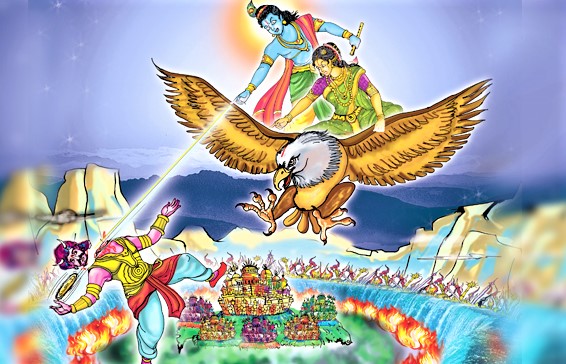
Sri Sathya Sai On: Diwali’s Spiritual Message for Humanity The Navaratri is celebrated in commemoration of the victory of Daivatwam (Divinity) over Daanavatvam (Satanity) through the intercession of the Maha Shakti as Chandi, Durga and Kaali; this day is Deepavali, commemorating the victory of heavenly over hellish influences, of virtue over vice, as symbolised by the victory of Krishna-Satyabhama over Narakasura, of the upward pull into Heaven and the drag down into Hell. Man’s career in this world is a perpetual struggle with the down-dragging impulses and the raising impulses. It is Dharmakshetra, where the Kurukshetra battle is being waged, from birth to death. Life is a game with fire; one has to derive the warmth without getting burnt. One has to use the senses and the intellect wisely, for liberation rather than get entangled in their wiles. The joy one has lost has to be recovered from the inner consciousness which has been covered by the darkness of ignorance. How can the bangle, lost in the field where Dal (lentil) was grown, be recovered from the vessel in which the Dal is being boiled? Search for the joy in the inner vision; set it right and you can discover it there. The Narakasura in man can be destroyed by the constant dwelling of the mind on Krishna who slew him, as the Bhagavata relates. The Smarana has to be constant. If you rub a bit of iron on a hard surface, it develops heat; continue to rub it vigorously; then it can be made red-hot: If you do so with long intervals, the iron bit will become cold and all the effort up till then is a waste. The work has to be repeated over again. There are some who set a limit of ten thousand or twenty thousand repetitions of the Nama everyday and when that number is reached, they are content; they resume the Smarana (remembrance of God’s name) only when another day dawns. The mind, meanwhile, like a sheet of water from the top of which floating moss has been pushed aside with great care, resumes its cover of moss very soon. The task has to be repeated. Hold the Feet of God wherever you are Smarana must be the unseen spring of every activity of man, every minute of his waking life; then it will become the spring even during dream and will help the ‘I’ during deep sleep to merge in the ‘He’, for ever. Like the mother whose attention and anxiety are centered on the baby in the cradle, whether she is near the well or in the cow-shed, in the kitchen or the temple, man too has to keep his mind at the Feet of God, wherever his body may be. This state of constant remembrance can come only through long practice; it will not be acquired suddenly. So, strive for it steadily. With Vishweshwara (Lord of the Universe) in your heart, you can wander over the entire Vishwa (world). A priest who was employed in a Shiva temple had to go to some village some day and so he asked his son to do the Puja (ritual worship) and perform Arati. The son was a novice; while doing Arati, he has to wave in a circle the lighted camphor cube with his right hand and at the same time ring a bell vigorously with his left hand. But both his hands automatically made the same movements; both waved round, or both shook vigorously. A little practice is wanted to succeed in coordinating the two different movements. So, too, a little practice will teach you to hold fast to the Feet of God, while roaming about in the world doing all duties and carrying all responsibilities as dedicated to Him. Develop Shakti (physical health and mental alertness) and Yukti (cleverness in discovering the way to lasting happiness); then you will have Rakti (attachment, which if turned to God becomes Bhakti (devotion) which promotes Virakti (detachment from all that distracts the mind away from God) and leads to Mukti (liberation). World must be charming when it moves away Lakshmi (wealth) and Jyeshtaadevi (poverty), Her elder sister quarrelled as to who was superior in status; they approached the three Gods – Brahma, Vishnu and Shiva – to decide it for them; but they could not assume the responsibility for the decision! They excused themselves with the plea that they had no time. When Narada was approached next, he recommended that they should abide by the judgement of a certain famous merchant of Varanasi. They proceeded to his presence; he was caught in a dilemma, for if Lakshmi the Goddess of Wealth was displeased by his pronouncement, he would suffer; nor did he want to be blessed by Her elder sister, for she was the Goddess of Poverty! So he pleased both by his reply. The elder sister is welcome, charming and beneficent, when she moves away; the younger is welcome, charming and beneficent, when she moves towards. Both were satisfied that they were declared equally charming, beneficent and welcome. The world must be charming to the seeker, when it moves away from him; that is all that there is in it. We now consider the atom as all-important and the Atma as insignificant. This is a tragic reversal of values. That sense of real value must influence every choice that you make. The Lakshya (goal) is God-realisation, the realisation of the reality over which all this is but appearance. That should not be allowed to fade. So long as you act with an eye to benefit by it for yourself, you will have to undergo the consequence and suffer either joy or grief, being born to bear them both. A person being transferred from one jail to another will have two constables who will escort him; the Punya and Paapa (good consequences and bad consequences of actions) are the constables who lead man from one birth to another’. If you must escape from their attention and avoid migration from one jail to another, act-but do not calculate the consequences. That is to say, do not worry about the consequences; leave it to God who prompted the act and made it possible. Dedicate the act, the will, the wish, all to God. The process of learning lasts until death Samartha
Sri Sathya Sai On: Diwali’s Spiritual Message for Humanity Read Post »